Lecture | Matthew Keagle on Military Material Culture
From BGC:
Matthew Keagle, Military Material Culture
Bard Graduate Center, New York, 1 February 2023, 6.00pm

James Byers, Howitzer, Philadelphia, 1777 (Fort Ticonderoga Museum Collections; photo by Gavin Ashworth).
Military history and its related material culture elicit strong opinions. The objects of war shape the technologies, aesthetics, and ideologies of everyday life and reveal their own historiography. In this Alumni Spotlight Lecture, Fort Ticonderoga curator Matthew Keagle shares his experiences working in military material culture and the challenges and distinct opportunities this field offers for scholars and amateur historians.
Matthew Keagle has been involved in curation, exhibitions, research, and interpretation for historic sites and museums in Massachusetts, Rhode Island, Connecticut, New York, Delaware, Virginia, and North and South Carolina. He holds a BA from Cornell University, an MA in American material culture from the Winterthur Museum, and a PhD from Bard Graduate Center. Since joining Fort Ticonderoga in 2014, he has been developing exhibits, conducting research, and delivering programs that explore the eighteenth-century military experience. He has researched and lectured at collections and archives across the US, Canada, and Europe, with a particular focus on military dress in the eighteenth century.
Registration is available here»
Exhibition | A Japanese Bestiary
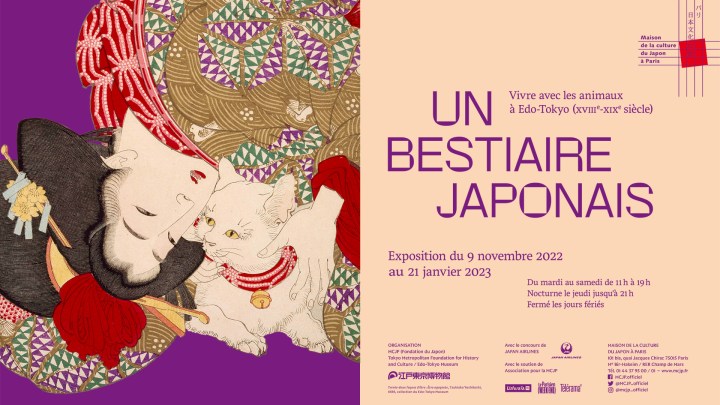
Co-organized with the Edo-Tokyo Museum, this exhibition brings together more than a hundred ukiyo-e prints, paintings, and everyday objects to explore the relationship between humans and animals in Japan during the eighteenth and nineteenth centuries.
Un bestiaire japonais: Vivre avec les animaux à Edo-Tokyo, XVIIIe–XIXe siècle
Maison de la culture du Japon, Paris, 9 November 2022 — 21 January 2023
La gentillesse avec laquelle les Japonais traitent les animaux surprend les premiers Occidentaux qui se rendent dans l’archipel. Les liens entre les humains et le monde animal sont cependant plus complexes comme en témoigne une remarquable réplique d’une paire de paravents de 1634 représentant un panorama détaillé d’Edo et de ses faubourgs. Outre des scènes avec le shogun poursuivant cerfs et sangliers, ou chassant au faucon, on y remarque des montreurs de singes, des chiens errants, des bœufs de labour, des chevaux sacrés…
Dans la section suivante sont présentés les différents rôles des animaux, en lien avec la vie de la noblesse guerrière, des paysans et des commerçants. L’établissement d’Edo comme capitale des guerriers explique une forte présence de chevaux militaires dans les premiers temps. Avec la paix durable, le nombre de chevaux de trait, soutien de la vie citadine, se met à croître. Les bœufs sont utilisés pour le transport des marchandises à Edo ainsi que pour le labour dans les zones rurales à l’extérieur de la ville. Les activités culturelles connaissent un essor important et on s’entoure volontiers d’animaux de compagnie : petits chiens et chats, rossignols et cailles, poissons rouges, ou encore grillons et criquets dont on apprécie le chant. Nombre d’estampes et d’ouvrages sur la façon de s’en occuper sont publiés.
Dans les zones périphériques d’Edo où vit une abondante faune sauvage, la noblesse guerrière pratique régulièrement la chasse. On chasse au faucon des grues, des oies et des canards. Organisées par le shogun, les grandes chasses au cerf visent les cervidés, sangliers, lièvres et faisans. Certains animaux sauvages sont associés à des croyances religieuses, tel le renard, connu pour être le messager d’Inari, dieu des moissons. Les habitants d’Edo, ville riche en collines, rivières, et ouverte sur la mer, vivent profondément en lien avec la nature.La vie des animaux sauvages est un élément familier, étroitement lié aux croyances religieuses et aux rites saisonniers.
À partir du début du XVIIe siècle, Edo s’urbanise rapidement et la population devient friande de nouvelles attractions. Des animaux rares, notamment les paons et perroquets provenant de Chine ou de Hollande, sont exposés dans des lieux spécifiques, ancêtres des zoos, avec des boutiques proposant nourriture et boissons. Très vite, la mode des animaux exotiques connaît un boom sans précédent. Avec l’entrée dans l’ère Meiji (1868–1912), période de modernisation et d’ouverture à l’Occident, le Japon construit des installations sur le modèle occidental, tels que zoos et hippodromes.
À l’époque Edo, la puissance financière nouvelle de la classe commerçante stimule la naissance d’une véritable culture citadine et le raffinement des objets du quotidien: les motifs décoratifs représentant des animaux évoluent vers une plus grande liberté de conception et des variations plus riches. Vers la fin du XIXe siècle, la symbolique des motifs animaliers commence à s’estomper et l’accent est mis de plus en plus sur le côté «kawaii» des animaux de compagnie.
Exhibition | Mr. Pergolesi’s Curious Things
Now on view at Cooper Hewitt–and please note the upcoming programming described below. . .
Mr. Pergolesi’s Curious Things: Ornament in 18th-Century Britain
Cooper Hewitt, Smithsonian Design Museum, New York City, 1 October 2022 — 29 January 2023
Curated by Julia Siemon

Michel Angelo Pergolesi, Ornament Design, Tripod and Roman Standards, 1776, pen and ink, brush and watercolor over graphite on laid paper; 48 × 34 cm (Cooper Hewitt, Smithsonian Design Museum; gift of an unknown donor, 1980-32-1443; photo by Matt Flynn).
Mr. Pergolesi’s Curious Things: Ornament in 18th-Century Britain showcases fanciful drawings and prints by Michel Angelo Pergolesi (died 1801), an Italian-born artist whose professional specialty, in his words, was “the ornaments of the ancients.” In the early 1760s, Pergolesi moved to London, where he helped popularize a neoclassical style that employed ornament inspired by artifacts from ancient Greece and Rome. Brilliantly hued watercolors from Cooper Hewitt’s collection highlight Pergolesi’s skill in transforming ancient relics—what he called “curious Things”—into lighthearted decorative motifs. Although his name is now largely forgotten, these rarely seen works call attention to Pergolesi’s legacy, to the Beaux-Arts neoclassical decoration of Cooper Hewitt’s historic mansion (built 1897–1902), and to the ways in which ornament of all kinds enlivens our built environment.
The exhibition is made possible with support from the Marks Family Foundation Endowment Fund. It was organized by Julia Siemon. Exhibition design is by Field Guide Architecture and Design with graphic design by Kelly Sung.
◊ ◊ ◊ ◊ ◊
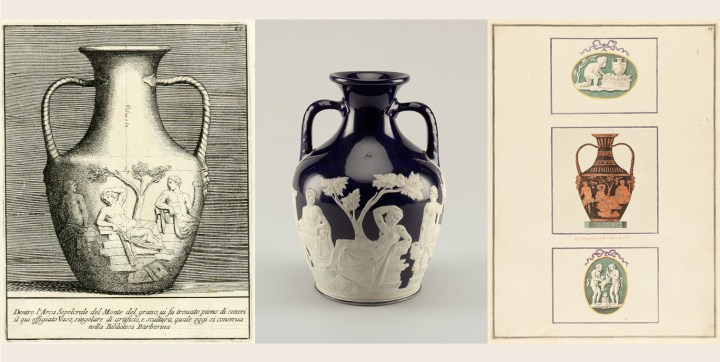
Left: Pietro Santi Bartoli, Gli antichi sepolcri, overo Mausolei Romani et Etruschi, trovati in Roma & in altri luoghi celebri…, Rome, 1697, plate 84 (Los Angeles: Getty Research Institute Library, 82-B2112). Middle: Copy of the Portland Vase, 1850–60, manufactured by Josiah Wedgwood and Sons, stoneware (Smithsonian Institution, Gift of Mrs. Frederick F. Thompson, 1915-30-1; photo by Matt Flynn). Right: Michel Angelo Pergolesi, Ornament Design with Portland Vase and Two Cameos, 1776, pen and ink, brush and watercolor over graphite on laid paper (Smithsonian Institution, Gift of Unknown Donor, 1980-32-1463; photo by Matt Flynn).
◊ ◊ ◊ ◊ ◊
The Antique in Print: The Classical Past and the Visual Arts in the Long 18th Century
Online, Wednesday, 18 January 2023, 1.00pm ET
Classical reliefs, sarcophagi, frescoes, coins, and gems were frequently copied and readapted by Renaissance artists from the 15th century onwards. Yet it was only in the age of the Enlightenment that a selection of them was canonized, illustrated, and diffused in Europe through antiquarian publications. Scholars and travelers on the Grand Tour viewed antiquity through the lens of these books. Their printed illustrations offered a range of images and symbolic references for artists, decorators, and architects whenever they wanted to quote the Antique in their creations. Join us as Dr. Adriano Aymonino explores how the print culture of the long 18th century shaped the visual and allegorical language of Neoclassicism. At the same time, he will contextualize Michel Angelo Pergolesi’s drawings and popular set of prints (Designs for Various Ornaments, 1777–1801). Dr. Julia Siemon, curator of Cooper Hewitt’s Mr. Pergolesi’s Curious Things: Ornament in 18th Century Britain will provide a brief overview of the exhibition at the start of the program.
The program will feature a lecture with a slideshow presentation followed by an audience Q&A hosted through Zoom, with the option to dial in as well. Details will be emailed upon registration. This program includes closed captioning. It will be recorded and available on Cooper Hewitt’s YouTube channel a week following the lecture. For general questions or if we can provide additional accessibility services or accommodations to support your participation in this program, please email CHEducation@si.edu or let us know when registering.
Adriano Aymonino is Director of Undergraduate Programmes in the Department of History of Art at the University of Buckingham and Programme Director for the MA in the Art Market and the History of Collecting. He has curated several exhibitions, such as Drawn from the Antique: Artists and the Classical Ideal, held at the Sir John Soane’s Museum in London in 2015. His book Enlightened Eclecticism was published by Yale University Press in June 2021 and has won the 2022 William MB Berger Prize for British Art History. He is currently working on a revised edition of Francis Haskell and Nicholas Penny’s Taste and the Antique (2023); and on a critical edition of Robert Adam’s Grand Tour correspondence, which will be hosted on the Sir John Soane’s Museum website (2024). He is also co-editor of the series Paper Worlds published by MIT Press and associate editor of the Journal of the History of Collections.
Julia Siemon is Assistant Curator of Paintings at the J. Paul Getty Museum. Prior to joining the Getty, she was Assistant Curator of Drawings, Prints, and Graphic Design at Cooper Hewitt, Smithsonian Design Museum, where she organized Mr. Pergolesi’s Curious Things: Ornament in 18th-Century Britain. Previously, as Assistant Research Curator in the Department of European Sculpture and Decorative Arts at The Metropolitan Museum of Art, she organized The Silver Caesars: A Renaissance Mystery (2017–18) and was editor and co-author of the related volume. Her other publications include contributions to The Medici: Portraits and Politics 1512–1570 (The Metropolitan Museum of Art, 2021) and A Royal Renaissance Treasure and its Afterlives: The Royal Clock Salt (British Museum Research Publications, 2021). She holds a PhD from Columbia University (2015), where she specialized in Italian Renaissance painting.
◊ ◊ ◊ ◊ ◊
Tour with Exhibition Curator Julia Siemon
Cooper Hewitt, New York, Friday, 20 January 2023, 1.30pm ET
In this guided tour with exhibition curator Julia Siemon, visitors will encounter fanciful drawings and prints by Michel Angelo Pergolesi, an Italian-born artist whose professional specialty, in his words, was “the ornaments of the ancients.” The tour is free with reserved museum admission; limited space is offered on a first-come basis.
New Book | Buddhist Art of Tibet: In Milarepa’s Footsteps
With postings, I typically aim for editorial invisibility, allowing the marketing materials of an exhibition or book to do the talking. In this case, however, I would also point readers to Erin Thompson’s review “Sex Tourism with Statues: Buddhist Art of Tibet: In Milarepa’s Footsteps Is a Cringe-worthy Display of ‘Spiritual Colonialism’,” Hyperallergic (3 January 2023). As an associate professor of art crime at John Jay College of Criminal Justice (CUNY), Thompson holds a JD from Columbia Law School and a PhD in art history from Columbia University (both 2010). Lots of interesting questions about lots of things; I can imagine using the review in class next time I teach my introduction to Chinese art. –CH
From Rizzoli:
Etienne Bock, Jean-Marc Falcombello, and Magali Jenny, Buddhist Art of Tibet: In Milarepa’s Footsteps, Symbolism and Spirituality (Paris: Flammarion, 2022), 288 pages, ISBN: 978-2080280947, $50.
 Fascinated by Buddhist art and Asian spirituality, Alain Bordier has spent more than forty years building a unique collection of religious objects from the Himalayas (Tibet, Nepal, and Bhutan). On display today at the Tibet Museum in the heart of the medieval city of Gruyères, Switzerland, some six hundred works offer visitors the rare opportunity to discover an endangered world heritage. This volume presents a general historic and artistic framework of Tibetan art through narratives, anecdotes, and commentary from Bordier on the different subjects and the collection itself. Beyond the artistic aspect, this work demonstrates the symbolism and spirituality that emerge from each object and offers an interpretation of the themes from a Buddhist viewpoint. The highlight of the book is the presentation of an unpublished manuscript retracing the life of Milarepa, the great eleventh-century Tibetan yogi, whose analysis provides an excellent introduction to the great Buddhist principles.
Etienne Bock is a specialist in Himalayan art and literature. Jean-Marc Falcombello is a cultural journalist and a disciple of Lama Teunsang, one of the oldest living Tibetan masters, for four decades. Magali Jenny is an ethnologist.
Note: The image used for the cover of the book is a Tibetan depiction of Milarepa, from the 18th century, pigment on cloth, 24 × 16 inches (Gruyères: Tibet Museum: Fondation Alain Bordier).
Exhibition | Weng Family Collection: Art Rocks

Scholar’s rock, Qing dynasty, stone (Boston: MFA, Gift of the Wan-go H. C. Weng Collection and the Weng family, in honor of Weng Tonghe).
◊ ◊ ◊ ◊ ◊
Now on view at the MFA Boston:
Weng Family Collection of Chinese Painting: Art Rocks
Museum of Fine Arts, Boston, 26 March 2022 — 27 November 2023
In China, rocks in their natural form are objects of great aesthetic appreciation. As far back as one thousand years ago, serious art collectors and critics acquired and competed for rocks with the same passion they afforded great works of painting and calligraphy.
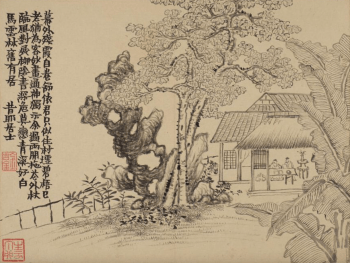
Jin Nong (1687–1764), Elegant Ink (Landscapes after Ancient Masters) / 龍梭墨妙畫冊 (金農), Qing dynasty, 1757, ink on paper, 27 × 35 cm (Boston: MFA, Gift of the Wan-go H. C. Weng Collection and the Weng family, in honor of Weng Tonghe, 2018.2828.1).
Rather than celebrating superficial beauty, collectors exalted imperfection for its expressive possibilities and sought rocks that were not symmetrical or smooth or pretty. They used terms like strange, weird, and awkward as complimentary descriptions of the rocks they most preferred. The humble rock became, like an abstract sculpture, a medium to explore forms and textures, and to express one’s inner being. In the minds of serious connoisseurs, rocks, as microcosms of mountains—or even the entire universe—were meditations on life itself.
From 2018 to 2021, Wan-go H. C. Weng (1918–2020) made the largest gift of Chinese paintings and calligraphy to the MFA in the institution’s history, comprising more than 390 objects acquired and passed down through six generations of his family. Rocks were integral to the Weng family’s art collection, as subjects of paintings and as art objects themselves.

Glass in the shape of a rock / 北京造湖石形料器, Qing dynasty, 18th century, 7 inches (17.8 cm) high (Boston: MFA, Gift of the Rosenblum Family, 2001.221).
This exhibition features more than 25 works from the gift as well as the MFA’s collection that explore how rock aesthetics have permeated architecture, landscape design, and painting styles in China for a millennium. Visitors can envision themselves in paintings of gardens where colossal rocks loom over a scholar’s studio, or scenes of fantastical caves where artists gaze in awe at mysterious rock formations. And rocks of all kind—large and small, weird and imperfect—are on view throughout the gallery, welcoming viewers to ponder, explore or, like the ancient poets, venerate.
This is the third in a series of three exhibitions celebrating the landmark donation made by Wan-go H. C. Weng, a longtime supporter of the MFA who, until he passed away in 2020 at the age of 102, devoted his life to the preservation, study, and promotion of China’s cultural heritage.
More information is available from Asian Art.
◊ ◊ ◊ ◊ ◊
Note (added 14 October 2023) — The posting was updated to include the extended run of the exhibition (from 3 May to 27 November).
Call for Collaborators | The Digital Piranesi

View of the Flavian Amphitheatre, called the Colosseum (Veduta dell’Anfiteatro Flavio detto il Colosseo), from Giovanni Battista Piranesi’s Opere, volume 1 of 29 (Paris: Firmin Didot, 1837–39). Piranesi’s original copper plates were used for this posthumously published collection; this specific print comes from a complete set of volumes at the University of South Carolina, home to The Digital Piranesi project.
◊ ◊ ◊ ◊ ◊
From the Call for Participants:
Essay Contributors for The Digital Piranesi
Applications due by 1 March 2023
 Digital art history, word-image studies, architectural history, and book history meet in The Digital Piranesi, a developing digital humanities project devoted to the complete works of Giambattista Piranesi (1720–1778). With funding from the Kress Foundation, six collaborators will be invited to contribute to the project. Following an introductory in-person workshop in Columbia, South Carolina, in late Summer 2023, regular virtual meetings through Summer 2024 will be dedicated to writing brief, impactful scholarly essays about each image in the first volume of his Roman Antiquities / Le Anthichità Romane (1756). Travel and accommodation will be supported by grant funds.
Each image of the first volume of the Roman Antiquities appears with original annotations and (in metadata) English translations here.
Please send a CV and one-page statement detailing qualifications, experience, and interest to Jeanne Britton at jbritton@mailbox.sc.edu by 1 March 2023. Inquiries are welcome.
The Digital Piranesi has received generous support from the NEH Division of Preservation and Access, the Kress Foundation, and, at the University of South Carolina, the Office of the Vice President for Research, the Center for Digital Humanities, the Magellan Scholar Program, the Maners-Pappas Endowment, the Humanities Collaborative, and the Irvin Department of Rare Books and Special Collections.
Seminar | Holly Shaffer and Sussan Babaie on Food and the Senses

Painting attributed to Muzaffar ‘Ali, from The Coronation of the Infant Shapur II, Folio 538r from the Shahnama (Book of Kings) of Shah Tahmasp by Abu’l Qasim Firdausi, ca. 1525–30, opaque watercolour, ink, silver, and gold on paper.
◊ ◊ ◊ ◊ ◊
From the PMC:
Holly Shaffer and Sussan Babaie on Food and the Senses
In-person and online, Paul Mellon Centre for Studies in British Art, London, 11 January 2023, 5pm
Part of the series In Conversation: New Directions in Art History, which will explore the changing modes and methodologies of approaching visual and material worlds. Running from January to March 2023.
Holly Shaffer | Plants, Gardens, Markets, Delicacies: Food and Art in 18th- and 19th-Century India
Food is ephemeral. Produce can last at most months, while cooked foods remain for a few hours or, with conservation, a few years. Yet artists, cooks, and writers have developed methods of preservation—from documenting the cultivation of plants to transcribing recipes—that acknowledge continuity through memory and repetition as well as change through colonial and environmental factors, artistic ingenuity and loss. In this paper, I will align botanical, ethnographic and narrative manuscript paintings, recipe books, and vessels produced by artists and chefs in north India in the eighteenth and nineteenth centuries with oral histories taken primarily in Lucknow in the twenty-first century. How does thinking through a framework of ephemerality allow multiple items to co-exist and perishable objects to survive? Does art history as a discipline offer a method to study ephemeral arts such as cultivation or cuisine? What might the intersection of food and art—and their different temporalities—offer us as art historians?
Holly Shaffer is Assistant Professor of History of Art and Architecture at Brown University with a specialisation in British and South Asian Art and their intersections. Her book, Grafted Arts: Art Making and Taking in the Struggle for Western India, 1760–1910, published by the Paul Mellon Centre with Yale University Press in 2022, won the AIIS Edward C. Dimock, Jr. Book Prize in the Indian Humanities. She has published essays in The Art Bulletin, Art History, Journal 18, Modern Philology, and Third Text, and has edited volume 51 of Ars Orientalis (2021) on the movement of graphic arts across Asia and Europe. Currently, she is co-curating an exhibition at the Yale Center for British Art on Artists and the British East India Company, and is developing a book project on food and art.
Sussan Babaie | ‘Adorning the Delicious Food Is To Say Grace for the Blessings’: Persian Art and Cookery in the 16th and 17th Centuries
This talk is about rice. The history of rice and its adaptation from a staple food in East Asia to a culinary canvas for innovative recipes, objects, and ceremonies is, I claim, an altogether Iranian story. Thanks largely to the Mongol rule in West Asia, rice was made a widespread agricultural product, just as Persian spread across West, Central, and South Asia as the language of literary high culture, and being a shah, and not a caliph, gained ascendency as the legitimate mode of rulership. Rice, however, does not command its central role as a marker of Iranian cuisine and a source of effect in food—a style nowadays called ‘fine dining’—until the early modern period and especially in Persianate Asia. From the late fifteenth century onwards cookbooks, written by chefs not chroniclers, indicate a form of professionalisation in the cookery crafts. Vessels, amongst which the large, wide, shallow platters are distinctive products of the ceramic arts of the sixteenth and seventeenth centuries in Safavid (1501–1722) Iran, indicate a specialised function, namely for serving rice dishes in a particularly ‘artistic’ manner. The cooks write on how to arrange food in a dish and the dishes carry epigraphic sayings about specific functions of the vessels and the food they were to serve. These—the recipes, the objects for food, and the visual representations of foodways—act as mediators marking the food and the dish as a multisensory experience of rice as art.
Sussan Babaie is Professor of Islamic and Iranian Art History at the Courtauld, University of London. She has curated exhibitions on Persian and Islamic arts at the Metropolitan Museum of Art, at Harvard, Smith College and Michigan University museums, and at the Calouste Gulbenkian Museum in Lisbon. She is the author of the award-winning Isfahan and Its Palaces and co-author of Persian Kingship and Architecture; Shirin Neshat, Honar: The Afkhami Collection of Modern and Contemporary Iranian Art; and Geometry and Art: In the Modern Middle East. Sussan is currently working on a co-curated exhibition about arts of the Great Mongol State for The Royal Academy, London, and on a book about Persian art and food.
Exhibition | Jean Bardin (1732–1809)
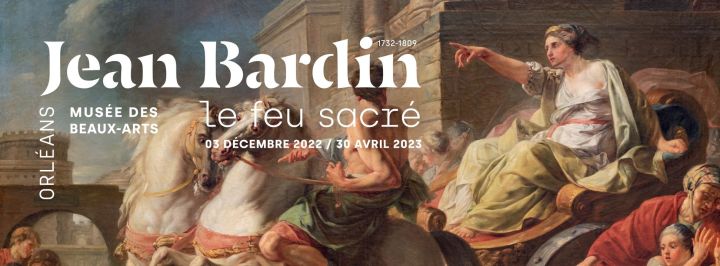
Jean Bardin, Tullia Driving Her Chariot over the Body of Her Father, detail, 1765, oil on canvas, 114 × 146 cm
(Landesmuseum Mainz)
◊ ◊ ◊ ◊ ◊
Now on view at the Museum of Fine Arts in Orléans:
Jean Bardin (1732–1809), le feu sacré
Le musée des Beaux-Arts d’Orléans, 3 December 2022 — 30 April 2023
Curated by Frédéric Jimeno
Le musée des Beaux-Arts d’Orléans présente la première exposition rétrospective consacrée à l’un de ses grands hommes : le peintre Jean Bardin (1732–1809).
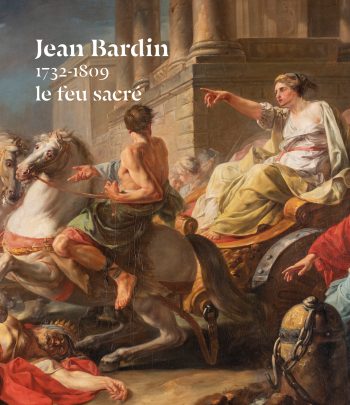 L’exposition Jean Bardin (1732–1809), le feu sacré réunit pour la première fois le corpus de l’artiste. Des tableaux provenant de cathédrales et églises françaises (Bayonne, Mesnil-le-Roi, Charmentray…), récemment restaurés, seront présentés aux côtés d’œuvres provenant des grands musées français (Louvre, Nancy…) et européens (Albertina à Vienne, Mayence…) ainsi que de collections particulières. L’un des temps forts sera le cycle monumental des Sept sacrements, réalisé entre 1780 et 1791 pour la chartreuse de Valbonne et aujourd’hui conservée à la chartreuse d’Aula Dei à Saragosse. Cette série monumentale est exposée en France pour la première fois.
Cette exposition, initiée en 2016 avec Frédéric Jimeno, spécialiste de l’artiste et commissaire scientifique de l’exposition, est le fruit de plusieurs années de recherches. Elle révèle un artiste parmi les principaux de son temps, dans les premières lueurs du néoclassicisme. Le catalogue de l’exposition constitue la première monographie du peintre et propose également une synthèse sur la naissance des institutions artistiques orléanaises sous son égide. Jean Bardin (1732–1809), le feu sacré déploie ainsi un parcours allant de ses débuts dans l’atelier de Jean-Baptiste- Marie Pierre jusqu’à sa mort, qui laisse en héritage les fondements du musée des Beaux-Arts actuel qui ouvrira en 1825. Cette exposition est par ailleurs l’occasion d’évoquer l’entourage familial du peintre, à commencer par la figure de sa fille, Ambroise- Marguerite (1768–1842), artiste formée par son père, seconde femme peintre orléanaise connue après Thérèse Laperche (1743–1814), elle-même révélée au public en 2020 dans le cadre de l’exposition Jean- Marie Delaperche.
Mehdi Korchane, ed., Jean Bardin (1732–1809), le feu sacré (Paris: Les éditions Le Passage, 2023), 304 pages, ISBN: 978-2847424973, €38.
Additional information and more images can be found here»
Exhibition | Mirror of the World
Now on view at the Musée du Luxembourg:
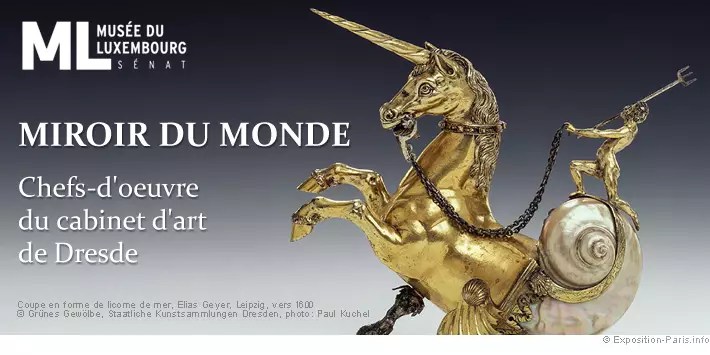
Mirror of the World: Masterpieces from the Dresden Cabinet of Curiosities
Miroir du monde: Chefs-d’œuvre du Cabinet d’art de Dresde
Musée du Luxembourg, Paris, 14 September 2022 — 15 January 2023
Curated by Claudia Brink
The exhibition at the Musée du Luxembourg brings together around one hundred remarkable artworks and objects collected between the 16th and 18th centuries by the powerful Prince-electors of Saxony. During a period marked by the struggle for imperial power between the Electorates of the Holy Roman Empire and the courts of Europe, this dazzlingly rich collection demonstrates the political power of the Prince-elector. Featuring objets d’art, instruments and scientific books, natural materials and ethnographic objects, the Kunstkammer or ‘cabinet of curiosities’ was the first European collection to open to the general public, who viewed it as a place of knowledge and learning. This exhibition places an emphasis on the artistic quality and provenance of the works, which not only reflect the many global relationships and cultural exchanges, but also the Euro-centric world view they embody. A few historical objects are arranged so as to mirror works by contemporary artists, putting these historic collections into perspective through the key issues of our time.
The exhibition is curated by Claudia Brink, curator at the Staatliche Kunstsammlungen Dresden (SKD) / Dresden State Art Collections.
L’ E X P O S I T I O N
Introduction
1 Étudier le Monde, Images du Ciel et de la Terre
2 La Vogue des Cabinets Curiosités, Une Quête de la Rareté
3 L’Ivoire, Un Matériau d’Intérêt Mondial
4 Naturalia, l’Art, et la Nature
5 Visions du Monde, Formation de Stéréotypes
6 La Porcelaine, Symbole des Échanges entre l’Orient et l’Occident
7 L’Art de l’Empire Ottoman, Mode et Fêtes de Cour
The exhibition guide (in French) is available as a PDF file here»
Exhibition | Hieroglyphs: Unlocking Ancient Egypt

Mummy bandage of Aberuait, linen, Egypt, Ptolemaic Period 332–30 BC (Paris: Musée du Louvre / photo: Georges Poncet). This bandage was a souvenir from one of the earliest ‘mummy unwrapping events’ in the late seventeenth century, where attendees would witness a mummy’s unwrapping and receive a piece of the wrapping linen, preferably inscribed with hieroglyphs.
◊ ◊ ◊ ◊ ◊
From the press release (July 2022) for the exhibition:
Hieroglyphs: Unlocking Ancient Egypt
The British Museum, London, 13 October 2022 — 19 February 2023
Curated by Ilona Regulski
Hieroglyphs: Unlocking Ancient Egypt, a major exhibition at the British Museum, marks one of the most important moments in our understanding of ancient history: the decipherment of Egyptian hieroglyphs. The exhibition explores the inscriptions and objects that helped scholars unlock one of the world’s oldest civilisations 200 years ago.
At the exhibition’s heart is the Rosetta Stone, amongst the world’s most famous ancient objects and one of the British Museum’s most popular exhibits. Before hieroglyphs could be deciphered, life in ancient Egypt had been a mystery for centuries with only tantalising glimpses into this forgotten world. The discovery of the Rosetta Stone in 1799, with its decree written in hieroglyphs, demotic, and the known language of ancient Greek, provided the key to decoding hieroglyphs in 1822—a breakthrough that expanded the modern world’s knowledge of Egypt’s history by some 3,000 years.
 This immersive exhibition brings together over 240 objects, including loans from national and international collections, many of which will be shown for the first time. It will chart the race to decipherment, from initial efforts by medieval Arab travellers and Renaissance scholars to more focussed progress by French scholar Jean-François Champollion (1790–1832) and England’s Thomas Young (1773–1829). The Rosetta Stone is on view alongside the very inscriptions that Champollion and other scholars studied in their quest to understand the ancient past. The exhibition also features stunning objects that highlight the impact of that breakthrough.
Star objects include ‘the Enchanted Basin’, a large black granite sarcophagus from about 600 BCE, covered with hieroglyphs and images of gods. The hieroglyphs were believed to have magical powers and that bathing in the basin could offer relief from the torments of love. The reused ritual bath was discovered near a mosque in Cairo, in an area still known as al-Hawd al-Marsud—‘the enchanted basin’. It has since been identified as the sarcophagus of Hapmen, a nobleman of the 26th Dynasty.
Rarely on public display, the richly illustrated Book of the Dead papyrus of Queen Nedjmet is over 3,000 years old and more than four metres long. A recitation of the texts demonstrates the power of the spoken word, with ritual spells there to be pronounced. The papyrus is presented alongside a set of four canopic vessels that preserved the organs of the deceased. These were dispersed over French and British collections after discovery, and this is the first time this set of jars has been reunited since the mid-1700s.
Among the exceptional loans to the exhibition is the mummy bandage of Aberuait from the Musée du Louvre, which has never been shown in the UK. It was a souvenir from one of the earliest ‘mummy unwrapping events’ in the 1600s where attendees received a piece of the linen, preferably inscribed with hieroglyphs. The exhibition also brings together personal notes by Champollion from the Bibliothèque nationale de France, and by Young from the British Library. A 3,000-year-old measuring rod from the Museo Egizio in Turin was an essential clue for Champollion to unravel Egyptian mathematics, discovering that the Egyptians used units inspired by the human body.
The striking cartonnage and mummy of the lady Baketenhor, on loan from the Natural History Society of Northumbria, was studied by Champollion in the 1820s. In correspondence with colleagues in Newcastle, Champollion correctly identified the inscription on the mummy cover as a prayer addressed to several deities for the soul of the deceased only a few years after he cracked the hieroglyphic writing system. Baketenhor lived to about 25–30 years of age, sometime between 945 and 715 BCE.
From love poetry and international treaties, to shopping lists and tax returns, the exhibition reveals fascinating stories of life in ancient Egypt. As well as an unshakeable belief in the power of the pharaohs and the promise of the afterlife, ancient Egyptians enjoyed good food, writing letters, and making jokes.
Many people in ancient Egypt could not read or write so language was enjoyed through readings, recitations, and performances. The exhibition includes digital media and audio to bring the language to life alongside the objects on display. As part of the interpretation, the British Museum has worked with Egyptian colleagues and citizens from Rashid (modern day Rosetta), with their voices featured throughout the exhibition.
Ilona Regulski, Curator of Egyptian Written Culture at the British Museum, said: “The decipherment of hieroglyphs marked the turning point in a study that continues today to reveal secrets of the past. The field of Egyptology is as active as ever in providing access to the ancient world. Building on 200 years of continuous work by scholars around the globe, the exhibition celebrates new research and shows how Egyptologists continue to shape our dialogue with the past.”
Hartwig Fischer, Director of the British Museum, said: “Hieroglyphs: Unlocking Ancient Egypt marks 200 years since the remarkable breakthrough to decipher a long-lost language. For the first time in millennia the ancient Egyptians could speak directly to us. By breaking the code, our understanding of this incredible civilisation has given us an unprecedented window onto the people of the past and their way of life. I would like to express my gratitude to our long-term exhibition partner BP. Without their support, the British Museum would not be able to present such exhibitions, allowing visitors to discover the art, culture and language of ancient Egypt through the eyes of the pioneering scholars who unlocked those ancient secrets.”
Ilona Regulski, Hieroglyphs: Unlocking Ancient Egypt (London: The British Museum, 2022), 272 pages, ISBN: 978-0714191287 (hardback), £35 / ISBN: 978-0714191294 (paperback), £20.










 Enfilade
leave a comment