Institutional Membership, New York Society Library
From the SHARP-L listserv (14 December 2022) . . .
The New York Society Library offers e-memberships for those interested in access to its collection of 20+ electronic resources, including JSTOR, Project Muse, the America Founding Era Collection (papers and correspondence from several 18th-and early 19th-century figures), back issue archives for The TLS, The New York Review of Books, and the London Review of Books, various Oxford University Press databases (including the The Grove Dictionary of Art and the Oxford DNB), American National Biography, and many more. For leisure reading, the Library also offers databases of popular e-books and magazines (The Economist, The New Yorker, Harper’s, thousands more). Assistance with research questions is available by emailing the Reference Desk.
The E-membership costs $100 / year.
E-memberships also include 10 building visits annually, with access to the quiet study spaces and reading rooms in our beautiful, landmark Italianate building. (The membership does not include circulating privileges for the print collection or access to individual study rooms.)
The New York Society Library was founded in 1754 as a membership library. Various membership options provide circulating privileges from our collection of 300,000 volumes in open stacks, electronic resources, reading and study spaces, member-only events, and more. The Library is open to all for reading, reference, and many events. More information on e-memberships is available here: https://www.nysoclib.org/members/e-memberships.
Exhibition | Kimono Style
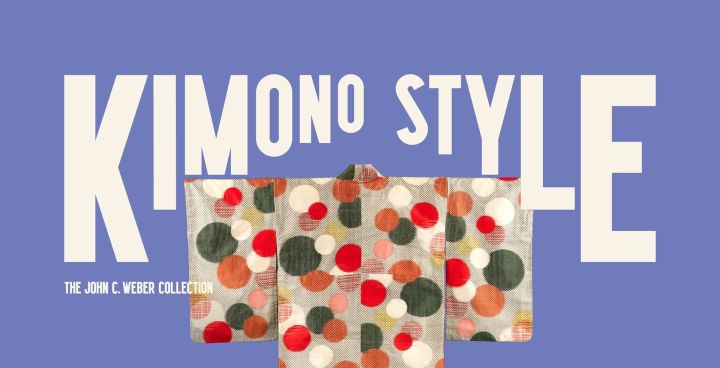
From the press release (1 June 2022) for the exhibition:
Kimono Style: The John C. Weber Collection
The Metropolitan Museum of Art, New York, 7 June 2022 — 20 February 2023
Curated by Monika Bincsik, with Karen Van Godtsenhoven
Kimono Style: The John C. Weber Collection traces the transformation of the kimono from the late 18th through the early 20th century, as the T-shaped garment was adapted to suit the lifestyle of modern Japanese women. The exhibition features a remarkable selection of works, including a promised gift of numerous modern kimonos from the renowned John C. Weber Collection of Japanese art, as well as highlights from The Costume Institute’s collection. More than 60 kimonos, including men’s and children’s wear, are displayed alongside Western garments, Japanese paintings, prints, and decorative art objects.
“This outstanding exhibition presents the kimono from a transnational perspective, highlighting the artistic conversations between Japan and the West, and the garment’s continued impact on designers around the world,” said Max Hollein, Marina Kellen French Director of The Metropolitan Museum of Art. “We are extremely grateful to John C. Weber for his promised gift, his loans to this exhibition, and his long-term support of Asian art at The Met.”

青竹色地輪宝瑞雲模様唐織, Noh Costume (Karaori) with Dharma Wheels and Clouds, Edo period (1615–1868), mid-18th century, twill-weave silk with silk supplementary weft patterning, 158 × 136 cm (John C. Weber Collection).
Monika Bincsik, the Diane and Arthur Abbey Associate Curator for Japanese Decorative Arts, said, “The kimono has served for centuries as a tableau on which to describe and record the histories of women. The variety of patterns and colors and the often-changing trends reveal much about Japanese culture and society when we shed light on the circumstances of the owners of these intricate garments and their production techniques. For many Western couturiers and designers, the kimono was a catalyst to inspire new motifs and novel cuts and to provide freedom to the wearer by creating space between the body and the clothes. At the same time, Western manufacturing techniques and materials along with artistic trends contributed to the modernization of the T-shaped garments and helped to create fresh styles.”
The weaving, dyeing, and embroidery techniques for which Japan is so well known reached their peak of artistic sophistication during the Edo period (1615–1868). Members of the ruling military class were the primary consumers of sumptuous kimonos, each one being custom made. At the same time, a dynamic urban culture emerged, and the merchant class used its wealth to acquire material luxuries. One of the most visible art forms in daily life, kimonos provided a way for townspeople to proclaim their aesthetic sensibility. The kimono-pattern books and ukiyo-e woodblock prints used during that time are comparable to modern fashion magazines and provide evidence of a sophisticated system of production, distribution, and consumption.
Depictions of kimonos in Japanese woodblock prints were widely studied by Western couturiers in the late 19th century who were first inspired by the garment’s decorative motifs. Later, the kimono’s comparatively loose, enveloping silhouette and its rectilinear cut would have a most profound and lasting influence on Western fashion, with couturiers like Madeleine Vionnet and Cristóbal Balenciaga taking inspiration for their avant-garde creations from the kimono’s construction and geometric lines.
In the Meiji period (1868–1912), Western clothing was introduced to Japan. Simultaneously, modernization and social changes enabled more women to gain access to silk kimonos than ever before. Later, some of the kimono motifs were even inspired by Western art. Around the 1920s, affordable ready-to-wear kimonos (meisen) became very popular and reflected a more Westernized lifestyle. These were sold in department stores modeled on Western retailers, following Western-style marketing strategies.
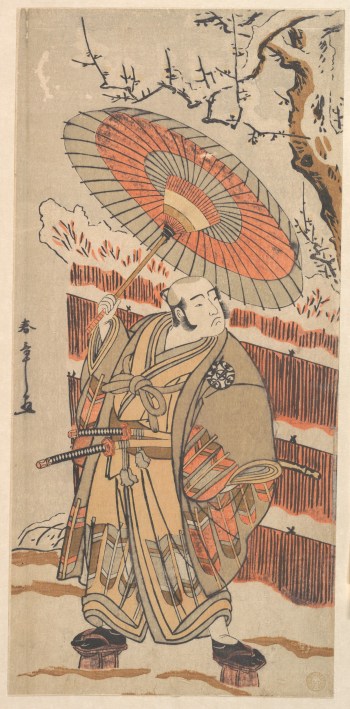
Katsukawa Shunshō (Japanese, 1726–1792), 勝川春章画 二代目中村傳九郎, Kabuki Actor Nakamura Denkurō II, Edo period (1615–1868), ca. 1770s, woodblock print (nishiki-e); ink and color on paper, 29 × 14 cm (New York: The Metropolitan Museum of Art, Rogers Fund, 1914, JP125).
Kimono Style is organized thematically and largely chronologically across 10 galleries. A number of the textiles were rotated in October. The exhibition begins with a look at the costumes worn for Japan’s traditional forms of theater, Noh and Kyōgen, to highlight earlier traditions of clothing from which these elaborate costumes derive. While the two theater forms share roots, they grew from different stage conventions: Noh is solemn drama, while Kyōgen is comic and emphasizes dialogue. They developed together in the 14th century, with Kyōgen pieces performed during interludes or between acts of the main Noh play. The costumes—ornately decorated silk weaves, often made in the Nishijin district of Kyoto, for Noh, and simpler dyed fabrics for Kyōgen, such as the Kyōgen suit with rabbits jumping over waves—were integral to distinguishing the age, social status, and gender of the different characters, all played by male actors. Deriving from actual garments, these costumes preserved past traditions of apparel and shed light on Japanese textile history.
In the early days of Noh theater, during the Muromachi period (1392–1573), audience members often gave their own richly decorated clothing to actors in appreciation. These precious gifts subsequently were transformed into costumes, a tradition that likely led to the creation of exquisite garments specifically for the stage, such as the elegant Noh costume (nuihaku) with orchids and interlinked circles on view in the exhibition, decorated with refined gold foil and silk embroidery patterns
During the Edo period (1615–1868), the military government’s strict control of society meant that dress was not an entirely free or personal choice. Many aspects of clothing, such as the use of gold and expensive techniques, were regulated by the Tokugawa shogunate. At the top of the social hierarchy were the samurai. On the rare official occasions when elite samurai women were seen in public, they wore finely crafted silk garments rooted in conservative traditions, like the Summer robe (hito-e) with court carriage and waterside scene from the late Edo period, made for a woman in the Tokugawa shogun family. Of the three tiers of commoners who followed the samurai in the social order—farmers, artisans, and merchants—merchant-class women had the most freedom in deciding what to wear. Although their choices were supposed to reflect their class position and conform to sumptuary laws, they often disregarded such rules in order to be fashionable and to show off their families’ wealth. Their distinct looks will be illustrated through a number of Edo-period woodblock prints and fashion books depicting the patterns and dye techniques.

茶緑段蘭七宝模様縫箔, Noh Costume (Nuihaku) with Orchids and Interlinked Circles, Edo period (1615–1868), 18th century, plain-weave silk with gold- and silver-leaf application and silk embroidery, 168 × 136 cm (John C. Weber Collection).
Specialized apparel worn to conduct dangerous tasks—whether fighting enemy warriors or battling fires—exemplified the fusion of function and fashion in Japanese textiles. High-ranking samurai had access to the finest materials, including wool imported from Europe, and used boldly decorated battle surcoats (jinbaori) to project status and individual taste. Jinbaori, produced from about the 15th through the mid-19th century, were sleeveless garments originally worn over armor as protection from the weather that eventually became ceremonial wear, such as the Battle surcoat with tattered fan. Firefighters also enjoyed respect in Japan, especially in Edo (present-day Tokyo), where wood architecture led to frequent outbreaks of fire. Samurai firefighters wore expensive garments made of imported wool. The townsmen’s coats were reversible and made of thick, quilted cotton with a plain indigo-dyed exterior and an elaborately decorated interior, usually depicting warrior heroes and mythical creatures that instill bravery or are related to water. One example portrays a legendary warrior, Tarō Yoshikado, who acquired magical skills to be able to morph into a toad.
Access to cotton for commoners, especially those living in the north, increased in the late 17th century with the establishment of the kitamaesen, a commercial shipping route between northern and central Japan, which enabled the secondhand clothing trade to flourish. Castoff cotton clothing was brought from Edo to Osaka and dispersed to the north. Nothing was wasted. The respect for and ingenious use of scarce materials led to the emergence of regional folk textile traditions. On view will be sturdy working clothes for farmers and fishermen as well as lightweight indigo-dyed cotton kimonos for women intended for summertime.
After the collapse of the Tokugawa shogunate in 1868 and the abolition of the class structure, the modernization of the Japanese fashion system occurred first in textile production. Global trade and industrialization in the second half of the 19th century vastly expanded Japan’s access to expensive or restricted wool, cotton, and machine-spun silk. Kimono patterns in the early to mid-20th century increasingly drew from Western art movements, including the organic style characteristic of Art Nouveau and the bold, geometric forms of Art Deco, as can be seen in the Summer kimono (hito-e) with swirls. At the same time, Western couturiers looked to Japanese art and clothing. Kimonos were first reinterpreted as dressing gowns, and later, primarily their fabrics, became a source of inspiration for the creations of couture houses such as Worth. By the early decades of the 20th century, the garment’s rectilinear form and loose shape revolutionized Western fashion: couturiers gave up the S-shaped, corseted bodice for a flat, straighter, modern line. Parisian innovators such as Paul Poiret, Callot Soeurs, and Madeleine Vionnet borrowed Japanese ideas and draped their garments from the shoulder, rather than tailoring the fabric to follow the shape of the body. For example, Poiret’s modernist ‘Paris’ coat from 1919, one of the highlights from The Costume Institute’s collection, was constructed using a single 15-foot length of silk velvet with minimal cutting, recalling the concept of creating a kimono from a single bolt of fabric without any waste and using only rectilinear elements.
 In the Edo period, dry-goods stores or fabric merchants (gofukuten) sold high-quality, made-to-order kosode (the predecessor of the kimono, with small sleeve openings) of silk or fine hemp to men and women of the samurai and wealthy merchant classes. Precursors to the department store, the best-known gofukuten all had branches in multiple cities, including Kyoto, from where they ordered the fabrics. Around the early 20th century, these gofukuten gradually transitioned into modern department stores, adopted Western retail practices, and promoted a modernized lifestyle.
Affordable, stylish kimonos made from meisen, an inexpensive silk woven from predyed yarns, a technique known as ikat (kasuri), became popular in the early 20th century. By the 1920s and 1930s, working- and middle-class women from high-school students to shop assistants could buy these casual, bright-colored, ready-to-wear modern kimonos with bold, graphic patterns. Department stores frequently released new designs to spark trends and inspire purchases. Many meisen kimono patterns were inspired by avant-garde art movements, such as Italian Futurism and the Dutch ‘De Stijl’. Piet Mondrian’s compositions were particularly influential, as demonstrated by a large ikat (ōgasuri) kimono in bright yellow, teal, and raspberry red.
Since the second half of the 20th century, the kimono’s iconic structure has been a source of inspiration in both Japanese and Western fashion. Some modern designers use its shape as a starting point for architecturally constructed garments, as seen in the work of Issey Miyake and Cristobal Balenciaga, whose Evening wrap from 1951 will be on view. Others play with the kimono’s symbolic associations. Remixed and reinterpreted by Japanese designers active in the West, including Yohji Yamamoto and Rei Kawakubo, the kimono dynamically reflects Japanese culture both to the world and back onto itself as evident in Rei Kawakubo’s Ensemble for Comme des Garçons featuring a manga figure. Through all these iterations, the kimono has gestured toward a future beyond fashion trends, cultural boundaries, and gender norms.
Kimono Style: The John C. Weber Collection is curated by Monika Bincsik, Diane and Arthur Abbey Associate Curator for Japanese Decorative Arts, with guest co-curator Karen Van Godtsenhovenk. The exhibition is made possible by the Mary Livingston Griggs and Mary Griggs Burke Foundation Fund, 2015. A fully illustrated catalogue accompanies the exhibition. Published by The Metropolitan Museum of Art and distributed by Yale University Press, it is made possible by the Florence and Herbert Irving Fund for Asian Art Publications. Additional support is provided by the Richard and Geneva Hofheimer Memorial Fund.
Monika Bincsik, Karen van Godtsenhoven, and Masanao Arai, Kimono Style: Edo Traditions to Modern Design (New York: The Metropolitan Museum of Art, 2022), 176 pages, ISBN: 978-1588397522, $35.
Monika Bincsik is the Diane and Arthur Abbey Associate Curator for Japanese Decorative Arts in the Asian Art Department at The Metropolitan Museum of Art, New York. Karen Van Godtsenhoven is an independent curator based in Belgium. Arai Masanao is a textile historian based in Japan.
Exhibition | Ganesha: Lord of New Beginnings

Seated Ganesha, detail, 16th century, India (Odisha), ivory, 7 inches (18.4 cm) high
(New York: The Metropolitan Museum of Art, 64.102)
◊ ◊ ◊ ◊ ◊
Now on view at The Met:
Ganesha: Lord of New Beginnings
The Metropolitan Museum of Art, New York, 19 November 2022 — 25 February 2024
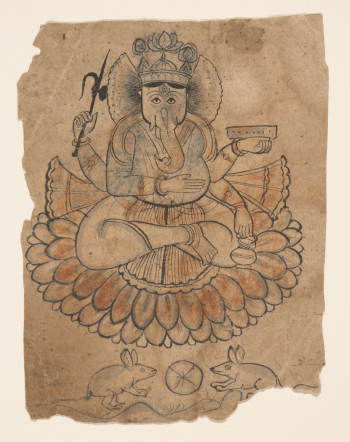
Seated Four-Armed Ganesha, ca. 1775, India (Rajasthan, Bundi), ink and opaque watercolor on paper, 15 × 11 cm (New York: The Metropolitan Museum of Art, 1977.440.15).
Ganesha, the son of Shiva and Parvati, is a Brahmanical (Hindu) deity known to clear a path to the gods and remove obstacles in everyday life. He is loved by his devotees (bhakti) for his many traits, including his insatiable appetite for sweet cakes and his role as a dispenser of magic, surprise, and laughter. However, Ganesha is also the lord of ganas (nature deities) and can take on a fearsome aspect in this guise.
The seventh- to twenty-first-century works in this exhibition trace his depiction across the Indian subcontinent, the Himalayas, and Southeast Asia. Featuring 24 works in a variety of media—sculptures, paintings, musical instruments, ritual implements, and photographs— the exhibition emphasizes the vitality and exuberance of Ganesha as the bringer of new beginnings.
The exhibition is made possible by the Florence and Herbert Irving Fund for Asian Art Exhibitions.
Exhibition | Embracing Color: Enamel in Chinese Decorative Arts
Now on view at The Met:
Embracing Color: Enamel in Chinese Decorative Arts, 1300–1900
The Metropolitan Museum of Art, New York, 2 July 2022 — 17 February 2025

Incense burner in the shape of a rooster / 清中期 掐絲琺瑯鷄形香薰, Qing dynasty (1644–1911), Qianlong period (1736–95), second half 18th century, cloisonné enamel, 8 inches (21cm) high (New York: The Metropolitan Museum of Art, 29.110.41). A symbol of diligence and fortune, the rooster is a particularly popular Chinese decorative motif. The hollow body houses the burning incense and the detachable wings serve as the lid, with several small openings on the wings allowing the fragrant smoke to escape.
Enamel decoration is a significant element of Chinese decorative arts that has long been overlooked. This exhibition reveals the aesthetic, technical, and cultural achievement of Chinese enamel wares by demonstrating the transformative role of enamel during the Ming (1368–1644) and Qing (1644–1911) dynasties. The first transformational moment occurred in the late 14th to 15th century, when the introduction of cloisonné enamel from the West, along with the development of porcelain with overglaze enamels, led to a shift away from a monochromatic palette to colorful works. The second transformation occurred in the late 17th to 18th century, when European enameling materials and techniques were brought to the Qing court and more subtle and varied color tones were developed on enamels applied over porcelain, metal, glass, and other mediums. In both moments, Chinese artists did not simply adopt or copy foreign techniques; they actively created new colors and styles that reflected their own taste. The more than 100 objects on view are drawn mainly from The Met collection.
Rotation 1 | 2 July 2022 — 30 April 2023
Rotation 2 | 20 May 2023 — 24 March 2024
Rotation 3 | 13 April 2024 — 17 February 2025
Symposium | Digging for Delftware

Plate with the Head of King James II, painted in blue, yellow, and manganese-purple on a white glaze
(Bristol Museum & Art Gallery, Na625)
◊ ◊ ◊ ◊ ◊
From Bristol Museums:
Digging for Delftware
Bristol Museum & Art Gallery, 27—28 February 2023
Organized by Amber Turner
Comprising over 2000 pieces of delftware, Bristol Museum has one of the largest and most important collections of in the UK. For over 100 years, Bristol was a leading manufacturer of delftware, producing objects that were exported across the globe. Bristol Museum has been working for two years on a project funded by Arts Council England to research and re-display its collection of English delftware.
In celebration of the project, this two-day symposium will bring together specialists from around the world. They will share insights into delftware from Bristol and beyond and explore the latest international research in the field of delftware studies. There will also be an opportunity to visit the new displays and to see a selection of objects from our reserve collection.
We will be joined by an array of experts including Karin Walton, Matthew Winterbottom, Ian Betts, Caroline McCaffrey-Howarth, Peter Francis, Femke Diercks, Roger Massey, David Dawson, Oliver Kent, and Amanda Lange.
M O N D A Y , 2 7 F E B R U A R Y 2 0 2 3
10.00 Registration, with Tea and Coffee
10.25 Welcome — Kate Newnham (Senior Curator of Visual Arts, Bristol Museum & Art Gallery)
10.30 A Century of Collecting — Karin Walton (Former Curator of Applied Art, Bristol Museum & Art Gallery)
11.05 Archaeology and Delftware: Production in Bristol — David Dawson (Former Curator of Archaeology at Bristol Museums)
11.40 Break
12.00 The Decorative Delftware Wall Tiles of Bristol — Ian Betts
12.35 Louis Lipski and the Limekiln Lane Pottery — Roger Massey (Ceramics Historian)
13.10 Lunch Break
14.15 Digging for Delftware: Bristol Museum’s Collection of Tin-glazed Earthenware — Amber Turner (Curator of Applied Art, Bristol Museum & Art Gallery)
14.50 Free-flow tour of the ceramics gallery
15.35 Tea Break
16.00 ICP Analysis of Delftware Sherds from Bristol: New Insights into Production — Kamal Badreshany (Assistant Professor, Department of Archaeology, Durham University)
16.35 Study of delftware sherds from Bristol Museum’s reserve collection
T U E S D A Y , 2 8 F E B R U A R Y 2 0 2 3
10.00 Registration, with Tea and Coffee
10.25 Welcome — Amber Turner (Curator of Applied Art, Bristol Museum & Art Gallery)
10.30 Wincanton Delftware Pottery: Some New Discoveries — Roger Massey (Ceramics Historian)
11.10 Irish Delftware: Some Recent Discoveries — Peter Francis (Former Research Fellow, Institute of Irish Studies, Queen’s University Belfast)
11.50 Break
12.10 Dutch Delftware at the Rijksmuseum: New Research — Femke Diercks (Head of Decorative Arts, Rijksmuseum, Amsterdam)
12.50 Delftware as Historical Agents, c. 1640–1700 — Caroline McCaffrey-Howarth (Lecturer in History of Art, University of Edinburgh)
13.30 Lunch
14.30 Margaret Macfarlane’s Delftware Teawares: The Ashmolean Bequest — Matthew Winterbottom (Curator of Sculpture and Decorative Arts, Ashmolean Museum, Oxford)
15.10 Transatlantic Trade and Global Connections: English Delftware for American and Caribbean Markets — Amanda Lange (Curatorial Department Director and Curator of Historic Interiors, Historic Deerfield, Massachusetts)
15.50 Tea Break
16.10 ‘Just Arrived from Bristol’: Tin-glazed Earthenware above and below Ground in Virginia (delivered via pre-recorded talk) — Angelika Kuettner (Associate Curator of Ceramics, Colonial Williamsburg, Virginia)
16.50 Closing Remarks — Amber Turner
Basile Baudez’s Inessential Colors Wins the 2022 Hitchcock Medallion
The Society of Architectural Historians of Great Britain (SAHGB) recently announced its award winners for 2022.
 We are pleased to congratulate the winners of this year’s SAHGB awards. The Alice Davis Hitchcock Medallion has been awarded annually since 1959 to a monograph that makes an outstanding contribution to the study or knowledge of architectural history. This year’s winner is:
Basile C. Baudez’s Inessential Colors: Architecture on Paper in Early Modern Europe (Princeton University Press), which the panel commend as a landmark work, beautifully written, methodologically innovative and which will have significant impact on future studies.
Elizabeth McKellar, on behalf of the judging panel, commented: “The judges praised this as an original, complex and ambitious work which examines changes in architectural drawing c. 1500–1800. The author skilfully weaves an investigation of the changing use of colour in architectural representation to argue for new understandings of draughtsmanship and its place in architectural practice. Furthermore, Baudez reveals how histories of the practice of architecture are inextricably interwoven with those of painting, engineering and cartography as well as the professional, commercial and institutional networks that shaped its activities. The book is to be commended for its mastery of a huge range of secondary literature across the broad chronological and geographical sweep of both southern and northern Europe (including Britain) in an integrated approach. The book is beautifully and generously illustrated incorporating a breath-taking range of sources, many of them little-known. The quality of this visual material together with the clarity of the writing combine to produce a powerful re-assessment of the role of coloured maps, plans and drawings in communicating and defining early modern architecture in Europe.”
The shortlist is available here, with the full announcement of winners here.
New Book | Collective Wisdom: Collecting in the Early Modern Academy
From Brepols:
Anna Marie Roos, Vera Keller, eds., Collective Wisdom: Collecting in the Early Modern Academy (Brepols, 2022), 325 pages, ISBN: 978-2503588063, €85.
 Collective Wisdom analyses the connections between early modern scholarly societies and to what extent these networks shaped the formation of early museums and the categorisation of knowledge.
This volume analyses how and why members of scholarly societies such as the Royal Society, the Society of Antiquaries of London, and the Leopoldina collected specimens of the natural world, art, and archaeology in the seventeenth and eighteenth centuries. These scholarly societies, founded before knowledge became subspecialised, had many common members. We focus upon how their exploration of natural philosophy, antiquarianism, and medicine were reflected in collecting practice, the organisation of specimens and how knowledge was classified and disseminated. The overall shift from curiosity cabinets with objects playfully crossing the domains of art and nature, to their well-ordered Enlightenment museums is well known. Collective Wisdom analyses the process through which this transformation occurred, and the role of members of these academies in developing new techniques of classifying and organising objects and new uses of these objects for experimental and pedagogical purposes.
Anna Marie Roos, FLS FSA is the Professor of the History of Science and Medicine at the University of Lincoln (UK). Vera Keller is Professor of History at the University of Oregon.
C O N T E N T S
Vera Keller and Anna Marie Roos — Introduction
Kelly J. Whitmer — Putting Play to Work: Collections of Realia and Useful Play in Early Modern Educational Reform Efforts
Chantal Grell — Tito Livio Burattini, a Seventeenth-Century Engineer and Egyptologist
Georgiana Hedesan — University Reform and Medical Alchemy in Ole Worm’s Museum Wormianum (1655)
Fabien Krämer — The Curiosi as Collectores: The Publications of the Academia Naturae Curiosorum, c. 1652–1706
Vera Keller — Vernacular Knowledge, Learned Medicine, and Social Technologies in the Leopoldina, 1670–1700, or, How to Publish on Sirens, Dragons, and Basilisks
Philip Beeley — ‘The Antiquity, Excellence, and use of Musick’: Wallis, Wanley, and the Reception of Ancient Greek Music in Late Seventeenth-Century Oxford
Julia A. Schmidt-Funke — Urban Fabric and Knowledge of Nature: Physicians as Naturalists in Early Modern Commercial Towns
Kim Sloan — Sloane’s Antiquities: Providing a ‘Body of History’ through Beads, Bottles, Brasses and Busts
Dustin Frazier Wood — Antiquarian Science and Scientific Antiquarianism at the Spalding Gentlemen’s Society
Anna Marie Roos — The First Egyptian Society
Louisiane Ferlier — Collective Wisdom in the Digital Age: Digitizing Early Modern Collections at the Royal Society
Thematic Route | Women as Art Promoters and Patrons at the Prado
This thematic route is one tangible result of a symposium held in March of this year, which focused on the period 1451 to 1633; a second symposium addressing the seventeenth and eighteenth centuries is scheduled for 6–7 March 2023 (see the note at the end of this posting and a separate posting).
El Prado en femenino
The Female Perspective: The Role of Women as Promoters and Patrons of the Arts at the Prado
Museo Nacional del Prado, Madrid, 14 December 2022 — 9 April 2023
Developed with Noelia García Pérez
In collaboration with the Ministry of Culture’s Institute for Women, from today (14 December 2022) until 9 April 2023 the Museo Nacional del Prado is offering a new perspective on its permanent collection through a thematic route devised with the academic supervision of Noelia García Pérez, associate professor of art history at the University of Murcia. The result is a fresh viewpoint and one that encourages us to focus on the role of women as promoters and patrons of the arts.
Among all European museums, the Prado is probably the one in which women have played the most decisive role with regard to its configuration, either as collectors and promoters or through their key contribution to its foundation and existence. Works such as Van der Weyden’s Descent from the Cross, Titian’s Charles V at the Battle of Mühlberg, the superb bronze sculptures of Philip II and Mary of Hungary commissioned from Pompeo and Leone Leoni, and The Holy Family with Saints by Rubens would not be present in the Prado’s collection without women’s involvement.
The works included in this thematic route are associated with women who were not only notable for their activities as patrons but also in the promotion of the artists who worked in their service. One particularly notable example is that of Isabel Clara Eugenia (1566–1633). The Prado houses dozens of works directly resulting from her patronage, in addition to the fact that the Museum’s close connections with Rubens is particularly allied to the promotion and dissemination of his career on the part of the Archduchess, who was governor of the Southern Netherlands. This explains why the Prado houses the largest collection of works by Rubens in the world.
The Female Perspective reflects the first edition of the symposium Key Women in the Creation of the Prado’s Collections: From Isabella I of Castile to Isabel Clara Eugenia (Protagonistas femeninas en la formación de las colecciones del Prado: De Isabel I de Castilla a Isabel Clara Eugenia), which took place in March this year and will be followed by Key Women in the Creation of the Prado’s Collections, Part II: From Elisabeth of France to Mariana of Neuburg (Protagonistas femeninas en la formación de las colecciones del Museo del Prado II: De Isabel de Borbón a Mariana de Neoburgo), to be held on 6 and 7 March 2023.
The full press release is available here»
The Female Perspective: Women Art Patrons of the Museo del Prado (Madrid: Prado, 2022), 160 pages, €10.
Symposium | Women in the Creation of the Prado’s Collections, Part II
From The Prado:
Key Women in the Creation of the Prado’s Collections, Part II: From Elisabeth of France to Mariana of Neuburg
Protagonistas femeninas en la formación de las colecciones del Museo del Prado II: De Isabel de Borbón a Mariana de Neoburgo
Museo del Prado, Madrid, 6-7 March 2023
El Museo del Prado posee dos peculiaridades que lo convierten en un modelo paradigmático para explorar, recuperar y difundir el destacado papel desempeñado por las mujeres en el ámbito del patronazgo artístico. La primera de ellas, vinculada a su creación y consolidación, nos remite a ejemplos tan significativos como el de su fundadora, Isabel de Braganza, o el de Isabel II, quien logró mantener unidas las obras que integraban el Real Museo de Pintura. La segunda de estas peculiaridades alude a la estrecha vinculación que existe entre la formación de sus colecciones y las mujeres de las casas reales europeas. Reinas, princesas, regentes y gobernadoras que, como quedó de manifiesto en la primera edición del simposio Protagonistas femeninas, celebrado en 2022, contribuyeron poderosamente, por haber aportado algunas de sus obras más valiosas, a enriquecer las colecciones que tenemos la fortuna de poder admirar aún hoy.
Para la segunda edición de este encuentro científico, cuya celebración hacemos coincidir con las vísperas del Día Internacional de la Mujer, el Museo del Prado reúne a un destacado elenco de investigadores internacionales que analizarán la promoción y agencia artística desarrollada por nuevas Protagonistas femeninas, esta vez por mujeres de una época encuadrada entre las vidas de Isabel de Borbón (1603–1644) y la de Mariana de Neoburgo (1667–1740).
En las diferentes sesiones teóricas y mesas redondas planteadas se examinarán, entre otras cuestiones, el concepto de reginalidad o queenship en la cultura visual de la Edad Moderna, la construcción de la imagen de poder femenina, la instrumentalización de arte al servicio de intereses políticos o devocionales y el papel que las mujeres desempeñaron como mediadoras artísticas y culturales, creando redes femeninas con importantes repercusiones en lo relativo al intercambio de obras y promoción de artistas.
Estas sesiones teóricas se verán complementadas con una propuesta de carácter práctico: la presentación y posterior visita al itinerario expositivo El Prado en femenino. Promotoras artísticas de las colecciones del Museo (1451–1633). Un recorrido a través de la colección permanente que nos invita a explorar nuevas narrativas, a conocer los relatos originales y sorprendentes que subyacen tras las obras comisionadas por mujeres de tan considerable repercusión histórica como María de Hungría, Juana de Austria o Isabel Clara Eugenia.
6 M A R Z O 2 0 2 3
9.00 Recogida de acreditaciones
Sesión 1. Mujeres y patronazgo artístico en el contexto de la cultura visual del Barroco
9.30 Presentación del simposio. Las mujeres de las Casas Reales (1602–1740) y la formación de las colecciones del Museo del Prado — Javier Arnaldo (Museo Nacional del Prado) y Noelia García Pérez (Universidad de Murcia)
10.00 Early Modern Women’s Patronage in a Global Context — Merry E. Wiesner (University of Wisconsin-Milwaukee)
10.45 Descanso-Café
11.30 Queenship in Early Modern World: Display, Ceremonial, Portraiture and Patronage — Elena Woodacre (University of Winchester)
12.15 Presentación del Itinerario expositivo El Prado en femenino: Promotoras artísticas de las colecciones del Museo (1541–1633) — Miguel Falomir Faus (Museo Nacional del Prado), Victor Cageao Santacruz (Museo Nacional del Prado), y Noelia García Pérez (Universidad de Murcia)
13.00 Visita libre al Itinerario
Sesión 2. Promotoras artísticas en el Museo del Prado (1602–1740)
16.30 Legado histórico-político de cuatro reinas de España en el siglo XVII (1621–1700): Proyectos realizados e inacabados — Silvia Mitchell (Purdue University)
17.30 Mesa redonda: De Isabel de Borbón a Mariana de Neoburgo: arte, política y devoción al servicio de la Casa de Austria
Modera: Mía Rodríguez Salgado (The London School of Economics and Political Science)
• Ezequiel Borgognoni (Universidad de Buenos Aires, Universidad Rey Juan Carlos)
• Gloria Martínez Leiva (Investigadora independiente)
• Cecilia Paolini (Università degli Studi di Teramo)
• Álvaro Pascual Chenel (Universidad de Valladolid)
7 M A R Z O 2 0 2 3
Sesión 3. Líneas de investigación y nuevas perspectivas de estudio
9.00 Starting the Conversation with Pictures: How Art Collecting Gave Women a Voice — Sheila Barker (University of Penssylvania/ Studio Incamminati)
9.45 Retratos y poder femenino en la cultura visual del Barroco: La construcción de la imagen Mariana de Austria
Modera: Mía Rodríguez Salgado (The London School of Economics and Political Science)
• Mercedes Llorente Molina (Universidad Jaume I)
• Patricia Manzano Rodríguez (Durham University)
10.45 Descanso-Café
11.15 Arte y devoción femenina en las colecciones del Museo del Prado en el contexto de la Contrarreforma — Benito Navarrete (Universidad de Alcalá)
12.00 Mesa redonda: Las mujeres de la Casa de Austria en las cortes europeas del Barroco
Modera: Kathleen Wilson Chevalier (American University, París)
• Katrin Keller (Austrian Academy of Sciences)
• Mathieu De Vinha (Centre de recherche du château de Versailles)
Sesión 4: Cristina de Suecia, reina, filósofa y patrona de las artes
15.30 Christina of Sweeden: Art Patron and Collector — Theresa Kutasz Christensen (Baltimore Museum of Art)
16.15 Mesa redonda: La huella de Cristina de Suecia en las colecciones del Museo del Prado
Modera: Manuel Arias (Museo Nacional del Prado)
• Beatrice Cacciotti (Università degli Studi di Roma)
• Miguel Ángel Elvira Barba (Universidad Complutense de Madrid)
• Mercedes Simal López (Universidad de Jaén)
UK’s National Trust Launches the Cultural Heritage Magazine
Published between 2006 and 2022, the National Trust’s Arts, Buildings, and Collections Bulletin (ABC Bulletin) was replaced this fall by the Cultural Heritage Magazine. Recent issues of ABC Bulletin can still be downloaded here, and earlier issues can be requested by emailing the ABC Bulletin team. The first issue of Cultural Heritage Magazine includes the following note of welcome from NT Director-General, Hilary McGrady:
 Building on the success of the National Trust Arts, Buildings & Collections (ABC) Bulletin, the Cultural Heritage Magazine will be the place to explore the work of the Trust’s cultural heritage teams in depth, with a broad range across curation, conservation, research, and beyond. It will also share shorter features, including interviews and photo essays, aimed at giving a deeper insight into the work being undertaken on cultural heritage within the Trust. In addition to the opening ‘Briefing’ pages, which share news of forthcoming cultural heritage events and publications, there are also regular sections on new acquisitions to the Trust’s collections, loans to major new exhibitions (in the spring issue), and research and conservation project round-ups. The magazine will be published twice a year, in spring and autumn, and is available to download from the Trust website. You can also ask to be added to the mailing list to receive it direct to your inbox by emailing chm@nationaltrust.org.uk. . . .
The full welcome is available here»










 Enfilade
leave a comment