Exhibition | Women on Paper
From the press release for the exhibition:
Women on Paper
Rijksmuseum, Amsterdam, 3 December 2022 — 5 June 2023
The Rijksmuseum presents Women on Paper, an exhibition about women who have made their mark on art history. Work by a selection of women artists from the Rijksmuseum collection has been brought together in five rooms in different parts of the museum. Included are drawings, prints, and photographs by Gesina ter Borch, Berthe Morisot, Käthe Kollwitz, and Julia Margaret Cameron, as well as recent acquisitions by Cornelia de Rijck and Thérèse Schwartze. Women on Paper is the result of a long-term study to take stock of work by women artists in the Rijksmuseum collection and create a more balanced representation in the collection and exhibition.

Cornelia de Rijck, Butterflies: A Small Tortoiseshell, a Dryas Lulia, a Heliconius Sara, a Large Tortoiseshell, a Heliconius Melpomene, a Comma, and Others, ca. 1700, watercolor and bodycolor, watermark posthorn within a shield surmounted by a crown, 28 × 20 cm (Amsterdam: Rijksmuseum, purchased with the support of I.Q van Regteren Altena Fonds/Rijksmuseum Fonds). The work sold at Christie’s in New York on 28 January 2021 (online sale #19290, lot 71) for $30,000, ten times its high estimate.
Women were commonly educated within the family, and as with other professions, the production and publishing of prints was often a family business. Printmakers Diana Mantuana and Barbara van den Broeck developed into independent and enterprising engravers, and the 15th- and 16th-century print cabinet is dedicated to their work. The display in the 17th-century cabinets centres on the work of Magdalena de Passe and Gesina ter Borch. De Passe, like her three brothers, was trained as an engraver, and her work was highly regarded. Ter Borch came from an artistic family and devoted her life to art. On display are watercolours characterised by originality, humour, and beauty, alongside highly personal poems, writing, and drawings by Ter Borch and her family. The display in the 18th-century print cabinet focuses on flora and fauna, with watercolours by artists including Dorothea Maria Graff and Alida Withoos, whose precise and colourful work was an important contribution to the developing natural sciences. Their travels took them to a wide range of destinations, as far afield as Suriname.
The final print room focuses on the 19th century, with work by artists including Thérèse Schwartze, Lizzy Ansingh, Julia Margaret Cameron, and Eva Watson-Schütze. In the early 19th century, an exhibition circuit arose for drawings and pastels, through which many women artists achieved recognition and commercial success. The advent of photography brought another art form that was embraced by women for its many artistic possibilities.
Women on Paper and the research project have been made possible in part by the Women of the Rijksmuseum Fund. The exhibition in the print cabinets is on display from 3 December 2022 to 5 June 2023.
At Bonhams | New Auction Record for Pair of Meissen Vases

Lot 89: An extremely rare pair of Meissen red-ground bottle vases, from around 1735, sold at Bonhams for £831,900, more than four times their high estimate, and a new world record for a pair of Meissen vases.
◊ ◊ ◊ ◊ ◊
Press release from Bonhams, announcing the results of the sale:
500 Years of European Ceramics
Bonhams, London, 7 December 2022
On Wednesday, 7 December 2022, at Bonhams 500 Years of European Ceramics sale in London an extremely rare pair of Meissen red-ground vases from around 1735 achieved £831,900, a new world record for a pair of Meissen vases. The vases more than quadrupled their pre-sale estimate of £120,000–180,000. The 219-lot sale made a total £1,625,280.
Nette Megens, Bonhams Director, Decorative Arts, U.K. and Europe, said: “This is an exceptional result for an important and hitherto unrecorded pair of vases. Bottle vases of this kind were made by the Meissen factory exclusively for the Dresden court, and these are the largest size and only known examples with this rare ground colour. These qualities, and the fact that these vases were fresh to the market, led to fierce competition in the saleroom. The price they achieved is also a testament to the taste of one of the greatest collectors of the 20th century, Catalina von Pannwitz (1876–1959), to whom they once belonged.”
Another top lot was the very rare pair of Nymphenburg large circular dishes from the ‘Hofservice’, ca. 1760–1735, which sold for £164,000, soaring past an estimate of £20,000–30,000.
Other sale highlights included:
• A pair of Meissen models of hares, ca. 1750, sold for £36,840 (estimate: £8,000–12,000).
• A rare Meissen footed stand from the Sulkowski service sold for £35,580 (estimate: £15,000–20,000).
• A Meissen basket centrepiece from Podewils service, ca. 1741–42, sold for £25,500 (estimate: £6,000–8,000).
• A large Vincennes/Sèvres oval green-ground dish (plat à groseilles) from the Frederick V of Denmark service, dated 1735–38, sold for £25,500 (estimate: £20,000–30,000).
• A Sèvres plate from the ‘service de dessert marly rouge’ for Emperor Napoleon I, dated 1809, sold for £20,400 (estimate: £8,000–12,000).
• A Meissen waste bowl from the Sulkowski service, ca. 1735–38, sold for £16,575 (estimate: £6,000–8,000).
• A rare Meissen large dish from the Sulkowski service, ca. 1735–38, sold for £14,025 (estimate: £12,000–18,000).
Exhibition | The Secret of Colours: Ceramics in China and Europe
Now on view at the Baur Foundation, Museum of Far Eastern Art:
The Secret of Colours: Ceramics in China and Europe from the 18th Century to the Present
Le secret des couleurs: Céramiques de Chine et d’Europe du XVIIIe siècle à nos jours
Fondation Baur, Musée des arts d’Extrême-Orient, Geneva, 14 September 2022 — 12 February 2023
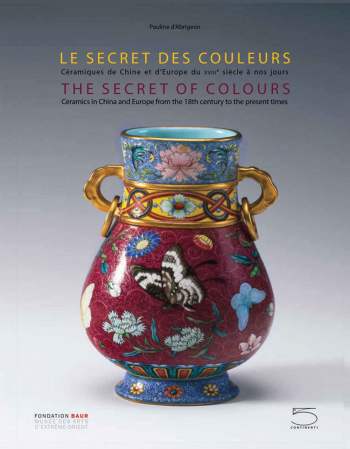 This exhibition tells the often turbulent story of the quest for colour on porcelain in China and France. It contrasts two crucial moments in the history of porcelain driven by the desire to extend the range of enamels. They occurred at the turn of the 18th century in China and during the 19th century in France, two periods during which the interactions between Europe and China, whether cultural or belligerent, were particularly intense.
The first room in the exhibition introduces visitors to enamelling techniques, the notions of translucent and opaque enamels, and to the famille verte and famille rose. This is followed by a presentation of Chinese enamelled porcelain, principally from the reigns of Kangxi (1662–1722), Yongzheng (1723–35), and Qianlong (1736–95), which are among the jewels of Alfred Baur’s collection and which exemplify the use of colour on porcelain over a period of more than a century. The new palette developed in the imperial workshops was soon exported from the port of Canton on porcelain and copper-enamel wares on that had been specially designed for the Western market.
The second section of the exhibition takes place a century later in France, at the Sèvres manufactory, where Chinese colors, long coveted for their brilliance, were keenly researched. Missionaries, chemists, and French consuls in China all contributed to bringing back samples to France where the mysteries of Chinese manufacturing techniques could be fathomed.
The last part of the exhibition introduces more contemporary research on the use of color, first of all by Fance Franck (1927–2008), who from the late 1960s worked with the Sèvres factory to recreate the famous ‘fresh red’ (‘rouge frais‘) or ‘sacrificial red’ (‘rouge sacrificiel‘) that had been mastered by the potters in Jingdezhen several centuries earlier. The exhibition’s investigation into this endless chromatic quest is brought to a close by the pure and gleamingly colourful works of Thomas Bohle (b. 1958).
Pauline d’Abrigeon, Le secret des couleurs: Céramiques de Chine et d’Europe du XVIIIe siècle à nos jours (Milan: 5 Continents Editions, 2022), 170 pages, ISBN: 979-1254600054, €45. Bilingual edition (French and English).
Cover image: Vase with handles, porcelain and polychrome enamels on glaze, China, Jingdezhen, Qing Dynasty, mark and reign of Qianlong (1736–1795) (Geneva: Fondation Baur).
New Book | Global Objects
From Princeton UP:
Edward Cooke, Global Objects: Toward a Connected Art History (Princeton: Princeton University Press, 2022), 336 pages, ISBN: 978-0691184739, £28 / $35.
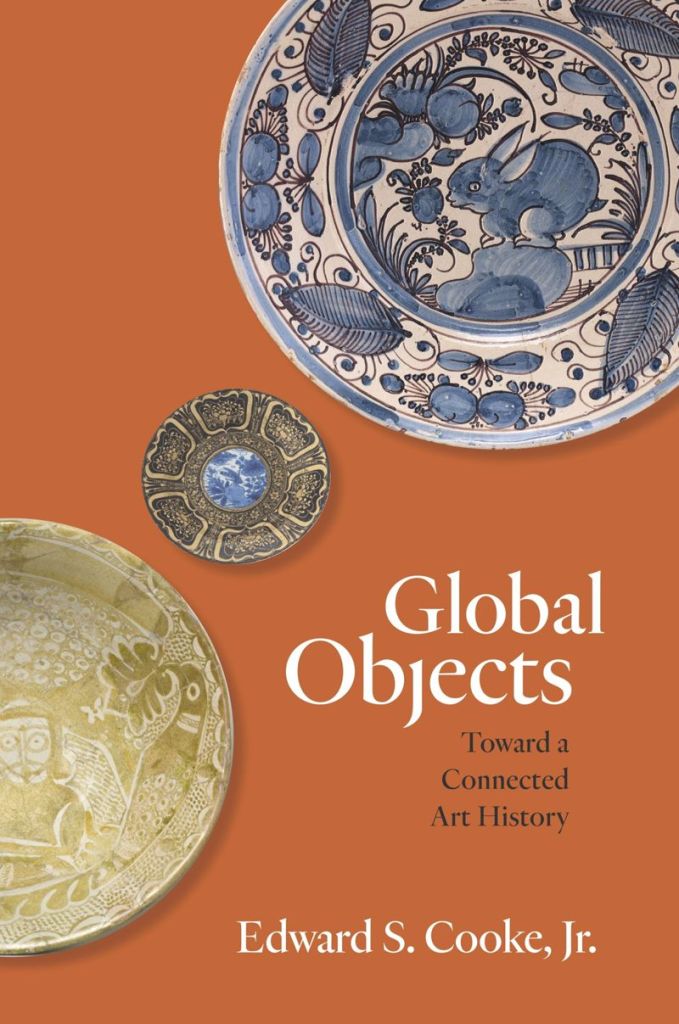 Art history is often viewed through cultural or national lenses that define some works as fine art while relegating others to the category of craft. Global Objects points the way to an interconnected history of art, examining a broad array of functional aesthetic objects that transcend geographic and temporal boundaries and challenging preconceived ideas about what is and is not art. Avoiding traditional binaries such as East versus West and fine art versus decorative art, Edward Cooke looks at the production, consumption, and circulation of objects made from clay, fiber, wood, and nonferrous base metals. Carefully considering the materials and process of making, and connecting process to product and people, he demonstrates how objects act on those who look at, use, and acquire them. He reveals how objects retain aspects of their local fabrication while absorbing additional meanings in subtle and unexpected ways as they move through space and time. In emphasizing multiple centers of art production amid constantly changing contexts, Cooke moves beyond regional histories driven by geography, nation-state, time period, or medium.
Beautifully illustrated, Global Objects traces the social lives of objects from creation to purchase, and from use to experienced meaning, charting exciting new directions in art history.
Edward S. Cooke, Jr. is the Charles F. Montgomery Professor of American Decorative Arts at Yale University. His books include Inventing Boston: Design, Production, and Consumption, 1680–1720 and Making Furniture in Preindustrial America: The Social Economy of Newtown and Woodbury, Connecticut.
C O N T E N T S
Introduction
I. Making
1 Materials
2 Realization
II. Movement
3 Circulation and Interchange
4 Function
III. Meaning
5 Memory and Gift
6 Appearance
7 Touch
Conclusion
Acknowledgments
Glossary
Notes
Index
Photo Credits
Call for Papers | The Swiss Periodical Press, 1623–1803
Proposals welcome in German, French, or English. From the Call for Papers, which also includes the German text:
La presse périodique suisse dans le contexte médiatique européen
Die periodische Presse in der Schweiz im medialen Kontext Europas
Tagung der Schweizerischen Gesellschaft für die Erforschung des 18. Jahrhunderts (SGEAJ)
Colloque de la Société Suisse pour l’Étude du XVIIIe Siècle (SSEDS)
University of Fribourg, 18–19 April 2024
Proposals due by 5 March 20223
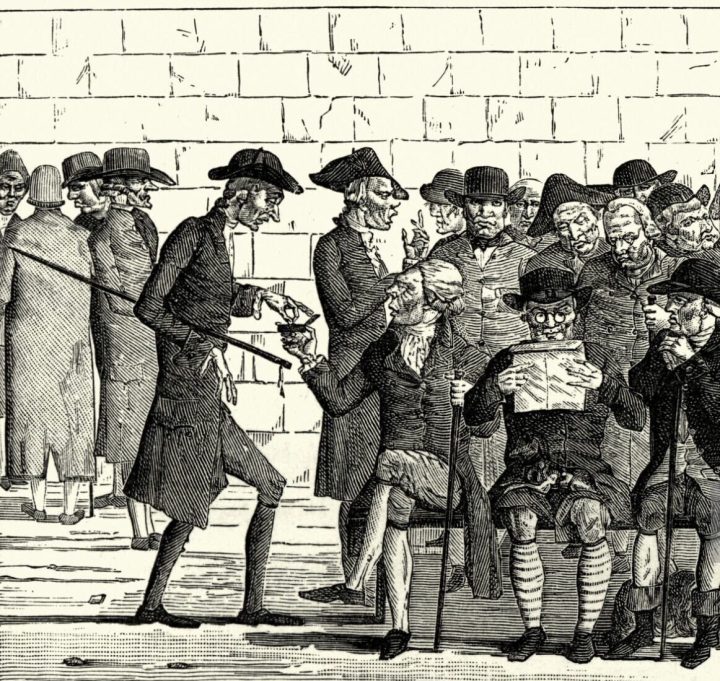
Satirical image of a group of people reading a newspaper (La lecture du journal), detail, French, late 18th century (1790s).
Lorsque le premier journal imprimé parait à Strasbourg en 1605, il ne dispose pas d’un programme de publication nouveau. Pour l’éditeur, l’imprimeur Johann Carolus, il s’agit simplement d’économiser les frais afférents à la diffusion d’un journal manuscrit et d’optimiser sa diffusion. Pourtant, malgré ce début peu spectaculaire et un contenu fait de la compilation de nouvelles sans commentaire éditorial, la presse imprimée a un succès décisif. Désormais, une information régulière sur ce qui se passe dans le monde est disponible. Un nouveau système de communication et d’information se met en place, qui a l’ambition d’être en prise sur l’actualité. Très tôt, ces publications sont collationnées par les organes de gouvernement des princes et des villes, mais se diversifient aussi rapidement selon le lectorat visé. Des journaux savants, des revues mondaines, des périodiques spécialisés ou généralistes sont ainsi diffusés.
La presse périodique a fait l’objet de nombreuses recherches depuis une quarantaine d’années, favorisées encore par la numérisation des supports—les conditions de conservation sont en effet très aléatoires—en particulier en Allemagne autour de Jürgen Wilke, Holger Böning et Daniel Bellingradt et en France avec Gilles Feyel, Jean-Pierre Vittu ou Pierre Rétat. Malgré les travaux de Jean-Daniel Candaux, de Séverine Huguenin et Timothée Léchot, de Fritz Blaser, Hanspeter Marti et Emil Erne ou Andreas Würgler, la presse suisse reste en revanche moins connue.
Le but de ce colloque est de cerner des périodiques suisses, leur conception, fabrication, profil éditorial et journalistique, mais aussi leurs lectorats. Avec sa diversité confessionnelle, linguistique et politique, la Suisse forme un cas d’étude particulièrement riche des médias locaux, régionaux ou transnationaux. Aussi, le colloque s’attachera aux journalistes suisses hors de Suisse, aux réseaux journalistiques et à leurs mises en œuvre en particulier lors de controverses, au cheminement des nouvelles dans différents médias, aux reprises et compilations commentées ou non, à la gestation de discussions dans les médias, aux rythmes de l’information et à leurs effets, à la perception positive ou négative des journaux et à leur emploi, par exemple dans telle décision. Il se centrera sur la presse périodique tout en prenant aussi en considération des « canards », des libelles, des feuilles volantes (« Flugschriften »), des gravures commentées (« Flugblätter »), des calendriers, des étrennes, des almanachs et des messagers boiteux.
Le cadre chronologique couvre la période de 1623 (premières gazettes hebdomadaires suisses qui nous sont parvenues) à 1803 (fin de la République helvétique).
Trois axes seront particulièrement interrogés.
• La presse périodique suisse dans une perspective transnationale
Ce volet se penchera sur la presse périodique rédigée en Suisse ou lue en Suisse, et les journalistes suisses dans leurs réseaux européens ; sur le marché et la fabrication de l’information, la compilation de l’information ; enfin sur d’autres modes de circulation de l’information
• Intermédialité et savoirs
Cet axe sondera les formes manuscrites, voire orales, de l’information, les correspondances en lien avec la presse périodique
• Les représentations dans et de la presse
Ce pan examinera la circulation des images imprimées, les artistes suisses et la satire politique, la question de la censure, etc. Il étudiera les représentations de la presse et les images de la Suisse dans la presse.
Des analyses littéraires, linguistiques ou iconographiques et des études sur l’histoire des savoirs et l’histoire de la communication et des médias sont les bienvenues.
Un temps de 25 minutes est prévu pour les communications d’un intervenant, et de 40 minutes pour les communications à plusieurs intervenants. Des propositions de thématique peuvent être adressées en allemand, en anglais ou en français (max. 300 mots) jusqu’au 5.03.2023 à Claire Gantet (claire.gantet@unifr.ch) ou Andreas Würgler (Andreas.Wuergler@unige.ch). Le comité de préparation du colloque se prononcera sur elles d’ici le 30.04.2023.
Exhibition | François Boucher, du théâtre à l’Opéra
Now on view at the Musée des Beaux-Arts in Tours:
L’amour en scène! François Boucher, du théâtre à l’Opéra
Musée des Beaux-Arts, Tours, 5 November 2022 — 30 January 2023
Curated by Jessica Degain and Guillaume Kazerouni
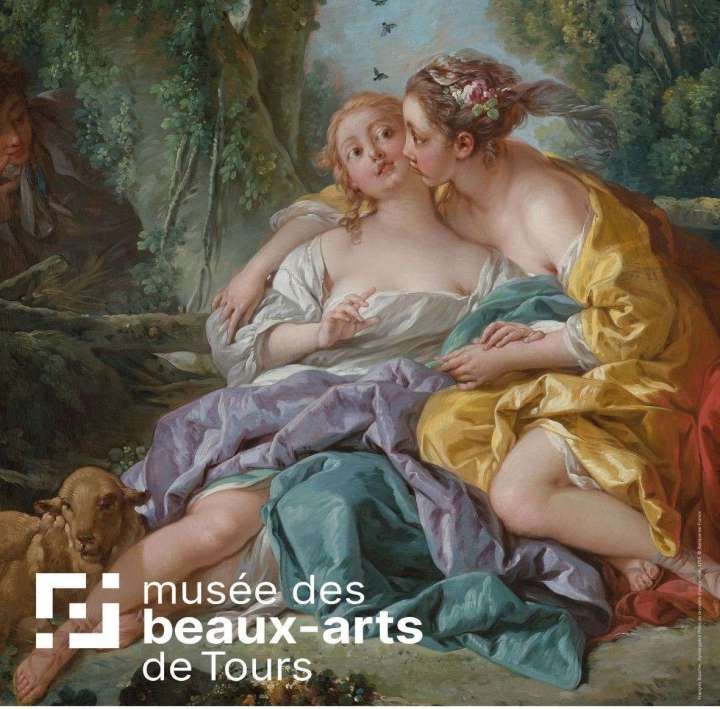
François Boucher, Sylvie Cures Philis of a Bee Sting, 1755, oil on canvas, 103 × 138 cm (Paris: Banque de France).
Le musée des Beaux-arts de Tours propose de mettre en lumière un pan méconnu de la carrière de François Boucher (1703–1770), peintre majeur du 18ᵉ siècle au service de Louis XV et de Madame de Pompadour : sa passion pour le théâtre et l’opéra. Actif à l’Opéra de Paris, à l’Opéra-Comique et au théâtre des Petits Cabinets à Versailles, François Boucher oeuvre tout au long de sa vie à près d’une centaine de spectacles. Qu’il conçoive ou supervise les décors et les costumes de scène, aucun autre peintre de son temps ne fut autant investi dans le monde théâtral.
Point de départ de l’exposition et restaurés à cette occasion, les quatre tableaux du musée de Tours, chefs-d’oeuvre de l’art rocaille, témoignent de l’engouement de l’artiste pour les arts de la scène. Aux côtés de l’esquisse d’Apollon couronnant les arts, réputée être un projet de rideau de scène pour l’Opéra, les trois peintures d’Apollon et Issé et de Sylvie et Aminte mettent à l’honneur les opéras baroques d’Issé et de Silvie. Apollon révélant sa divinité à la bergère Issé est en effet peint par Boucher en 1750 pour la marquise de Pompadour, en souvenir de ses représentations théâtrales à Versailles dans le rôle d’Issé. De même, les tableaux de Sylvie fuyant le loup et Aminte revenant à la vie dans les bras de Sylvie rappellent son apparition théâtrale dans le rôle de la nymphe. Conçus à l’origine pour former un ensemble de quatre tableaux, la série de l’histoire de Sylvie et Aminte sera réunie pour la première fois depuis le 18ᵉ siècle, grâce aux prêts exceptionnels de la Banque nationale de France (qui conserve aujourd’hui Sylvie guérit Philis de la piqûre d’une abeille et Sylvie délivrée par Aminte). OEuvres de maturité, ces tableaux constituent un magnifique témoignage du talent de François Boucher à dépeindre des univers bucoliques, merveilleux et théâtraux.
 Complétés par une soixantaine d’oeuvres, en particulier de la Bibliothèque nationale de France et du Musée du Louvre, l’exposition permettra par ailleurs d’illustrer d’autres contributions de Boucher aux arts de la scène. De ses gravures de jeunesse pour illustrer les OEuvres de Molière, dont on célèbre cette année le quatre centième anniversaire de la naissance, aux décors et costumes conçus pour divers opéras tels Armide ou Aline, reine de Golconde, les oeuvres rassemblées éclairent la vitalité de sa création.
Déployés autour des tableaux du musée, estampes, tapisseries et objets d’art décoratifs s’accompagneront d’oeuvres d’art moderne et contemporain, de Berthe Morisot à Cindy Sherman. La contribution du créateur de mode Sami Nouri révélera enfin comment Boucher et le rococo continuent à inspirer les artistes du 21e siècle.
L’exposition est à découvrir du 5 novembre 2022 au 30 janvier 2023, grâce aux prêts prestigieux de nombreuses institutions : Bibliothèque national de France / Musée du Louvre / Musée national des Châteaux de Versailles et de Trianon / Moulins, Centre national du costume de scène / Narbonne, musée d’art et d’histoire / Paris, Mobilier national / Paris, musée Marmottan-Monet / Centre National des Arts Plastiques / Paris, Banque de France / Sèvres, Cité de la Céramique / Paris, musée des Arts décoratifs / Paris, musée Cognacq-Jay / Paris, Petit Palais / Agen, musée des Beaux-Arts.
Love on Stage! Francois Boucher, from the Theater to the Opera
Commissariat de l’exposition
• Jessica Degain, conservatrice du patrimoine chargée des collections XVIIᵉ–XIXᵉ siècles du musée des Beaux-Arts de Tours
• Guillaume Kazerouni, conservateur, chargé des collections anciennes du musée des Beaux-Arts de Rennes
Jessica Degain, L’amour en scène! François Boucher, du théâtre à l’Opéra (Paris: Éditions Snoeck, 2022), 239 pages, ISBN: 978-9461617200, €29.
New Book | Butts: A Backstory
Sarah Bartmann is part of the story as recounted by Radke; from Simon & Schuster:
Heather Radke, Butts: A Backstory (New York: Simon & Schuster, 2022), 320 pages, ISBN: 978-1982135485, $29.
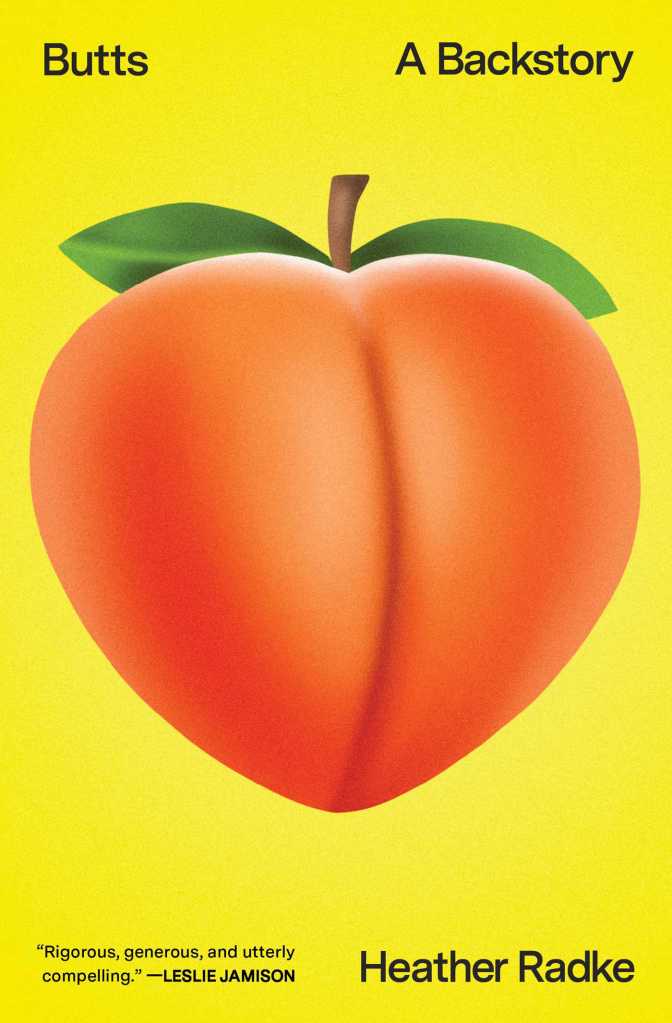 Whether we love them or hate them, think they’re sexy, think they’re strange, consider them too big, too small, or anywhere in between, humans have a complicated relationship with butts. It is a body part unique to humans, critical to our evolution and survival, and yet it has come to signify so much more: sex, desire, comedy, shame. A woman’s butt, in particular, is forever being assessed, criticized, and objectified, from anxious self-examinations trying on jeans in department store dressing rooms to enduring crass remarks while walking down a street or high school hallways. But why? In Butts: A Backstory, reporter, essayist, and RadioLab contributing editor Heather Radke is determined to find out.
Spanning nearly two centuries, this “whip-smart” (Publishers Weekly, starred review) cultural history takes us from the performance halls of 19th-century London to the aerobics studios of the 1980s, the music video set of Sir Mix-a-Lot’s “Baby Got Back” and the mountains of Arizona, where every year humans and horses race in a feat of gluteal endurance. Along the way, she meets evolutionary biologists who study how butts first developed; models whose measurements have defined jean sizing for millions of women; and the fitness gurus who created fads like “Buns of Steel.” She also examines the central importance of race through figures like Sarah Bartmann, once known as the “Venus Hottentot,” Josephine Baker, Jennifer Lopez, and other women of color whose butts have been idolized, envied, and despised. Part deep dive reportage, part personal journey, part cabinet of curiosities, Butts is an entertaining, illuminating, and thoughtful examination of why certain silhouettes come in and out of fashion—and how larger ideas about race, control, liberation, and power affect our most private feelings about ourselves and others.
Heather Radke is an essayist, journalist, and contributing editor and reporter at Radiolab, the Peabody Award–winning program from WNYC. She has written for publications including The Believer, Longreads, and The Paris Review, and she teaches at Columbia University’s creative writing MFA Program. Before becoming a writer, Heather worked as a curator at the Jane Addams Hull-House Museum in Chicago.
◊ ◊ ◊ ◊ ◊
In her piece for The New York Times (28 November 2022), Marisa Meltzer narrates a visit to The Met with Radke to discuss the variety of bottoms—and attitudes toward them—across the history of art.
Exhibition | Michaelina Wautier and ‘The Five Senses’
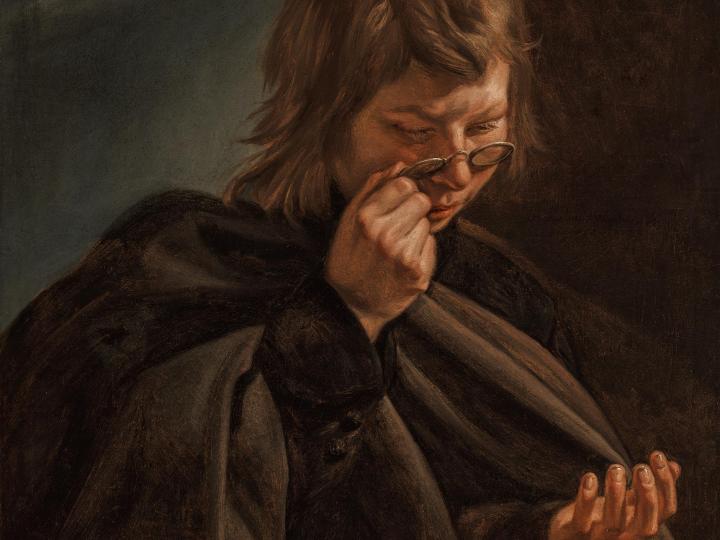
Michaelina Wautier, detail of Sight from The Fives Senses series, 1650
(Collection of Rose-Marie and Eijk van Otterloo, on loan to the MFA)
◊ ◊ ◊ ◊ ◊
Predating even the long eighteenth century, this was the first I learned of the artist (though a 2021 posting here at Enfilade did note an auction sale). –CH.
Now on view at Boston’s MFA:
Michaelina Wautier and The Five Senses: Innovation in 17th-Century Flemish Painting
Museum of Fine Arts, Boston, 12 November 2022 — 12 November 2023
Organized by Christopher Atkins and Jeffrey Muller, with six PhD students from Brown University
Centered around her rare series The Five Senses (1650), this is the first gallery space in the Americas dedicated to the art of Michaelina Wautier (1614–1689), a painter from Brussels all but forgotten until the recent rediscovery of her work. The set of five pictures was virtually unknown until it was acquired by Rose-Marie and Eijk van Otterloo and lent to the MFA in 2020. Here, it is joined by Wautier’s remarkable Self-Portrait (1645), on loan from a private collection and on public view in the US for the first time.
Wautier’s technique, process, and training are mysterious. Few records about her life exist, due in part to her gender. This exhibition, organized by the MFA’s Center for Netherlandish Art in collaboration with a professor and six doctoral students from Brown University, presents new scholarship about the artist and her unusual career as a female painter working in mid-17th-century Brussels.
The Five Senses and Self-Portrait, all of which have only been attributed to Wautier in recent years, are among fewer than 40 known works by the artist. Wautier focuses on boys—a different model in each painting—performing everyday activities in her detailed portrayals of Sight, Hearing, Smell, Taste, and Touch. Accompanying prints by her predecessors and contemporaries, including Cornelis Cort (1533–1578) and Johannes Gillisz. van Vliet (about 1610–about 1640), demonstrate Wautier’s originality, showcasing how she defied a convention at the time of depicting the senses as experienced by idealized women. In her Self-Portrait, Wautier presents herself both in a formal aristocratic setting and as a professional artist, facing an easel and holding painting tools. Together, these extraordinary pictures are exemplary of Wautier’s unique style and brushwork. The exhibition also features a print after a now lost portrait by Wautier from MFA Boston that has never been on view.
The installation is accompanied by the first volume of the digital publication series CNA Studies, edited by Professor Jeffrey Muller and with essays by the six organizing students: Yannick Etoundi, Sophie Higgerson, Emily Hirsch, Regina Noto, Mohadeseh Salari Sardari, and Dandan Xu.
This is the second in a series of collaborations between the CNA and its academic partners that draws on MFA Boston’s deep collection of Dutch and Flemish art in new and unexpected ways, bringing new perspectives and diverse voices to the forefront while showcasing cross-disciplinary scholarship. The previous installation, A Modern Art Market, was on view from November 2021 through October 2022.
◊ ◊ ◊ ◊ ◊
More information is available from this piece in The NY Times:
Milton Esterow, “For Centuries, Her Art Was Forgotten, or Credited to Men. No More,” The New York Times (2 December 2022). The work of Michaelina Wautier, a 17th-century artist, was long overlooked. She is belatedly gaining recognition as an old master, as the first US show of her work opens in Boston.
In addition to the MFA’s exhibition, the article addresses the work of Professor Katlijne Van der Stighelen (University of Leuven), who learned of Wautier’s work in 1993 and organized the 2018 exhibition Michaelina Wautier: Baroque’s Leading Lady, held at Antwerp’s Museum aan de Stroom.
New Book | William Ellis
From the University of Hertfordshire Press:
Malcolm Thick, William Ellis: Eighteenth-Century Farmer, Journalist, and Entrepreneur (Hatfield: University of Hertfordshire Press, 2022), 224 pages, ISBN: 978-1912260492, £17 / $34.
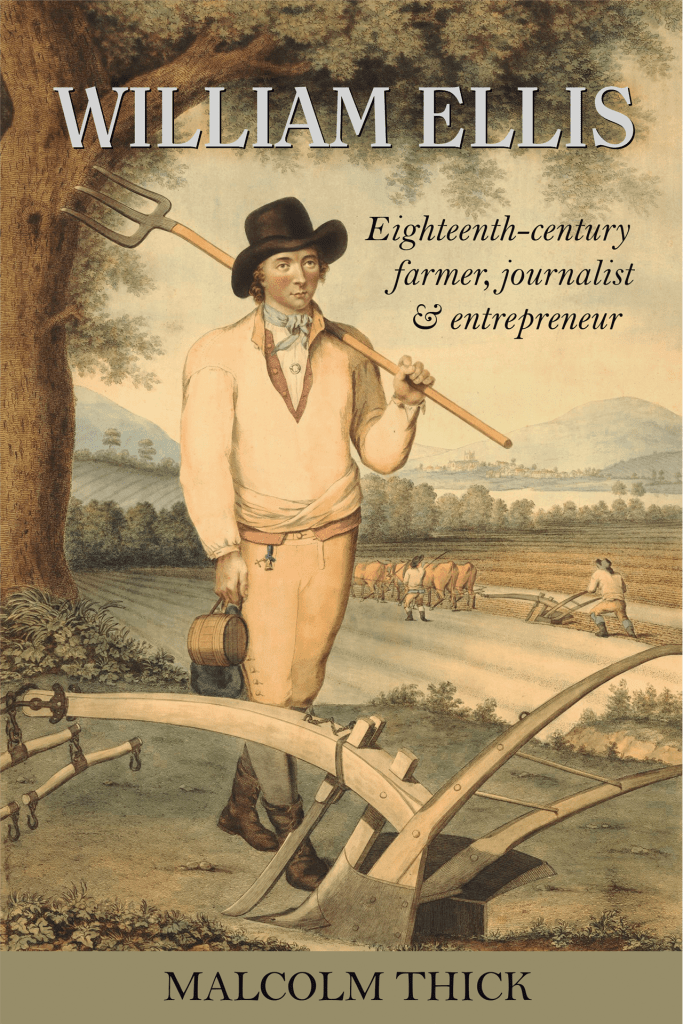 William Ellis, who lived and farmed at Little Gaddesden in Hertfordshire in the first half of the eighteenth century (d. 1759), is an important figure in English agricultural history. In his time the most prolific writer on agriculture in England, he authored many works that were read not only at home but also in the American colonies and continental Europe. Ellis was essentially an agricultural journalist, then a relatively new occupation. He wrote about his own life as well as those of the ordinary people of Little Gaddesden and further afield—he travelled extensively throughout the southern half of England. Most of his copy was derived from conversations he had had with farmers, their wives, and other rural folk, the sheer immediacy of his books outshining those of his rivals.
Ellis’s style was discursive, particularly so in The Country Housewife’s Family Companion (1750). As well as providing a compendium of household management, cookery, and medicine, Ellis delighted in relaying gossip. He included the activities of farmers, wives and maids, labourers, travellers, and beggars, as well as the gentry and aristocracy, rich pickings for social historians.
Ellis also used his books to advertise his business as a supplier of agricultural instruments, seeds, plants, trees, and fowls—an innovative approach. The Swedish botanist Pehr Kalm visited Little Gaddesden in 1748 to inspect Ellis’s farming and the various farm implements he advertised for sale. The two men didn’t warm to each other, but Kalm’s independent observations add to what we know about Ellis.
Piecing together the scant facts about Ellis’s early life, Malcolm Thick has uncovered new information on his time before he commenced farming and unravelled some of the complexities of his two marriages. The book’s central focus is on Ellis’s agricultural writings, which provide a fascinating picture of rural life in the period and shed light on the evolution of English farming. This is the first book about Ellis for over sixty years and the first to consider him fully in the round—as a farmer, an active member of his community, an innovative salesman, and a wonderfully curious mind.
Malcolm Thick is a Fellow of the Royal Historical Society and a winner of the Sophie Coe prize for food history writing. He has published books and papers on early modern gardening, food, and agriculture, including a critically acclaimed biography of the early scientist Sir Hugh Plat and a history of market gardening around London. He also wrote the introduction to a new edition of Ellis’s Country Housewife’s Family Companion and has contributed a chapter on “Plants as Staple Foods” in volume 3 of A Cultural History of Plants (Bloomsbury, 2022).
C O N T E N T S
1 Introduction
2 Life before Little Gaddesden and at Church Farm
3 Agriculture
4 Advertising and Trading
5 Food, Drink, and Medicine
6 Ellis the Man
7 Other Matters
8 Conclusion
Online Exhibitions | Museum of the American Revolution
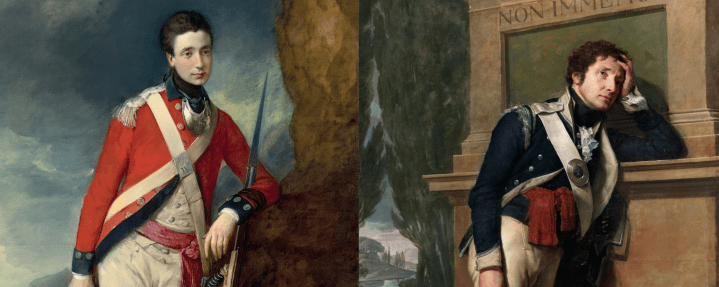
Left: Thomas Gainsborough, Portrait of Richard Mansergh St. George, detail, 1776 (Melbourne: National Gallery of Victoria). Right: Hugh Douglas Hamilton, Portrait of Richard Mansergh St. George, detail, ca. 1796 (Dublin: National Gallery of Ireland, purchased, 1992)
◊ ◊ ◊ ◊ ◊
From the Museum of the American Revolution:
Cost of Revolution: The Life and Death of an Irish Soldier
Museum of the American Revolution, Philadelphia, 28 September 2019 — 17 March 2020, online version ongoing
What can a life tell us about an era? These two portraits depict Richard Mansergh St. George, an Irish soldier who fought against two revolutions, one in America and one in Ireland. To the left is the young and confident St. George in 1776, dressed in his British Army uniform, ready to ship off to fight the American ‘rebels’. To the right is Richard Mansergh St. George grieving at his wife’s tomb two years before his tenants killed him at the beginning of the Irish Revolution of 1798.
In the 20 years separating his portraits, St. George’s life changed dramatically. He survived a severe head wound in America, mourned over the tragic death of his wife, and saw the power of kings and of gentlemen like himself violently challenged on two continents. Along the way, St. George created and commissioned artwork to deal with his trauma and make sense of his rapidly changing world. His portraits, paintings, sketches, and cartoons provide new insight into the personal cost of revolution and the entangled histories of the American Revolution of 1776 and the Irish Revolution of 1798.
1 St. George’s Ireland: A Divided Population
2 American War: Fighting for the Crown
3 Wounded Veteran: A Man Versed in Misfortune
4 Irish Revolution: Fighting for Independence in 1798

1797 New Jersey Electoral Reform Enrolled Law
(New Jersey State Archives, Department of State)
◊ ◊ ◊ ◊ ◊
From the Museum of the American Revolution:
When Women Lost the Vote: A Revolutionary Story, 1776–1807
Museum of the American Revolution, Philadelphia, 2 October 2020 — 25 April 2021, online version ongoing
Women voted in Revolutionary America, over a hundred years before the United States Constitution guaranteed that right to women nationally. The 1776 New Jersey State Constitution referred to voters as “they,” and statutes passed in 1790 and 1797 defined voters as “he or she.” This opened the electorate to free property owners, Black and white, male and female, in New Jersey. This lasted until 1807, when a new state law said only white men could vote. What can this story of changing laws about who could vote from the earliest days of American democracy teach us about what it means to vote and what it takes to preserve and expand that right? A newly discovered set of sources—lists of men and women, Black and white—who voted in New Jersey between 1798 and 1807 set off our quest to find the answers.
1 How Did Women Gain the Vote? The Promise of 1776 for Women
2 How Did the Vote Expand? New Jersey’s Revolutionary Decade
3 How Did Women Lose the Vote? The Backlash
4 How Was the Vote Regained? Redemption










 Enfilade
leave a comment