New Book | Turner & Constable: Art, Life, Landscape
From Yale UP (with a paperback edition scheduled for publication in January) . . .
Nicola Moorby, Turner and Constable: Art, Life, Landscape (New Haven: Yale University Press, 2025), 352 pages, ISBN: 978-0300266481, $35.
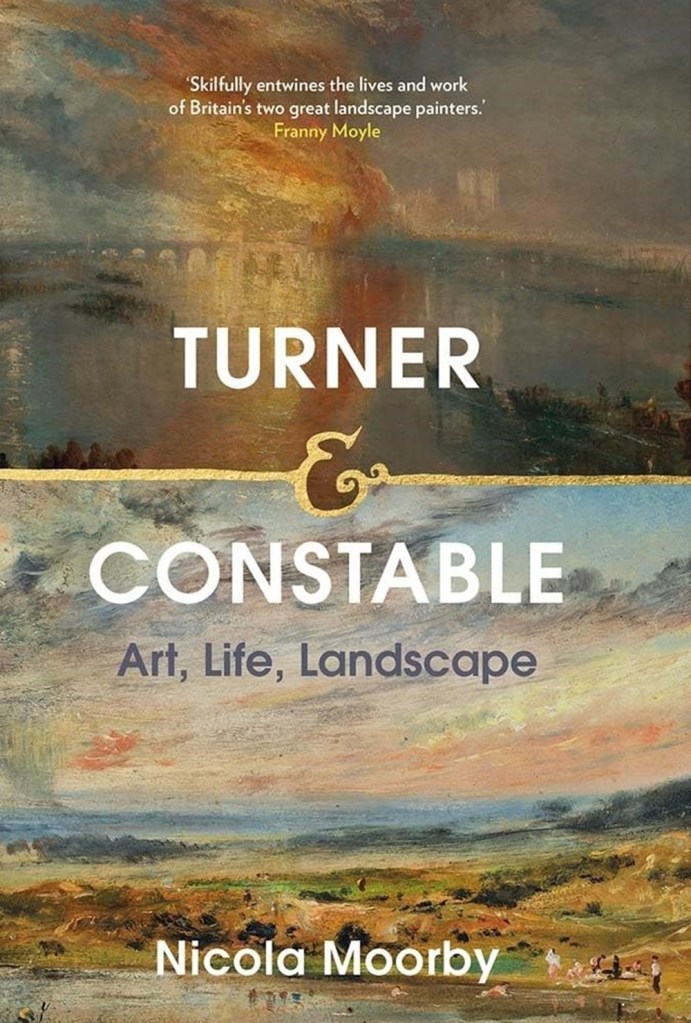 Born just fourteen months apart, one in London and the other in rural Suffolk, J.M.W. Turner and John Constable went on to change the face of British art. The two men have routinely been seen as polar opposites, not least by their peers. Differing in temperament, background, beliefs, and vision, they created images as dissimilar as their personalities.
Yet in many ways they were fellow travellers. As children of the late eighteenth century, both faced the same challenges and opportunities. Above all, they shared common cause as champions of a distinctively British art. Through their work, they fought for the recognition and appreciation of landscape painting—and in doing so ensured their reputations were forever intertwined and interlinked. Nicola Moorby offers us a fresh perspective on two extraordinary artists, uncovering the layers of fiction that have embellished and disguised their greatest achievements. For Turner & Constable is not just a tale of two artists; it is also the story of the triumph of landscape painting.
Nicola Moorby is an independent art historian and curator specialising in British art of the nineteenth and early twentieth centuries, particularly J.M.W. Turner, British watercolour, and early British modernism.
Conference | Turner 250
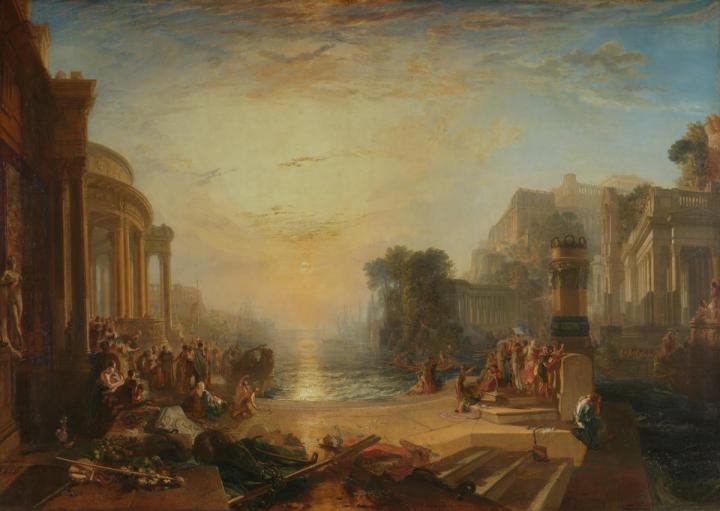
J.M.W. Turner, The Decline of the Carthaginian Empire, exhibited in 1817, oil on canvas, 170 × 239 cm (London: Tate, accepted by the nation as part of the Turner Bequest 1856, N00499).
◊ ◊ ◊ ◊ ◊
From the Paul Mellon Centre:
Turner 250
Tate Britain, London, 4–5 December 2025
2025 marks two hundred and fifty years since the birth of Romantic painter J.M.W. Turner (1775–1851). Timed to coincide with the Turner and Constable exhibition at Tate Britain and to help bring celebrations of Turner’s 250th anniversary year to a close, this conference will take Turner’s art and life as a starting point for exploring what it means to research Turner and to curate his work today.
t h u r s d a y , 4 d e c e m b e r
9.30 Registration with tea and coffee
10.00 Opening Remarks — Amy Concannon (Manton Senior Curator of Historic British Art at Tate)
10.10 Panel 1 | Curating Turner Now
Chair: Esther Chadwick (senior lecturer in history of art and Head of the History of Art Department, The Courtauld)
• Turner as Teacher: Lessons in Perspective — Helen Cobby (curator and lecturer, Bath Spa University)
• A Maligned Masterpiece? Displaying Turner’s The Battle of Trafalgar in Greenwich — Katherine Gazzard (Curator of Art (Post-1800), Royal Museums Greenwich)
• Reimagining the Liber Studiorum: Reasserting the Primacy of Print in Turner’s Art — Imogen Holmes-Roe (Curator (Historic Art), the Whitworth, University of Manchester)
• Curating Turner in East Anglia — Emma Roodhouse (curator and researcher) and Francesca Vanke (Senior Curator and Keeper of Fine and Decorative Art, Norwich Museums)
• A Site of Inspiration: Curating Turner at Petworth — Emily Knight (Property Curator, Petworth House) and Sue Rhodes (Visitor Experience Manager, Petworth House)
• The New Carthaginian: Turner, Memory, and Imperial Echoes (Performative Lecture) — Nick Makoha (poet and playwright)
12.50 Lunch break
Completing the Turner Cataloguing Project, the Paul Mellon Centre (PMC) film to be screened
2.00 Panel 2 | Researching Turner’s Bequest
Chair: Nicola Moorby (Curator, British Art 1790–1850, Tate)
• Introduction to Turner Bequest Catalogue — Matthew Imms (former Senior Cataloguer and Editor: Turner Bequest, Tate)
• The Discovery and Assembly of the 1838 Tour — Hayley Flynn (former Turner Cataloguer, Tate), with support from the Turner Society.
• Turner Technical Studies: Their Legacy and Preservation — Joyce Townsend (Senior Conservation Scientist, Tate)
3.10 Tea and coffee break
Completing the Turner Cataloguing Project, PMC film to be screened
3.40 Panel 3 | Building Turner’s Reputation
• About Carthage – An Exhibition of Seven Paintings by Stephen Farthing RA Held at the UK Ambassador’s Residence in Carthage 2025 — Stephen Farthing (artist)
• Turner and Robert Hills: Collaborating Contemporaries? — Kimberly Rhodes (professor of art history, Drew University)
• Paper Galleries and the Mediation of Art: Turner, John Constable, and Clarkson Stanfield in The Royal Gallery of British Art (ca. 1851) — Chia-Chuan Hsieh (professor, Graduate Institute of Art Studies, National Central University, Taiwan)
• From Patriotic Patronage to National Property: The Trajectory of the Petworth Turners, 1805–1956 — Andrew Loukes (Curator of the Egremont Collection, Petworth House)
5.20 Drinks reception
6.15 Evening Lecture
• Art, Music, and the Sublime — Tim Barringer, with live performance by the Kyan Quartet of Franz Schubert’s string quartet no.14 in D minor, D.810, Death and the Maiden
f r i d a y , 5 d e c e m b e r
10.00 Registration with tea and coffee
10.30 Panel 4 | Eco-critical Approaches to the Artist
Chair: Tom Ardill (Curator of Paintings, Prints and Drawings, London Museum)
• Out of the Blue: Exploring Water in Turner’s Work — Martha Cattell (artist, curator and researcher)
• Watermarks: Environmental Contingencies and the Turner Bequest — Tobah Aukland-Peck (postdoctoral fellow, PMC), with support from the Turner Society.
• Rethinking Turner’s Human Landscape — Caterina Franciosi (PhD candidate in the history of art, Yale University), with support from the Turner Society.
• What Was in Turner’s Lungs? — Sarah Gould (assistant professor, Université Paris 1, Panthéon-Sorbonne)
• Necro-Geographies of the Sublime: A Posthuman Reckoning with Turner’s Horizon (Multimedia Video-Essay) — Parham Ghalmdar (artist and researcher, The New Centre for Research & Practice)
12.40 Lunch break
Completing the Turner Cataloguing Project, PMC film to be screened
1.40 Panel 5 | Artistic Legacies
Chair: John Bonehill (senior lecturer in history of art, University of Glasgow)
• Encounters at MoMA: Turner, Rothko, and the Invention of ‘Modernist’ — Nicole Cochrane (Assistant Curator, Historic Art, 1790–1850, Tate Britain)
• 1966: Turner, Frank Bowling, and the Subject of Modernism — Ed Kettleborough (PhD candidate in history of art, University of Bristol), with support from the Turner Society.
• Where Sky Meets Ground: Turner and Sheila Fell in the Solway Firth — Kate Brock (researcher, Royal College of Art)
• Reservoirs of Recollection: John Akomfrah and the Oceanic Afterlives of Turner’s Sublime — Sabo Kpade (writer, curator, and researcher)
• What Can We Find in Turner’s Shadows? Artist Libby Heaney at Orleans House Gallery — Julia DeFabo (curator and creative producer), with support from the Turner Society.
4.20 Historical Fiction
• Varnishing Day: Ruskin, Turner, and the End of Idolatry — Cal Barton (writer and teacher)
4.40 Closing Remarks — Nicola Moorby and Amy Concannon (Tate) and Martin Myrone (PMC)
New Book | Patriots Before Revolution
From Yale UP:
Amy Watson, Patriots Before Revolution: The Rise of Party Politics in the British Atlantic, 1714–1763 (New Haven: Yale University Press, 2025), 344 pages, ISBN: 978-0300263213, $65. Series: The Lewis Walpole Series in Eighteenth-Century Culture and History
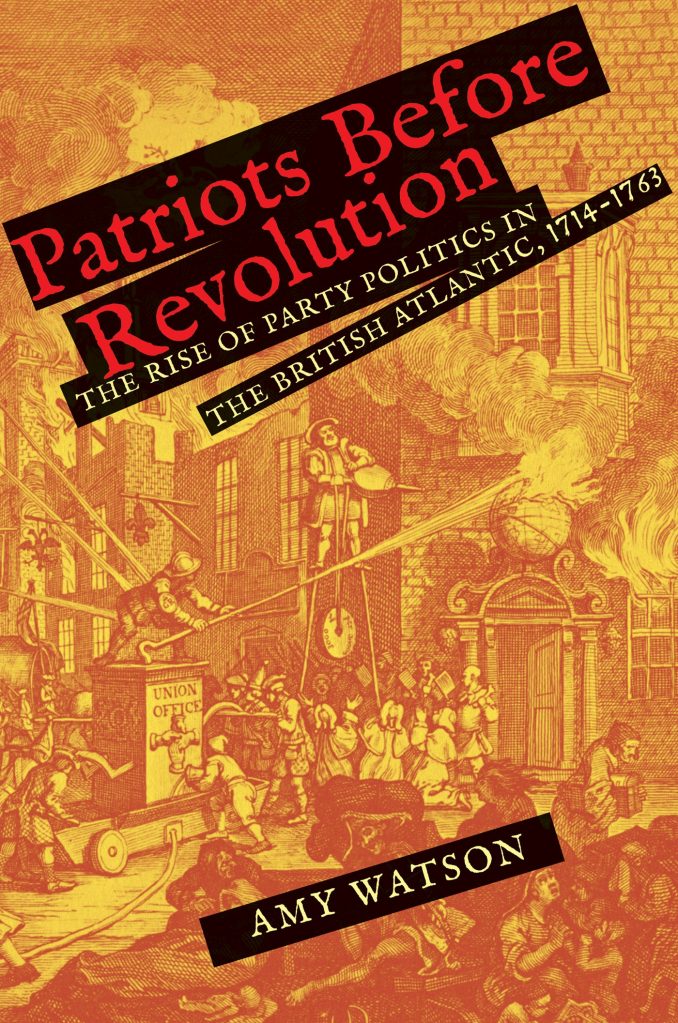 A new history of the Patriot movement before the American Revolution, tracing its origins to reform movements in British politics
The American revolutionaries—George Washington, Thomas Jefferson, John and Abigail Adams—called themselves Patriots. But what exactly did it mean to be a Patriot? Historian Amy Watson locates the origins of Patriotism in British politics of the early eighteenth century, showing that the label ‘Patriot’ was first adopted by a network of British politicians with radical ideas about the principles and purpose of the British Empire. The early Patriots’ ideological mission was not American independence but, rather, imperial reform: Patriots sought to create a British Empire that was militant, expansionist, confederal, and free.
Over the course of the next half century, these British reformers used print media and grassroots mobilization efforts to build an empire-wide political party with adherents in London, Edinburgh, New York City, and the new colony of Georgia. While building this party, the Patriots’ advocacy drew Britons into a series of violent political conflicts over taxes and civil liberty, as well as three expansive global wars, the War of Jenkins’ Ear (1739–48), the War of the Austrian Succession (1740–48), and the Seven Years’ War (1756–63). Patriot ideas and organizations came to divide Britons on increasingly sharp political lines, laying the groundwork for the revolutionary decades to come.
Amy Watson is assistant professor of history at the University of Alabama at Birmingham.
New Book | The Zorg
Reviewing the book for The New York Times, Marcus Rediker highlights successes—broadly describing it as “a model of sophisticated research, lucid writing and engaged conscience”—as well as moments of overreach. From Macmillan:
Siddharth Kara, The Zorg: A Tale of Greed and Murder That Inspired the Abolition of Slavery (New York: St. Martin’s Press, 2025), 304 pages, ISBN: 978-1250348227, $30.
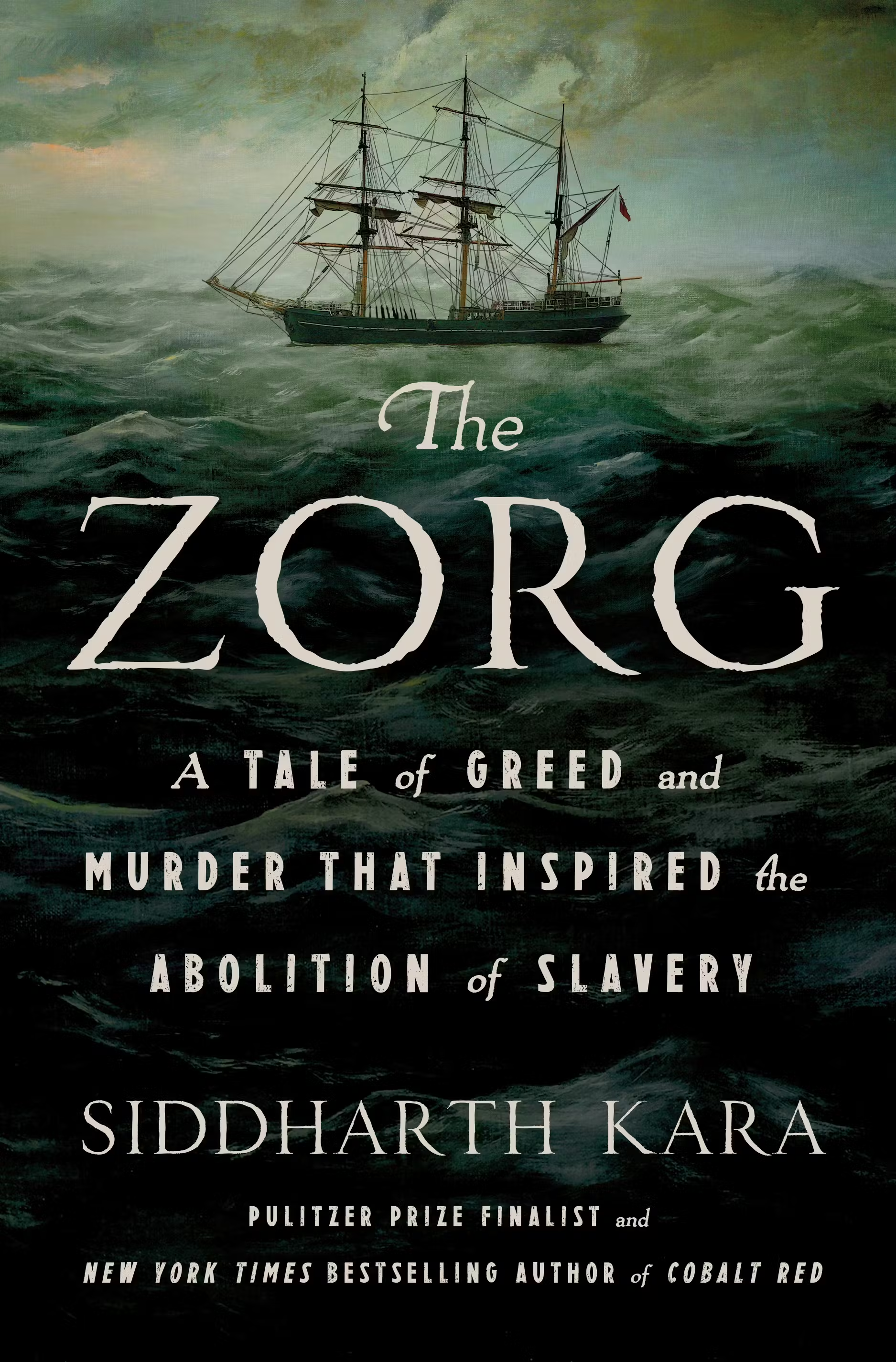 In late October 1780, a slave ship set sail from the Netherlands, bound for Africa’s Windward and Gold Coasts, where it would take on its human cargo. The Zorg (a Dutch word meaning ‘care’) was one of thousands of such ships, but the harrowing events that ensued on its doomed journey were unique. By the time its journey ends, the Zorg would become the first undeniable argument against slavery.
When a series of unpredictable weather events and navigational errors led to the Zorg sailing off course and running low on supplies, the ship’s captain threw more than a hundred slaves overboard in order to save the crew and the most valuable slaves. The ship’s owners then claimed their loss on insurance, a first for slaves who had not been killed due to insurrection or died of natural causes.
The insurers refused to pay due to the higher than usual mortality rate of the slaves on board, leading to a trial which initially found in their favor, in which the Chief Justice compared the slaves to horses. Thanks to the outrage of one man present in court that day, a retrial was held. For the first time, concepts such as human rights and morality entered the discourse on slavery in a courtroom case that boiled down to a simple yet profound question: Were the Africans on board people or cargo?
What followed was a fascinating legal drama in England’s highest court that turned the brutal calculus of slavery into front-page news. The case of the Zorg catapulted the nascent anti-slavery movement from a minor evangelical cause to one of the most consequential moral campaigns in history―sparking the abolitionist movement in both England and the young United States. The Zorg is the astonishing yet little-known true story of the most consequential ship that ever crossed the Atlantic.
Siddharth Kara is an author, researcher, and activist on modern slavery. Kara has written several books and reports on slavery and child labor, most recently the New York Times bestseller and Pulitzer Prize finalist, Cobalt Red. Kara also won the Frederick Douglass Book Prize. He has lectured at Harvard University and held a professorship at the University of Nottingham. He divides his time between Los Angeles and London.
New Book | Republic and Empire
From Yale UP:
Trevor Burnard and Andrew Jackson O’Shaughnessy, Republic and Empire: Crisis, Revolution, and America’s Early Independence (New Haven: Yale University Press, 2025), ISBN: 978-0300280180, $35.
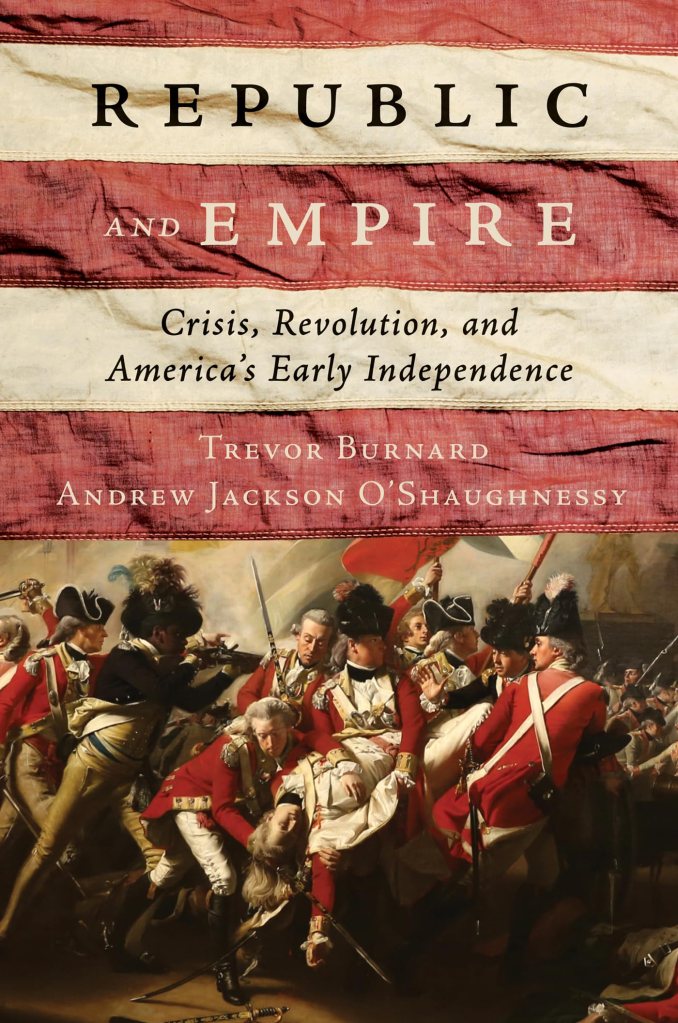
A fresh look at the American Revolution as a major global event
At the time of the American Revolution (1765–83), the British Empire had colonies in India, Africa, the Caribbean, the Pacific, Canada, Ireland, and Gibraltar. The thirteen rebellious American colonies accounted for half of the total number of provinces in the British world in 1776. What of the loyal half? Why did some of Britain’s subjects feel so aggrieved that they wanted to establish a new system of government, while others did not rebel? In this authoritative history, Trevor Burnard and Andrew Jackson O’Shaughnessy show that understanding the long-term causes of the American Revolution requires a global view. As much as it was an event in the history of the United States, the American Revolution was an imperial event produced by the upheavals of managing a far-flung set of imperial possessions during a turbulent period of reform. By looking beyond the familiar borders of the Revolution and considering colonies that did not rebel—Quebec, Nova Scotia, Bermuda, India, the British Caribbean, Senegal, and Ireland—Burnard and O’Shaughnessy go beyond the republican, liberal, and democratic aspects of the emerging American nation, providing a broader history that transcends what we think we know about the Revolution.
Trevor Burnard (1960–2024) was Wilberforce Professor of Slavery and Emancipation at the University of Hull and director of the Wilberforce Institute. He was the author of numerous books on Caribbean plantation history and imperial history and served as editor of the Oxford Bibliography Online in Atlantic History. Andrew Jackson O’Shaughnessy is professor of history at the University of Virginia. His books include An Empire Divided: The American Revolution and the British Caribbean and the prizewinning The Men Who Lost America: British Leadership, the American Revolution, and the Fate of the Empire.
Documentary | The American Revolution

The series premiers Sunday evening. Jill Lepore addresses it within the larger context of institutions celebrating the 250th anniversary of the Revolution, “Revolutionary Whiplash: Commemorating a Nation’s Founding in a Time of Fear and Foreboding,” The New Yorker (17 November 2025), pp. 14–18. . . . .
The American Revolution: A Film by Ken Burns, Sarah Botstein, and David Schmidt, 12 hours, PBS, 2025. With Claire Danes, Hugh Dancy, Josh Brolin, Kenneth Branagh, and Liev Schreiber.
The American Revolution examines how America’s founding turned the world upside-down. Thirteen British colonies on the Atlantic Coast rose in rebellion, won their independence, and established a new form of government that radically reshaped the continent and inspired centuries of democratic movements around the globe.
 An expansive look at the virtues and contradictions of the war and the birth of the United States of America, the film follows dozens of figures from a wide variety of backgrounds. Through their individual stories, viewers experience the war through the memories of the men and women who experienced it: the rank-and-file Continental soldiers and American militiamen (some of them teenagers), Patriot political and military leaders, British Army officers, American Loyalists, Native soldiers and civilians, enslaved and free African Americans, German soldiers in the British service, French and Spanish allies, and various civilians living in North America, Loyalist as well as Patriot, including many made refugees by the war.
The Revolution began a movement for people around the world to imagine new and better futures for themselves, their nations, and for humanity. It declared American independence with promises that we continue to strive for. The American Revolution opened the door to advance civil liberties and human rights, and it asked questions that we are still trying to answer today.
Each episode is two hours.
1 | In Order to Be Free (May 1754 – May 1775)
2| An Asylum for Mankind (May 1775 – July 1776)
3 | The Times That Try Men’s Souls (July 1776 – January 1777)
4 | Conquer by a Drawn Game (January 1777 – February 1778)
5 | The Soul of All America (December 1777 – May 1780)
6 | The Most Sacred Thing (May 1780 – Onward)
Geoffrey Ward and Ken Burns, The American Revolution: An Intimate History (New York: Knopf, 2025), 608 pages, ISBN: 978-0525658672, $80.
Call for Papers | The Local and the Global in New England
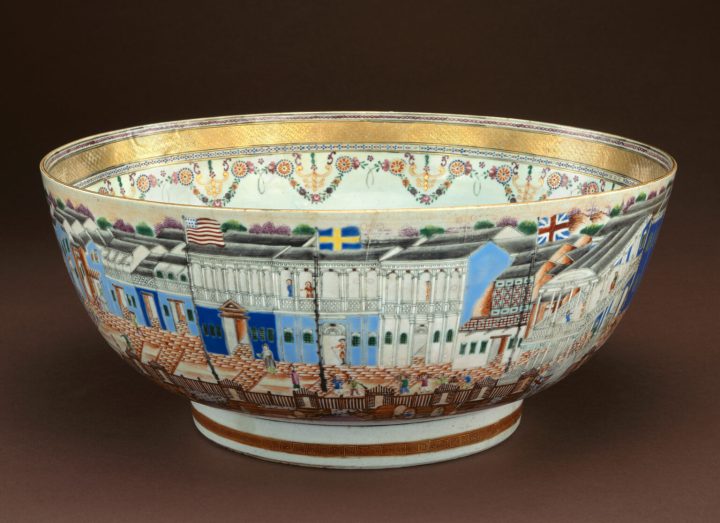
Punch bowl, made in China, 1788–89, hard paste porcelain, overglaze polychrome enamels, gilding
(Historic Deerfield, HD 2772)
◊ ◊ ◊ ◊ ◊
From Historic Deerfield:
The Local and the Global in New England
Historic Deerfield, 7 March 2026
Proposals due by 9 January 2026
A one-day symposium sponsored by Historic Deerfield, Inc. and the Grace Slack McNeil Program for Studies in American Art at Wellesley College.
New England has always been a place characterized by movement, exchange, and connectivity. People, animals, objects, and ideas traversed the land and waterways long before European colonization, which in turn transformed trade, technology, migration, and warfare in the region. This one-day symposium aims to gather scholars and researchers who explore the nature of local, regional, and global networks in New England from the seventeenth to the twenty-first centuries. By bringing together a diverse range of scholars from multiple disciplines, we hope to elucidate how objects—from fine and decorative arts, to buildings, to everyday pieces of material culture—linked New England localities to far-flung makers and markets.
We are interested in a broad range of papers that address how material things complicate our sense of what was local and what was global about the region now called New England, including:
• How do objects, from tools to trade goods, reveal patterns of circulation within and beyond this region?
• How can material things challenge our understanding of distance and proximity?
• How did the creation and exchange of objects both useful and decorative shape the creation of particular New England identities?
• How was the trade of objects local and global entwined with concepts of refinement, social class, and exclusion?
• What methods can scholars and Native knowledge keepers offer to better understand items as they moved in and out of Indigenous and settler communities over time?
• How can objects reveal histories of cultural plurality, transculturation, and survivance?
• How does the movement of objects suggest ways that urban makers and markets mutually constituted those objects’ meanings with their rural counterparts?
• Did New Englanders’ gendering of particular objects, and consumption generally, reflect or diverge from related notions held elsewhere?
• How do networks of exchange crystallize into unique hybrid forms?
• How can we find all these narratives in not only form and function, but also the material substance of these objects?
• And how do responses to these questions complicate the very definition of ‘New England’?
We welcome proposals for 20-minute presentations. Speakers invited to present will receive overnight accommodation and dinner on Friday, March 6 and lunch on Saturday, March 7. We can also offer some reimbursement of travel expenses (with receipts) and a modest honorarium. Presenters will be expected to participate fully in the in-person symposium program on site in Deerfield, MA. Please email, as one document, a 250-word proposal and a CV (not longer than two pages) to Erika Gasser at egasser@historic-deerfield.org. Proposals should include the title of the paper and the presenter’s name and title/affiliations, if any. The deadline for submissions is 9 January 2026; the selection committee will respond to submitters in February.
Colonial Williamsburg’s Antiques Forum, 2026
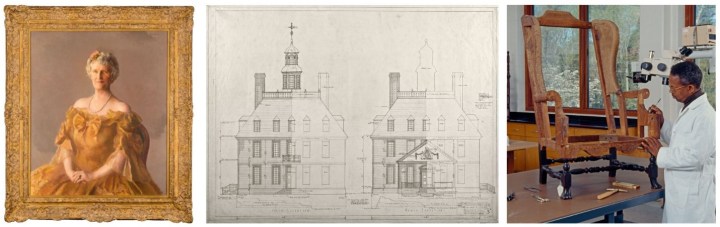
Left: Robert Brackman, Portrait of Abby Aldrich Rockefeller (Mrs. John D. Rockefeller), 1941, oil on canvas·(Gift of the Blanchette Hooker Rockefeller Fund through the generosity of John D. Rockefeller 3rd, his wife Blanchette Hooker Rockefeller, and their four children, 2019-82, A&B). Center: David Hayes, Governors Palace North and South Elevations, Drawing #5, 30 October 1931. Right: Upholstery Conservator Leroy Graves Examines an Easy Chair in the Conservation Lab RIG.
◊ ◊ ◊ ◊ ◊
In 2026 the US will turn 250 and Colonial Williamsburg 100. From the Antiques Forum press release:
78th Annual Antiques Forum at Colonial Williamsburg
Online and in-person, Williamsburg, Virginia 19–25 February 2026
Scholarship applications for students and emerging scholars due by 16 December 2025
The Colonial Williamsburg Foundation will host its 78th Annual Antiques Forum February 19–25, 2026. Offered both virtually and in-person, this year’s conference is organized around the Foundation’s mission statement, “That the future may learn from the past.” To commemorate the 250th anniversary of American independence and the 100th anniversary of Colonial Williamsburg’s founding, the 2026 forum will explore past inspiration and future influence through the lens of material culture and the decorative arts. Forum attendees will also have an exclusive opportunity to preview Colonial Williamsburg: The First 100 Years, a new exhibition at the Art Museums of Colonial Williamsburg opening February 28.

Mourning Ring with Print of George Washington, possibly by the Philadelphia jeweler Jean-Simon Chaudron with a print by Charles Balthazar Julien Fevret de Saint-Memin, ca. 1800, copper/gold/silver alloys, enamel, paper, glass (Colonial Williamsburg, Gift of Mike and Carolyn McNamara, 2025–26). The ring descended through the family of the Marquis de Lafayette who may have acquired it during his tour of the United States in 1824–25.
Curators and scholars from Colonial Williamsburg will be joined by leading experts and collectors from across the nation to present on historic preservation, decorative arts, antiques, architecture, historic costume and more. President and CEO of the Museum of the American Revolution in Philadelphia, Dr. R. Scott Stephenson, will open the conference with a keynote address that expands upon their recent exhibition, Banners of Liberty: Flags that Witnessed the American Revolution. Additional guest presenters include Jeff Evans, decorative arts specialist; Calder Loth, senior architectural historian, Virginia Department of Historic Resources; Amanda Keller, executive director, Wilton House Museum; Elyse Werling, director of interpretation and collections, Preservation Virginia; Samantha Dorsey, independent consultant; Matthew Wood, curator, Castle Howard; William L. Coleman, director of the Andrew & Betsy Wyeth Student Center, Brandywine Museum of Art; Janine Skerry, independent consultant; and emerging scholars presenting new scholarship as part of the Carolyn and Michael McNamara Young Scholars Series sponsored by the Decorative Arts Trust.
The majority of conference activities will take place in the Virginia Room of the Williamsburg Lodge, located at 310 S. England Street. A variety of exclusive pre- and post-conference activities are available for in-person registrants, as are special room rates at Colonial Williamsburg hotel properties. A limited number of in-person and virtual attendance scholarships are available to students and emerging professionals in relevant positions or programs; scholarship applications are due by December 16. In-person registration is $660 per person through January 4 and includes a welcome reception, continental breakfasts, coffee and refreshment breaks, conference reception and dinner, and presentations as well as access to the conference streaming platform. Virtual-only registration is $150 per person and includes access to all general session presentations through the conference streaming platform. Both in-person and virtual-only registrations include a seven-day ticket voucher to Colonial Williamsburg’s Art Museums and Historic Area, valid for redemption through December 31, 2026. Registration and payment in full are required by Sunday, February 8.
Details are available here»
Antiques Forum is sponsored by Roger & Ann Hall and Friends of Colonial Williamsburg Collections, Mark & Loretta Roman, Jeffrey S. Evans & Associates, Brunk Auctions, The Decorative Arts Trust, Doyle Auctions, Americana Insights, Winterthur Museum, Jamestown Yorktown Foundation, Bayou Bend, and The National Institute of American History & Democracy.
Working Wood in the 18th C. Conference at Colonial Williamsburg
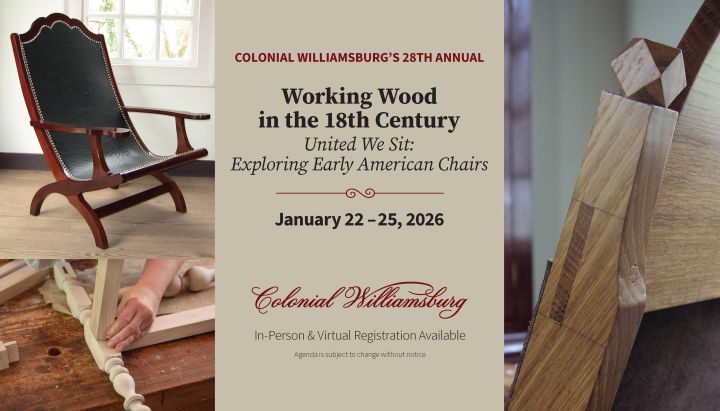
From the press release for the 2026 Working Wood in the 18th Century Conference:
Working Wood in the 18th Century Conference at Colonial Williamsburg
Online and in-person, Williamsburg, Virginia 22–25 January 2026
The Colonial Williamsburg Foundation will host its annual Working Wood in the 18th Century Conference January 22–25, 2026. Offered both virtually and in-person, this year’s conference, United We Sit: Exploring Early American Chairs, will center around six different chairs that spotlight a multitude of topics and techniques drawn from early America’s rich woodworking traditions. A limited number of in-person and virtual attendance scholarships are available to students and emerging professionals in relevant positions or programs.
Conference highlights include a presentation by esteemed chairmakers Elia Bizzarri and Curtis Buchanan on Windsor chairmaking techniques with a focus on hand-powered production rates and Elia’s research into early 19th-century Massachusetts chairmaker Samuel Wing. Celebrated cabinetmaker and carver Ray Journigan will demystify and recreate one of pre-Revolutionary Philadelphia’s rococo masterpieces, a heavily carved side chair made in Benjamin Randolph’s shop for the Cadwallader family. Historical interpreter and woodworker Jerome Bias will take us into the antebellum world of Thomas Day’s North Carolina shop where complex race relations intertwine with the collision of the handwork tradition and the coming machine age as he explores a curvaceous and veneered mahogany side chair. Scholar Daniel Ackermann, director of Bayou Bend Collection and Gardens, will deliver an opening keynote on a group of mid-18th-century Annapolis chairs.
From Colonial Williamsburg, master cabinetmaker Bill Pavlak will demonstrate the design and structure of Campeche chairs, a form with ancient roots that became fashionable on the east coast in the early 19th century by way of Mexico, New Orleans, and Thomas Jefferson’s Monticello. Master joiner Brian Weldy will explore a Boston baroque armchair with complex turnings, sculpted arms, and Russia leather upholstery. Conservator of upholstery Sarah Towers will walk attendees through the fundamentals of making a traditional slip seat. Apprentice joiner Laura Hollowood will demonstrate weaving a rush seat with traditional materials and senior curator of furniture Tara Chicirda will provide an overview of different period approaches to seats by showing off several examples from the Colonial Williamsburg collection. Journeyman cabinetmaker John Peeler will explore some of the planes and planecraft required for period chairmaking. Director of Historic Trades and Skills Ted Boscana will offer a banquet talk that pulls back the curtain on nine decades of Trades at Colonial Williamsburg to glimpse where we’ve been and where we’re headed.
The majority of conference activities will take place at the Art Museums of Colonial Williamsburg, located at 301 South Nassau Street. A variety of exclusive pre-conference activities are available for in-person registrants, as are special room rates at Colonial Williamsburg hotel properties. In-person registration is $400 per person through December 1 and includes presentations, opening reception, continental breakfasts on Friday, Saturday and Sunday, coffee and refreshment breaks, and a conference reception and dinner Saturday evening. Virtual-only registration is $150 per person and includes access to all presentations through the conference streaming platform. Both in-person and virtual-only registration include a seven-day ticket voucher to Colonial Williamsburg’s Art Museums and Historic Area, valid for redemption through December 31, 2026. Registration and payment in full are required by January 2 for in-person attendance and by January 22 for virtual attendance.
Details are available here»
Working Wood is sponsored by the Society of American Period Furniture Makers, Early American Industries Association, and Lie-Nielsen Toolworks, Inc.
Conference | Mapping Fashion Savoir Faire, 16th–21st Centuries
From the conference website:
Mapping Fashion Savoir Faire: Craft, Space, and Scale, 16th–21st Centuries
Paris, 11–13 December 2025
Organized by Ariane Fennetaux and Emilie Hammen
A typically French and even somewhat untranslatable expression, the notion of ‘savoir-faire’ in France seems to refer to the traditional sets of specialist technical skills and know-how underpinning the fashion trades. This narrative however is predicated upon what is commonly understood as ‘the fashion system’, itself a cultural, social and economic construction invented in the nineteenth and twentieth centuries often in relation to the great Parisian fashion houses.
The notion of space invites us to recalibrate our gaze and ask new questions about fashion, its actors, its sites and its dynamics—in space and time. Looking beyond the twentieth century, and beyond the European-centric prism that often dominates thinking about fashion and dress, the conference aims to question the traditional vision of fashion as a Western invention. By looking at clothing practices, textile crafts and the materials and resources specific to other regions of the world, the conference borrows from global history and examines the links and spatial dynamics between various centres and peripheries.
t h u r s d a y , 1 1 d e c e m b e r
Institut Français de la Mode, Auditorium
9.00 Registration and coffee
9.30 Keynote
• Mei Mei Rado (Bard Graduate Center), Cross-cultural Savoir-faire and Remaking: Transformations of Chinese Skirts into Western Fashion
10.30 Tea and coffee break
10.45 Colonial and Post Colonial Crafts
• Pierre Jean Desemerie (Bard Graduate Center/ Musée des Arts Décoratifs), ‘Moderniser’ la Chebka (dentelle algérienne) en période coloniale
• Pragya Sharma (University of Brighton), ‘Everyone will praise you’: Fashioning the Knitted Self in 20th-Century India
11.45 Lunch break
13.00 Interlocking Networks and Scales
• Miriam Fleck-Vidal (McGill University), French Silk, Global Networks: Negotiating National Identity through Silk Production in Early Modern France
• Tristan Dot (Universitéy of Cambridge), 19th-Century Textile Design Studios as Nodes of Visual Circulation
• Victoria De Lorenzo (London College of Fashion, University of London), Crafting a Culturally-Situated Demand: A Microhistory of Market Sub-Segmentation in Chile and Peru, 1845–1855
14.30 Tea and coffee break
14.45 Transnational Circulations
• Kirsty Hassard (V&A, Dundee), Tartan: Mapping Craft, Space, and Scale in Scotland and Beyond
• Antonia Behan (Queen’s University), The Texture of Nationalism and Transnational Handweaving Revival
• Elena Kanagy Loux (Bard Graduate Center), Interlacing the Globe: Mapping the Magdalena Nuttall Lace Collection
16.15 Tea and coffee break
16.30 Workshop #1
19.00 Opening of the Savoir Faire exhibition at the Galliera Museum (for conference speakers only)
f r i d a y , 1 2 d e c e m b e r
Institut Français de la Mode, Auditorium
8.45 Coffee
9.00 Keynote
• Ulinka Rublack (Cambridge University), The Triumph of Fashion
10.15 Coffee break
10.30 Resources and Techniques: From Local to Global
• Marie Colas des Francs (EPHE), Le voyage des plumes: Provenance des matériaux et des techniques de la plumasserie parisienne autour de 1600
• Jean-Alexandre Perras (IZEA, Martin-Luther Universität, Halle-Wittenberg), Technial Expertise in 18th-Century Women’s Hairstyling: The Case of Rouen
11.30 Tea and coffee break
11.45 Colonial Couture
• Khemais Ben Lakhdar (Université Paris I-Panthéon Sorbonne), Une jubla parsie devenue dernier cri de la mode à Paris: Itinéraire d’une tunique brodée entre la Chine, l’Inde et la maison Paul Poiret dans un contexte colonial
• Tokiko Sumida (Université Toulouse Jean Jaurès), L’art du Savoir-Faire du Kimono et la Résistance Spatiale: Du japonisme aux Innovations Contemporaines en France
• Chiara Faggella (The Daniel and Gayle D’Aniello Syracuse University Program in Florence), Beyond the Tourist Gaze: Colonial Legacies and Spatial Entanglements in the Making of Italian Fashion
13.15 Lunch break
14.30 Géographies du réemploi / The Geographies of Reuse
• Miki Sugiura (Hosei University, Tokyo – University of Antwerp), Mapping Savoir-Faire in the Circulation of Second-Hand Kimono in Early Modern Japan
• Estelle Dupuis (Paris I Panthéon Sorbonne- IFM), Vraie et fausse usure dans la mode: Circulations esthétiques paradoxales à l’heure de la crise environnementale
15.30 Tea and coffee break
16.00 Workshop #2
20.00 Conference Dinner – Le Bougainville
s a t u r d a y , 1 3 d e c e m b e r
INHA, Galerie Colbert, salle Vasari
9.30 Keynote
• Malick N’Diaye (Cheik Antia Diop/ IFAN, Dakar), Le Musée sur le fil
10.30 Coffee Break
10.45 Museums and Decentered Narratives
• Pierre-Antoine Vettorello (Antwerp Research Institute for the Arts), Decentering the Fashion Museum: Colonial Legacies and Indigenous Voices in French Fashion History
• Chiara Tuani (École du Louvre), Tositea Moala Hoatau Broutin et le Tapa: Transmission des Savoir-Faire d’Uvéa et de Futuna en Nouvelle-Calédonie
12.15 Workshop #3










 Enfilade
leave a comment