New Book | Stourhead: Henry Hoare’s Paradise Revisited
Published by Head of Zeus and distributed by IPG:
Dudley Dodd with an introduction by James Stourton and photographs by Marianne Majerus, Stourhead: Henry Hoare’s Paradise Revisited (London: Apollo, 2021), 320 pages, ISBN: 978-1788543620, £40 / $65.
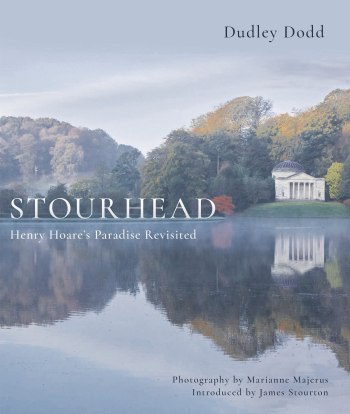 An illustrated history of the landscape garden at Stourhead, created by generations of the Hoare banking dynasty.
Cross the south lawn at Stourhead and enter the leafy embrace of the Shades. Descend through the ancient and rare trees, and as the ground falls away a great lake appears. It is punctuated with classical temples, and a great arched bridge lunges to the other side of the water. Continue on and you will find a mystical, jagged grotto; a gothic hideaway; gods, muses and saints. This is how Henry Hoare—known as Henry the Magnificent—would have approached the garden he designed with Henry Flitcroft. It truly is an English arcadia. Perhaps he imagined himself as a journeying Aeneas, or wished to recreate a Claude Lorrain landscape? This is the history of a unique landscape, created in a misty Wiltshire valley by generations of the Hoare banking family. It follows its evolution, describing how flights of folly, individual flair and tastes, combined with careful stewardship, have formed a national treasure and one of the finest examples of the English landscape garden.
Dudley Dodd had a long career with the National Trust, where he was Secretary of the Arts Panel, and has published widely on Stourhead, whose first modern guidebook he wrote in 1981, as well as guidebooks to several other National Trust houses. He is co-author of Roman Splendour, English Arcadia: The Pope’s Cabinet at Stourhead.
The Met Acquires an Early Work by the Marquise de Grollier
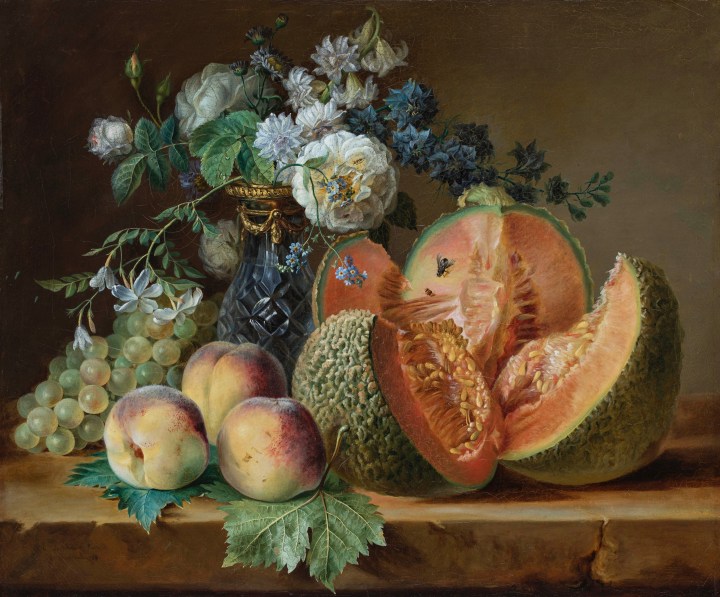
Charlotte Eustache Sophie de Faligny Damas, marquise de Grollier, Still Life with a Vase of Flowers, Melon, Peaches, and Grapes, 1780, oil on canvas, 46 × 56 cm (New York: The Metropolitan Museum of Art, Purchase, Friends of European Paintings Gifts, 2022.264).
◊ ◊ ◊ ◊ ◊
The Metropolitan Museum of Art recently acquired an early still life by the marquise de Grollier, a French painter largely ignored in the history of art, though Antonio Canova described her as “the Raphael of flower painting.” The object webpage went live on Friday, with a catalogue entry by David Pullins.
Charlotte Eustache Sophie de Faligny Damas, the marquise de Grollier (1741–1828), “painted flowers with great superiority,” in the words of her artist-friend Elisabeth Louise Vigée Le Brun. However, Grollier’s aristocratic status prevented her from painting professionally or from exhibiting her work to any extent. Still Life with a Vase of Flowers, Melon, Peaches, and Grapes from 1780 is one of the artist’s earliest dated works, and shows how Grollier worked through a number of technical challenges as she mastered the still life genre. The acquisition is part of The Met’s goal of expanding the narratives told in its European Paintings galleries. It will be displayed in late 2023, when the galleries are fully reinstalled upon the completion of the Skylights Project.
More information about the painting is available here»
Call for Applications | Decorative Arts Curatorial Internship Grants
Decorative Arts Curatorial Internship Grants, starting 2023
Institutional applications due by 30 September 2022
The Decorative Arts Trust underwrites curatorial internships for recent Masters or PhD graduates in partnership with museums and historical societies. These internships allow host organizations to hire a deserving young professional who will learn about the responsibilities and duties common to the curatorial field while working alongside a talented mentor.
The Trust’s internship program seeks to provide mutually beneficial opportunities that will nurture the next generation of museum curators while providing essential staffing for the host. The Trust encourages projects that advance diversity in the study of American decorative arts and will have a defined impact on the professional development of emerging scholars. Preference is given to those internships that provide opportunities for interns to make consequential contributions to exhibitions, publications, public programs, and community outreach. Read about the impact of the internship experience here.
We currently offer two 24-month internships with one grant cycle opening per year. For this cycle, the Trust is offering a two-year grant with $40,000 available per year for the intern’s salary. The Trust requires the host organization to allocate funds for the intern’s health insurance and other available benefits. The host organization need not be in the United States, nor does the intern need to be a United States citizen.
More information is available here»
New Book | Ceremonial Splendor
From U of Penn Press:
Joy Palacios, Ceremonial Splendor: Performing Priesthood in Early Modern France (Philadelphia: University of Pennsylvania Press, 2022), 288 pages, ISBN: 978-1512822786, $55.
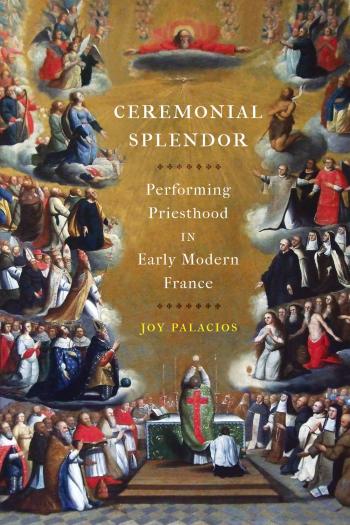 By the end of France’s long seventeenth century, the seminary-trained, reform-minded Catholic priest had crystalized into a type recognizable by his clothing, gestures, and ceremonial skill. Although critics denounced these priests as hypocrites or models for Molière’s Tartuffe, seminaries associated the features of this priestly identity with the idea of the vray ecclésiastique, or true churchman.
Ceremonial Splendor examines the way France’s early seminaries promoted the emergence and construction of the true churchman as a mode of embodiment and ecclesiastical ideal between approximately 1630 and 1730. Based on an analysis of sources that regulated priestly training in France, such as seminary rules and manuals, liturgical handbooks, ecclesiastical pamphlets and conferences, and episcopal edicts, the book uses theories of performance to reconstruct the way clergymen learned to conduct liturgical ceremonies, abide by clerical norms, and aspire to perfection.
Joy Palacios shows how the process of crafting a priestly identity involved a wide range of performances, including improvisation, role-playing, and the display of skills. In isolation, any one of these performance obligations, if executed in a way that drew attention to the self, could undermine a clergyman’s priestly persona and threaten the institution of the priesthood more broadly. Seminaries counteracted the ever-present threat of theatricality by ceremonializing the clergyman’s daily life, rendering his body and gestures contiguous with the mass. Through its focus on priestly identity, Ceremonial Splendor reconsiders the relationship between Church and theater in early modern France and uncovers ritual strategies that continue to shape religious authority today.
Joy Palacios is an Assistant Professor of Religious Studies in the Department of Classics and Religion at the University of Calgary.
New Resource | Russian Books of the 18th Century

Атлас российской, состоящей из девятнадцати специальных карт представляющих Всероссийскую империю… / Atlas rossiiskoi, sostoiashchei iz deviatnadtsati spetsial’nykh kart predstavliaiushchikh Vserossiiskuiu imperiiu… / (Atlas of Russia, consisting of nineteen special maps representing the All-Russian Empire), 1745. Link»
◊ ◊ ◊ ◊ ◊
Thanks to Margaret Samu for noting this new digital collection. The examples of particular titles are her selections, underscoring the range of books included. –CH
As noted several days ago at H-SHERA (Society of Historians of Eastern European, Eurasian, and Russian Art and Architecture). . .
The Slavic Reference Service at the University of Illinois has just announced the publication of a new digital collection: Russian Books of the 18th Century, which is now freely available on Internet Archive.
This collection is an ongoing project to make all of the books listed in Svodnyi katalog russkoi knigi grazhdanskoi pechati XVIII veka digitally available. It is designed to be used in tandem with the catalog: each item is cross-referenced with its entry number and transliterated title for easy access. We hope this will be a more convenient option for finding 18th-century Russian books than its microform predecessor. There are currently over 400 items uploaded, with our eventual goal being to have the full contents of the catalog online. Digitized books have been curated from the Russian National Electronic Library (RusNEB).
From the Internet Archive. . .
Russian Books of the 18th Century is a newly available collection of books printed in Russia from 1725 to 1801 based on the Union Catalogue of Russian 18th-Century Civil Typeface Books (Svodnyi katalog russkoi knigi grazhdanskoi pechati XVIII veka). Most titles were curated from the impressive digitization project, Natsional’naia Elektronnaia Biblioteka, operated by the Russian State Library in Moscow. This collection is curated by the Slavic Reference Service (SRS) at the University of Illinois Urbana-Champaign and is open to all researchers. Items are cross-referenced with Svodnyi katalog entry numbers and ALA-romanized titles. Descriptions contain a truncated version of the item’s listing in Svodnyi katalog. Users can use the ‘Search this collection’ function to search by entry number, title, and author in Latin or Cyrillic letters.
The ‘civil type’ refers to the new, simplified typeface introduced by Peter the Great in 1708, intended for secular publications, replacing the earlier Church Slavonic. Some titles are original Russian works, others are texts translated from European languages, while still others appear in bilingual editions, such as this Allegorical Imagery of Fireworks in Honor of Her Imperial Highness Elizaveta Petrovna in Russian and German.
Other notable books:
• The Life and Deeds of Marcus Aurelius (1740), link»
• A 1745 atlas with maps, link»
• The Adventures of Chevalier de ***. A True Story, by Jean-Baptiste de Boyer, marquis d’Argens (1772), link»
• Theoretical and Practical Arithmetics, by D. S. Anichkov (1775), link»
New Book | Against the Map
From UVA Press:
Adam Sills, Against the Map: The Politics of Geography in Eighteenth-Century Britain (Charlottesville: University of Virginia Press, 2021), 318 pages, ISBN: 978-0813945989 (hardback), $115 / ISBN: 978-0813946009 (ebook), $35 / ISBN: 978-0813945996 (paperback), $45.
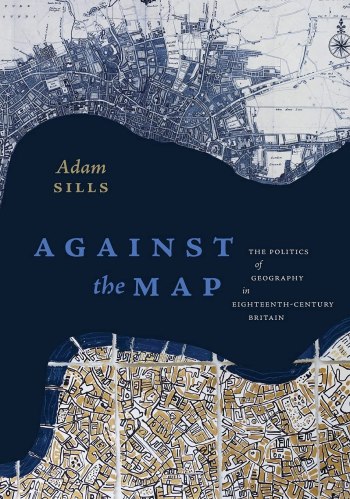 Over the course of the seventeenth and eighteenth centuries, the increasing accuracy and legibility of cartographic projections, the proliferation of empirically based chorographies, and the popular vogue for travel narratives served to order, package, and commodify space in a manner that was critical to the formation of a unified Britain. In tandem with such developments, however, a trenchant anti-cartographic skepticism also emerged. This critique of the map can be seen in many literary works of the period that satirize the efficacy and value of maps and highlight their ideological purposes. Against the Map argues that our understanding of the production of national space during this time must also account for these sites of resistance and opposition to hegemonic forms of geographical representation, such as the map.
This study utilizes the methodologies of critical geography, as well as literary criticism and theory, to detail the conflicted and often adversarial relationship between cartographic and literary representations of the nation and its geography. While examining atlases, almanacs, itineraries, and other materials, Adam Sills focuses particularly on the construction of heterotopias in the works of John Bunyan, Aphra Behn, Jonathan Swift, Daniel Defoe, Samuel Johnson, and Jane Austen. These ‘other’ spaces, such as neighborhood, home, and country, are not reducible to the map but have played an equally important role in the shaping of British national identity. Ultimately, Against the Map suggests that nation is forged not only in concert with the map but, just as important, against it.
Adam Sills is Associate Professor of English at Hofstra University.
New Book | Teachable Monuments
This week (11–12 August) marked the fifth anniversary of the white supremacist rally in Charlottesville. This collection of essays appeared in hardback in 2021; it’s due to be released in paperback this fall from Bloomsbury:
Sierra Rooney, Jennifer Wingate, and Harriet Senie, eds., Teachable Monuments: Using Public Art to Spark Dialogue and Confront Controversy (Bloomsbury Publishing, 2021), 296 pages, ISBN: 978-1501356940 (hardcover), $130 / ISBN: 979-8765100462 (paperback), $35.
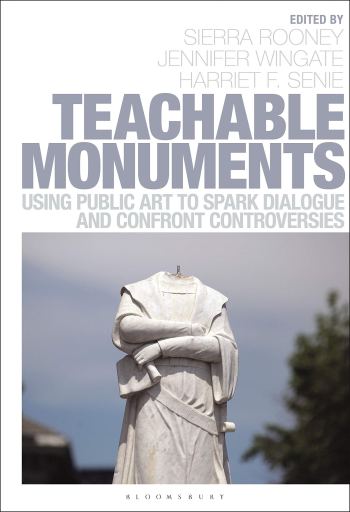 Monuments around the world have become the focus of intense and sustained discussions, activism, vandalism, and removal. Since the convulsive events of 2015 and 2017, during which white supremacists committed violence in the shadow of Confederate symbols, and the 2020 nationwide protests against racism and police brutality, protesters and politicians in the United States have removed Confederate monuments, as well as monuments to historical figures like Christopher Columbus and Dr. J. Marion Sims, questioning their legitimacy as present-day heroes that their place in the public sphere reinforces. The essays included in this anthology offer guidelines and case studies tailored for students and teachers to demonstrate how monuments can be used to deepen civic and historical engagement and social dialogue. Essays analyze specific controversies throughout North America with various outcomes as well as examples of monuments that convey outdated or unwelcome value systems without prompting debate.
Sierra Rooney is Assistant Professor of Art History at University of Wisconsin-La Crosse. She is the author of numerous articles on public monuments and controversy.
Jennifer Wingate is Professor of Fine Arts at St. Francis College. She was co-editor of Public Art Dialogue (2017–2020) and is the author of Sculpting Doughboys: Memory Gender, and Taste in America’s Worlds War I Memorials (2013). She has published on representations of the domestic display of FDR portraits, WWI memorials, and public art.
Harriet F. Senie is Professor Emerita of Art History at the City College of New York and the Graduate Center, The City University of New York. She is the author of Memorials to Shattered Myths: Vietnam to 9/11 (2015), The ‘Tilted Arc’ Controversy: Dangerous Precedent? (2001), and Contemporary Public Sculpture: Tradition, Transformation, and Controversy (1992). She has edited several anthologies on different aspects of public art.
C O N T E N T S
List of Illustrations
List of Contributors
Acknowledgements
Introduction: Why Monuments Matter — Sierra Rooney (University of Wisconsin-La Crosse) and Jennifer Wingate (St. Francis College)
Part I: Teaching Strategies
1 Developing Essential Questions for a Student-Driven 4th Grade Monument Study — Adelaide Wainwright (Oregon Episcopal School)
2 Encouraging Intervention: Project-Based Learning with Problematic Public Monuments — Mya Dosch (California State University-Sacramento)
3 Mapping Art on Campus — Annie Dell’Aria (Miami University)
4 Moving Beyond ‘Pale and Male’: A Museum Educator Approach to the Campus Portrait Debate — Jennifer Reynolds-Kaye (Yale Center for British Art)
5 ‘From Commemoration to Education’: Re-setting Context and Interpretation for a Confederate Memorial Statue on a University Campus — Sarah Sonner (Briscoe Center for American History, University of Texas-Austin)
6 Making Material Histories: Institutional Memory and Polyvocal Interpretation — Kailani Polzak (University of California-Santa Cruz)
Part II: Political Strategies
7 Dismantling the Confederate Landscape: The Case for a New Context — Sarah Beetham (Pennsylvania Academy of the Fine Arts)
8 Learning from Louisville: John Breckenridge Castleman, His Statue, and a Public Sphere Revisited — Chris Reitz (University of Louisville)
9 Addressing Monumental Controversies in New York City Post Charlottesville — Harriet Senie (City University of New York)
10 The Preservation Dilemma: Confronting Two Controversial Monuments in the United States Capitol — Michele Cohen (Architect of the Capitol)
11 Up Against The Wall: Commemorating and Framing the Vietnam War on the National Mall — Jennifer K. Favorite (City University of New York)
12 ‘I feel like I have hated Lincoln for 110 years’: Debates over the Lincoln Statue in Richmond, Virginia — Evie Terrono (Randolph-Macon College)
Part III: Engagement Strategies
13 Paper Monuments as Public Pedagogy — Sue Mobley (Colloqate Design)
14 Charging Bull and Fearless Girl: A Dialogue — Charlene G. Garfinkle (Independent Scholar)
15 The Afterlife of E Pluribus Unum — Laura Holzman (Indiana University–Purdue University Indianapolis), Modupe Labode (National Museum of American History), and Elizabeth Kryder-Reid (Indiana University–Purdue University Indianapolis)
16 Unforeseen Controversy: Reconciliation and Re-contextualization of Wartime Atrocities through ‘Comfort Women’ Memorials in the United States — Jung-Sil Lee (George Washington University and Maryland Institute College of Art)
17 Free History Lessons: Contextualizing Confederate Monuments in North Carolina — Matthew Champagne (North Carolina State University), Katie Schinabeck (North Carolina State University), and Sarah A. M. Soleim (North Carolina State University)
18 Future History: New Monumentality in Old Public Spaces, An interview with Artist Kenseth Armstead — Maria F. Carrascal (Artipica Creative Spaces, Spain)
Index
Esther Bell Appointed Deputy Director of the Clark
From the press release, via Art Daily (11 August 2022) . . .
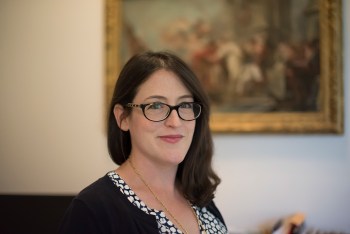 Esther Bell, who currently serves as the Robert and Martha Berman Lipp Chief Curator of the Clark Art Institute, in Williamstown, Massachusetts, has been promoted to Deputy Director. Bell retains her curatorial role and takes on added responsibilities in overseeing the work of the Clark library, supervising visitor services activities, and supporting Director’s Office initiatives.
“In the five years since she joined the Clark’s staff, Esther Bell has proven herself to be an exceptional leader and a trusted colleague, and she brings great ingenuity and creativity to all aspects of her work. I have every confidence that she will manage her additional duties with the same keen eye for detail and deep commitment to the Clark’s mission that has made her such an important part of our team,” said Olivier Meslay, Hardymon Director of the Clark.
Bell joined the Clark staff in 2017 and has since been deeply immersed in the Clark’s special exhibition program as well as managing all aspects of the care, growth, and development of the Clark’s permanent collection. Bell co-curated the 2019 exhibition Renoir: The Body, The Senses, with George T.M. Shackleford, deputy director of the Kimbell Art Museum, Fort Worth, Texas, and was heavily involved in all aspects of the Clark’s first outdoor exhibition, Ground/work, which opened in 2020. She is the co-curator of an upcoming exhibition featuring French drawings from the Bibliothèque nationale de France and is preparing a major monographic exhibition for 2024 on Guillaume Guillon-Lethière (1760–1832).
“I am honored to serve as the Clark’s Deputy Director and am deeply committed to collaborating closely with my colleagues across the Institute as we bring new projects and programs to the forefront. The Clark has many exciting plans ahead and I look forward to working with Olivier Meslay, and with the entire Clark team, as we continue the important mission of serving our communities,” said Bell.
In addition to overseeing the Clark’s curatorial staff, Bell supervises the Institute’s Departments of Education and Public Programs. She is also active in several senior management working groups and internal staff committees, including its Diversity, Equity, Inclusion, and Accessibility Advisory Group.
In 2020, Bell completed a fellowship at the Center for Curatorial Leadership in New York, a rigorous program designed to identify emerging arts leaders and provide them with the training necessary to prepare them for work in the rapidly evolving cultural climate of the twenty-first century. Bell holds a doctorate in the history of art from the Institute of Fine Arts, New York University, with a specialization in seventeenth- and eighteenth-century European art. She earned a master’s degree from the Williams College/Clark Graduate Program in the History of Art, and a bachelor’s degree in the history of art from the University of Virginia. She completed a Fulbright Fellowship at the Musée du Louvre in 2003 and has held numerous fellowships.
Before joining the Clark’s staff, Bell served as the curator in charge of European paintings at the Fine Arts Museums of San Francisco. Prior to that, she was the curator of European paintings, drawings, and sculpture at the Cincinnati Art Museum. Bell began her career in New York, serving as a research assistant and curatorial fellow at both the Metropolitan Museum of Art and the Morgan Museum and Library. In 2015, Apollo magazine named Bell as one of the top ten curators in North America under the age of forty.
New Book | Maria Sibylla Merian: Changing the Nature of Art and Science
Coming soon, with distribution by ACC Art Books:
Marieke van Delft, Kay Etheridge, Hans Mulder, Bert van de Roemer, and Florence Pieters, Maria Sibylla Merian: Changing the Nature of Art and Science (Tielt: Lannoo: 2022), 304 pages, ISBN: 978-9401485333, $70.
 The revolutionary artist and naturalist Maria Sibylla Merian (1647–1717) has come into the spotlight in recent years. The life and work of this German-born woman, who would later settle in the Netherlands, has been studied internationally by entomologists, botanists and historians and are a source of inspiration for contemporary artists and writers. In 2016, Lannoo Publishers, in collaboration with the Koninklijke Bibliotheek, republished her masterpiece Metamorphosis insectorum Surinamensium as a facsimile. This well-illustrated book assembles the most recent scientific knowledge about this remarkable woman. The authors examine, among other things, Merian’s pioneering work on the reproduction and development of insects, the methods and materials she used for her work, her remarkable journey to Suriname, her network of family, friends and patrons, and her widespread influence on the history of art and science. Her work is compared to that of early modern and contemporary artists and scientists
This book gathers essays by of 23 international experts, most of whom are connected to the international Maria Sibylla Merian Society. The editorial team consists of Marieke van Delft, Kay Etheridge, Hans Mulder, Bert van de Roemer, and Florence Pieters.
Online Talk | Kay Etheridge on Maria Sibylla Merian
Part of this fall’s offerings from Smithsonian Associates:
Kay Etheridge | Maria Sibylla Merian: A Biologist to the Bone
Online, Smithsonian Associates, Thursday, 17 November 2022, 6.45pm

Maria Sibylla Merian, Metamorphosis insectorum surinamensium (The Metamorphosis of the Insects of Suriname), plate 31 (Amsterdam, 1705).
The aesthetic appeal of the images created by Maria Sibylla Merian (1647–1717) has led history to label her as an artist who painted and etched natural history subjects. However, Merian was as passionate a naturalist (biologist in modern terms) as Charles Darwin or Carl Linnaeus, and like all scientists, she was impelled by her curiosity about nature. Merian was the first person to spend decades studying the relationships of insects and plants, and her work revolutionized what came to be the field of ecology. Kay Etheridge, professor emeritus of biology at Gettysburg College, draws on Merian’s own words to consider her motivations in the context of her time and place, and discusses Merian’s body of work in comparison to that of her near-contemporaries working in natural history. $20 (members) / $25 (nonmembers).










 Enfilade
leave a comment