Conference | English and Irish Crystal Drinking Glass, 1640–1702
From the V&A:
Celebrating the Birth of English and Irish Crystal Drinking Glass, 1640–1702
In-person and online, Victoria and Albert Museum, London, 6 October 2022
Organised by Colin Brain, Reino Liefkes, and Caroline McCaffrey-Howarth, with assistance from Simon Spier
2022 has been designated the International Year of Glass by the United Nations. This year also marks 125 years since the publication of Albert Harshorne’s Old English Glasses, the first serious study of the history of English and Irish glass. To celebrate, the V&A is presenting a conference Celebrating the Birth of English and Irish Crystal Drinking Glass, 1640–1702, in partnership with the Association for the History of Glass. This study day aims to explore the evolving story of the birth of these sophisticated products, a century before the ‘industrial revolution’ began.
The conference has been organised by Colin Brain (Association for the History of Glass), Reino Liefkes (V&A) and Dr Caroline McCaffrey-Howarth (University of Edinburgh), with assistance from Dr Simon Spier (V&A).
In-person tickets, through Eventbrite
Online tickets, through Eventbrite

Roemer drinking glass, attributed to George Ravenscroft, probably at the Savoy Glasshouse, London, ca. 1677 (London: V&A, C.530-1936).
P R O G R A M M E
10.00 Registration with Tea and Coffee
10.25 Welcome — Justine Bayley and Reino Liefke
10.30 Morning Session
• Colin Brain — ‘And of noe other sorts or fashions’: Fashionable Design in the Birth of English and Irish Crystal Drinking Glass
• Peter Francis — The Irish ‘Lead Glass Revolution’
• Jo Wheeler — Recipes for Lead-glass and Cristallo in Venetian and Florentine Sources and Their Influence on Antonio Neri
• Reino Liefkes — A New Type of Colourless Glass in Imitation of Rock Crystal: Crizzled Glass of the Late-Seventeenth Century
1.00 Lunch Break
2.15 Afternoon Session
• Oliver Gunning — New Perspectives on the Role of the Migrant in British Crystal Glass
• Antoine Giacometti — Seventeenth-Century Glass from the Dublin Castle Excavations, 1961–1987
• Inês Coutinho and Colin Brain — Science in the Service of History: Analysis of Early English and Irish Crystalline Glasses
• Iris Moon and Karen Stamm — Drinking Glass in the Met Museum’s British Galleries
5.10 Closing Remarks — Caroline McCaffrey-Howarth
New Book | The Marlborough Mound
From Boydell & Brewer:
Richard Barber, ed., The Marlborough Mound: Prehistoric Mound, Medieval Castle, Georgian Garden (London: Boydell Press, 2022), 224 pages, ISBN: 978-1783271863 (hardcover), £45 / $65 | ISBN: 978-1787446748 (ebook), £20 / $25.
 The Marlborough Mound has recently been recognised as one of the most important monuments in the group around Stonehenge. It was also a medieval castle and a feature in a major Georgian garden. This is the first comprehensive history of this extraordinary site.
Marlborough Mound, standing among the buildings of Marlborough College, has attracted little attention until recently. Records showed it to be the motte of a Norman castle, of which there were no visible remains. The local historians and archaeologists who investigated it found very little in the way of archaeological evidence beyond a few prehistoric antler picks, the odd Roman coin, and a scatter of medieval pottery. The most dramatic discovery came after the Mound Trust began to restore the mound in 2003. English Heritage was investigating Silbury Hill and arranged to take cores from the Mound for dating purposes. The results were remarkable, as they showed that the Mound was almost a twin of Silbury Hill and therefore belonged to the extraordinary assembly of prehistoric monuments centred on Stonehenge.
For the medieval period, this book brings together for the first time all that we know about the castle from the royal records and from chronicles. These show that it was for a time one of the major royal castles in the land. Most of the English kings from William I to Edward III spent time here. For Henry III and his queen Eleanor of Provence, it was their favourite castle after Windsor.
As to its final form as a garden mound next to the house of the dukes of Somerset, in the eighteenth century, this emerges from letters and even poems, and from the recent restoration. Much of this has been slow and painstaking work, however, involving the removal of the trees which endangered the structure of the Mound, the recutting of the spiral path and the careful replanting of the whole area with suitable vegetation. By doing this, the shape of the Mound as a garden feature has re-emerged, and can now be seen clearly.
This book marks the end of the first stage of the work of the Mound Trust, which, following the restoration, turns to its second objective of promoting public knowledge of the Mound based on scholarly research.
Richard Barber has had a huge influence on the study of medieval history and literature, as both a writer and a publisher. His first book on the Arthurian legend appeared in 1961, and his major works include The Knight and Chivalry (winner of the Somerset Maugham Award in 1971), Edward Prince of Wales and Aquitaine, The Penguin Guide to Medieval Europe, and The Holy Grail: the History of a Legend, which was widely praised and was translated into six languages.
C O N T E N T S
Preface — Barry Cunliffe
1 ‘One Remarkable Earthen-work’: The Neolithic Origins of the Marlborough Mound — Jim Leary and Joshua Pollard
2 Castles and the Landscape of Norman Wessex, c. 1066–1154 — Oliver Creighton
3 Marlborough Castle in the Middle Ages — Richard Barber
4 The Mound as a Garden Feature — Brian Dix
5 Epilogue: The Marlborough Mound Trust
Afterword: The Round Mound Project — Jim Leary, Elaine Jamieson, and Phil Stastney
Appendices
A Inquisition into the State of Marlborough Castle, 11 September 1327
B Castellum Merlebergae, by H.C. Brentnall, FSA
C Constables of Marlborough Castle
D Marlborough Castle: Archaeological Findings for the Medieval Period
Bibliography
Index
In Memoriam | Mark Girouard (1931–2022)
Yesterday’s posting noted the Colvin Prize Shortlist (as announced this week by The Society of Architectural Historians of Great Britain), which includes Mark Girouard’s A Biographical Dictionary of English Architecture, 1540–1640. I should have included notice of Girouard’s very recent passing. The following paragraphs come from the opening of Girouard’s obituary in The Guardian.
Otto Saumarez Smith, “Mark Girouard Obituary,” The Guardian (26 August 2022).
Architectural historian who wrote extensively on stately homes and campaigned to save the Georgian houses of Spitalfields
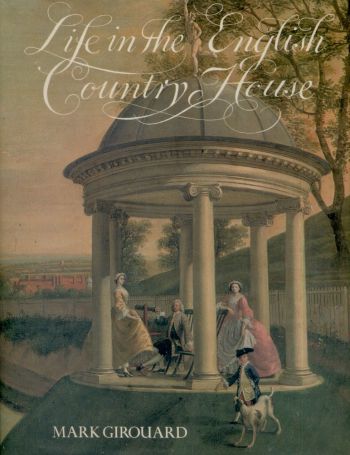 Mark Girouard, who has died aged 90, was Britain’s most readable architectural historian, a great authority on Elizabethan and Victorian architecture whose extensive writings used the study of buildings to illuminate the social life of the past. The publication of Life in the English Country House: A Social and Architectural History in 1978 captured the zeitgeist in a period when stately homes were being repurposed as sites of mass leisure. It sold more than 140,000 copies in hardback.
When Girouard started his career the study of architectural history in Britain was dominated by the German-trained Nikolaus Pevsner, for whom the discipline was essentially about tracking artistic styles through intense formal and spatial analysis. In contrast, Girouard’s books placed buildings within their cultural, social and intellectual milieu. The results were scholarly, but also immensely fun, gossipy and stylish.
Although he wrote a great deal about country houses, he found much of the fogeyish snobbery and nostalgia that often goes with the territory distasteful. Free of pomposity, puckish, self-effacing and urbane, he was much loved by all sorts of people for his kindness and sense of fun. Girouard took on a terrific range of subjects beyond country houses, writing with verve about Victorian Pubs (1975) and urban history in Cities and People: A Social and Architectural History (1985) and The English Town: A History of Urban Life (1990). . . .
The full obituary is available here»
Shortlists Announced for Hitchcock Medallion and Colvin Prize
From The Society of Architectural Historians of Great Britain (SAHGB) . . . with shout-out to HECAA member Basile Baudez!
The shortlists for two of the most important prizes in architectural history—the Alice Davis Hitchcock Medallion and the Colvin Prize—were announced this week. The Alice Davis Hitchcock Medallion is awarded to a monograph that makes an outstanding contribution to the study of architectural history—previous winners include Howard Colvin, Dorothy Stroud, John Summerson, Nikolaus Pevsner, Hermione Hobhouse, and Jill Lever. The Colvin Prize, established in 2017, is awarded to an outstanding work of reference of value to the discipline irrespective of format.
The two shortlists for the awards this year demonstrate a broad range of subjects and approaches to architectural history, ranging from a global atlas of queer spaces, forensic analysis of the urban and architectural fabric of Whitechapel, a fulsome biographical dictionary of early-modern architects in Britain, through to a compendious photographic recording of all the 437 Carnegie libraries that still remain in the UK, and much more.
The winners will be selected in the autumn and announced at the Society’s Annual Lecture and Awards Ceremony in December 2022.
The awards are overseen by the SAHGB to reward work that is innovative, ambitious, and rigorous in tackling histories of the built environment as broadly conceived. The SAHGB’s awards programme, which also includes the ‘Hawksmoor’ Essay Medal, Heritage Research Award, and Dissertation Prize, is open and inclusive wherever possible, celebrating diversity of approach and recognising work at all career levels.
◊ ◊ ◊ ◊ ◊
 Alice Davis Hitchcock Medallion Shortlist
• Basile Baudez, Inessential Colors: Architecture on Paper in Early Modern Europe (Princeton University Press)
• Manolo Guerci, London’s ‘Golden Mile’: The Great Houses of the Strand, 1550–1650 (Paul Mellon Centre for Studies in British Art)
• Jasmine Kilburn-Toppin, Crafting Identities: Artisan Culture in London, c. 1550–1640 (Manchester University Press)
• Nathaniel Walker, Victorian Visions of Suburban Utopia: Abandoning Babylon (Oxford University Press)
Colvin Prize Shortlist
• Adam Nathaniel Furman + Joshua Mardell, eds., Queer Spaces: An Atlas of LGBTQIA+ Places and Stories (RIBA Publishing)
• Mark Girouard, A Biographical Dictionary of English Architecture, 1540–1640 (Paul Mellon Centre for Studies in British Art)
• Oriel Prizeman, The Carnegie Libraries of Britain: A Photographic Chronicle (Arts and Humanities Research Council)
• Peter Guillery, ed., Survey of London, Whitechapel: Vols 54 + 55 (Paul Mellon Centre for Studies in British Art/Yale University Press)

Tessin Lecture | Melissa Hyde on Pink and Portraits
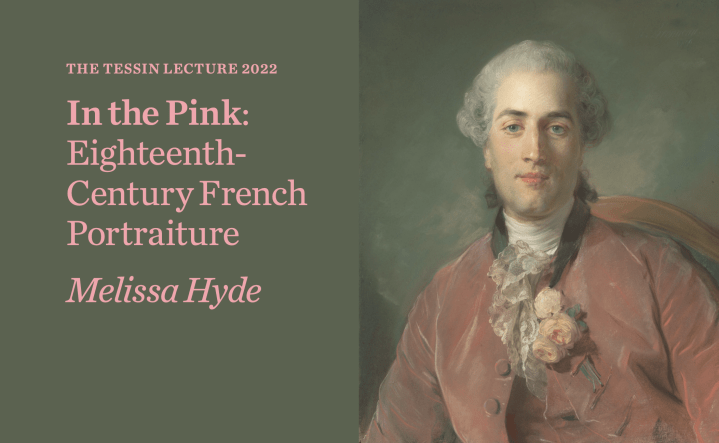
Jean-Baptiste Perronneau, Portrait of Olivier Journu, 1756, pastel on blue-gray laid paper, laid down on canvas, 58 × 47 cm
(New York: Metropolitan Museum of Art, 2003.26)
◊ ◊ ◊ ◊ ◊
This conference marks the 200th anniversary of the establishment of Sweden’s national portrait gallery at Gripsholm. Melissa Hyde will deliver this year’s Tessin lecture as the keynote address on Thursday, 15 September. The full conference schedule is available here.
Statens porträttsamling 200 år / The State Portrait Collection: 200 Years
Nationalmuseum, Stockholm and Gripsholm Castle, Mariefred, 15–16 September 2022
Melissa Hyde, In the Pink: Eighteenth-Century French Portraiture
Though never as ubiquitous in the eighteenth century as the colour blue, pink became the colour par excellence of the French Rococo. The colour was intimately associated with the so-called ‘Godmother of the Rococo’, Madame de Pompadour, the famous mistress of Louis XV. But even before Pompadour, pink was a hue much favored amongst elites in France, where it attained an unprecedented level of visibility in the visual and decorative arts and in the fashions worn by women, children, and men. This talk will demonstrate why, in the eighteenth-century, to wear pink was to make a statement—a statement made all the more emphatic and enduring when memorialized in portraiture; and one in which gender, class and/or race played a fundamental role. These matters concerning portraiture ‘in the pink’ will be addressed by way of some very basic, but actually quite complicated, questions: what did pink mean in the eighteenth century? What colors were comprehended by ‘pink’? Who did or didn’t embrace this color and why? In light of the complexities and nuances of pink, what might it have meant for a racially ‘white’ Frenchman to wear this notionally feminine colour (or to have himself depicted wearing it)?
Melissa Hyde is Professor and Distinguished Teaching Scholar at the University of Florida. Her scholarly interests include: women artists, and more broadly, the gendering of aesthetic culture, the cultural meanings of color, the history of the Salon and art criticism, self-portraiture, and questions of identity and place. She teaches courses on European art (c. 1650–1830), as well as courses on gender and the visual arts from the late Renaissance to the early nineteenth century. Professor Hyde’s research and publications focus on gender and visual culture in eighteenth- century France. Her work has appeared in The Art Bulletin, Eighteenth-Century Studies, Studies in Eighteenth-Century Culture, and numerous edited volumes. Key publications include Making Up the Rococo: François Boucher and His Critics (2006), Becoming a Woman in the Age of Enlightenment (catalogue for an exhibition she co-curated in 2017), and numerous book chapters and articles. She is author of two recent essays on the contemporary pastel artist, Nicolas Party. She is currently completing a book project entitled, Painted by Herself: Marie-Suzanne Giroust: Madame Roslin, the Forgotten Académicienne.
The Tessin Lecture
Once a year the Nationalmuseum, Stockholm invites a prominent international scholar to give a lecture in art history. The lecture, which is public, is a way to pay tribute to an exceptional scholar in art history and emphasize the museum’s commitment to research.
Exhibition | Eighteenth-Century Pastels
From the press release (1 August) for the exhibition:
Eighteenth-Century Pastels
Getty Museum, Los Angeles, 30 August 2022 — 26 February 2023
Curated by Emily Beeny and Ellie Bernick, with Julian Brooks

Pietro Antonio Rotari, Young Woman with a Fan, early 1750s, pastel on blue-green paper, mounted on canvas, 18 × 15 inches (Los Angeles: Getty Museum, 2019.111).
Exhibition highlights the Pan-European popularity of pastels with recently acquired works and loans from the Mauritshuis museum.
The J. Paul Getty Museum presents Eighteenth-Century Pastels, an exhibition that explores the popularity of pastels across eighteenth-century Europe and showcases their striking physical properties. Presenting works from the Getty Museum collection along with four loans, the exhibition is on view at the Getty Center from 30 August 2022 to 26 February 2023.
By the mid-eighteenth century, pastels reached an unprecedented peak of popularity and acclaim. The dry, satiny pigments, manufactured in sticks of every hue, were portable and allowed for swift execution—allowing artists to essentially ‘draw’ a painting.
“Working with pastels differs greatly from painting with oils, which require cumbersome equipment, long sittings, and extensive drying times,” says Emily Beeny, curator of European paintings at the Fine Arts Museums of San Francisco and former associate curator of drawings at the Getty Museum. “Their relative ease and portability made pastels an especially desirable medium for traveling artists seeking to expand their portfolio with portraits.”
Pastelists were often very mobile, traveling far and wide in search of commissions. The artists and sitters represented in Eighteenth-Century Pastels hail from Austria, England, France, Germany, Italy, Switzerland, and the Netherlands—a testament to the Pan-European nature of the pastel phenomenon. The exhibition highlights works from the Getty Museum collection by Jean-Étienne Liotard, John Russell, and Rosalba Carriera, among others. The show also includes recently acquired works by Adélaïde Labille-Guiard and Pietro Antonio Rotari, as well as seldom-seen works by Cornelis Troost on long-term loan from the Mauritshuis in the Netherlands.
With standout pieces like Rotari’s Young Woman with a Fan and Liotard’s Portrait of Maria Frederike van Reede-Athlone at Seven Years of Age, the pastels in this exhibition will entrance audiences with their rich hues and ethereal quality.
“Featuring works by many of the most talented pastel portraitists of the age, this exhibition is a sumptuous feast for the eyes,” says Ellie Bernick, graduate intern at the Getty Museum and co-curator of the exhibition. “Plus, the exhibition features several works by female pastelists like Adélaïde Labille-Guiard, Rosalba Carriera, and Mary Hoare, exemplifying the important role the medium played in bringing women artists into the profession.”
Eighteenth-Century Pastels is curated by Emily Beeny, curator of European paintings at the Fine Arts Museums of San Francisco and former associate curator of drawings at the Getty Museum, and Ellie Bernick, graduate intern at the Getty Museum, with the assistance of Julian Brooks, senior curator of drawings at the Getty Museum.
Exhibition | (Re)Inventing the Americas
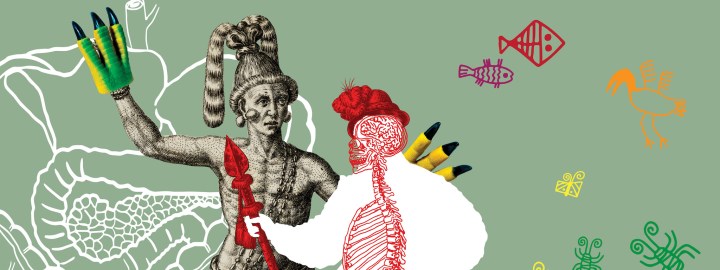
Denilson Baniwa, The Celebration of the Lizard (detail), Spirit Animals (detail), 2022, digital intervention on Columnam à Praefecto prima navigation locatam venerantur Floridenses (Column in Honor of the First Voyage to Florida) (detail), from Jacques de Morgues Le Moyne (French, ca. 1533–before 1588), Brevis narratio eorum quae in Florida Americæ provincia Gallis acciderunt (Frankfurt, 1591), pl. 8 (Getty Research Institute, 87-B24110). Courtesy the artist. Design © 2022 J. Paul Getty Trust.
◊ ◊ ◊ ◊ ◊
From the press release (via Art Daily) for the exhibition:
(Re)Inventing the Americas: Construct. Erase. Repeat.
Getty Center, Los Angeles, 23 August 2022 — 8 January 2023
Curated by Idurre Alonso with Denilson Baniwa
America is a European invention. Between 1492 and the late 1800s, European conquistadors, travelers, and artists produced prints, books, and objects that illustrated the natural resources and Native peoples of the Americas, often constructing fantastic and fictional ideas. Mixing reality with their own conventions and interpretations, they created portable and reproducible images that circulated around the world, fueling the spread of stereotypes and prejudices. (Re)Inventing the Americas: Construct. Erase. Repeat., on view from 23 August 2022 until 8 January 2023, analyzes the creation of the mythologies that arose during the conquest and exploration of the continents and reveals the influence that those myths and utopian visions have had on defining the Americas.
“This exhibition reframes the colonial and 19th-century materials in the Getty Research Institute collections, challenging European representations of the American continents,” says Mary Miller, director of the Getty Research institute. “It proposes that the Americas were reinvented utilizing European conventions and imaginaries.”
Re)Inventing the Americas is divided into five thematic sections. The first one examines the allegorical construction of America and the sources and evolution of these images. The second section explores the natural wealth of the Americas, while highlighting the exploitation of those resources. The third part looks at the construction of archetypes by analyzing recurring topics, such as the depiction of local people with feathers and hammocks and the portrayal of idolatry and cannibalism. The fourth section is devoted to images of the conquest, emphasizing the political overtones of certain narratives. The final section looks at the work of European travelers, stressing the differences and commonalities with previous constructions.
The exhibition features a collaboration with Denilson Baniwa, a contemporary artist from the Brazilian Amazon region who will generate different artistic interventions throughout the show. Baniwa’s work prompts us to critically reevaluate the materials from the past to help us navigate the colonial traumas, generating new reinventions of the Americas. Additionally, commentary on exhibition objects by Latinx and Indigenous members of the Los Angeles community gives a multi-perspectival approach to the pieces.
“Our collections illustrate the construction of an image of the Americas based on the European perspective,” says Idurre Alonso, curator at the Getty Research Institute. “Thus, it was important to me to analyze and counter that European view by introducing a multilayered presentation of the exhibition objects. To do that, I collaborated with Denilson Baniwa and our local Latin American and Latinx community. Their voices became part of the narrative of the show, challenging the persistence of certain notions. The outcome of these collaborations is a multifaceted exhibition that showcases the complex reinventions of the Americas from the Colonial time to today.”
Denilson Baniwa (born 18 April 1984) is an Indigenous artist who was born in the village of Darí, in Rio Negro, Amazonas, in the tri-border area between Brazil, Colombia and Venezuela. His artistic practice includes graphic design, drawings, performances, and urban interventions. His oeuvre seeks points of intersection between Indigenous culture and the contemporary art world. Through his art he questions the colonial past and stereotypical representations of Indigenous people, often layering components from colonial and nineteenth-century art with elements from his own cultural traditions. Some of the themes he approaches include the relationships of Indigenous peoples and technology as well as the harmful effects of agri-business for Native peoples.
Esta exhibición se presenta en inglés y en español.
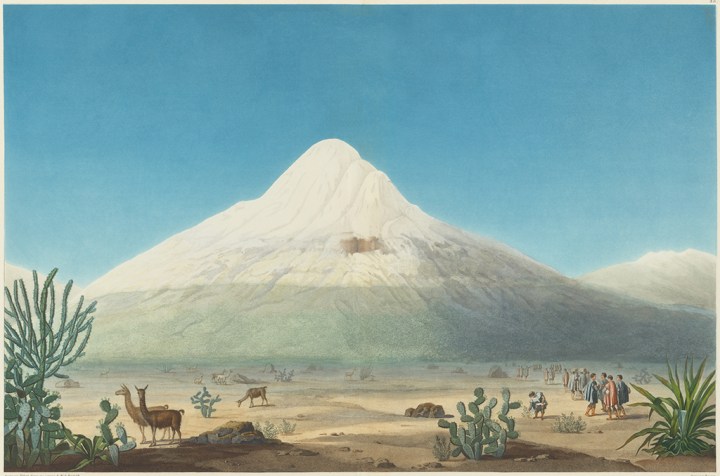
Louis Bouquet, Chimborazo Seen from the Plain of Tapia, engraving from Alexander von Humboldt, Vues des Cordillères, et monumens des peuples indigènes de l’Amérique (Paris, 1810), between pp. 200 and 201 (Getty Research Institute, 85-B1535).
Statue of Elizabeth Freeman Unveiled in Massachusetts
On Sunday (21 August) a statue of Elizabeth Freeman (ca.1744–1829) was unveiled in Sheffield, Massachusetts, as reported by the Associated Press:
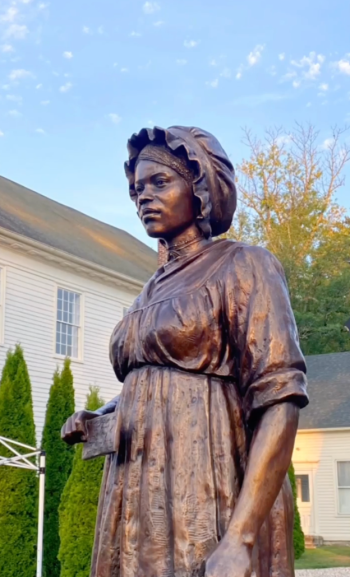
Brian Hanlon, Elizabeth Freeman, 2022 (Photo from the artist’s Instagram, hanlonstudio1). As noted by @PhyllisASears at Herstorical Monuments, there is also a sculpture of Freeman at the National Museum of African American History and Culture in Washington, DC.
The story of an enslaved woman who went to court to win her freedom [in 1781] more than 80 years before the Emancipation Proclamation had been pushed to the fringes of history.
A group of civic leaders, activists, and historians hope that ended Sunday in the quiet Massachusetts town of Sheffield with the unveiling of a bronze statue of the woman who chose the name Elizabeth Freeman, also when she shed the chains of slavery 241 years ago to the day.
Her story, while remarkable, remains relatively obscure. . . .
The enslaved woman, known as Bett, could not read or write, but she listened. And what she heard did not make sense.
While she toiled in bondage in the household of Col. John Ashley, he and other prominent citizens of Sheffield met to discuss their grievances about British tyranny. In 1773, they wrote in what are known as the Sheffield Resolves that “Mankind in a state of nature are equal, free, and independent of each other.”
Those words were echoed in Article 1 of the Massachusetts Constitution in 1780, which begins “All men are born free and equal, and have certain natural, essential, and unalienable rights.”
It is believed that Bett, after hearing a public reading of the constitution, walked roughly 5 miles from the Ashley household to the home of attorney Theodore Sedgwick, one of the citizens who drafted the Sheffield Resolves, and asked him to represent her in her legal quest for freedom, said Paul O’Brien, president of the Sheffield Historical Society.
Sedgwick and another attorney, Tapping Reeve, took the case. Women had limited legal rights in Massachusetts courts at the time, so a male slave in the Ashley household named Brom was added to the case. The jury agreed with the attorneys, freeing Bett and Brom on August 21, 1781. . . .
The full article is available here»
New Book | Stourhead: Henry Hoare’s Paradise Revisited
Published by Head of Zeus and distributed by IPG:
Dudley Dodd with an introduction by James Stourton and photographs by Marianne Majerus, Stourhead: Henry Hoare’s Paradise Revisited (London: Apollo, 2021), 320 pages, ISBN: 978-1788543620, £40 / $65.
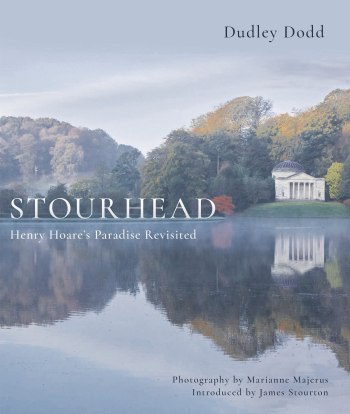 An illustrated history of the landscape garden at Stourhead, created by generations of the Hoare banking dynasty.
Cross the south lawn at Stourhead and enter the leafy embrace of the Shades. Descend through the ancient and rare trees, and as the ground falls away a great lake appears. It is punctuated with classical temples, and a great arched bridge lunges to the other side of the water. Continue on and you will find a mystical, jagged grotto; a gothic hideaway; gods, muses and saints. This is how Henry Hoare—known as Henry the Magnificent—would have approached the garden he designed with Henry Flitcroft. It truly is an English arcadia. Perhaps he imagined himself as a journeying Aeneas, or wished to recreate a Claude Lorrain landscape? This is the history of a unique landscape, created in a misty Wiltshire valley by generations of the Hoare banking family. It follows its evolution, describing how flights of folly, individual flair and tastes, combined with careful stewardship, have formed a national treasure and one of the finest examples of the English landscape garden.
Dudley Dodd had a long career with the National Trust, where he was Secretary of the Arts Panel, and has published widely on Stourhead, whose first modern guidebook he wrote in 1981, as well as guidebooks to several other National Trust houses. He is co-author of Roman Splendour, English Arcadia: The Pope’s Cabinet at Stourhead.
The Met Acquires an Early Work by the Marquise de Grollier
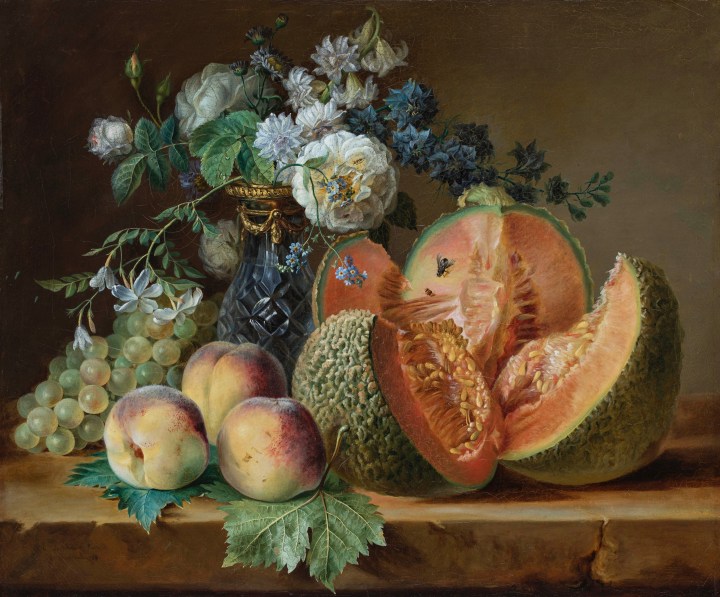
Charlotte Eustache Sophie de Faligny Damas, marquise de Grollier, Still Life with a Vase of Flowers, Melon, Peaches, and Grapes, 1780, oil on canvas, 46 × 56 cm (New York: The Metropolitan Museum of Art, Purchase, Friends of European Paintings Gifts, 2022.264).
◊ ◊ ◊ ◊ ◊
The Metropolitan Museum of Art recently acquired an early still life by the marquise de Grollier, a French painter largely ignored in the history of art, though Antonio Canova described her as “the Raphael of flower painting.” The object webpage went live on Friday, with a catalogue entry by David Pullins.
Charlotte Eustache Sophie de Faligny Damas, the marquise de Grollier (1741–1828), “painted flowers with great superiority,” in the words of her artist-friend Elisabeth Louise Vigée Le Brun. However, Grollier’s aristocratic status prevented her from painting professionally or from exhibiting her work to any extent. Still Life with a Vase of Flowers, Melon, Peaches, and Grapes from 1780 is one of the artist’s earliest dated works, and shows how Grollier worked through a number of technical challenges as she mastered the still life genre. The acquisition is part of The Met’s goal of expanding the narratives told in its European Paintings galleries. It will be displayed in late 2023, when the galleries are fully reinstalled upon the completion of the Skylights Project.
More information about the painting is available here»










 Enfilade
leave a comment