Exhibition | Dare to Know

Alexandre-Evariste Fragonard, A Centurion Begging for Protection from Marc Antony during a Seditious Revolt, ca. 1800, black ink and black and gray wash, probably over graphite, framing lines in black ink, on off-white antique laid paper (laid down), 20 × 48 cm (Harvard Art Museums, 2018.210).
◊ ◊ ◊ ◊ ◊
Opening this week at Harvard:
Dare to Know: Prints and Drawings in the Age of Enlightenment
Harvard Art Museums, Cambridge, MA, 16 September 2022 — 15 January 2023
Curated by Elizabeth Rudy and Kristel Smentek
See how the graphic arts inspired, shaped, and gave immediacy to new ideas in the Enlightenment era, encouraging individuals to follow their own reason when seeking to know more.
 What role did drawings and prints play during the Enlightenment era, from roughly 1720 to 1800? Dare to Know explores many nuances of this complex time—when political and cultural revolutions swept across Europe and the Americas, spurring profound shifts in science, philosophy, the arts, social and cultural encounters, and our shared sense of history. Indeed, the Enlightenment itself has been described as a “revolution of the mind.” Novel concepts in every realm of intellectual inquiry were communicated not only through text and speech, but in prints and drawings that gave these ideas a visual, concrete form. They made new things visible—and familiar things visible in powerful new ways. They wielded the potential to visually articulate, reinforce, or contradict beliefs as well as biases, while also arguing for social action and imagining new realities.
In 1784, in response to a journal article asking “What Is Enlightenment?,” German philosopher Immanuel Kant argued that the Enlightenment’s main impulse was to “dare to know!”: to pursue knowledge for oneself, without relying on others to interpret facts and experiences. But is this ever truly possible?
Bringing together 150 prints, drawings, books, and other related objects from Harvard as well as collections in the United States and abroad, this exhibition offers provocative insights into both the achievements and the failures of a period whose complicated legacies reverberate still today. Dare to Know asks new and sometimes uncomfortable questions of the so-called age of reason, inviting visitors to embrace the Enlightenment’s same spirit of inquiry—to investigate, to persuade, and to imagine.
Curated by Elizabeth M. Rudy, Carl A. Weyerhaeuser Curator of Prints, Harvard Art Museums, and Kristel Smentek, Associate Professor of Art History, Massachusetts Institute of Technology. With special thanks to Heather Linton, Curatorial Assistant for Special Exhibitions and Publications, Division of European and American Art, and Christina Taylor, Associate Paper Conservator, Straus Center for Conservation and Technical Studies. Research contributions by Austėja Mackelaitė, Stanley H. Durwood Foundation Curatorial Fellow (2016–18), and by PhD candidates in Harvard’s Department of History of Art and Architecture and former graduate interns in the Division of European and American Art: J. Cabelle Ahn, Thea Goldring, and Sarah Lund.
This project is supported in part by an award from the National Endowment for the Arts. Support for the exhibition is provided by the Melvin R. Seiden and Janine Luke Fund for Publications and Exhibitions, the Robert M. Light Print Department Fund, the Stanley H. Durwood Foundation Support Fund, the Catalogues and Exhibitions Fund for Pre-Twentieth-Century Art of the Fogg Museum, and the Gladys Krieble Delmas Foundation. The accompanying catalogue was made possible by the Andrew W. Mellon Publication Funds, including the Henry P. McIlhenny Fund. Related programming is supported by the M. Victor Leventritt Lecture Series Endowment Fund.
The catalogue is distributed by Yale UP:
Edouard Kopp, Elizabeth Rudy, and Kristel Smentek, eds., Dare to Know: Prints and Drawings in the Age of Enlightenment (Cambridge: Harvard Art Museums, 2022), 334 pages, ISBN: 978-0300266726, $50.
Are volcanoes punishment from God? What do a fly and a mulberry have in common? What utopias await in unexplored corners of the earth and beyond? During the Enlightenment, questions like these were brought to life through an astonishing array of prints and drawings, helping shape public opinion and stir political change. Dare to Know overturns common assumptions about the age, using the era’s proliferation of works on paper to tell a more nuanced story. Echoing the structure and sweep of Diderot’s Encyclopédie, the book contains 26 thematic essays, organized A to Z, providing an unprecedented perspective on more than 50 artists, including Henry Fuseli, Jean-Honoré Fragonard, Francisco Goya, Jean-Baptiste Greuze, William Hogarth, Giovanni Battista Piranesi, and Giambattista Tiepolo. With a multidisciplinary approach, the book probes developments in the natural sciences, technology, economics, and more—all through the lens of the graphic arts.
Edouard Kopp is the John R. Eckel, Jr., Foundation Chief Curator at the Menil Drawing Institute in Houston; Elizabeth M. Rudy is the Carl A. Weyerhaeuser Curator of Prints at the Harvard Art Museums, Cambridge, MA; and Kristel Smentek is associate professor of art history in the Department of Architecture at the Massachusetts Institute of Technology, Cambridge, MA.
With contributions by J. Cabelle Ahn, Elizabeth Saari Browne, Rachel Burke, Alvin L. Clark, Jr., Anne Driesse, Paul Friedland, Thea Goldring, Margaret Morgan Grasselli, Ashley Hannebrink, Joachim Homann, Kéla Jackson, Penley Knipe, Edouard Kopp, Ewa Lajer-Burcharth, Heather Linton, Austėja Mackelaitė, Tamar Mayer, Elizabeth Mitchell, Elizabeth M. Rudy, Brandon O. Scott, Kristel Smentek, Phoebe Springstubb, Gabriella Szalay, and Christina Taylor.
R E L A T E D E V E N T S
Dare to Know: An Introduction
15 September 2022, 5.30pm
Join us for a series of brief presentations and a discussion about the special exhibition Dare to Know: Prints and Drawings in the Age of Enlightenment, with curators Elizabeth Rudy and Kristel Smentek, along with several contributors to the exhibition catalogue.
Exhibition Tours by Elizabeth Rudy
18 September, 2 and 23 October, 11 December, and 15 January, noon
Join exhibition co-curator Elizabeth Rudy for a tour of the exhibition. She will share insights about how works on paper played a critical role in the 18th century, wielding the power to visually articulate, reinforce, or contradict beliefs as well as biases.
Gallery Talk by Morgan Grasselli
22 September 2022, 12.30pm
Join Margaret Morgan Grasselli for a discussion about the 18th-century invention of the multicolor, multiplate printing technique that laid the foundation for today’s CMYK process.
Gallery Talk by Sam Nehila
30 September 30, 2022, 12.30pm
Join Sam Nehila, curatorial assistant in the Division of European and American Art, for a discussion of William Hogarth’s print series The Four Stages of Cruelty.
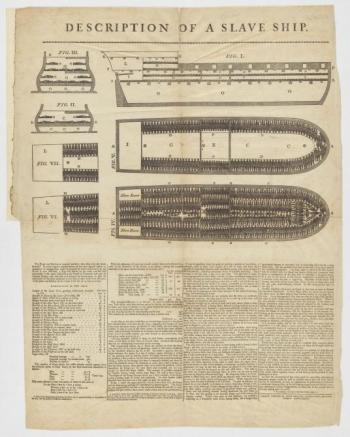
Printed by James Phillips, Description of a Slave Ship, 1789, engraving (Harvard University, Houghton Library, Gift of O. Peck, 1845, p EB75 A100, TL42422.5).
Gallery Talk by John Overholt
25 October 2022, 12.30pm
Join Houghton Library curator John Overholt for a discussion of one of the most important and consequential prints of the 18th century, Description of a Slave Ship.
Gallery Talk by Joachim Homann
27 October 2022, 12.30pm
Join curator Joachim Homann for a discussion about a rare, intact example of French inventor Louis Carrogis de Carmontelle’s multi-sheet drawings on translucent paper. The work was originally attached to rollers, lit from behind with candles, and unfurled for a captive audience.
Gallery Talk by Horace Ballard
3 November 2022, 12.30pm
Join curator Horace Ballard for an exploration of the observation and documentation of astronomical events in the 18th century as exemplified in a drawing by British artist Paul Sandby.
Gallery Talk by Ben Sibson
5 November 2022, 12.30pm
Join Ben Sibson, PhD candidate in Harvard’s Department of Human Evolutionary Biology, for a discussion about the depiction of the human body in selected works on view in the exhibition.
Gallery Talk by Paris A. Spies-Gans
6 November 2022, 12.30pm
Join art historian Paris A. Spies-Gans, of the Harvard Society of Fellows, for a discussion about works of art made by women in the exhibition. Spies-Gans will examine objects by a range of artists, with particular attention given to Marguerite Gérard and Marie-Gabrielle Capet.
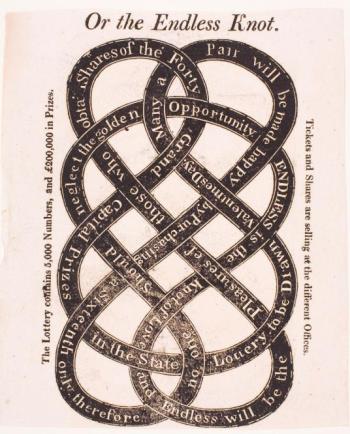
Unidentified artist, American, Lottery Ticket: The Endless Knot, ca. 1785–95, woodcut (Harvard Art Museums/Fogg Museum, Gift of Walter S. Poor, Class of 1905, M20297).
Gallery Talk by Casey Monahan
8 November 2022, 12.30pm
Join curatorial assistant Casey Monahan for a discussion of a dynamic display of ball invitations, advertisements, trade cards, and currency notes in the exhibition. Monahan will share insights about the acquisition of these small prints and the story behind their creative installation.
Gallery Talk by Joachim Homann
10 November 2022, 12.30pm
Join curator Joachim Homann for a discussion of Jean-Honoré Fragonard’s drawing The Girls’ Dormitory.
Gallery Talk by Sarah Mallory
20 November 2022, 12.30pm
Join Sarah Mallory, PhD candidate in Harvard’s Department of History of Art and Architecture, for a discussion of the emergence of the modern notion of ecology in the 18th century as articulated in selected works in the exhibition.
Gallery Talk by Yi Bin Liang
6 December 2022, 12.30pm
Join conservation technician Yi Bin Liang for an exploration of 18th-century methods and techniques of book binding in a close examination of works on view.
Online Workshop around Simon Burrows’ Oeuvre

From the Pamphlets and Patrons project:
18th-Century Libelles, Libellistes, and Book Trade
Workshop around Simon Burrows’ Oeuvre
Online and in-person, 22 September 2022
Organised by Damian Tricoire and the Pamphlets and Patrons (PAPA) project at the University of Trier
All times are Central European Time
13.00 Introduction — Damien Tricoire (Universität Trier)
13.15 Where’s Marie-Antoinette? Pamphlets, Politics, and French Enlightenment Print Culture — Simon Burrows (Western Sydney University)
14.00 The Palais-Royal Style of Revolution: Brissot, Secretary General of the Chancellery of the Duc d’Orléans — Damien Tricoire (Universität Trier)
14.45 Break
15.15 Political Pamphlets and Print Culture in Liège from the Triumph of Enlightenment to Revolution, 1764–1790 — Daniel Droixhe (Université de Liège)
16.00 Persecuting Printers in France before and after 1789 — Jane McLeod (Brock University)
16.45 Break
17.15 Round Table Discussion
• Simon Burrows (Western Sydney University)
• Edmond Dziembowski (Université de Franche-Comté)
• Olivier Ferret (Université de Lyon)
• Julian Swann (Birbeck University of London)
If you wish to attend online through Zoom or in person, please write to doering@uni-trier.de.
22 September 2022, 12.45pm Paris
Zoom-Meeting
https://uni-trier.zoom.us/j/87391514608?pwd=MlMxYzFsU1hUNFM0OUhndzMwZXBYUT09
Meeting-ID: 873 9151 4608
Passcode: dbjpxFg1
New Book | Against Sex
From UNC Press:
Kara French, Against Sex: Identities of Sexual Restraint in Early America (Chapel Hill: The University of North Carolina Press, 2021), 232 pages, ISBN: 978-1469662138 (hardcover), $95 / ISBN: 978-1469662145 (paperback), $30 / ISBN: 978-1469662152 (ebook), $25.
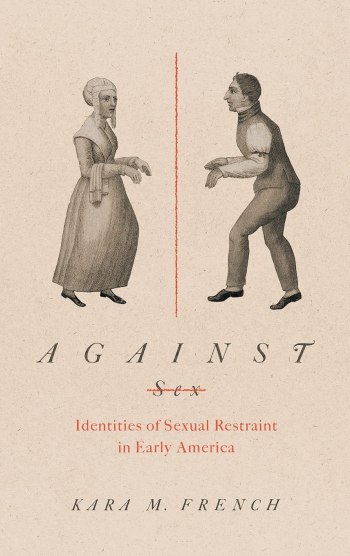 How much sex should a person have? With whom? What do we make of people who choose not to have sex at all? As present as these questions are today, they were subjects of intense debate in the early American republic. In this richly textured history, Kara French investigates ideas about, and practices of, sexual restraint to better understand the sexual dimensions of American identity in the antebellum United States. French considers three groups of Americans—Shakers, Catholic priests and nuns, and followers of sexual reformer Sylvester Graham—whose sexual abstinence provoked almost as much social, moral, and political concern as the idea of sexual excess. Examining private diaries and letters, visual culture and material artifacts, and a range of published works, French reveals how people practicing sexual restraint became objects of fascination, ridicule, and even violence in nineteenth-century American culture.
Against Sex makes clear that in assessing the history of sexuality, an expansive view of sexual practice that includes abstinence and restraint can shed important new light on histories of society, culture, and politics.
Kara M. French is associate professor of history at Salisbury University.
C O N T E N T S
Acknowledgments
Introduction
1 Vinegar-Faced Sisters and Male Monsters: The Gender of Sexual Restraint
2 Identities of Sexual Restraing
3 Breaking and Remaking the Family
4 Alternative Extracts: Sexual Retraint in the Antebellum Marketplace
5 Performing Sexual Restraint
Conclusion
Notes
Bibliography
Index
Call for Papers | Gender and Otherness in the Humanities
From the Call for Papers
Gender and Otherness in the Humanities: Drama, Literature, and Visual Culture
3rd Annual GOTH Symposium
The Open University, Milton Keynes, 18–20 May 2023
Proposals due by 30 November 2022
The annual GOTH Symposium welcomes scholars from within and outside The Open University for three days of productive interdisciplinary discussion and debate. The program committee invites proposals for 20-minute papers focusing on the following aspects of gender and otherness in drama, literature, and visual culture:
1. Gender and/or otherness in pre-1800 images of drama and literature, with topics including but not limited to:
• images by or relating to William Hogarth, and especially to his early career and book illustrations
• the anti-hero: Don Quixote and Hudibras illustrations at Littlecote House and elsewhere
• any aspect of the Littlecote House murals
2. Gender and/or otherness in modern performance receptions of ancient Greek drama, possibly addressing topics including but not limited to:
• new versions of rarely staged or fragmentary texts
• innovative or non-traditional modes of performance
• productions engaging with intersecting identities
3. Race, disability, and/or otherness in early modern theatre, with topics including but not limited to:
• depictions of otherness in dramatic writing and staging practices
• historical receptions of race and disability
• the significance of gender in representations of race and disability
4. ‘Collectible Otherness’, 1500–1800, with topics including but not limited to:
• dwarfs, conjoined twins, the abnormally hirsute
• genre: visual culture, drama, and literature
• contextualizing agency and Intersectionality of otherness: court, theatre, fairground, curiosity cabinet (Wunderkammer)
Please submit your proposal (300 words max) and academic bio (150 words max) on or before 30 November 2022, to m.a.katritzky@open.ac.uk and FASS-GOTH-Admin@open.ac.uk. Presenters will be provided with one night of accommodation. A limited number of travel bursaries will be awarded; if you wish to be considered please include a brief statement explaining what sum is required and why. Inquiries on any aspect of the symposium can be emailed to FASS-GOTH-Admin@open.ac.uk. Further information will be posted on the GOTH website as it becomes available.
GOTH Committee
• M. A. Katritzky – GOTH director / Barbara Wilkes Research Fellow in Theatre Studies
• Christine Plastow – GOTH web and media manager / Lecturer in Classical Studies
• Molly Ziegler – Lecturer in Drama and Performance Studies
Guest Co-Organizer
• Birgit Ulrike Münch, Rheinische Friedrich-Wilhelms-Universität Bonn
Exhibition | Feminine Power: The Divine to the Demonic
Closing this month at The British Museum:
Feminine Power: The Divine to the Demonic
The British Museum, London, 19 May — 25 September 2022
Curated by Belinda Crerar and Lucy Dahlsen
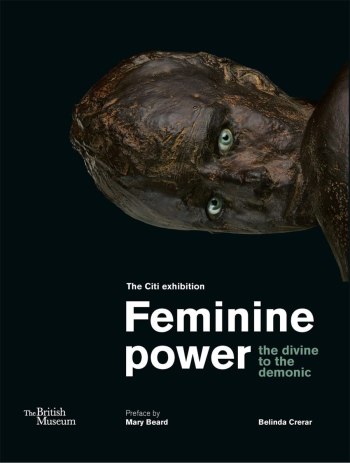 The first exhibition of its kind, Feminine Power takes a cross-cultural look at the profound influence of female spiritual beings within global religion and faith. Explore the significant role that goddesses, demons, witches, spirits and saints have played—and continue to play—in shaping our understanding of the world.
How do different traditions view femininity? How has female authority been perceived in ancient cultures? For insights, the exhibition looks to divine and demonic figures feared and revered for over 5,000 years. From wisdom, passion and desire, to war, justice and mercy, the diverse expression of female spiritual powers around the world prompts us to reflect on how we perceive femininity and gender identity today.
Worship of Pele, the Hawaiian goddess of volcanoes, reveals how her destructive capacity is venerated alongside her ability to create. The Buddhist bodhisattva of compassion, who transcends gender and is visualised in male form in Tibet and female in China and Japan, uncovers the importance of gender fluidity in some spiritual traditions. And the terrifying Hindu goddess Kali, depicted in art carrying a severed head and bloodied sword, is honoured as the Great Mother and liberator from fear and ignorance.

Porcelain Figure of Guanyin, China, 18th century, 41 cm high (London: The British Museum, 1980,0728.93).
Enhanced by engagement with contemporary worshippers, faith communities and insights from high-profile collaborators Bonnie Greer, Mary Beard, Elizabeth Day, Rabia Siddique, and Deborah Frances-White, the exhibition considers the influence of female spiritual power and what femininity means today.
Bringing together sculptures, sacred objects and artworks from the ancient world to today, and from six continents, the exhibition highlights the many faces of feminine power—ferocious, beautiful, creative or hell-bent—and its seismic influence throughout time.
Belinda Crerar, Feminine Power: The Divine to the Demonic (London: The British Museum, 2022), 272 pages, ISBN: 978-0714151304, £30 / $45.
C O N T E N T S
Introduction
1 Forces of Nature
2 Passion and Desire
3 Evil
4 Justice and Defence
5 Compassion and Salvation
Conclusion
Notes and Bibliography
Acknowledgements and Credits
Exhibition | Fuseli and the Modern Woman
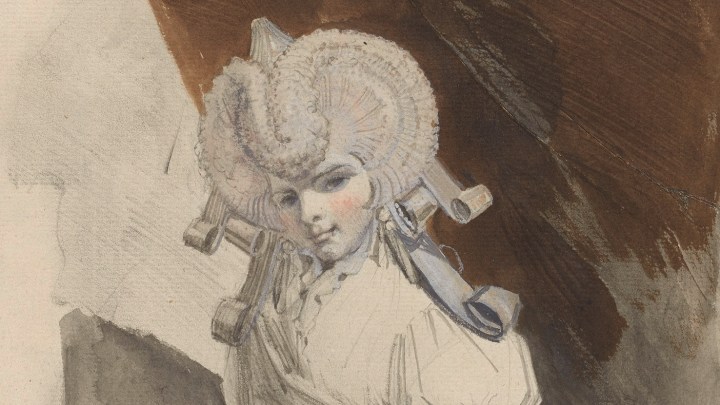
Henry Fuseli, Sophia Fuseli, Her Hair in Large Rolls, with Pink Gloves, in Front of a Brown Curtain, detail, 1790
(Kunsthaus Zürich, Collection of Prints and Drawings)
◊ ◊ ◊ ◊ ◊
From The Courtauld:
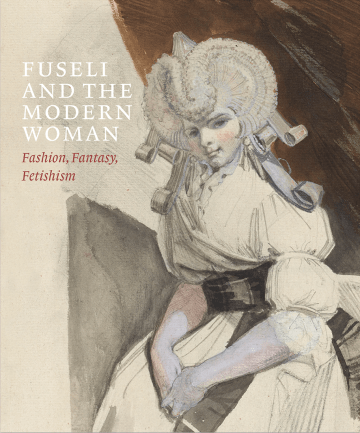
Fuseli and the Modern Woman: Fashion, Fantasy, Fetishism
The Courtauld Gallery, London, 14 October 2022 — 8 January 2023
Kunsthaus Zürich, 24 February – 21 May 2023
One of the most original and eccentric artists of the 18th century, Henry Fuseli (1741–1825) will be the subject of a new exhibition at The Courtauld, opening 14 October 2022.

Henry Fuseli, Half-length Figure of a Courtesan with Feathered Head-dress, ca. 1800–10 (Kunsthaus Zürich, Collection of Prints and Drawings).
Born in Zurich, Switzerland, Fuseli spent a formative period in Rome in the 1770s before settling in London, where he was elected Professor of Painting at The Royal Academy and served for 21 years as Keeper of the RA Schools, working and living at Somerset House in what is now The Courtauld Gallery.
While Fuseli was famous in his lifetime for stylised paintings depicting fantastic and supernatural scenes drawn from his imagination and literature, The Courtauld’s exhibition explores an altogether different dimension to his art. Fuseli and the Modern Woman: Fashion, Fantasy, Fetishism will reveal the artist’s secret lifelong obsession with the female figure through fifty of his strange and striking private drawings, many of which depict the spectacularly extravagant hairdos and fashions of the day. The exhibition will explore Fuseli’s fascination with female sexuality and the modern woman—as a figure of mystery, transgression, and dangerous allure—and provides an insight into late 18th- and early 19th-century anxieties about gender, identity, and sexuality during a transformative period in European history.
Organised in collaboration with the Kunsthaus Zürich, the exhibition will showcase drawings brought together from international collections. Following its presentation at The Courtauld, the exhibition will travel to Zürich, the city where Fuseli was born.
The catalogue is published by PHP and distributed by The University of Chicago Press:
David Solkin, ed., with contributions by Jonas Beyer, Mechthild Fend, and Ketty Gottardo, Fuseli and the Modern Woman: Fashion, Fantasy, Fetishism (London: Paul Holberton Publishing, 2022), 168 pages, ISBN: 978-1913645298, £30 / $40.
 Best known for his notoriously provocative painting The Nightmare, Fuseli energetically cultivated a reputation for eccentricity, with vividly stylised images of supernatural creatures, muscle-bound heroes, and damsels in distress. While these convinced some viewers of the greatness of his genius, others dismissed him as a charlatan, or as completely mad.
Fuseli’s contemporaries might have thought him even crazier had they been aware that in private he harboured an obsessive preoccupation with the figure of the modern woman, which he pursued almost exclusively in his drawings. Where one might have expected idealised bodies with the grace and proportions of classical statues, here instead we encounter figures whose anatomies have been shaped by stiff bodices, waistbands, puffed sleeves, and pointed shoes, and whose heads are crowned by coiffures of the most bizarre and complicated sort. Often based on the artist’s wife Sophia Rawlins, the women who populate Fuseli’s graphic work tend to adopt brazenly aggressive attitudes, either fixing their gaze directly on the viewer or ignoring our presence altogether. Usually they appear on their own, in isolation on the page; sometimes they are grouped together to form disturbing narratives, erotic fantasies that may be mysterious, vaguely menacing, or overtly transgressive, but where women always play a dominant role. Among the many intriguing questions raised by these works is the extent to which his wife Sophia was actively involved in fashioning her appearance for her own pleasure, as well as for the benefit of her husband.
By bringing together more than fifty of these studies (roughly a third of the known total), The Courtauld Gallery will give audiences an unprecedented opportunity to see one of the finest Romantic-period draughtsmen at his most innovative and exciting. Visitors to the show and readers of the lavishly illustrated catalogue will further be invited to consider how Fuseli’s drawings of women, as products of the turbulent aftermath of the American and French Revolutions, speak to concerns about gender and sexuality that have never been more relevant than they are today.
The exhibition showcases drawings brought together from international collections, including the Kunsthaus Zürich, in Zurich, the Auckland Art Gallery in New Zealand, and from other European and North American institutions.
David Solkin is Emeritus Professor at The Courtauld Institute of Art, London.
Jonas Beyer is Curator of Drawings at the Kunsthaus Zürich, Zurich.
Mechthild Fend is Professor of Art History at the Goethe University, Frankfurt am Main.
Ketty Gottardo is Martin Halusa Curator of Drawings at The Courtauld Gallery, London.
Exhibition | Füssli: The Realm of Dreams and the Fantastic

Henry Fuseli, The Dream of Queen Catherine of Aragon (Shakespeare, Henry VIII, Act 4, Scene 2), detail, 1781, oil on canvas, 147 × 211 cm
(Borough of Fylde, Lancashire: Lytham St Annes Art Collection, no. 52).
◊ ◊ ◊ ◊ ◊
Opening this month at the Musée Jacquemart-André:
Füssli: The Realm of Dreams and the Fantastic / Füssli, entre rêve et fantastique
Musée Jacquemart-André, Paris, 16 September 2022 — 23 January 2023
Curated by Christopher Baker and Andreas Beyer
This autumn discover the oeuvre of the Swiss-born British painter Henry Fuseli (Johann Heinrich Füssli, 1741–1825). Comprising sixty works from public and private collections, the exhibition presents a selection of the most emblematic of works by Füssli, the artist of the imaginary and the sublime. From Shakespearean themes to representations of dreams, nightmares, and apparitions, and mythological and Biblical illustrations, Füssli forged a new aesthetic that shifted between reality and the fantastic.

Henry Fuseli, Self-Portrait, 1780s, black and white chalk on buff paper (London: V&A Museum, E.1028-1918).
The son of a painter and art historian, Henry Füssli was trained as a priest and started his artistic career relatively late, during a first trip to London, where he was influenced by the President of the Royal Academy, Sir Joshua Reynolds. After a long stay in Italy, during which he was especially fascinated by the power of Michelangelo’s works, he settled in London at the end of the 1770s. An atypical and intellectual artist, Füssli drew his inspiration from the literary sources that he interpreted imaginatively. In his paintings he developed a dreamlike and dramatic pictorial language, with its blend of the marvellous and the fantastic, the sublime and the grotesque.
Come explore Füssli’s oeuvre, which has not been the subject of a monographic exhibition in Paris since 1975: from works that represent Shakespeare’splays (particularly Macbeth), onto those depicting mythological and biblical tales, the female figures represented in his graphic works and the themes of nightmares, a truly Füselian obsession, dreams, and apparitions.
Füssli developed a fantastic vein that was quite marginal at the time, as it distorted academic rules. In 1782, he presented his first version of Nightmare, an emblematic work drawn from his imagination that truly established his career as a painter. Elected Associate Member of the Royal Academy in 1788, and Academician in 1790, Füssli, while working in a serial fashion, embodied the quest for the sublime that was all the rage in England at the time.
Discover the striking works of the artist—works that are all too rare in French collections—by a highly original painter whose oeuvre was paradoxical, inspired by an imagination in which terror and horror were combined, forming the aesthetic origins of Dark Romanticism (‘romantisme noir’).
Christopher Baker and Andreas Beyer, et al., Füssli, entre rêve et fantastique (Brussels: Fonds Mercator, 2022), 208 pages, €40.
In addition, works from the exhibition are featured in a 44-page special edition of Connaissance des Arts (€11) and an 84-page special edition of Beaux-Arts magazine (€14).
More information is included in the full press packet.
Memorial Service for Christopher Johns
From Vanderbilt University . . . (the event may be live-streamed or at least recorded; I’ll update this posting as details emerge, and please feel free to add comments if you have more information. –CH)
Memorial Service for Christopher M. S. Johns
Cohen Memorial Hall, Vanderbilt University, Nashville, Saturday, 17 September 2022
A memorial service and reception for Christopher M. S. Johns, the Norman L. and Roselea J. Goldberg Professor of Fine Arts and professor of history of art and architecture, will be held on Saturday, 17 September, from 2 to 4pm in the atrium of Cohen Memorial Hall on the Peabody College campus. The memorial program will begin at 2:30pm, with the reception to follow. Johns died May 8 following an extended illness. He was 67.
The event is hosted by the College of Arts and Science and the Department of History of Art and Architecture.
◊ ◊ ◊ ◊ ◊
Note (added 12 September 2022) — Event organizers plan to live-stream the event via Zoom with the following link:
https://vanderbilt.zoom.us/j/8816519966
As ASECS president, Wendy Wassying Roworth has contributed the following statement, which will be read alongside other tributes: “Christopher was a longtime active member of the American Society for Eighteenth-Century Studies. A generous scholar, editor, mentor, and friend, he was always willing to share his vast knowledge of Italian art and culture with colleagues and students. He will be missed, but his significant contributions to eighteenth-century studies will continue to inform and inspire.”
New Book | General William Roy (1726–1790)
From Edinburgh UP:
Humphrey Welfare, General William Roy (1726–1790): Father of the Ordnance Survey (Edinburgh: Edinburgh University Press, 2022), 310 pages, ISBN: 978-1399505789, $120.
 The first biography of William Roy, exploring his life, career, and legacy
• Considers the influences on William Roy and his work by examining the people in his circle, including some of the most famous scientists and explorers of the day
• Reviews the importance of the Military Survey of Scotland to the history of cartography
• Considers the significance of Roy’s experiments in measuring heights by barometric pressure
• Re-assesses—for the first time since 1917—his important contribution to British archaeology
Born in Clydesdale, William Roy was a polymath and a visionary. His work established the path that would lead to the formation of the Ordnance Survey and to all of the paper-based and digital mapping products that we use today. His story—very much one of the Enlightenment—demonstrates how one man’s curiosity and diligence enabled him to excel across a diverse range of topics: military reconnaissance and intelligence; the lessons that could be learned from the past about the tactical use of landscape; the science of determining the height of mountains; and the development of a meticulous methodology to achieve an unprecedented accuracy in topographical measurement. In this biography, Humphrey Welfare uncovers the career and activities of this important figure, and in doing so paints a vivid picture of the inner complexities of 18th-century Britain.
Humphrey Welfare is Visiting Fellow in the School of History, Classics, and Archaeology at the University of Newcastle. Formerly he was Director of the Architectural and Archaeological Survey at the Royal Commission, and, after merger with English Heritage, the Director of Research Projects. His last post before retirement in 2011 was as English Heritage Planning and Development Director for the North. Humphrey has published over forty papers in peer-reviewed journals on the archaeology and history of southern Scotland and northern England, as well as three books, including Roman Camps in England: The Field Archaeology (with V. Swan, HMSO, 1995). He is a former editor of the Proceedings of the Society of Antiquaries of Scotland.
C O N T E N T S
Prologue: A Dinner Party for Captain Cook
Acknowledgements
Introduction
1 Foundations
2 The Map-maker: Developing the Soldier’s Eye
3 The Military Engineer: Reconnaissance, Resources, and Fortifications
4 The Antiquary in the Field: Empathy with the Army of Rome
5 The Practical and Sociable Scientist: Hypsometry and the Royal Society
6 The Geodesist: Large Triangles and Miniscule Adjustments
7 Aftermath and Legacy: The Birth of the Ordnance Survey
Appendix 1 Chronology
Appendix 2 General Roy’s Instructions on Reconnoitring
Appendix 3 Glossary
Abbreviations
Bibliographical References
Index
Colloquium | Inventaires et cartographies du patrimoine
From the conference programme, with more information about the Collecta research project noted below :
Inventaires et cartographies du patrimoine, XVIIe–XXIe siècle
École du Louvre, Paris, 15–16 September 2022
 Organisé dans le cadre du programme de recherche Collecta Archives numériques de la collection Gaignières (1642–1715)
Depuis 2014, le programme de recherche Collecta interroge les pratiques érudites du Grand Siècle et les met en perspective à partir de l’exemple de la collection de François-Roger de Gaignières (1642–1715).
Sa reconstitution et sa mise en ligne ont requis la création d’un outil numérique (collecta.fr) qui tente de rendre compte des liens et des cheminements qui se trament, au sein de la collection :
• à travers les stades du travail de l’érudit — des sources, notes et brouillons aux dessins mis au net et classés pour la présentation au public ;
• à travers les matériaux réunis par l’érudit — tableaux et gravures, manuscrits et imprimés, dessins et copies d’archives ;
• à travers les points d’entrée retenus par l’érudit — personnes, familles, institutions, lieux, périodes.
Se dessinent ainsi les itinéraires mentaux, documentaires, mais aussi spatiaux de l’érudit à travers ses sources, son réseau de contacts, les lieux qu’il visite, ses centres d’intérêt et les méthodes qu’il déploie dans son objectif d’inventaire des monuments et des familles du royaume et de l’Europe.
J E U D I , 1 5 S E P T E M B R E 2 0 2 2
9.30 Accueil des participants
10.00 Ouverture du colloque — Claire Barbillon (École du Louvre) et François Bougard (Institut de recherche et d’histoire des textes – CNRS)
10.20 Introduction
• Après Gaignières : continuité et discontinuité, les enjeux d’une reconstitution numérique de la collection — Anne Ritz-Guilbert (École du Louvre / Institut de recherche et d’histoire des textes – CNRS)
• Le point de vue du design : mise en perspective de la nouvelle interface Collecta & esthétique de la structure — Sophie Fétro (Paris 1 Panthéon-Sorbonne) et Kim Sacks (Université de Strasbourg)
13.00 I. Héraldique et territoires
Michel Pastoureau (École pratique des Hautes Études)
• Marquage héraldique, cartographie et histoire des lignages : les relevés de Gaignières à la chapelle des chanoinesses de Luynes — Sarah Héquette (École du Louvre / École pratique des Hautes Études)
• Une géographie des ordres ? L’ombre de la chevalerie dans la collection Gaignières — Pierre Couhault (Bibliothèque nationale de France)
• Inventorier et cartographier l’héraldique des municipalités portugaises : l’armorial de Cristóvão Alão de Morais — Miguel Metelo de Seixas (Universidade NOVA de Lisboa)
• La cartographie héraldique de Frotier de la Messelière — Laurent Hablot (École pratique des Hautes Études)
15.45 II. La copie comme mise en récit des archives
Marlène Helias-Baron (Institut de recherche et d’histoire des textes – CNRS)
• L’apport des copies de Gaignières à la connaissance des archives de l’abbaye de Longpont — Benoît-Michel Tock (Université de Strasbourg)
• Voyage au passé. Les cartulaires de la collection Gaignières comme fenêtres sur les archives de jadis — Annalena Müller (Université de Fribourg)
V E N D R E D I , 1 6 S E P T E M B R E 2 0 2 2
9.00 III. Voyages, séries, topographies
Émilie d’Orgeix (École pratique des Hautes Études)
• Construire une collection topographique au XVIIe siècle. L’élaboration des portefeuilles dans la collection Gaignières — Damien Bril (Institut national du patrimoine)
• Mémoires des lieux, mémoires des hommes. Étude du portefeuille topographique « Beauce et Vendômois » de la collection Gaignières (1642–1715) — Clotilde Vivier (École du Louvre)
• Imprimer, collecter et concentrer l’image des villes. Lieux d’édition et représentations urbaines en Europe (fin du XVe siècle – milieu du XVIIe siècle) — Eric Grosjean (École pratique des Hautes Études)
• Voyager en image : la topographie dans la collection de Jehannin de Chamblanc (1722–1797) — Johanna Daniel (Institut national d’histoire de l’art, LAHRA – Lyon 2)
14.00 IV. Visualisation et narration, du portefeuille au numérique
Anne Ritz-Guilbert (École du Louvre/Institut de recherche et d’histoire des textes – CNRS)
• Les humanités numériques, un lieu pour les archives du bizarre — Myriam Marrache-Gouraud (Université de Poitiers)
• Construire un outil d’association de données à l’heure de l’open data : la Fabrique Numérique du Passé — Laurent Costa (UMR 7041 ArScAn)
• La fabrique du paysage urbain parisien avant les destructions haussmanniennes : inventorier et cartographier les savoirs — Ellie Khounlivong (École du Louvre), Christophe Claramunt (Institut de Recherche de l’École navale), Éric Mermet (Centre d’analyse et de mathématique sociales, UMR 8557), et Alexandre Radjesvarane (CY Tech)
◊ ◊ ◊ ◊ ◊
From Le Domaine d’Intérêt Majeur Sciences du Texte et Connaissances Nouvelles:
The Collecta + Project is part of a larger research program in digital humanities, devoted to the collection of François-Roger de Gaignières (1642–1715). After launching the website http://www.collecta.fr and its database which provides a reconstitution of the collection now dispersed, Collecta + has defined three main objectives, in partnership with the ANG-G project (Digital Geolocated Archive — the Gaignières collection) sponsored by the ANR (Research Project Funding) within the framework of the IRHT-CNRS.
The first goal is to enrich the database, giving priority to documents relating to the Ile-de-France region. The complete digitization of the Gaignières collection kept in the Bodleian Library of Oxford—1,600 drawings of medieval and modern monuments, mainly from the Paris region—offers a considerable breakthrough in the knowledge of the region’s collection and heritage.
Secondly, we will examine the contribution of geolocation to bring out a better understanding of the collection and the monuments concerned. A mobile application based on the drawings of the Gaignières collection will be the central tool of a participatory research method to launch an inquiry on local heritage. The collection of geolocated datas will offer the opportunity to conduct a large-scale study on the history of viewpoints.
The third objective is to promote interchanges with other projects or partners of the DIM STCN, in particular E-signa and the Bibale database of the IRHT-CNRS. Sharing digital ressources and tools, we will accentuate the interoperability of academic programmes and we will ultimately offer a common platform as a reference frame for research on regional, national and international levels.










 Enfilade
leave a comment