Call for Essays | The Académie Royale Art Collection
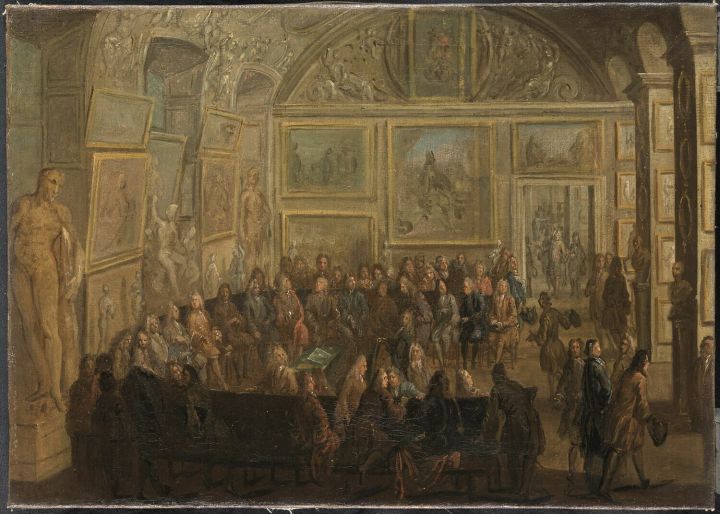
Jean-Baptiste Martin, View of the Salon of Diana at the Louvre, a Gathering of the Académie Royale de Peinture et de Sculpture (Séance de l’Académie royale de peinture et de sculpture au Louvre), ca. 1712–21, oil on canvas, 30 × 42 cm (Paris: Musée du Louvre, RF 1998-36).
◊ ◊ ◊ ◊ ◊
From ArtHist.net:
The Académie Royale Art Collection
Edited by Markus Castor, Sofya Dmitrieva, and Anne Klammt
Proposals due by 30 September 2022; selected contributions will be due 31 March 2023
Our book aspires to highlight the importance of the art collection that the Académie royale de peinture et de sculpture assembled in the century and a half of its existence (1648–1793) and show that this unique, yet almost entirely unstudied, body of works is essential to our understanding of eighteenth-century art and institutional practices.
The Académie royale art collection consisted mainly of reception pieces—the works that young artists submitted for examination by the academic jury to become full members of the institution. It also included miscellaneous donated artworks as well as portraits of the Académie’s patrons that the institution frequently commissioned from current members. Around 300 paintings and some 30 sculptures were on display in the Académie’s rooms at the Louvre and daily surrounded the artists who lived and worked there. The latter could also consult a rich collection of engravings at the Académie’s print room.
The collection was a unique corpus for multiple reasons. Firstly, as almost all the prominent old regime artists were members of the Académie royale, it united such iconic reception pieces as Watteau’s Pilgrimage to the Isle of Cythera (1717), Chardin’s Ray (1728), and Greuze’s Septimius Severus and Caracalla (1769). Secondly, these and other examinational works now offer invaluable insights into academic reception practices and aesthetic values as much as the commissioned portraits of the Académie’s patrons—into its behind-the-scenes personal networks. Finally, the hang of the works in the Louvre is an outstanding example of eighteenth-century curatorial work: since the collection’s arrangement was decided upon by academicians themselves, it stands an important ‘internal’ counterpart to the Académie’s public display, the Salons.
After the French Revolution, this one-of-a-kind body of works got dispersed and is shared today by the Louvre, the Versailles, the ENSBA, and several French regional museums. Thankfully, however, two detailed descriptions are still extant: in 1715, when the collection was housed on the Louvre’s ground floor, it was documented by Nicolas Guérin (Paris: J. Collombat), and in 1781, when it moved to the first floor, it was recorded by Antoine-Nicolas Dezallier d’Argenville (Paris: De Bure). In 1893, the two descriptions were republished as one volume by Anatole de Montaiglon. Two key critical works on the collection are the exhibition catalogue Les peintres du roi, 1648–1793 (Paris: Réunion des musées nationaux, 2000) and Hannah Williams’s monograph Académie Royale: A History in Portraits (Farnham: Ashgate, 2015).
The present book is part of the project run by the DFK Paris in collaboration with the Centre Dominique-Vivant Denon (Louvre) and the INHA that aspires to reconstruct the collection digitally and build a database of the works that constituted it.
We invite contributions that define the role of the Académie royale art collection and discuss its history and arrangement. Issues of our interest include but are not limited to:
• Collection arrangement: How did the hangs of the collection on the first and the ground floor of the Louvre differ? What were the guiding principles of the collection’s arrangement? What role did genre play in it? What was the function of different rooms and how did the works adorning the room reflect it? Did the arrangement reflect the Académie’s institutional hierarchy? How did prints, sculptures, and paintings that formed the collection work together?
• Instructive function of the collection: How did these sculptures, paintings, and prints, seen by the Académie’s students on day-to-day basis, influence their work? What message (if any) did they convey?
• Reception pieces: What role did the reception play in the artist’s career? What was the canon of academic reception pieces? How did it help crystallise the academic genre classification?
• Commissioned portraits: Who were the Académie’s patrons whose portraits the institution commissioned from its members? What role did these patrons play in the history of the Académie royale? How were they related to each other and what was their specific interest in sponsoring the institution?
• Conférences de l’Académie royale: How do the lectures that the members regularly delivered at the Académie royale relate to the collection? How do both reflect the Académie’s institutional and aesthetic values? What is the significance of the Salle d’Assemblée as the centre of the institutional life of the Académie royale?
• Dispersal of the collection: How were the works constituting the collection distributed after the French Revolution? What were the unique stories of these paintings, prints, and sculptures post-1793?
Contributions are welcome in English or French and are expected to be between 5,000 and 15,000 words in length. If you are interested, please send a short 300-word abstract and a brief 50-word biography to Sofya Dmitrieva sofya.k.dmitrieva@gmail.com by 30 September 2022. The deadline for selected contributions will be 31 March 2023.
◊ ◊ ◊ ◊ ◊
Note (added 12 August 2022) — The posting has been updated to include the editors and the painting by Jean-Baptiste Martin (from the PDF file of the Call for Essays)
Call for Papers | Boiseries: Decoration and Migration

From the Call for Papers:
Boiseries: Decoration and Migration from the Eighteenth Century to the Present
Camden Place, Chislehurst (Kent), 12–13 January 2023
Organized by Lindsay Macnaughton and Laura Jenkins
Proposals due by 9 September 2022
This conference investigates the cultural and commercial migrations of French eighteenth-century boiseries from their places of production in Paris and the Bâtiments du Roi to the drawing rooms of Britain and the United States.
From an historical perspective boiseries have always, in a sense, been mobile. In the eighteenth century, Paris joiners and carvers travelled to locations outside the city to install panelling, and entire decorative schemes were sent abroad to Germany, Spain, and Latin America. Accompanied by mirrors and tapestries from royal manufactories, these panels disseminated French style in accordance with the diplomacy of the monarch and the desires of foreign courts. Boiseries executed for particular sites but not installed were also sometimes reused elsewhere: failed deliveries and changes in taste during the period from commission to installation occasioned opportunities for buyers, and sets of panelling conceived as complete ensembles were broken up and dispersed for use in multiple locations, or disused altogether. Shifting fashions and continual reallocations of appartements at Versailles set into motion near-ceaseless rotations of décors, including boiseries. And, notwithstanding the legal categorisations of panels, once fixed, as immeubles, removals were negotiated by tenants during their lease of, and on their departure from, urban hôtels.
In the nineteenth century, the pace and directionality of movement changed, as elements of interior decoration began to be acquired for their own merit and eighteenth-century boiseries became the relics of a physically and culturally disappearing French national history as well as the trophies of an international collecting elite. Elements of woodwork, disassembled from demolished châteaux or reproduced in survey drawings and plaster casts, made their way into rooms in Britain and the United States, their proportions and ornament amplified and metamorphosed—to borrow terms used by John Harris and Bruno Pons—to match the pitch of the French Second Empire and later living.
Professional interior decorators and commercial dealers in decorative arts were largely to credit, providing channels by which goods could easily be transported from place to place. However, boiseries also emigrated, as it were, with exiles of the Republic, extending the presence of French style to less-cosmopolitan regions and adding geopolitical to social and architectural concerns.
Camden Place, where the conference will be held, is an English country house whose history and interiors have been shaped by the migration of people and decoration for over 300 years. Home to Chislehurst Golf Club, the Grade II* listed building features architectural elements by the British architects George Dance the Younger (1741–1825) and James ‘Athenian’ Stuart (1713–1788), and played host to the French Imperial court after the fall of the Empire in 1870. French chimney pieces, boiseries from the eighteenth-century Château de Bercy (demolished in 1862), and heavily carved oak panelling are among the elements that make up the house’s many layers, testifying both to the eclectic tastes of its nineteenth-century occupants and to the multifaceted, and multinational, histories of many English country houses.
This conference provides a unique opportunity for cultural historians of France, art and architectural historians, historians of collecting, curators, and heritage professionals to meet in a room reassembled following the landmark Château de Bercy sale (1860) and to meditate on the finer points of its significance in the dispersal of French cultural patrimony.
The organisers invite abstracts for 20-minute papers on topics engaging with, but not limited to:
• The relative mobility (meubles/immeubles) of boiseries in the 18th century
• Collecting, architectural salvage, and markets for boiseries in the 19th and 20th centuries
• Exchanges of taste and culture as a result of political displacement, in particular the influence of French émigrés
• Memory and the material traces of Empire
• Documentary and curatorial challenges posed by collections of boiseries
• The management of architectural heritage in private and commercial spaces today
Confirmed speakers include Dr Lee Prosser (Historic Royal Palaces), Frédéric Dassas (Musée du Louvre), Dr Ulrich Leben (German Ambassador’s residence, Paris), Dr Mathieu Deldicque (Musée Condé, Château de Chantilly), and Dr Tom Stammers (University of Durham).
Some funds will be available to support travel and accommodation for speakers. The conference is generously supported by the University of Buckingham, The Chislehurst Society, and Chislehurst Golf Club as part of a programme of events marking the 150th anniversary of the death of Napoleon III at Camden Place.
Submissions for 20-minute papers (300 words) should be sent to lindsay.macnaughton@buckingham.ac.uk and laura.jenkins@courtauld.ac.uk by Friday, 2 September 2022. We look forward to receiving your abstracts.
For more information, please visit: boiseriescamdenplace.wordpress.com (coming soon).
With thanks from the organisers: Dr Lindsay Macnaughton (University of Buckingham) and Laura C. Jenkins (The Courtauld Institute of Art).
◊ ◊ ◊ ◊ ◊
Note (added 31 August 2022) — The posting was updated with the new due date, extended from the original deadline of 2 September 2022.
New Book | Baroque Prague
The Czech edition appeared in 2017:
Vít Vlnas, Baroque Prague, translated by Derek Paton (Prague: Karolinum Press, Charles University, 2022), 330 pages, ISBN: 978-8024643762, $30.
 Baroque Prague is a lavish excursion through Prague’s important baroque period, beginning with the defeat of Czech Protestants at the Battle of White Mountain in 1620 and ending with the philosophical era of Enlightenment in the eighteenth century. In this book, Vit Vlnas explores both the material and spiritual transformations the city went through during this boisterous period, treating the baroque epoch as a cultural phenomenon vital to the current genius loci of the great Central European capital. Vlnas guides readers through the city from Prague Castle to the Lesser Town, Old Town, and New Town, as well as Vyšehrad, the important historic fortress. In a special section, he takes us to equally important baroque monuments outside of the historical city center. Lushly illustrated with over 200 color plates, including both historical images and contemporary photographs of architectural exteriors, the text is accompanied by helpful maps indicating the location of the monuments, as well as a glossary of prominent figures during the period. Both a highly readable introductory study and a work for experienced scholars of the history of Bohemia, Baroque Prague is an exciting homage to Europe’s great ‘city of a hundred spires’, and shows how a place’s storied past informs its present soul.
Vít Vlnas is head of the Institute of Christian Art History at Charles University and head of the Center for Humanistic Studies at the Moravian Museum.
Call for Papers | Design, Description, and Discovery in Cataloging
From ArtHist.net:
Terms of Art: Design, Description, and Discovery in Cataloging
Online, The Hood Museum of Art and Dartmouth Research Computing, Hanover, NH, 22–24 February 2023
Proposals due by 31 August 2022
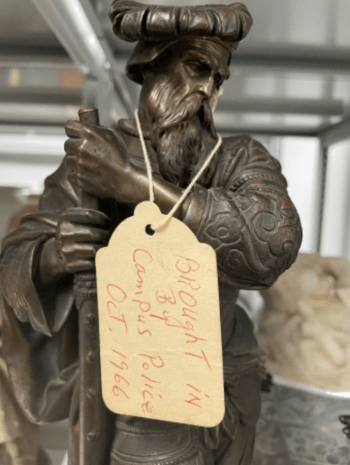
An unusually tagged bronze statue, found in museum storage, “Brought in By Campus Police Oct. 1966” (Photo courtesy Beth Mattison).
Institutions such as museums, libraries, and archives have a mission to preserve, interpret, and disseminate cultural heritage. In addition to new acquisitions for their collections, these institutions must also update the tools with which researchers access and study these holdings, objects, and works of art. Increasingly, stakeholders like academics, educators, and the public treat a collection’s digital representation—its metadata records—as an entry point for discovery. Paradoxically, these web-based experiences meant to expose collections to broad audiences often assume users have specialized knowledge of the terms and processes GLAM (Galleries, Libraries, and Art Museums) institutions use to describe their own work, making them inaccessible to the majority of visitors. Additionally, variation and evolution of language often outpaces or does not align with public understanding. For example, someone interested in 17th-century Dutch art might not know that the phrase “Dutch Golden Age” has colonialist implications and has been removed from many museums’ internal databases. The search language isn’t wrong, it’s just outmoded.
The Hood Museum of Art and Dartmouth Research Computing are organizing a virtual symposium to bring together museums, libraries, and archives to discuss issues of access and ethical vocabularies in cultural heritage. The aim of the virtual conference is to develop the debate about how the language we use to describe collections impacts the communities that create and seek out art. The organizers hope to prompt dialogue on the issues curators and researchers face in trying to maintain equitable and anti-racist progress and research. Additionally, this symposium will emphasize the role of technologists who specialize in user-centered design as critical to promoting equity in information systems. In combining subject-matter specialists and user-centered design technologists, we aim to bridge the communication gap between institutions and the publics they serve, allowing each to educate the other about how they describe collections.
This virtual conference will feature panels, workshops, and roundtables from different institutions around the world. Speakers will be compensated at the rate of $250 per person.
Types of Panels
• Papers, posters, or case studies: 20-minute presentation with 10-minute Q&A
• Roundtables or panel discussions: 45- or 50-minute presentation with 10-minute Q&A
• Extended discussions and workshops: 90-minute participatory session with a 5- or 10-minute break for ideation, brainstorming, cross-pollination
• Other: a session you would like to submit that doesn’t fit the above criteria (prototyping, hackathon/datathon)
Organizers
• Meredith Steinfels, Assistant Director, Digital Platforms, Media, and Archives
• John Bell, Program Director, Data Experiences and Visualizations Studio
• Ashley Offill, Associate Curator of Collections
• Elizabeth Rice Mattison, Andrew W. Mellon Associate Curator of Academic Programming
Application requirements and submission details are available here»
Deadlines
Session submission: 31 August 2022
Approval and feedback: 3–7 October 2022
This conference is made possible by the generous support of the Leslie Center for the Humanities.
Exhibition | Chroma: Ancient Sculpture in Color
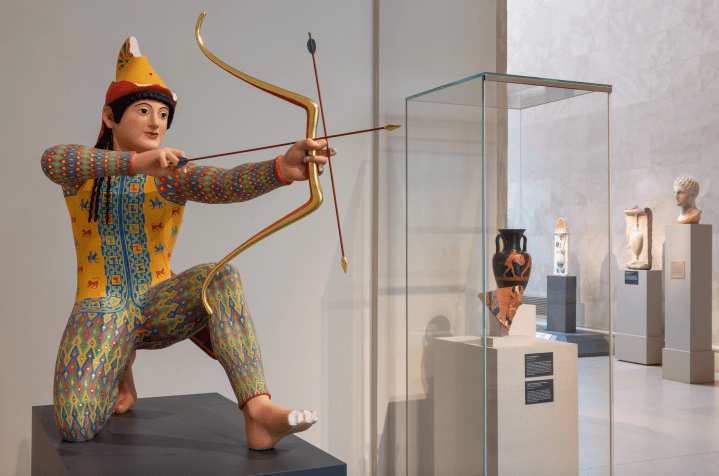
Installation view of Chroma: Ancient Sculpture in Color, on view at The Metropolitan Museum of Art
(Photo by Anna-Marie Kellen for The Met)
◊ ◊ ◊ ◊ ◊
Not explicitly an eighteenth-century exhibition, but central to eighteenth-century conversations. From The Met:
Chroma: Ancient Sculpture in Color
The Metropolitan Museum of Art, New York, 5 July 2022 — 26 March 2023
 Ancient Greek and Roman sculpture was once colorful, vibrantly painted and richly adorned with detailed ornamentation. Chroma: Ancient Sculpture in Color reveals the colorful backstory of polychromy—meaning “many colors,” in Greek—and presents new discoveries of surviving ancient color on artworks in The Met’s world-class collection. Exploring the practices and materials used in ancient polychromy, the exhibition highlights cutting-edge scientific methods used to identify ancient color and examines how color helped convey meaning in antiquity, and how ancient polychromy has been viewed and understood in later periods.
The exhibition features a series of reconstructions of ancient sculptures in color by Prof. Dr. V. Brinkmann, Head of the Department of Antiquity at the Liebieghaus Skulpturensammlung, and Dr. U. Koch-Brinkmann, and introduces a new reconstruction of The Met’s Archaic-period Sphinx finial, completed by The Liebieghaus team in collaboration with The Met. Presented alongside original Greek and Roman works representing similar subjects, the reconstructions are the result of a wide array of analytical techniques, including 3D imaging and rigorous art historical research. Polychromy is a significant area of study for The Met, and the Museum has a long history of investigating, preserving, and presenting manifestations of original color on ancient statuary.
New Book | The Historic Heart of Oxford University
Distributed by The University of Chicago Press:
Geoffrey Tyack, The Historic Heart of Oxford University (Oxford: Bodleian Library Publishing, 2022), 192 pages, ISBN: 978-1851245284, $55.
 Over eight centuries, the University of Oxford—the third oldest university in Europe—gradually came to occupy a substantial portion of the city, creating in the process a unique townscape containing the Bodleian Library, the Sheldonian Theatre, and the Radcliffe Camera. This book tells the story of the growth of the forum universitatis, as the architect Nicholas Hawksmoor called it, and relates it to the broader history of the University and the city. Based on up-to-date scholarship, The Historic Heart of Oxford University draws upon the author’s research into Oxford’s architectural history and the work of Christopher Wren, Nicholas Hawksmoor, James Gibbs, and Giles Gilbert Scott. Each of the eight chapters focuses on the gestation, creation, and subsequent history of a single building or pair of buildings, relating them to developments in the University’s intellectual and institutional life, and to broader themes in architectural and urban history.
Accessible and well-illustrated with plans, archival prints, and specially commissioned photography, this book will appeal to anyone who wishes to understand and enjoy Oxford’s matchless architectural heritage.
Geoffrey Tyack is an emeritus Fellow of Kellogg College, University of Oxford, and President of the Oxfordshire Architectural and Historical Society.
C O N T E N T S
1 The University Church and the Congregation House
2 The Divinity School and the Duke Humfrey’s Library
3 The Schools Quadrangle
4 The Sheldonian Theatre
5 The Old Ashmolean Museum
6 The Clarendon Building
7 The Radcliffe Camera and Radcliffe Square
8 The New Bodleian and the Weston Library
Notes
Further Reading
Picture Credits
Index
Call for Papers | 2023 Wallace Seminars in the History of Collecting
From the Call for Papers:
Seminars in the History of Collecting, 2023
The Wallace Collection, London, last Monday of the Month
Proposals due by 30 September 2022
The seminar series was established as part of the Wallace Collection’s commitment to the research and study of the history of collections and collecting, especially in the eighteenth and nineteenth centuries in Paris and London. We are keen to encourage contributions covering all aspects of the history of collecting, including:
• Formation and dispersal of collections
• Dealers, auctioneers, and the art market
• Collectors
• Museums
• Inventory work
• Research resources
The seminars, which are normally held on the last Monday of every month during the calendar year, excluding August and December, act as a forum for the presentation and discussion of new research into the history of collecting. Seminars are open to curators, academics, historians, archivists, and all those with an interest in the subject. Papers should generally be about 45–60 minutes long. Seminars take place between 5.30 and 7pm. The seminars will take place at the Wallace Collection in 2023.
If interested, please send a short text (500–750 words), a brief CV, and indicate any months when you would not be available to speak, by Friday 30 September 2022. For more information and to submit a proposal, please contact:
collection@wallacecollection.org.
Please note that we are able to contribute up to the following sums towards speakers’ travelling expenses to present their papers at the Wallace Collection on submission of receipts:
• Speakers within the UK – £100
• Speakers from Continental Europe – £180
• Speakers from outside Europe – £300
New Book | English Garden Eccentrics
From Yale UP:
Todd Longstaffe-Gowan, English Garden Eccentrics: Three Hundred Years of Extraordinary Groves, Burrowings, Mountains, and Menageries (London: Pual Mellon Centre, 2022), 400 pages, ISBN: 978-1913107260, $40.
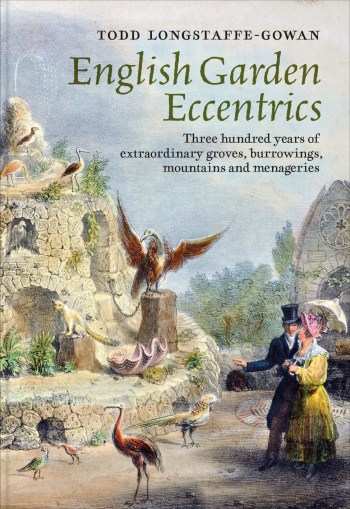 In his new book, English Garden Eccentrics, renowned landscape architect and historian Todd Longstaffe-Gowan reveals a series of obscure and eccentric English garden-makers who, between the early seventeenth and the early twentieth centuries, created intensely personal and idiosyncratic gardens. They include such fascinating characters as the superstitious antiquary William Stukeley and the animal- and bird-loving Lady Read, as well as the celebrated master of Vauxhall Gardens, Jonathan Tyers, who created at his home at Denbies one of the gloomiest and most perverse anti-pleasure gardens in Georgian England. Others built miniature mountains, shaped topiaries, displayed exotic animals, excavated caves, and assembled architectural fragments and fossils to realise their gardens in a way that was often thought to be excessive.
With quirky and compelling illustrations and chapters including “Lady Broughton’s ‘Miniature Copy of the Swiss Glaciers’,” “Topiary on a Gargantuan Scale: The Clipped ‘Yew-trees’ at Four Ancient London Churchyards,” and “The Burrowing Duke at Harcourt House,” English Garden Eccentrics brings together garden and landscape history with cultural history and biography. The book engagingly reveals what it is about the gardener and his or her creation that can be seen as eccentric and focuses on an area of garden history that has scarcely been previously explored: gardens seen as expressions of the singular character of their makers, and therefore functioning, in effect, as a form of autobiography. This lively and accessible book calls on gardeners today to learn from example and dare to be eccentric.
Todd Longstaffe-Gowan is a landscape architect with an international practice based in London. He is gardens adviser to Historic Royal Palaces, lecturer at New York University (London), president of the London Gardens Trust, editor of The London Gardener, and author of several books including The London Town Garden (Yale, 2001) and The London Square (Yale, 2012).
Online Courses from the V&A, Autumn 2022
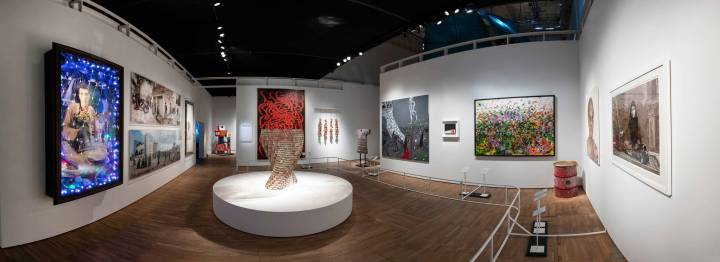
Installation view of the exhibition Epic Iran (London: V&A, 29 May 2021 — 12 September 2021).
◊ ◊ ◊ ◊ ◊
A selection of upcoming online courses from the V&A:
Principles of Exhibition Making
V&A Academy Online, Tuesdays, 13.00–16.30, 13 September — 18 October 2022
Working with the V&A’s expert staff and industry professionals, you will study the process and driving ideas behind V&A exhibition-making: from concept to build and design, you will get a 360-degree insight into the major considerations when putting on a show. Focusing on six key themes—mission, audience, research, experience design, project management, and collaboration—this course will give you the skills and knowledge you need to feel more confident about putting on an exhibition of your own.
The course is intended primarily for people who are early- or mid-career in the museum/heritage sector or people interested in working in exhibitions. It will be delivered online and will be made up of live presentations, tutorials, panel discussions, exclusive interviews, and small-group workshop sessions, designed to create an engaging and interactive experience whichever time zone you are joining from. Course fee: £365. More information»
Course director Matilda Pye is an independent curator, educator, and a V&A Research Institute, Paul Mellon, Public Engagement Fellow. Since 2004 she has worked with museums and galleries in the UK and internationally including Tate, the National Portrait Gallery, Royal Museums Greenwich, and the Baltic Centre for Contemporary Art.

François Boucher, Portrait of Madame de Pompadour, detail, 1758, oil on canvas, 29 × 22 inches (London: V&A, 487-1882).
◊ ◊ ◊ ◊ ◊
The Age of Revolutions: Art in 18th-Century Europe
V&A Academy Online, Thursdays, 10.30–16.30, 22 September — 8 December 2022
From Rococo to Romanticism, explore a remarkable period in the history of art. Expert lecturers will bring to life themes such as taste, patronage, and the art market, while you discover how artists and designers responded to an age of enlightenment and revolution.
The 18th-century art world was remarkable in its stylistic diversity, from the austere British Palladian style to the exuberance of continental Rococo. By the early nineteenth century, two leading cultural movements, Neo-classicism and Romanticism, co-existed to dynamic effect in the fields of art, design, and architecture. Throughout Europe, increasing wealth, together with better opportunities for travel, widened the market for both the fine and decorative arts. Drawing on the V&A’s collections, expert lecturers will trace stylistic developments within a wider political and cultural context, and in relation to themes such as taste, patronage and the art market. Course fee: £395. More information»
Course director Kathy McLauchlan is an art historian specialising in French painting and lecturer with the Arts Society, Morley College, and Oxford University. Guest lecturers include Justine Hopkins, specialist in 19th- and 20th-century art and design; Angela Cox, specialist in British painting; and Jacqueline Cockburn, Director of Art and Culture Andalucía and lecturer for the V&A and the Arts Society.
22 September | Introductions
• Introduction to the Course — Kathy McLauchlan
• Historical Background — Angela Cox
• Patrons and Markets — Kathy McLauchlan
• Introduction to the Museum: The Ceramic Staircase — Justine Hopkins
29 September | Institutions and Ideals
• Academies — Kathy McLauchlan
• Language of Architecture — Caroline Knight
• How to Look at a Painting — Angela Cox
• Meet and Greet
6 October | French Style
• Inventing the fête champêtre — Jeremy Howard
• Madame de Pompadour as Patron — Barbara Lasic
• Interiors — Barbara Lasic
• Spotlight Session: 18th-Century Bronzes — Kira d’Alburquerque
13 October | Fantasy and Imagination
• ‘All Spirit and Fire’: The Art of Giambattista Tiepolo — Catherine Parry-Wingfield
• Meissen and Sèvres — Susan Bracken
• Catholic Magnificence: Architecture of Germany and Central Europe — Clare Ford-Wille
• Spotlight Session: A Virtual Menagerie in Dresden 1732 — Susan Bracken
20 October | Capturing Life
• Hogarth’s Narratives — Justine Hopkins
• Painting with Feeling: The Art of Chardin — Clare Ford-Wille and Kathy McLauchlan
• French Sculptors from Pigalle to Houdon — Catherine Parry-Wingfield
27 October | Lure of Italy
• Grand Tour — Clare Ford-Wille
• Rome, Art Capital of the World — Kathy McLauchlan
• England’s Country Houses — Caroline Knight
• Spotlight Session. Palladio’s Quattro Libri — Caroline Knight
3 November | Business of Art
• Carriera, La Tour, Liotard: Masters of the Pastel Portrait — Clare Ford-Wille
• Images for All: London and the Print Market — Angela Cox
• Reynolds, Gainsborough, and the Business of Portraiture — Angela Cox
• Spotlight Session: Design for the Enlightenment — Caroline McCaffrey-Howarth
10 November | Town and Country
• The British Watercolour, from Cozens to Cotman — Angela Cox
• From Garden Architecture to Landscape Architecture: William Kent to Capability Brown — TBC
• London Entertainment and the Arts — Catherine Parry-Wingfield
• Spotlight Session: Canova’s Theseus — Justine Hopkins
17 November | Revolution
• Boullée, Visionary Architect — Barbara Lasic
• Jacques-Louis David: Revolution to Empire — Kathy McLauchlan
• Blake, Palmer, and Revolution — Justine Hopkins
24 November | Age of Napoleon
• Empire Style — Clare Ford-Wille
• Canova and the New Sculpture — Justine Hopkins
• Goya — Justine Hopkins
• Spotlight Session: Behind the Scenes at the Royal Collection, The Waterloo Chamber — Richard Williams
1 December | Romantics
• Pugin, Landseer, and the Revival of the Middle Ages — Justine Hopkins
• The Victorian Dream of Chivalry: Spectacle, Pageantry, and Bad Weather — Tobias Capwell
• The New Houses of Parliament — Justine Hopkins
• Spotlight Session: Behind the Scenes at the Wallace Collection — Tobias Capwell
8 December | Lure of the Past
• Friedrich and the Spirit of Longing — Justine Hopkins
• Géricault and Delacroix: Romantics at the Salon — Kathy McLauchlan
• Constable and Turner — Angela Cox

The Age of Glass, 1650 to Now
V&A Academy Online, Wednesdays, 14.00–16.30, 2 November — 7 December 2022
In celebration of the United Nations 2022 International Year of Glass, museum curators, historians, and artists will explore the global history of glass from 1650 to the present. This 6-week course follows a chronological structure, from the early modern methods of glassmaking in Venice, to experiments at 17th-century London glasshouses, and the celebrated Crystal Palace at the Great Exhibition of 1851. Bringing in historic and contemporary approaches to the study of glass, it shines a light on techniques, materials, makers, and markets and aims to celebrate the significant role played by glass in wider social, cultural, and historical contexts. Each week we will cover a range of themes, including materials and techniques, dining, industry, empire, historic recreation, women glass artists, and the role of gender in a largely male-dominated world. Course fee: £120. More information»
Course leader Dr Caroline McCaffrey-Howarth specialises in the histories of collecting and displaying European decorative arts, 1650–1900. She was previously V&A Curator, Ceramics and Glass, 1600–1800 and is now Lecturer in 18th- and 19th-Century Visual and Material Culture in the History of Art Department at the University of Edinburgh.
2 November | Materials, Makers, and Markets
• Introduction — Caroline McCaffrey Howarth
• Selling and Making Glass in 17th- and 18th-Century London — Caroline McCaffrey-Howarth
• Recorded Tour of V&A Glass Galleries, with live Q&A session — Reino Liefkes, Senior Curator, Ceramics and Glass
9 November | Glass Techniques
• Historic Recreation — TBC
• Live Studio Demonstration with Q&A — Bethany Wood, Glass Artist and Founder of Blowfish Gallery
16 November | The Global Story of Glass
• Transparency and Enlightenment, Race and Glass — Kerry Sinanan, University of Texas and Rakow Researcher, Corning Museum of Glass
• Artist Spotlight Session — Chris Day, Glass and Ceramics Artist
23 November | A Glassy Society
• Breaking the Ice with Glass, Canons, Blue Balls, Fountains, and Fantasy Animals in the National Glassmuseum in Leerdam — Kitty Laméris, Dutch Glass Expert
• Dining in Style in the 18th Century: The Age of Glass — Kit Maxwell, Curator of Applied Arts, Art Institute Chicago; curated the 2020–22 exhibition In Sparkling Company, Corning Museum of Glass
30 November | Glass and Industry
• Antonio Salviati and the 19th-Century Revival of Venetian Glass — Reino Liefkes, Senior Curator, Ceramics and Glass
• The New Stourbridge Glass Museum (opened April 2022) and the Growth of the British Glass Industry — Harrison Davies, Curator, Stourbirdge Glass Museum
7 December | Breaking the Glass Ceiling: Women and Glass
• Pioneer Women in 20th-Century Glass — Diane Wright, Curator of Glass, Toledo Art Museum
• Artist in Focus: Maria Bang-Espersen (Watch: Maria Bang Espersen WSKG Arts & Culture short)
Exhibition | Beauty and Ritual: Judaica from The Jewish Museum, NY
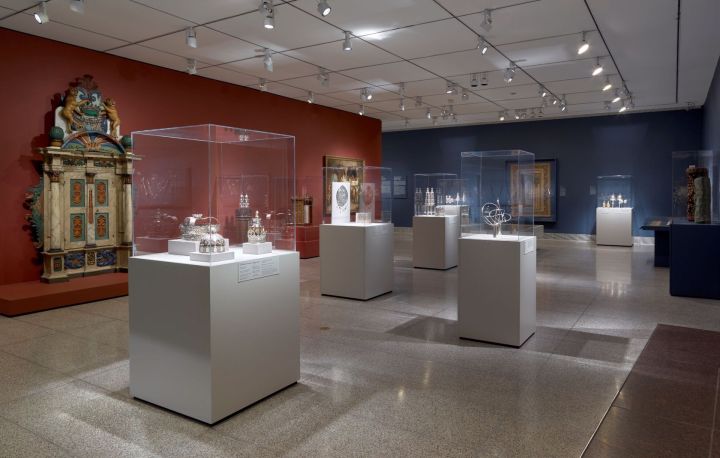
Now on view at the MFAH:
Beauty and Ritual: Judaica from The Jewish Museum, New York
Museum of Fine Arts, Houston, 10 July — 18 September 2022
Examining Jewish ceremonial objects from antiquity to the present, Beauty and Ritual: Judaica from the Jewish Museum, New York marks the first in a series of presentations from the world-renowned collection of the Jewish Museum in New York City. The new, ongoing partnership between the MFAH and the Jewish Museum brings exceptional objects to Houston over a period of years.

Torah Ark, 18th century, pinewood: carved and painted; fabric: embroidered with metallic thread (The Jewish Museum, New York, gift of Arthur Heiman; photograph by John Parnell).
Beauty and Ritual explores the artistic, ritualistic, and cultural significance of more than 140 works. The objects on view derive from Jewish communities throughout the world, spanning Central Asia to North Africa and Western Europe. The exhibition also explores how artists—from different backgrounds—and Jewish communities have creatively adapted traditional forms of Judaica by utilizing a rich array of styles, materials, and techniques, and drawing on broader cultures. The exhibition comprises three thematic galleries: “The Art of the Synagogue: Adorning the Torah,” “A Day of Rest: The Radiance of the Sabbath,” and “Beyond the Synagogue and the Home: The Light of the Hanukkah Menorah.”
In early 2023, the Albert and Ethel Herzstein Gallery for Judaica opens at the MFAH for the ongoing presentation of objects on loan from the Jewish Museum.
From the press release (8 June 2022) from The Jewish Museum:
The Museum of Fine Arts, Houston, and The Jewish Museum, New York today announced a partnership to establish an ongoing presence for Judaica at the MFAH: In July 2022, the MFAH will open the exhibition Beauty and Ritual: Judaica from The Jewish Museum, New York, the first step in the ongoing partnership, which will bring exceptional objects from the Jewish Museum to Houston over a period of years. In early 2023, ongoing presentations centered on objects on loan from the Jewish Museum will begin when The Albert and Ethel Herzstein Gallery for Judaica opens at the MFAH. The Herzstein Gallery is a centerpiece of the World Faiths Initiative at the MFAH, a program of interfaith projects based on the museum’s collections and exhibitions and funded by the Lilly Endowment Inc.
Commented Gary Tinterow, Director, Margaret Alkek Williams Chair, of the MFAH: “The first significant piece of Judaica to enter the Museum’s collection was the Montefiore Mainz Mahzor, in 2018. Calligraphed and illustrated around 1310 in Mainz, some 150 years before Gutenberg would print his Bible in that same medieval town, the Mahzor is one of the earliest surviving illuminated Jewish prayer books from Central Europe. Now, with this significant partnership with The Jewish Museum, New York, and access to their extraordinary collections, we are able to amplify the cultural and artistic history of Judaism, first with this summer’s exhibition, Beauty and Ritual, and, beginning early next year, with presentations in the newly endowed, permanent Judaica gallery. I am enormously grateful to the Jewish Museum, New York, for their partnership, and to The Albert and Ethel Herzstein Foundation, in making possible this permanent presence for Judaica and historic Jewish traditions at the MFAH.”
“After two years of discussion and planning, I am delighted that the Museum of Fine Arts, Houston will be offering its audiences a chance to see highlights from the Jewish Museum’s renowned collection of Judaica,” commented Claudia Gould, the Helen Goldsmith Menschel Director of The Jewish Museum, New York. “There are very few general fine-arts museums in the nation that have a dedicated space for Judaica, and this exciting collaboration will have significant impact on the field. As head of the Jewish Museum in New York, which maintains a unique collection of nearly 30,000 works of art, ceremonial objects, and media including one of the world’s major Judaica collections, I am looking forward to working with the MFAH on this important initiative.”
About Beauty and Ritual: Judaica from The Jewish Museum, New York
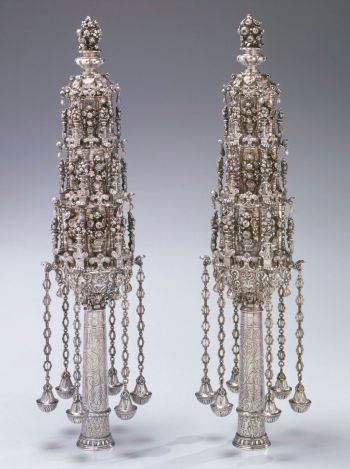
Torah Finials, early 18th century, silver: cast repousse, and engraved (The Jewish Museum, New York)
The exhibition Beauty and Ritual: Judaica from The Jewish Museum, New York is the first of a series of presentations at the MFAH from the collection of The Jewish Museum, New York. The exhibition will feature over 140 objects from the Jewish Museum’s world-renowned collection, examining Jewish ceremonial objects from antiquity to the present and exploring their artistic, ritualistic, and cultural significance.
The objects presented derive from Jewish communities throughout the world, ranging from Central Asia to North Africa and Western Europe. The exhibition also explores how artists— from different backgrounds—and Jewish communities have creatively adapted traditional forms of Judaica by utilizing a rich array of styles, materials, and techniques, and drawing on broader cultures. Three thematic galleries explore the ceremonial objects used for Jewish practice in the synagogue, in the home and beyond.
“The Art of the Synagogue: Adorning the Torah” features ceremonial objects used within the synagogue for the purpose of beautifying and protecting the Torah, the central ritual text of Judaism. One Torah ark, intended for housing the Torah, is a monumental 18th-century pinewood enclosure from Bavaria. The ark echoes the colorful, painted decorations of houses of that region, resembling an entrance to a home, and, at 10 feet in height, nearly at the same scale.
“A Day of Rest: The Radiance of the Sabbath” presents Judaica traditionally used for the Sabbath, the weekly day of rest. At the center of the gallery will be a 2012 commission for the Jewish Museum by artist Beth Lipman. In this ethereal work, Beth Lipman drew inspiration from traditional Jewish ceremonial objects in the museum’s collection, including those used for the Sabbath. The piece is a table set with an abundance of glass objects, evocative of the Baroque still life tradition of the vanitas painting in which worldly objects are shown together with symbols of mortality to prompt reflection on the inherent transience of beauty and life. The work conveys the household table as a place where festivity, family, history, and the fragile passing of time converge.
“Beyond the Synagogue and the Home: The Light of the Hanukkah Menorah,” examines the menorah, traditionally the lamp used to celebrate the holiday of Hanukkah, the eight-day festival of lights. This final gallery of the exhibition showcases the menorah’s history and visual presence as a symbol of Jewish culture to the world—from the earliest times with a fired-clay lamp from the third to the fifth century CE, to elaborate 18th- and 19th-century Italian and German metalwork, and to 20th-century depictions by modern artists Marc Chagall and Ben Shahn.
About the World Faiths Initiative at the MFAH
Funded by a grant from the Lilly Endowment Inc., the Museum of Fine Arts, Houston’s World Faiths Initiative seeks to activate themes of religion, faith and spirituality in the Museum’s encyclopedic collections through innovative programming and reimagined displays. The focus on the many expressions of faith in the collections of the MFAH seeks to honor the diverse communities of Houston and inspire connections across cultures and beliefs. The World Faiths Initiative is centered on both The Albert and Ethel Herzstein Gallery for Judaica and cross-cultural installations and public programming exploring faith and spirituality, activities that serve the Museum’s long-term goals of representing world religions within the permanent collection. The project team is being led by Aimée Froom, MFAH curator, Art of the Islamic Worlds, and Caroline Goeser, W.T. and Louise J. Moran Chair of Learning and Interpretation. The initiative is supported with grant funds from the Lilly Endowment Inc.










 Enfilade
leave a comment