New Book | New World Objects of Knowledge
Distributed by The University of Chicago Press:
Mark Thurner and Juan Pimentel, eds., New World Objects of Knowledge: A Cabinet of Curiosities (London: University of London Press, 2021), 350 pages, ISBN: 978-1908857828, $75.

From the late fifteenth century to the present day, countless explorers, conquerors, and other agents of empire have laid siege to the New World, plundering and pilfering its most precious artifacts and treasures. Today, these natural and cultural products—which are key to conceptualizing a history of Latin America—are scattered in museums around the world. With contributions from a renowned set of scholars, New World Objects of Knowledge delves into the hidden histories of forty of the New World’s most iconic artifacts, from the Inca mummy to Darwin’s hummingbirds. This volume is richly illustrated with photos and sketches from the archives and museums hosting these objects. Each artifact is accompanied by a comprehensive essay covering its dynamic, often global, history and itinerary. This volume will be an indispensable catalog of New World objects and how they have helped shape our modern world.
Mark Thurner is professor of Latin American studies at the University of London. His books include The First Wave of Decolonization and History’s Peru: The Poetics of Colonial and Postcolonial Historiography. Juan Pimentel is research professor in the history of science at the Centro de Ciencias Humanas y Sociales, CSIC, Madrid. He is the author of many books, including The Rhinoceros and the Megatherium: An Essay in Natural History.
C O N T E N T S
Introduction by Mark Thurner and Juan Pimentel
Part 1: Artificialia
1 Codex Mendoza by Daniela Bleichmar
2 Macuilxochitl by Juan Pimentel
3 Potosi by Kris Lane
4 Piece of Eight by Alejandra Irigoin and Bridget Millmore
5 Pieza de Indias by Pablo Gomez
6 Rubber by Heloisa Maria Bertol Domingues and Emilie Ana Carreón Blaine
7 Silver Basin by Mariana Francozo
8 Feathered Shield by Linda Baez
9 Black by Adrian Masters
10 Cards by Jorge Canizares Esguerra
11 Mary’s Armadillo by Peter Mason
12 Mexican Portrait by Andrés Gutiérrez Usillos
13 Clay Vessel by Jorge Canizares-Esguerra
14 Singing Violin by Jorge Canizares Esguerra
15 Creole Cabinet by Juan Pimentel and Mark Thurner
16 Modern Quipu by Sabine and William Hyland
17 Memory Palaces by Jorge Canizares-Esguerra
18 Inca Mummy by Christopher Heaney
19 Xilonen by Miruna Achim
20 Machu Picchu by Amy Cox-Hall
Part 2: Naturalia
21 Amazon by Roberto Chauca
22 Bird of Paradise by Jose Ramon Marcaida
23 Emeralds by Kris Lane
24 Pearls by Jorge Canizares Esguerra
25 Cochineal by Miruna Achim
26 Opossum by Jose Ramon Marcaida
27 Guinea Pig by Helen Cowie
28 Bezoar by Jose Pardo-Tomas
29 Cacao by Peter Mason
30 Strawberry by Elisa and Ana Sevilla
31 Volcano by Sophie Brockmann
32 Andes by Mark Thurner and Jorge Canizares-Esguerra
33 Anteater by Helen Cowie
34 Megatherium by Juan Pimentel
35 Tapir by Irina Podgorny
36 Cinchona by Matthew Crawford
37 Potato by Rebecca Earle
38 Guano by Gregory Cushman
39 Tortoise by Elizabeth Hennessey
40 Darwin’s Hummingbird by Iris Montero
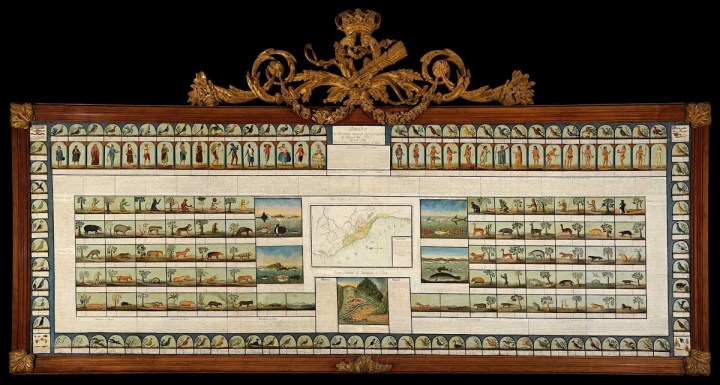
José Ignacio de Lequanda and Louis Thiébaut, Quadro de Historia Natural, Civil y Geográfica del Reyno del Perú, 1799, 331 × 119 cm (Madrid: Museo Nacional de Ciencias Naturales). This exceptional work presents 195 scenes and 381 figures describing the physical geography, the history, the ethnography, the fauna, and flora of the Peruvian Viceroyalty, via Google Arts & Culture.
Online Talk | Felicity Myrone on Prints and Drawings at the BL

King’s Concordance, C.23.e.4. f.34r (London: The British Library).
◊ ◊ ◊ ◊ ◊
Felicity Myrone | Prints and Drawings at the British Library: Revealing Hidden Collections
Wallace Collection Seminars on the History of Collections and Collectin
Online, Monday, 25 July 2022, 17.30 (BST)
It is our pleasure to invite you to the next Wallace Collection Seminar in the History of Collecting. Viewing options are provided below.
The British Library’s collections contain extensive visual materials, much originating from its foundation as part of the British Museum. While the collections that remained at the Department of Prints and Drawings at the British Museum have now been fully catalogued, there is currently no index or catalogue to the British Library’s far more extensive holdings of prints and drawings. Valuable and diverse collections and materials are usually unlisted and undescribed, found in collective records and in items categorised as other formats.
A project to make more of the Library’s collections accessible is now underway. With the support of a Getty Paper Project grant and building on a Paul Mellon Mid-Career Fellowship, this involves writing the first handbook to the prints and drawings collections. What do we hold and why? How are our prints and drawings currently described, or more commonly, not? How can archival research into the collections—including historic acquisitions and Library/Museum duplication and transfers—help us to question the long-held assumption that art found its natural place at the Print Room? This paper explores how the perceived purpose and status of prints and drawings has varied and developed in the context of library collections in the 18th and 19th centuries, using case studies drawn from the history of the British Museum and Library.
Felicity Myrone is Lead Curator of Western Prints and Drawings at the British Library in London.
New Book | Collectionner: Acteurs, Lieux, et Valeurs, 1750–1815
This collection of conference essays will not be commercially available, though copies will be distributed to select academic libraries; see the GRHAM website:
Ludovic Jouvet, Alice Ottazzi, and Maël Tauziède-Espariat, eds., Collectionner: Acteurs, Lieux, et Valeur(s), 1750–1815 (Paris: Editions du GRHAM, 2022, ISBN: 978-2955954621.
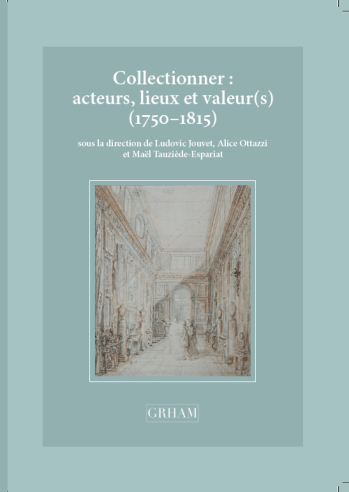 Le présent ouvrage réunit les actes du colloque organisé par le GRHAM (Groupe de Recherche en Histoire de l’art Moderne) et le Séminaire Collection les 26 et 27 octobre 2020. Dans une perspective interdisciplinaire innovante, les douze contributions questionnent la pratique du collectionnisme au tournant des XVIIIe et XIXe siècles. Alors que le rationalisme des Lumières, friand de taxinomie, a parfois entraîné une histoire simplifiée du collectionnisme, ces contributions soulignent au contraire la grande diversité des pratiques parallèlement à la normalisation de certains lieux, objets ou statuts du collectionneur.
C O N T E N T S
• Une culture de la collection au XVIIIe siècle ? — Olivier Bonfait
• La réception de Jean Warin au XVIIIe siècle — Ludovic Jouvet
• Gendering Collecting, Collections, and Consumption in 18th-Century Paris — Natasha Shoory
• L’art britannique à Paris au XVIIIe siècle : le recueil gravé comme outil pour l’étude de la réception — Alice Ottazzi
• Collecting Landscape Drawings in 18th-Century Paris: Delectare and Docere — Camilla Pietrabissa
• Antiques et culture d’un amateur et financier parisien de la seconde moitié du XVIIIe siècle : le salon et la bibliothèque d’Harenc de Presle (1710–1802) — Maël Vandewalle
• La pratique de la collection chez le financier de la seconde moitié du XVIIIe siècle — Élodie Kong
• La restitution des biens étrangers sous le Consulat : politique et finance relatives à deux tableaux de Claude Lorrain — Christine Godfroy-Gallardo
• Le Goût des Anglais pour le Mobilier Français: Collectors, Dealers, and the Market, 1785–1815 — Diana Davis
• Redécouverte d’une collection particulière parisienne du XVIIIe siècle : le cabinet de Louis Petit de Bachaumont — Léo Davy
• Le médailliste du siècle des Lumières : entre érudition, prestige et sociabilité — Charlotte Rousset
• Perfide Albion ! Douce Angleterre ? Le collectionnisme d’antiques en temps de rivalité napoléonienne à travers l’exemple croisé de Lord Elgin et du comte de Choiseul-Gouffier — Odile Boubakeur
• Le cabinet d’objets d’art de Balthazar-Georges Sage : la découverte d’une collection entre cabinet particulier et musée au tournant de la Révolution — Maddalena Napolitani
Exhibition | Louis Gauffier’s Journey to Italy
Now on view at the Musée Fabre:
Le Voyage en Italie de Louis Gauffier (1762–1801)
Musée Fabre, Montpellier, 7 May — 4 September 2022
Musée Sainte-Croix de Poitiers, 14 October 2022 — 12 February 2023
Curated by Pierre Stepanoff
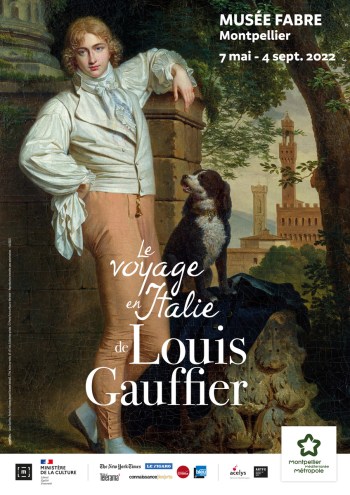 Cette exposition d’été au musée Fabre, organisée en collaboration avec le musée Sainte-Croix de Poitiers—où elle sera présentée du 14 octobre 2022 au 12 février 2023—est la première consacrée à la carrière de Louis Gauffier, peintre de la fin de XVIII e siècle.
Né à Poitiers en 1762, Louis Gauffier est de ces artistes européens pour qui l’Italie fut une terre d’élection. Vainqueur du Prix de Rome en 1784, il découvre la Ville Éternelle et ses vestiges, puis Florence et la Toscane à partir de 1793, jusqu’à son décès précoce en 1801.
Le peintre déploie son art aussi bien dans les sujets mythologiques que bibliques, les portraits et le paysage. À l’orée du XIX e siècle, il propose des formules nouvelles d’une grande originalité, intimes et poétiques, qui le distinguent de ses contemporains. Le charme singulier de ses toiles explique la riche représentation du peintre dans les musées français et internationaux, qui soutiennent par leur prêts l’exposition du musée Fabre : musée des Offices à Florence, Kenwood House à Londres, National Gallery of Scotland à Edimbourg, Nationalmuseum à Stockholm, Philadelphia Museum of Art, Minneapolis Art Institute, Fine Art Museums à San Francisco, National Gallery of Victoria à Melbourne.
C’est en Italie, à Rome puis à Florence, que Louis Gauffier et François-Xavier Fabre devinrent camarade et amis. Le soin avec lequel Fabre recueilli des œuvres de son ami après son décès précoce explique aujourd’hui la très belle représentation de Gauffier au musée de Montpellier, dont l’exposition permettra de découvrir la richesse de sa carrière.
L’exposition montre à travers des sections chronologiques et thématiques l’évolution de la carrière de Gauffier, aussi bien dans le langage néoclassique qu’il développe dans ses peintures d’histoire, marquées par une grande curiosité archéologique comme par un sentimentalisme doux, ou encore dans son goût novateur pour le paysage, mettant en scène l’aristocratie européenne du Grand Tour partant à la découverte de la Toscane.
Cette rétrospective mettra également l’artiste en perspective avec ses contemporains, qu’il s’agisse de ses camarades français, Drouais, Gagneraux et surtout Fabre, mais également avec le contexte artistique italien profondément marqué par des peintres issus de toute l’Europe et dans lequel s’inscrit Gauffier, notamment dans ses portraits et ses paysages. C’est à une véritable découverte de l’Italie du Grand Tour que le visiteur sera convié.
Pierre Stepanoff,, ed., Le voyage en Italie de Louis Gauffier (Ghent: Éditions Snoeck, 2022), 408 pages, ISBN: 978-9461615831, €39.
Exhibition | Renoir: Rococo Revival
I’m sorry to have missed notice of this exhibition earlier. There is an excellent ‘digitorial‘ component, and the catalogue is still available. –CH
Renoir: Rococo Revival
Städel Museum, Frankfurt am Main, 2 March — 19 June 2022
Curated by Alexander Eiling, Juliane Betz, and Fabienne Ruppen
Pierre-Auguste Renoir (1841–1919) was one of the outstanding painters of French Impressionism—and far more than that. For the first time the Städel Museum addressed the surprising references in his art to Rococo painting in a large-scale special exhibition. Whereas Rococo painting was considered frivolous and immoral after the French Revolution, it underwent a revival in the nineteenth century and was widely visible in Renoir’s lifetime.
Having trained as a porcelain painter, Renoir was intimately acquainted with the imagery of artists such as Antoine Watteau, Baptiste Siméon Chardin, François Boucher, and Jean-Honoré Fragonard. He shared the Rococo’s predilection for certain subjects, among them promenaders in the park and on the riverbank, moments of repose in the outdoors, and the garden party. Renoir also frequently devoted himself to the depiction of domestic scenes and family life as well as intimate moments such as bathing, reading, or making music. Yet he not only took orientation from the motifs of the Rococo, but also particularly admired its loose and sketchy manner of painting as well as its brilliant palette, aspects that would have a formative influence on him and many other artists in the Impressionist circle.
Trenchant juxtapositions of Renoir’s art with works of the eighteenth century as well as his own contemporaries—Edgar Degas, Édouard Manet, Claude Monet, and Berthe Morisot—provided an overview of Impressionism’s intense artistic examination of the Rococo. The exhibition showed a total of some 120 outstanding paintings, works on paper and handcrafted objects from international museums such as the National Gallery in Washington, D.C., the Musée d’Orsay in Paris, the National Gallery in London, the Metropolitan Museum of Art in New York, the J. Paul Getty Museum in Los Angeles, as well as private collections.
Curators
Dr. Alexander Eiling (Head of Modern Art, Städel Museum), Dr. Juliane Betz (Deputy Head of Modern Art, Städel Museum), Dr. Fabienne Ruppen (Research Assistant, Modern Art, Städel Museum)
Alexander Eiling with Juliane Betz and Fabienne Ruppen, eds, Renoir: Rococo Revival (Stuttgart: Hatje Cantz, 2022), 328 pages, ISBN 978-3775751346 (English edition), ISBN 978-3775751339 (German edition), €50. Text by Michela Bassu, Juliane Betz, Alexander Eiling, Guillaume Faroult, Marine Kisiel, Matthias Krüger, Mary Morton, Astrid Reuter, and Fabienne Ruppen.
Exhibition | Fantastically French! Design and Architecture in Prints
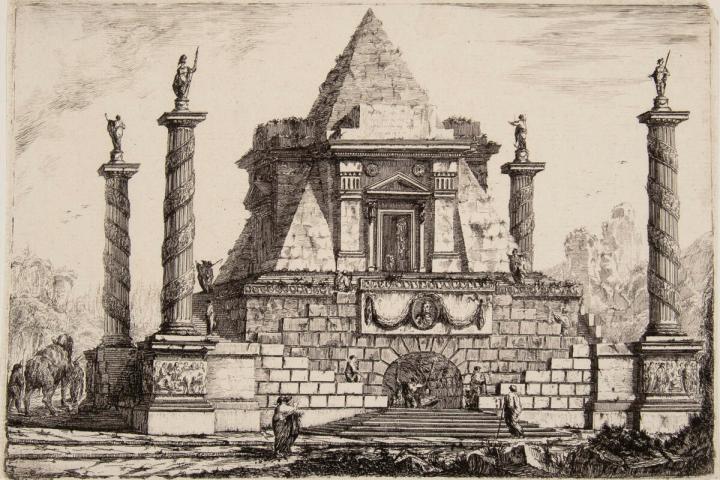
Pierre Moreau, Mausoleum, 1730, etching, approximately 5 × 8 inches
(Blanton Museum of Art, The University of Texas at Austin)
◊ ◊ ◊ ◊ ◊
Now on view at the Blanton Museum of Art:
Fantastically French! Design and Architecture in 16th- to 18th-Century Prints
Blanton Museum of Art, The University of Texas at Austin, 5 March — 14 August 2022
From arabesques to grotesques and from sphinxes to snails, French printmakers combined ancient decorative motifs with newly invented ones to create designs for everything from jewelry to architectural façades. Beginning in the mid-sixteenth century with ornamentation for the royal hunting lodge of Fontainebleau, through garden designs at the palace of Versailles, to patterns for eighteenth-century home furnishings, prints were important sites of invention and served as vehicles for the proliferation of decorative motifs across a variety of media. Drawing primarily from the Blanton’s extensive holdings of French prints, this exhibition invites visitors to look closely at exquisite details, marvel at fantastic forms, and take delight in ornate embellishments that celebrate the creativity of artistic imagination across three centuries.
New Book | Grinling Gibbons and His Contemporaries
From Brepols:
Ada De Wit, Grinling Gibbons and His Contemporaries (1650–1700): The Golden Age of Woodcarving in the Netherlands and Britain (Turnhout: Brepols, 2022), 426 pages, ISBN: 978-2503584881, €150.
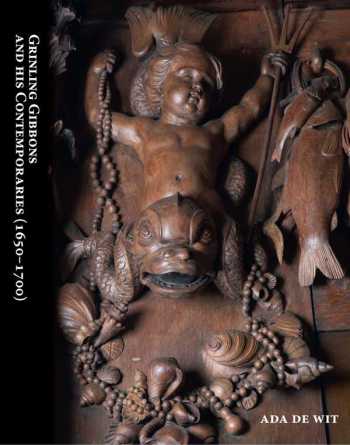 One of the greatest artists of the English Baroque, Grinling Gibbons (1648–1721) was born in Rotterdam to English parents. He moved to England at the age of nineteen and embarked on a spectacular career. His exuberant lifelike carvings in limewood can be admired at Hampton Court Palace and at St Paul’s Cathedral in London. But what was the Dutch tradition that shaped him? And what set him apart from the other carvers of his time? This book explains the importance of woodcarving and provides new insights into the work of woodcarvers in the Netherlands and Britain. Full of discoveries and new images, it discusses little-known interiors, objects, craftsmen, and their patrons and provides a rich introduction to the ornamental world of woodcarving.
Ada de Wit is Curator of Works of Art and Sculpture at The Wallace Collection, London. A specialist in decorative arts and historic interiors, she is an expert on the art of Grinling Gibbons.
Call for Proposals | IDEAL Internship Grants, Decorative Arts Trust
From the Decorative Arts Trust:
IDEAL Internship Grants from the Decorative Arts Trust
Proposals due by 9 September 2022
The Decorative Arts Trust IDEAL Internship Grant program offers grants to museums and historic sites in support of internships that improve and promote inclusivity, diversity, equity, access, and leadership (IDEAL) in the museum field by creating opportunities for underrepresented communities. The Trust seeks to fund summer and academic-year internships beginning in the summer and fall of 2023, ideally for disadvantaged high school and undergraduate students. Internships should focus on the decorative arts and object-based research, exhibitions, installations, and educational programs. The Trust’s IDEAL Internship Grants are for up to $5,000 and will be remitted in 2023. There is an opportunity for a second year of funding if the grantee institution can demonstrate sufficient impact.
Learn more about this special grant opportunity here»
Exhibition | Japan—Arts and Life: The Montgomery Collection
Japan—Arts and Life: The Montgomery Collection
Museo delle Culture, Lugano, 10 February 2022 — 8 January 2023
 Japan—Arts and Life, a major exhibition dedicated to the Jeffrey Montgomery Collection, is now on view at the Museo delle Culture in Lugano. At home in Lugano for over fifty years, it is one of the largest and best-known collections of Japanese art outside Japan. With this project, MUSEC celebrates a passion for collecting and a heritage of great artistic and cultural value—a heritage that brings prestige to Lugano, consolidating the Ticino city’s historic ties with Swiss and international private art collecting.
Installed throughout two floors of the Villa Malpensata, home of MUSEC, the exhibition presents 170 works dating from the 12th to the 20th centuries—including textiles, furniture, paintings, religious and everyday-objects—each carefully selected from the over one thousand objects collected over a lifetime by Jeffrey Montgomery.
Known worldwide, the Montgomery Collection displays an extraordinary richness and a singular substance. The experience and sensitivity of the collector are at the heart of the project developed by MUSEC and mark its originality, compared to the way in which the collection has been interpreted until now. As Francesco Paolo Campione, director of MUSEC, writes in his introduction to the exhibition catalogue, “art collections can only have meaning and deep value if they are linked to an existential dimension and the human experience of those who wanted, planned, and consolidated them around themselves. The collector is indispensable to the collection: not only because he created it, but also because he guarantees its originality, interpreting the spirit of the times.”
Paolo Campione teaches Cultural Anthropology at the University of Insubria and is the Director of MUSEC. Moira Luraschi, anthropologist, is curator of the Japanese collections and the photographic collection of the Yokohama School at MUSEC.
Francesco Paolo Campione and Moira Luraschi, eds., Japan—Arts and Life: The Montgomery Collection (Milan: Skira, 2022), 288 pages, ISBN: 978-8857247724, $54.
Essays
• Francesco Paolo Campione — An Impermanent Journey between Art and Life
• Matthi Forrer — Collecting Japanese Art Objects
• Rossella Menegazzo — The Other Side of Japan: The Jeffrey Montgomery Collection between Art, Crafts, and Folklore
• Giorgio Amitran — Japan, the Beautiful, and Ourselves
• Imogen Heitmann — The Museographical Display as a Creative ‘Meta-work’
Catalogue Entries
• Paintings
• Woven Objects
• Hooks and Counterweights
• Ceramics
• Fabrics
• Lanterns
• Masks
• Furniture
• Signs
• Kettles and Pourers
• Sculptures
• Lacquers
Bibliography
Author Biographies
Workshop | Japanese Woodblock Printing
The Wonders of Woodblock Printing: Experiencing Early Modern Japan, with block cutter Nagai Saeko and printer Ogawa Nobuto, in conversation with Elenor Ling and Laura Moretti
Fitzwilliam Museum, Cambridge, 13 August 2022, 2pm
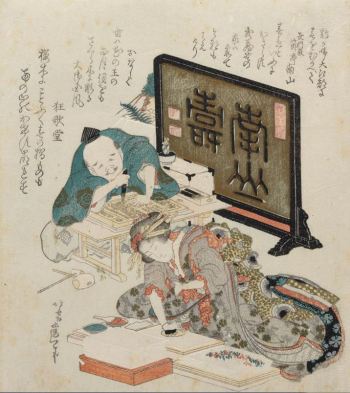
Katsushika Hokusai, Block-cutting and printing surimono, 1825, color print from woodblocks, with metallic pigment and blind embossing, 213 x 191 mm (Cambridge: Fitzwilliam Museum, P.438-1937).
Wonderfully flexible in shaping visionary mise-en-page and in combining text and images, woodblock printing fuelled a buoyant publishing industry in early modern Japan. From the seventeenth century until the end of the nineteenth century woodblock-printed books and ephemera inundated the market, firing the imagination of authors, artists, publishers, and readers. This two-hour workshop brings this rich tradition to your fingertips, featuring professional block cutter Nagai Saeko and printer Ogawa Nobuto from the Sekioka Mokuhanga studio in Tokyo. You will observe how a woodblock is cut, experience how to print from it, and engage with original early modern woodblocks. In conversation with Laura Moretti, there will be a chance to learn more about how a publisher’s workshop would have operated. There will also be an opportunity to view some of the Fitzwilliam’s colour woodblock prints and printed books in the Study Room with Curator Elenor Ling.
This workshop is run in conjunction with the Ninth Summer School in Early Modern Palaeography at Emmanuel College. It is generously sponsored by The Great Britain Sasakawa Foundation, Mitsubishi Corporation London Branch, and Jonathan Hill Bookseller.
Book your place here»










 Enfilade
leave a comment