Call for Papers | Vivre la Révolution des Colonies, 1774–1804
From the Call for Papers:
Croisements, Métissages, Trajectoires: Vivre la Révolution des Colonies, 1774–1804
Musée de la Révolution Française, Vizille, 27–29 September 2023
Proposals due by 30 September 2022
L’histoire récente des espaces coloniaux et de leur intégration à la dynamique révolutionnaire a reçu une attention méritée et soutenue ces dernières années. Il n’est désormais plus possible d’écrire l’histoire des Révolutions de la fin du XVIIIe siècle sans intégrer l’héritage colonial de l’Ancien régime et sans comprendre les événements propres à ces espaces qui influencent plus que les métropoles, les grands équilibres géopolitiques de la planète encore prise dans le duel franco- britannique pour l’hégémonie mondiale dans un jeu d’alliances des plus complexes.
Ces travaux roboratifs et nécessaires, refondant une histoire de la mondialité, ont induit des formes d’appréhension du réel, où les êtres se trouvaient pris dans des logiques de groupes qui les dépassaient ou les entrainaient. Bien souvent leurs positions pouvaient être définies par leur appartenance à un groupe social précis, à une fonction professionnelle acquise ou bien aussi par la couleur de leur peau, autant d’éléments déterminants du statut des individus au sein de conflits mêlant émancipation, lutte de classes, conquête politique.
Le colloque proposé tente une autre approche. Celle des individus, celles des personnes dans leur intégrité propre, dans leurs témoignages d’actrices et d’acteurs d’une période qui voient des bouleversements majeurs transformer leur vie. Il s’agit de retrouver les personnes dans leur complexité et dans leur individualité et tenter d’approcher au plus près leur expérience vécue des révolutions successives qui les surplombent mais dans lesquelles elles se trouvent pleinement intégrées. Comment les personnes accueillent, perçoivent, vivent les formes de catégorisation qui leur sont imposées ou qu’elles reçoivent, ou qu’elles conquièrent ? Que sont les statuts sociaux, les couleurs, les fonctions, les genres, les âges de la vie, les transferts. Comment marquent-ils les existences ?
Partir de la subjectivité des acteurs et des actrices, lorsque les sources le permettent ne revient nullement à refuser l’ensemble du travail effectué pour comprendre les catégories dans lesquelles ils et elles évoluent, mais permet de reposer les questions différemment, d’une histoire au ras du sol, au plus près des personnes.
Ce sont donc les notions de destins historiques, de parcours individuels, de trajectoires personnelles, dans ce monde largement métissé que l’on souhaite interroger, pour rendre toute leur importance au vécu historique et à sa complexité, que l’on peut nuancer au-delà des oppositions binaires et comprendre dans son inextricable difficulté de société violente aspirant à de nouvelles formes de gouvernance pour chacun.
Le cadre chronologique tend à déplacer quelque peu les approches jusque-là classiques, séparant un avant et un après 1789, en intégrant pleinement la France de l’Ancien Régime, à l’avènement de Louis XVI en 1774, qui précède de peu la guerre d’indépendance américaine devenant une Révolution du Nouveau monde, un événement tout simplement inimaginable, impensable au moment où monte sur le trône le petit fils de Louis XV. Le questionnement se poursuit sur une période de trente ans jusqu’en 1804, date de l’indépendance d’Haïti. Ce sont ainsi trois Révolutions qui sont interrogées, si différentes, avec leur chronologie et leur spécificité et en même temps reliées entre elle par le littoral du vaste espace atlantique. Elle ne sont nullement identique pourtant elles dialoguent, s’observent, par les formes politiques qu’elles peuvent prendre, leur volonté de se conclure par une constitution, leur destin adverse de devoir affronter des guerres extérieures et civiles, et l’influence qu’elles ont eu les unes sur les autres en un jeu de miroir complexe.
En ce temps, la France d’Ancien Régime étend ses possessions au-delà des mers aux Antilles (Saint-Domingue, Guadeloupe, Martinique), en Guyane, aux Mascareignes (Réunion, Île Maurice). Les Révolutions qui secouent les rivages de l’Océan atlantique, provoquent un impact important en déclenchant des phénomènes politiques qui aboutissent à la fondation d’une république esclavagiste aux Etats-Unis mais aussi à la première abolition de l’esclavage le 4 février 1794, lors de la Première République française.
La particularité des sociétés coloniales est d’être formée de blancs ou réputés tels, de libres de couleur et des esclaves. Ces sociétés sont soumises à la servitude, au préjugé de couleur et à une dépendance étroite à l’égard de la métropole qui se manifeste par le système de l’Exclusif. Le vent de la liberté va bouleverser ce monde. Qu’en est-il de chacun et de chacune en particulier? Est-ce une ambition démesurée que d’essayer de retrouver ces vies pour les raconter dans leur transformation ? N’est-il pas temps, au contraire, d’aborder ces existences pour elles-mêmes et de les appréhender dans leur force, leur fragilité, leur humanité pleine et intègre ?
I — Sources et méthodologie
Dans un premier temps il s’agit de s’interroger sur les façons d’approcher ces destins si différents. Des communications pourront être proposées sur les sources utilisées pour écrire l’histoire des personnes dans les colonies en Révolution. Correspondance administrative, actes notariés, journaux personnels, correspondances privées, ouvrages imprimés sont les sources habituellement utilisées. Est-il possible d’en dresser une typologie ? De les repérer dans les fonds publics ou privés? Avec quelles précautions méthodologiques peut-on les employer ? D’en inventer d’autres ? À partir du repérage de ces sources et de leur dépouillement pour retrouver les destins individuels comment faire pour repenser la nature des phénomènes révolutionnaires dans les colonies ? Peut-on parler de révolutions coloniales, de révolutions dans les colonies, de colonies à l’ère des révolutions ? Comment l’étude des personnes et de leurs traces peut-elle aider à mieux concevoir une histoire globale ?
II — Trajectoires
Il s’agira de voir comment la Révolution a été reçue par des femmes et des hommes dans les colonies, mais aussi par les originaires des colonies qui vivaient sur le sol français. Certaines figures comme Julien Raimond et Vincent Ogé sont connues, mais le groupe des libres de couleur est particulièrement actif à Paris de 1789 à 1794 et nécessite encore de nouvelles études. Comment ces femmes et ces hommes mobilisent-ils le langage de la Révolution et notamment le langage des droits ?
Les communications pourront porter sur des trajectoires d’individus ou de groupes en Révolution ou en Contre-révolution. La question des récits de vie, sous la forme de biographie ou de portrait à des moments particuliers d’une existence ou de fragments de vie proposés permettraient de donner corps à l’enquête en croisant des trajectoires croisées, affrontées, adversaires mais aussi alliées, amies également. Un puzzle d’existences juxtaposées peut rendre compte d’une réalité complexe connectée, inter-sectionnelle. Il s’agirait clairement de remettre en valeur la notion de récit de vie dans une logique interprétative large des interactions entre colonies, dans les colonies et dans les métropoles.
III — Représentations
Du législateur célèbre à la plus inconnue des esclaves, l’ambition serait de dresser un ensemble de portraits qui donnerait à voir la chair et le sang de ces histoires incarnées par tant de personnes différentes. Quelle représentation la France a-t-elle de ses colonies ? Des tableaux célèbres comme le portrait de Belley (Girodet), député de Saint-Domingue à la Convention ou de Madeleine (Benoist) représentent des personnes issues des colonies. La Révolution engendre-t-elle une nouvelle représentation des individus ? Cette section peut se diviser en deux sous-parties. Le colloque entend s’ouvrir à des spécialistes de littérature et d’histoire de la littérature ainsi qu’à des historiens de l’art.
A. Littérature
Théâtre, romans… comment la fiction s’empare-t-elle des destinées entre les océans, sur les océans et quelle image façonne-t-elle des personnes dans des métropoles qui perçoivent largement ces espaces soit comme sauvages, soit comme exotiques, soit comme des espaces lucratifs, soit comme des espaces dangereux, autant d’images qu’un Victor Hugo écrivant Bug-Jargal peut véhiculer ou que madame de Duras peut décrire avec tant de finesse dans Ourika.
B. Histoire de l’art
Comment la peinture, le dessin, la sculpture se sont-ils emparés de la représentation des corps et des espaces antillais et tout particulièrement de ceux des métisses ou des noirs, par-delà le portait de Belley devenu plus que célèbre deux cents ans plus tard ! Quelles sont les possibilités de représenter les visages, l’histoire sur les corps ? Ou tout simplement les portraits des protagonistes connus ou moins connus qui ont retenu l’attention des artistes. En somme, ce colloque se propose de replacer l’individu au cours de cette histoire des révolutions des métropoles et des colonies entre 1774 et 1804 et tenter une nouvelle perception et écriture de cette histoire encore en chantier.
Comité d’organisation
Hélène Puig, Alain Chevalier, Frédéric Régent et Pierre Serna
helene.puig@isere.fr, Frederic.Regent@univ-paris1.fr, Pierreserna@wanadoo.fr
Comité Scientifique
Esther Bell, Hélène Cussac, Gusti Gaillard-Pourchet, Bernard Gainot, David Geggus, Olivier Meslay, Marie-Jeanne Rossignol, Jean-Pierre Sainton, Bertrand Van Ruymbeke .
Call for Papers | Revolutionary Speeches, Speeches about Revolutions
From the Call for Papers:
Revolutionary Speeches, Speeches about Revolutions: A Comparative Study of Revolutionary Eloquence in France and in the United States
Paris Nanterre University, 16–17 March 2023
Organized by Hélène Parent and Augustin Habran
Proposals due by 31 October 2022
“The eulogy for this American hero should be delivered by the most eloquent mouths,” Fontanes affirmed in the funeral oration he gave for George Washington in the temple of Mars on February 9, 1800. The revolutionary American hero and first president of the United States, who died in December 1799, was frequently used as a reference by the orators of the French Revolution from all political camps as a tool for various rhetorical strategies. Indeed, as they looked for founding myths and heroes that would suit the new nation, that was not founded from scratch, French revolutionaries kept convoking models from other times and spaces. The example of Washington perfectly illustrates this outstanding circulation of references. He was first celebrated in the United States as a modern Cincinnatus; and this myth was then reclaimed by French orators who had themselves been educated to classical culture.
It is this dynamic circulation of references and rhetorical and political models between these two spaces (the United States and France) at the time of their respective revolutions that this symposium aims at studying. We will focus more particularly on the representations and the founding myths that allowed for the emergence and definition of concepts including the nation, the political figure (as an ideal orator) and the people in political speeches. Furthermore, the way these two revolutionary events also became myths, symbols or models shall be analyzed through the study of their representations in literature and art more generally (painting, theater, cinema, etc.) from the time they occurred until today. As far as the American Revolution is concerned, we shall focus on the period spanning from the Declaration of Independence in 1776 to the ‘Revolution of 1800’, Thomas Jefferson’s election, that provided the ongoing debate over the very nature of federalism in the early republic with a temporary solution. Regarding the French Revolution, we shall consider the period spanning from the General Estates of 1789 to the suppression of the Tribunat, last deliberative assembly of the Empire, in 1807.
The study of these partly concurrent periods of democratic establishment will be carried out through the prism of the notion of eloquence, being defined here both as whatever has to do with the political speech per se (deliberative eloquence, parliamentary notably) and as the spaces where the latter circulates by means of imitation, repercussion or parody of the rhetorical forms and codes of the oratory genre: newspapers, essays, pamphlets, founding documents, etc.
The committee invites proposals that may address—but not limited to—the following questions:
1. The imaginary figures, symbols and models convoked in political speeches, laws, essays or newspapers of the French and American revolutions may be studied. Particular attention shall be paid to proposals allowing for a comparative perspective that will highlight the circulation of references between the two spaces (how the French Revolution reappropriates specific symbols of the American Revolution for instance) or potential similarities in the apprehension of symbols or models in both spaces. Besides the content, the question of style may also be addressed: What language(s), what style(s), what stylistic device(s) are used to express these imaginaries? What vision(s) of the ideal orator (and of the “political figure”) emerge(s) with the birth of these modern democracies? What is a representative of the people? How is this figure theorized and represented (and therefore, how is the “people” theorized and represented)? All these questions shall be addressed in the light of a striking paradox: How can one affirm inventing something new (a nation, a political regime) while using models and symbols from the past? How were those models adapted and transformed?
2. The question of the multiplicity of eloquence should also be tackled: in contrast with the parliamentary eloquence developed in dominant political spheres, where, how and through which figures does popular and minority eloquence emerge? (the eloquence of the people versus that of the elites; the eloquence of women, of African Americans, of Native Americans, etc.)
3. Ex post representations of public speaking in its plurality and of its diverse practitioners may also be studied: how are the great figures of both revolutionary periods (the Founding Fathers in the United States, the orators of the French Revolution, the figures of popular/minority eloquence, etc.) themselves turned into models or deterrents through their later (positive or negative) representations in literature and art until today? How do revolutions become new myths through the narratives developed around them? Here again, the comparative perspective will be favored.
Proposals in French or English (about 300 words) with a short bio should be sent before 31 October 2022 to Hélène Parent (hparent1404@gmail.com) and Augustin Habran (augustin.habran@gmail.com). Communications may be delivered in both French and English during the symposium.
Organizing Committee
Hélène Parent (Ph.D. in French Literature, CSLF, Paris Nanterre University) and Augustin Habran (Associate Professor of American History, REMELICE, University of Orléans)
Discours des révolutions, discours sur les révolutions: Une étude comparée de l’éloquence révolutionnaire aux États-Unis et en France
Held at Paris Nanterre University, on Thursday, 16 and Friday 17, March 2023, this symposium is part of the Dire / montrer l’éloquence, 1750–1850 project (University Paris Lumière – Paris Nanterre / Paris 8, 2021–2023).
[1] Louis de Fontanes, Éloge funèbre de Washington, prononcé dans le temple de Mars le 20 pluviôse an 8 [9 février 1800], Paris, Henri Agasse et Dupont, an VIII, p. 13.
[2] Voir par exemple Denis Lacorne, « Mémoire et amnésie : les fondateurs de la république américaine, Montesquieu et le modèle politique romain », in Revue française de science politique, N° 42-3, p. 363-374, ou encore Garry Wills, Cincinnatus : George Washington and the Enlightenment, New York, Doubleday, 1984.
[3] Voir Hélène Parent, Modernes Cicéron. La romanité des orateurs d’assemblée de la Révolution française et de l’Empire (1789-1807), thèse de doctorat soutenue à l’Université Paris Nanterre le 12 octobre 2020, 704 p.
[4] Par exemple, la Déclaration d’Indépendance, les constitutions, le Code civil, les journaux révolutionnaires, les Federalist Papers, etc.
Call for Papers, Panels, and Roundtables | ISECS 2023, Rome

Giovanni Paolo Panini, Préparation du feu d’artifice et de la décoration de la fête donnée sur la place Navone à l’occasion de la naissance du Dauphin, 30 Novembre 1729, 1729 oil on canvas, 42 × 98 inches (Paris: Musée du Louvre , 415)
◊ ◊ ◊ ◊ ◊
From ISECS:
International Society for Eighteenth-Century Studies (ISECS / SIEDS)
16th International Congress for Eighteenth-Century Studies
Rome, 3–7 July 2023
Proposals due 15 September 2022 and 31 January 2023
The Congress of the International Society for Eighteenth-Century Studies (ISECS / SIEDS) is the world’s largest meeting of specialists on all aspects of the eighteenth century, and takes place every four years. Recent ISECS congresses have been held in Montpellier (2007), Graz (2011), Rotterdam (2015), and Edinburgh (2019). The 16th ISECS Congress will be held in Rome, Italy, from Monday, 3 July to Friday, 7 July 2023. It is organized by the Italian Society for Eighteenth-Century Studies (Società Italiana di Studi sul Secolo Diciottesimo – SISSD) and hosted by Sapienza Università di Roma and Università degli Studi di Roma Tor Vergata.
While proposals for papers, panels, and roundtables on any topic relevant to the long eighteenth century (1670–1830) are warmly welcomed, we particularly invite contributions that address the Congress theme: Antiquity and the Shaping of the Future in the Age of Enlightenment.
In the 18th century, a new interpretation of the past radically innovated the dominating view of and approach to tradition. The legacy of antiquity was always there as shared memory, but the critical and analytical attitude that characterised 18th-century culture also transformed its relationship with antiquity, which was renegotiated and modernised. Indeed, the 1700s witnessed a reconstruction of the foundations of knowledge, considering not only the different forms of knowledge itself, but also the individual and his/her existence in the present. This change created a major break with the past and laid the groundwork for the new patterns of thought and expression that have developed in the subsequent ages and continue to do so, up to the present day. They build for the future, but in creative dialogue with a vanished Antiquity. The challenge that the Congress is to face lies precisely in the capturing of the deep sense and meaning of this transformation, which involves all branches of knowledge and can be approached from different perspectives and with different methodologies.
The programme will include theme-related keynote lectures, panels, round tables, and paper presentations. The congress languages are English, French, and Italian. As a first step in the scientific organization of the Congress, the online Call for Panels and Round Tables is now open from 30 April 2022 until 15 September 2022.
Please submit a proposal through https://www.isecs-roma2023.net. Panel organizers are asked to supply (1) a title, (2) a brief description of the theme of the proposed panel, and (3) a list of the panelists along with a title and abstract of their contributions. Panels have a duration of one and a half hours, and should consist of 3 to 4 speakers (depending on the amount of discussion time the panel organizer wants to provide). It is also possible to submit a panel proposal without panelists or only partly filled with panelists. A list of the accepted panels will published on the congress website before October 15.
When the online Call for individual Papers is open (from 15 October 2022 until 31 January 2023), it will be possible to submit proposals either for an already accepted open panel (i.e. a panel with fewer than 4 panelists) or for new panels to be set up by the congress organizers on the basis of the paper proposals received and selected.
Roundtable organizers are asked to supply (1) a title, (2) a brief description of the theme of the proposed round table, and (3) a list of the contributors to the round table. Please note that Panel organizers will be allowed to submit a proposal for a paper to be read in another panel if they do not contribute a paper to the panel they are chair of. Roundtable organizers and contributors will be allowed to submit a proposal for a paper anyway.
Call for Panel Proposals | HECAA at 30

Hannah Otis, View of Boston Common, about 1750
(Museum of Fine Arts, Boston, 1996.26)
◊ ◊ ◊ ◊ ◊
HECAA@30: Environments, Materials, and Futures of the Eighteenth Century
Boston, 12–15 October 2023
Proposald due by 1 September 2022
The Historians of Eighteenth-Century Art and Architecture (HECAA) announce an open call for panel proposals for our quinquennial conference, to be held in Boston, 12–15 October 2023.
On the land of the Massachusett and neighboring Wampanoag and Nipmuc peoples, Boston developed in the eighteenth century as a major colonized and colonizing site. Its status today as a cultural and intellectual hub is shaped by that context, making it a critical location to trace the cultural legacies of racism and social injustice between the eighteenth century and today. For whom is ‘eighteenth-century art and architecture’ a useful category? What eighteenth-century materials, spaces, and images offer tools or concepts for shaping our collective futures? In considering these questions, we aim to be deliberate about expanding HECAA’s traditional focus on Western European art and architecture and specifically encourage proposals from scholars working on Asia, Africa and the African diaspora, Indigenous cultures, and the Islamic world.
We invite proposals for panel topics that engage with any of the above questions from various cultural perspectives. Topics could focus on ‘environments’ (e.g., workshops, urban spaces, oceans, religious spaces, domestic spaces), ‘materials’ (e.g., silver, sugar, canvas, wood, paper), ‘futures’ (e.g., period visions of the future or new directions in the field); or ‘actors’ (e.g., artists, workers, makers, patrons). We encourage creative and expansive ways of thinking about these topics. We also welcome panel proposals addressing other questions and approaches that are vital to eighteenth-century art and architecture.
Selected organizers will be asked to form panels of 3–4 speakers delivering 15-minute papers, or a roundtable session, from a separate open call for papers that will be publicized widely in Fall 2022.
In addition to plenary sessions, the conference will feature visits to area museums and architectural sites; panels that connect to collections or places in or around Boston, Cambridge, Salem, and Providence are welcome. Panel organizers should expect to attend the conference in person.
Interested panel organizers should submit a one-page abstract describing the topic and proposed format to Stacey Sloboda (stacey.sloboda@umb.edu) and Susan Wager (susan.wager@unh.edu) by 1 September 2022. Organizers of successful panels will be asked to join HECAA if they are not already members.
New Book | The Fountain of Latona
From Penn Press:
Thomas Hedin, The Fountain of Latona: Louis XIV, Charles Le Brun, and the Gardens of Versailles (Philadelphia: University of Pennsylvania Press, 2022), 296 pages, ISBN: 978-0812253757, $70.
 Ovid tells the story of Latona, the mother by Jupiter of Apollo and Diana. In her flight from the jealous Juno, she arrives faint and parched on the coast of Asia Minor. Kneeling to sip from a pond, Latona is met by the local peasants, who not only deny her effort but muddy the water in pure malice. Enraged, Latona calls a curse down upon the stingy peasants, turning them to frogs.
In his masterful study, Thomas Hedin reveals how and why a fountain of this strange legend was installed in the heart of Versailles in the 1660s, the inaugural decade of Louis XIV’s patronage there. The natural supply of water was scarce and unwieldy, and it took the genius of the king’s hydraulic engineers, working in partnership with the landscape architect André Le Nôtre, to exploit it. If Ovid’s peasants were punished for their stubborn denial of water, so too the obstacles of coarse nature at Versailles were conquered; the aquatic iconography of the fountain was equivalent to the aquatic reality of the gardens.
Latona was designed by Charles Le Brun, the most powerful artist at the court of Louis XIV, and carried out by Gaspard and Balthazar Marsy. The 1660s were rich in artistic theory in France, and the artists of the fountain delivered substantial lectures at the Académie royale de peinture et de sculpture on subjects of central concern to their current work. What they professed was what they were visualizing in the gardens. As such, the fountain is an insider’s guide to the leading artistic ideals of the moment.
Louis XIV was viewed as the reincarnation of Apollo, the god of creativity, the inspiration of artists and scientists. Hedin’s original argument is that Latona was a double declaration: a glorification of the king and a proud manifesto by artists.
Thomas F. Hedin is Emeritus Professor of Art History at the University of Minnesota Duluth. He is the author, with Robert W. Berger, of Diplomatic Tours in the Gardens of Versailles, also published by University of Pennsylvania Press.
C O N T E N T S
Acknowledgments
Note on Measurements
List of Illustrations
Prologue
1 Foundations
2 Fountains in Context
3 Original State
4 Visual Narrative
5 Latona Group
6 Lycean Peasants
7 Panegyric and Manifesto
Epilogue
Appendix A: Execution of the Fountain
Appendix B: Mansart’s Marble Cone
Appendix C: Marsy’s Lecture of 7 December 1669
Appendix D: Nathan Whitman’s ‘Fronde Thesis’
Appendix E: Translations of Ovid
Appendix F: Elaborations of the Western Axis, Briefly
List of Abbreviations
Notes
Bibliography
Index
Illustrations follow page 90
Call for Papers | G.L.F. Laves and Colleagues, 1770–1860
From the Call for Papers:
G.L.F. Laves and Colleagues: Architects as Designers of Interiors and Furniture, 1770–1860
Museum August Kestner, Hanover, 17–18 March 2023
Proposals due by 12 September 2022
Georg Ludwig Friedrich Laves (1788–1864), among the most important representatives of classicism in Germany, decisively shaped the image of the city of Hanover with his urban-planning designs and structures. Numerous secular buildings, including the Leineschloss in the city centre—the residence of the kings of Hanover from 1837 to 1866 and today the seat of the Landtag of Lower Saxony—as well as the reconstructed Schloss Herrenhausen and private palace, are reminders of this court architect of the Kingdom of Hanover. Building alterations and new constructions based on his designs have survived in various places in what is now Lower Saxony, including Schloss Derneburg and the Schloss Celle. As part of these projects, Laves also designed the corresponding interiors, which put him in line with his famous contemporaries Karl Friedrich Schinkel (Berlin), Leo von Klenze and Jean-Baptiste Métivier (Munich), and Johann Conrad Bromeis (Kassel). A majority of the interiors designed by Laves were destroyed in World War II—such as the representative halls of the Leineschloss (1834–36) and the living quarters of the royal family in the Palais an der Leinstrasse (ca. 1818 and later)—and the furniture scattered. Based on the research project of Thomas Dann, who has a comprehensive view of designs for furniture and interiors thanks to his many years of archival work and research around surviving furniture, the Museum August Kestner is showing the exhibition G. L. F. Laves—ein Hofarchitekt entwirft Möbel from 6 November 2022 to 26 March 2023. For the first time in Hanover, a selection of Laves’s drawings for furniture and interiors will be on view, together with examples of furniture created according to his designs.
Parallel to the exhibition, mobile – Gesellschaft der Freunde von Möbel- und Raumkunst e.V., the Museum August Kestner, and the Deutsches Forum für Kunstgeschichte Paris are organizing an international conference that seeks to place Laves’s furniture and interior designs in a larger historical and cultural context. Among the well-known architects who were frequently encountered in the 19th century and who—like Laves in Hanover—designed interiors as well as furniture were the English architects Jeffry Wyatville, John Nash, and Thomas Hope, along with Charles Percier, Pierre François Léonard Fontaine, and Jakob-Ignatz Hittorff in France, and Pelagio Palagi in Italy. It is this special aspect of his work that is the focus of the conference Georg Ludwig Friedrich Laves and Colleagues: Architects as Designers of Interiors and Furniture, 1770–1860, with particular emphasis on the furniture designs. From an expanded European perspective, the question of the defining characteristics of architects’ furniture will be taken up.
Further themes and questions might include:
• What sources of inspiration/role models are called upon and what materials are preferred for the execution?
• What role do surrogate materials play, such as decoration in stucco or sheet iron and zinc?
• How did the transfer of knowledge transnationally between the architects and craftsmen work?
• What is the relationship between architect and client when it comes to the design of interior spaces?
• What sources are there on the collaboration between designers and the executing tradesmen?
The conference will take place on 17–18 March 2023 in the Museum August Kestner in Hanover and is geared towards junior and early career scholars. Proposals for a 20-minute presentation (abstract of 300 words maximum; the conference languages are German and English) together with a short biography (including email and physical address as well as institutional affiliation) should be emailed to the following address by 12 September 2022: laves@dfk-paris.org. You will be informed of the outcome of your submission by the beginning of October 2022 at the latest.
Conference Organizers
Mirjam Brandt (Museum August Kestner, Hanover), Andreas Büttner (Städtisches Museum Braunschweig), Jörg Ebeling (Deutsches Forum für Kunstgeschichte Paris), Martin Glinzer (art historian, Berlin), Henriette Graf (Stiftung Preußische Schlösser und Gärten Berlin-Brandenburg), Petra Krutisch (Germanisches Nationalmuseum, Nuremberg), and Sally Schöne (Museum August Kestner, Hanover)
◊ ◊ ◊ ◊ ◊
Note (added 27 March 2023)— A summary of the conference (in German) by Meinrad von Engelberg can be found at ArtHist.net.
New Book | Carrying All before Her
From the University of Delaware Press:
Chelsea Phillips, Carrying All before Her: Celebrity Pregnancy and the London Stage, 1689–1800 (Newark: University of Delaware Press, 2022), 304 pages, ISBN: 978-1644532492, $120 / ISBN: 978-1644532485, $35.
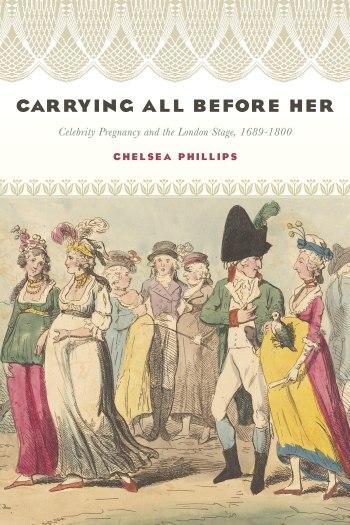 The rise of celebrity stage actresses in the long eighteenth century created a class of women who worked in the public sphere while facing considerable scrutiny about their offstage lives. Such powerful celebrity women used the cultural and affective significance of their reproductive bodies to leverage audience support and interest to advance their careers, and eighteenth-century London patent theatres even capitalized on their pregnancies. Carrying All Before Her uses the reproductive histories of six celebrity women—Susanna Mountfort Verbruggen, Anne Oldfield, Susannah Cibber, George Anne Bellamy, Sarah Siddons, and Dorothy Jordan—to demonstrate that pregnancy affected celebrity identity, impacted audience reception and interpretation of performance, changed company repertory and altered company hierarchy, influenced the development and performance of new plays, and had substantial economic consequences for both women and the companies for which they worked. Deepening the fields of celebrity, theatre, and women’s studies, as well as social and medical histories, Phillips reveals an untapped history whose relevance and impact persists today.
Chelsea Phillips is an associate professor of theatre at Villanova University in Pennsylvania.
C O N T E N T S
Figures
Acknowledgments
Introduction
1 Inheriting Greatness: Susanna Mountfort Verbruggen and Anne Oldfield
2 Pregnant Sensibility: Susannah Cibber and George Anne Bellamy
3 Conceiving Genius: Sarah Siddons
4 Prolific Muse: Dorothy Jordan
Conclusion: Celebrity Pregnancy, Then and Now
Appendix: Birth and Christening Dates
Notes
Bibliography
Index
New Book | Celebrity across the Channel, 1750–1850
From the University of Delaware Press:
Anaïs Pédron and Clare Siviter, eds., Celebrity across the Channel, 1750–1850 (Newark: University of Delaware Press, 2021), 336 pages, ISBN: 978-1644532126, $120 / ISBN: 978-1644532133, $35.
 Celebrity across the Channel, 1750–1850 is the first book to study and compare the concept of celebrity in France and Britain from 1750 to 1850 as the two countries transformed into the states we recognize today. It offers a transnational perspective by placing in dialogue the growing fields of celebrity studies in the two countries, especially by engaging with Antoine Lilti’s seminal work, The Invention of Celebrity, translated into English in 2017.
With contributions from a diverse range of scholarly cultures, the volume has a firmly interdisciplinary scope over the time period 1750 to 1850, which was an era marked by social, political, and cultural upheaval. Bringing together the fields of history, politics, literature, theater studies, and musicology, the volume employs a firmly interdisciplinary scope to explore an era marked by social, political, and cultural upheaval. The organization of the collection allows for new readings of the similarities and differences in the understanding of celebrity in Britain and France. Consequently, the volume builds upon the questions that are currently at the heart of celebrity studies.
Anaïs Pédron is an independent scholar based in London, England. She has recently published the article “‘Nous aussi nous sommes citoyennes’: Female Activism during the French Revolution” in Women in French Studies (special issue 2019) and the chapter “Olympe de Gouges, anti-esclavagiste et anticolonialiste?” in Les Lumières, l’esclavage et l’idéologie coloniale: XVIIIe–XIXe siècle (2020), edited by Pascale Pellerin.
Clare Siviter is a theater historian of the longer French Revolutionary period and is lecturer in French Theatre at the University of Bristol. She is the author of Tragedy and Nation in the Age of Napoleon.
C O N T E N T S
List of Illustrations
Antoine Lilti, Preface
Anaïs Pédron and Clare Siviter, Introduction
Section I: Theorizing Celebrity
1 Chris Haffenden, ‘Immortality in This World’: Reconfiguring Celebrity and Monument in the Romantic Period
2 Blake Smith, The Scholar as Celebrity: Anquetil-Duperron’s Discours Préliminaire
3 Meagan Mason, The Physiognomies of Virtuosi in Paris, 1830–1848
Section II: Representing Celebrity
4 Anna Senkiw, ‘To Perdition’: Politicians, Players, and the Press
5 Anaïs Pédron, Clairon’s Strategies to Achieve Celebrity and Glory
6 Miranda Kiek, Celebrity—Thou Art Translated! Corinne in England
7 Clare Siviter, Celebrity across Borders: The Chevalier d’Eon
Section III: Inheriting Celebrity
8 Emrys D. Jones: ‘Knowing My Family’: Dynastic Recognition in Eighteenth-Century Celebrity Culture
9 Gabriel Wick, Princes of the Public Sphere: Visibility, Performance, and Princely Political Activism, 1771–1774
10 Ariane Viktoria Fichtl, Ancient Parallels to Eighteenth-Century Concepts of Celebrity
11 Laure Philip, The Celebrity, Reputation, and Glory of the Empire and Restoration France through the Lens of Adèle de Boigne’s Memoirs
Bibliography
About the Contributors
Exhibition | Grand Tour: The Two Horaces and the Court of Florence

Thomas Patch, A Caricature Group in Florence, ca. 1765–66, oil on canvas, 84 × 119 cm
(Exeter: Royal Albert Memorial Museum)
◊ ◊ ◊ ◊ ◊
From the press release (via London Art Week) for the exhibition:
The Grand Tour: The Two Horaces and the Court of Florence
Strawberry Hill House & Garden, Twickenham, 27 March — 24 July 2022
Curated by Silvia Davoli
The third In Focus display at Strawberry Hill House was inspired by a survey of the architecture of Florence, richly illustrated by the renowned Italian architect Ferdinando Ruggeri in 1722, which has now returned to the house 300 years after its publication.
The display is dedicated to the Italian Grand Tour, in particular the friendship between Strawberry Hill creator Horace Walpole (1717–1797) and the British Envoy to Florence, Horace Mann (1706–1786). Both men were infatuated with Florence and the Medici family. “I can truly say that I never was happy but at Florence,” wrote Horace Walpole in his correspondence (vol.19, p.486).
Strawberry Hill contained a conspicuous number of Florentine works of art received as gifts or acquired thanks to the intervention of Horace Mann—Walpole’s library included biographies, festival books, catalogues of the Medici’s collections, and books dedicated to Florence. Walpole even contemplated writing a history of the Medici Family, starting to prepare for it in 1759, but eventually dropped the project due to a lack of archival material.
The exhibition is inspired by three volumes of Studio d’architettura civile sopra gli ornamenti di porte, e finestre .. tratte da alcune fabbriche insigni di Firenze, which had been illustrated by the renowned Italian architect Ferdinando Ruggieri (1691–1741) and produced exactly 300 years ago in 1722. The volumes, which represent a rare survey of Florentine architecture, are illustrated with exquisite plates showing the works by the leading Mannerist architects active in Florence between the end of the 16th and the beginning of the 17th century, including Ammanati, Buontalenti, Dosio, Vasari, Michelangelo, and Cigoli.
Originally part of Walpole’s Library, they were dispersed at auction in 1842 along with the rest of the collection. It is thanks to the Acceptance in Lieu Scheme, administered by the Arts Council, that these three volumes have finally returned home. The purpose of the show is to place Ruggeri’s volumes at the centre of a dense network of relationships and works of art that resonate with Walpole’s infatuation with Florence and the Medici.
Mann, who arrived in Florence in 1737, was a leading figure at the Court of Florence, not only from a diplomatic point of view but also for his indefatigable promotion of the arts. Highly esteemed by the Florentine intelligentsia, he became a point of reference for all the British Grand tourists. Some of the most iconic objects in the Walpole collection were received thanks to Mann’s mediation, from the portrait of Bianca Capello—the unfortunate wife of Francesco I de Medici—to the famous marble Roman Eagle, one of Walpole’s most treasured trophies.
After Walpole’s departure, the two men were never to meet again. However, their correspondence, which covers over 40 years, constitute a lively and invaluable source of information about the cultural and artistic life of Florence at that time, while simultaneously illustrating in detail the artistic relations, antiquarian interests, and dissonances in taste of the two friends.
“Their letters not only provide us with invaluable information about contemporary collecting, the Italian art market and British taste, but also about political matters and diplomatic conundrums,” notes Dr Silvia Davoli, Strawberry Hill’s Curator.
The three volumes will be displayed together with a series of important paintings and objects coming both from public and private collections that tell us more about the passion of the two Horaces for Florence and their antiquarian pursuits. These include some of Thomas Patch’s most distinctive paintings and engravings; various extraordinary portraits such as Walpole as a young grand tourist by Venetian painter Rosalba Carriera (Lord Cholmondeley’s Collection) and Horace Mann by Anton Van Maron (private collection); a splendid trompe-l’oeil or inganno by Caterina della Santa with a dedication to Cavaliere Orazio Mann; along with the typical grand tourist paraphernalia including antique gems, ancient coins, drawings, and engravings.
Strawberry Hill House & Garden has been open to visitors for over 250 years. Created by renowned writer Horace Walpole (1717–1797), Strawberry Hill is internationally famous as Britain’s finest example of domestic Georgian Gothic revival architecture. Walpole was a pivotal figure in 18th-century society, literature, art and architecture. The third son of Sir Robert Walpole, Britain’s first Prime Minister, Horace Walpole was a man of many talents with a large network of influential friends. From 1739 to 1741, Walpole embarked on a Grand Tour and European influences can be seen in the design of Strawberry Hill House and the works that formed its vast collection of treasures. He was author of the world’s first Gothic novel, The Castle of Otranto.
Talk | Pride of Passage: Strawberry Hill
Celebrating Pride Month, in conjunction with the exhibition The Grand Tour: The Two Horaces and the Court of Florence; from EventBrite:
Pride of Passage: Strawberry Hill, Sexuality, and the Grand Tour
The London Library, St James’s Square, 29 June 2022, 7pm
Last year World Monuments Fund (WMF) announced a commitment to Underrepresented Heritage as one of three global priorities. This year is significant for the Pride movement and LGBTQ+ community, as it marks the 50 years since the first Pride took place in the United Kingdom. Join WMF Britain for its annual Paul Mellon Lecture, in partnership with Strawberry Hill House and Queer Britain.
This special event will take a fresh look at Horace Walpole, the creator of the ‘little Gothic castle’ at Strawberry Hill, his sexuality, and the liberating impact of the Grand Tour, exploring research into the correspondence between his network of friends and acquaintances, which has informed the interpretation of the house and collection. The discussion will also address the importance of telling historical LGBTQ+ narratives across the cultural sector, ensuring these stories are preserved, understood, and celebrated.
The event, hosted by John Darlington, Executive Director at WMF Britain, will spotlight WMF’s focus on underrepresented heritage and its involvement at Strawberry Hill. Dan Vo, Head of Learning and Engagement at Queer Britain, will join Joseph Galliano, Director and Co-Founder of Queer Britain, in conversation, taking the audience on their own Grand Tour, from Walpole to the UK’s first LGBTQ+ museum. The event will include a Q&A with both speakers.
“Queer people have impacted every part of culture, yet all too often their lives have been written in the margins of history books.” –Queer Britain
John Darlington is Executive Director of World Monuments Fund in Britain. He is an archaeologist, author, and Fellow of the Society of Antiquaries with over 30 years’ experience of heritage conservation in the UK and internationally. Prior to joining WMF, John was Regional Director for the National Trust in Northwest England and County Archaeologist for Lancashire.
Joseph Galliano is Director and Co-Founder of Queer Britain. He is a fundraiser, journalist, former editor of Gay Times magazine, and third sector ambassador manager who has just opened the UK’s first national LGBTQ+ museum, Queer Britain, at 2 Granary Square, Kings Cross, N1C 4BH.
Dan Vo is Head of Learning and Engagement at Queer Britain and Project Manager of the Queer Heritage and Collections Network. He founded the award-winning volunteer-led V&A LGBTQ+ Tours and has developed LGBTQ+ programmes for the National Gallery, National Galleries of Scotland, National Museum Wales, and the Fitzwilliam Museum in Cambridge, among others.










 Enfilade
leave a comment