Conference | Portrait Miniatures
From the Tansey Miniatures Foundation and the conference programme:
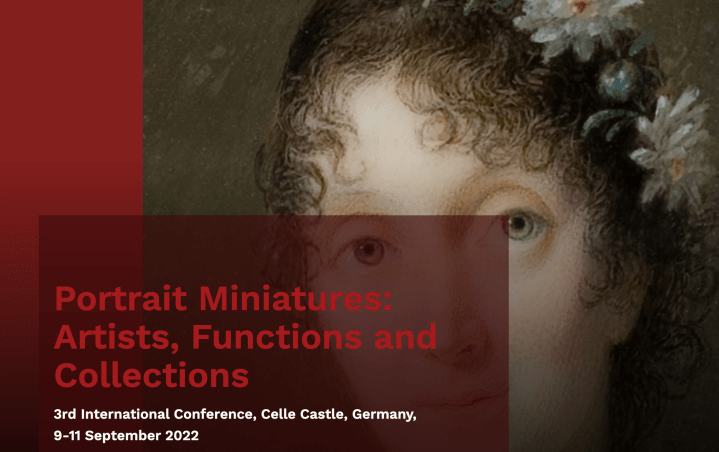
Portrait Miniatures: Artists, Functions, and Collections
Celle Castle, Tansey Miniatures Foundation, Celle Castle (near Hanover), 9–11 September 2022
This conference will take place in conjunction with the seventh exhibition of the Tansey Miniatures Foundation and the publication of the accompanying catalogue Miniatures from the Time of Napoleon in the Tansey Collection. 23 speakers from 11 different countries will address a range of topics related to portrait miniatures:
• Individual miniaturists, specific workshop contexts, and places of production
• Use and functions of both court and private types and their protagonists
• Iconographic aspects in the context of representation or intimacy
• Evolution of techniques and materials
• Private and public collections
The conference will be in English. The presentations will subsequently be published in a richly illustrated book. Admission is free. Both conference venues are within walking distance (20 minutes) from the railway station. Trains from Hannover take approximately 25 to 45 minutes (Deutsche Bahn, Metronom, and S-Bahn). For registration, please contact Juliane Schmieglitz-Otten, The Tansey Miniatures Foundation, juliane.schmieglitz-otten@tansey-miniatures.com. For more information, please contact Bernd Pappe, The Tansey Miniatures Foundation, bernd.pappe@tansey-miniatures.com.
F R I D A Y , 9 S E P T E M B E R 2 0 2 2
16.00 Registration
18.00 Welcome and Opening Lectures
• Juliane Schmieglitz-Otten, Realism and Modernism in the Likenesses of a New Epoch: Highlights of the Exhibition Miniatures from the Time of Napoleon
• Bernd Pappe, Making a Small Man Great: Miniatures of Napoleon I
• Birgitt Schmedding, Two Views: The Power of Seeing
S A T U R D A Y , 1 0 S E P T E M B E R 2 0 2 2
9.00 Objects, Agencies, and Social Practices
• Gerrit Walczak (Berlin), Icons of Intimacy: Sex, Agency, and the Portrait Miniature
• André and Anne-Marie Regnard-Denis (Belgium), Gestures and Their Meaning in Portrait Miniatures
• Karin Schrader (Bad Nauheim), ‘Telling Objects’: Miniatures in 18th-Century Courtly Portraits
• Lea C. Stephenson (Philadelphia), Racial Capital: Peter Marié’s Miniatures and Gilded Age Whiteness
• Jann Matlock (London), The Museum of Lost Portraits: Paris, 1794–1805
• Damiët Schneeweisz (London), Shipped, Worn, or Carried: Portrait Miniatures in the Atlantic Ocean World
13.00 Lunch
14.15 Politics and Representation
• Juliane Schmieglitz-Otten (Celle), Pictorial Family Ties: Series of Portrait Miniatures Serving Political Networks
• Martin Miersch (Ulm), Fashion and Political Statement: Portrait Miniatures from the Time of the French Revolution
• Maxime Charron (Paris), Examples of Intimate Portraits from the Royal and Imperial Courts of France during the First Half of the 19th Century
• Agnieszka Fulińska (Krakow), A Reputed Portrait Miniature of the King of Rome and Images of Children from Napoleon’s Entourage
• Marina Vidas (Copenhagen), Portrait Miniatures Set in Jewellery and Objects of Personal Adornment Connected to Queen Louise of Denmark and Her Daughter, Maria Feodorovna, Empress of Russia
17.30 Special Techniques and Materials
• David Hradil, Janka Hradilová, and Olga Trmalová (Prague), Benefits of Non-Invasive Macro X-Ray Fluorescence Scanning for the Analysis of Materials in Portrait Miniatures
S U N D A Y , 1 1 S E P T E M B E R 2 0 2 2
9.00 Special Techniques and Materials
• Christine Slottved Kimbriel, Paola Ricciardi, and Flavia Fiorillo (London), Unlocking the English Portrait Miniature: The Materiality of Isaac Oliver’s Oeuvre
• Alan Derbyshire and Lucia Burgio (London), The William Wood Manuscripts
10.00 Miniature Painters
• Martin Spies (Giessen), In Search of Charles Townley, Painter of Miniatures and Engraver to the King of Prussia
• Luise Schreiber Knaus and Peter Knaus (Bodelshausen), The Miniature Painter Jeremiah Meyer: His Life and Career during the Reign of King George III
• Sonja Remensberger (Winterthur), Pierre-Louis Bouvier (1765–1836): Life and Work of a Geneva Miniature Painter whilst Working Abroad
• Nathalie Lemoine-Bouchard (Paris), Ambroise Charlemagne Victor Le Chenetier: When a 19th-Century Artist Hides Another One
13.00 Lunch
14.15 Collections of Portrait Miniatures
• Stephen Lloyd (Liverpool), Horace Walpole’s Recently Discovered Plan for Displaying His Miniatures and Enamels in the Cabinet of the Tribuna at Strawberry Hill
• Maria Dunina (Moscow), The Collection of Miniatures of the State Pushkin Museum of Fine Arts, Moscow
• Tatiana Udras (Moscow), Portrait Miniatures of the Romanoff Family in Russian and Foreign Collections
• Cecilia Rönnerstam (Stockholm), On Origins and Originals: The History of a Collection
• Blythe Sobol (Kansas City), An Outsized Passion for Miniatures: The Starr Collection of Portrait Miniatures at the Nelson-Atkins Museum of Art
Exhibition | Miniatures from the Time of Napoleon
From the Tansey Miniatures Foundation:
Miniatures from the Time of Napoleon / Miniaturen der Zeit Napoleons
Tansey Miniatures Foundation, Bomann-Museum, Celle, from 26 June 2020
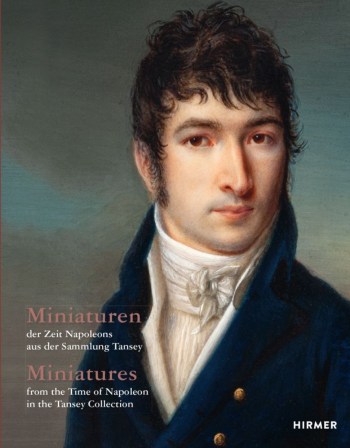 The Tansey miniatures, now held by the Bomann Museum in Celle, represent one of the most significant collections of European miniature paintings. This exhibition showcases a total of 150 works from the time of Napoleon I (1795–1815). These tiny portraits, which were generally intended for personal use, date from the ‘golden age’ of miniature painting. They exhibit a high degree of artistic skill and refined craftsmanship. Unlike the staged, theatrical portraits of absolutism, now for the first time we see realistic likenesses of people who appear ‘modern’—a gallery of women, men, and children from a period of political upheaval dominated by wars.
The accompanying bilingual catalogue (in German and English) provides comprehensive insight into the art of miniature painting in this magnificent era. Specialists have contributed detailed and richly illustrated introductory essays. This volume joins earlier entries in the series, exploring the collection in key periods and presenting new photographic reproductions of the miniatures at actual size.
Bernd Pappe and Juliane Schmieglitz-Otten, with photography by Birgitt Schmedding, Miniatures from the Time of Napoleon in the Tansey Collection (Munich: Hirmer Verlag, 2022), 452 pages, ISBN: 978-3777436098, €58 / $65.
Newly Discovered Portrait of John Locke on View at London Art Week
From the press release via Art Daily:
Miles Wynn Cato | British Art Rediscovered: Unseen Pictures, Untold Stories
London Art Week, 3–8 July 2022

Dr. Alexander Geekie, Portrait of John Locke, 1696, pastel on paper.
As part of London Art Week, British art dealer Miles Wynn Cato will present a remarkable selection of fourteen important discoveries, including a rare portrait of the English philosopher John Locke (1632–1704). Unrecorded since 1727, this fine pastel portrait was drawn from life by Dr Alexander Geekie (1655–1727), who was Locke’s doctor and friend, as well as a highly-accomplished amateur artist and art collector.
John Locke is widely acknowledged as one of the great thinkers of the Enlightenment and indeed, of all time. Locke’s ideas were also profoundly influential in the founding of the United States. Thomas Jefferson believed Locke to be one of “the three greatest men that have ever lived, without any exception.”
Archive letters between Locke and Dr Geekie reveal their close mutual regard, and in this superb personal portrayal, Geekie has managed to capture the essence of Locke’s character. The image is inscribed on the reverse, “Mr Lock by A Geekie, 1696,” and it is singled out for special mention in Geekie’s will. This discovery marks a significant addition to the iconography of John Locke. It is also very rare on the market, since almost all the other known portraits of John Locke are owned by public institutions.
This special selling exhibition British Art Rediscovered: Unseen Pictures, Untold Stories is held in conjunction with London Art Week. It will contain fourteen rediscovered paintings and drawings by some of Britain’s most important artists including Sir Thomas Lawrence, Thomas Jones, Angelica Kaufman, Joseph Wright of Derby, and Thomas Gainsborough (with Gainsborough remarkably represented by five rediscovered pictures).
• All of these artworks had been long lost, miscatalogued, or previously unrecorded.
• Each picture is also notable in the artist’s oeuvre for stylistic reasons or because the sitter or scene is exceptionally rare, such as the portrait of John Locke.
• The exhibition will include three paintings by early female artists, including a lost painting by Angelica Kauffman, RA.
• In two instances—Thomas Gainsborough and Thomas Lawrence—the image on view is one of the artist’s earliest known pictures to survive; so these significant new finds will shed fresh light on the early techniques of these outstanding artists.
This is a unique, limited opportunity to see these exciting new discoveries for the first time.
New Book | America’s Philosopher
From The University of Chicago Press:
Claire Rydell Arcenas, America’s Philosopher: John Locke in American Intellectual Life (Chicago: The University of Chicago Press, 2022), 280 pages, ISBN: 978-0226638607, $35.
 America’s Philosopher examines how John Locke has been interpreted, reinterpreted, and misinterpreted over three centuries of American history.
The influence of polymath philosopher John Locke (1632–1704) can still be found in a dizzying range of fields, as his writings touch on issues of identity, republicanism, and the nature of knowledge itself. Claire Rydell Arcenas’s new book tells the story of Americans’ longstanding yet ever-mutable obsession with this English thinker’s ideas, a saga whose most recent manifestations have found the so-called Father of Liberalism held up as a right-wing icon.
The first book to detail Locke’s trans-Atlantic influence from the eighteenth century until today, America’s Philosopher shows how and why interpretations of his ideas have captivated Americans in ways few other philosophers—from any nation—ever have. As Arcenas makes clear, each generation has essentially remade Locke in its own image, taking inspiration and transmuting his ideas to suit the needs of the particular historical moment. Drawing from a host of vernacular sources to illuminate Locke’s often contradictory impact on American daily and intellectual life from before the Revolutionary War to the present, Arcenas delivers a pathbreaking work in the history of ideas.
Claire Rydell Arcenas is assistant professor of history at the University of Montana.
C O N T E N T S
Preface
1 Locke’s Legacy in Early America
2 Locke’s Authority in the Revolutionary and Founding Eras
3 Problematizing Locke as Exemplar in the Early United States
4 Locke Becomes Historical
5 Making Locke Relevant
6 Locke and the Invention of the American Political Tradition
7 Lockean ‘-isms’
Epilogue
Acknowledgments
List of Abbreviations
Notes
Bibliography
Index
At Bonhams | Preview of Summer Auctions at After Hours Event

Detail of a tray from a Sèvres tea service (déjeuner ‘corbeille losange’) painted by Armand l’aîné, dated 1758 (Five Hundred Years of European Ceramics, Lot 164, estimate £100,000–£150,000).
◊ ◊ ◊ ◊ ◊
From Bonhams and Eventbrite:
After Hours at Bonhams: The Classics
Bonhams, London, New Bond Street, 4 July 2022, 6pm
This summer, explore The Classics, a series of auctions dedicated to the Classic Arts at Bonhams. This season of sales will offer rare and exceptional items across traditional collecting categories, including ceramics, fine glass, works of art, furniture, silver, sculpture, clocks, Old Master paintings, antiquities, books and manuscripts, and more.
Join us After Hours at Bonhams for an evening of art, drinks, food, music, workshops, and conversation set against the backdrop of our forthcoming auctions.
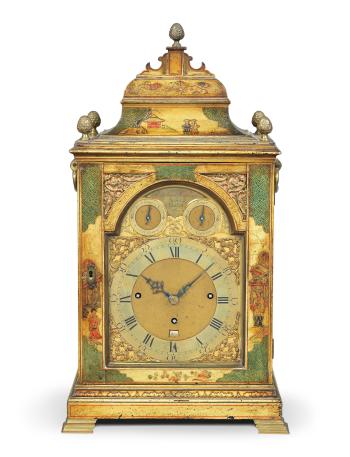
A fine and rare mid-18th-century quarter chiming table clock, chinoiserie decorated on a light yellow ochre ground; Eardley Norton, London, numbered 297 (Fine Clocks, 14 July 2022, Lot 73, estimate: £7,000–10,000).
Programme Highlights
• Join broadcaster and creative director at Glassette Laura Jackson in conversation with The Wallace Collection, celebrating the must-see exhibition Inspiring Walt Disney: The Animation of French Decorative Arts, with co-curators Helen Jacobsen and Wolf Burchard
• Live performances by multi-instrumental duo Momento Sounds
• Portraits by artist Michalis Christodoulou
• London Calligraphy pop-up booth
Also Featuring
• Ice-Cream Parlour by Ladurée
• Pay Drinks and Cocktail Bar
On View, The Summer Classics
• Old Master Paintings, 6 July 2022
• Antiquities, 7 July 2022
• 500 Years of European Ceramics, 7 July 2022
• Decorative Arts through the Ages, 13 July 22
• The Grand Tour Sale, 14 July 22
• Fine Clocks, 14 July 22
New Books | Recent Biographies
If biographies are your summer thing, some possibilities . . .
Leo Damrosch, Adventurer: The Life and Times of Giacomo Casanova (New Haven: Yale University Press, 2022), 432 pages, ISBN: 978-0300248289, $35.
 A fast-paced narrative about the world-famous libertine Giacomo Casanova, from celebrated biographer Leo Damrosch
The life of the iconic libertine Giacomo Casanova (1725–1798) has never been told in the depth it deserves. An alluring representative of the Enlightenment’s shadowy underside, Casanova was an aspiring priest, an army officer, a fortune teller, a con man, a magus, a violinist, a mathematician, a Masonic master, an entrepreneur, a diplomat, a gambler, a spy—and the first to tell his own story. In his vivid autobiography Histoire de Ma Vie, he recorded at least a hundred and twenty love affairs, as well as dramatic sagas of duels, swindles, arrests, and escapes. He knew kings and an empress, Catherine the Great, and most of the famous writers of the time, including Voltaire and Benjamin Franklin.
Drawing on seldom used materials, including the original French and Italian primary sources, and probing deeply into the psychology, self-conceptions, and self-deceptions of one of the world’s most famous con men and seducers, Leo Damrosch offers a gripping, mature, and devastating account of an Enlightenment man, freed from the bounds of moral convictions.
Leo Damrosch is the Ernest Bernbaum Professor of Literature Emeritus at Harvard University. His many books include The Club: Johnson, Boswell, and the Friends Who Shaped an Age and Jonathan Swift: His Life and His World, winner of the National Book Critics Circle award and Pulitzer finalist for biography. He lives in Newton, MA.
◊ ◊ ◊ ◊ ◊
Tristram Hunt, The Radical Potter: The Life and Times of Josiah Wedgwood (Metropolitan Books, 2021), 352 pages, ISBN: 978-1250128348, $30.
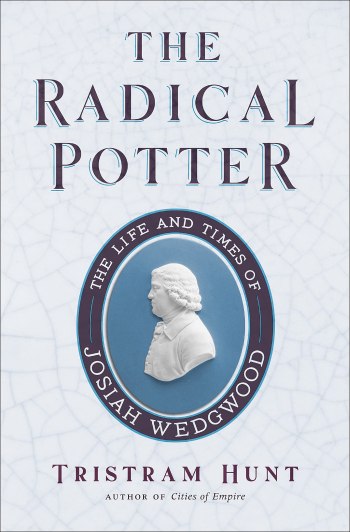 From one of Britain’s leading historians and the director of the Victoria & Albert Museum, a scintillating biography of Josiah Wedgwood, the celebrated eighteenth-century potter, entrepreneur, and abolitionist
Wedgwood’s pottery, such as his celebrated light-blue jasperware, is famous worldwide. Jane Austen bought it and wrote of it in her novels; Empress Catherine II of Russia ordered hundreds of pieces for her palace; British diplomats hauled it with them on their first-ever mission to Peking, audaciously planning to impress China with their china. But the life of Josiah Wedgwood is far richer than just his accomplishments in ceramics. He was a leader of the Industrial Revolution, a pioneering businessman, a cultural tastemaker, and a tireless scientific experimenter whose inventions made him a fellow of the Royal Society. He was also an ardent abolitionist, whose Emancipation Badge medallion—depicting an enslaved African and inscribed “Am I Not a Man and a Brother?”—became the most popular symbol of the antislavery movement on both sides of the Atlantic. And he did it all in the face of chronic disability and relentless pain: a childhood bout with smallpox eventually led to the amputation of his right leg.
As historian Tristram Hunt puts it in this lively, vivid biography, Wedgwood was the Steve Jobs of the eighteenth century: a difficult, brilliant, creative figure whose personal drive and extraordinary gifts changed the way we work and live. Drawing on a rich array of letters, journals, and historical documents, The Radical Potter brings us the story of a singular man, his dazzling contributions to design and innovation, and his remarkable global impact.
Tristram Hunt is the director of the Victoria & Albert Museum and one of Britain’s best-known historians. His previous books, which include Cities of Empire: The British Colonies and the Creation of the Urban World and Marx’s General: The Revolutionary Life of Friedrich Engels, have been published in more than a dozen languages. Until taking on the leadership of the V&A, he served as Member of Parliament for Stoke-on-Trent, the home of Wedgwood’s potteries. A senior lecturer in British history at Queen Mary University of London, he appears regularly on BBC radio and television.
◊ ◊ ◊ ◊ ◊
Catherine Ostler, The Duchess Countess: The Woman Who Scandalized Eighteenth-Century London (New York: Atria Books, 2022), 432 pages, ISBN: 978-1982179731, $30.
 As maid of honor to the Princess of Wales, Elizabeth Chudleigh (1721–1788) enjoyed a luxurious life in the inner circle of the Hanoverian court. With her extraordinary style and engaging wit, she both delighted and scandalized the press and public. She would later even inspire William Thackeray when he was writing his classic Vanity Fair, providing the inspiration for the alluring social climber Becky Sharp. But Elizabeth’s real story is more complex and surprising than anything out of fiction. A clandestine, candlelit wedding to the young heir to an earldom, a second marriage to a duke, a lust for diamonds, and an electrifying appearance at a masquerade ball in a gossamer dress—it’s no wonder that Elizabeth’s eventual trial was a sensation. Charged with bigamy, an accusation she vehemently fought against, Elizabeth refused to submit to public humiliation and retire quietly.
Catherine Ostler has been editor-in-chief of Tatler, the Evening Standard (London), and editor of The Times (London) Weekend Edition. She has also written for a wide range of publications, including Vogue, Daily Mail (London), and Newsweek. She read English at Oxford University, specializing in literature.
◊ ◊ ◊ ◊ ◊
Andrew Roberts, The Last King of America: The Misunderstood Reign of George III (New York: Viking, 2021), 784 pages, ISBN: 978-1984879264, $40. In the UK: George III: The Life and Reign of Britain’s Most Misunderstood Monarch.
 The last king of America, George III, has been ridiculed as a complete disaster who frittered away the colonies and went mad in his old age. The truth is much more nuanced and fascinating—and will completely change the way readers and historians view his reign and legacy.
Most Americans dismiss George III as a buffoon—a heartless and terrible monarch with few, if any, redeeming qualities. The best-known modern interpretation of him is Jonathan Groff’s preening, spitting, and pompous take in Hamilton, Lin-Manuel Miranda’s Broadway masterpiece. But this deeply unflattering characterization is rooted in the prejudiced and brilliantly persuasive opinions of eighteenth-century revolutionaries like Thomas Paine and Thomas Jefferson, who needed to make the king appear evil in order to achieve their own political aims. After combing through hundreds of thousands of pages of never-before-published correspondence, award-winning historian Andrew Roberts has uncovered the truth: George III was in fact a wise, humane, and even enlightened monarch who was beset by talented enemies, debilitating mental illness, incompetent ministers, and disastrous luck.
In The Last King of America, Roberts paints a deft and nuanced portrait of the much-maligned monarch and outlines his accomplishments, which have been almost universally forgotten. Two hundred and forty-five years after the end of George III’s American rule, it is time for Americans to look back on their last king with greater understanding: to see him as he was and to come to terms with the last time they were ruled by a monarch.
Andrew Roberts is the bestselling author of Churchill: Walking with Destiny; Leadership in War; The Storm of War: A New History of the Second World War; Masters and Commanders: How Four Titans Won the War in the West, 1941-1945; Waterloo: Napoleon’s Last Gamble; and Napoleon: A Life, winner of the Los Angeles Times Book Prize for biography and a finalist for the Plutarch Award. He has won many other prizes, including the Wolfson History Prize and the British Army Military Book of the Year. He is the Roger and Martha Mertz Visiting Fellow at the Hoover Institution at Stanford University, chair of the judges of the Gilder Lehrman Military History Prize, and a visiting professor in the Department of War Studies at King’s College, London.
◊ ◊ ◊ ◊ ◊
Anna Marie Roos, Martin Folkes (1690–1754): Newtonian, Antiquary, Connoisseur (Oxford: Oxford University Press, 2021), 432 pages, ISBN: 978-0198830061, $100.
 • First full-length biography of this eminent Enlightenment figure, mathematician, and protégé of Isaac Newton
• Contains the first complete analysis and reconstruction of the tragic life and career of Folkes’s wife, Drury Lane star Lucretia Bradshaw
• Features a novel analysis of the prints and drawings of William Hogarth with regard to the Royal Society, freemasonry, and coffeehouse culture
Martin Folkes (1690–1754): Newtonian, Antiquary, Connoisseur is a cultural and intellectual biography of the only President of both the Royal Society and the Society of Antiquaries. Sir Isaac Newton’s protégé, astronomer, mathematician, freemason, art connoisseur, Voltaire’s friend, and Hogarth’s patron, his was an intellectually vibrant world. Folkes was possibly the best-connected natural philosopher and antiquary of his age, an epitome of Enlightenment sociability, and yet he was a surprisingly neglected figure, the long shadow of Newton eclipsing his brilliant disciple.
Anna Marie Roos is a Professor of the History of Science and Medicine at the University of Lincoln.
New Books | Recent Historical Fiction
If historical fiction is your summer thing, some possibilities . . .
Jessie Burton, The House of Fortune (New York: Bloomsbury, 2022), 304 pages, ISBN: 978-1635579741, $28.
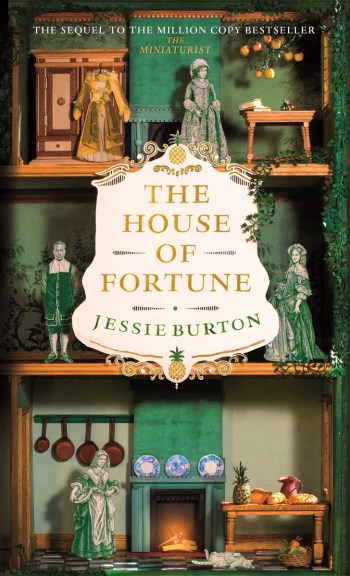 Alive with the magic of 18th-century Amsterdam, an enchanting, fantastical stand-alone companion novel to the sensational New York Times bestseller The Miniaturist, which has sold over two million copies worldwide.
Amsterdam in the year 1705. It is Thea Brandt’s eighteenth birthday. She is ready to welcome adulthood with open arms, but life at home is increasingly difficult. Her father Otto and her Aunt Nella argue endlessly over their financial fate, selling off furniture in a desperate attempt to hold on to the family home.
As catastrophe threatens to engulf the household, Thea seeks refuge in Amsterdam’s playhouses. She loves the performances, and the stolen moments afterwards are even better. In the backrooms of her favorite theater, Thea can spend a few precious minutes with her secret lover, Walter, the chief set-painter, a man adept at creating the perfect environments for comedies and tragedies to flourish. The thrill of their hidden romance offers Thea an exciting distraction from home. But it also puts her in mind of another secret that threatens to overwhelm the present: Thea knows her birthday marks the day her mother, Marin, died in labor. Thea’s family refuses to share the details of this story, just as they seem terrified to speak of ‘the miniaturist’—a shadowy figure from their past who is possessed of uncanny abilities to capture that which is hidden.
Aunt Nella believes the solution to all Thea’s problems is to find her a husband who will guarantee her future. An unexpected invitation to Amsterdam’s most exclusive ball seems like a golden opportunity. But when Thea finds, on her doorstep, a parcel containing a miniature figure of Walter, it becomes clear that someone out there has another fate in mind for the family . . . A feat of sweeping, magical storytelling, The House of Fortune is an unputdownable novel about love and obsession, family and loyalty, and the fantastic power of secrets.
Jessie Burton’s first novel, The Miniaturist, was a New York Times bestseller and was adapted into a PBS series, starring Anya Taylor-Joy. Jessie’s second novel, The Muse, was also a #1 international bestseller. Jessie has written essays and reviews for The New York Times and The Wall Street Journal. She lives in London.
◊ ◊ ◊ ◊ ◊
James Runcie, The Great Passion (London, Bloomsbury, 2022), 272 pages, ISBN: 978-1635570670, $28.
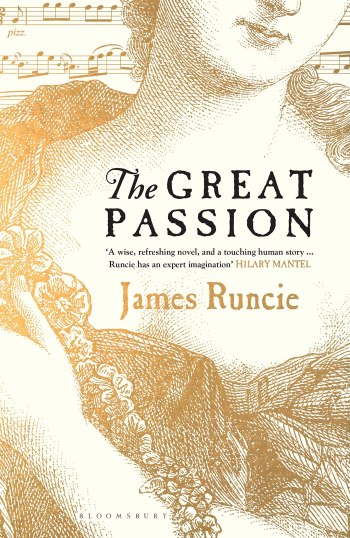 From acclaimed bestselling author James Runcie, a meditation on grief and music, told through the story of Bach’s writing of the St. Matthew Passion.
In 1727, Stefan Silbermann is a grief-stricken thirteen-year-old, struggling with the death of his mother and his removal to a school in distant Leipzig. Despite his father’s insistence that he try not to think of his mother too much, Stefan is haunted by her absence, and, to make matters worse, he’s bullied by his new classmates. But when the school’s cantor, Johann Sebastian Bach, takes notice of his new pupil’s beautiful singing voice and draws him from the choir to be a soloist, Stefan’s life is permanently changed.
Over the course of the next several months, and under Bach’s careful tutelage, Stefan’s musical skill progresses, and he is allowed to work as a copyist for Bach’s many musical works. But mainly, drawn into Bach’s family life and away from the cruelty in the dorms and the lonely hours of his mourning, Stefan begins to feel at home. When another tragedy strikes, this time in the Bach family, Stefan bears witness to the depths of grief, the horrors of death, the solace of religion, and the beauty that can spring from even the most profound losses.
Joyous, revelatory, and deeply moving, The Great Passion is an imaginative tour de force that tells the story of what it was like to sing, play, and hear Bach’s music for the very first time.
James Runcie is an award-winning film-maker, playwright and literary curator. He is the author of twelve novels that have been translated into twelve languages, including the seven books in the Grantchester Mysteries series. He has been Artistic Director of the Bath Literature Festival, Head of Literature and Spoken Word at the Southbank Centre, London, and Commissioning Editor for Arts on BBC Radio 4. He is a Fellow of the Royal Society of Literature. He lives in Scotland.
◊ ◊ ◊ ◊ ◊
Eva Stachniak, The School of Mirrors: A Novel (New York: William Morrow, 2022), 416 pages, ISBN: 978-0063119604, $17.
 A scintillating, gorgeously written historical novel about a mother and a daughter in eighteenth-century France, beginning with decadence and palace intrigue at Versailles and ending in an explosive new era of revolution.
During the reign of Louis XV, impoverished but lovely teenage girls from all over France are sent to a discreet villa in the town of Versailles. Overseen by the King’s favorite mistress, Madame de Pompadour, they will be trained as potential courtesans for the King. When the time is right, each girl is smuggled into the palace of Versailles, with its legendary Hall of Mirrors. There they meet a mysterious but splendidly dressed man who they’re told is merely a Polish count, a cousin of the Queen. Living an indulgent life of silk gowns, delicious meals, and soft beds, the students at this “school of mirrors” rarely ask questions, and when Louis tires of them, they are married off to minor aristocrats or allowed to retire to one of the more luxurious nunneries.
Beautiful and canny Veronique arrives at the school of mirrors and quickly becomes a favorite of the King. But when she discovers her lover’s true identity, she is whisked away, sent to give birth to a daughter in secret, and then to marry a wealthy Breton merchant. There is no return to the School of Mirrors.
This is also the story of the King’s daughter by Veronique—Marie-Louise. Well-provided for in a comfortable home, Marie-Louise has never known her mother, let alone her father. Capable and intelligent, she discovers a passion for healing and science, and becomes an accredited midwife, one of the few reputable careers for women like her. But eventually Veronique comes back into her daughter’s life, bringing with her the secret of Marie-Louise’s birth. But the new King—Louis XVI—is teetering on his throne and it’s a volatile time in France…and those with royal relatives must mind their step very carefully.
Eva Stachniak was born in Wroclaw, Poland. She moved to Canada in 1981 and has worked for Radio Canada International and Sheridan College, where she taught English and humanities. Her first novel of Catherine the Great, The Winter Palace was a #1 international bestseller and was followed by another Catherine the Great novel Empress of the Night, also a bestseller. She lives in Toronto.
Call for Papers | Variety, Variation, Multiplication
From ArtHist.net, which includes the German version:
Variety, Variation, Multiplication: Imaging Techniques in Premodern Art and Their Products
Die Vielfalt des Vervielfältigten: Bildgebende Verfahren in der Kunst der Neuzeit und ihre Produkte
Institut für Kunstwissenschaft und Historische Urbanistik, Technische Universität Berlin, 13–15 April 2023
Organized by Magdalena Bushart, Livia Cárdenas, and Andreas Huth
Proposals due by 1 August 2022
Interdependencies VII – Seventh international conference of the research project Interdependencies: Arts and Artistic Techniques at the Department for Art History, Institut für Kunstwissenschaft und Historische Urbanistik, Technische Universität Berlin
Printed images and moulded artworks have one thing in common: they refer to an ‘original form’ to which they stand in a complex relationship. Produced in a mechanical process with the help of a (negative) form—a casting mould, a printing block, or a printing plate—they assert a reference of similarity both to their model and each other. Nevertheless, they are not reproductions that are largely identical to their ‘prototype’. After all, the transfer of the original is done in a different technique and usually also in a different material than that of the ‘prototype’. Thus, each is produced in its medium which influences the form with its technical requirements. From a technical, material, and formal point of view, they rather represent variants than precise reproductions of the initial work. And even the reproduced works do not look the same. Although they are based on a common casting or impression mould, they are subject to the conditions and contingencies of the production process, as well. In addition, these products were often further processed, i.e. ‘varied’. This is particularly the case in the 15th and 16th centuries, the period in which the techniques of printmaking and moulding were redefined through the innovative use of materials, the opening up of new markets, and the development of a specific aesthetic: Three-dimensional objects—such as sculptures made of terracotta or plaster—were reshaped in parts and individually polychromed, while two-dimensional works—mainly woodcuts and copper engravings—were coloured, trimmed, or silhouetted. This raises the question of the relationship of the artefacts to each other or their individuality: Were the works understood as individual pieces, as part of a series, as repetitions? Or did the attraction lay precisely in the knowledge of the singularity of the pieces despite their obvious similarities?
Variety, Variation, and Multiplication in the Art of the 14th to 18th Centuries shall be the subject of the seventh conference in the series Interdependencies: The arts and their techniques. Instead of focusing on the standardising effect of reproduced artworks and printed images (e.g. through the establishment of certain types of images and the standardisation of knowledge), we want to question the variants and their variances arising through printing and moulding processes or further processing. On the one hand, we are interested in the differences between the originals and the repetitions. On the other hand, we want to explore the margin opened up by the respective production process as well as by the possibilities of further handling: How do the products relate to their ‘prototype’ and each other? Do the variances result from intentional interventions or, the production process? What is the function of the medium of transfer? What is the effect of the change in materiality? What forms of further processing can be observed? How can common and singular characteristics of the reproduced works be described? What connects two- and three-dimensional reproductions and how do they differ? And last, but not least: How has the tension between similarity and deviation been received? Did it play a role in the perception of contemporaries or was it ignored?
All those interested in the conference are invited to submit an abstract of no more than 5,000 characters together with a short CV. Please send your proposal by 1 August 2022 to Prof. Dr. Magdalena Bushart (magdalena.bushart@tu-berlin.de) and Dr. Andreas Huth (andreas.huth@tu-berlin.de).
Exhibition | Design around 1800

Staatliche Kunstsammlungen Dresden:
Design around 1800 / Gestaltung um 1800
Schloss Pillnitz, Dresden
The Kaiserzimmer (imperial rooms) in Pillnitz Palace, still known to many as the Weinlig-Rooms, were reopened to the public in 2020 after several years of restoration. In the future, the new permanent exhibition Design around 1800 will be on display in the rooms steeped in history, showcasing outstanding arts and crafts pieces from the classicism period.

Centerpiece, French, ca. 1800, cast bronze, patinated and gilded, 49.7 cm high (Dresden: Kunstgewerbemuseum, 30982).
The time around 1800 was one of enormous dynamism: social, scientific, technological—the signs pointed everywhere to change, a new dawn, progress. Paradoxically, in the decorative arts the path to the future of design led back to classical antiquity. The excavations in Herculaneum and Pompeii from the middle of the 18th century and the beginning of intensive research triggered a new enthusiasm for antiquities. A decisive impulse for this came from Dresden. Johann Joachim Winckelmann (1717–1768) shaped the ideas of German classicism with his writings like no other. After the organically growing, wildly bizarre play of forms of the Rococo, ancient art offered new starting points, not only because of its clear structure and the ornamental and decorative world that was completely contrary to the Rococo. According to Winckelmann, Greek art had reached an aesthetic perfection that now had to be imitated.
The permanent exhibition Design around 1800 makes this spirit of classicism tangible on two levels. On the one hand, the lavishly restored imperial rooms, together with the preserved original interior, are themselves a splendid example of classicist interior design. The window and door crowns alone, finely proportioned in individual fields, illustrate the wealth of antique formal language: rams’ heads and sphinxes from ancient Egypt, scenes from Greek and Roman mythology, and ornaments such as urns, mascarons, palmettes, lotus blossoms, and acanthus foliage used in a quotation-like manner speak a clear picture.
The exhibition uses this early classicist interior, which is so important for Saxon art history, to illuminate various facets of applied art around 1800 on a second level. Here, the Kunstgewerbemuseum presents outstanding pieces of Classicist design from its own collection, including ceramics, textiles, glass and metalwork, furniture, paper wallpaper and clocks. Special attention is paid to the Saxon developments, the players acting in the environment of the Dresden court and the local craftsmanship of the time. For this purpose, the exhibits of the Kunstgewerbemuseum are additionally supplemented by loans from the Porcelain Collection, the Green Vault, the Numismatic Collection, and the Sculpture Collection.
After the first quarter of the 19th century, ancient art lost its primacy as a model. However, it never fell into oblivion again. In the stylistic melting pot of historicism, numerous classicist elements can be found, impressively seen, for example, in the works of the late Karl Friedrich Schinkel (1781–1841) and Gottfried Semper (1803–1879). Certain forms and ornaments also have a firm place in design, architecture and arts and crafts right up to the present day. In the exhibition, a separate room is dedicated to this classicist afterlife.
The archduke of Austria and Holy Roman Emperor Leopold II (1747–1792) was the name sponsor. On the occasion of the meeting with the Prussian King Frederick William II (1744–1797) in August 1791, the emperor took up residence in Pillnitz for a few days. The talks were later to go down in history as the Pillnitz Monarchs’ Meeting. As honored host for this event of European magnitude, the Saxon Elector Friedrich August III (1750–1827) had the wing buildings of the Bergpalais, which had been completed only a few months earlier, splendidly decorated. Just two years later, the palace inventory referred to the rooms in the west wing as ‘kayserliche Zimmer’.
The Imperial Rooms with their original wall paneling and carvings, mirrors, stove and fireplace are the only example of Early Classicist interior decoration around the Dresden court that has been preserved largely in its original state. During the extensive restoration of the rooms, the wall coverings in the two main rooms were also reconstructed with silk atlas fabric in the original color scheme, making the original design concept much more tangible again.
 So far, there is no archival evidence of who designed the rooms. The attribution to and corresponding naming of the architect Christian Traugott Weinlig, which was valid for a long time due to stylistic analogies, is no longer supported by today’s research. Also in view of the approximation to the state of 1791 achieved during the restoration by the Sächsisches Immobilien- und Baumanagement (SIB), the name ‘Kaiserzimmer’, which was valid for a good 180 years, is now used again.
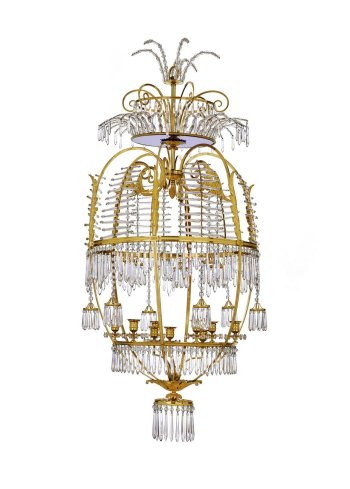
As the only object without a historical room reference, but with an all the stronger stylistic reference to Weinlig’s decorations, a new acquisition will be presented this fall, which the Kunstgewerbemuseum was able to realize with the support of the Ernst von Siemens Art Foundation: an early classicist chandelier in the shape of an egg. The chandelier is documented as a product of the Chursächsische Spiegelfabrik by a detailed review with accompanying pictorial plate in the March 1800 issue of the Journal des Luxus und der Moden. The piece is of outstanding quality, both in terms of design and technology. Its unconventional basket or egg shape is also a great unusual feature for the period of early classicism. The interplay of the gilded bronze frame with the richly varied Bohemian glass hanging is superb and testifies to the high level of Saxon craftsmanship of the time. In particular, the Chursächsische Spiegelfabrik was one of the leading Central European manufacturers of brass-mounted glassware and candlesticks around 1800.
Exhibition | Bernardo Bellotto at the Court of Saxony
From the Staatliche Kunstsammlungen Dresden:
Enchantingly Real: Bernardo Bellotto at the Court of Saxony
Zwinger, Gemäldegalerie Alte Meister, Dresden, 21 May — 28 August 2022
Royal Castle, Warsaw, 23 September 2022 — 8 January 2023
 Coinciding with the 300th anniversary of his birth, the Gemäldegalerie Alte Meister is holding a major monographic exhibition in celebration of the work of Venetian painter Bernardo Bellotto (1722–1780). The artist—who, like his uncle and teacher Antonio Canal, also called himself Canaletto—ranks as one of the most important 18th-century painters of city views or vedute. The Dresden retrospective is the culmination of a years-long conservation project and results from a cooperation with the Royal Castle in Warsaw. It features the Gemäldegalerie’s own collection of Bellotto’s paintings, itself the largest in the world.
The show presents Bellotto’s life and work by tracing the most important phases and milestones of his career. After formative years in Venice, he came to Dresden in 1747 and painted large-scale vedute for the Saxon elector and Polish king, Augustus III, as well as for his prime minister, Count Heinrich von Brühl. Bellotto’s paintings continue to offer unique insights into the architecture and life of the royal capital of Saxony as well as the nearby town of Pirna and the fortresses of Sonnenstein and Königstein. After working briefly at the courts of Vienna and Munich, in 1766 Bellotto took up residency in the royal city of Warsaw, painting numerous views of that city until his death in 1780.
Several etchings by the master present another side to Bellotto as printmaker and entrepreneur. The prints stem from Dresden’s Kupferstich-Kabinett, which boasts a remarkably complete collection of the artist’s printmaking oeuvre. Further enriched with drawings loaned from Warsaw and Darmstadt, the survey show reveals the range of Bellotto’s lively pictorial innovations. Also on view are books, porcelain objects, sculptures, and scientific instruments that together create a vivid snapshot of an era that Bellotto, as an artist, helped define.
Stephan Koja and Iris Yvonne Wagner, Zauber des Realen: Bernardo Bellotto am sächsischen Hof (Dresden: Staatliche Kunstsammlungen Dresden, 2022), 256 pages, ISBN: 978-3954986774, €48.










 Enfilade
leave a comment