New Book | The Fountain of Latona
From Penn Press:
Thomas Hedin, The Fountain of Latona: Louis XIV, Charles Le Brun, and the Gardens of Versailles (Philadelphia: University of Pennsylvania Press, 2022), 296 pages, ISBN: 978-0812253757, $70.
 Ovid tells the story of Latona, the mother by Jupiter of Apollo and Diana. In her flight from the jealous Juno, she arrives faint and parched on the coast of Asia Minor. Kneeling to sip from a pond, Latona is met by the local peasants, who not only deny her effort but muddy the water in pure malice. Enraged, Latona calls a curse down upon the stingy peasants, turning them to frogs.
In his masterful study, Thomas Hedin reveals how and why a fountain of this strange legend was installed in the heart of Versailles in the 1660s, the inaugural decade of Louis XIV’s patronage there. The natural supply of water was scarce and unwieldy, and it took the genius of the king’s hydraulic engineers, working in partnership with the landscape architect André Le Nôtre, to exploit it. If Ovid’s peasants were punished for their stubborn denial of water, so too the obstacles of coarse nature at Versailles were conquered; the aquatic iconography of the fountain was equivalent to the aquatic reality of the gardens.
Latona was designed by Charles Le Brun, the most powerful artist at the court of Louis XIV, and carried out by Gaspard and Balthazar Marsy. The 1660s were rich in artistic theory in France, and the artists of the fountain delivered substantial lectures at the Académie royale de peinture et de sculpture on subjects of central concern to their current work. What they professed was what they were visualizing in the gardens. As such, the fountain is an insider’s guide to the leading artistic ideals of the moment.
Louis XIV was viewed as the reincarnation of Apollo, the god of creativity, the inspiration of artists and scientists. Hedin’s original argument is that Latona was a double declaration: a glorification of the king and a proud manifesto by artists.
Thomas F. Hedin is Emeritus Professor of Art History at the University of Minnesota Duluth. He is the author, with Robert W. Berger, of Diplomatic Tours in the Gardens of Versailles, also published by University of Pennsylvania Press.
C O N T E N T S
Acknowledgments
Note on Measurements
List of Illustrations
Prologue
1 Foundations
2 Fountains in Context
3 Original State
4 Visual Narrative
5 Latona Group
6 Lycean Peasants
7 Panegyric and Manifesto
Epilogue
Appendix A: Execution of the Fountain
Appendix B: Mansart’s Marble Cone
Appendix C: Marsy’s Lecture of 7 December 1669
Appendix D: Nathan Whitman’s ‘Fronde Thesis’
Appendix E: Translations of Ovid
Appendix F: Elaborations of the Western Axis, Briefly
List of Abbreviations
Notes
Bibliography
Index
Illustrations follow page 90
Call for Papers | G.L.F. Laves and Colleagues, 1770–1860
From the Call for Papers:
G.L.F. Laves and Colleagues: Architects as Designers of Interiors and Furniture, 1770–1860
Museum August Kestner, Hanover, 17–18 March 2023
Proposals due by 12 September 2022
Georg Ludwig Friedrich Laves (1788–1864), among the most important representatives of classicism in Germany, decisively shaped the image of the city of Hanover with his urban-planning designs and structures. Numerous secular buildings, including the Leineschloss in the city centre—the residence of the kings of Hanover from 1837 to 1866 and today the seat of the Landtag of Lower Saxony—as well as the reconstructed Schloss Herrenhausen and private palace, are reminders of this court architect of the Kingdom of Hanover. Building alterations and new constructions based on his designs have survived in various places in what is now Lower Saxony, including Schloss Derneburg and the Schloss Celle. As part of these projects, Laves also designed the corresponding interiors, which put him in line with his famous contemporaries Karl Friedrich Schinkel (Berlin), Leo von Klenze and Jean-Baptiste Métivier (Munich), and Johann Conrad Bromeis (Kassel). A majority of the interiors designed by Laves were destroyed in World War II—such as the representative halls of the Leineschloss (1834–36) and the living quarters of the royal family in the Palais an der Leinstrasse (ca. 1818 and later)—and the furniture scattered. Based on the research project of Thomas Dann, who has a comprehensive view of designs for furniture and interiors thanks to his many years of archival work and research around surviving furniture, the Museum August Kestner is showing the exhibition G. L. F. Laves—ein Hofarchitekt entwirft Möbel from 6 November 2022 to 26 March 2023. For the first time in Hanover, a selection of Laves’s drawings for furniture and interiors will be on view, together with examples of furniture created according to his designs.
Parallel to the exhibition, mobile – Gesellschaft der Freunde von Möbel- und Raumkunst e.V., the Museum August Kestner, and the Deutsches Forum für Kunstgeschichte Paris are organizing an international conference that seeks to place Laves’s furniture and interior designs in a larger historical and cultural context. Among the well-known architects who were frequently encountered in the 19th century and who—like Laves in Hanover—designed interiors as well as furniture were the English architects Jeffry Wyatville, John Nash, and Thomas Hope, along with Charles Percier, Pierre François Léonard Fontaine, and Jakob-Ignatz Hittorff in France, and Pelagio Palagi in Italy. It is this special aspect of his work that is the focus of the conference Georg Ludwig Friedrich Laves and Colleagues: Architects as Designers of Interiors and Furniture, 1770–1860, with particular emphasis on the furniture designs. From an expanded European perspective, the question of the defining characteristics of architects’ furniture will be taken up.
Further themes and questions might include:
• What sources of inspiration/role models are called upon and what materials are preferred for the execution?
• What role do surrogate materials play, such as decoration in stucco or sheet iron and zinc?
• How did the transfer of knowledge transnationally between the architects and craftsmen work?
• What is the relationship between architect and client when it comes to the design of interior spaces?
• What sources are there on the collaboration between designers and the executing tradesmen?
The conference will take place on 17–18 March 2023 in the Museum August Kestner in Hanover and is geared towards junior and early career scholars. Proposals for a 20-minute presentation (abstract of 300 words maximum; the conference languages are German and English) together with a short biography (including email and physical address as well as institutional affiliation) should be emailed to the following address by 12 September 2022: laves@dfk-paris.org. You will be informed of the outcome of your submission by the beginning of October 2022 at the latest.
Conference Organizers
Mirjam Brandt (Museum August Kestner, Hanover), Andreas Büttner (Städtisches Museum Braunschweig), Jörg Ebeling (Deutsches Forum für Kunstgeschichte Paris), Martin Glinzer (art historian, Berlin), Henriette Graf (Stiftung Preußische Schlösser und Gärten Berlin-Brandenburg), Petra Krutisch (Germanisches Nationalmuseum, Nuremberg), and Sally Schöne (Museum August Kestner, Hanover)
◊ ◊ ◊ ◊ ◊
Note (added 27 March 2023)— A summary of the conference (in German) by Meinrad von Engelberg can be found at ArtHist.net.
New Book | Carrying All before Her
From the University of Delaware Press:
Chelsea Phillips, Carrying All before Her: Celebrity Pregnancy and the London Stage, 1689–1800 (Newark: University of Delaware Press, 2022), 304 pages, ISBN: 978-1644532492, $120 / ISBN: 978-1644532485, $35.
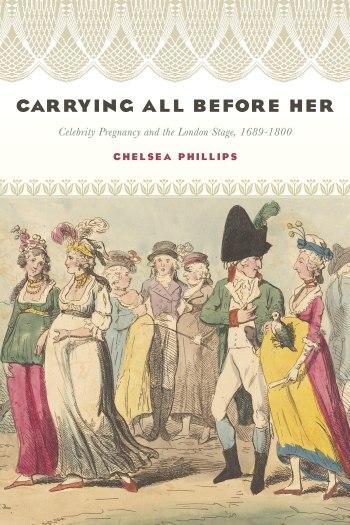 The rise of celebrity stage actresses in the long eighteenth century created a class of women who worked in the public sphere while facing considerable scrutiny about their offstage lives. Such powerful celebrity women used the cultural and affective significance of their reproductive bodies to leverage audience support and interest to advance their careers, and eighteenth-century London patent theatres even capitalized on their pregnancies. Carrying All Before Her uses the reproductive histories of six celebrity women—Susanna Mountfort Verbruggen, Anne Oldfield, Susannah Cibber, George Anne Bellamy, Sarah Siddons, and Dorothy Jordan—to demonstrate that pregnancy affected celebrity identity, impacted audience reception and interpretation of performance, changed company repertory and altered company hierarchy, influenced the development and performance of new plays, and had substantial economic consequences for both women and the companies for which they worked. Deepening the fields of celebrity, theatre, and women’s studies, as well as social and medical histories, Phillips reveals an untapped history whose relevance and impact persists today.
Chelsea Phillips is an associate professor of theatre at Villanova University in Pennsylvania.
C O N T E N T S
Figures
Acknowledgments
Introduction
1 Inheriting Greatness: Susanna Mountfort Verbruggen and Anne Oldfield
2 Pregnant Sensibility: Susannah Cibber and George Anne Bellamy
3 Conceiving Genius: Sarah Siddons
4 Prolific Muse: Dorothy Jordan
Conclusion: Celebrity Pregnancy, Then and Now
Appendix: Birth and Christening Dates
Notes
Bibliography
Index
New Book | Celebrity across the Channel, 1750–1850
From the University of Delaware Press:
Anaïs Pédron and Clare Siviter, eds., Celebrity across the Channel, 1750–1850 (Newark: University of Delaware Press, 2021), 336 pages, ISBN: 978-1644532126, $120 / ISBN: 978-1644532133, $35.
 Celebrity across the Channel, 1750–1850 is the first book to study and compare the concept of celebrity in France and Britain from 1750 to 1850 as the two countries transformed into the states we recognize today. It offers a transnational perspective by placing in dialogue the growing fields of celebrity studies in the two countries, especially by engaging with Antoine Lilti’s seminal work, The Invention of Celebrity, translated into English in 2017.
With contributions from a diverse range of scholarly cultures, the volume has a firmly interdisciplinary scope over the time period 1750 to 1850, which was an era marked by social, political, and cultural upheaval. Bringing together the fields of history, politics, literature, theater studies, and musicology, the volume employs a firmly interdisciplinary scope to explore an era marked by social, political, and cultural upheaval. The organization of the collection allows for new readings of the similarities and differences in the understanding of celebrity in Britain and France. Consequently, the volume builds upon the questions that are currently at the heart of celebrity studies.
Anaïs Pédron is an independent scholar based in London, England. She has recently published the article “‘Nous aussi nous sommes citoyennes’: Female Activism during the French Revolution” in Women in French Studies (special issue 2019) and the chapter “Olympe de Gouges, anti-esclavagiste et anticolonialiste?” in Les Lumières, l’esclavage et l’idéologie coloniale: XVIIIe–XIXe siècle (2020), edited by Pascale Pellerin.
Clare Siviter is a theater historian of the longer French Revolutionary period and is lecturer in French Theatre at the University of Bristol. She is the author of Tragedy and Nation in the Age of Napoleon.
C O N T E N T S
List of Illustrations
Antoine Lilti, Preface
Anaïs Pédron and Clare Siviter, Introduction
Section I: Theorizing Celebrity
1 Chris Haffenden, ‘Immortality in This World’: Reconfiguring Celebrity and Monument in the Romantic Period
2 Blake Smith, The Scholar as Celebrity: Anquetil-Duperron’s Discours Préliminaire
3 Meagan Mason, The Physiognomies of Virtuosi in Paris, 1830–1848
Section II: Representing Celebrity
4 Anna Senkiw, ‘To Perdition’: Politicians, Players, and the Press
5 Anaïs Pédron, Clairon’s Strategies to Achieve Celebrity and Glory
6 Miranda Kiek, Celebrity—Thou Art Translated! Corinne in England
7 Clare Siviter, Celebrity across Borders: The Chevalier d’Eon
Section III: Inheriting Celebrity
8 Emrys D. Jones: ‘Knowing My Family’: Dynastic Recognition in Eighteenth-Century Celebrity Culture
9 Gabriel Wick, Princes of the Public Sphere: Visibility, Performance, and Princely Political Activism, 1771–1774
10 Ariane Viktoria Fichtl, Ancient Parallels to Eighteenth-Century Concepts of Celebrity
11 Laure Philip, The Celebrity, Reputation, and Glory of the Empire and Restoration France through the Lens of Adèle de Boigne’s Memoirs
Bibliography
About the Contributors
Exhibition | Grand Tour: The Two Horaces and the Court of Florence

Thomas Patch, A Caricature Group in Florence, ca. 1765–66, oil on canvas, 84 × 119 cm
(Exeter: Royal Albert Memorial Museum)
◊ ◊ ◊ ◊ ◊
From the press release (via London Art Week) for the exhibition:
The Grand Tour: The Two Horaces and the Court of Florence
Strawberry Hill House & Garden, Twickenham, 27 March — 24 July 2022
Curated by Silvia Davoli
The third In Focus display at Strawberry Hill House was inspired by a survey of the architecture of Florence, richly illustrated by the renowned Italian architect Ferdinando Ruggeri in 1722, which has now returned to the house 300 years after its publication.
The display is dedicated to the Italian Grand Tour, in particular the friendship between Strawberry Hill creator Horace Walpole (1717–1797) and the British Envoy to Florence, Horace Mann (1706–1786). Both men were infatuated with Florence and the Medici family. “I can truly say that I never was happy but at Florence,” wrote Horace Walpole in his correspondence (vol.19, p.486).
Strawberry Hill contained a conspicuous number of Florentine works of art received as gifts or acquired thanks to the intervention of Horace Mann—Walpole’s library included biographies, festival books, catalogues of the Medici’s collections, and books dedicated to Florence. Walpole even contemplated writing a history of the Medici Family, starting to prepare for it in 1759, but eventually dropped the project due to a lack of archival material.
The exhibition is inspired by three volumes of Studio d’architettura civile sopra gli ornamenti di porte, e finestre .. tratte da alcune fabbriche insigni di Firenze, which had been illustrated by the renowned Italian architect Ferdinando Ruggieri (1691–1741) and produced exactly 300 years ago in 1722. The volumes, which represent a rare survey of Florentine architecture, are illustrated with exquisite plates showing the works by the leading Mannerist architects active in Florence between the end of the 16th and the beginning of the 17th century, including Ammanati, Buontalenti, Dosio, Vasari, Michelangelo, and Cigoli.
Originally part of Walpole’s Library, they were dispersed at auction in 1842 along with the rest of the collection. It is thanks to the Acceptance in Lieu Scheme, administered by the Arts Council, that these three volumes have finally returned home. The purpose of the show is to place Ruggeri’s volumes at the centre of a dense network of relationships and works of art that resonate with Walpole’s infatuation with Florence and the Medici.
Mann, who arrived in Florence in 1737, was a leading figure at the Court of Florence, not only from a diplomatic point of view but also for his indefatigable promotion of the arts. Highly esteemed by the Florentine intelligentsia, he became a point of reference for all the British Grand tourists. Some of the most iconic objects in the Walpole collection were received thanks to Mann’s mediation, from the portrait of Bianca Capello—the unfortunate wife of Francesco I de Medici—to the famous marble Roman Eagle, one of Walpole’s most treasured trophies.
After Walpole’s departure, the two men were never to meet again. However, their correspondence, which covers over 40 years, constitute a lively and invaluable source of information about the cultural and artistic life of Florence at that time, while simultaneously illustrating in detail the artistic relations, antiquarian interests, and dissonances in taste of the two friends.
“Their letters not only provide us with invaluable information about contemporary collecting, the Italian art market and British taste, but also about political matters and diplomatic conundrums,” notes Dr Silvia Davoli, Strawberry Hill’s Curator.
The three volumes will be displayed together with a series of important paintings and objects coming both from public and private collections that tell us more about the passion of the two Horaces for Florence and their antiquarian pursuits. These include some of Thomas Patch’s most distinctive paintings and engravings; various extraordinary portraits such as Walpole as a young grand tourist by Venetian painter Rosalba Carriera (Lord Cholmondeley’s Collection) and Horace Mann by Anton Van Maron (private collection); a splendid trompe-l’oeil or inganno by Caterina della Santa with a dedication to Cavaliere Orazio Mann; along with the typical grand tourist paraphernalia including antique gems, ancient coins, drawings, and engravings.
Strawberry Hill House & Garden has been open to visitors for over 250 years. Created by renowned writer Horace Walpole (1717–1797), Strawberry Hill is internationally famous as Britain’s finest example of domestic Georgian Gothic revival architecture. Walpole was a pivotal figure in 18th-century society, literature, art and architecture. The third son of Sir Robert Walpole, Britain’s first Prime Minister, Horace Walpole was a man of many talents with a large network of influential friends. From 1739 to 1741, Walpole embarked on a Grand Tour and European influences can be seen in the design of Strawberry Hill House and the works that formed its vast collection of treasures. He was author of the world’s first Gothic novel, The Castle of Otranto.
Talk | Pride of Passage: Strawberry Hill
Celebrating Pride Month, in conjunction with the exhibition The Grand Tour: The Two Horaces and the Court of Florence; from EventBrite:
Pride of Passage: Strawberry Hill, Sexuality, and the Grand Tour
The London Library, St James’s Square, 29 June 2022, 7pm
Last year World Monuments Fund (WMF) announced a commitment to Underrepresented Heritage as one of three global priorities. This year is significant for the Pride movement and LGBTQ+ community, as it marks the 50 years since the first Pride took place in the United Kingdom. Join WMF Britain for its annual Paul Mellon Lecture, in partnership with Strawberry Hill House and Queer Britain.
This special event will take a fresh look at Horace Walpole, the creator of the ‘little Gothic castle’ at Strawberry Hill, his sexuality, and the liberating impact of the Grand Tour, exploring research into the correspondence between his network of friends and acquaintances, which has informed the interpretation of the house and collection. The discussion will also address the importance of telling historical LGBTQ+ narratives across the cultural sector, ensuring these stories are preserved, understood, and celebrated.
The event, hosted by John Darlington, Executive Director at WMF Britain, will spotlight WMF’s focus on underrepresented heritage and its involvement at Strawberry Hill. Dan Vo, Head of Learning and Engagement at Queer Britain, will join Joseph Galliano, Director and Co-Founder of Queer Britain, in conversation, taking the audience on their own Grand Tour, from Walpole to the UK’s first LGBTQ+ museum. The event will include a Q&A with both speakers.
“Queer people have impacted every part of culture, yet all too often their lives have been written in the margins of history books.” –Queer Britain
John Darlington is Executive Director of World Monuments Fund in Britain. He is an archaeologist, author, and Fellow of the Society of Antiquaries with over 30 years’ experience of heritage conservation in the UK and internationally. Prior to joining WMF, John was Regional Director for the National Trust in Northwest England and County Archaeologist for Lancashire.
Joseph Galliano is Director and Co-Founder of Queer Britain. He is a fundraiser, journalist, former editor of Gay Times magazine, and third sector ambassador manager who has just opened the UK’s first national LGBTQ+ museum, Queer Britain, at 2 Granary Square, Kings Cross, N1C 4BH.
Dan Vo is Head of Learning and Engagement at Queer Britain and Project Manager of the Queer Heritage and Collections Network. He founded the award-winning volunteer-led V&A LGBTQ+ Tours and has developed LGBTQ+ programmes for the National Gallery, National Galleries of Scotland, National Museum Wales, and the Fitzwilliam Museum in Cambridge, among others.
Conference | Portrait Miniatures
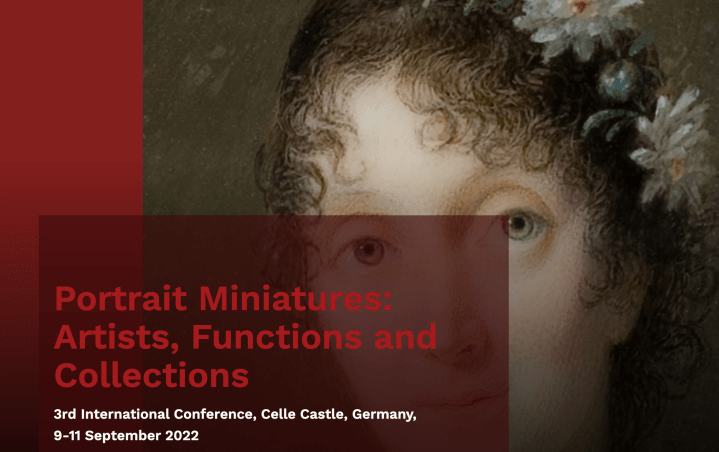
From the Tansey Miniatures Foundation and the conference programme:
Portrait Miniatures: Artists, Functions, and Collections
Celle Castle, Tansey Miniatures Foundation, Celle Castle (near Hanover), 9–11 September 2022
This conference will take place in conjunction with the seventh exhibition of the Tansey Miniatures Foundation and the publication of the accompanying catalogue Miniatures from the Time of Napoleon in the Tansey Collection. 23 speakers from 11 different countries will address a range of topics related to portrait miniatures:
• Individual miniaturists, specific workshop contexts, and places of production
• Use and functions of both court and private types and their protagonists
• Iconographic aspects in the context of representation or intimacy
• Evolution of techniques and materials
• Private and public collections
The conference will be in English. The presentations will subsequently be published in a richly illustrated book. Admission is free. Both conference venues are within walking distance (20 minutes) from the railway station. Trains from Hannover take approximately 25 to 45 minutes (Deutsche Bahn, Metronom, and S-Bahn). For registration, please contact Juliane Schmieglitz-Otten, The Tansey Miniatures Foundation, juliane.schmieglitz-otten@tansey-miniatures.com. For more information, please contact Bernd Pappe, The Tansey Miniatures Foundation, bernd.pappe@tansey-miniatures.com.
F R I D A Y , 9 S E P T E M B E R 2 0 2 2
16.00 Registration
18.00 Welcome and Opening Lectures
• Juliane Schmieglitz-Otten, Realism and Modernism in the Likenesses of a New Epoch: Highlights of the Exhibition Miniatures from the Time of Napoleon
• Bernd Pappe, Making a Small Man Great: Miniatures of Napoleon I
• Birgitt Schmedding, Two Views: The Power of Seeing
S A T U R D A Y , 1 0 S E P T E M B E R 2 0 2 2
9.00 Objects, Agencies, and Social Practices
• Gerrit Walczak (Berlin), Icons of Intimacy: Sex, Agency, and the Portrait Miniature
• André and Anne-Marie Regnard-Denis (Belgium), Gestures and Their Meaning in Portrait Miniatures
• Karin Schrader (Bad Nauheim), ‘Telling Objects’: Miniatures in 18th-Century Courtly Portraits
• Lea C. Stephenson (Philadelphia), Racial Capital: Peter Marié’s Miniatures and Gilded Age Whiteness
• Jann Matlock (London), The Museum of Lost Portraits: Paris, 1794–1805
• Damiët Schneeweisz (London), Shipped, Worn, or Carried: Portrait Miniatures in the Atlantic Ocean World
13.00 Lunch
14.15 Politics and Representation
• Juliane Schmieglitz-Otten (Celle), Pictorial Family Ties: Series of Portrait Miniatures Serving Political Networks
• Martin Miersch (Ulm), Fashion and Political Statement: Portrait Miniatures from the Time of the French Revolution
• Maxime Charron (Paris), Examples of Intimate Portraits from the Royal and Imperial Courts of France during the First Half of the 19th Century
• Agnieszka Fulińska (Krakow), A Reputed Portrait Miniature of the King of Rome and Images of Children from Napoleon’s Entourage
• Marina Vidas (Copenhagen), Portrait Miniatures Set in Jewellery and Objects of Personal Adornment Connected to Queen Louise of Denmark and Her Daughter, Maria Feodorovna, Empress of Russia
17.30 Special Techniques and Materials
• David Hradil, Janka Hradilová, and Olga Trmalová (Prague), Benefits of Non-Invasive Macro X-Ray Fluorescence Scanning for the Analysis of Materials in Portrait Miniatures
S U N D A Y , 1 1 S E P T E M B E R 2 0 2 2
9.00 Special Techniques and Materials
• Christine Slottved Kimbriel, Paola Ricciardi, and Flavia Fiorillo (London), Unlocking the English Portrait Miniature: The Materiality of Isaac Oliver’s Oeuvre
• Alan Derbyshire and Lucia Burgio (London), The William Wood Manuscripts
10.00 Miniature Painters
• Martin Spies (Giessen), In Search of Charles Townley, Painter of Miniatures and Engraver to the King of Prussia
• Luise Schreiber Knaus and Peter Knaus (Bodelshausen), The Miniature Painter Jeremiah Meyer: His Life and Career during the Reign of King George III
• Sonja Remensberger (Winterthur), Pierre-Louis Bouvier (1765–1836): Life and Work of a Geneva Miniature Painter whilst Working Abroad
• Nathalie Lemoine-Bouchard (Paris), Ambroise Charlemagne Victor Le Chenetier: When a 19th-Century Artist Hides Another One
13.00 Lunch
14.15 Collections of Portrait Miniatures
• Stephen Lloyd (Liverpool), Horace Walpole’s Recently Discovered Plan for Displaying His Miniatures and Enamels in the Cabinet of the Tribuna at Strawberry Hill
• Maria Dunina (Moscow), The Collection of Miniatures of the State Pushkin Museum of Fine Arts, Moscow
• Tatiana Udras (Moscow), Portrait Miniatures of the Romanoff Family in Russian and Foreign Collections
• Cecilia Rönnerstam (Stockholm), On Origins and Originals: The History of a Collection
• Blythe Sobol (Kansas City), An Outsized Passion for Miniatures: The Starr Collection of Portrait Miniatures at the Nelson-Atkins Museum of Art
Exhibition | Miniatures from the Time of Napoleon
From the Tansey Miniatures Foundation:
Miniatures from the Time of Napoleon / Miniaturen der Zeit Napoleons
Tansey Miniatures Foundation, Bomann-Museum, Celle, from 26 June 2020
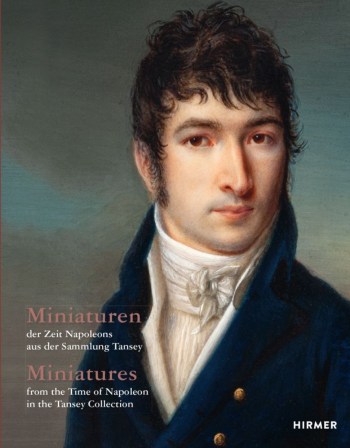 The Tansey miniatures, now held by the Bomann Museum in Celle, represent one of the most significant collections of European miniature paintings. This exhibition showcases a total of 150 works from the time of Napoleon I (1795–1815). These tiny portraits, which were generally intended for personal use, date from the ‘golden age’ of miniature painting. They exhibit a high degree of artistic skill and refined craftsmanship. Unlike the staged, theatrical portraits of absolutism, now for the first time we see realistic likenesses of people who appear ‘modern’—a gallery of women, men, and children from a period of political upheaval dominated by wars.
The accompanying bilingual catalogue (in German and English) provides comprehensive insight into the art of miniature painting in this magnificent era. Specialists have contributed detailed and richly illustrated introductory essays. This volume joins earlier entries in the series, exploring the collection in key periods and presenting new photographic reproductions of the miniatures at actual size.
Bernd Pappe and Juliane Schmieglitz-Otten, with photography by Birgitt Schmedding, Miniatures from the Time of Napoleon in the Tansey Collection (Munich: Hirmer Verlag, 2022), 452 pages, ISBN: 978-3777436098, €58 / $65.
Newly Discovered Portrait of John Locke on View at London Art Week
From the press release via Art Daily:
Miles Wynn Cato | British Art Rediscovered: Unseen Pictures, Untold Stories
London Art Week, 3–8 July 2022

Dr. Alexander Geekie, Portrait of John Locke, 1696, pastel on paper.
As part of London Art Week, British art dealer Miles Wynn Cato will present a remarkable selection of fourteen important discoveries, including a rare portrait of the English philosopher John Locke (1632–1704). Unrecorded since 1727, this fine pastel portrait was drawn from life by Dr Alexander Geekie (1655–1727), who was Locke’s doctor and friend, as well as a highly-accomplished amateur artist and art collector.
John Locke is widely acknowledged as one of the great thinkers of the Enlightenment and indeed, of all time. Locke’s ideas were also profoundly influential in the founding of the United States. Thomas Jefferson believed Locke to be one of “the three greatest men that have ever lived, without any exception.”
Archive letters between Locke and Dr Geekie reveal their close mutual regard, and in this superb personal portrayal, Geekie has managed to capture the essence of Locke’s character. The image is inscribed on the reverse, “Mr Lock by A Geekie, 1696,” and it is singled out for special mention in Geekie’s will. This discovery marks a significant addition to the iconography of John Locke. It is also very rare on the market, since almost all the other known portraits of John Locke are owned by public institutions.
This special selling exhibition British Art Rediscovered: Unseen Pictures, Untold Stories is held in conjunction with London Art Week. It will contain fourteen rediscovered paintings and drawings by some of Britain’s most important artists including Sir Thomas Lawrence, Thomas Jones, Angelica Kaufman, Joseph Wright of Derby, and Thomas Gainsborough (with Gainsborough remarkably represented by five rediscovered pictures).
• All of these artworks had been long lost, miscatalogued, or previously unrecorded.
• Each picture is also notable in the artist’s oeuvre for stylistic reasons or because the sitter or scene is exceptionally rare, such as the portrait of John Locke.
• The exhibition will include three paintings by early female artists, including a lost painting by Angelica Kauffman, RA.
• In two instances—Thomas Gainsborough and Thomas Lawrence—the image on view is one of the artist’s earliest known pictures to survive; so these significant new finds will shed fresh light on the early techniques of these outstanding artists.
This is a unique, limited opportunity to see these exciting new discoveries for the first time.
New Book | America’s Philosopher
From The University of Chicago Press:
Claire Rydell Arcenas, America’s Philosopher: John Locke in American Intellectual Life (Chicago: The University of Chicago Press, 2022), 280 pages, ISBN: 978-0226638607, $35.
 America’s Philosopher examines how John Locke has been interpreted, reinterpreted, and misinterpreted over three centuries of American history.
The influence of polymath philosopher John Locke (1632–1704) can still be found in a dizzying range of fields, as his writings touch on issues of identity, republicanism, and the nature of knowledge itself. Claire Rydell Arcenas’s new book tells the story of Americans’ longstanding yet ever-mutable obsession with this English thinker’s ideas, a saga whose most recent manifestations have found the so-called Father of Liberalism held up as a right-wing icon.
The first book to detail Locke’s trans-Atlantic influence from the eighteenth century until today, America’s Philosopher shows how and why interpretations of his ideas have captivated Americans in ways few other philosophers—from any nation—ever have. As Arcenas makes clear, each generation has essentially remade Locke in its own image, taking inspiration and transmuting his ideas to suit the needs of the particular historical moment. Drawing from a host of vernacular sources to illuminate Locke’s often contradictory impact on American daily and intellectual life from before the Revolutionary War to the present, Arcenas delivers a pathbreaking work in the history of ideas.
Claire Rydell Arcenas is assistant professor of history at the University of Montana.
C O N T E N T S
Preface
1 Locke’s Legacy in Early America
2 Locke’s Authority in the Revolutionary and Founding Eras
3 Problematizing Locke as Exemplar in the Early United States
4 Locke Becomes Historical
5 Making Locke Relevant
6 Locke and the Invention of the American Political Tradition
7 Lockean ‘-isms’
Epilogue
Acknowledgments
List of Abbreviations
Notes
Bibliography
Index










 Enfilade
leave a comment