Exhibition | Making East London Porcelain

Now on view:
Making East London Porcelain
Stratford Library, London, 1–30 June 2022
It is now over 250 years since the earliest dated pieces of Bow porcelain were produced in London. The success of the Bow Porcelain Factory reminds us that Newham was a global centre for experimentation and creativity during the middle of the eighteenth century. As part of our Making London Porcelain Project funded by the Arts and Humanities Research Council (AHRC), scientists and curators at the Victoria and Albert Museum and the Ashmolean Museum have been researching 15 objects owned by Newham Borough of London. Using scientific analysis, we have been trying to better understand the materials and processes used to create such incredible works of art.
Making East London Porcelain is part of a collaborative science-led heritage project between the V&A Museum and Newham Borough of London, which has been made possible by the Arts and Humanities Research Council’s (AHRC) Capability for Collections Fund. Focusing on the celebrated Bow Porcelain Factory, this project brings communities together to explore Newham Borough as a place of creativity, experimentation, and entrepreneurship in the mid-eighteenth century. Co-curated with sixth-form students from Chobham Academy (Newham) and Cardinal Vaughan Memorial School (Chelsea), the exhibition explores how heritage science and re-making practices can help us better understand the places we live today and inspire us to innovate and experiment tomorrow.
◊ ◊ ◊ ◊ ◊
Exploring Bow Porcelain
Stratford Library, London, Wednesday, 15 June 2022, 6.00pm
Join us for an object-handling workshop with local artists as we celebrate the launch of the exhibition Making East London Porcelain.
Take part in a conversation with local ceramic artist Julia Ellen Lancaster, one of the Explorer Leach 100 Artists, whose work offers a modern twist on sculptural figures and historic clay recipes, such as those made by the Bow Porcelain Factory. You will have the opportunity to handle and examine historic pieces of eighteenth-century Bow porcelain from Newham’s special collections guided by V&A Ceramics Curator, Dr Caroline McCaffrey-Howarth, and learn about how historic making processes inspire and influence ceramic artists in Newham today.
Call for Articles | William Hogarth and Cinema

Paul Sandby, Satire with Hogarth as a Magic Lantern Projecting a Parody of his ‘Paul before Felix’, 1753, etching
(London: British Museum, Cc,3.12)
◊ ◊ ◊ ◊ ◊
From the Call for Papers:
William Hogarth and Cinema
Special issue of Ecrans (Spring 2024), edited by Marie Gueden and Pierre Von-Ow
Abstracts due by 5 September 2022; drafts due by 30 March 2023
According to Sergei Eisenstein, “Diderot talked about cinema.” It could likewise be suggested that the eighteenth-century artist William Hogarth (1697–1764) inaugurated cinematic discourse. Through his visual and theoretical work, Hogarth offers a crucial contribution to the narrative and aesthetic reflections that predate—and somehow anticipate—the invention of cinema. Eisenstein did indeed comment upon and commend Hogarth’s visual productions (praising in particular his stage-like compositions and visual narratives articulated in sequences of images). The Russian filmmaker admired his English predecessor’s artistic theory, preoccupied with the movement of bodies and gazes: Eisenstein appropriated the idea of a “line of beauty” developed in Hogarth’s The Analysis of Beauty in his directing and editing. Yet, the filmic potentialities of Hogarth’s work and ideas still await extended critical and scholarly attention. The artist’s name appears sporadically in film studies that mention his influence for set designs—especially in Hollywood where Fritz Lang, Mark Robson, and Stanley Kubrick, among others, drew from Hogarth’s works to stage their historical films—and on the legacy of his artistic writings in film theory and criticism. The abundant art historical literature devoted to Hogarth, however, rarely evokes the artist’s cinematographic legacy. A special issue of the peer-reviewed journal Ecrans (No. 20, Spring 2024), to be published in French and English, seeks to explore the largely understudied connections between William Hogarth and global and expanded cinema.
We invite papers on topics that may include (but are not limited to):
• Pre-cinema, with particular emphasis on magic lanterns and early cinema, for example, filmed tableaux vivants
• William Hogarth in Hollywood, especially in the studios’ archives
• The temporality of images and sequencing of visual narratives
• Graphic novels, illustrated journals, and cartoons
• Adaptations of literary ‘Progresses’ between prints, paintings, theatre, performance, film, TV series, etc.
• Case studies from global cinema, including art documentaries
• Experimental cinema, particularly the challenging of narrative linearity
• The legacy of Hogarth’s satirical work in comedy, including productions featuring Hogarth as a character of fiction
• The legacy of Hogarth’s artistic theory and his “line of beauty” in film theory (for example through various visual shorthand systems) and criticism
• Marxist, feminist, and post-colonial currents in the reception of Hogarth’s work
Please submit a proposal by 5 September 2022 in English or French (up to 400 words), as well as a short bio, to the guest editors of this special issue: Marie Gueden (marie.gueden@univ-lyon2.fr) and Pierre Von-Ow (pierre.von-ow@yale.edu). Final papers should not exceed 8000 words. First drafts expected on 30 March 2023 for publication in April 2024. Feel free to contact us if any questions should arise before submitting your proposal. More information about Ecrans is available here.
Library at Trinity College Dublin Preps for Restoration

The Long Room of the Old Library at Trinity College Dublin
(Wikimedia Commons, July 2015)
◊ ◊ ◊ ◊ ◊
From The NY Times:
Ed O’Loughlin, “An Irish National Treasure Gets Set for a Long-Needed Restoration,” The New York Times (28 May 2022). The majestic Old Library at Trinity College Dublin, where some of Ireland’s most ancient and valuable books are stored, is a popular tourist attraction.
The Long Room, with its imposing oak ceiling and two levels of bookshelves laden with some of Ireland’s most ancient and valuable volumes, is the oldest part of the library in Trinity College Dublin, in constant use since 1732.
But that remarkable record is about to be disrupted, as engineers, architects and conservation experts embark on a 90 million euro, or $95 million, program to restore and upgrade the college’s Old Library building, of which the Long Room is the main part.
The library, visited by as many as a million people a year, had been needing repairs for years, but the 2019 fire at Notre Dame cathedral in Paris was an urgent reminder that it needed to be protected, according to those involved in the conservation effort. . . .
Much of the effort will be focused on conserving the historic worked wood that makes up much of the library’s interior and the frames of its windows, as well as improving fireproofing and environmental controls needed to protect the valuable book collection.
Faced with the example of Notre Dame, and the realization that something similar could happen to an Irish national treasure, the government pledged €25 million, with the college and private donors adding €65 million more.
Work started in April, and in October 2023, the Old Library’s doors will close to visitors for at least three years as it moves into full gear. . . .
The full article is available here»

James Malton (1761—1803), Trinity College Library, The Long Room, eighteenth-century watercolour (Wikimedia Commons). From the Wikipedia entry for “Library of Trinity College Dublin”: “The 65-metre-long (213 ft) main chamber of the Old Library, the Long Room, was built between 1712 and 1732 and houses 200,000 of the Library’s oldest books. Initially, The Long Room had a flat ceiling, shelving for books only on the lower level, and an open gallery. By the 1850s the room had to be expanded as the shelves were filled due to the fact that the Library had been given permission to obtain a free copy of every book that had been published in Ireland and Britain. In 1860, The Long Room’s roof was raised to accommodate an upper gallery.”
Symposium | Thinking Europe Visually
From ArtHist.net, where the posting also includes the French version:
Thinking Europe Visually
Centre IMAGO / École normale supérieure, Paris / Musée du Jeu de Paume, Paris, 9–10 June 2022
“If I had to do it again, I would start with culture.” This statement, often erroneously attributed to Jean Monnet, suggests that in the absence of a shared culture, Europe as a political and economic construct remains nothing but a hollow shell. This conference aims to question the disillusioned position which holds that there is no meaningful common European culture, and to do so through images. One way to visualize the potential existence and limits of a European cultural base is indeed to trace the circulation of images—be they works of art, press images, posters, photographs, or even motifs and patterns—in the region, from antiquity through to the present day. What are the images that have circulated most widely in Europe? Are they specific to Europe or are they already globalized? What was their visual and symbolic impact? Is there a ‘visual culture’ specific to Europe and, if so, what might be its distinctive ‘patterns’?
The symposium will take place on June 9 and 10, 2022 in Paris at the Ecole normale supérieure, 45 rue d’Ulm. It is hosted by European Excellence Center Jean Monnet IMAGO (ENS), in collaboration with the project VISUAL CONTAGIONS at the University of Geneva (Switzerland). If is supported by the European agency Erasmus + and by the Swiss national Fund for research.
The symposium is also structured around three exhibitions:
• Contagions visuelles, an exhibition for the Espace de Création numérique du Jeu de Paume (10 May — 31 December 2022, curated by Béatrice Joyeux-Prunel with Nicola Carboni).
• Ces images qui ont fait l’Europe / Those Images That Made Europe, a digital exhibition hosted by Europeana.eu (forthcoming June 2022)
• Correspondances, a ‘real’ exhibition at the University of Geneva (16–30 May 2022) on the circulation of images, with works and texts by students from the chair in digital humanities at UNIGE (Prof. Béatrice Joyeux-Prunel) and the Atelier de Photographie at the Beaux-Arts de Paris led by Marie José Burki.
Organisation
• Béatrice Joyeux-Prunel, Professeure à l’université de Genève, chaire des humanités numériques
• Léa Saint-Raymond, postdoctorante, ENS-PSL / IMAGO
• Centre d’excellence Jean Monnet IMAGO, ENS-PSL (https://www.imago.ens.fr), en partenariat avec le projet FNS VISUAL CONTAGIONS, Université de Genève (https://visualcontagions.unige.ch)
◊ ◊ ◊ ◊ ◊
T H U R S D A Y , 9 J U N E 2 0 2 2
8.30 Welcome and Coffee
9.30 Béatrice Joyeux-Prunel (UNIGE) and Léa Saint-Raymond (ENS-PSL), Introduction
9.45 Keynote
• Adeline Rispal, L’Étoffe de l’Europe®, une œuvre pour tisser l’avenir [The Fabric of Europe, A Work to Weave the Future]
10.45 Pause
11.00 Morning Session
• Areti Adamopoulou (University of Ioannina), The Pediment and the Column: The Persistence of Values
• Fabienne Gallaire (INP), A Stable Continent: On the Horse and the Other Animal Attributes of Europe in Early Modern Allegories, 16th–18th c.
• Eveline Deneer (University of Utrecht), A Light on Europe: The International and Intermedial Trajectory of a Medieval Chandelier at the Turn of the 19th Century
12.30 Lunch
14.00 Afternoon Session
• Sylvain-Karl Gosselet (CNRS, Université de Paris Cité, LARCA), Fashionable Europe: Iconological Wonders à la Bonnart
• Emilia Olechnowicz (Institute of Art of the Polish Academy of Sciences), Fabrication of Europe: Europe as the Space and the Myth in Early Modern Costume Books
• Béatrice Joyeux-Prunel (UNIGE), What Images Made Europe in the Era of Illustrated Print? The Imago/Visual Contagions Project
• Nicola Carboni (UNIGE), The Rise of Machines: A Data-Driven Approach to the Study of Image Circulations
• Marie Barras (UNIGE), Visual Hits from the Past: Tracing the Global Circulation of Art Images from 1890 until 1990
17.00 Pause
17.30 Grégory Chatonsky (artist) – Réalisme contrefactuel : l’introduction des images possibles dans l’histoire de l’art [Counterfactual Realism: The Introduction of Possible Images in Art History]
18.30 Roundtable — Europe between Its Vision and Its Images / Vision et images de l’Europe
• Thomas Serrier (Université Lille III), Béatrice Joyeux-Prunel (UNIGE), Léa Saint-Raymond (ENS-PSL) and the team of the journal Le Grand Continent
19.30 Cocktail Reception
F R I D A Y , 1 0 J U N E 2 0 2 2
9.00 Coffee
10.00 Keynote
• Christophe Charle (Université Paris 1 Panthéon-Sorbonne), The Cultural Spaces of Europe in the 19th Century
11.00 Pause
11.15 Morning Session
• Emmelyn Butterfield-Rosen (Williams College Graduate Program in the History of Art, Clark Art Institute), Posture and the Invention of European Art
• Léa Saint-Raymond (ENS-PSL) and Quentin Bernet (Ecole du Louvre), The ‘Madonna of Humility’: A Pattern That Made Europe, 14th–16th c.
12.15 Lunch
13.45 Coffee
14.00 Afternoon Session
• Marie Blanc (Université Grenoble Alpes), An Image of Europe for and by Its Tourists during the Cold War: The Example of Czechoslovakia
• Paolo Villa (University of Udine), War and Peace: The Film « iconeme » of the Urban Square as Mirror of Europe in Translation, 1944–1948
• Lefteris Spyrou (Institute for Mediterranean Studies-FORTH), Promoting a Shared European Cultural Heritage: The Council of Europe’s Art Exhibitions in the 1950s
• Antje Kramer (Université Rennes 2), T 1956-9 by Hans Hartung: A Line Drawn between Europe and Africa?
• Matteo Bertele (Ca’Foscari University of Venice), Defining European Art through International Exhibitions, 1955–1958
18.30 Evening at Jeu de Paume Museum (Auditorium)
à propos the exhibition Visual Contagions / Contagions visuelles; les images dans la mondialisation – Jeu de Paume, Espace de Création numérique — with Marta Ponsa (Jeu de Paume), Béatrice Joyeux-Prunel and Nicola Carboni (UNIGE), and the artists Valentine Bernasconi, Robin Champenois, Nora Fatehi, Thomas Gauffroy-Naudin, Anim Jeon, Rui-Long Monico
U of Buckingham | MA in French and British Decorative Arts
MA in French and British Decorative Arts and Historic Interiors
University of Buckingham, starting September 2022
Bursary applications due by 20 June 2022
 Applications are invited for a bursary on the University of Buckingham’s MA in Decorative Arts and Historic Interiors starting September 2022. Generously funded by The Leche Trust, the award is worth £7,500 and will contribute towards course fees. The deadline for bursary applications is Monday, 20 June, 4.30pm.
This unique MA in French and British Decorative Arts and Interiors, taught in partnership with the Wallace Collection, focuses on the development of interiors and decorative arts in England and France in the ‘long’ eighteenth century (c.1660–c.1830) and their subsequent rediscovery and reinterpretation in the nineteenth and twentieth centuries.
A key element of the course is the emphasis on the first-hand study of furniture, silver, and ceramics, where possible in the context of historic interiors. Based in central London, it draws upon the outstanding collections of the nearby Wallace Collection and the Victoria and Albert Museum as well as the expertise of the Wallace Collection curatorial staff and other leading specialists who participate in the teaching.
Bursary priority will be given to applicants:
• with excellent academic qualifications, seeking, or currently pursuing careers in museums, the built heritage or conservation,
• in need of financial assistance,
• have a strong interest in the decorative arts and historic buildings,
• or, for those wishing to go on to pursue academic research in the decorative arts and historic interiors.
The bursary is also open to part-time students commencing their studies in 2022 for whom the funding would be spread over two-years. To be eligible for the bursary, students will need to have applied for and been offered a place on the course.
Online Symposium | Women and Religion in 18th-C France

After Magdeleine Horthemels, Burial of Nuns at the Abbey of Port-Royal-des-Champs (Musée de Port-Royal des Champs).
◊ ◊ ◊ ◊ ◊
From the conference website:
Women and Religion in Eighteenth-Century France: Ideas, Controversies, Representations
Online, Queen Mary, University of London, 24 June 2022
Organized by Marie Giraud and Cathleen Mair
From Catholics to Protestants, abbesses to lay sisters, or even artists and salonnières, religious women played an important role in the social, cultural, and political life of France during the eighteenth century. Drawing on new approaches and sources, this interdisciplinary symposium will consider the identities, controversies, ideas, experiences, and representations of religious women in the period. It will explore how women of faith navigated, adopted, challenged, or subverted the religious canon, cultural norms, and social conventions as the understanding of religion, politics, and power shifted rapidly throughout the eighteenth century.
The keynote address will be delivered by Professor Mita Choudhury (Vassar College), whose work on gender, sexuality, and the place of nuns within the larger political and intellectual world of pre-revolutionary France lays the groundwork for further studies of women religious in the period.
The symposium will take place online via Zoom and is free to attend. All times in BST. Please click here to register to attend. The Zoom link will be circulated with registered attendees 24 hours in advance. A PDF version of the programme is available to download here.
This event is generously supported by London Arts and Humanities Partnership and the Doctoral College Initiative Fund at Queen Mary University of London.
P R O G R A M M E
9.30 Welcome and Housekeeping
• Marie Giraud (QMUL) and Cathleen Mair (QMUL)
9.45 Panel 1 — Living Faith: Everyday Religion in Women’s Letters
Chair: Ben Jackson (Birmingham)
• Cormac Begadon (Durham University), Nuns and Their Confessors: Appeals, Emotions, and Gender in the English Convents
• Gemma Betros (Australian National University), Marie de Botidoux: Religion in the Life of a Young Woman in Late-Eighteenth-Century Paris
10.45 Panel 2 — Recovering Voices: Women Religious in Print Culture
Chair: Gemma Tidman (QMUL)
• Rebecca Short (University of Oxford), Posthumous Presence: Religious Authority in the Lettres à une illustre morte (1770)
• Sean Heath (Independent Scholar), Je ne suis qu’une femme: Madame de Lionne’s Intervention in the Chinese Rites Controversy, 1700–1705
11.45 Break
12.00 Panel 3 — Faith on Trial: Religious Sects and the State
Chair: Liesbeth Corens (QMUL)
• Sarah Barthélemy (Durham University / Université Saint-Louis – Bruxelles), Gender, Catholicism, and Dissimulation: The Trial of Adélaïde Champion de Cicé
• Otto Selles (Calvin University), Prophétesses de Sion: Women and the Multipliant Sect (Montpellier, 1720–1723)
13.00 Lunch Break
14.00 Panel 4 — Contested Meanings: Women Religious and Revolutionary Politics
Chair: Ben James (KCL)
• Corinne Gressang (Erskine College), What Does Liberty Mean to a Nun?
• Richard Yoder (Pennsylvania State University), Jacqueline-Aimée Brohon: Victim-Soul and Revolutionary Prophet
15.00 Panel 5 — Representing Faith: Spaces and Objects of Devotion
Chair: Hannah Williams (QMUL)
• Killian Harrer (University of Munich), Wellsprings of Devotion: Marian Apparitions and Female Pilgrims in Revolutionary France
• Samuel Weber (EHESS), Handmaids of the Sacred Heart: Nuns’ Production of Paraphernalia and the Making of Sentimental Catholicism in Eighteenth-Century France
16.00 Break
16.15 Keynote Lecture
Chair: Miri Rubin (QMUL)
• Mita Choudhury (Vassar College), Reflecting on Gender, Religion, and the Historian’s Craft
Versailles Acquires Portrait of Catherine Duchemin
Press release from château de Versailles, via Art Daily (28 May 2022). . .

Unidentified artist, Portrait of Catherine Duchemin, oil on canvas (Palace of Versailles Dist RMN, C. Fouin).
The Palace of Versailles has just acquired an oil on canvas painting of Catherine Duchemin (1630–1698, the first woman to be admitted as a painter to France’s Académie Royale de Peinture et de Sculpture (Royal Academy of Painting and Sculpture) in 1663. Acquiring this rare painting serves to further enrich Versailles’ collection of Académie artists’ portraits, which until now has featured men exclusively.
Catherine Duchemin was one of the rare few female painters working in 17th-century France and known to us today. She stands out from her fellow female artists in her achievement in being the first woman admitted to the Académie Royale de Peinture et de Sculpture on 14 April 1663 upon presenting a painting of flowers that prompted the academy to feel it was a “duty” and an “honour,” “in accordance with the King’s wishes […] to spread her grace among all those who excel in the arts of painting and sculpture […] without regard to differences between the sexes.”
Catherine Duchemin was born in 1630, the daughter of a Parisian painter and decorator who may well have taught her the basics of painting. At the age of 27 in 1657, she married the sculptor François Girardon. Despite a number of pioneering examples at the time, female artists were relatively rare in those days: it would take a further generation for their artistic careers to flourish in Paris. This first admission of a woman to the Académie was of paramount importance, serving as an event that would prompt change beyond Catherine Duchemin’s own life, as others followed in her footsteps up until the early 18th century.
The model’s steady gaze meets the viewer’s eyes as she readies herself to begin painting a bouquet of double-flowered anemones and poppies in a vase. The format of the canvas, the opulence of the armchair, and the elegance of the colourful, black ribbon-embellished clothing are all highly ambitious.
Although the painting is unsigned, cross-referencing it with portraits from the Palace of Versailles’ collection and notably those produced by Académie members may allow for this remarkably well-executed piece to be attributed to a named artist. Catherine Duchemin may have painted the floral composition herself, which would make this portrait the only remaining example of her work. Indeed, the artist “excelled at painting flowers” to the extent that “so real were they, you might almost smell them,” according to her first biographer, Florent Le Comte. The three flowers—one budding, the other in full bloom, and the third a poppy used to symbolise slumber—may be read as an allegory for life.
Once it has been restored, this portrait will fit seamlessly in with the exceptional collection of Académie member portraits that now hang in the Louis XIV rooms. These 17th-century artworks are invaluable testimonies to how the Académie Royale de Peinture et de Sculpture would once have worked: a key component in Louis XIV’s arts promotion policy.
At Christie’s | Hubert de Givenchy: Collectionneur
From the press release for the sales:
Hubert de Givenchy: Collectionneur
Christie’s, Paris, live: 14–17 June 2022, and online: 8–23 June 2022
Christie’s has announced details of the full 1229 lots in the Hubert de Givenchy: Collectionneur sale, which will be offered in auctions taking place live in Paris (Sale 21549 and Sale 20825) and online (Sale 21420) between 8 and 23 of June 2022. A passionate aesthete, deeply rooted in the culture of his country, Hubert de Givenchy (1927–2018) embodied a constant and successful quest for an ideal, that of classical beauty. The extraordinary variety and richness of works in these sales perfectly represent the world-renowned couturier’s deep passion for objects and impeccable good taste. The overall estimate for the collection is in the region of €50million.

Hubert de Givenchy’s bedroom at Hôtel d’Orrouer © François Halard. Christie’s Images Limited.
Christie’s will present selected highlights from the auctions as follows:
Provenance
For Hubert de Givenchy, each object had a life of its own. For him, appreciation and engagement came not only from the beauty of the object, but also from its provenance, and the auctions are filled with such pieces of prestigious provenance. In the 1950s, the young couturier began his ‘second career’ as an art collector. From the collection of Coco Chanel, who invited him regularly for dinner, comes a superb Régence console (estimate €60,000–100,000), while from the collection of José-Maria and Misia Sert comes a rare Italian neoclassical console table, probably the work of Torinese craftsmen active at the court of Savoy (estimate €12,000–18,000). From the ‘Palais Murat’, the home of a very important collection visited by the royal families of the 19th century, comes a shaped porphyry potpourri vase, probably acquired by the King of Naples around 1780 (estimate €60,000–100,000). Of Imperial provenance are a pair of monumental girandoles attributed to Pierre-Philippe Thomire for Tsar Paul I of Russia (estimate €700,000–1,000,000). These sculptural pieces surrounded the access to the garden at his Paris home, the Hôtel d’Orrouer. In the same salon, any visitors’ eye was drawn to a set of Regency ormolu-mounted vases attributed to Vulliamy & Son delivered around 1807 to the 1st Earl of Harewood (estimate €100,000–150,000). Today, the name of Hubert de Givenchy is synonymous with a prestigious provenance, sought-after by the most discerning collectors.

Attributed to François Girardon, Bacchus, ca. 1700, estimate: €1.5–2.5million.
Architecture
From fashion to decoration, Givenchy approached his projects as an architect, as did his mentor Cristóbal Balenciaga. Architecture embodies Givenchy’s ideal of balance, harmony, and majesty and is therefore omnipresent in many of the pieces included in the collection, as is the case with a superb baroque bronze censer from Augsburg (estimate €30,000–50,000) and a pair of late Louis XV candlesticks attributed to Pierre Gouthière (estimate €60,000–100,000). Architecture is also present in paintings, such as Hubert Robert’s The Pool in the Terms (estimate €12,000–15,000) and the Landscape with Obelisk and Colonnade (estimate €250,000–350,000). In Givenchy’s bedroom at Hôtel d’Orrouer, the neoclassical lines of the monumental desk by Roentgen are perfectly matched by those of a mechanical box by the same artist (estimate €8,000–12,000) and a Louis XVI commode by Pierre Garnier (estimate €200,000–400,000).
Seat Furniture
For Givenchy, “every object is the result of an encounter, of love at first sight” (2). Chairs—which are represented by more than 400 examples—occupy a very special place in the collection. Not hesitating to declare himself “madly in love” (1) with a Louis XVI fauteuil, Givenchy was also seduced by a pair of bergères stamped by Georges Jacob from the same period (estimate €15,000–25,000). Equally, he appreciated the lines of a pair of Régence armchairs, formerly from the collection of Lady Baillie at Leeds Castle (estimate €100,000–200,000). Often Givenchy reupholstered furniture with modern textiles such as a Louis XVI bergère by Nicolas-Quinibert Foliot with a designed textile by Georges Braque (estimate €6,000–10,000), transcending periods and styles. The sale also includes a number of more modern seat models from the 20th century, including Decour bergères from the grand salon of the Manoir du Jonchet (estimate €800–1,200).
Wild Life
Givenchy also liked to be surrounded by representations of animals. They were omnipresent and gave life and majesty to the interiors he designed. For example, The Gazelle by Jean-Marc Winckler watched over the guests in the dining room of Hôtel d’Orrouer (estimate €1,000–1,500). Givenchy had three deer heads added to the façade of the Jonchet in honour of his patron saint, and in 2011 he generously donated the casts that allowed the restoration of the Cour des Cerfs to the Château de Versailles. Posthumously, the large stag by François Pompon, was donated to the Château de Chambord, having originally decorated the grand salon at Manoir Jonchet. In the park of the Manoir du Jonchet, lived a splendid pair of bronze deer, executed in 1964 by Janine Janet, gifted as a present by Cristóbal Balenciaga (estimate €80,000–120,000 each). And approaching the house, visitors were greeted by François-Xavier Lalanne’s Oiseaux de jardin (estimate €400,000–600,000 each), while a 1973 turtle by the same artist slumbered in Givenchy’s bedroom (estimate €20,000–30,000). Furthermore, the park held five sculptures by Diego Giacometti (estimate €20,000–30,000 each) immortalising Bucky, Lippo, Sandy, and Assouan, Givenchy’s canine companions. Animals were also to be found at the Hôtel d’Orrouer, where a pair of 19th-century gilded copper Tibetan deer were placed on the mantel piece of the main salon (estimate €20,000–30,000).
Fine Arts
Givenchy’s eye was equally drawn to Domenico Piola’s monumental 1695 painting Alexander and the Family of Darius (estimate €80,000–120,000), Max Ernst’s luminous, tiny 1961 Untitled (Soleil) (estimate €50,000–70,000), and the elegant minimalism in Robert Courtright’s 1972 painting Untitled (estimate €10,000–15,000). In the collection, representations of the human figure abound, whether a pair of busts of emperors in the Antique style (estimate €250,000–350,000) or the portrait Grande tête de Katia by Henri Matisse (estimate €7,000–10,000). Keeping with the collector’s concept of architecture and fashion, fabric and clothing were important, as in the portrait of an Indian dignitary, luxuriously dressed in 17th-century Persian fashion (estimate €60,000–80,000).

The ‘Empire’ living room at Hôtel d’Orrouer in Paris © François Halard. Christie’s Images Limited.
Decorative Arts
Givenchy had always loved imposing furniture and especially large armoires and bookcases. The auction offers two superb armoires, the first dating from the Louis XIV period, made in the Boulle technique, with ebony marquetry, and the second a replica made by Michel Jamet at de Givenchy’s request to form a pair (estimate €50,000–100,000, the pair). Furthermore, the collection includes a splendid commode, attributed to Joseph Poitou (estimate €250,000–400,000) as well as an important selection of pieces by Diego Giacometti, a close friend, including a Console oiseau et coupelle from 1976 (estimate €400,000–600,000). Collectors will also be able to acquire an imposing contemporary travertine and granite dining table (estimate €8,000–12,000), which comes from the Manoir du Jonchet.
Givenchy and the Colour Green
A leitmotif of the interiors created by Givenchy, the colour green is undoubtedly not foreign to the feeling of serenity and calm evoked by all visitors entering Hôtel d’Orrouer or the Manoir du Jonchet. Green is omnipresent in the collection, and the salon on the second floor of the Hôtel d’Orrouer is named in its honour. A natural sponge, painted in green by Charles Sevigny (estimate €2,000–3,000) is a nod to another great master of the art mixing modern and classical works, Charles Sevigny. He decorated Givenchy’s first apartment, in addition to those of the Empress of Iran and Bunny Mellon.
◊ ◊ ◊ ◊ ◊
Note (added 27 June 2022)— A press release (via Art Daily) reports on the results of the auctions. “Total: €118,116,172 / $123,694,746 / £101,932,654 – doubling the low pre-sale estimate.”
New Book | Indian Tiles: Architectural Ceramics
From Penguin Random House:
Arthur Millner with contributions by Mehreen Chida-Rasvi, Indian Tiles: Architectural Ceramics from Sultanate and Mughal India and Pakistan (London: Prestel, 2021), 304 pages, ISBN: 978-3791387666, £70 / $95.
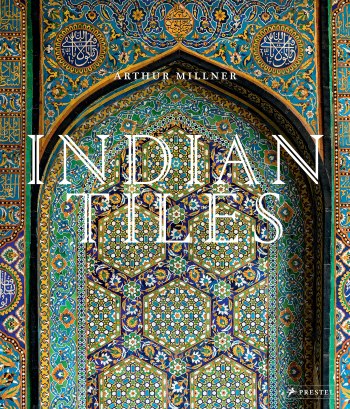 Historic India, which now encompasses the modern nations of India, Pakistan and Bangladesh, is celebrated for the richness of its architectural and decorative arts, but less well known for glazed tiles. Arthur Millner opens up this hitherto neglected subject with a richly illustrated narrative of the development of tiles across the South Asian Subcontinent. Millner traces the craft’s roots in Muslim Persia, Afghanistan and Central Asia, showing how imported glazing techniques combined with an ancient local tradition of clay craftsmanship. He explores the production, designs and influences in Indian tiles from antiquity to the colonial period, tracing the historical evolution through a series of key eras, including the Delhi Sultanate and the Mughal Empire in Northern India as well as the independent sultanates in the Deccan, Bengal, Central India and the Indus region. Although glazed tiles are generally associated with Islam, they also briefly flourished in both Hindu strongholds, such as Gwalior and Orchha, and in Christian Portuguese-ruled Goa. More than four hundred photographs, many of little-known sites, are drawn from the author’s years of travel as well as from colleagues, the archives of the Victoria and Albert Museum, auction houses and other celebrated institutions. These images capture both the architectural context and the visual appeal of the vibrant colors and intricate designs, and provide a visual compendium of the different styles and techniques. Taken together they offer a unique chronicle of an important and environmentally threatened aspect of the region’s cultural, artistic and religious evolution over centuries—one that will appeal to both the specialist and general reader including anyone with an interest in Indian history and architecture, as well as those interested in Islamic art and ceramics.
Arthur Millner is a consultant and independent scholar in the field of Indian and Islamic art. He lectures at the London School of Oriental and African Studies, the Victoria and Albert Museum, the Royal Asiatic Society, and the Oriental Rug and Textile Society. He is the author of numerous articles and the 2015 book, Damascus Tiles (Prestel). He also makes tiles himself in his spare time.
New Book | Indian Botanical Art
Distributed by ACC Art Books:
Martyn Rix, Indian Botanical Art: An Illustrated History (New Delhi: Roli Books, 2022), 224 pages, ISBN: 978-8195256655, $35.
 This book brings together striking botanical art of Indian origin spanning a period of 300 years, focussing on the 18th and 19th centuries. Drawn mostly from original works held in the collections of the Royal Botanic Gardens, Kew, some of the paintings have never been published before. They showcase the richness and variety of art commissioned from talented, mostly unknown, Indian artists who made a substantial contribution to the documentation of the flora of the Indian subcontinent. A foreword written by Sita Reddy places the collections in contemporary context. The book concludes with works from a new generation of botanical artists in India, who excite interest today.
Martyn Rix is a renowned horticulturalist, author of many books, and editor of Curtis’s Botanical Magazine. He is the recipient of the Veitch Memorial Medal from the Royal Horticultural Society for services to horticulture, and a Tercentenary Bronze Medal from the Linnean Society.










 Enfilade
leave a comment