Call for Articles | Fall 2023 Issue of J18: Cold

Victor Marie Picot, after Philippe de Loutherbourg, Winter, 1784, stipple and etching
(London: The British Museum)
◊ ◊ ◊ ◊ ◊
From the Call for Proposals for J18:
Journal18, Issue #16 (Fall 2023) — Cold
Issue edited by Michael Yonan, University of California, Davis
Proposals due by 15 September 2022; finished articles will be due by 31 March 2023
Feeling cool is increasingly a great privilege in our warming world. Cold weather arrives later each winter and departs sooner, lengthening warm seasons across the globe and reducing the cooler periods necessary to the planet’s healthy functioning. One need not be terribly old to have recollections of cooler times. Accompanying changes to global mean temperatures are erratic and often dangerous weather patterns, melting icecaps, rising seas, stronger storms, droughts, and other environmental transformations that, in sum, represent an existential problem for humankind.
The cause of these changes is the consumption of fossil fuels, which transformed human life profoundly in the pursuit of modernity. The origin of this transformation falls squarely in the eighteenth century; indeed the terminus post quem for measuring human effects on global temperatures is the year 1800. Recognizing this draws attention to a truth little noticed in art-historical scholarship: eighteenth-century art was made for a colder world than the one we now inhabit.
This special issue of Journal18 invites contributions that address the relationship between temperature and the art of the long eighteenth century. It seeks to insert eighteenth-century visual and material culture into the growing literature on historical climatology. The 1700s are the final century of the Little Ice Age, a climatological phenomenon characterized by lower global mean temperatures that took place between the late sixteenth and early nineteenth centuries. What are the implications of this climatological context for the narratives we tell about eighteenth-century art? How did an Enlightenment understanding of temperature inflect the period’s art? And do the conditions of eighteenth-century life, as filtered through the period’s artistic production, help us understand why the world became warmer?
Potential topics include the relationship between architecture and temperature, including the technologies used to keep buildings warm or cool; the material culture of gauging temperature (thermometers, barometers, hygrometers, etc.); pictorial representations of extreme climates, e.g., the tropics or the Arctic; the relationship between theories of climate and the representation of peoples; clothing and body temperature; the sub-Arctic north as a cultural space; and the visualization of industrialization. Particularly welcome are essays from a technical art history perspective that address challenges to conserving eighteenth-century things in a warming world.
To submit a proposal, send an abstract (250 words) and brief biography by 15 September 2022 to the following two addresses: editor@journal18.org and meyonan@ucdavis.edu. Articles should not exceed 6000 words (including footnotes) and will be due by 31 March 2023 for publication later that year. For further details on submission and Journal18 house style, see Information for Authors.
New Exhibition | Governing the Nation from Fraunces Tavern, 1785–88
From the press release from the Fraunces Tavern Museum:
Governing the Nation from Fraunces Tavern, 1785–88
Fraunces Tavern Museum, New York, opening 22 June 2022
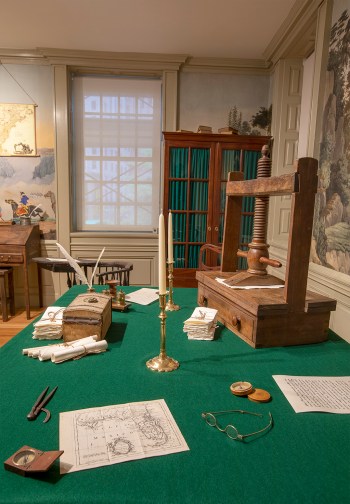
View of the negotiation table inside the Department of Foreign Affairs at Fraunces Tavern with map of east and west Florida in the foreground. Photo: Courtesy of Fraunces Tavern® Museum.
While Fraunces Tavern in New York City is one of the 18th century’s best-known taverns and the site of General George Washington’s famous farewell to his officers at the end of the American Revolution, it is less known that in the late 1700s, the site at 54 Pearl Street in lower Manhattan was also home to the nation’s first executive governmental building that housed three offices of the Confederation Congress. (Although Congress met in City Hall, the space was too small for the government’s departments and other office space had to be leased.) In 1785, the Department of Foreign Affairs, Department of War and offices of the Board of Treasury leased space at the Tavern and remained tenants there until 1788. Thanks to an extraordinary document—a cashbook that detailed the purchases for the Department of Foreign Affairs during its time at the Tavern that is now housed at the National Archives—the Department’s office will be recreated in a new permanent exhibition, Governing the Nation from Fraunces Tavern, set to open on June 22, 2022. Featuring approximately 60 objects, most of which are authentic to the period and many of which have never before been on public display, including tables, chairs, desks, maps, newspapers and other items, visitors will have the opportunity to travel back to post-colonial New York City and enter the Department of Foreign Affairs office as it appeared during a fascinating period in the nation’s history when John Jay was the first Secretary of Foreign Affairs. Visitors will learn about the diplomatic, military and financial challenges that all three departments faced after the Revolutionary War and how those challenges affected the formation of the U.S. Constitution.
“We are in the unique position of having access to a rare, surviving cashbook from the Department of Foreign Affairs,” explains Craig Hamilton Weaver, co-chairman of the Museum and Art Committee at Fraunces Tavern Museum. “We diligently researched each object in the cashbook and acquired authentic items to create an accurate setting that allows the visitor to step back into history. This is indeed a magnificent gift to the nation.”
 After an exhaustive search to locate objects that would have been found in the original office, visitors will not only see an extraordinary assemblage of fine American and British decorative arts, many pieces of which have been donated from private collections, but they will also gain insights into an often-overlooked period in American history. Objects such as A New and Accurate Map of East and West Florida Drawn from the best Authorities, a circa 1700s map engraved by J. Prockter, London, highlighting Spanish-controlled West Florida; a rare copy of the French-language newspaper Courier de L’Europe published in London on 29 September 1786, reporting on America’s diplomatic activities with Prussia and Spain; and an array of directional and mapping compasses will help to illustrate the Department’s first two pressing matters. The Barbary Pirate Crisis, which led to the 1787 diplomatic treaty with Morocco to end pirate seizures of American vessels in the Mediterranean Sea, and negotiations with Spain regarding control of the Mississippi River will be examined in the exhibition to offer visitors insights into what it took to form a new government as well as a deep appreciation for those individuals who rose to the challenge to do so.
“We want visitors to have an immersive experience,” said Scott Dwyer, director of Fraunces Tavern Museum. “The exhibition room was designed and will be arranged to give the sense that John Jay, his under secretary, diplomats, translators, clerks and messengers might enter and resume work at any moment.”
Additionally, the office’s furnishings will illuminate the socioeconomic stratification of the staff who worked in the room. From Henry Remsen, Jr., Jay’s undersecretary for foreign affairs, to the two clerks, a part-time French translator and a messenger, the hierarchy of those employed there will be clearly seen through the caliber of each staffer’s work space in his desk, chair and even desk set; the seniority of the employee’s position correlated to the finery of his work area and accoutrements. For example, Under Secretary Remsen’s desk has a full writing set made of late 18th-century fused Sheffield plate while the clerk’s desk has a pewter inkstand and the messenger’s station has a simple stoneware inkwell. The under secretary’s desk also features examples of Chinese porcelain that would have come to New York aboard the Empress of China, the first American ship to trade with China. The ship returned to New York Harbor and distributed its cargo for local merchants the same year the Department of Foreign Affairs office opened at Fraunces Tavern. Aboard was Samuel Shaw, who would become America’s first Consul to Canton (now Guangzhou), China.

Tea Table, New York, 1770–85, mahogany (New York: Fraunces Tavern Museum, 2022.01.007, gift of Craig Hamilton Weaver; photo by John Bigelow Taylor).
Assembling as many New York- or mid-Atlantic-made furnishings as possible to be seen in Governing the Nation from Fraunces Tavern was another goal in organizing the exhibition to ensure that the room would be authentic to what would likely have been in the original space. One example to be seen at the messenger’s station is a circa 18th-century, brace-back Windsor chair made by Walter MacBride, who worked at 63 Pearl Street in the vicinity of the Tavern. Another such object is a circa 1770–85, mahogany tilt-top tea table, which was likely made in the vicinity of lower Manhattan where many furniture makers were known to have worked at the time. The table features details characteristic of New York style, such as a flat top (rather than the dish top that was popular in other regions), a vase-form pedestal with a cup and square, webbed feet, all of which are typical of New York-made furniture. Although made later than the time period for the office (circa early 19th century), a pair of brass andirons with the rare mark of New York City craftsman David Phillips is included in the exhibition to exemplify other common, locally produced objects during that period. Phillips may have been working earlier as an apprentice near the neighboring South Street Seaport. In a small yet authentic homage to the important document that guided the reconstruction of the office, a leather-bound account book with entries dating from 1765 at the Garret Abel Company of South Street in lower Manhattan, will be seen placed on the clerk’s desk, representing the Foreign Affairs cashbook that informed the object selection for the exhibition. In addition, a facsimile of a page from the actual Foreign Affairs cashbook from 1785 will hang on the wall near the visitor area.
Other featured objects in the exhibition include the negotiation table, made in New York of mahogany and pine in the Chippendale style, circa 1780. The table has carved knees and claw-and-ball legs and is composed of three heavy, solid boards. The strongly carved, original legs have fully developed shells and robust feet. Placed centrally in the room, this is where much of the official business would have been conducted, maps examined and debate likely to have occurred. Another highlight of Governing the Nation from Fraunces Tavern will be found hanging above the clerk’s desk: British engineer Bernard Ratzer’s engraved map, Plan of the City of New York in North America, published in 1776 by Jeffreys & Faden, London, commonly referred to as the ‘Ratzer Map’. One of the best depictions of the city before the Revolutionary War, it was originally issued in 1770 and was heavily influenced by a 1767 map of New York by British engineer John Montresor. The map offers a bird’s-eye view of lower Manhattan Island, eastern New Jersey, and western Brooklyn and includes the city’s important landmarks, many of which are listed in the legend or key. Additionally, an excellent example of a late-18th-century book press with the rare feature of a built-in drawer will also be seen in the office. Such pieces of equipment were used to copy the multitude of correspondence and documents generated by the office.
Governing the Nation from Fraunces Tavern is made possible through a major gift from Stanley and Elizabeth Scott who are longtime supporters of the Museum.
Fraunces Tavern Museum’s mission is to preserve and interpret the history of the American Revolutionary era through public education. This mission is fulfilled through the interpretation and preservation of the Museum’s collections, landmarked buildings, and varied public programs that serve the community. Visit the rooms where General George Washington said farewell to his officers and where John Jay negotiated treaties with foreign nations. Explore six additional galleries focusing on America’s War for Independence and the preservation of early American history.
Online Talk | Disaster on the Spanish Main
From the Fraunces Tavern Museum:
Craig S. Chapman, The American Experience in the West Indies, 1740–42
Online, Fraunces Tavern Museum, New York, Thursday, 16 June 2022, 6.30pm (ET)
 Thirty-five years before the battles of Lexington and Concord, the British colonies in North America raised a regiment to serve in the British Army for an expedition to seize control of the Spanish West Indies. The expedition marked the first time American soldiers deployed overseas. In this lecture, Craig Chapman will discuss the Americans’ role in the conflict, their terrible suffering, and the awful results of the expedition. This lecture will be held via Zoom. Registration ends at 5.30pm on the day of the lecture.
The talk is based on the author’s recent book, published by Potomac, an imprint of the University of Nebraska Press:
Craig Chapman, Disaster on the Spanish Main: The Tragic British-American Expedition to the West Indies during the War of Jenkins’ Ear (Lincoln, Nebraska: Potomac Books, 2021), 426 pages, ISBN: 978-1640124318, $30.
Disaster on the Spanish Main unveils and illuminates an overlooked yet remarkable episode of European and American military history and a land-sea venture to seize control of the Spanish West Indies that ended in ghastly failure. Thirty-four years before the Battles of Lexington and Concord, a significant force of American soldiers deployed overseas for the first time in history. Colonial volunteers, 4,000 strong, joined 9,000 British soldiers and 15,000 British sailors in a bold amphibious campaign against the key port of Cartagena de Indias. From its first chapter, Disaster on the Spanish Main reveals a virtually unknown adventure, engrosses with the escalating conflict, and leaves the reader with an appreciation for the struggles and sacrifices of the 13,000 soldiers, sailors, and marines who died trying to conquer part of Spain’s New World empire. The book breaks new ground on the West Indies expedition in style, scope, and perspective and uncovers the largely untold American side of the story.
Craig S. Chapman spent thirty years managing dual careers in telecom network sales and the U.S. Army and National Guard. He is the author of Battle Hardened: An Infantry Officer’s Harrowing Journey from D-Day to VE Day and More Terrible Than Victory: North Carolina’s Bloody Bethel Regiment, 1861–65. Chapman lives and writes in Raleigh, North Carolina.
Conference | Grinling Gibbons and the Story of Carving

From the V&A:
Grinling Gibbons and the Story of Carving
Victoria and Albert Museum, London, 24–25 June 2022
Organized by Jenny Saunt, Kira d’Alburquerque, and Ada de Wit
Grinling Gibbons (1648–1721) is the most celebrated carver in British history. His closely observed depictions of full-bodied natural forms, executed in hyperreal detail, captivated audiences of his own time as much as they captivate audiences today. But how much is really known about this man, his work, and its implications in terms of the way we think about carving now? As part of the year-long Gibbons tercentenary celebrations of 2021/22, the V&A is hosting a two-day conference to explore the story of Gibbons and to investigate broader themes around the subject of carving in late seventeenth- and early eighteenth-century Britain and Europe. On day one of the conference, an invited panel of speakers will present the latest research on Grinling Gibbons and his work. On the second day, international scholars, across disciplines, will consider the broader story of carving in this period, exploring themes of design, production, materials, and techniques, and how these interacted to create the type of physical forms so recognizable as the product of Gibbons’s world. Registration £15–35.
F R I D A Y , 2 4 J U N E 2 0 2 2
10.00 Registration
10.30 Welcome and Introduction
10.40 Session 1: Introducing Mr Gibbons
• Ada de Wit, Gibbons’s Dutch Roots and Early Career
• David Luard, Development of a Style
• Alan Lamb, An Extension of his Hand: Gibbons’s Technique and Workshop Practice
12.25 Lunch
14.00 Session 2: Processes and Commissions
• Frances Sands, Gibbons as a Master of Two Dimensions
• Gordon Higgott, Gibbons and the Choir of St Paul’s Cathedral
15.20 Break
15.50 Session 3: Wood and Stone
• Kira d’Alburquerque, Gibbons’s Stone Monuments and Bronze Sculptures
• Lee Prosser, The Transition from Wood to Stone: Gibbons’s Work for the Crown after 1706
S A T U R D A Y , 2 5 J U N E 2 0 2 2
10.00 Registration
10.30 Welcome
10.35 Screening of V&A film: How It Was Made: Grinling Gibbons’s Cravat
10.45 Session 4: Investigating Mr Gibbons
• Nick Humphrey, ‘Even unto deception’: Re-examining Gibbons’s Cravat
• Jonathan Taveres and Lisa Akerman, Retracing the Master’s Gouge: Recovering the Art Institute of Chicago’s Gibbons Overmantel
• Sandra Rossi and Maria Cristina Gigli, Two Masterpieces by Gibbons: Notes on Restoration Work
12.30 Lunch
14.00 Session 5: Gibbons from Other Perspectives
• Ada de Wit, Floating Splendour: Dutch and English Ship Carving, 1650–1700
• Lauren R. Cannady, Gibbons, Naturally
15.20 Break
15.50 Session 6: Beyond Gibbons
• Wendy Frère, In the Shadow of Grinling Gibbons: Arnold Quellinus and His Stay in Britain, 1678–1686
• Tessa Murdoch, Carvers at Court: Gibbons’s Huguenot Contemporaries
Speaker biographies are available on the full programme. Also, please note that the schedule is subject to change.
Exhibition | 25 Artists Fascinated by Piranesi
Opening next week in Dublin; from Hélène Bremer’s website:
For the Love of the Master, 25 Artists Fascinated by Piranesi
The Coach House Gallery, Dublin Castle and the Casino Marino, 17 June — 18 September 2022
Curated by Hélène Bremer
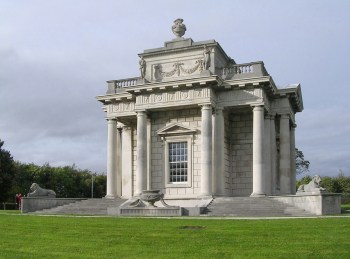
William Chambers, Casino Marino in Dublin, designed for James Caulfeild, the 1st Earl of Charlemont, starting in the late 1750s and finishing around 1775.
2020 marked the tricentenary of the birth of Giovanni Battista Piranesi (1720–1778). The Italian architect, antiquarian, etcher, vedutista, designer, and writer was one of the foremost artistic personalities of 18th-century Rome. His interpretation of the classical world was of great significance not only during his lifetime, but also long after his death. Ireland’s Office of Public Works presents the international exhibition For the Love of the Master: 25 Artists Fascinated by Piranesi to celebrate his legacy in the 21st century, with work from a group of international artists including Emily Allchurch, Pablo Bronstein, Léo Caillard, and Michael Eden. Many of the pieces on display were made specifically for this occasion. One of the show’s locations, the Casino Marino, an important 18th-century neo-classical building, serves to link Piranesi and Ireland, present and past.
Exhibition | Copy-Cat
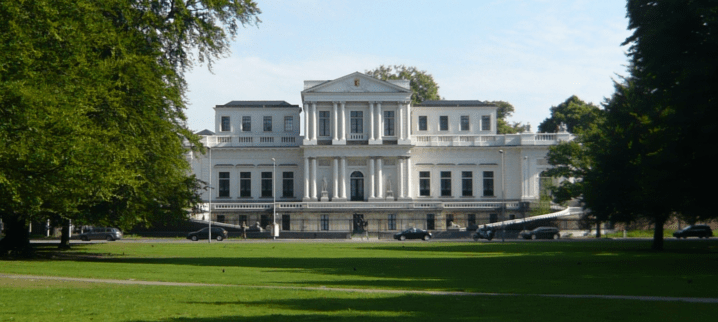
Villa Welgelegen, Haarlem, following the 2009 restoration, view from Haarlemmerhout park (Wikimedia Commons, August 2009). Designed by Abraham van der Hart, the house was commissioned by Henry Hope of the banking family and constructed between 1785 and 1789.
◊ ◊ ◊ ◊ ◊
Now on view in Haarlem:
Copy-Cat
Paviljoen Welgelegen, Haarlem, 8 April — 24 June 2022
Curated by Hélène Bremer
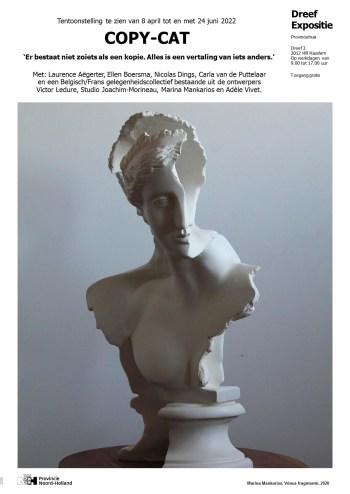 De tentoonstelling Copy-Cat stelt de vraag centraal wat de grenzen van reproductie zijn en wanneer een kopie een zelfstandig kunstwerk met een eigen betekenis wordt. Geïnspireerd door dit thema selecteerde curator Hélène Bremer werk uit diverse kunstdisciplines. Er zijn foto’s, keramiek, beeldhouwkunst en design te zien allemaal geïnspireerd door de beeldhouwwerken van Paviljoen Welgelegen, zorgvuldig gemaakte 21e -eeuwse replica’s. Kopieën dus. Bezoekers kunnen werken bekijken van Laurence Aëgerter, Ellen Boersma, Nicolas Dings, Carla van de Puttelaar en een Belgisch/Franse gelegenheidscollectief bestaande uit de ontwerpers Victor Ledure, Studio Joachim-Morineau, Marina Mankarios en Adèle Vivet.
And from Bremer’s website:
“There is no such thing as a copy. Everything is a translation of something else.”*
The 18th-century building, Paviljoen Welgelegen, the seat of the King’s commissioner of the province of Noord-Holland in Haarlem, stages every three months a contemporary art exhibition under the name Dreef exposities, produced by a guest-curator. Copy-Cat presents art inspired by the classical sculpture that is part of the fabric of the house. The original 18th-century sculptures commissioned in Rome by Henry Hope from Francesco Righetti are now part of the collection of the Rijksmuseum in Amsterdam. There they are prominently displayed in the central hall. In Haarlem they are not missed, though; the sculptures are replaced by bronze copies made in 2009. This theme of copying classical art has been the red threat in selecting artists for this project. However, the cycle of copying literally is broken by the participating artists. Each in their own way appropriate the classical idiom. On view are a selection of photographs, ceramics, and sculpture.
Participating artists: Laurence Aëgerter, Ellen Boersma, Nicolas Dings, Carla van de Puttelaar, and a Belgian/French design collective consisting of Victor Ledure, Studio Joachim-Morineau, Marina Mankarios, and Adèle Vivet.
* David Hockney in Spring Cannot Be Cancelled, with Martin Gayford (London: Thames & Hudson, 2020).
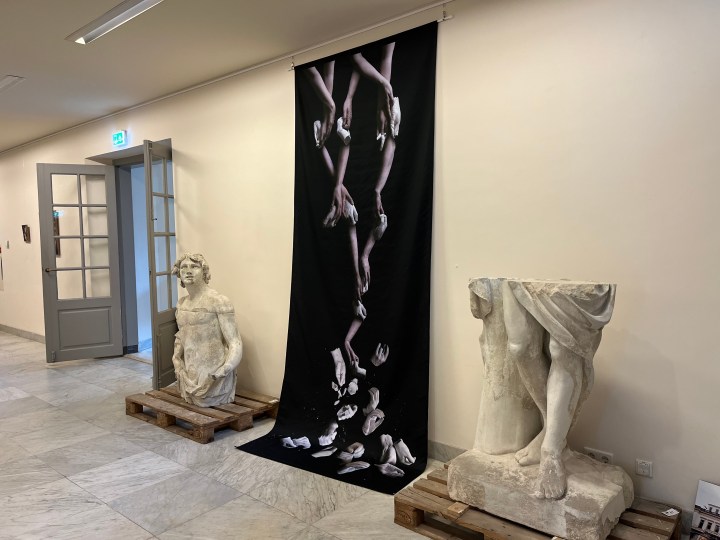
Carla van de Puttelaar, Copy-Cast, 2022, photographic print on eco cotton, 130 × 300 cm, edition 1 of 3; shown alongside a work by the Belgian sculptor Gilles Lambert de Godecharle (1750–1815), which was taken from the storage depot for the occasion of the exhibition.
Panels and Performances | Porcelain, Chinoiserie, and Dance
The Ballet des Porcelaines arrives in the UK this month with performances at Waddesdon Manor (16–17 June) and Brighton’s Royal Pavilion (19–21 June). In conjunction with the project, The Oxford Research Centre in the Humanities (TORCH) presents a day of panel discussions:
Porcelain, Chinoiserie, and Dance: The Teapot Prince
Worcester College, Oxford, Friday, 17 June 2022
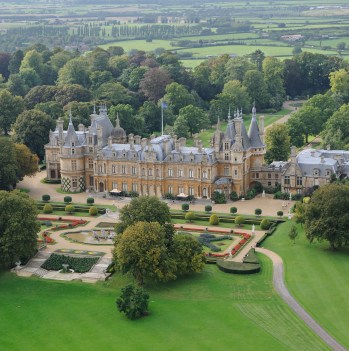
Waddesdon Manor
Three panels of creative artists and academics discuss the porcelain ballet, The Teapot Prince, as part of its world tour. Panel members include choreographer, Phil Chan, founder of Final Bow for Yellow Face; Meredith Martin, art historian and co-creator with Phil Chan, of The Teapot Prince; artist, Hannah Lim; poet and academic, Sarah Howe; ceramicist, Matt Smith; writer and ceramicist, Edmund de Waal; and art historian, Katie Scott. All are welcome! Registration is available here»
The Teapot Prince is based on an Orientalist fairy tale about a sorcerer who lives on a ‘Blue Island’ and transforms anyone who dares to trespass into porcelain cups, vases, and other wares. When the sorcerer turns the eponymous prince into a teapot, his lover, the princess comes to his rescue…The original Ballet des Porcelaines can be seen as an allegory for the aggressive European desire to know and steal the secrets of Chinese porcelain manufacture. In the new version, the narrative is flipped. The main protagonists are now Chinese, the Sorcerer a mad European porcelain collector, modelled on Augustus II the Strong (1670–1733), King of Poland, elector of Saxony and founder of Meissen, the first European manufactory to succeed in making true porcelain.
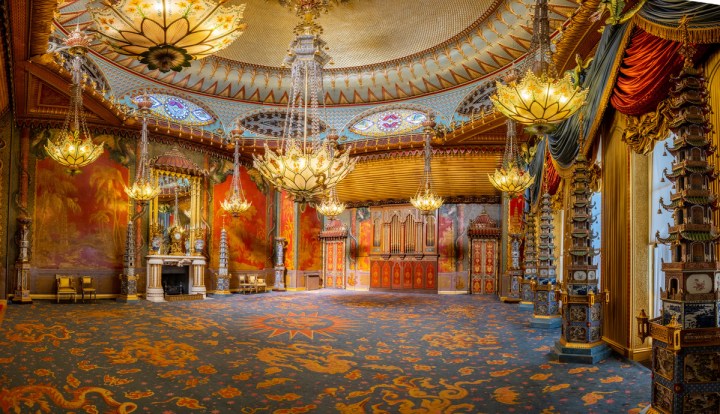
Music Room at the Royal Pavilion, Brighton,
Photo by Jim Holden
Exhibition | Dressed by Nature: Textiles of Japan
Opening later this month at Mia:
Dressed by Nature: Textiles of Japan
Minneapolis Institute of Art, 25 June — 11 September 2022

Festival kimono decorated with carp ascending a waterfall made in Akita Prefecture (detail), late 19th–early 20th century, cotton (Minneapolis: Mia, purchase from the Thomas Murray Collection, 2019.20.84).
The Japanese archipelago is home to extremely diverse cultures that made clothing and other textile objects in a kaleidoscope of materials and designs. This exhibition will focus on the resourcefulness of humans to create textiles from local materials like fish skin, paper, elm bark, nettle, banana leaf fiber, hemp, wisteria, deerskin, cotton, silk, and wool. It will showcase rare and exceptional examples of robes, coats, jackets, vests, banners, rugs, and mats, made between around 1750 and 1930, including the royal dress of subtropical Okinawa, ceremonial robes of the Ainu from northern Japan and the Russian Far East, and folk traditions from throughout Japan.
Exhibition | The Three Perfections
Now on view at Mia:
The Three Perfections: Image, Poem, and Calligraphy in Chinese Painting
Minneapolis Institute of Art, 18 December 2021 — 4 December 2022

Zheng Xie (1693–1765), Qing dynasty, Bamboo and Rocks, detail, ca. 1760, 68 x 39 inches, ink on paper (Minneapolis: Mia, gift of Ruth and Bruce Dayton 95.54.2).
Western viewers are often curious about why Chinese artists write on their paintings and what the characters say. This exhibition answers such questions and explores the idea of integrating fine painting, poetry, and calligraphy, known as the ‘Three Perfections’, in a single artwork.
In traditional China, painting was regarded as ‘silent poetry’, and poetry as ‘painting with sound’. Both could only be manifested through the ‘art of handwriting’—calligraphy. Scholars and scholar-artists used calligraphic brushstrokes in their paintings and considered their artworks to be vehicles of self-expression. As a result, painting was not only considered the only art pure and lyrical enough to stand on an equal footing with poetry and contemplative thought, but also something through which one could experience sight, sound, smell, touch, and emotions.
Exhibition | Venice in the 1700s

Francesco Guardi, The Return of the Buncintoro from S. Nicolò di Lido (detail), ca. 1778, pen and brown ink and wash, over black chalk
(Minneapolis: Mia, the John R. Van Derlip Trust Fund 2021.25)
◊ ◊ ◊ ◊ ◊
Now on view at Mia:
Venice in the 1700s
Minneapolis Institute of Art, 22 January — 16 October 2022
By the 1700s, the once mighty seafaring republic of Venice had been in decline for 300 years. Yet the island city still had one undiminished power—magic. Grand palaces, churches, flotillas of elegant gondolas floated above luminous reflections. Intricate systems of canals and walkways offered endless unexpected perspectives. Centuries of exquisite art could be found everywhere. With much support from tourists who flocked to see the city’s wonders, Venice’s artistic tradition continued to flourish. Three great artists and their families dominated: Antonio Canale (known as Canaletto), Giambattista Tiepolo, and Francesco Guardi. Mia has long had fine prints and drawings by the first two. This presentation celebrates the recent addition of Mia’s first outstanding Guardi drawing.










 Enfilade
leave a comment