Sneak Preview | Seven Works from the Van Caloen Collection
On view this week in Bruges:
Seven Works from the Van Caloen Collection
Groeninge Museum, Bruges, 17–22 May 2022

François Boucher, Young Woman with a Lace Cap, 24 × 18 cm (Musea Brugge, 2022.GRO0326.II).
On 17 May, the Jean van Caloen Foundation transferred the administration of 1,920 drawing masterpieces and 25 sketchbooks by world famous artists like Michelangelo, Jordaens, and Boucher to the Bruges Print Room. To celebrate this exceptional transfer, we are exhibiting seven top works from the collection during an exclusive sneak preview in the Groeninge Museum together with the Caloen Foundation.
Discover The Priest’s Blessing by Jacques Jordaens and a fine depiction of a young woman by the French master François Boucher. The highlight of the collection is the magnificent Stoning of St. Stephen by Michelangelo Buonarotti. The only drawing of the celebrated Italian Renaissance artist currently held in Belgium, it is a remarkable piece, not least because it is a composition study: a drawing in which Michelangelo set down some of his ideas on paper. Drawings of this kind were used by artists as preparatory sketches for larger final works, such as paintings or sculptures.
The works will be on display from 17 to 22 May, after which they will be given a place with all the collection’s other works in the Bruges Print Room. Once there, they will be registered and digitalized in high resolution, before being made freely available to the public via Musea Brugge’s digital collection database. We will also thoroughly investigate and study the drawings. This research will result in the publication of a scientific catalogue for the collection and an exhibition of works from the collection in the new exhibition space at BRUSK.
New Book | Trading Freedom
From The University of Chicago Press:
Dael Norwood, Trading Freedom: How Trade with China Defined Early America (Chicago: The University of Chicago Press, 2022), 312 pages, ISBN: 978-0226815589, $45.
 Trading Freedom explores the surprisingly rich early history of US-China trade and its unexpected impact on the developing republic.
The economic and geographic development of the early United States is usually thought of in trans-Atlantic terms, defined by entanglements with Europe and Africa. In Trading Freedom, Dael A. Norwood recasts these common conceptions by looking to Asia, making clear that from its earliest days, the United States has been closely intertwined with China—monetarily, politically, and psychologically. Norwood details US trade with China from the late eighteenth through the late nineteenth centuries—a critical period in America’s self-definition as a capitalist nation—and shows how global commerce was central to the articulation of that national identity. Trading Freedom illuminates how debates over political economy and trade policy, the building of the transcontinental railroad, and the looming sectional struggle over slavery were all influenced by Sino-American relations. Deftly weaving together interdisciplinary threads from the worlds of commerce, foreign policy, and immigration, Trading Freedom thoroughly dismantles the idea that American engagement with China is anything new. Publication supported by the Bevington Fund.
Dael A. Norwood is assistant professor of history at the University of Delaware.
C O N T E N T S
Introduction: America’s Business with China
1 Founding a Free, Trading Republic
2 The Paradox of a Pacific Policy
3 Troubled Waters
4 Sovereign Rights, or America’s First Opium Problem
5 The Empire’s New Roads
6 This Slave Trade of the Nineteenth Century
7 A Propped-Open Door
8 Death of a Trade, Birth of a Market
Acknowledgments
Appendix: Accounting for the China Trade
Notes
Index
Journal18, Spring 2022 — Race
From J18:
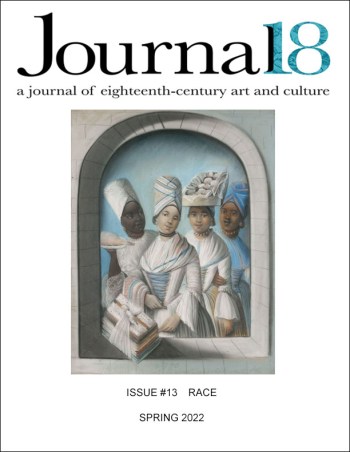
Journal18, Issue #13 (Spring 2022) — Race: Representation in the French Colonial Empire
Edited by Susannah Blair and Stephanie O’Rourke
 I N T E R V E N T I O N S
• Making Whiteness: Art, Luxury, and Race in Eighteenth-Century France — Marika Takanishi Knowles
• Some Thoughts on Fashion and Race in the Classroom; or, TikTok, Cottagecore, and the Allure of Eighteenth-Century Empire Style Dress — Alicia Caticha
• Order and Disorder: The Iconography of Morality and Colonial Enslavement — Christelle Lozère
• Ethno-geographies in the Making of Enlightenment Cartography: The Mural Maps of Jean Janvier and Sébastien-G. Longchamps (1754) — Íris Kantor and Milena Natividade da Cruz
A R T I C L E S
• Latitudes of Tenderness: Imagining Nouvelle France in the Ancien Régime — J. Cabelle Ahn
• Overseeing Senegal: French Prints of the Late-Eighteenth-Century Slave Trade — Katherine Calvin
Issue Editors
Susannah Blair, Columbia University
Stephanie O’Rourke, University of St Andrews
Cover image: Marie-Joseph-Hyacinthe Savart, Four Creole Women, 1770, pastel on paper, 56 × 45 cm (Musée Schoelcher, Pointe-à-Pitre).
Exhibition | Les Planches de l’Encyclopédie
Opening this month at the Mazarin Library in Paris:
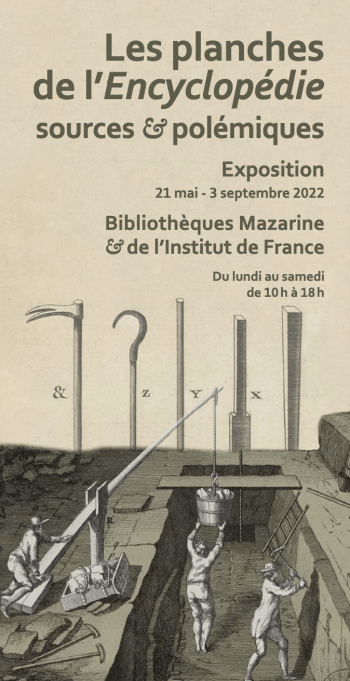
Les Planches de l’Encyclopédie: Sources et Polémiques
Bibliothèque Mazarine, Paris, 21 May – 3 September 2022
Curated by Emmanuel Boussuge with Florine Lévecque-Stankiewicz and Marianne Besseyre
 Entreprise emblématique des Lumières, l’Encyclopédie (1751–1772) doit une bonne partie de son formidable écho à sa composante technologique, illustrée à une échelle jusque-là inconnue. Les 11 volumes de planches, publiés à partir de 1761, proposaient la plus vaste collection d’images relatives aux « arts mécaniques » jamais rassemblée. Diderot entendait bien mettre en valeur cette part souvent méprisée de l’activité humaine, qu’il fallait envisager « comme la branche la plus importante de la vraie Philosophie ». Il dut renverser les préjugés, rassembler une vaste documentation complétée par de nouvelles enquêtes, s’entourer de collaborateurs aptes à dominer l’étendue des domaines embrassés, se coordonner avec des dessinateurs experts, et travailler en bonne intelligence avec les artisans du livre, notamment graveurs et imprimeurs.
Mais l’Encyclopédie n’était pas la première grande enquête sur les arts et métiers. Sous l’égide de l’Académie des Sciences, un projet de description complète avait été lancé dès 1693. Visant cependant un public restreint, il était en voie d’abandon dans les années 1740. De nombreuses gravures avaient été exécutées depuis les années 1690, mais elles restaient inexploitées. Diderot retrouva leur trace en 1748 et s’en servit de modèle général comme de sources pour la première mouture des planches de l’Encyclopédie. Cet emprunt fournit matière à scandale en novembre 1759. Ce fut « l’affaire Patte », qui touchait l’Encyclopédie alors qu’elle était déstabilisée par l’interdiction du Parlement, la condamnation du Conseil du roi et sa mise à l’index. Les encyclopédistes, avec le soutien de Malesherbes, surent une nouvelle fois se rétablir, mais il leur fallut réorganiser l’ensemble des planches, qui tripla presque de volume.
Filiations cachées, réemplois ou démarquages ostensibles, retombées polémiques croisées… la relation entre les planches de l’Encyclopédie et celles de la Description des Arts et Métiers de l’Académie des sciences constitue un vaste territoire d’investigation.
Commissariat: Emmanuel Boussuge, chercheur sur contrat rattaché (CELLF – Sorbonne Université-CNRS), avec la collaboration de Florine Lévecque-Stankiewicz (Mazarine) et de Marianne Besseyre (bibl. de l’Institut)
Autour de l’exposition: Les planches de l’Encyclopédie en lumière: Mises en perspective et recherches sur le Recueil de planches (1762–1772) de l’Encyclopédie de Diderot et D’Alembert (Colloque international, 19–21 mai 2022)
Colloquium | Les planches de l’Encyclopédie
From ArtHist.net:
Les planches de l’Encyclopédie en lumière, 1762–1772
Observatoire, Institut de France, Sorbonne Université, Paris, 19–21 May 2022
 Mises en perspective et recherches sur le Recueil de planches (1762–1772) de l’Encyclopédie de Diderot et D’Alembert
Colloque international organisé par l’ENCCRE, avec le soutien de l’Académie des sciences et de son comité D’Alembert, de la Fondation Del Duca, de la Société Ferdinand Berthoud, du Labex COMOD, du SYRTE et de l’Observatoire de Paris, de la Bibliothèque Mazarine, de l’ANR VHS, de la Faculté des Sciences et Ingénierie de Sorbonne Université, de l’Institut Camille Jordan, de la Société Diderot, du laboratoire LASLAR de l’Université de Caen et de l’Institut de mathématiques de Jussieu-Paris Rive Gauche (CNRS, Sorbonne Université, Université Paris Cité). Inscription et informations pratiques sur le site.
J E U D I , 1 9 M A I 2 0 2 2
Observatoire de Paris, ‘salle du Conseil’
9.30 Ouverture officielle
10.00 Première session — Questions de représentation
Présidence : Christophe Martin
• Jean-Pierre Le Goff (IREM Basse Normandie), Re-voir le réel ou ses fabriques : vers une typologie des moyens de représenter dans l’Encyclopédie
• Charles Kostelnick (Iowa State U.), Paradoxical Plates : Drawing Conventions, Neo-Classicism, and the Emerging Picturesque Aesthetics of the Encyclopédie
13.30 Deuxième session — Nature, science et technique
1e partie, présidence : Matthieu Husson
• François Pépin (IHRIM-ENS Lyon), et Leslie Villiaume (EHESS), Les planches d’horlogerie, un pont entre art et science
• David Valls-Gabaud (LERMA, Observatoire de Paris), On Spherical Angles, Celestial Maps, and Instruments: Astronomy under the Prism of the Planches
• Antoine D’Albis (Dir. lab. Manufacture de Sèvres), Céline Paul (Dir. Musée nat. A. Dubouché), et Odile Richard-Pauchet (U. de Limoges), Les Arts de la Céramique dans les Planches : l’approche délicate d’une technique insaisissable
15.45 Pause café
16.30 Deuxième session – Nature, science et technique
2e partie, présidence : Marie Leca-Tsiomis
• Muriel Brot (CNRS ; CELLF), Les animaux de l’Arctique
• Paolo Zani, et Gabriele Micheletti (U. de Bologne), Le ‘Travail du soufre‘ : Occurrence, Purification, and Industry of Sulfur in the Recueil de Planches de l’Encyclopedie and in Other Publications of the Period
V E N D R E D I , 2 0 M A I 2 0 2 2
Institut de France, salle Hugot
9.30 Troisième session — Dessiner et bâtir : entre le réel et ses représentations (discursives, figuratives)
Présidence : Irène Passeron
• Cyril Lacheze (IHMC, U. Paris 1 Panthéon-Sorbonne), ‘Une tuilerie & tous les bâtimens nécessaires’. La tuilerie des Planches de l’Encyclopédie : un unicum ?
• Valérie Nègre (U. Paris 1 Panthéon-Sorbonne), La participation des artisans aux planches de l’Encyclopédie relatives aux arts du bâtiment [Lucotte]
• Béatrice Gaillard (Labo. de recherche de l’ENS d’Architecture de Versailles), Les ordres d’architecture dans l’Encyclopédie : le dessin vaut-il mieux qu’un long discours ?
15.00 Quatrième session — Dessin et écriture
Présidence : Yann Sordet
• Camilla Pietrabissa (IUAV, U. of Venice), Les contradictions du dessin : la série Dessein
• Kaitlyn Quaranta (Brown U.), From Jaucourt to Deshauterayes : Chinese Characters in the Encyclopédie
17.00 Aux sources des planches : conférence & exposition
• Emmanuel Boussuge (CELLF), L’affaire Patte et la grande réorganisation des volumes de planches (1759–1760) : chronologie complète, bilan revu, documents inédits, conférence suivie d’une présentation des pièces inédites de l’exposition de la Bibliothèque Mazarine (Archives de l’Académie des sciences, Bibliothèque de l’Institut, Bibliothèque Mazarine)
18.30 Inauguration de l’exposition Les Planches de l’Encyclopédie: Sources et Polémiques (Bibliothèque Mazarine, 21 Mai — 3 Septembre 2022)
S A M E D I , 2 1 M A I 2 0 2 2
Sorbonne Université, Campus Pierre et Marie Curie
9.30 Cinqième session — Musique, opéra, théâtre
Présidence : Alain Cernuschi
• Nathan Martin (U. of Michigan), Rousseau, de Lusse et les ‘systèmes musicaux’
• Malou Haine (U. Libre de Bruxelles), Les métamorphoses des planches de lutherie et de musique
• Anthony Saudrais (U. Rennes 2), Les techniques du merveilleux. Les machines de théâtre dans les planches de l’Encyclopédie
12.00 Bilan du colloque par les organisateurs
New Book | Taking Travel Home
From Manchester UP:
Emma Gleadhill, Taking Travel Home: The Souvenir Culture of British Women Tourists, 1750–1830 (Manchester: Manchester University Press, 2022), 312 pages, ISBN: 978-1526155276, £80 / $120.
 Taking Travel Home provides a cultural history of the travel souvenir. It situates the souvenir at the crossroads of competing ideas of what travel stood for which were fought out amongst a rapidly growing constituency of British tourists between 1750 and 1830. Drawing from the theory of the souvenir as a nostalgic narrative instrument, the book uncovers how elite women tourists developed a souvenir culture around the texts and objects they brought home to realise their ambitions in the arenas of connoisseurship, science, and friendship. Ultimately, it argues that souvenirs are representative of female agency during this period. For elite women, revelling in the independence and identity formation of travel, but hampered by polite models of femininity and reliant on their menfolk, the creation of souvenirs provided a way to prove their claims to the authority of the travelling subject.
Emma Gleadhill is a Sydney-based historian and artist.
C O N T E N T S
Introduction: Remembering Travel
Part I: Gendering Connoisseurship
1 The Grand Tour: A Masculine Legacy of Taste
2 Shopping for Souvenirs
3 Creating Their Own Cultural Capital: Lady Anna Miller and Hester Lynch Piozzi
Part II: Gendering Science
4 Every Fair Columbus
5 Dorothy Richardson’s Extensive Knowledge
6 Lady Elizabeth Holland, the Social Orchestrator of Science
Part III: Gendering Friendship
7 From Diplomatic Gift to Trifle from Tunbridge Wells
8 A Snuff-box and Other Napoleonic Keepsakes
9 Princess Ekaterina Dashkova’s Gifts to Martha Wilmot
Conclusion: Remembering the Souvenir
Index
Exhibition | The Belvedere in Vienna
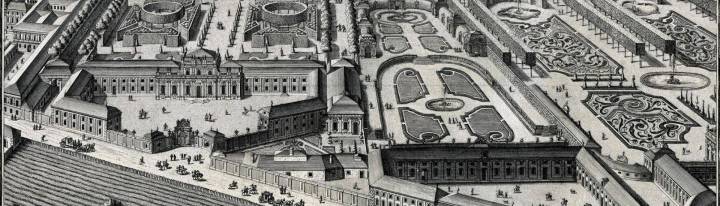
Salomon Kleiner, View of the Gardens of The Belvedere, detail, ca. 1731
(Vienna: Bibliothek des Belvedere)
◊ ◊ ◊ ◊ ◊
Opening in December at The Belvedere:
The Belvedere in Vienna: 300 Years a Place of Art
Lower Belvedere, Vienna, 2 December 2022 — 7 January 2024
It took more than a decade to build the summer residence of Vienna’s most famous general, Prince Eugene of Savoy. In 1723, construction of the upper palace drew to a close and the Belvedere estate was finally completed. The 300th anniversary of this event presents the perfect occasion for the museum to reflect on its history. Both as a museum and a landmark building, the Belvedere has stood for power and prestige throughout the ages, serving as the setting for courtly festivities, at times as a royal residence, and as the venue for the signing of the Austrian State Treaty in 1955. In an extensive exhibition, the museum will examine the building’s changing roles.
The show will mark the Belvedere’s 300th-anniversary year of 2023. Presented as a homage to an institution dedicated to the arts throughout the centuries, the exhibition casts a critical eye on historical developments and institutional changes. It illustrates the abundance and diversity of the museum, highlighting the collection’s evolution and the role of the holdings as symbols of power.
In 1777 when Marie Theresa opened the Imperial Picture Gallery in the Upper Belvedere to the public, she made a groundbreaking decision heralding a new age of enlightened absolutism: the collections would no longer be limited to courtly representation but would also serve to educate the general public. The Belvedere thrived during the succeeding centuries as both a place for the arts and a scene for glamorous events such as Marie Antoinette’s wedding. It was also the residence of the heir to the throne Franz Ferdinand, and the site where the Austrian State Treaty was signed. All of which is mirrored in its building and collection history.
The importance of the Belvedere as an art nexus over the centuries is examined in detail based on the rich holdings of the collection: they reflect the institution’s changing thematic concerns. The circulation and transfer of objects—additions and disposals of works from the collection due to museum reforms and barter transactions—provide further clues. This is particularly evident during the period from 1938 to 1945, when the museum was an agent and beneficiary of the Nazi state’s looting and cultural exploitation policy. Numerous works acquired after 1933 have been returned to the rightful heirs of the former owners since the enactment of the Austrian Art Restitution Law in 1998—the most notable example being Klimt’s Woman in Gold in 2006.
The Belvedere gallery and its collections reopened after World War II, once the damaged buildings and gardens were restored to their former glory. In 1955, the Austrian State Treaty was signed in the Upper Belvedere and presented to the public from the palace’s balcony.
The exhibition covers the period from the completion of the upper palace in 1723 to the present day, and illustrates the Belvedere’s role as a museum that honors the past, reflects on the present, and looks toward the future.
New Book | In the Shadow of the Empress
Maria Theresa was born on this day (13 May) in 1717; from Little, Brown and Company:
Nancy Goldstone, In the Shadow of the Empress: The Defiant Lives of Maria Theresa, Mother of Marie Antoinette, and Her Daughters (Little, Brown and Company, 2021), 640 pages, ISBN: 978-0316449335, $32.
 The vibrant, sprawling saga of Empress Maria Theresa—one of the most renowned women rulers in history—and three of her extraordinary daughters, including Marie Antoinette, the doomed queen of France.
Out of the thrilling and tempestuous eighteenth century comes the sweeping family saga of beautiful Maria Theresa, a sovereign of uncommon strength and vision, the only woman ever to inherit and rule the vast Habsburg Empire in her own name, and three of her remarkable daughters: lovely, talented Maria Christina, governor-general of the Austrian Netherlands; spirited Maria Carolina, the resolute queen of Naples; and the youngest, Marie Antoinette, the glamorous, tragic queen of France, and perhaps the most famous princess in history.
Unfolding against an irresistible backdrop of brilliant courts from Vienna to Versailles, embracing the exotic lure of Naples and Sicily, this epic history of Maria Theresa and her daughters is a tour de force of desire, adventure, ambition, treachery, sorrow, and glory.
Each of these women’s lives was packed with passion and heart-stopping suspense. Maria Theresa inherited her father’s thrones at the age of twenty-three and was immediately attacked on all sides by foreign powers confident that a woman would to be too weak to defend herself. Maria Christina, a gifted artist who alone among her sisters succeeded in marrying for love, would face the same dangers that destroyed the monarchy in France. Resourceful Maria Carolina would usher in the golden age of Naples only to face the deadly whirlwind of Napoleon. And, finally, Marie Antoinette, the doomed queen whose stylish excesses and captivating notoriety have masked the truth about her husband and herself for two hundred and fifty years.
Vividly written and deeply researched, In the Shadow of the Empress is the riveting story of four exceptional women who changed the course of history.
Nancy Goldstone is the author of six previous books including Daughters of the Winter Queen: Four Remarkable Sisters, the Crown of Bohemia, and the Enduring Legacy of Mary, Queen of Scots; The Rival Queens: Catherine de’ Medici, Her Daughter Marguerite de Valois, and the Betrayal that Ignited a Kingdom; The Maid and the Queen: The Secret History of Joan of Arc; Four Queens: The Provençal Sisters Who Ruled Europe; and The Lady Queen: The Notorious Reign of Joanna I, Queen of Naples, Jerusalem, and Sicily. She has also coauthored six books with her husband, Lawrence Goldstone. She lives in Del Mar, California.
In Memoriam | Christopher M. S. Johns (1955–2022)
It is difficult to overstate Christopher’s generous and kind contributions to the HECAA community, collectively and individually, for so many members. And, of course, many readers were also just very fortunate to count him as a dear friend. From Vanderbilt:
Christopher M.S. Johns, the Norman L. and Roselea J. Goldberg Professor of Fine Arts and professor of history of art and architecture, died at his home on May 8 after a long illness. He was 67.
Johns graduated summa cum laude from Florida State University with a bachelor of arts. He went on to earn both a master of arts and a doctor of arts from the University of Delaware, where his doctoral thesis was titled “The Art Patronage of Pope Clement XI Albani and the Early Christian Revival in Eighteenth-Century Rome.”
“Christopher was a groundbreaking scholar who made significant contributions in areas that included early-modern Italian art and culture, Asian art history, and relationships between art, politics and religion,” said John Geer, Ginny and Conner Searcy Dean of the College of Arts and Science and professor of political science. “However, he also was a friend and colleague who will be remembered for his dedication to mentoring students. Christopher’s legacy will live on in all those students with whom he worked. He will be deeply missed in our college.”
Keep reading here»
New Book | Grafted Arts
Distributed by Yale UP:
Holly Shaffer, Grafted Arts: Art Making and Taking in the Struggle for Western India, 1760–1910 (London: Paul Mellon Centre, 2022), 320 pages, ISBN: 978-1913107284, £45 / $55.
 Grafted Arts focuses on Maratha military rulers and British East India Company officials who used the arts to engage in diplomacy, wage war, compete for prestige, and generate devotion as they allied with (or fought against) each other to control western India in the eighteenth century. This book conceptualises the artistic combinations that resulted as ones of ‘graft’—a term that acknowledges the violent and creative processes of suturing arts, and losing and gaining goods, as well as the shifting dynamics among agents who assembled such materials. By tracing grafted arts from multiple perspectives—Maratha and British, artist and patron, soldier and collector—this book charts the methods of empire-building that recast artistic production and collection in western India and from there across India and in Britain. This mercenary method of artistry propagated mixed, fractured and plundered arts. Indeed, these ‘grafted arts’—disseminated across India and Britain over the nineteenth century to aid in consolidating empire or revolting against it entirely—remain instigators of nationalist agitation today.
Holly Shaffer is assistant professor of History of Art and Architecture at Brown University with a focus on eighteenth- and nineteenth-century British and South Asian arts and their intersections.
◊ ◊ ◊ ◊ ◊
Note (added 17 January 2024) — As announced in January 2024, Grafted Arts was awarded an HBA Book Prize, for a single-authored book with a subject between 1800 and 1960 (alongside Mark Crinson’s Shock City: Image and Architecture in Industrial Manchester).










 Enfilade
leave a comment