Display | Bedford Square: Creating Social Distance
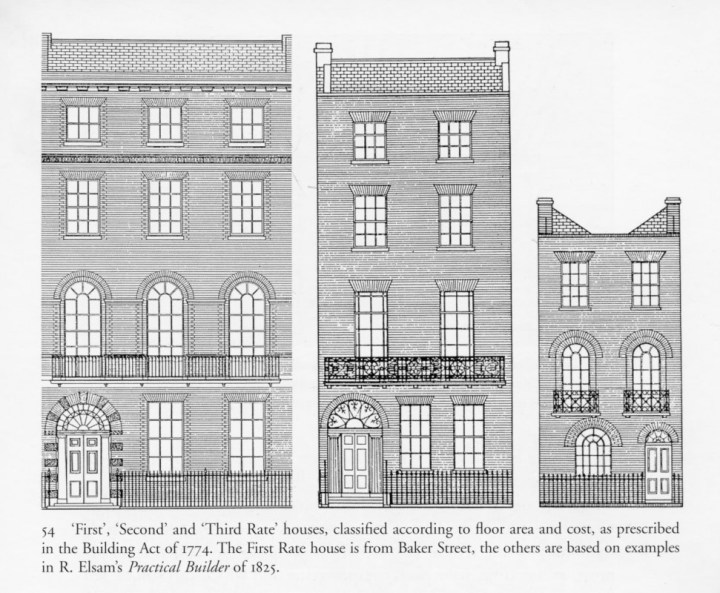
Alison Shepherd, Drawing of ‘First’, ‘Second’ and ‘Third Rate’ Houses, in John Summerson, Georgian London (Yale University Press, 2003), figure 54, image courtesy of Alison Shepherd / Trustees of the Estate of John Summerson..
◊ ◊ ◊ ◊ ◊
Now on view at the Paul Mellon Centre:
Bedford Square: Creating Social Distance
Drawing Room, Paul Mellon Centre, London, 31 January — 9 September 2022
Curated by Martin Myrone with Bryony Botwright-Rance
Bedford Square has always been acclaimed as an outstanding piece of urban planning. Built between 1775 and 1782, the fifty-three houses of the square—all but one arranged in apparently symmetrical order, in four ‘palace-fronted terraces’ around a gated, landscaped garden—are considered exemplars of Georgian architecture. The arrangement of the buildings remains intact, and many original architectural details and even interiors are preserved along with much of the character of the private garden, making Bedford Square one of the most complete survivals of Georgian London. Through literature on Bedford Square’s architectural history and records of its inhabitants, this Drawing Room display at the Paul Mellon Centre highlights the way that classic Georgian architecture created forms of social distancing: in its physical form; in creating closed and exclusive urban sites; through its internal spaces which separated inhabitants and allocated roles in highly predictable ways; and its aesthetic values which lay claim to supposedly timeless and universal principles of classical design and geometrical order.
The accompanying exhibition pamphlet by Martin Mryone is available for download at the PMC.
At Auction | Ewa Juszkiewicz’s Portrait of a Lady (After Boilly)
From the press release (via Art Daily) . . .
21st Century Evening Sale, #20975
Christie’s, New York, 10 May 2022

Lot 9B: Ewa Juszkiewicz, Portrait of a Lady (After Louis Leopold Boilly), 2019, oil on canvas, 200 × 160 cm. Estimate: $200,000–300,000.
On Tuesday, May 10th, Portrait of a Lady (After Louis Leopold Boilly) by widely recognized Polish artist Ewa Juszkiewicz will be offered in one of the most prestigious art sales in the United States at Christie’s New York, sold to benefit the POLIN Museum of the History of Polish Jews. Viewings take place at Christie’s Rockefeller Center galleries. The artwork has been brought to auction thanks to a generous gift of one of the POLIN Museum donors, American Friends of POLIN Museum, together with the support of the Association of the Jewish Historical Institute of Poland, and Weil Gotshal & Manges. The sale launches the beginning of a series of partnered sales of works of art at Christie’s in order to benefit POLIN Museum. POLIN is the only museum in the world dedicated to commemorating the history of Polish Jews, based in Warsaw, Poland.
The auction explores groundbreaking masterpieces by Jean-Michel Basquiat, Christopher Wool, Yoshitomo Nara, and other defining artists of the 21st century—Jeff Koons, Banksy, and Helmut Newton among others. It also introduces fresh-to-market works by contemporary pioneers like Jonas Wood, Matthew Wong, and Shara Hughes. Engage with this wide spectrum of influential works that reframe the current dialogue and develop new directions for the next generation of artists.
The Polish artist Ewa Juszkiewicz (b. 1984) is known for her adept appropriations of historical portrait paintings. This work—Portrait of a Lady (After Louis Leopold Boilly)—is an exquisite example of the artist’s masterful brushwork and keen questioning of gender and class representations within the realm of 18th- and 19th-century European painting.
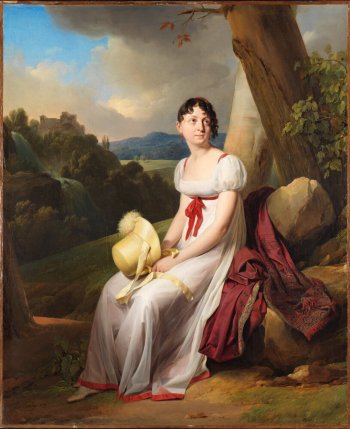
Louis-Léopold Boilly, Madame Saint-Ange Chevrier, 1807, oil on canvas, 74 × 60 cm (Nationalmuseum, Stockholm, 7298).
Ana Maria Celis, Christie’s Head of the 21st Century Evening Sale, remarks, “Portrait of a Lady (After Louis Leopold Boilly) [Lot 9b] thoughtfully examines the historical erasure of women through Juszkiewicz’s singular and subversive technique. We are honored to offer it in our 21st Century Evening Sale this season to benefit POLIN Museum of the History of Polish Jews. The juxtaposition of the classical stylization with the evocative subject matter of a female sitter’s whose head is fully wrapped, sparks new narratives around portrayals of femininity and deconstructs the past to create new dialogues.”
The POLIN Museum is a modern institution of culture—a historical museum that presents 1000 years of Jewish life in the Polish lands. It is also a place of meeting and dialogue among those who wish to explore the past and present Jewish culture, those eager to draw conclusions for the future from Polish-Jewish history, and finally those who are ready to face stereotypes and oppose xenophobia and nationalistic prejudices that threaten today’s societies. By promoting ideas of openness, tolerance, and truth, POLIN Museum contributes to the mutual understanding and respect among Poles and Jews, and other nations at the same time. Despite the global pandemic, after months of closure and economical struggle, it continues its mission, welcomes guests from all around the world at its core exhibition and organizes temporary exhibitions, historical, artistic, and educational events for Polish and international audience.
POLIN Museum understands its mission as a social responsibility, and is also responding to different current situations. To this end, alongside the efforts of many others, the Museum has responded to the current war in Ukraine, having just opened a new temporary exhibition, What’s Cooking? Jewish Culinary Culture, at a time when Warsaw is receiving a steady flow of Ukrainian refugees in great need of shelter and food. Within the Cooking for Ukraine project, POLIN Museum’s restaurant is preparing free hot meals featuring Jewish specialities and is delivering them directly to those in greatest need. “We must not remain indifferent,” Zygmunt Stępiński, Director of POLIN Museum, remarks.
Many of POLIN Museum’s activities, including Cooking for Ukraine, are supported by donors and friends from Poland and abroad, with a special support from American Friends of POLIN Museum. In the words of Stepinski, “We are grateful for the support of American Friends of POLIN Museum and Christie’s who believe in our mission and work with us to write the next chapter in the history of Polish Jews and Jewish life in Poland.”
A representative of Christie’s states: “Christie’s is proud to support philanthropic initiatives through our networks, whether by facilitating the sale of artwork to benefit important causes; offering, when we can, our salerooms as a venue for fundraising events; or providing expert charity auctioneers.”
◊ ◊ ◊ ◊ ◊
Note (added 24 May 2022) — Ewa Juszkiewicz’s Portrait of a Lady (After Louis Leopold Boilly) [Lot 9b] sold for $1.56million, more than five times its high estimate. It’s one of the paintings that Jason Farago addresses in his article for The New York Times: Jason Farago, “Catch a Rising Star at the Auction House,” The New York Times (23 May 2022). No longer does museum validation or scholarly attention determine a painting’s value. Now, the collectors’ hunger comes first, and institutions must follow.
Exhibition | Young Gainsborough: Rediscovered Landscape Drawings
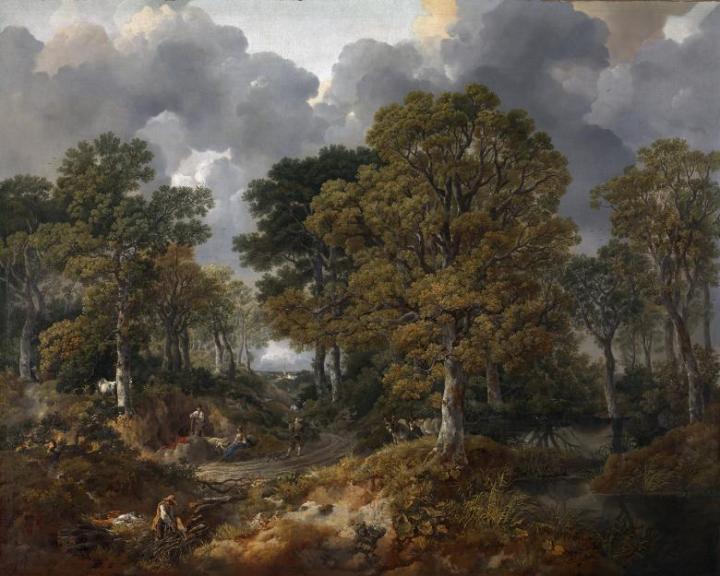
Thomas Gainsborough, Cornard Wood, near Sudbury, Suffolk, 1748, oil on canvas, 122 × 155 cm
(London: The National Gallery, NG925)
◊ ◊ ◊ ◊ ◊
Now on view at the National Gallery of Ireland:
Young Gainsborough: Rediscovered Landscape Drawings
York Art Gallery, 1 October 2021 — 13 February 2022
National Gallery of Ireland, Dublin, 5 March — 12 June 2022
Nottingham Castle Museum, 2 July — 25 September 2022
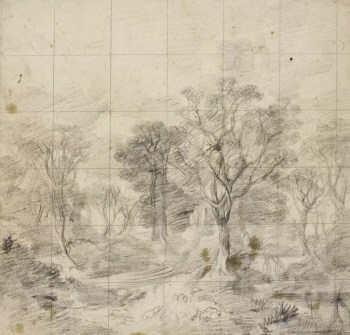
Thomas Gainsborough, Study for Cornard Wood, ca. 1748 (Royal Collection Trust).
In 2017 an exciting discovery was made among the drawings in the Royal Collection at Windsor Castle. The art historian Lindsay Stainton identified an album of 25 drawings—previously anonymous—as the work of the young Thomas Gainsborough (1727–1788), one of the greatest British painters of the eighteenth century. Sketched in the countryside around his native Suffolk or conjured from his imagination, these beautiful drawings from the late 1740s shed new light on our understanding of the artist’s early career. The drawings will be presented alongside paintings and works on paper borrowed from collections across the UK and Ireland, including the National Gallery’s recently conserved masterpiece Cornard Wood (1748). Together, they will shed new light on Gainsborough’s early landscape practice and the techniques that made him one of the country’s most significant and influential artists. In addition to the drawings from the Royal Collection Trust, the exhibition is supported by generous loans from the National Gallery, London; the Fitzwilliam Museum, Cambridge; the Whitworth Art Gallery, Manchester; and Colchester and Ipswich Museums.
The wall labels from the York installation are available for download here»
New Book | Lives of Gainsborough
From The Getty:
Philip Thicknesse, William Jackson, and Sir Joshua Reynolds, with an introduction by Anthony Mould, Lives of Gainsborough (Los Angeles: Getty Publications, 2020), 144 pages, ISBN: 978-1606066645, $13.
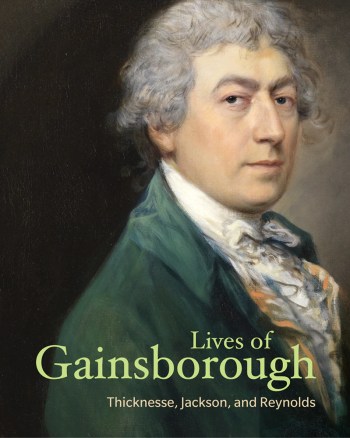 A collection of contemporary texts about Thomas Gainsborough, a leading British portraitist and landscape painter in the eighteenth century.
Thomas Gainsborough (1727–1788) was a leading English landscape and portrait painter, draftsman, and printmaker who is now considered one of the most important British artists of the eighteenth century. This volume illuminates his life, career, personality, and passions through three diverse character sketches by Philip Thicknesse, an eccentric British adventurer, businessman, and writer; William Jackson, an artist and close friend to Gainsborough; and Sir Joshua Reynolds, an English portrait painter and the first president of the Royal Academy of Arts. An obituary published shortly after Gainsborough’s death lends insight into the artist’s impact. An introduction by Anthony Mould, a British art dealer and independent scholar, offers an overview of Gainsborough’s life and career.
At Auction | Chardin’s Basket of Wild Strawberries
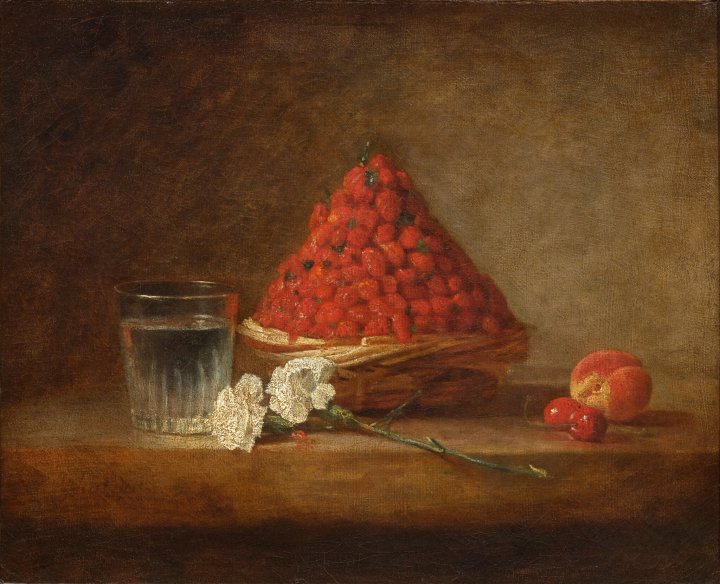
Jean-Siméon Chardin, The Basket of Wild Strawberries, shown at the Salon of 1761, oil on canvas, 38 × 46cm. The painting sold for €24,381,400 on 23 March 2022 at Artcurial in Paris. More information is available here.
◊ ◊ ◊ ◊ ◊
From The New York Times and Art Daily:
Laura Zornosa, “Louvre Bids to Keep a Chardin Bought by U.S. Museum in France,” The New York Times (4 May 2022). The Kimbell Art Museum in Texas is revealed to be the buyer of “Basket of Wild Strawberries,” at auction. The Louvre has been working to name it a national treasure.
On a computer screen, the still life Basket of Wild Strawberries by the 18th-century French painter Jean Siméon Chardin is quiet and unassuming. His talent in capturing the reflection of light off the rim of a water glass is muted in that setting. In person, though, it casts a spell.
“It’s deceptively simple, and it’s absolutely captivating and it’s magical,” said Eric Lee, the director of the Kimbell Art Museum, which bought the work at auction in France in March for more than $22 million. “The painting completely mesmerized me, and it mesmerizes almost anyone who sees it.”
But now the Kimbell, whose successful bid for the work was first reported by the Art Newspaper of France, has to wait to see whether it can actually export the picture, which it purchased at the auction house Artcurial in Paris.
The Louvre has requested that the artwork be classified as “a national treasure” and is looking for sponsorship to purchase it. Under French law, the export can be frozen for 30 months, or 2 1/2 years.
“We are fully mobilized to bring it into the national collection,” Laurence des Cars, president and director of the Louvre, told Le Figaro in March. . . .
The full article is available here»
Exhibition | La Chine
Closing this weekend in Dresden at the Kupferstich-Kabinett:
La Chine: The 18th-Century China Collection in the Dresden Kupferstich-Kabinett
Residenzschloss, Staatliche Kunstsammlungen Dresden, 19 November 2021 — 8 May 2022
 In the early eighteenth century, when the legendary art collection of August the Strong (1670–1733), came into being, Asia was viewed with excited fascination in Europe.
In addition to today‘s world-famous porcelain wares, more than 1100 Chinese drawings and watercolour paintings on paper and silk, as well as woodcuts and coloured prints, were brought to Dresden. This important collection, along with 850 chinoiserie prints, is preserve in the Kupferstich-Kabinett of the Staatliche Kunstsammlungen Dresden. In the first inventory of the Kupferstich-Kabinett, drawn up in 1738, the objects were listed under the categories ‘La Chine’ and ‘La Chine européenne’.
An outstanding feature is the large collection of Chinese popular prints. In China itself, such New Year pictures, congratulatory leaflets, and theatre scenes were considered mere commodities, so that hardly any have been preserved. The prints were cheap to buy. With their wideranging symbolism, usually promising good fortune and prosperity, these sheets were hung up in homes for the New Year or passed on as a blessing, for example, and usually were not preserved. In Europe, Chinese folk art was seen as documenting the costumes and customs of distant lands. In the courtly sphere, the sheets were used as wall decorations, for example. They also served as models for chinoiserie prints. These provided motifs for decorations on buildings and furniture, as well as for porcelain painting.
Ines Beyer, Transformation
The first copperplate prints created in China were made by Matteo Ripa in collaboration with artists from the court painting workshops, on commission to the Kangxi Emperor, after woodcuts illustrating the Emperor’s own poems. The work by Ines Beyer entitled Transformation, based on the eighth view in the series, creates a link to the present day.
Cordula Bischoff and Petra Kuhlmann-Hodick, La Chine: Die China-Sammlung Des 18. Jahrhunderts Im Dresdner Kupferstich-Kabinett (Dresden: Sandstein Verlag, 2021), 256 pages, ISBN: 978-3954986286, €38.
New Book | British Dandies
Distributed by The University of Chicago Press:
Dominic Janes, British Dandies: Engendering Scandal and Fashioning a Nation (Oxford: Bodleian Library Publishing, 2022), 248 pages, ISBN: 978-1851245598, £30 / $45.
 Reveals how the scandalous history of fashionable men and their clothes is a reflection of changing attitudes to style, gender, and sexuality.
Well-dressed men have played a distinctive part in the cultural and political life of Britain over several centuries. But unlike the twenty-first-century hipster, the British dandies provoked intense degrees of fascination and horror in their homeland and played an important role in British society from the seventeenth to the twentieth century. This book explores that social and cultural history through a focus on three figures: the macaroni, the dandy, and the aesthete. The first was noted for his flamboyance, the second for his austere perfectionism, and the third for his perversity. All were highly controversial in their time, pioneering new ways of displaying and performing gender, as demonstrated by the impact of key figures such as Lord Hervey, George ‘Beau’ Brummell, and Oscar Wilde. Illustrated with contemporary prints, portraits, and caricatures, this groundbreaking study tells the fascinating—and scandalous—story of fashionable men and their clothes.
Dominic Janes is professor of modern history at Keele University.
C O N T E N T S
List of Illustrations
1 British Dandies
2 Dressing the Sexes in the Seventeenth and Eighteenth Centuries
3 A Georgian Taste for Macaroni
4 Fine and Dandy in the Regency
5 Victorians and the Aesthetic Pose
6 Fashion and Scandal in the Twentieth Century
Notes
Bibliography
Picture Credits
Index
Call for Articles | Thresholds 51: Heat
From Thresholds:
Thresholds 51: Heat
Edited by Hampton Smith and Zachariah DeGiulio
Submissions are due by 1 June 2022
 Thresholds is the annual peer-reviewed journal produced by the MIT Department of Architecture, held in over 150 university art & architecture libraries around the world. Content features leading scholars and practitioners from the fields of architecture, art, and culture.
Heat is elusive: always on the move, always fugitive. Though we have many signs of its presence—sweating, ‘hot’ and ‘cool’ media, sitting under the shade, catching fire—heat itself largely evades conventional forms of representation. As the transference of energy from one system to another, heat radiates and penetrates. Immanent and intense, heat binds and nourishes as much as it reshapes or destroys. While helping us navigate the material world as tool, medium, and affect, heat forces us to come to terms with the fragility of the systems in which we take part. And though temperature is regularly mapped across graphs and thermometers, the feeling of heat is often so localized and so personal that it evades historic perception altogether. Even if we know things are hotter now than they were yesterday, where is heat within art and architecture practice?
Thresholds 51: Heat takes enthalpy—the thermodynamic property that comprises heat, pressure, and volume to effect chemical state change—as its guiding principle. We seek scholarly writing, artistic interventions, and criticism from art, architecture, and related fields to apply pressure within the volume to effect disciplinary state change. We aim to discover the ways art and architecture have historically navigated, wielded, and avoided heat.
Courtyard buildings across the Islamic world produce thermal delight; Mande blacksmiths carefully wield heat to make iron tools for repairing and nourishing communities; museum conservators curate temperature-controlled environments for artworks; Yurok practices of fire stewardship regulate natural rhythms of growth and decay. And though thermodynamic flux underlies such practices of making and maintenance, heat just as frequently effaces or prevents knowledge production—think of the conflagration of the University of Cape Town’s special collections or mold consuming boxes of archival material.
Recognizing that heat has never been evenly felt, from the violently racialized fictions of the ‘torrid zone’ to the lack of adequate shade in urban communities, we are particularly invested in alternative architectural or aesthetic mobilizations of heat—in the contestation of thermal violence, in the activation of ritual, or in the warmth of community, desire, and lust. A critical account of heat within art and architecture must attend to its use as a medium and structure of violence, while nevertheless exploring how ‘feeling the heat’ productively links scales of being, practices, and types of labor.
Please send all submissions to the editors via email at thresh@mit.edu with the subject heading THAT’S HOT. Essay submissions should be in English, approximately 3000 words, and formatted in accordance with the Chicago Manual of Style. Submission should include a brief cover letter, contact information, and bio of 50–75 words for each author. Text should be submitted in MS Word. Images should be submitted at 72 dpi as uncompressed TIFF files. Other creative proposals, including, but certainly not limited to, performances, poetry, and film are not limited in size or medium. All scholarly submissions are subject to peer review.
Call for Papers | Shipwrecks in Art, History, and Archaeology
From ArtHist.net:
Resurfacing: Shipwrecks in Art, History, and Archaeology
The Warburg Institute, The Royal Museums Greenwich, London, 11–12 November 2022
Proposals due by 27 May 2022
Organized by Caspar Pearson, Johannes von Müller, Andrew Choong Han Lin, and Imogen Tedbury
Every sea voyage entails the possibility of disaster. This makes the motif of the shipwreck a highly significant symbol, to which its popularity as an artistic subject in the early modern period attests. Today, the potential symbolism of a shipwreck and its contents remains key to marine archaeology. Since Plato, the ship can act as a metaphor for a state and consequently a state can also invest itself into its ships—and its shipwrecks. Examples like the Mary Rose (1545) or the Titanic (1912) demonstrate how these structures can, in the public imagination, become era-defining symbols of certain technological or social achievements. Archaeology can reveal wondrous relics of a wreck’s active life, a snapshot of the past frozen in the moment of the vessel’s abrupt end.
The shipwreck, already a versatile metaphor, can therefore also serve as a figure for history itself. In his architectural treatise, Alberti, who dabbled in nautical archaeology when he attempted to raise an ancient ship from the bed Lake Nemi, discusses Vitruvius as one of the few survivors of a shipwrecked antiquity. In turn, Winckelmann likens the ruins of classical artworks to the fragments of a ship that can never be seen in its entirety. In these two key moments in the history of art history, the figure of the ship signifies the suspension of time, and the shipwreck, in consequence, marks the end of an era. Perhaps it is for this reason that Jacob Burckhardt would eventually conceive of the scholar drifting upon vast seas of past and present turmoil.
As the horizons of art history have expanded beyond their former Eurocentric focus, increasing interest in processes of exchange, trade and migration have also led to the discovery of sunken treasures that are now claimed as objects of study. In this context, the shipwreck may eventually reveal itself as a guiding principle for art history written on the fragmented grounds of surviving data. This conviction, however, demands to take into account the systemic suppression of marginalised histories, gradually resurfacing and challenging scholars to review their standpoint.
Considerations like these spark a variety of questions. What meaning does the figure of the shipwreck hold for art history, archaeology and related disciplines? Are the vessels lost at sea merely shattered cabinets of forgotten wonders that are now resurfacing? Or does the interest in them which art historians and archaeologists share with maritime historians, literary scholars and artists hold the potential to recalibrate an understanding of the knowledge produced in confrontation with material objects of both past and diverse aesthetics? And how do questions such as these resonate in a moment in which the dangers of the voyage by sea are very real and not metaphorical at all for hundreds of thousands who desperately try to cross the bodies of water separating the Global South from the Global North?
This two-day conference, held on 11 and 12 November 2022 in London at the Warburg Institute and the Royal Museums Greenwich, invites scholars from a variety of fields—art history, archaeology, history of ideas, literary studies, and others—in order to discuss the following topics and more:
a) material and epistemic cultures of shipwrecks
b) the shipwreck as a subject in the arts of the past and the present alike
c) the shipwreck as a metaphor as which it runs through histories of both literature and scholarship
d) the shipwreck as a potential paradigm for an expansion of subject areas in art history, archaeology and related fields.
Please send a proposal of 300 words max. together with a short CV to caspar.pearson@warburg.sas.ac.uk by 27 May 2022.
Organisers
Dr Caspar Pearson (The Warburg Institute), Dr Johannes von Müller (Christian-Albrechts-Universität Kiel), Andrew Choong Han Lin, and Dr Imogen Tedbury (The Royal Museums Greenwich)
New Book | Jean-Baptiste Greuze et ses têtes d’expression
Published by the Comité des travaux historiques et scientifiques and the Institut national d’histoire de l’art:
Yuriko Jackall, Jean-Baptiste Greuze et ses têtes d’expression: La fortune d’un genre (Paris: CTHS / INHA, 2022), 320 pages, ISBN: 978-2735509393, €38.
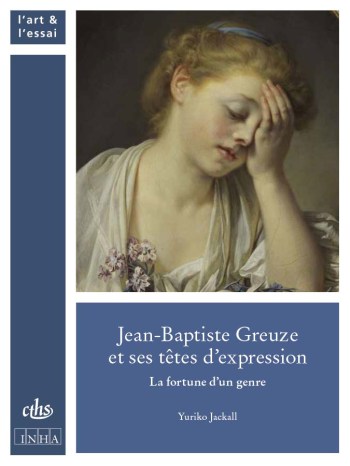 La représentation de têtes dites d’expression a été initiée par Charles Le Brun au xviie siècle et s’inscrit dans la tradition académique. Les figures de Jean-Baptiste Greuze, principalement féminines, sont
d’abord le vecteur narratif des œuvres au sein desquelles elles ont vocation à s’intégrer. Toutefois, les émotions vont peu à peu constituer l’unique élément fictionnel des productions de l’artiste. L’autrice montre comment les têtes «greuziennes » — parfois jugées décadentes en raison de leur lascivité et leur volupté affichées — acquièrent finalement un statut autonome et deviennent un genre artistique à part entière entretenu par les collectionneurs et perpétué par une nouvelle génération d’artistes.
Spécialiste de la peinture française du xviiie siècle, Yuriko Jackall est conservatrice en chef de la Wallace Collection (London). Auparavant conservatrice à la National Gallery of Art (Washington, DC), elle a participé à l’exposition Hubert Robert (1733–1808) (musée du Louvre / National Gallery of Art, 2016), puis a été commissaire des expositions America Collects Eighteenth-Century French Painting et Fragonard: The Fantasy Figures (National Gallery of Art, 2017).
Table des matières
Liste des abréviations
Remerciements
Préface
Avertissement
Introduction
• Greuze peintre
• Deux approches de Greuze peintre
• Un nouveau regard sur les têtes de Greuze
• Greuze éclipsé ?
• Greuze et Diderot
• Le sens du dessin de Denon
I. Un lexique pour la tête isolée
• Une tête d’après nature
• Tête et tête d’après nature
• Tête de fantaisie
• Tête de caractère
• Tête d’expression
• Tête d’étude
• Transformations de la tête isolée
II. Les identités académiques de Greuze
• Greuze et l’Académie
• Greuze selon Gougenot
• Peintre d’expression
• Peintre de nature
• Nature et expression
• Greuze entre nature et expression
III. La tête autonome : découper, isoler, extraire, remplacer
• Corrège, Coypel et le recadrage
• Mettre le tableau en morceaux
• Couper les têtes
• L’image du sentiment
• Le visage métonymique
• Greuze et le comte de Caylus
• Caylus et Watteau : dess(e)ins et jeux de fonds
• Caylus et Vien : sculpter la tête
IV. Morceler Greuze
• La question de matérialité
• Greuze, dessinateur
• Surfaces
• Greuze, peintre
• Du dessin à la peinture
• D’un tableau à l’autre
• Faire de la tête un condensé de l’oeuvre
V. Exprimer le désir et l’admiration
• De l’allégorie
• La Tête d’une jeune fille, exprimant l’admiration et le désir
• Abondance
• Interchangeabilité
• Expressions symboliques
• La part du spectateur : une lecture libertine
• La part du spectateur : un choix féminin
Conclusion: De l’expression au caractère
• La place de Greuze
• Évolutions lexicales
Bibliographie
Index
Crédits photographiques










 Enfilade
leave a comment