Online Talk | Paweł Gołyźniak on Philipp von Stosch

From The Wallace Collection:
Paweł Gołyźniak, Philipp von Stosch and His Circle: Collecting and Studying of Ancient Engraved Gems, from Antiquarianism to Proto-Archaeology
Online, The Wallace Collection, London, 25 April 2022, 17.30 (BST)
Paweł Gołyźniak’s research traces and examines Philipp von Stosch’s (1691–1757) collecting, antiquarian, and scholarly activities in terms of engraved gems on the basis of the unknown pictorial (drawings) and archival sources. The discovery of nearly 2300 unknown gem drawings in the Princes Czartoryski Museum in Krakow gives an opportunity to present him as one of the most instrumental figures of 18th-century antiquarianism. The seminar will discuss Stosch’s outstanding collection of intaglios and glass gems, and most importantly his scholarly projects: starting from his celebrated book Gemmae antiquae caelatae published in 1724 in Amsterdam, through to his attempts to write a supplement to that study, documentation of his own collection of gems and other European gem cabinets, and, finally, the virtually unknown project Histoire universaille, meant to reflect history, mythologies, and customs of the ancient Egyptians, Etruscans, Greeks, and Romans, combined with a reconstruction of the history of glyptic art.
For all his enterprises, Stosch commissioned large quantities of drawings that were produced in a truly archaeological vein with attention paid to such issues as material, form, right proportions, state of preservation, provenance, etc. of the reproduced gems. Often the gems received extensive commentaries explaining their iconography and providing analogies in sculpture, reliefs, wall paintings, and coins. Relevant passages in ancient literary sources were also referenced. The study of Stosch’s scholarly activities advances our understanding of emergence of archaeology as a scientific discipline. The discovered pictorial documentation provokes us to hypothesise that Stosch, his collecting, and scholarly enterprises greatly inspired and influenced Johann Joachim Winckelmann (1717–1768) in writing his first synthesis of ancient art (Geschichte der Kunst des Alterthums) published in 1764.
This talk will be hosted online through Zoom and The Wallace Collection’s YouTube channel.
Pawel Golyzniak is a Research Fellow in the Institute of Archaeology at Jagiellonian University in Krakow.
Lecture Series | 2022 Wallace Seminars on Collections and Collecting
This year’s Wallace Seminar Series on Collections and Collecting:
2022 Wallace Collection Seminars on the History of Collections and Collecting
Online and/or In-Person (depending upon session), The Wallace Collection, London, last Monday of most months
Established in 2006, The Seminars in the History of Collecting series helps fulfil The Wallace Collection’s commitment to the research and study of the history of collections and collecting, especially in the 18th and 19th centuries in Paris and London. Seminars are normally held on the last Monday of each month, excluding August and December. They act as a forum for the presentation and discussion of new research into the history of collecting, and are open to curators, academics, historians, archivists and all those with an interest in the subject. Each seminar is 45–60 minutes long, with time for Q&A.
Book your place via the Wallace Collection website. Bookings will open a few weeks before each seminar. A detailed summary of each forthcoming seminar will be provided around the same time. Please also check the website nearer the time to find out whether the seminar will be held in person at the Wallace Collection, or online via Zoom.
Monday, 17 January
Lelia Packer (Curator of Dutch, Italian, Spanish, German, and Pre-1600 Paintings, The Wallace Collection), The Laughing Cavalier, the ‘Mad Marquis’, and the Revival of Frans Hals
Monday, 28 February
Malika Zekhni (PhD Candidate, Faculty of History, University of Cambridge), Between Empires and beyond Labels: Collecting and Presenting Central Asia in British Museums
Monday, 28 March
John D. Ward (Head of Silver and Vertu Department, Sotheby’s, New York), The Lost George J. Gould Collection and the Beginning of Duveen Taste in America
Monday, 25 April
Paweł Gołyźniak (Research Fellow, Department of Classical Archaeology, Institute of Archaeology, Jagiellonian University, Krakow, Poland), Philipp von Stosch (1691–1757) and His Circle: Collecting and Studying of Ancient Engraved Gems, from Antiquarianism to Proto-Archaeology
Monday, 30 May
Simon Kelly (Curator and Head of Department of Modern and Contemporary Art, Saint Louis Art Museum), Collector, Photographer, Art Critic: The Multiple Roles of Paul Casimir-Périer (1812–1897)
Monday, 27 June
John E. Davies (Independent Scholar), Ancient and Modern: The Collecting Habit of John Campbell, First Baron Cawdor (1755–1821)
Monday, 25 July
Felicity Myrone (Lead Curator, Western Prints and Drawings, British Library, London), Prints and Drawings at the British Library: Revealing Hidden Collections
Monday, 26 September
Feng Schöneweiß (PhD Candidate, University of Heidelberg), Provenancing the Dragoon Vases: Porcelain, Architecture, and Monumentality in German Antiquarianism, 1700–1933
Monday, 31 October
Rosie Razzall (Curator of Prints and Drawings, Royal Collection Trust, London), Paul Sandby’s Collection of Drawings
Monday, 28 November
Tom Hardwick (Consulting Curator of Egyptology, Houston Museum of Natural Science), Wonderfully Expensive Things: Howard Carter and the Market for Egyptian Art, 1920–1940
Paul Mellon Centre Rome Fellowship, 2022–23
From the Paul Mellon Centre:
Paul Mellon Centre Rome Fellowship
The British School at Rome, three months between September 2022 and July 2023
Applications due by 29 April 2022
 The Rome Fellowship offers one individual the opportunity to research in Rome for three months, whilst being hosted by the British School at Rome (BSR). Whilst based at the BSR the Fellow will have access to their have a specialist library with c. 110,000 volumes, their rich collection of maps and rare prints, as well as the photographic archive which includes prints and negatives of rare and unique collections.
The Fellowship provides residential accommodation and meals at the BSR, which hosts some 35 individuals at any one time, from academics and fine artists who have all won awards to spend an extended period in Rome. There is a big sense of community at the BSR with fellows and residents encouraged to take part in the vibrant life, from communal dining to events. A recent Rome Fellow said that his time in Rome was enhanced by the “the extraordinary intellectual, creative, and supporting environment of the BSR.”
To be eligible to apply for the Rome Fellowship you must be an individual who is working on a topic British-Italian art or architectural history and who requires dedicated time in Rome to visit collections, libraries, archives, or historic sites. The scope is relatively wide, please contact the Fellowships & Grants Manager with any questions regarding topic eligibility.
The individual needs to be able to take up the Fellowship for three months between September 2022 – July 2023 and applications are open to scholars, researchers, curators, archivists and GLAM professionals from any country but who must be willing to engage with the Italian language (lessons will be included if needed). Alongside receiving free accommodation and meals, there will be an honorarium awarded to the individual.
Applications are now open and will close at midnight on 29 April. References are due by Thursday, 5 May. The successful applicant will be notified by the end of May.
Online Talks | HECAA Emerging Scholars Showcase, Spring 2022
HECAA Emerging Scholars Showcase
Online, Saturday, 23 April 2022, 12.30–2.00pm (ET)
Please save the date for HECAA’s Spring 2022 Emerging Scholars Showcase, scheduled for Saturday, 23 April 2022. The showcase will take place from 12.30 to 2pm Eastern Time (a time slot that allows us to accommodate presenters from five different time zones). Registration is available here.
We hope you’ll join us for eight exciting presentations:
1 Chiara Betti (SAS: Institute of English Studies), Richard Rawlinson (1690–1755) and His Printing Plates
2 Demetra Vogiatzaki (Harvard University), On Marvels and Stones: Architecture and Virtuality in Late Eighteenth-Century France
3 Nandita Punj (Rutgers University), Jain Artistic Practices and Visual Culture in Eighteenth-Century Bikaner
4 Tamara Ambramovitch (Hebrew University, Jerusalem), Cutting Edges: The Symbolic and Social Role of Frames in Eighteenth-Century France
5 Jean Chistensen (Southern Methodist University), ‘In the Style of a Sovereign’: The Politics of Beauty and Disability in Queen Anne’s Portraiture
6 Aubrey Hobart (Savannah College of Art and Design), Reading Inhumanity in the Casta Paintings of New Spain
7 Felix Martin (RWTH Aachen University), The Inhabited Monument: Sir William Chambers’s Casino at Marino in Dublin
8 Anastasia Michopoulou (University of Crete), Aedes Pembrochianae: Displaying and Publishing the Collections in Wilton House
Please note that the order of presenters is subject to change.
◊ ◊ ◊ ◊ ◊
Note (added 16 April)— The original posting, based on a ‘save-the-date’ email sent to HECAA members, included nine speakers. The updated posting reflects the latest program, along with the registration link. –CH
Exhibition | Moses Mendelssohn in His Time
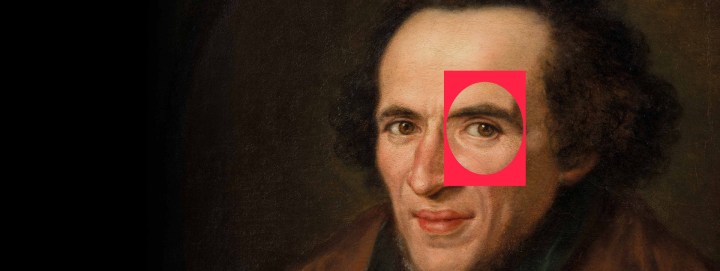
Johann Christoph Frisch, Portrait of Moses Mendelssohn, detail, 1783
(Jewish Museum Berlin, 2013.355.0; photo by Roman März)
◊ ◊ ◊ ◊ ◊
Opening this week at the Jewish Museum in Berlin:
‘We Dreamed of Nothing but Enlightenment’: Moses Mendelssohn in His Time
‘Wir träumten von nichts als Aufklärung’: Moses Mendelssohn in seiner Zeit
Jüdisches Museum Berlin, 14 April — 11 September 2022
Immigrant, Enlightenment philosopher, and self-made intellectual: in his time, Moses Mendelssohn (1729–1786) was already a European celebrity, and he remains a central figure in German Judaism to this day. This exhibition tells of Mendelssohn’s life in Berlin and shows him as a figure who integrated polarizing forces in the midst of historical upheaval and awakening.
With his Christian and Jewish friends, Moses Mendelssohn discussed philosophical and political questions. As an author he challenged his audience to think critically. As an observant Jew, he linked tradition with Enlightenment ideas, and championed secular education and civil equality for his ‘Jewish nation’. His translation of the Torah made religious knowledge accessible to all. The exhibition presents the era of the Enlightenment as a laboratory for radical change, in which human rights, freedom of opinion, and the diversity of individual ways of life were articulated and demanded. With his arguments for the emancipation of Jews, rights for minorities, and the separation of religion and the state, Mendelssohn opened paths into modernity—and provoked questions about Jewish identity that persist to this day.
Inka Bertz and Thomas Lackmann, eds., ‘Wir träumten von nichts als Aufklärung’: Moses Mendelssohn (Cologne: Wienand Verlag, 2022), 248 pages, ISBN 978-3868326901, €30.
Online Talk | Christopher Webster on Late Georgian Churches

St Mary, Paddington Green, London, 1788–91, designed by John Plaw. It is a one of the finest surviving interiors from the late Georgian period, one carefully designed for the auditory worship of the age. (Photograph by Geoff Brandwood).
◊ ◊ ◊ ◊ ◊
Presented by the Ecclesiological Society:
Christopher Webster, Late-Georgian Churches: A Reassessment
Online and In-person, Art Workers’ Guild, London, Thursday, 21 April 2022, 7pm
In the summer of 2022, Christopher Webster’s book Late-Georgian Churches: Anglican Architecture, Patronage, and Church-Going in England, 1790–1840 will be published by John Hudson Publishing. It will be the first comprehensive study of church-building in the late Georgian period. After centuries of post-Reformation inactivity, the Church of England began to address the desperate shortage of accommodation and build on a huge scale. Almost all the leading architects were involved and, amongst approximately 1500 new churches, there are some outstanding designs—buildings of the very highest order architecturally. The lecture will examine these churches, free from the Ecclesiological zeal that condemned them and has, for so long, prevented their serious study. It will consider them in the context of Georgian auditory worship and the period’s attitudes to the architecture of the past. Revealing some remarkable buildings, the talk will also explore what church-going involved at the time.
The Ecclesiological Society’s annual general meeting (for ES members) will begin at 6.30pm followed at 7.00 by Dr. Webster’s lecture (for the general public).
We are excited to provide the option of attending the annual meeting and this lecture either in-person at the Art Workers’ Guild or by Zoom for those who would like to join from home. Current government regulations suggest the in-person option will be entirely feasible, and it is the organisers’ intention that it be available: only new government restrictions will remove that option. After so long, we would love to see you in person and to enjoy a glass of wine! In the event, however, of new regulations, the lecture will still take place, though solely as a Zoom event–in which case it is assumed that all those who have booked for ‘live’ attendance will be content to move online. For those who opt to join us via Zoom, the link to the meeting will be sent a couple of days in advance.
New Book | Late-Georgian Churches, 1790–1840
Forthcoming from John Hudson Publishing:
Christopher Webster, Late-Georgian Churches: Anglican Architecture, Patronage, and Church-Going in England, 1790–1840 (London: John Hudson Publishing, 2022), 360 pages, ISBN: 978-1739822903, £80 / $115. Also available as an ebook for £20.
 This book is the first comprehensive study of late-Georgian church-building. After centuries of post-Reformation inactivity, the Church of England began to address the desperate shortage of accommodation and build on a huge scale. Almost all the leading architects were involved and, amongst approximately 1500 new churches, there are some outstanding designs—buildings of the very highest order architecturally. In this pioneering study, the churches are considered free from the Ecclesiological zeal that condemned them and has, for so long, prevented their serious study. It celebrates the best of them and provide valuable insights into the design and planning of the whole corpus. Included is a thorough examination of the stylistic alternatives and contemporary liturgical imperatives, along with their architectural implications. The book also explores a lost world of late-Georgian churchgoing: what people expected and experienced in a church service. Also considered are some of the period’s remarkable material and constructional innovations, ones often exploited in church-building, along with the provision of architectural services in the era that preceded full professionalisation.
Christopher Webster is an independent architectural historian whose work focuses on Georgian England. His books include R.D. Chantrell (1793–1872) and the Architecture of a Lost Generation (2009) and edited volumes of essays: Episodes in the Gothic Revival (2011); Building a Great Victorian City: Leeds Architects and Architecture, 1790–1914 (2011); and The Practice of Architecture (2012). Dr Webster has also published articles in Architectural History, The Georgian Group Journal, and Ecclesiology Today.
C O N T E N T S
1 Introduction
2 The Church in Danger
3 Ecclesiastical Architecture and the Question of Style
4 Church Designers and Their World
5 Constructional and Decorative Innovation in Church-building
6 Designing for Worship: The Practical Issues
7 Planning Liturgical Spaces
8 Late-Georgian Worship
9 Seating the Congregation
10 Late Eighteenth Century Church-building: The Final Triumph of Classicism
11 Church-building, 1800–1820
12 The Gothic Revival in West Yorkshire and Liverpool, 1800–1820
13 Design Debates and Solutions, 1820: The Commissioners, the ICBS and Publications
14 Church-building in the 1820s
15 Church-building in London, c1790–1830: From Classical to Gothic
16 Church-building in South-East Lancashire, 1790–1830: The Role of the Clergy
17 Church-building in the 1830s
18 A Brave New World?
19 Conclusions
Select Bibliography
Select Gazetteer
Index
Exhibitions | Contemporary Art at the Wellington Arch

Decimus Burton, Wellington Arch, Hyde Park Corner, 1826–30 (Photo by Beata May, June 2012, Wikimedia Commons). Together with Marble Arch, Wellington Arch was conceived by George IV in 1825 to celebrate Britain’s victories in the Napoleonic Wars. From 1846, the arch supported a massive equestrian sculpture by Matthew Cotes Wyatt depicting the Waterloo hero, a statue many people saw as painfully out of proportion for the arch. In the early 1880s, Wellington Arch was moved from its original nearby site to its current location, and the statue was relocated to Aldershot. Adrian Jones’s bronze quadriga was installed in 1912. For a fine essay grappling with the site as a war memorial, see Sharifa Rhodes-Pitts, “Peace Descending on the Chariot of War, Hyde Park Corner, London,” Bidoun (Winter 2008).
◊ ◊ ◊ ◊ ◊
From the press release (via Art Daily):
Contemporary Art at the Wellington Arch: Jordy Kerwick, Ibrahim El-Salahi, Matthew Burrows, and Marcus Harvey
Quadriga Gallery, Wellington Arch, London, April 2022 — January 2023
This year a programme of exhibitions curated by Vigo Gallery will be on display in London at Wellington Arch. The historic site, under the care of English Heritage, is hosting the exhibitions in its Quadriga Gallery from April 2022 to January 2023. Th installations include a series of epic paintings by Australian artist Jordy Kerwick, a group of never-before-exhibited works by Ibrahim El-Salahi created in the run up to his solo retrospective at Tate Modern, the much-anticipated exhibition of new paintings by #ArtistSupportPledge founder Matthew Burrows, and an exciting exhibition of specially commissioned work by YBA favourite Marcus Harvey. The partnership offers a new way for contemporary art to reach a larger audience and to encourage engagement with this important landmark in a new way.
Toby Clarke, Director of Vigo Gallery says: “It is a privilege to be able to bring contemporary exhibitions inspired by history to one of London’s most iconic landmarks and to work in partnership with English Heritage to create interesting opportunities for both the artists and public to experience this setting within a new context.”
Josephine Oxley, Keeper of the Wellington Collection for Apsley House and Wellington Arch added: “We welcome the opportunity to work in partnership with Vigo Gallery and are excited about the varied and diverse programme that they have put together. The exhibitions will give our visitors to the Wellington Arch a wholly new and exciting experience.”
Jordy Kerwick, Vertical Planes
6 April — 29 May 2022
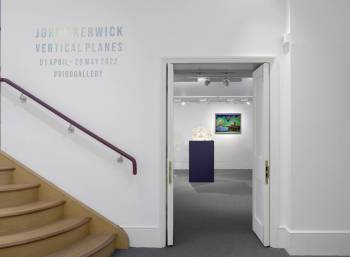 Jordy Kerwick’s brazen, colour saturated paintings transport you to a dream world of mythology, folk law, and misadventure. The artist explores his own domestic family frivolity through the lens of alternative bodies or forms. Snakes, bears, wolves, and tigers are juxtaposed with his favourite books, still life flowers, trees, and domestic arrangements within almost fairy-tale narratives. His two sons Sony and Milo, for example, are often represented as double-headed beasts.
The current exhibition is a playful reaction to the history—or alternate histories—of Wellington Arch and some of the characters it immortalises. Tigers, bears, snakes, and unicorns all take sides in the artist’s own version of the Battle of Waterloo, replacing key characters such as Napoleon and Wellington but leaving these characters ambiguous and interchangeable. The work was by Ken Webster’s book Vertical Planes (1989), which documents the author’s experience of receiving contact from people of the 16th-century and the future who had all inhabited the same cottage in Dodleston, Cheshire. Webster believed in parallel planes of existence all running simultaneously, an idea that also fascinates Kerwick.
Ibrahim El-Salahi, Black and White
1 June — 30 October 2022
This group of Black and White works on paper by Ibrahim El-Salahi from 2012 have never before been exhibited. They were completed in the lead up to his 2013 solo show at Tate Modern, when he became the first artist of African birth to be featured there in a retrospective exhibition. The works show the ‘godfather of African art’ at his best with a confidence of line reflecting over seventy years of creating his surreal multilayered visions.
Born in Sudan in 1930, Ibrahim El-Salahi is one of the most important living African artists and a key figure in the development of African Modernism. El-Salahi grew up in Omdurman, Sudan and studied at the Slade School in London. On his return to Sudan in 1957, he established a new visual vocabulary, integrating various Sudanese, Islamic, African, Arab, and Western artistic traditions.
2022 is an exciting year for the now Oxford-based El-Salahi. The artist has been selected to participate with 99 drawings in the 2022 59th Venice Biennale, The Milk of Dreams curated by Cecilia Alemani. Alongside the exhibition at Wellington Arch, Vigo will also show El-Salahi at their gallery in Masons Yard, London (June 2021), and his Pain Relief drawings will be the subject of a solo exhibition at the Norwegian Drawing Association (Tegnerforbundet), a show which will travel in an expanded format to The Drawing Center in New York in October. The Pain Relief canvases relating to these drawings will also be the subject of a solo exhibition at Hastings Contemporary (the Jerwood Gallery) from April to June. In a busy year the 91-year-old legend will further participate in group exhibitions at the Chrysler Museum of Art (October) and the Fisk University Galleries (October).
Matthew Burrows, In and Through
8 November 2022 — 8 January 2023
The paintings of Matthew Burrows explore a coalescence between stillness and movement. Work from the In and Through series has a preoccupation with watchfulness and the lines that delineate the landscape and our physiology. Burrows speaks of his work as an internal vigilance for place, creating images that meditate on the deep knowledge derived from repeatedly moving in and through the landscape. His relationship with habitat is not one of description or nostalgia, but one of dwelling and ritual. It is a process of mythologising, of drawing meaning from the particularities of the environment, of realising its wilderness and ours.
In 2020, a week before the first national lockdown, Burrows founded the Artists Support Pledge initiative, to help artists and makers through the COVID-19 pandemic. Artist Support Pledge has become a global phenomenon helping sustain thousands of artists across the globe during the pandemic. It has become a global movement empowering both artists and collectors. For his efforts, Matthew was awarded an MBE for services to Arts and Culture. Many are excited to celebrate this ‘artist’s artist’ who has contributed so much to his community.
Marcus Harvey, Waterloo Sunset
11 January — 19 March 2023
Marcus Harvey makes raw, expressive figurative paintings and sculptures. He seeks out imagery that is emblematic of a brutish but proud Britishness, iconic images—whether good, bad, or ambiguous—without commenting on his own relationship to them. Harvey’s most infamous work is Myra, a painting of the infamous child-murderer, which was exhibited as part of the groundbreaking 1997 exhibition Sensation. This chilling portrait derived much of its potency from the iconography of a photograph so engrained in the British psyche through years of media reproduction. A family man, Harvey was after sensation, and this painting regarded as so important in British art history is also one of the most misunderstood.
Recently, Harvey has started to work extensively with ceramics creating motifs and emblems of Britishness into collaged portraits of historical British figures, or foes, from history, from Nelson to Margaret Thatcher and Napoleon, to Tony Blair. He works the imagery, handling the clay in a battle to find its form through multiple firings. The result is tough but humorous sculpture, unapologetic and brash, political yet ambiguous, considered, and painterly.
Wellington and his eponymous boot fit snugly into Harvey’s ‘Punch and Judy’ ensemble as it fights to balance our nation’s patriotic sympathies with its dark imperial legacy. These complex and contradictory emotions will infuse the characters who will take temporary residence in the upper galleries of Wellington Arch.
Exhibition | Wellington, Women, and Friendship
From the press release (via Art Daily) for the exhibition now on view at Apsley House:
Wellington, Women, and Friendship
Apsley House, London, 21 April — 30 October 2022
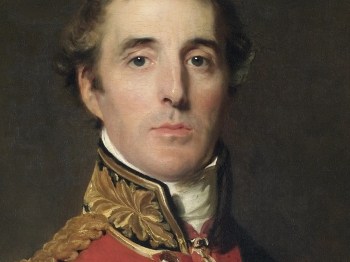
Sir Thomas Lawrence, Portrait of The Duke of Wellington, detail, ca. 1815 (London: English Heritage, Wellington Collection, Apsley House).
Through letters, portraits, and much more, on loan from public and private collections, Wellington, Women, and Friendship presents an intimate picture of a very public life, revealing Wellington’s social circle, his marriage, and how his friendships with women could sometimes provoke rumour and gossip.
From the moment he secured victory at the battle of Waterloo in June 1815, Wellesley’s legendary status was assured. He was not only a military hero but also a hugely influential figure in the high society of his day. As Sir Thomas Lawrence’s portraits attest, with his high cheekbones, aquiline nose and piercing blue eyes, the Duke was often the centre of female attention.
In 1806, after returning from eight years of service with the British Army in India, Wellesley married Catherine Pakenham, whom he had known from his formative years in Ireland. It soon sadly became apparent that they were ill matched—not least because the couple had neither seen nor spoken to each other during his time overseas. Shortly after their marriage Wellington was off again, and this time they were separated for nearly five years. This was the form the pattern for the rest of their married life. Over the years that followed the Duke gained a loyal circle of female friends who he regularly corresponded with.

Sir Thomas Lawrence, Portrait of Marianne Patterson, 1818 (Stratfield Saye Preservation Trust).
Wellington, Women and Friendship presents around fifteen works including paintings, miniatures, drawings, and previously unseen or published letters—even contemporary cartoons that give us a window onto the world of celebrity gossip. Many of these portraits of the woman he corresponded with hung in his own home during his lifetime.
Josephine Oxley, Keeper of the Wellington Collection says, “Wellington was a very private person, but after Waterloo he was of interest to everyone in society and he quickly became aware of the growing chatter about his female companions. It was well known that his marriage was not a happy one, but what was the truth behind all those other friendships? This exhibition will bring a new perspective on Wellington’s very private life and tackle some of the difficult questions.”
Apsley House is a unique survival of an aristocratic townhouse in the centre of London. The house was purchased in 1817 by Arthur Wellesley, 1st Duke of Wellington (1769–1852) after his victory at Waterloo and became known as ‘Number 1 London’. The house reflects the style and taste of the 1820s when it was remodelled for Wellington by his architect Benjamin Dean Wyatt. Today the house holds an important collection of fine art, including paintings by Velazquez, Goya, Titian, and Rubens alongside an outstanding display of porcelain and silver.
Online Talk | Anne Helmreich on the Future of Art Market Studies
From Art Market Studies:
Anne Helmreich | Charting our Future: Art Market Studies & Provenance Research in a Digital Age
The 2022 Hugo Helbing Lecture
Online, Zentralinstitut für Kunstgeschichte, Munich, 27 April 2022, 18.15 (CET)
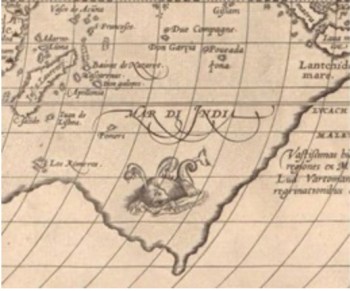
Frans Hogenberg and Abraham Ortelius, Typvs Orbis Terrarvm, detail (Antwerp: Abraham Ortelius, 1584?) https://www.loc.gov/item/2017585795/
‘Here be dragons’, a trope used by Western early modern mapmakers to signify uncharted or dangerous territories may also describe attitudes to digital approaches in art history within certain circles. But if we aim to understand the histories of art markets at scale and over space and time, we must set sail. This talk will chart potential future directions for art market studies and provenance research, exploring both possibilities and challenges offered by digital methods. To frame this exploration, the talk will draw on complex issues raised by the transatlantic art trade at the turn of the last century and its key nodes of New York and London. In particular, it is concerned with the role played by dealers, such as Boussod, Valadon & Cie, Knoedler, Yamanaka & Co., and Hagop Kevorkian, and the different forms of archival evidence we can deploy to study this question, ranging from paper documents produced at the time—stockbooks, exhibition catalogues and reviews, correspondence, photographs, etc.—to today’s digital databases and online museum catalogues.
Anne Helmreich is Associate Director, Getty Foundation, and formerly Associate Director, Digital Initiatives, Getty Research Institute, both of the J. Paul Getty Trust. She has also served as Dean, TCU College of Fine Arts; Senior Program Officer, The Getty Foundation; and Associate Professor of Art History and Director, Baker-Nord Center for the Humanities, Case Western Reserve University. Her current research focuses on the history of the art market and the productive intersection of the digital humanities and art history. Her essay “The Art Market as a System, Florence Levy’s Statistics” appeared in American Art in Fall 2020. “Purpose-built: Duveen and the Commercial Art Gallery,” co-authored with Edward Sterrett and Sandra van Ginhoven, was published by Nineteenth-Century Art Worldwide in Summer 2021. She and Pamela Fletcher recently co-authored “Digital Methods and the Study of the Art Market” for The Routledge Companion to Digital Humanities and Art History (Routledge, 2020) and the epilogue to Art Crossing Borders: The Internationalisation of the Art Market in the Age of Nation States, 1750–1914 (Brill, 2019).
The lecture will also take place via Zoom; you can attend via the following link:
https://us02web.zoom.us/j/85659345839?pwd=UmFZYU0xN1NxMGJ1MjlQM054NXgvZz09
Meeting-ID: 856 5934 5839 | Password: 148258










 Enfilade
leave a comment