Exhibition | Boilly: Parisian Chronicles

Louis-Léopold Boilly, Trompe-l’oeil aux cartes et pieces de monnaie, detail, ca. 1808–15
(Lille: Palais des Beaux-Arts)
◊ ◊ ◊ ◊ ◊
From the Cognacq-Jay:
Boilly: Parisian Chronicles
Musée Cognacq-Jay, Paris, 16 February — 26 June 2022
Curated by Annick Lemoine and Sixtine de Saint-Léger
A virtuosic and prolific artist in a class of his own, Louis-Léopold Boilly (1761–1845) was the enthusiastic chronicler of Parisian life for sixty years, spanning a period from one revolution to the dawn of the next (1789 and 1848). In addition to being a portraitist for Parisians and a painter of city scenes, Boilly was also the inventor of stunning trompe-l’œil paintings and the author of witty caricatures. This monographic exhibition explores Boilly’s productive career through a selection of 130 works, giving us a glimpse into the artist’s uniqueness, brilliance, humour, and inventiveness. It presents several previously unseen masterpieces, some of which have never been shown in France.
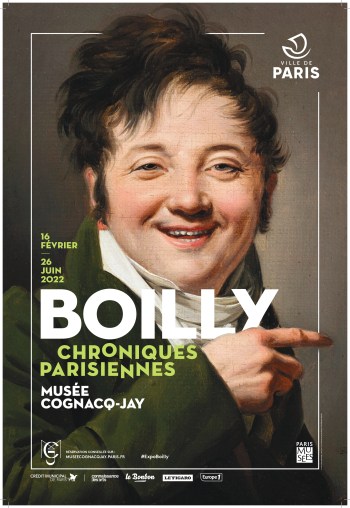 Born in the North of France, Boilly set out to win over the capital at the age of 24, in 1785. He would live there his whole life. Taking little interest in the grand history of Paris, he instead became fascinated by the city’s modernity, its hustle and bustle, and its many spectacles. As a true chronicler of everyday life, Boilly painted an intimate portrait of his generation. The artist developed a fondness for scrutinising the views and faces he came across in the city. He distinguished himself in the art of portraiture by capturing the faces of Parisians on the small formats that would become his trademark. The portraitist was also a keen caricaturist who looked at his fellow citizens with an amused, and perhaps even scathing, eye. His taste for provocation and technical proficiency can also be found in his stunningly illusionistic trompe-l’œil.
The exhibition also showcases the subtle tricks the artist employed to depict himself in his works. In addition to painting derisive self-portraits and using a variety of signatures, he also slid his likeness amongst the protagonists of his crowd scenes, just as Alfred Hitchcock did in his films. These stratagems establish a knowing relationship between the artist and viewer. Throughout the exhibition, visitors are taken along on a fun treasure hunt to find Boilly’s face or clues of his presence.
Organised as a follow-up to the publication of Étienne Bréton and Pascal Zuber’s catalogue raisonné of the artist’s work (Boilly: Le peintre de la société parisienne de Louis XVI à Louis-Philippe, Arthena, 2019), the exhibition is curated by Annick Lemoine and Sixtine de Saint-Lége. On display are several masterpieces never before shown in France on loan from prestigious private collections, including one of the largest, currently held by the Ramsbury Manor Foundation (United Kingdom).
Annick Lemoine, ed., with contributions by Etienne Bréton, Sixtine de Saint-Léger, Côme Fabre, Martial Guédron, Charlotte Guichard, Annick Lemoine, Susan L. Siegfried, Anne-Laure Sol, Francesca Whitlum-Cooper, and Pascal Zuber, Boilly: Chroniques Parisiennes (Paris: Musées, 2022), 160 pages, ISBN: 978-2759605187, €30.
New Book | Libel and Lampoon: Satire in the Courts, 1670–1792
Andrew Bricker will be speaking online (via Zoom) with Marissa Nicosia about his new book on Tuesday, 12 April 2022, at noon (ET) in a session sponsored by the Society of Fellows in Critical Bibliography and the Rare Book School. From Oxford UP:
Andrew Benjamin Bricker, Libel and Lampoon: Satire in the Courts, 1670–1792 (Oxford: Oxford University Press, 2022), 352 pages, ISBN: 978-0192846150, $90.
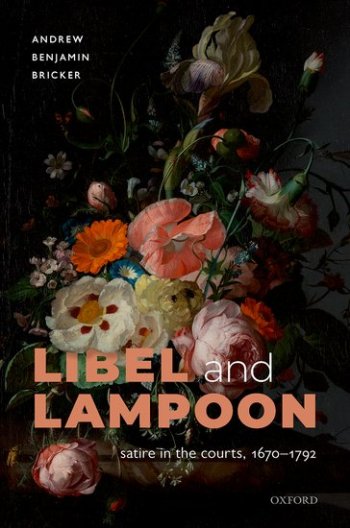 Libel and Lampoon shows how English satire and the law mutually shaped each other during the long eighteenth century. Following the lapse of prepublication licensing in 1695, the authorities quickly turned to the courts and newly repurposed libel laws in an attempt to regulate the press. In response, satirists and their booksellers devised a range of evasions. Writers increasingly capitalized on forms of verbal ambiguity, including irony, allegory, circumlocution, and indirection, while shifty printers and booksellers turned to a host of publication ruses that complicated the mechanics of both detection and prosecution. In effect, the elegant insults, comical periphrases, and booksellers’ tricks that came to typify eighteenth-century satire were a way of writing and publishing born of legal necessity. Early on, these emergent satiric practices stymied the authorities and the courts. But they also led to new legislation and innovative courtroom procedures that targeted satire’s most routine evasions. Especially important were a series of rulings that increased the legal liabilities of printers and booksellers and that expanded and refined doctrines for the courtroom interpretation of verbal ambiguity, irony, and allegory. By the mid-eighteenth century, satirists and their booksellers faced a range of newfound legal pressures. Rather than disappearing, however, personal and political satire began to migrate to dramatic mimicry and caricature-acoustic and visual forms that relied less on verbal ambiguity and were therefore not subject to either the provisions of preperformance dramatic licensing or the courtroom interpretive procedures that had earlier enabled the prosecution of printed satire.
Andrew Benjamin Bricker is an Assistant Professor of English Literature in the Department of Literary Studies at Ghent University and a Senior Fellow at the Andrew W. Mellon Society of Fellows in Critical Bibliography at the Rare Book School at the University of Virginia. He received his BA and MA from the University of Toronto and his PhD from Stanford University. Before joining UGent, he was a Mellon Foundation Postdoctoral Fellow in the Humanities at McGill University and a Killam Postdoctoral Research Fellow at the University of British Columbia.
C O N T E N T S
Introduction: The Perils of Satire
1 Keeping out of Court I: Libel and Lampoon after Hale and Dryden
2 Keeping out of Court II: Swift and the Illicit Book Trade
3 Irony in the Courts: Defoe and the Law of Seditious Libel
4 Naming in the Courts: Pope and the Dunciad
5 Allegory in the Courts: Satire and the Problem of ‘Libellous Parallels’
6 Keeping out of Court III: Caricature, Mimicry, and the Deverbalization of Satire
Epilogue: A Shandean History of the Press
Call for Papers | The Longue Durée of Cultural Heritage
From ArtHist.net:
The Longue Durée of Cultural Heritage: Curation of the Past from Antiquity to the Present Day
Norwegian Institute in Rome, 5–7 December 2022
Proposals due by 15 May 2022
An interdisciplinary conference at the Norwegian Institute in Rome (University of Oslo), in collaboration with the Heritage Experience Initiative (HEI), University of Oslo.
Across the world, there is a burgeoning interest in cultural heritage, among academics and professionals, as well as in politics. While heritage is typically thought of as a modern concept with origins in the late-eighteenth and nineteenth centuries, there is ample proof that pre-modern societies curated their pasts in highly comparable ways. Starting from the understanding of cultural heritage as a process, we recognize certain practices regarding the management of spaces, monuments, and objects in pre- and early modern societies as congruent to types of activity commonly placed within the heritage rubric. By adopting a long-term approach to the subject, this conference aims to create opportunities for new lines of research across disciplines. This includes examining historical examples to contextualize, interrogate, and deepen our understanding of modern approaches to heritage. Moreover, developments in contemporary heritage theory and practice can provide a fresh and productive framework for examining and categorizing processes in the past. By bringing together scholars working on issues of heritage in the present day with those studying similar ideas in more remote, historical contexts, this interdisciplinary conference aims to foster a dialogue which can enrich analyses of heritage practices in the past and in the present day.
We invite contributions from scholars with a contemporary and/or historical focus (in particular, we welcome research on pre-modern periods). Relevant themes include (but are not restricted to):
• Methodologies of heritage
• Case studies of pre-modern heritage curation/preservation
• Authenticity
• Destruction and iconoclasm
• Ruins and reconstructions
• Commodification
• Preservation as deconsecration
• Restoration
• Are texts intangible heritage? Textual heritage(s) and their material dimensions: epigraphy, archives, corpora, etc.
• Images/representations of heritage processes
Please submit a paper proposal of no more than 250 words and a short CV (half page) to k.b.aavitsland@roma.uio.no by 15 May 2022. Scholars without funding from their home institutions may apply for travel grants to the same address.
Confirmed invited speakers include Thora Petursdottir (HEI/University of Oslo), David C. Harvey (Aarhus University), Birgit Meyer (University of Utrecht), Chiara Mannoni (Ca’ Foscari University of Venice), Lars Boje Mortensen (University of Southern Denmark), Anne Eriksen (University of Oslo), Arnold Witte (University of Amsterdam), and Christopher Whitehead (Newcastle University).
Call for Articles | Black Artists in the Atlantic World, 1500–1900
From the Call for Papers at Arts:
Special Issue of Arts: Black Artists in the Atlantic World, 1500–1900
Guest edited by Paul Niell and Emily Thames
Abstracts due by 31 May 2022, with drafts of completed articles due by 31 March 2023
We are seeking submissions for a special issue of Arts, which will focus on Black Artists in the Atlantic World, ca. 1500–1900. Invoking the modern/colonial racial category of ‘black’ draws critical and much-needed attention to the role of race in the lives and careers of artists of African descent, and others who have had to negotiate being inscribed and socialized into blackness by Atlantic societies. We approach this topic hemispherically, considering both colonial and national socio-political frameworks bordering or shaped by the broader Atlantic arena, including the Americas, Europe, and Africa. In this way, we hope to foster a comparative conversation between scholars working on the various geographic spheres of the Atlantic in order to better understand the transnational and transimperial realities faced by black artists and how they have worked through their respective settings.
This special issue acknowledges and draws inspiration from recent scholarship on artists in the Spanish colonial territories throughout the Americas, such as the essay by Barbara Munday and Aaron Hyman, “Out of the Shadow of Vasari: Towards a New Model of The ‘Artist’ in Colonial Latin America,” Colonial Latin American Review 24.3 (2015): 283-317; the monograph by Susan Verdi-Webster, Lettered Artists and the Language of Empire: Painters and the Profession in Early Colonial Quito (University of Texas Press, 2017); the 2019 Hescah symposium at the University of Florida “Beyond Biography: Artistic Practice & Personhood in Colonial Latin America,” organized by Maya Stanfield-Mazzi; and the special edition of the Colonial Latin American Review, “Visualizing Blackness in Colonial Latin America,” co-edited by Kathryn Santner and Helen Melling, 30.2 (2021). The study of black artists and image makers in the southern Atlantic has been further advanced by the work of scholars, such as Ximena A. Gómez, Agnes Lugo-Ortiz, Linda Rodríguez, and Miguel Valerio. These studies shed light on the methodological challenges as well as the importance of considering the lives, careers, and agencies of Spanish colonial artists in the writing of these regions’ social and cultural histories. Among the salient dimensions addressed by these projects is the role of race in shaping the professional lives of artists. For the northern Atlantic, which is situated later in time than those of the Ibero-Americas and the Caribbean and in contexts informed by Protestant conceptions and practices of the image, relationships between the artist, the art, the viewer, and race have been examined in such works as Kirsten Pai Buick’s Child of the Fire: Mary Edmonia Lewis and the Problem of Art History’s Black and Indian Subject (Duke University Press, 2010), Anna O. Marley’s edited collection of essays Henry Ossawa Tanner: Modern Spirit (University of California Press, 2012), and Jasmine Nichole Cobb, Picture Freedom: Remaking Black Visual Culture in the Early Nineteenth Century (New York University Press, 2015).
Engaging with the subject of black artists in the Atlantic world raises a number of critical questions. How did racial blackness shape the professional worlds negotiated by artists in the Atlantic? How does race impact the ways in which we consider black artists in the Atlantic whose racial classification is not necessarily evident in the formal and stylistic properties of their work? If an artist is of African descent, must their art be a matter of race? What was the relationship between race, blackness, and the creation of the category of ‘artist’ in the Atlantic? What other forms of making and imagery are at stake in this field of inquiry beyond artist and art, as institutionally redefined by academies of art? How has the discourse of race obscured African and African American agency, awareness, and negotiations of imperial/colonial power? How do we address the limits of the historic archive in recovering the stories of such artists? What can be learned by looking across national and imperial boundaries in the Atlantic with respect to the histories of black artists? These questions will be considered and addressed within this special issue.
Dr. Paul Niell
Department of Art History, Florida State University, Tallahassee
Interests: Spanish colonial art; architecture and visual culture; the material culture of the African diaspora with an emphasis on the Caribbean region
Dr. Emily Thames
Department of Art History, Florida State University, Tallahassee
Interests: the visual and material cultures of the colonial Atlantic world; art and empire; art in the age of revolution and nationalism; the history of colonialism; the intersection of art and race; the visual and material cultures of the African diaspora
Online Talk | Database Presentation: Black People in European Sculpture
Presented by the Public Statues and Sculpture Association:
Vicky Avery, Database Presentation: Black People in European Sculpture, 1450 to the Present Day
Online, Public Statues and Sculpture Association, Wednesday, 4 May 2022, 1.30pm
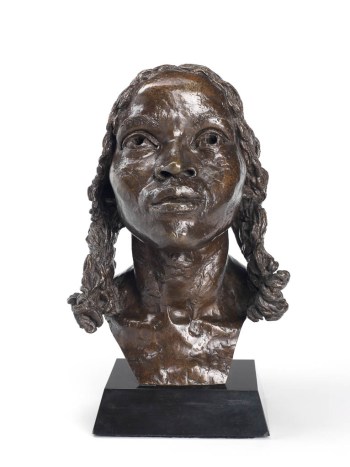
Jacob Epstein, First Portrait of Roma of Barbados (detail), ca. 1932, bronze (Cambridge: Fitzwilliam Museum, M.1-1945).
Vicky Avery is keen to share her new sculpture mapping database with the PSSA in order to get critical feedback on its pilot phase—which focuses exclusively on sculpture located in the UK—before she applies for further funding. The database aims to increase expert and lay understanding of, and engagement with, sculptures of Black people created from 1450 onwards by artists born in, or based in, the continent of Europe. This is a neglected but important category of Western art, which needs urgent research and reinterpretation.
Dr Victoria Avery has been Keeper of the Applied Arts Department at the Fitzwilliam Museum, University of Cambridge, since 2010, prior to which she was Associate Professor in the History of Art Department, University of Warwick. Vicky has researched, lectured, and published widely on all aspects the applied arts, especially on European sculpture and Italian Renaissance bronzes, most recently editing the monograph Michelangelo: Sculptor in Bronze. She has also been responsible for co-curating several ambitious, interdisciplinary, research-led collaborative exhibitions at the Fitzwilliam, most recently Feast & Fast: The Art of Food in Europe, 1500–1800. She is currently co-curating a legacies-related exhibition, Enslavement and Resistance: Cambridge’s World History (working title, 25 July 2023 — 7 January 2024).
Exhibition Programming | Jacques Louis David: Radical Draftsman
I noted the exhibition in February but included no programming information. Perrin Stein’s introduction is still available to watch on YouTube, and Daniella Berman will focus on a selection of works in her upcoming “Conversations with a Scholar” sessions. Berman will also lead three public tours. –CH
Virtual Opening | Jacques Louis David: Radical Draftsman
Online, 28 February 2022 [and still available via YouTube]
Join Perrin Stein, Curator, in the Department of Drawings and Prints, for a virtual tour of Jacques Louis David: Radical Draftsman, the first exhibition devoted to works on paper by the celebrated French artist. David navigated vast artistic and political divides throughout his life—from his birth in Paris in 1748 to his death in exile in Brussels in 1825—and his iconic works captured the aspirations and suffering of a nation, while addressing timeless themes that continue to resonate today. Through the lens of his preparatory studies, the exhibition looks beyond his public successes to chart the moments of inspiration and the progress of ideas. Visitors will follow the artist’s process as he gave form to the neoclassical style and created major canvases that shaped the public’s perceptions of historical events in the years before, during, and after the French Revolution. Organized chronologically, the exhibition features more than eighty drawings and oil sketches—including rarely loaned or newly discovered works—drawn from the collections of The Met and dozens of institutional and private lenders.
From The Met:
Conversation with a Scholar | Daniella Berman on Jacques Louis David: Radical Draftsman
The Metropolitan Museum of Art, New York, Mondays, 11 and 25 April 2022, 11.00am
Join Daniella Berman for a lively 30-minute dialogue, exploring a selection of objects from the exhibition Jacques Louis David: Radical Draftsman. Free with museum admission. Please note: Limited space is allotted on a first come, first served basis.
In addition, Berman will lead three public tours of the exhibition on the following dates:
Friday, 22 April 2022, 2.00pm
Friday, 6 May 2022, 10.30am
Monday, 9 May 2022, 2.00pm
Daniella Berman, a doctoral candidate in art history and archaeology at NYU’s Institute of Fine Arts, is the 2019–20 Marica and Jan Vilcek Fellow in the Department of Drawings and Prints at The Met.
PhD Opportunity | Women, Art Making, and the English Country House

Mirabel Jane Neville[?], mid-nineteenth-century watercolour of the Saloon at Audley End, Essex.
◊ ◊ ◊ ◊ ◊
From the project announcement:
‘Spaces of Femininity’: Making Art and Craft in the English Country House, c.1750–1900
AHRC Collaborative Doctoral Partnership
PhD Project supervised by Kate Retford and Peter Moore, starting 1 October 2022
Applications due by 9 May 2022
Birkbeck, University of London and English Heritage are pleased to announce the availability of a fully funded collaborative doctoral studentship, from October 2022. This is to undertake research into the artistic production of women in country houses in the later eighteenth and nineteenth centuries, using English Heritage properties as case studies. This PhD project will be jointly supervised by Professor Kate Retford (History of Art Department, Birkbeck) and Dr. Peter Moore (Curator of Collections and Interiors, Audley End and Wrest Park). The closing date is Monday, 9 May 2022, 5pm.
Country houses are full of ‘amateur’ art work—particularly the work of the wives and daughters who lived in them, and particularly from the later Georgian and Victorian periods when such practice flourished, and the commercial sector developed to support it (providing instruction manuals, materials, tutors etc). This ranges from drawings, etchings and watercolours through to objects such as containers crafted from shell work, panelled folding screens showcasing petit-point needlework and hand painted ceramics. The houses managed by English Heritage are no exception. The student will select case studies from amongst properties such as Audley End, Wrest Park, and Brodsworth, considering objects and interiors still at the houses, as well as material now in other public or private collections.
The student has the scope to develop both the topic and approach, in conjunction with the supervisors, but proposed research questions include:
1 What kinds of work did these women produce? In which genres and media did they work?
2 Why did they produce such work? A popular contemporary stereotype presented this as a genteel accomplishment, of particular value in the marriage market: does this hold up?
3 What did these women do with such work? Was it intended for display, whether in their own home or elsewhere? To what extent did this creative practice support familial and social networks through exchange of these objects?
4 What relationship did these women have with the ‘professional’ art world? What instruction manuals and other pedagogic literature did they consult? What commercially produced materials did they use? Who taught them, and how did tutoring work in practice? How did they engage with the organisations that provided training, prizes and opportunities for exhibiting work?
5 What can this work tell us about women’s historical experience? What can it tell us about their daily lives and personal relationships? What can it tell us about their relationships with their houses and landscapes?
6 What can this work tell us about the eighteenth- and nineteenth-century domestic interior? How did these objects relate to the décor and furnishings designed and created by professionals?
This studentship will provide the student with both invaluable academic skills and experience of working in the heritage sector. It will involve the student in a range of interdisciplinary research activities, drawing on archival and primary textual material and working closely with collections and interiors. In addition to preparing the PhD thesis, it is envisaged that the student will also be engaged in a range of related activities such as cataloguing and interpretation work, and to take the lead on a temporary display at Audley End. They will also be expected to play a full role in the research cultures of both institutions.
Additional information is available here»
Study Day | Thomas Baxter (1782–1821)
From The English Ceramic Circle:
Thomas Baxter, Junior (1782–1821)
An English Ceramic Circle Study Day
Victoria & Albert Museum, London, 5 May 2022
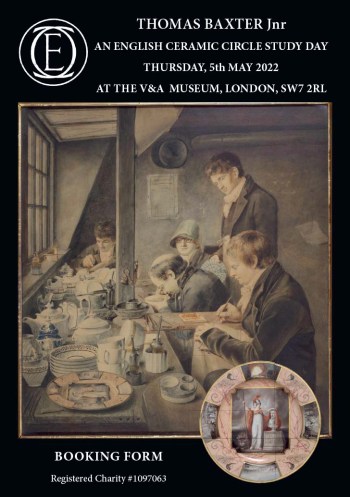 Seven papers by leading scholars will cover Thomas Baxter Jnr’s ceramic and related work in London, Worcester, and Swansea. The study day starts at 10.30am and should finish by 5pm. The price—which includes refreshments (tea, coffee, etc)—is £40 for English Ceramic Circle members and £60 for non-members; the registration fee does not include lunch, which can be purchased from the V&A café.
Confirmed speakers and titles include:
• Roger Edmundson — The Baxter family
• Martin Myrone — The Royal Academy School, Its Students, and Henry Fuseli
• John Sandon — ‘All that is Great…’ Emma, the Merton Albums, and the Lost Garrick Drawings
• Andrew Renton — Thomas Baxter in Swansea
• Caroline McCaffrey-Howarth and Florence Tyler — Thomas Baxter’s Recipe Book and the Collections at the V&A
• Charles Dawson — Thomas Baxter at Worcester
• Jonathan Gray — Thomas Baxter: Notable Collectors
Online Talk | Cabinet Cup and Stand by Thomas Baxter
From Rienzi:
Misty Flores | Worcester Cabinet Cup and Stand by Thomas Baxter
Online, Rienzi, MFAH, Houston, Tuesday, 19 April 2022, 1pm (Central Time)
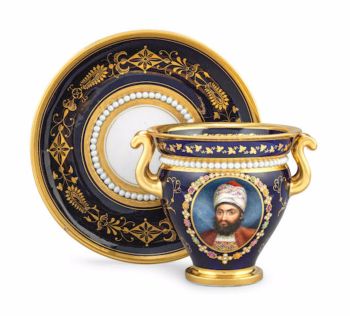
Worcester Porcelain Manufactory, Thomas Baxter, Cabinet Cup and Stand, ca. 1814–16, porcelain (Museum of Fine Arts, Houston / Photograph: Bonham, 2021).
This Worcester porcelain cup depicts Mirza Abu’l Hassan Khan (1776–1845), the Persian ambassador sent to the English court in 1809. A figure of much fascination while in England, he was the subject of prints and poetry and was even depicted on porcelain objects. Find out more about this Cabinet Cup and Stand, newly acquired by Rienzi, during this free 30-minute talk with assistant curator Misty Flores. Live via Zoom.
Registration is available here»
Online Panels | Museum Careers
Presented by the Yale Center for British Art:
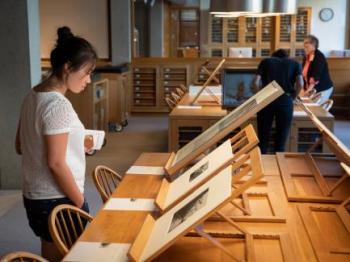
Visitors in the Study Room, YCBA (Photo by Harold Shapiro).
This two-part online discussion is for graduate students from any discipline who are interested in pursuing a professional career in museums. In each session, Yale alumni who work in the field share their personal experiences and professional opinions. The goal is to better equip individuals for a museum position by discussing the range of specialist professions that support museums and sharing information about how to be competitive in the job market. There will be opportunities to ask questions with the online Q&A feature.
Attendees must register to receive the link.
Yale Alumni Panels: Museum Careers and Trajectories
Friday, 8 April 2022, 11.00am (ET)
This session addresses personal career trajectories to highlight the diversity of pathways into museums and the range of positions related to audience outreach, curatorial practice, collections, and programming. Each panelist shares their current duties and responsibilities and how their position fits into their wider career goals and intellectual life. The discussion also touches on how to prioritize the skills and experience needed to be competitive in the job market, such as publishing scholarly research, gaining work experience, presenting at conferences, networking, interning, and applying to professional or fellowship positions.
Panelists
• Ashley James (Yale PhD 2021, English Literature, African American Studies, and Gender Studies), Associate Curator, Contemporary Art, Solomon R. Guggenheim Museum
• Elizabeth Mattison (Yale MA 2014, History of Art), Andrew W. Mellon Assistant Curator of Academic Programming, Hood Museum of Art
• Rebecca Peabody (Yale PhD 2006, History of Art and African American Studies), Head of Research Projects & Programs, Getty Research Institute
Moderator
• Laurel Peterson (Yale PhD 2018, History of Art), Assistant Curator of Prints and Drawings, Yale Center for British Art
To join us for this program, please register here»
◊ ◊ ◊ ◊ ◊
Yale Alumni Panels: Museums and the Hiring Process
Friday, 22 April 2022, 11.00am (ET)
This session focuses on the process of applying, interviewing, and securing a position within the museum field. Panelists reflect on their own successes and share insights into the recruitment process at their respective institutions. The conversation also covers some of the effective strategies that candidates have used and touches on resources and training options.
Panelists
• Desirée Gordon (Yale BA 2002, American Studies and Cultural Anthropology), Director of Programs and Strategy, Brooklyn Arts Council
• Megan Heuer (Yale BA 2000, Women’s and Gender Studies), Director of Public Programs and Public Engagement, Whitney Museum of American Art
• Julie Ludwig (Yale MA 1996), Associate Archivist, The Frick Collection
Moderator
• James Vanderberg, Educator, High School, College, University, and Community Engagement, Yale Center for British Art
To join us for this program, please register here»










 Enfilade
1 comment