Exhibition | The Essence of a Painting, The Sense of Smell
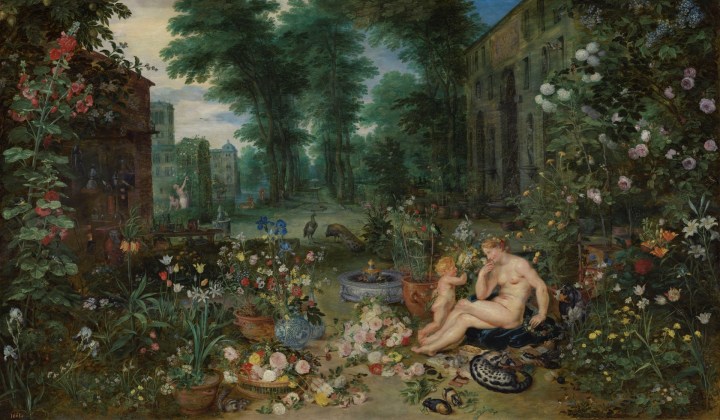
Jan Brueghel the Elder and Peter Paul Rubens, The Sense of Smell, 1617–18, oil on panel, 67 × 110 cm
(Madrid: Museo Nacional del Prado)
◊ ◊ ◊ ◊ ◊
The painting at the center of the exhibition dates to 1617–18, but the olfactory sources for the show include late seventeenth- and eighteenth-century materials—including a 1696 formula for scenting gloves with ambergris and the period’s engagement with neroli, named for Marie-Anne de la Trémoille (1642–1722), whose several titles included Princess of Nerola (for the town in Lazio) and who used the scent to perfume her gloves, clothing, and baths. Now on view at the Prado:
The Essence of a Painting: An Olfactory Exhibition / La esencia de un cuadro: Una exposición olfativa
Museo Nacional del Prado, Madrid, 4 April — 3 July 2022
Curated by Alejandro Vergara and Gregorio Sola with fragrances by Sola
The Sense of Smell by Jan Brueghel the Elder with allegorical figures by Peter Paul Rubens is the focus of The Essence of a Painting: An Olfactory Exhibition, curated by Alejandro Vergara, Chief Curator of Flemish Painting and the Northern Schools at the Museo Nacional del Prado, and Gregorio Sola, Senior Perfumer at Puig and an academician of the Perfume Academy. Evoking the garden of rare trees and plants belonging to Isabel Clara Eugenia and her husband in early 17th-century Brussels, the painting depicts more than 80 species of plants and flowers, as well as various animals associated with the sense of smell, such as the scent hound and civet, and a range of objects relating to the world of perfume, including scented gloves, vessels holding fragrant substances, a perfume burner warmed in a sumptuous brazier, and vessels for distilling essences. With the technological sponsorship of Samsung and a special collaboration of the Perfume Academy Foundation and the ‘AirParfum’ technology developed by Puig, the perfumer Gregorio Sola has created an assortment of fragrances associated with elements pictured in the painting:
• ‘Allegory’, for example, encourages viewers to focus on the small bouquet of flowers that the allegorical figure smells.
• ‘Gloves’, based on a 1696 formula, reproduces the smell of gloves scented with ambergris.
• ‘Fig Tree’ leads us to spot the tree in the painting.
• ‘Orange Blossom’ directs the gaze towards the distillation devices used to obtain the plant extract.
In total, ten fragrances accompany the sense of sight, providing unique sensations for an appreciation of the painting.
More information is available here»
Exhibition | French Taste in Spain, 17th–19th Centuries
Now on view at the Fundacion MAPFRE:
The French Taste and Its Presence in Spain, 17th–19th Centuries
El gusto francés y su presencia en España, siglos XVII–XIX
Fundación MAPFRE, Madrid, 11 February — 8 May 2022
Curated by Amaya Alzaga Ruíz with Gloria Martínez Leiva
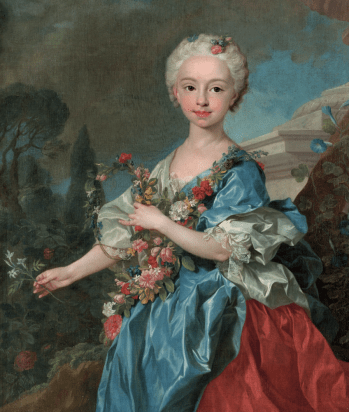
Louis-Michel Van Loo, María Antonia Fernanda de Borbón, Infanta of Spain, detail, ca. 1737, oil on canvas, 88 × 71 cm (Museo de Bellas Artes de Asturias, Repository of the Collection of the IX Count of Villagonzalo; photo by Marcos Morilla).
Through numerous paintings, sculptures, textiles, sumptuary arts, and everyday objects, the exhibition El gusto francés y su presencia en España, siglos XVII–XIX delves into the evolution of French taste in Spain, which until now has been studied only on an ad hoc basis. A cross-cutting project that covers such an extensive historical period cannot be understood without its historical context. In this sense, the exhibition also addresses aspects that make this evolution possible, such as diplomatic relations, the history of collecting, and the construction of national identities. The nearly 110 works on display are from both public and private collections and are all pieces of national heritage. The project commences at the moment when French artworks began to arrive in Spain, as France emerged as a model of European taste, and it concludes when the opposite phenomenon occurred, when Spain became the focus of attraction for French culture, due to the image constructed around its diversity and exoticism throughout the 19th century.
17th Century | Difficult Relations: Portraits, Exchanges, and Gifts
The 1630s and 1640s, under the reign of Louis XIII, who for a time managed to stabilize the power of the crown, witnessed a golden age for French painting. Both Louis XIII and his advisor, Cardinal Richelieu, launched an extremely active artistic policy and commissions proliferated, which encouraged the art market.
Towards 1650, Spain was irrevocably losing its primacy as a world power to the France of Louis XIV, the Sun King. One of the strategies used to seal the peace was to establish alliances through marriages with the Spanish royal house. In this context, it was common for gifts of a very different nature to be exchanged between the two: horses, sumptuary arts, small pieces of furniture and above all portraits. From 1660 onwards, thanks to his marriage to Maria Teresa of Austria, daughter of Philip IV, known as the Planet King—a union that brought the Thirty Years’ War to an end— the exchange of gifts became even more frequent. The queen was portrayed on numerous occasions alone or accompanied by her son Louis, known as the Grand Dauphin of France, as can be seen in María Teresa de Austria y el Gran Delfín de Francia (Maria Theresa of Austria and the Grand Dauphin of France), ca. 1664, by cousins Charles and Henri Beaubrun.
18th Century | The Arrival of French Artists in Bourbon Spain, the Emergence of French Taste
In 1700, with the accession to the throne of Philip V, the Bourbon dynasty, of French origin, was established in Spain, and in the early years of his reign, the king wanted to bring everything he had known in Versailles and Paris to the Spanish court. He commissioned the work on the Buen Retiro, as well as the interior renovation of the Alcázar, and undertook the construction of the Granja de San Ildefonso, in Segovia. In addition, all kinds of furniture, jewelry, and clothing were imported. In 1715, the painter Michel-Ange Houasse came to the Spanish court from France, later being succeeded by Jean Ranc. In 1735, Louis-Michel Van Loo replaced Ranc, and became the King’s principal painter, as well as the director of painting at the Real Academia de Bellas Artes de San Fernando, founded in 1752. From his hand came the portrait María Antonia Fernanda de Borbón, infanta de España (María Antonia Fernanda de Borbón, Infanta of Spain), ca. 1737.
 During this period, artistic transfers between France and Spain were sometimes made by way of Italy, which was home to an important French community fostered by the presence of the Académie de France in Rome, founded by Louis XIV in 1666. Spanish artists traveled to Rome more and more frequently, which gave them the opportunity to become familiar with French art without the need to travel to Paris. This was the case of Francisco Goya, who was able to become acquainted with the work of Nicolas Poussin and Pierre Subleyras during his documented stay in the Italian capital.
The blossoming of French culture and taste in Spain reached its pinnacle during the reign of Charles IV, grandson of Philip V. Born in Portici during the reign of his father Charles III in Naples and Sicily, Charles Anthony of Bourbon (1748–1819) arrived in Spain as a teenager. He was first named Prince of Asturias and then crowned King of Spain and the Indies in 1788. In 1808 he was dethroned, exiled first in France and then in Rome, until his death in Naples. His interest in the sumptuary arts, furniture, painting, and sculpture became apparent at an early age and the best example of this is the Platinum Cabinet in the Casa del Labrador in Aranjuez, which was made entirely by French artists. On the occasion of his marriage to Maria Luisa Teresa of Parma in 1765, Louis XV gave the couple a table service from the porcelain company Manufactura Real de Porcelana de Sèvres, and his cousin Louis XVI, presented them with two paintings by Claude Joseph Vernet.
19th Century | The Romantic Vision of Spain
With the Napoleonic invasion that led to the War of Independence (1808–1814), Spain became the new destination to be explored by the French who, together with other foreign travelers and intellectuals, created what is known today as the ‘romantic image of Spain’. Some of those who contributed to this creation were the writer Victor Hugo and the painter Eugène Delacroix. We can see more specific examples in the exhibition, in the figures of Antonio de Orleans, Duke of Montpensier and Galliera, and Eugenia de Montijo.
The Duke of Montepensier married the sister of Queen Isabella II, the Infanta Luisa Fernanda. After the revolution of 1848 the couple left France, settling in Seville in 1849. Their stay led to a boom in culture and popular events in the city, to the point that Seville came to be nicknamed the ‘Small Court’. Eugenia de Montijo, the daughter of the Duke of Peñaranda, was born in Granada, but spent most of her life in France. Wife of Louis Napoleon Bonaparte, thanks to her education and refinement, she was one of those responsible for exporting the ‘Empire style’ to the Spanish court.
At the end of the 18th century, France and Spain became official allies and a change began to take place with respect to the foreign view of the latter. Spain, which was at peace, proved to be the perfect alternative for more inquisitive spirits, since it was home to magnificent remains from the Roman and Arab civilizations. In this context, Alexandre de Laborde (1773–1842), an officer, scholar and traveler, taking advantage of his diplomatic posting in Madrid, in 1800 penned the story of his travels, in the Voyage pittoresque et historique de l’Espagne. In 1808, he finally published a shorter version, entitled Itinéraire descriptif de l’Espagne, which led a considerable number of artists to Spain, including François Ligier.
In 1826, in Paris, Baron Isidore Justin Taylor began the publication of a Voyage pittoresque en Espagne, en Portugal et sur la Côte d’Afrique, de Tanger à Tétouan. In Paris, where he held the post of Royal Commissioner of French Theater, Taylor promoted the production of Hernani, Victor Hugo’s 1830 play set in the Spanish Golden Age, further catalyzing the Romantic enthusiasm for the Peninsula. At the same time, his involvement in governmental mechanisms allowed him to present himself as the connoisseur par excellence of Spain: in 1835, he was commissioned to assemble a collection of Spanish paintings for the Louvre Museum, a campaign personally financed by King Louis-Philippe, who was eager to acquire a Galérie espagnole, taking advantage of the imminent confiscations of Mendizábal. The two French artists most involved in illustrating the Baron’s work were Adrien Dauzats and Pharamond Blanchard, who also helped to locate the paintings destined for Louis Philippe’s Spanish gallery.
Although the perception of ‘Spanishness’ in France varied throughout the 19th century, after the 1848 Revolution, it became increasingly frequent to associate Spanish culture with the image of an archaic and free people, in contrast with the rigid rules of bourgeois society. Starting in 1850, several artists, among them Gustave Doré, Jean-Baptiste Achille Zo, and Édouard Manet, began to exhibit paintings in French salons featuring gypsies, beggars, vagabonds and working class ‘majos’. Made after their respective trips to Spain, in most cases they tried to exalt the Spanish Golden Age with the figures of Velázquez and Ribera at the forefront.
Amaya Alzaga Ruíz, ed., El Gusto francés y su presencia en España, siglos XVII–XIX (Madrid: Fundación MAPFRE, 2022), 331 pages, ISBN 978-8498447972, 50€.
Online Talk | Sarah Grandin on Drawings Engraved
This Thursday from The Clark:
Sarah Grandin | A Market for Imitation: Engraving Drawing in Eighteenth-Century France
Online, The Clark Art Institute, Williamstown, Massachusetts, 7 April 2022, noon (ET)
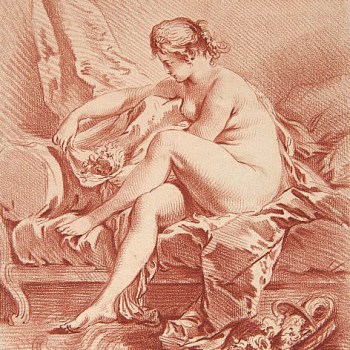
Gilles Antoine Demarteau, after François Boucher, Femme nue, after 1757, engraving in crayon manner with roulette on laid paper.
Sarah Grandin leads a virtual lunchtime talk exploring works on paper from the Clark’s collection, showcasing the role prints played in making drawing more accessible to the public in eighteenth-century France. After Grandin’s (recorded) presentation of a selection of works by Jean-Honoré Fragonard, François Boucher, Jean-Antoine Watteau, and others, she will join in a live Q&A session. Presented via Zoom and Facebook Live, the event is free, but advance registration for the Zoom transmission is required.
Sarah Grandin holds a PhD in the History of Art and Architecture from Harvard University (awarded in 2021) and is the Clark-Getty Paper Project Curatorial Fellow (2020–22) at The Clark Art Institute.
This program is made possible with support from the Getty Foundation through The Paper Project initiative.
The Clark Acquires Tea Service of Famous Women
From the press release (30 March 2022) . . .
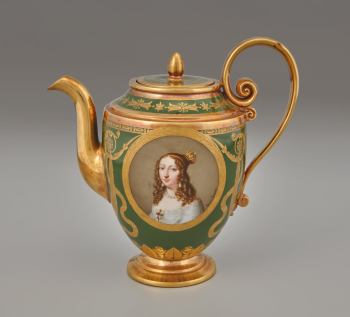
Sèvres Porcelain Manufactory, Teapot and cover (théière Asselin) with portraits of Anne of Austria (1601–1666) and Christina of Sweden (1626–1689) by by Marie-Victoire Jaquotot, 1811–12, hard-paste porcelain (The Clark Art Institute, 2021.3.1a-b).
The Clark Art Institute recently acquired an extremely rare tea service that is noted both for the exceptional craftsmanship on the part of the woman artist who was central to its creation and for its subject matter, a remarkable collection of portraits of women noted in European history. The Tea Service of Famous Women (Cabaret des femmes célèbres) is now on view in the Clark’s permanent collection galleries. With miniature portraits painted by Marie-Victoire Jaquotot between 1811 and 1812 for the Sèvres Porcelain Manufactory, the service is one of only three known sets and features portraits of women noted for their achievements within governance, literature, philosophy, and international relations.
One of the most successful porcelain painters of her time, Marie-Victoire Jaquotot (1772–1855) was both an artist and entrepreneur, achieving great professional success at a time when opportunities for women artists were limited. She was awarded the title premier peintre sur porcelaine du Roi (first porcelain painter to the King) in 1816, which allowed her to open her workshop to students. Jaquotot specialized in miniature portraits and reproductions of famous works of art at a time when these subjects were avidly collected and appreciated across Europe, both as prints and on porcelain. She used engraved portraits as sources for her portraits of the women on the tea service.
Jaquotot painted the three tea services over a five-year period from 1807 to 1812. The porcelain sets were produced by the legendary Sèvres Porcelain Manufactory outside Paris, in a complex process involving multiple specialists, including painters and gilders. The Sèvres factory employed many porcelain painters, both men and women, but few achieved the level of fame and success of Madame Jaquotot, who painted the portraits of the femmes célèbres on all three services at her Paris workshop.
These elaborate porcelain services were intended as special gifts. The set now in the Clark’s collection was originally presented in 1812 by Emperor Napoleon Bonaparte to his first wife, the Empress Josephine, whom he had divorced in 1810. Josephine rejected the gift and returned the service to the factory. It was then presented by Napoleon’s second wife, the Empress Marie-Louise, to her friend the Countess of Ségur in 1813.
“This exquisite tea service has so many stories to tell, with its of portraits of historic women, its technical expertise, and its association with one of the leading porcelain painters of the day—who just happened to be a woman,” said Kathleen Morris, the Clark’s curator of decorative arts and Marx Director of Collections and Exhibitions. “I am so pleased to be able to add this work by a woman artist who represented the pinnacle of her craft to our collection.”
The women represented on each piece in the set include powerful European rulers including Elizabeth I, queen of England (1533–1603); Christina, queen of Sweden (1626–1689); Maria Theresa, archduchess of Austria (1717–1780); and Catherine II, empress of Russia (1729–1796). Medieval warrior and saint Joan of Arc (c. 1412–1431) appears on the milk jug. Several cups feature women who were influential in political, literary, and philosophical circles, including Marie de Rabutin-Chantal, Madame de Sévigné (1626–1696), Hortense Mancini (1646–1699), and Antoinette du Ligier de la Garde Deshouliéres (1638–1694). The center of each saucer is decorated in gold with antique trophies and musical instruments, reinforcing the theme of power and accomplishment.
New Book | Luxury after the Terror
From Penn State UP:
Iris Moon, Luxury after the Terror (University Park: Pennsylvania State University Press, 2022), 272 pages, ISBN: 978-0271091617, $105. Also available as an ebook.
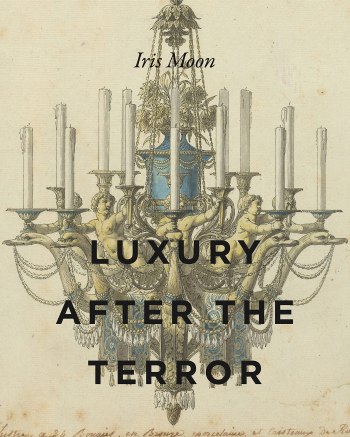 When Louis XVI was guillotined on January 21, 1793, vast networks of production that had provided splendor and sophistication to the royal court were severed. Although the king’s royal possessions—from drapery and tableware to clocks and furniture suites—were scattered and destroyed, many of the artists who made them found ways to survive. This book explores the fabrication, circulation, and survival of French luxury after the death of the king.
Spanning the final years of the ancien régime from the 1790s to the first two decades of the nineteenth century, this richly illustrated book positions luxury within the turbulent politics of dispersal, disinheritance, and dispossession. Exploring exceptional works created from silver, silk, wood, and porcelain as well as unrealized architectural projects, Iris Moon presents new perspectives on the changing meanings of luxury in the revolutionary and Napoleonic periods, a time when artists were forced into hiding, exile, or emigration. Moon draws on her expertise as a curator to revise conventional accounts of the so-called Louis XVI style, arguing that it was only after the revolutionary auctions liquidated the king’s collections that their provenance accrued deeper cultural meanings as objects with both a royal imprimatur and a threatening reactionary potential.
Lively and accessible, this thought-provoking study will be of interest to curators, art historians, scholars, and students of the decorative arts as well as specialists in the French Revolution.
Iris Moon is Assistant Curator in the European Sculpture and Decorative Arts Department at the Metropolitan Museum of Art and the author of The Architecture of Percier and Fontaine and the Struggle for Sovereignty in Revolutionary France. She teaches at The Cooper Union for the Advancement of Science and Art.
C O N T E N T S
List of Illustrations
Acknowledgements
Introduction
1 Death and Dispersal: The 1793–94 Revolutionary Auctions at Versailles
2 Henry Auguste: Precious Metals in the Age of Terror
3 Jean-Démosthène Dugourc: Political Fantasies of the Arabasque
4 Aubert-Henri-Joseph Parent: Carving in Exile
5 Alexandre Brongniart: Fragile Terrains
Coda
Notes
Bibliography
Index
Call for Papers | Historical Interiors and the Digital
From the Call for Papers (which includes a bibliography). . .
Historical Interiors and the Digital: The Possibilities and Limits of Virtual Reconstructions for Research
Paris and Versailles, 17–18 November 2022
Proposals due by 5 June 2022
The virtual reconstruction of historical interiors—from architecture to wall decoration and furniture to textiles—has been a proven instrument of cultural mediation in recent years, particularly in museums, exhibitions and/or for the study of historical monuments (for instance in archaeology). Questions of spatial proportions and fundamental architectural units are today at the forefront, with emphasis often placed on the possibility of visiting these spaces virtually, either on a 2D screen or with an immersive headset.
However, when it comes to the recreation of the aesthetic characteristics of interiors, which are one of the key issues for their understanding, the possibilities of these new models seem limited. Depending largely on the harmonious interaction of different materials such as woods, metals, and textiles, as well as the structures of their respective surfaces, the nuances of colour or gold, or even the traces of artisanship, the existing solutions in rendering the materiality of an historic interior remain insufficient, both aesthetically and scientifically. The hope to swiftly overcome the excessively sanitized surfaces of digital models, expressed in 2013 (Kohle 2013, p. 166), has not yet come to fruition. Nevertheless, there is more to it than that, as the possibilities of using virtual reconstruction effectively for researching historical interiors—for example, through the virtual insertion of materials that are no longer ethically justifiable or prohibited today—are not fully exploited.
Focusing on the possibilities and limits of virtual reconstructions of historical interiors, of which questions of materiality are only one aspect, this conference highlights the fundamental issues that occupy current research. Firstly, there is the question, not yet completely resolved, of the utility of three-dimensional virtual models—often drawn from the video-game sector—as instruments or even auxiliaries for research in art history. We cannot respond satisfactorily without also exploring the genesis and transformation of the object studied and the representation of one or more states including later modifications. Although research, and in particular archaeology, has already established a tradition of haptic and digital modelling of space, the history of art still seems to be far behind on this front (Messemer 2020). Such a circumspect attitude is off pace with the growing use of three-dimensional models and augmented-reality applications for the transmission of knowledge in museums or in connection with monuments and places of memory (Jeffrey 2021).
Moreover, this disciplinary reservation seems to contradict the often reaffirmed claim of the capacity of digital models to densify scientific reflection beyond the possibilities of language (Pfarr-Harst 2020). Analysis of historical interiors involves confronting architectural structures along with moving objects. However, in the scientific use of three-dimensional models to date, these structures and objects have largely been considered separately. This is why most discourses are interested either in the architectural dimension of spaces or in the objects themselves, considered in isolation. In this context, we would note that the 3D modelling of objects (e.g. pieces of furniture) can give rise to discussions of notions of reproduction and authenticity or, more recently, to questions of cultural appropriation (Jeffrey et al. 2020; Jeffs 2020).
As for the mise-en-scène of social representations and power (Hoppe/De Jonge/Breitling 2018), embodied in the visual and bodily perception of spaces (in their use, particularly ceremonial), this remains insufficiently conveyed by virtual reconstructions, as does the dimension of the use of objects—chairs or desks, for example—as constituting the experience of the room. In addition to the exploration of scenarios of historical utilization in comparison with modern exigencies, the modelling of the acoustic and thermal properties of spaces that were abundantly furnished with textiles (carpets and rugs, curtains, wall hangings, baldachins, and Gobelin tapestries) opens up new research perspectives of the utmost interest. Generally speaking, the absence of those sensory elements integral to the art of interior design constitutes a considerable limitation in the potential benefits of virtual representation.
The international conference—organized jointly by the German Center for Art History Paris (DFK Paris), the Mobilier national, and the Centre de recherche du château de Versailles (CRCV)—will allow for an exchange of information among specialists from the world of museums, historians and historians of art, and experts in digital reconstruction and 3D modelling. It will give occasion to reflect on the stages prior to modelling and virtual restoration, on the creation phase of the tool and dialogues between art historians and technicians, and finally on the future and the public’s reception of such tools. The conference will also enable young researchers to present their own research projects and submit them for discussion in a circle of specialists in the field.
The symposium will take place in Paris, both in person and via videoconference (DUAL MODE), in the conference room of the DFK Paris and the auditorium of the palace of Versailles on November 17 and 18, 2022. Presentations will be limited to 30 minutes. Proposals—in French or English—of around 3,000 characters (including spaces) must include the title of the paper, along with an abstract of its argument, and be accompanied by a short biography (1,200 characters) and the contact details of the candidate. Materials must be received before 5 June 2022, via email to interieursetnumerique@dfk-paris.org. Applicants will receive a response regarding their participation in the conference by 5 July 2022.
Organizing Committee
Muriel Barbier (Mobilier national), Marc Bayard (Mobilier national), Markus A. Castor (DFK Paris), Jörg Ebeling (DFK Paris), Anne Klammt (DFK Paris), Benjamin Ringot (CRCV), Mathieu da Vinha (CRCV)
The Burlington Magazine, March 2022
The eighteenth century in the March issue of The Burlington . . .
The Burlington Magazine 164 (March 2022)
G. B. Piranesi, Catalogo delle Opere, State I, with manuscript additions, 1761, etching, 40 × 30 cm (Private collection).
A R T I C L E S
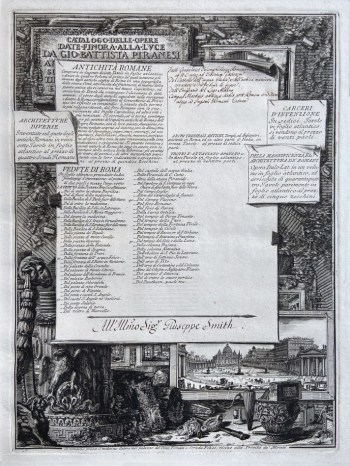
• Andrew Robison, “Piranesi’s Catalogo delle Opere,” pp. 230–45. When Piranesi moved to new quarters in Rome in 1761 he had space to store and sell his prints rather than entrust them to booksellers. This prompted him to publish an illustrated sales catalogue in the form of an etching and engraving, of which a number of copied inscribed to his friends and patrons survive. Revised twenty-nine times before Piranesi’s death in 1778, the catalogue provides important evidence about his understanding as well as the dating of his prints, series of prints and illustrated books.
• Giovan Battista Fidanza, “Carlo Maratti’s Additions to the Barberini Venus,” pp. 260–65. In 1999–2000 a restoration of the sixteenth-century mural in the Palazzo Barberini, Rome, known as the Barberini Venus, which was remodelled with additions by Carlo Maratti in 1693, removed tempera overpainting in the belief that it post-dated his changes. A newly discovered document in the Barberini archives both provides the fullest contemporary record of Maratti’s work on the mural and indicates that the tempera additions were painted by him.
R E V I E W S
• Isabelle Kent, Review of the Spanish Gallery, Bishop Auckland, pp. 276–83. In October 2021 the only museum in Britain devoted to Spanish art opened in Bishop Auckland, County Durham. Part of the Auckland Project, which uses art, faith and heritage to fuel long-term regeneration, the museum offers an impressive if idiosyncratic representation of Spain in the sixteenth and seventeenth century. [Paintings by Zurbarán were purchased by the Bishop of Durham, Richard Trevor in 1756.]
• Laura Moretti, Review of the newly opened galleries for the permanent collection at the Palazzo Maffei in Verona, pp. 290–92.
• Imogen Tedbury, Review of the exhibition Willem van de Velde and Son (Amsterdam: National Maritime Museum, 2021–22), pp. 293–95.
• Clare Hornsby, Review of the exhibition Grand Tour: Sogno d’Italia da Venezia a Pompei (Milan: Gallerie d’Italia, Piazza Scala, 2021–22), pp. 295-98.
• Carl-Johan Olsson, Review of the exhibition True to Nature: Open-Air Painting in Europe 1780–1870 (Paris: Fondation Custodia, 2021–22), pp. 298-300.
• María Cruz de Carlos Varona, Review of Beatriz Blasco Esquivias, Jonatan Jair López Muñoz, and Sergio Ramiro Ramírez, eds., Las mujeres y las artes: Mecenas, artistas, emprendedoras y coleccionistas (Abada Editores, 2021), pp. 316–17.
• Susanna Zanuso, Review of Aurora Laurenti, Intagli rococo: professionalità ed elaborazione del gusto negli interni del Palazzo Reale di Torino (Accademia University Press, Turin, 2020), pp. 318–20.
The Burlington Magazine, February 2022
The eighteenth century in February’s issue of The Burlington . . .
The Burlington Magazine 164 (February 2022) — Northern European Art
Nathaniel Dance Holland, Portrait of Christian VII, King of Denmark, 1768, oil on canvas, 77 × 63 cm (Royal Collection Trust).
A R T I C L E S
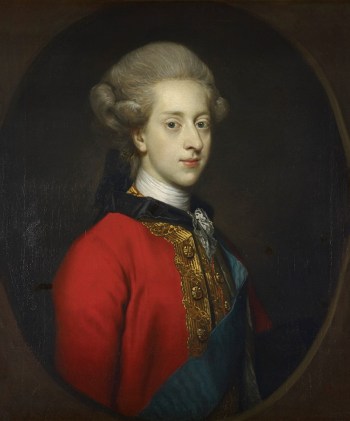
• Sara Ayres, “Christian VII of Denmark’s Lost British Portraits,” pp. 155–63. In 1768–69 the young Christian VII of Denmark visited London and Paris, where several portraits of him were painted. Three were by artists born or working in Britain—Angelica Kauffmann, Edward Cunningham, known as Calze, and Matthew Peters. All are now lost, but evidence about the comissions survives in copies and prints, contemporary descriptions and documents in the Danish State Archives.
• Lars Hendrikman, “The Finding of the Infant Bacchus,” pp. 180–83.
R E V I E W S
• Camilla Pietrabissa, Review of the exhibition Venetia 1600: Births and Rebirths (Venice: Palazza Ducale, 2021–22), pp. 190–92.
• Ivan Gaskell, Review of the new galleries of Dutch and Flemish art at the MFA Boston (open from November 2021), pp. 195–98.
• Richard Stemp, Review of the exhibition Hogarth and Europe (London: Tate Britain, 2021–22), pp. 198–200.
• Maryl Gensheimer, Review of Fabio Barry, Painting in Stone: Architecture and the Poetics of Marble from Antiquity to the Enlightenment (Yale UP, 2020), pp. 216–17.
• Clare Hornsby, Review of Ortwin Dally, Maria Gazzetti, and Arnold Nesselrath, eds., Johann Joachim Winckelmann (1717–1768): Ein Europ isches Rezeptionsph nomen / Fenomeno Europeo della Ricezione (Michael Imhof Verlag, 2021), pp. 217–18.
• Robert Skwirblies, Review of Lea Kuhn, Gemalte Kunstgeschichte: Bildgenealogien in der Malerei um 1800 (Wilhelm Fink Verlag, 2020), pp. 218–19.
• Thomas Stammers, Review of Stacey Boldrick, Iconoclasm and the Museum (Routledge, 2020), p. 222.
O B I T U A R I E S
• Marjorie Trusted, “Christian Theuerkauff (1936–2021),” pp. 223–24. For many years Deputy Director of the sculpture collection at the Bode Museum, Berlin, and honorary professor at the city’s Free University, Christian Theuerkauff was a leading scholar of Baroque ivories, whose expert connosseurship and archival research definitively shaped our understanding of many of the outstanding sculptors in the medium.
Lecture | Anne Lafont, Making Ornamental Africa
From the BGC:
Anne Lafont, Making Ornamental Africa: An Enlightenment Process
The Iris Foundation Awards Lecture
Online and in-person, Bard Graduate Center, New York, 26 April 2022, 6pm
Could it be that in the geographical conception of art developed in Enlightenment Europe, the primary role and the function of the so-called Black Continent was one of ornament? Or, on the contrary, did the aesthetic conception elaborated by the European Enlightenment deprive Africa of artistic potentiality? These two opposing hypotheses coexist in eighteenth-century artworks and texts. The talk will focus on some objects whose material, form, argument, use and reception invite us not only to historicize the notion of African art, but also to identify the registers of categorization specific to this pivotal eighteenth-century moment, when both anthropology and aesthetics were invented. African objects, as well as European objects inspired by the African presence in Europe, rub up against the emergence of these two disciplines, which intersected around the importance of the senses and sight, in particular.
Registration is open for a limited in-person audience. Bard Graduate Center requires proof of vaccination and photo identification to enter the building. Guests are required to wear masks regardless of vaccination status. This talk will also be available on Zoom (registration is available here). A link will be circulated to registrants by 4pm on the day of the event. This event will be live with automatic captions.
Anne Lafont is an art historian and professor at the École des hautes études en sciences sociales. She is interested in the art, images, and material culture of France and its colonial empire in the modern era, as well as in historiographical questions related to the notion of African art. She has published on art and knowledge in an imperial context, on gender issues in the discourse on art in the 18th and 19th centuries, and her most recent book is entitled L’Art et la Race: L’Africain (tout) contre l’oeil des Lumières. It was awarded the 2019 Fetkann Maryse Condé Literary Prize and the 2020 Vitale and Arnold Blokh Prize. Anne Lafont participated, as a member of the scientific committee, in the Musée d’Orsay exhibition The Black Model (2019). In 2021, she was awarded a residential fellowship from the cultural services of the French Embassy in the United States, the Villa Albertine, and she serves, for the academic year 2021–22, as the Robert Sterling Clark Visiting Professor of Art History at Williams College (Massachusetts).
Exhibition | Restoring Williamsburg

Arch Section and Pedestal Design on a Pine Board, Belle Farm, Gloucester County, Virginia. ca. 1775–80
(The Colonial Williamsburg Foundation, AF-VA22560.1.1)
◊ ◊ ◊ ◊ ◊
Opening in April at Colonial Williamsburg:
Restoring Williamsburg
DeWitt Wallace Decorative Arts Museum, Colonial Williamsburg, 20 April 2022 — December 2024
Since the 1930s, Colonial Williamsburg has been building its architectural collection. Now comprised of over 15,000 architectural fragments, it is an important and irreplaceable source of information on colonial American structures. The collection comes from existing structures and buildings lost to time. It includes everything from nails, bricks, framing and doors to wallpaper, plaster, and paint samples. These fragments play an important role in our understanding of 18th-century building materials and construction, and guide our everyday preservation of Colonial Williamsburg’s Historic Area. Highlights of the exhibition include the contents of a rat’s nest found during restoration of Wetherburn’s Tavern, the original weathervane from the Magazine, and a split-screen video showing the town as it appeared in 1930 and in 2014.
From the press release (14 March) . . . .

Southwest dining room of the reconstructed King’s Arms Tavern, Colonial Williamsburg.
Decades ago a simple wooden board in use as a shelf was discovered in Belle Farm, an 18th-century house in Gloucester County, Virginia. It turned out to be much more than an untrained eye would notice at first glance: etched into the surface was the original design for two arches that are still to be seen in the house today. This extraordinary artifact provided Colonial Williamsburg’s architectural historians with valuable information on design development and layout in the last half of the 1700s. The design was later used as the model for the arches in the southwest dining room of the reconstructed King’s Arms Tavern on Colonial Williamsburg’s Duke of Gloucester Street. This etched board is one of approximately 80 objects that will be on view in Restoring Williamsburg, a new exhibition in the James Boswell and Christopher Caracci Gallery at the DeWitt Wallace Decorative Arts Museum, one of the recently expanded Art Museums of Colonial Williamsburg. Opening on 30 April 2022, the exhibition will reveal how architectural historians and preservationists know what they know and do what they do. Through extremely rare objects and artifacts from the Colonial Williamsburg architectural collection, visitors will gain insights into the restoration and preservation work undertaken since the 1920s at the largest living history museum in the world and offer valuable clues to enhance their exploration of the Historic Area. Restoring Williamsburg will remain on view through December 2024.

Belle Farm with interior arches, ca. 1775–80.
“The art and science of accurately restoring original 18th-century buildings and meticulously recreating lost structures had their geneses at Colonial Williamsburg in the 1920s,” said Ronald L. Hurst, the Foundation’s vice president for museums, preservation, and historic resources. “As we enter the institutions 96th year, this is an exciting opportunity to reflect on the astonishing accomplishments of generations of Foundation scholars and tradespeople.”
Among the earliest and rarest surviving architectural elements from Williamsburg to be seen in Restoring Williamsburg is a ca.1695 scuttle door from the Nelson-Galt House on Francis Street (shown at left top), which served as an access hatch for the attic space. Its detailing includes foliated hinges and molded battens, typical of Williamsburg-area buildings in the 17th and early 18th centuries. Another extremely rare object appearing in the exhibition is a well-preserved 17th-century leaded casement window from Massachusetts (shown at bottom left). Such early windows were still to be found in Williamsburg as late as the 1760s. Archaeological excavations are the source of most information about the use of casement windows in Williamsburg. For example, the turned leads excavated at the site of Charlton’s Coffeehouse were used to guide the design of the casement windows now seen in the building’s cellar. The discovery of an iron staple in the foundations proved the location of what was by then a very old-fashioned window form.
“The architectural elements in the exhibition offer a snapshot of our collection, which forms the basis for the restoration and preservation work undertaken here at Colonial Williamsburg. They not only provide us actual 18th-century profiles, colors, and materials, but help further our understanding of Williamsburg’s 18th-century built environment,” said Dani Jaworski, Colonial Williamsburg’s manager of architectural collections.
Colonial Williamsburg’s ongoing restoration process frequently causes the architectural preservation team to reevaluate their understanding of individual buildings. One of the best examples of this process is illustrated by an overmantel painting of a landscape scene, originally installed in the 18th-century George Reid House. In order to try to date the painting, the team decided to restudy the building itself. Surprisingly, they discovered that the earliest section likely dates to the 1710s, making it the oldest surviving domestic structure on Duke of Gloucester Street. The new exhibition will show not only a rare paint-decorated panel, but explain how paint analysis, conservation, documentary research and architectural investigation combined to update both the historical record and the physical appearance of an original Historic Area building.
Restoring Williamsburg is generously funded by Thomas L. and Nancy S. Baker.










 Enfilade
leave a comment