New Book | The Material World of Eyre Hall
From Giles, in association with the Maryland Center for History and Culture, Baltimore:
Carl Lounsbury, ed., The Material World of Eyre Hall: Four Centuries of Chesapeake History (London: Giles, 2021), 448 pages, ISBN: 978-1911282914, £75 / $90.
With an Introduction by Cary Carson, and contributions by Laura Pass Barry, Bennie Brown, Edward A. Chappell, Sam Florer, Erik Goldstein, Haley Hoffman, Neal T. Hurst, Angelika R. Kuettner, Mark B. Letzer, Carl R. Lounsbury, George W. McDaniel, Katie McKinney, Elizabeth Palms, Margaret Pritchard, Sumpter Priddy, Will Rieley, Alexandra Rosenberg, Gary Stanton, Robert Watkins, and John Watson
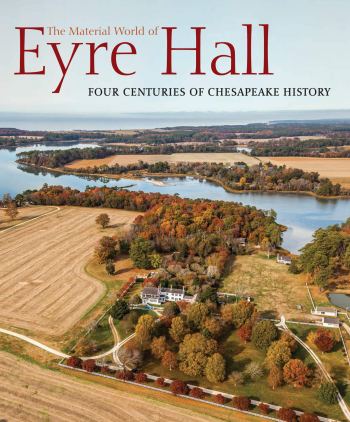 A microhistory of 400 years of southern USA history told in the study of one place, Eyre Hall on the eastern shore of Chesapeake Bay.
Erected in 1759 on the Eastern Shore of Virginia, Eyre Hall is still occupied by descendants of its builder. It retains a rich variety of objects from furniture and books to silver and paintings acquired by the family, reflecting the tastes and aspirations of its many different generations. Only a small handful of places in Virginia can claim such continuity. The material culture of Eyre Hall illustrates the ever-changing meanings of this place in American culture from the seventeenth through the twenty-first century. It represents the cultural endeavours of Southern society built on slavery and impacted by the tribulations of wars, emancipation, and economic depressions. This study explores the mutability of this inheritance in the wake of such transformative events. The book is divided into four sections. The first recounts the history of those who lived at Eyre Hall. The second examines the architecture of the house and its service buildings. The third explores the formal garden. The fourth section is a catalogue raisonné of its objects.
Carl R. Lounsbury was Senior Architectural Historian at Colonial Williamsburg Foundation (now retired) and Adjunct Associate Professor of History at the College of William and Mary. Cary Carson was Senior Vice President of Research at Colonial Williamsburg (now retired).
C O N T E N T S
Acknowledgments
Foreword by J. Thomas Savage
Eyreloom: An Introduction by Cary Carson
I. The Changing Fortunes of the Eyre Family through Four Centuries
Golden Quarter by Carl Lounsbury
Eyreville: Archaeology of the Late Seventeenth Century by Haley Hoffman
Eyre Hall: Power House by Carl Lounsbury
Working the Land by Sam Florer
The Bounty of Eyre Hall: From Working Plantation to Summer Retreat in the Long Nineteenth Century by Carl Lounsbury
Escaping Enslavement by Whaleboat, 1832 by Alexandra Rosenberg
Health Retreats and Pleasure Grounds by Robert Watkins
Hoofprints by Elizabeth Palms
Eyre Hall in the Twentieth Century: ‘I’m Home’ by George McDaniel
A Scrapbook of Recollections by Those Who Called Eyre Hall ‘Home’ by George McDanielII
II. Architecture
The Architecture of the House by Carl Lounsbury
Architectural Hardware by Edward Chappell
Wallpaper by Margaret Pritchard
Domestic Service Buildings by Carl Lounsbury
Home Farm: Overseer’s House by Carl Lounsbury
III. Landscape
Garden and Grounds by Will Rieley
Green-house by Will Rieley
Graveyard by Carl Lounsbury
IV. Catalogue
Furniture by Sumpter Priddy
Silver by Mark Letzer
Ceramics by Robert Hunter and Angelika Kuettner
Glass by Angelika Kuettner
Paintings by Laura Pass Barry
Maps by Katie McKinney
Prints by Katie McKinney
Books by Bennie Brown
Musical Instruments by John Watson
Sheet Music by Gary Stanton
Costume and Textiles by Neal Hurst
Ironwork and Arms by Erik Goldstein
Index
Photo Credits
New Book | Lover’s Eyes
This is an updated and expanded version of the 2012 exhibition catalogue. From Giles:
Elle Shushan, ed., with additional contributions by Graham Boettcher and Stephen Lloyd, Lover’s Eyes: Eye Miniatures from the Skier Collection (London: Giles, 2022), 280 pages, ISBN: 978-1911282938, £40 / $50.
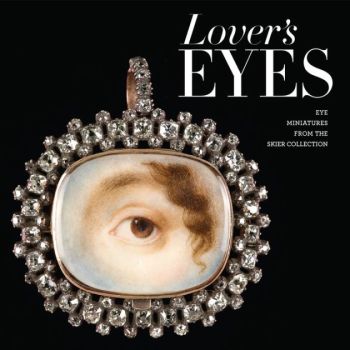 Until the early 2000s, little had been written about eye miniatures, or ‘Lover’s Eyes’, and their short-lived popularity at the end of the 18th and early 19th centuries, when hand-painted portraits of single human eyes were set in jewellery, or created to memorialize a deceased loved one. This new expanded and updated edition of the 2012 volume The Look of Love examines their role in the broader context of Georgian and early Victorian portrait miniatures; and looks in detail at the creation, and appeal, of these extraordinary objects.
Dr. and Mrs. David A. Skier’s collection of eye miniatures is one of the most complete such collections of this genre of miniature painting anywhere in existence. This volume features over 130 pieces from the Skier Collection, with 36 extraordinary newly acquired pieces, including two of the three known existing ‘lovers’ lips’, and six examples of a delightful sub-category known as ‘Flower Eyes’. There are four new illustrated essays: on forgeries and fakes of lovers’ eyes, on ‘Flower Eyes’, on the persistence of the eye image which continues the tradition of lovers’ eyes, and an essay on the eye miniatures created by Richard Cosway.
Elle Shushan is a specialist dealer, author, lecturer, and museum consultant. She is a member of the Antiques Dealers’ Association of America, the British Antique Dealers’ Association, CINOA, the Private Art Dealers Association, and the Association of Historians of American Art.
Stephen Lloyd is curator of the Derby Collection at Knowsley Hall, Merseyside. From 1993 to 2009 he was Assistant Keeper and then Senior Curator at the Scottish National Portrait Gallery, where he co-curated the exhibition The Intimate Portrait: Drawings, Miniatures, and Pastels from Ramsay to Lawrence.
Graham Corray Boettcher is the director of the Birmingham Museum of Art in Birmingham, Alabama.
C O N T E N T S
Collectors’ Preface
Acknowledgements
The Artist’s Eye by Elle Shushan
Eye Miniatures by Richard Cosway by Stephen Lloyd
Symbol & Sentiment: Lover’s Eyes and the Language of Gemstones by Graham Boettcher
Floriography by Elle Shushan
Fake of Fashion by Elle Shushan
Love Never Dies by Graham Boettcher
Catalogue of the Exhibition by Graham Boettcher, Nan Skier, and Elle Shushan, with the assistance of Laura Wallace and Maggie Keenan
Index
Author biographies
Harvard Art Museums Receive Important Gift of American Silver

Joseph Richardson Sr., The Hannah Emelen Logan Teapot, ca. 1745, silver and wood (Harvard Art Museums / Fogg Museum, The Pollack Collection, gift of Daniel A. Pollack A.B. ’60 and Susan F. Pollack A.B. ’64, 2020.199).
◊ ◊ ◊ ◊ ◊
From the press release(22 March 2022) . . .
The Harvard Art Museums announce a transformative gift of 21 works of 18th-century American silver from the collection of Daniel A. Pollack and Susan F. Pollack. The gift comprises a range of finely made vessels and table implements intended for domestic use, including cups, bowls, spoons, tankards, and teapots crafted by noted silversmiths from Boston, New York, Philadelphia, and Trenton. There is also a stunning caudle cup, an example of ecclesiastical silver made by Edward Winslow and believed to have been used during communion at First Congregational Church in Milford, Connecticut. The Pollacks’ gift strengthens the museums’ noted holdings of 17th- to 20th-century silver and comes at a time when curators and postdoctoral fellows are working to reimagine the balance among paintings, sculptures, and design objects on view in the galleries.
“The story of silver is in many ways a story of the Americas. Like other commodities such as coffee, mahogany, sugar, and tea, silver helps us unite the known world of the 16th century with our own time,” said Horace D. Ballard, the Theodore E. Stebbins Jr. Associate Curator of American Art at the Harvard Art Museums. “The Pollacks’ generosity allows us to more fully engage the capacious and complex story of European privilege and Afro- and indigenous labor across the Spanish-occupied Americas and British North America during the age of colonialization. It is estimated that 50 to 80 percent of the world’s silver from the 16th to early 19th century came from the infamous silver mines of Potosi in the Viceroyalty of Peru. Silver ore was shipped to China from America’s primary Pacific port in Peru; traded to Europe along with porcelain; melted into coin, plate, or brick; and then traded back to the Americas through the eastern seaboard ports of the Atlantic coast, to be molded, designed, and sold to merchants, religious institutions, and wealthy families. Works by American silversmiths of the 18th and 19th centuries are noted for their innovative silhouettes, turnings, and naturalistic allusions to animals and plants. The Pollack gift and its upcoming installations in our galleries will foreground this global orientation around luxury, leading us to ask new questions about hemispheric identity and aesthetic legacy.”

Paul Revere Jr., Two ragout spoons, 1786, silver (Harvard Art Museums / Fogg Museum, The Pollack Collection, gift of Daniel A. Pollack A.B. ’60 and Susan F. Pollack A.B. ’64, 2020.197.1, 2020.197.2).
Highlights of the gift include, from Boston-based silversmiths, a pair of ragout (serving) spoons from 1786 by Paul Revere, Jr., and a c. 1765 rococo-style cream jug and c. 1775 porringer (small bowl) with a keyhole-pattern handle by Benjamin Burt; a soup ladle with a shell-shaped bowl from c. 1772 and a waiter (small salver) from c. 1765 by the pioneering Jewish silversmith and philanthropist Myer Myers of New York; and an apple-shaped teapot from c. 1745 by Joseph Richardson, Sr., for prominent Quakers Hannah and William Logan, as well as a coffeepot by Richardson’s sons, Joseph Jr. and Nathaniel, both of whom trained with their father in Philadelphia. These are the first works by the Richardsons to enter the museums’ collections. The earliest object from the gift is the aforementioned caudle cup from 1707 by Edward Winslow of Boston.
Over the next six months, select objects from the Pollack gift will be installed in galleries on Level 2 of the museums. By mid-March, the Winslow caudle cup and the Myers soup ladle, among other objects, will be installed in the silver cabinet. By mid-May, the case featuring design objects in the museums’ Atlantic World gallery will highlight a rare two-handled silver punch strainer designed in the 1760s by Daniel Parker of Boston. By late July, the Pollack Arcade gallery on the second floor will host a case of 14 objects from the gift. Interpretive labels for the case will address Daniel Pollack’s longstanding commitment to American art at the Harvard Art Museums while also foregrounding the global threads of racialized labor and colonial trade at the heart of America’s colonization and our national becoming.
This gift of silver follows Daniel Pollack’s passing in October 2019 and builds upon a number of other significant gifts and generous support from the Pollacks over the last 17 years. An ardent supporter of the museums, Daniel was a member of the Director’s Advisory Council and served as chair of the American Art Curatorial Committee. The couple’s commitment also includes contributions toward the renovation and expansion of the Harvard Art Museums (which reopened in the fall of 2014) as well as the naming of four arcade galleries on the second floor overlooking the Calderwood Courtyard.

Edward Winslow, Caudle cup, 1707, silver (Harvard Art Museums / Fogg Museum, The Pollack Collection, gift of Daniel A. Pollack A.B. ’60 and Susan F. Pollack A.B. ’64, 2020.203).
“We are thrilled to be able to honor Dan’s legacy; I’m grateful to Susan for her gracious partnership and support,” said Martha Tedeschi, the Elizabeth and John Moors Cabot Director of the Harvard Art Museums.
Previous gifts of art include a 2016 gift of three pieces of ecclesiastical silver: a beaker (c. 1670) and two tankards (1690; 1759) used by churches in Salem, Massachusetts, for over 300 years. Other gifts have included prized paintings by American artists: Still Life with Pewter Candlestick and Clarinet (1886) by William Michael Harnett; and the trompe l’oeil-style Hanging Woodcock (1897) by George Cope and Theodore Roosevelt’s Cabin Door (1905) by Richard LaBarre Goodwin, the first works by either of these artists to enter the museums’ collections. Through the establishment of the Daniel A. Pollack, Class of 1960, American Art Acquisition Fund, the couple has supported the purchase of 19 paintings, including the highly detailed Still Life with Watermelon (1822) by Sarah Miriam Peale, one of the first professional female artists in the United States; the kaleidoscopic Ventriloquist (1952) by Jacob Lawrence, a prodigy of the Harlem Renaissance; and a stunning littoral scene of Rhode Island by Canadian-born African American painter Edward Mitchell Bannister—the first acquisition for the museums made by new American art curator Horace Ballard.
Daniel A. Pollack (Harvard College A.B. ’60, University of Oxford M.A. ’62, Harvard Law School LL.B. ’65) was a distinguished lawyer who founded and led the Pollack & Kaminsky law firm in New York City for more than 40 years, before joining the New York office of McCarter & English in 2009. Susan F. Pollack (Harvard Radcliffe Class of 1964, Harvard Law School ’67) has served as general counsel to New York City’s Department of Consumer Affairs and as a senior lawyer at Citibank; she has worked with the law firms of Barrett, Smith, Schapiro & Simon as well as Curtis, Mallet-Prevost, Colt & Mosle.
Online Talk | Caroline Stanford on Eleanor Coade
From The Royal Oak Foundation:
Caroline Stanford | Eleanor Coade and Her Remarkable Stone
Online, The Royal Oak Foundation, 30 March 2022, 2pm (ET)

Eleanor Coade (1733–1821) was a successful Georgian entrepreneur who created artificial stone for use in monuments, which she called Coade stone. Inventing the recipe and the firing technique, Mrs. Coade bought an existing artificial stone factory in South London in 1769 and turned out Coade stone architectural detailing, urns, tombs, and statues for the next 50 years. She combined artistic flair with successful marketing skills, and every architect of the time including Robert Adam, Sir John Soane, John Nash, and James and Samuel Wyatt commissioned her work for their projects. Her manufactory’s output was mostly classical in style but also produced wares in Gothic, Egyptian, and Chinese styles. Mrs. Coade’s genius lay in her entrepreneurship—convincing designers that her product was better than natural stone for its durability and weatherproof nature.
In an era, when successful businesswomen were far from typical, Eleanor Coade was exceptional. Many examples of Coade stone made during and after the inventor’s lifetime remain in the UK and beyond, including the South Bank lion at the east end of Westminster Bridge. The Landmark Trust’s historian, Caroline Stanford, will talk about this successful 18th-century business woman and her business practice, describing how Coade stone transformed late-Georgian architecture, including its use in America. Stanford will also feature Belmont, Coade’s own villa, rescued and restored by the Landmark Trust and available to rent.
Caroline Stanford read Modern History at Jesus College, Oxford and has two Masters in Early Modern History from Birbeck College London and in Historic Conservation at Oxford Brookes. She has been The Landmark Trust’s historian since 2001 and writes and speaks extensively about the Landmark Trust’s buildings. She was research historian for the Landmark Trust’s 2015 restoration of Eleanor Coade’s seaside villa, Belmont in Lyme Regis. A Fellow of the Society of Antiquaries, Stanford has also served on the committee of the Society of Architectural Historians of Great Britain. She co-authored Landmark: A History of Britain in 50 Buildings and has contributed to many television and radio programmes. She is currently working on a part time DPhil in Architectural History at Oxford University on “Fired Artificial Stone, 1650–1850” and is a leading Coade scholar.
Online via Zoom Webinar
Wednesday, 30 March 2022, 2.00 pm (ET)
$15 ROF members; $20 non-members
Recording Rental
Available between Thursday, 31 March and Monday, 11 April
Rent the recorded lecture to watch at your leisure
$15 ROF members; $20 non-members
ASECS 2022, Baltimore

Baltimore’s Inner Harbor
(Photo by Patrick Gillespie, September 2016; Wikimedia Commons)
◊ ◊ ◊ ◊ ◊
From ASECS:
2022 American Society for Eighteenth-Century Studies Conference
Hilton Baltimore Inner Harbor, 31 March — 2 April 2022
The 52nd annual meeting of the American Society for Eighteenth-Century Studies takes place in Baltimore. HECAA will be represented by the Anne Schroder New Scholars’ Session, chaired by Aaron Wile and Dipti Khera and scheduled for Thursday afternoon. HECAA’s annual business meeting will take place online in advance of the conference on March 25. A selection of 30 additional panels is included below (of the 172 sessions scheduled, many others will, of course, interest HECAA members). For the full slate of offerings, see the program.
◊ ◊ ◊ ◊ ◊
T H U R S D A Y , 3 1 M A R C H 2 0 2 2
Time and Temporality
Thursday, 8:00–9:30am, Key 1
Chair: Craig HANSON, Calvin University
1. Helena YOO ROTH, CUNY, “The Many Deaths of George II and Colonial Time Consciousness”
2. Stuart SHERMAN, Fordham University, “‘Unknown to All the Rest’: the Play of Time in Restoration Prologues and Epilogues”
3. Alexander CREIGHTON, Harvard University, “Tristram Shandy’s Variations on Habit”
◊ ◊ ◊ ◊ ◊
How ‘Byzantine’ was the Eighteenth Century? New Insights on the Christian Orthodox Art and Architecture of the Late Ottoman Empire, Part I
Thursday, 8:00–9:30am, Paca
Chair: Demetra VOGIATZAKI, Harvard University and Nikolaos MAGOULIOTIS, ETH Zurich/gta
1. Alper METIN, Università Sapienza di Roma, “Reflections of the So-called Ottoman Baroque on the 18th-Century Orthodox Buildings: Towards the Emergence of a New Imperial Architectural Synthesis?”
2. Theocharis TSAMPOURAS, University of Western Macedonia / Greek Ministry of Culture (Ephorate of Antiquities of Kozani), “Artists and Patrons Changing the Norms of Post-Byzantine Painting in the Eighteenth-Century-Ottoman Balkans”
◊ ◊ ◊ ◊ ◊
Skin & Bone: Animal Substrates
Thursday, 8:00–9:30am, Pickersgill
Chair: Sarah GRANDIN, The Clark Art Institute
1. Katherine FEIN, Columbia University, “Cracks in the Ivory: The Violence of Portrait Miniatures”
2. Catherine GIRARD, St. Francis Xavier University, “Forms of Erasure: Theorizing Reuses of Indigenous Beaver-Pelt Coats in European Hats”
3. Marianne VOLLE, York University/Glendon College & Université Paris 1 Panthéon- Sorbonne, “Flora Meets Fauna: A Reflection on the Use of Vellum for Botanical Illustrations at the Jardin du Roi”
◊ ◊ ◊ ◊ ◊
How ‘Byzantine’ was the Eighteenth Century? New Insights on the Christian Orthodox Art and Architecture of the Late Ottoman Empire, Part II
Thursday, 9:45–11:15, Paca
Chair: Demetra VOGIATZAKI, Harvard University and and Nikolaos MAGOULIOTIS, ETH Zurich/gta
1. Alexandra COURCOULA, MIT, “Ottoman Ecclesiastical Objects in the Benaki Museum: Shaping Greek National Historiography and Perceptions of Ottoman Art”
2. Maria GEORGOPOULOU, Gennadius Library, American School of Classical Studies at Athens, “Center and Periphery in the Ottoman Balkans: The Cultural Heritage of Ottoman, Turkish, Post-Byzantine and Greek Monuments”
3. Cosmin MINEA, ETH Zurich, “Writings about Romanian Art in the Late 19th Century and the Rise of the Brâncovenesc Heritage as National Style”
◊ ◊ ◊ ◊ ◊
Materials of Global Trade: Networks, Mobility, and Transformation
Thursday, 9:45–11:15, Key 5
Chair: Jennifer GERMANN, Independent Scholar
1. Tara ZANARDI, Hunter College, CUNY, “Bittersweet Empire: Alcora, Natural History, and the Chocolate Service”
2. Emily Rose BEEBER, University of Delaware, “Rubens Peale with a Geranium: Botanical Science and Slavery in the Early Republic”
3. Christina LINDEMAN, University of South Alabama, “Vermilion and Cinnabar: Seeing Red in Eighteenth-Century Europe”
◊ ◊ ◊ ◊ ◊
Spreading the Image: Print Cultures
Thursday, 11:30–1:00, Key 10
Chair: Susanne ANDERSON-RIEDEL, University of New Mexico
1. Michael FEINBERG, University of Wisconsin, Madison, “Flaming Landscapes in Stedman’s Narrative of a five year expedition”
2. Arthur LEE, Johns Hopkins University, “Illustrating the Haitian Revolution: Marcus Rainsford and Atlantic Visual Politics”
3. Ruth DAWSON, University of Hawaiʻi at Mānoa, “Picturing an Upstart Tsarina for a Downmarket Audience: Early Prints of Catherine the Great”
◊ ◊ ◊ ◊ ◊
Objects and the Making of Enlightenment Selves
Thursday, 11:30–1:00, Paca
Chair: Mary PEACE, Sheffield Hallam University, and Joelle DEL ROSE, College for Creative Studies
1. Sara WHISNANT, East Tennessee University, “‘The Sense of Taste’: Agency and Identity in Eighteenth-Century Group Portraiture”
2. Katherine ISELIN, University of Missouri, “Women and Eighteenth-Century Antiquarianism”
3. Lauren KELLOGG DISALVO, Dixie State University, “Women and Eighteenth-Century Antiquarianism”
4. Mary CRONE-ROMANOVSKI, Florida Gulf Coast University, “The Circulation of Material Objects In and Across Novels by Women”
◊ ◊ ◊ ◊ ◊
Gale Digital Scholar Lab, Lunch and Learn
Thursday, 1:00–2:15, Tubman B
Gale invites ASECS members to a lunch conversation about Gale Digital Scholar Lab, a text and data mining and visualization tool built specifically for primary sources. Using the analysis tools in the Lab, researchers can explore topics and patterns across collections including ECCO. During the session, Gale will provide an overview of the tool and case studies of how it’s been used in teaching and research at institutions around the world. Register at: https://forms.gle/hTMhLKirWMXm4usTA
◊ ◊ ◊ ◊ ◊
Anne Schroder New Scholars Session (HECAA)
Thursday, 2:30–4:00, Key 12
Chair: Aaron WILE, National Gallery of Art, and Dipti KHERA, New York University
1. Zoë DOSTAL, Columbia University, “From Idle to Industrious: Picturing Women Beating Hemp in the Bridewell”
2. Anna FICEK, CUNY Graduate Center, “From Print to Parlor: Les Incas’ Long Shadow in Visual and Decorative Arts”
3. Jinyi LIU, New York University, “Seaborne Craftsmen and Their Elastic Workshop Knowledge: An Eighteenth-Century Fujianese-made Sculpture of Mourning Mary”
4. Ankita SRIVASTAVA, Jawaharlal Nehru University, “The Architect and the Marchese: Two Italians at the Court of Begum Samru of Sardhana, India”
◊ ◊ ◊ ◊ ◊
Seen Here Making a Masterpiece: Rendering Artists, Musicians, and Authors in Painting, Poetry, Sculpture, and Prose [South-Central Society for Eighteenth-Century Studies]
Thursday, 2:30–4:00, Douglass
Chair: TBD
1. Bradford MUDGE, University of Colorado, Denver, “Transmediation and Portraiture”
2. Kristin O’ROURKE, Dartmouth College, “Picturing Artists and Writers: Media Specificity, Genre and Cultural Mythmaking”
3. Kevin L. COPE, Louisiana State University, “My Easel Just Fell into an Abysm and I’m under a Tidal Wave: Picturing Earthquake Experiencers”
◊ ◊ ◊ ◊ ◊
Performing the Eighteenth Century Today
Thursday, 4:15–5:45, Key 2
Chair: Ellen WELCH, University of North Carolina at Chapel Hill
1. Olivia SABEE, Swarthmore College, “Eighteenth-Century Performance Theory and Twenty-First Century Performance: Diderot, Noverre, The Noble, and the Grotesque”
2. Amanda MOEHLENPAH, University of North Carolina at Chapel Hill, “Foreign and Familiar: Cultural Codes and Affective Performance in Eighteenth-Century Ballet”
3. Meredith MARTIN, New York University, “Reimagining the Ballet des Porcelaines: Commerce, Colonialism, and Chinoiserie”
◊ ◊ ◊ ◊ ◊
Reproduction and Futurity, Part I
Thursday, 4:15–5:45, Key 9
Chair: Jane WESSEL, U.S. Naval Academy
1. Kirsten MARTIN, Rutgers University, “‘A Kind of Magick’: Imitation and Futurity in Sir Joshua Reynolds’s Pedagogy”
2. Laura EARLS,University of Delaware, “‘They could hardly persuade themselves they were not human creatures’: Women Waxwork Sculptors and Reproduction in the British Atlantic World”
3. Chelsea PHILLIPS, Villanova University, “Conceiving Genius: Sarah Siddons and the Future of Tragedy”
◊ ◊ ◊ ◊ ◊
Members’ Reception
Thursday, 6:00–7:30, Eutaw Street (Weather Permitting)
◊ ◊ ◊ ◊ ◊
Eighteenth-Century Game Night
Thursday, 7:30–midnight, Key 12
An open house to explore games inspired by the eighteenth century. For more information or to sign up for games, see http://aub.ie/asecs22games. Game Night also will be held on Friday, April 1.
◊ ◊ ◊ ◊ ◊
F R I D A Y , 1 A P R I L 2 0 2 2
The Eighteenth-Century Last Will and Testament, Part I
Friday, 9:45–11:15, Douglass
Chair: Pamela PHILLIPS, University of Puerto Rico, Río Piedras
1. Yvonne FUENTES, University of West Georgia, “Spanish Testaments, Wills, and Inventories: Bridging Heaven and Earth”
2. Melanie HAYES, Trinity College Dublin, “Crafted Legacies: Artisans’ Wills in Early Georgian Britain”
3. Stephanie KOSCAK, Wake Forest University, “‘Tokens of My Love’: Money, Memory, and Mourning in Eighteenth-Century England”
4. Emily ENGEL, Independent Scholar, “Portraits and Luxury in Eighteenth-Century South America”
◊ ◊ ◊ ◊ ◊
Let’s Get Small: Micro-Art Histories, Part I
Friday, 9:45–11:15, Key 6
Chair: Melissa HYDE, University of Florida
1. Rori BLOOM, University of Florida, “Miniature Portraits as Erotic Currency in Casanova’s Histoire de ma vie”
2. Jeff RAVEL, MIT, “An Eye on Theatrical Disorder: France and England, ca. 1800”
3. Yasemin ALTUN, Duke University, “Original-itty in Translation: Sophie Chéron’s Creative Reproduction of Miniature Gems”
◊ ◊ ◊ ◊ ◊
Presidential Session | Venice: Real and Imagined
Friday, 11:30–1:00, Key 12
Chair: Irene ZANINI-CORDI, Florida State University
1. Rebecca SQUIRES, Katholieke Universiteit Leuven, “Vedute of Venice: The Visual Construction of the Picturesque”
2. John HUNT, Utah Valley University, “Imaginary Hells: Witches and Magic Wells in Early Modern Venice”
3. Susan DALTON, Université de Montréal, “Venice’s Amazon? Giustina Renier Michiel’s Strategic Accommodations of Occupying Forces”
The panel will begin with a performed reading: “Giustina Renier Michiel’s and Chateaubriand’s Views on Venice,” presented by Aleksondra HULTQUIST, Stockton University, and Sayre GREENFIELD, University of Pittsburgh at Greensburg. *This reading is supported by the Arts, Theater, and Music Fund*
◊ ◊ ◊ ◊ ◊
Curious Taste: The Transatlantic Appeal of Satire
Friday, 11:30–1:00, Paca
Chair: Nancy SIEGEL, Towson University
1. Cynthia ROMAN, The Lewis Walpole Library, Yale University, “Museums ‘Look down on Them’ Librarians ‘Don’t Know How to Handle Them.’ The Layered Histories of Scholarship and Collecting of Eighteenth-Century British Satiric Prints at the Lewis Walpole Library”
2. Rebecca SZANTYR, Sterling and Francine Clark Art Institute, “Compiling Singularities: Alexander Anderson’s The Wheel of Fortune”
3. Allison STAGG, Technische Universitat Darmstadt, Germany, “Charles Pierce’s Album of Caricatures”
◊ ◊ ◊ ◊ ◊
Let’s Get Small: Micro-Art Histories, Part II
Friday, 11:30–1:00, Key 6
Chair: Melissa HYDE, University of Florida
1. Aoife COSGROVE, Trinity College Dublin, “Isabel Farnesio, Amateur: A Small-Scale Artist in a Big World”
2. Philippe HALBERT, Yale University, “Rouge, Redress, and the Sauvage: Reading Madame Bégon as Microhistory 1748–1753”
3. Ashley HANNEBRINK, Harvard University, “Small Sculptures, Big Ideas: Terracotta Statuettes and Theories of the Earth in Eighteenth-Century Paris”
◊ ◊ ◊ ◊ ◊
Conversations across the Arts: Adaptations
Friday, 11:30–1:00, Key 12
Chair: Daniella BERMAN, Institute of Fine Arts, NYU and Ashley BENDER, Texas Women’s University
1. Bethany E. QUALLS, University of California, Davis, “Sally Salisbury’s Eighteenth- Century Transmedia Adaptations and the Creation of B-List Celebrity”
2. Hamish WOOD, University of Sydney, “Adaptation, Epistolarity, and Staging the Letter: Jane Austen’s ‘Sir Charles Grandison or the happy man. A comedy’ (c.1800)”
3. Kathryn DESPLANQUE, University of North Carolina – Chapel Hill, “Why Have There Been No Great Women Starving Artists? The Presence and Absence of Women in Parisian Art-World Satire in the Long Eighteenth Century”
◊ ◊ ◊ ◊ ◊
Clothing and Empire: Dress and Power
Friday, 11:30–1:00, Douglass
Chair: Kristin, O’ROURKE, Dartmouth College
1. Marina KLIGER, Metropolitan Museum of Art, “A Turk at the Paris Salon: The Ambiguities of Dress and Cosmopolitanism in Jean-Baptiste Isabey’s Le Grand escalier du musée (1817)”
2. Jacqueline DELISLE, independent researcher, “The Straight-Edge Razor as a Tool of Masculine Self-Fashioning”
3. Nancy KARRELS, University of Illinois Urbana-Champaign, “Fashionable Loot: Female Influencers in Revolutionary France’s Cultural Heritage Debates”
4. Christine ADAMS, St. Mary’s College of Maryland, “Fashion and Politics: Élégantes and Merveilleuses under the Directory and Beyond”
◊ ◊ ◊ ◊ ◊
Lunches, Excursions, and Late-Breaking Special Sessions
Friday, 1:00–3:15
Use this time to explore Baltimore’s eighteenth-century history, connect with colleagues, or just take a breather amid our busy agenda!
Excursions: Except when noted, these are suggestions for members to organize on their own.
• Guide to Indigenous Baltimore (self-guided walking tour created by American University faculty member, Elizabeth Rule)
• Baltimore African American Heritage Walking Tour (self-guided walking tour)
• Baltimore Black History Tour (guided walking tour run by Black-owned business, I Love Baltimore Personal Tours)
• Reginald F. Lewis Museum of Maryland African American History & Culture
• Not exactly an excursion: but this an interesting digital resource: Visualizing Early Baltimore (batch of digital resources at UMBC, including BEARINGS of Baltimore, ca. 1815, an interactive 3D map that allows overlay of contemporary onto 1815 Baltimore)
• Walters Art Museum Guided Tour (capacity limited to 30; already full). On this two-stop private tour for ASECS members at the Walters Art Museum, Joaneath Spicer, the James A. Murnaghan Curator of European Renaissance and Baroque Art, will talk about two subjects for which she is well known: first, the presence and representation of Africans in Europe, specifically the museum’s newly acquired portrait of an African prince at the court of Louis XIV; and second, the Chamber of Wonders and its shifting character from the early 1600s to the 1700s.
◊ ◊ ◊ ◊ ◊
Flames of Freedom Showcase
Friday, 2:00–3:15, Key 12
Emily Friedman, Emily Kugler, and Sören Hammerschmidt will offer a brief introduction to Flames of Freedom, a table-top role-playing game that blends historical setting and folk horror genres with a deep commitment to diversity and equity in gaming, game design, and the broader community—followed by a hands-on showcase of the game’s approach to race, ethnicity, class, gender, disability, and other consideration in the character generation process. Those interested in playing the game can sign up for sessions on Thursday and Friday night, at http://aub.ie/asecs22games.
◊ ◊ ◊ ◊ ◊
Baltimore Museum of Art, HECAA Visit
Friday, 3:30–6:00
HECAA member Brittany Luberda, Assistant Curator of Decorative Arts at the Baltimore Museum of Art, has been kind enough to organize a HECAA-only tour of the museum’s eighteenth-century collections on Friday afternoon. Virginia Anderson, Curator of American Art, will be leading a tour of the early American galleries, and Brittany herself will offer a walk-through of the eighteenth-century European galleries. The tours are followed by an informal social hour at the museum bar starting at 5:00. Space is limited, so advanced registration for this event is required (see the HECAA email for details).
◊ ◊ ◊ ◊ ◊
ASECS Business Meeting / Presentation of ASECS Awards
Friday, 3:15–5:00, Key 7 & 8
Rebecca MESSBARGER, ASECS President, Mark BOONSHOFT, ASECS Executive Director, Joseph BARTOLOMEO, ASECS Treasurer
ASECS Presidential Address
Friday, 3:15–5:00, Key 7 & 8
Rebecca MESSBARGER Washington University in St. Louis, “Demystifying the Corpse in Italy’s Age of Reform”
◊ ◊ ◊ ◊ ◊
Eighteenth-Century Game Night
Friday, 7:00–midnight, Key 12
An open house to explore games inspired by the eighteenth century. For more information or to sign up for games, see http://aub.ie/asecs22games. Game Night also will be held on Thursday.
◊ ◊ ◊ ◊ ◊
S A T U R D A Y , 2 A P R I L 2 0 2 2
Transplanted Lives and Foreign Presence: Seeing Migration
Saturday, 9:45–11:15, Key 5
Chair: Marina KLIGER, Metropolitan Museum of Art, and Thea GOLDRING, Harvard University
1. Harvey Guy SHEPHERD, The Courtauld Institute of Art, “Alpine Identity in Transit: The Visual Culture of Savoyard Migrants in Eighteenth-Century Paris”
2. Oliver WUNSCH, Boston College, “The Limits of Visual Sensitivity: Sympathy, Sensibility, and Jean-Baptiste Perronneau’s Portrait of Mapondé”
3. Daniel O’QUINN, University of Guelph, “Between Superlunary and Sublunary Worlds: Muslims in the Metropolis of London”
◊ ◊ ◊ ◊ ◊
Trying to Earn Some Dosh: Chasing Economic and Professional Success in the in the Atlantic World
Saturday, 9:45–11:15, Key 10
Chair: Heather ZUBER, Queens College, CUNY and Amanda SPRINGS, Maritime College, SUNY
1. Christine WALKER, Yale-NUS College “‘I will not leave my affairs in any other hand:’ Women’s Trans-Atlantic Crossings and Caribbean Interests”
2. Heidi STROBEL, University of North Texas, “Mary Linwood’s Balancing Act”
3. Sonja LAWRENSON, Manchester Metropolitan University, “‘A World of New Wonders Shall Open on You’: Maria Edgeworth and Transatlantic Exchange”
4. Sarah CARTER, McGill University, “Artists, Antiquaries, and the Cosmopolitan Career of John Brown”
◊ ◊ ◊ ◊ ◊
The 38th James L. Clifford Memorial Lecture
Jennifer L. MORGAN, New York University, “On Race and Reinscription: Writing Enslaved Women into the Early Modern Archive”
Saturday, 11:30–12:30, Key 7 & 8
In this talk, Jennifer Morgan uses the history of three Black women from the sixteenth and seventeenth century to explore questions of methodology and evidence in the early history of the Black Atlantic. Through evidence from visual art, law, and commerce Morgan considers the challenges and possibilities of crafting a social historical study of women whose voices are so often absent from the archival record but whose lives and perspectives have proven to be essential for comprehending the origins of racial capitalism.
◊ ◊ ◊ ◊ ◊
Arts of the Table in Global Perspective
Saturday, 2:00–3:30, Key 9
Chair: Sarah R. COHEN, SUNY University at Albany
1. Ralph HOYLE, Independent Scholar, “The English Tea as Global Consumption”
2. Alicia CATICHA, Northwestern University, “Material Masquerade: Sugar and Marble on the Eighteenth-Century Dining Table”
3. Jacob MYERS, University of Pennsylvania, “The Cane-Rat, Delicacy, and Archival Stickiness on British Jamaica”
4. Susan B. EGENOLF, Texas A&M University, “Soup Tureens and Global Politics: Josiah Wedgwood’s Green Frog Service”
◊ ◊ ◊ ◊ ◊
Materializing Time and Temporality
Saturday, 2:00–3:30, Brent
Chair: Helena YOO ROTH, CUNY
1. Alexandra MACDONALD, William & Mary, “No Time to Dye: Gendered Labour in Eighteenth-Century Craft”
2. Craig HANSON, Calvin University, “The History and Present State of Before and After, The Origins of a Visual Convention”
3. Daniella BERMAN, NYU, “Uncertainty and Time: The Problem of Representing the French Revolution”
◊ ◊ ◊ ◊ ◊
Geographical Frontiers
Saturday, 2:00–3:30, Paca
Chair: Matthew GIN, Northeastern University
1. Zoe BEENSTOCK, University of Haifa, “Shifting Sands: Thomas Pownall’s Colonial Antiquarianism”
2. Laura GOLOBISH, University of New Mexico, “Piss, Poison, Potions, and other Paths from Scotland to England in London Caricature after 1745”
3. Emily CASEY, Independent Scholar, “Hydrographic Frontiers: Imagining Land and Sea in the Early Nation”
4. Nika ELDER, American University, “John Singleton Copley’s Watson and the Shark and the Whitewashing of History”
◊ ◊ ◊ ◊ ◊
Who Run(s) the World? Girl Culture in the Long Eighteenth Century
Saturday, 3:45–5:15, Key 9
Chair: Maura GLEESON, Valencia College, and Lauren WALTER, University of Florida
1. Nicole M. STAHL, West Virginia University, “The Girl in the Book: Anna Seward and Her Literary Forefathers”
2. Fiona BRIDEOAKE, American University, “Girls Narrating Girlhood in The Governess: or, The Little Female Academy”
3. Amanda STRASIK, Eastern Kentucky University, “Painting Paradoxes: Jeanne-Elisabeth Chaudet’s Little Girl Teaching her Dog to Read”
◊ ◊ ◊ ◊ ◊
Portraiture in the Americas
Saturday, 3:45–5:15, Armistead
Chair: Emily THAMES, Florida State University
1. Emily ENGEL, Independent Scholar, “Manifesting Visual Battlefields in Late Viceregal South America”
2. Kristi PETERSON, Skidmore College, “Material Ecologies: Silver, Women, and the Body Politic in Spanish American Portraiture”
3. Emily GERHOLD, High Point University, “A Portrait of the Artist as a Pair of Breasts: (Re)Considering Sarah Goodridge’s Self Portrait (1828)”
◊ ◊ ◊ ◊ ◊
HECAA Reception
Saturday, 5:00–7:00, Paca
A cash bar with conviviality; bring your friends!
◊ ◊ ◊ ◊ ◊
Note (added 25 March) — The original posting did not include the HECAA-organized tours at the Baltimore museum or the HECAA reception.
Online Talk | Chinoiserie in the Reign of Elisabeth Petrovna

Chinoiserie Figures, Imperial Porcelain Factory, 1752–60
(Jordanville, New York: Russian History Museum)
◊ ◊ ◊ ◊ ◊
Sponsored by the museum:
Ekaterina Heath | Art in Chinese Style during the Reign of Elisabeth Petrovna
Online, Russian History Museum, Jordanville, New York, 9 April 2022, 1.00pm (EDT)
Empress Elisabeth Petrovna (1709–1762), second-eldest daughter of Peter the Great, was an unexpected ruler whose place on the throne was under constant threat. As a young child, she experienced the intrigue and mystery of the Chinese embassy’s visit to Empress Anna Ioannovna. This visit had a lasting effect. The fact that the Chinese desired a relationship with a European country was unique in international relations at the time; yet Russian Empire’s attitude towards China remained ambiguous throughout Elisabeth’s reign. The Empress oscillated between critiquing China and seeking good relations with the Chinese Emperor.
The malleability of art in Chinese style (chinoiserie) allowed to use it to reflect the changing meanings of the East. At the same time, Russian chinoiserie often reveals more about Russian court culture and politics than it does about Russia’s complex relationship with China. Chinoiserie’s multiple meanings also served Elizabeth Petrovna to challenge the norms of her gender to support her legitimacy to rule. Neither Chinese nor European, chinoiserie allowed the Imperial court to define and promote the values and interests of the empress and the Russian state. Join us as we explore this unique combination of diplomacy through decorative arts.
This virtual lecture will be presented live via Zoom. Registered users will be emailed a link to join. If you’re unable to watch the live stream, please fill out this form and we will send you a link to the recording.
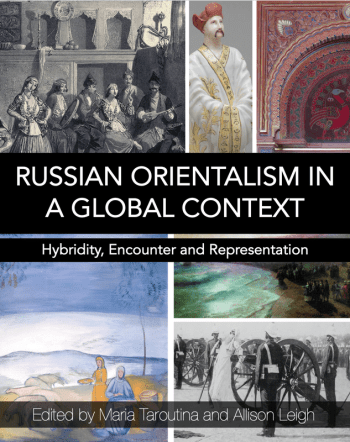 Dr. Ekaterina Heath is a Research Associate at the University of Sydney. She has published essays on Russian eighteenth-century art and gardens. Her recent articles include “Grand Tour Memories In Maria Feodorovna’s Pavlovsk Park, St Petersburg, 1782–1825” (with Emma Gleadhill), “Giving Women History: A History of Ekaterina Dashkova through Her Gifts to Catherine the Great and Others,” and “Sowing the Seeds for Strong Relations: Seeds and Plants as Diplomatic Gifts for the Russian Empress Maria Fedorovna.” She is finishing a book on Empress Maria Fedorovna’s use of Pavlovsk Park to influence Russian politics. This online talk is based on a chapter that Ekaterina Heath wrote with Professor Jennifer Milam, to be published shortly in the volume Russian Orientalism in a Global Context (edited by Maria Taroutina and Allison Leigh).
◊ ◊ ◊ ◊ ◊
Opened in 1984, the Russian History Museum in Jordanville, New York, 60 miles east of Syracuse, “promotes the understanding and appreciation of the rich history and culture of Russia and the Russian diaspora.” The museum’s history is closely associated with the Holy Trinity Monastery, founded in 1930. The monastery became “an important spiritual and cultural center for the Russian diaspora, [and] emigres from the former Russian Empire, displaced by revolution, civil war, and World War II, began to view the monastery as a trusted repository for the treasured artifacts and documents they brought with them from their homeland or had painstakingly collected abroad” (from the museum’s website). Responding to the Russian invasion of Ukraine, the museum’s ‘plea for peace’ is available here.
AHA Statement Condemning the Russian Invasion of Ukraine
While Enfilade is no longer an official extension of HECAA or part of its communication strategies, I am very glad the site remains affiliated with an organization that has been hugely formative for me and so many others. And I’m glad to see HECAA as a signature to the following statement (along with dozens of other academic societies), as noted in an email sent to HECAA members on 22 March. –CH
◊ ◊ ◊ ◊ ◊
Last week, the HECAA board voted to sign the American Historical Association (AHA) statement that condemns the Russian invasion of Ukraine. You will find the full text of the statement below, and you can also read it here.
Best regards,
HECAA Officers and Board
American Historical Association (AHA) Statement Condemning Russian Invasion of Ukraine
The American Historical Association condemns in the strongest possible terms Russia’s recent invasion of Ukraine. This act of overt military aggression violates the sovereignty of an independent Ukraine, threatening stability in the broader region and across the world.
Russian President Vladimir Putin’s rhetorical premise for this brutal violation of Ukraine’s sovereignty is anchored by a set of outlandish historical claims, including an argument that Ukraine was entirely a Soviet creation. In fact, Ukraine’s distinct language and culture date back over many centuries. Ukraine has been a crossroads of the region, connected to countries and cultures to the west as well as Russia to its east.
Over time, Ukrainians have contested both Russification and Sovietization. President Putin grossly simplifies and distorts Ukraine’s history, essentially erasing its distinct past and rendering it indistinguishable from Russia.
The AHA emphatically opposes this unprovoked act of military aggression; that the war is based on such a distorted and tendentious misreading of history makes it all the more deplorable. We vigorously support the Ukrainian nation and its people in their resistance to Russian military aggression and the twisted mythology that President Putin has invented to justify his violation of international norms.
The following organizations have signed onto this statement:
American Catholic Historical Association
American Folklore Society
American Musicological Society
American Political Science Association
American Society for Environmental History
American Society for Theatre Research
Association for Documentary Editing
Association for Historians of Nineteenth-Century Art
Austrian Studies Association
Berkshire Conference of Women Historians
College Art Association of America
Conference of Latin American History
Executive Committee of the Association for Slavic, East European, and Eurasian Studies
Forum on Early-Modern Empires and Global Interactions
French Colonial Historical Society
German Studies Association
Historians of Eighteenth-Century Art and Architecture
Historical Society for Twentieth Century China
Hungarian Studies Association
Immigration and Ethnic History Society
National Council of Teachers of English
National Council on Public History
North American Conference on British Studies
The Officers of the Medieval Academy of America
Polish American Historical Association
Renaissance Society of America
Roy Rosenzweig Center for History and New Media
Shakespeare Association of America
Sixteenth Century Society & Conference
Society for Austrian and Habsburg History
Society for Cinema and Media Studies
Society for Ethnomusicology
Society for Music Theory
Society for the History of Discoveries
Society for the Study of Early Modern Women and Gender
Society of Architectural Historians
Society of Biblical Literature
Urban History Association
Western Society for French History
World History Association
War in Ukraine | On Ukraine’s Cultural Heritage and Art Now

A selection of essays addressing the crucial role of art and culture in the war . . . Information on sites where one can contribute include Forbes, UNICEF, The Art Newspaper, HyperAllergic, and the Global Heritage Fund.
◊ ◊ ◊ ◊ ◊
From The Conversation:
Gauvin Alexander Bailey, “Ukraine: Heritage Buildings, If Destroyed, Can be Rebuilt But Never Replaced,” The Conversation (14 March 2022).
The tragic loss of life and desperate living conditions caused by the Russian invasion of Ukraine have gripped the world’s attention. However, another threat looms for the country’s heritage architecture, including United Nations Educational, Scientific and Cultural Organization (UNESCO) World Heritage monuments of global significance. These buildings lie directly in the line of fire as Russian forces advance on Kyiv and increase bombardments near Lviv. UNESCO Director-General Audrey Azoulay has called for the protection of these testimonies to the country’s “rich history.” . . .
◊ ◊ ◊ ◊ ◊
Bailey’s essay includes a link to Evan Rail’s article:
Evan Rail, “‘This Is Everyone’s Culture’: Ukraine’s Architectural Treasures Face Destruction,” The New York Times (11 March 2022). The country’s vast array of historic buildings, artworks and public squares are an integral part of Ukraine’s cultural identity. Amid the violence of war, many are being reduced to rubble.
Russia’s invasion of Ukraine brought searing images of human tragedy to witnesses around the world: thousands of civilians killed and injured; broken families, as mothers and children leave in search of refuge while fathers and other men stay behind to defend their country; and millions of refugees having already fled to neighboring countries, after just two weeks of war. In addition to that human suffering, a second tragedy comes into focus: the destruction of a country’s very culture. Across Ukraine, scores of historic buildings, priceless artworks and public squares are being reduced to rubble by Russian rockets, missiles, bombs and gunfire. . . .
◊ ◊ ◊ ◊ ◊
From The Washington Post:
Max Bearak and Isabelle Khurshudyan, “‘All Art Must Go Underground:’ Ukraine Scrambles to Shield Its Cultural Heritage,” The Washington Post (14 March 2022).
Emptying a museum is a gargantuan task, and the entire workforce of the Andrey Sheptytsky National Museum in Lviv had been at it for a week before the final piece—a century-old portrait of the museum’s namesake—was taken down, leaving the last of its walls bare.
Ihor Kozhan, the director of the grand gallery opposite Lviv’s opera house, explained the rush. “There is an egomaniac in Moscow who doesn’t care about killing children, let alone destroying art,” he said. “If our history and heritage are to survive, all art must go underground.”
Across Ukraine, artists, gallerists, curators and museum directors are desperately but carefully unhooking, wrapping and stashing away the country’s hefty cultural endowment as Vladimir Putin’s onslaught closes in. Statues, stained-glass windows and monuments are being covered with shrapnel-proof material. Basement bunkers are crammed with paintings. . . .
Saving art was secondary only to saving lives, many of those interviewed said, because Ukrainians’ pride in their culture serves as a deep well of inspiration for its resistance to invasion. Putin has made it clear that he considers Ukraine to be part of greater Russia, a contention artists here say denies Ukraine’s distinct heritage.
“With each invasion, some loss of culture is inevitable,” said Taras Voznyak, director of the Lviv National Art Gallery. “Putin knows that without art, without our history, Ukraine will have a weaker identity. That is the whole point of his war—to erase us and assimilate us into his population of cryptofascist zombies.” . . .
◊ ◊ ◊ ◊ ◊
From The Washington Post:
Peggy McGlone, “A Lab in Rural Virginia Is Racing to Preserve Ukraine’s Cultural Heritage,” The Washington Post (19 March 2022).
In the southwest corner of rural Virginia, about 5,000 miles from the war zone, a small but mighty team of archaeologists, historians and high-tech mapping experts are using sophisticated satellite imagery to help to protect Ukraine’s cultural heritage. Housed in the Virginia Museum of Natural History in Martinsville, the Cultural Heritage Monitoring Lab is the museum world’s version of a war room: a network of computers, satellite feeds and phones that represents one of the newest tools being employed to protect national treasures threatened by natural disasters or geopolitical events.
Created last year in partnership with the Smithsonian Institution Cultural Rescue Initiative—a world leader in this field—the lab is compiling imagery of Ukraine’s cultural sites to help track attacks on them. The goal is to quickly alert officials in Ukraine of damage, in case action can be taken—perhaps to protect artifacts exposed to the elements, or to board up stained-glass windows in the wake of a direct hit on a church—and to document the devastation.
“It’s a 24/7 operation,” director and archaeologist Hayden Bassett said, adding that the staff of six has been working 12 and 18 hours at a stretch to maintain their rapid response. “Even though we might not be staring at a screen at 3am, our satellites are imaging at 3am.”
Using their database of 26,000 cultural heritage sites—including historic architecture, cultural institutions such as museums and archives, houses of worship and places of archaeological significance—Bassett and his team of art historians, analysts and techies have identified several hundred potential impacts in the conflict’s first few weeks. . . .
◊ ◊ ◊ ◊ ◊
From NPR:
Lauren Frayer and Olena Lysenko, “How Some People Are Trying to Make Art, Not War, in Ukraine Right Now,” NPR Morning Edition (17 March 2022).
[Lyana] Mytsko [director of Lviv Municipal Arts Center] says artists and musicians keep contacting her and asking how they can help. Here’s what she tells them: “Art is not an extra little thing—a sidebar—in this war. Putin has said Ukraine is not a real country—that it doesn’t have a real culture of its own. Go out and prove him wrong” . . . .
◊ ◊ ◊ ◊ ◊
From i:
Isabella Bengoechea, “Ukraine War: Cancelling Russian Culture Is a Mistake and Helps No One But Putin, Say Art Lovers,” The i Paper (21 March 2022). Alex Beard, Chief Executive of the Royal Opera House, told i: “Swan Lake is for everybody.”
Since Russian bombs began falling on Ukraine, the world has united to make known its disgust for Vladimir Putin’s regime through sanctions targeting Russia’s economy, its business, military and its elites. However, high culture, traditionally a jewel in the crown of Russia’s soft power, has not escaped scrutiny. Russian performers have been dropped. Musicians have been told to denounce Mr Putin. Performances of Russian works have been cancelled—literally and figuratively—across the West. Vissi d’arte has been tried and found wanting, as the theatre of war bleeds into the concert halls and opera stages of the world.
This month, the Cardiff Philharmonic Orchestra cancelled a Tchaikovsky evening because of the conflict, while the Russian composer’s 1812 Overture was dropped from the Royal Albert Hall’s Classical Spectacular concerts, by Japan’s Chubu Philharmonic, by the Akashi Philharmonic and the Zagreb Philharmonic.
Switzerland’s Théâtre Bienne Soleure replaced Tchaikovsky’s Ukraine-based romantic opera Mazeppa over concerns about depicting war on stage, while the Polish National Opera cancelled a performance of Modest Mussorgsky’s opera Boris Godunov, about the downfall of a murderous tsar. Then two university ensembles, Trinity Orchestra and UCD Symphony Orchestra, said they would remove all music by Russian composers from the repertoire.
“This is a mistake,” said Maksym Tymoshenko, President of the Ukrainian National Tchaikovsky Academy of Music in Kyiv, whose musicians made headlines this month staging an outdoor concert in the city’s Independence Square. Mr Tymoshenko told i: “We disagree with banning Russian music. We don’t think it’s appropriate or reasonable. That you cannot perform great works of art, whether 1812 or others, is very twisted logic. Modern Putin’s Russia has nothing to do with the great Russian culture. By banning it we are not doing anybody a favour.” . . .
New Book | Worn: A People’s History of Clothing
From Penguin Random House:
Sofi Thanhauser, Worn: A People’s History of Clothing (New York: Pantheon, 2022), 400 pages, ISBN: 978-1524748395, $30.
 In this panoramic social history, Sofi Thanhauser brilliantly tells five stories—Linen, Cotton, Silk, Synthetics, Wool—about the clothes we wear and where they come from, illuminating our world in unexpected ways. She takes us from the opulent court of Louis XIV to the labor camps in modern-day Chinese-occupied Xinjiang. We see how textiles were once dyed with lichen, shells, bark, saffron, and beetles, displaying distinctive regional weaves and knits, and how the modern Western garment industry has refashioned our attire into the homogenous and disposable uniforms popularized by fast-fashion brands.
Thanhauser makes clear how the clothing industry has become one of the planet’s worst polluters and how it relies on chronically underpaid and exploited laborers. But she also shows us how micro-communities, textile companies, and clothing makers in every corner of the world are rediscovering ancestral and ethical methods for making what we wear. Drawn from years of intensive research and reporting from around the world, and brimming with fascinating stories, Worn reveals to us that our clothing comes not just from the countries listed on the tags or ready-made from our factories. It comes, as well, from deep in our histories.
Sofi Thanhauser teaches in the writing department at Pratt Institute. She has received fellowships from the Fulbright Program, MacDowell, and Ucross Foundation. Her writing has appeared in Vox, Essay Daily, and The Establishment, among other publications.
C O N T E N T S
Introduction
Linen
1 The Last Linen Shirt in New Hampshire
2 Underthings
Cotton
3 Texas Fields
4 The Fabric Revolution
5 Drought
Silk
6 Yangtze Silk
7 Costume Drama
8 The Rise of Mass Fashion
Synthetics
9 Rayon
10 Nylons
11 Export Processing Zones
Wool
12 Army of the Small
13 Woolfest
14 Weavers
Conclusion
Acknowledgments
Notes
Bibliography
Index
Call for Papers | CSECS, ECSSS, NEASECS 2022

Jean Siméon Chardin, Attributes of the Sciences, 1731, oil on canvas, oil on canvas, 140 × 220 cm
(Paris: Musée Jacquemart-André)
◊ ◊ ◊ ◊ ◊
From the Call for Papers for the conference. And please note the separate due date for NEASECS soliciting panels (April 8) with paper proposals due by May 6; send to neasecs@gmail.com. Art history panels and papers are encouraged!
Experiencing Modernity; Modernity of Experimentation
Expérience de la modernité; Modernité de l’expérimentation
Canadian Society for Eighteenth Century Studies (CSECS) in collaboration with the Eighteenth-Century Scottish Studies Society (ECSSS) and the Northeast American Society for Eighteenth-Century Studies (NEASECS)
University of Ottawa / Delta Hotel by Marriott, Ottawa City Centre, 26–29 October 2022
CSECS paper proposals due by 15 April 2022 / NEASECS panels due 8 April and papers due 6 May 2022
In the years leading up to the eighteenth century, the Quarrel of the Ancients and the Moderns sparked a passionate debate in which the concept of modernity featured prominently. This was not the first time the concept of the ‘modern’, as a present that contrasted with the remote past, was invoked, but it marks a significant, perhaps defining, development or consolidation of the idea. At issue in the Quarrel was the question of whether or not ancient learning, thought, and literary achievement had been overtaken and superseded by modern thinkers and writers. The Quarrel brought into focus the very idea of modernity itself, of novelty and newness. Was the new century in some fundamental way new and different from previous eras, whether in its socio-political organization; its understanding of nature and the cosmos; its conception of art, literature, and the aesthetic; or its invention of new technologies and material processes? How was the world of the eighteenth century different from what came before it? When and where did this modernity begin? Are we to see this as a heroic narrative of progress, or does it also manifest a dark, destructive dimension that undermined and defeated optimistic visions of the future?
Two features that stand out in this project of self-conceptualization are a sense of historical difference from the past and a drive to record human experience—in dictionaries and encyclopedias—or to measure it by experimentation. Our conference title highlights the interplay between these two terms, for historically, ‘experimentation’ and ‘experience’ are closely related. Indeed, in modern French the word expérience is almost interchangeable with expérimentation, and in English, the earliest meaning of ‘experience’ was an action of putting something to the test (“to make experience of: to make trial of” [OED]). An experience is also an observation of facts or events, and in more recent usage it refers to what a person might subjectively encounter, undergo, live through, and be affected by. We invite conference participants to explore all these facets of the experience of modernity in the eighteenth century.
For explorers, scholars, and creators of the eighteenth century, modernity demanded to be experienced and experimented with, and it came to be defined by a multiplicity of experiments. In the sciences and philosophy, this trend is especially clear, with the development of ‘experimental philosophy’, deriving from Bacon, Newton, and Locke, which made possible the development of new fields of knowledge, new understanding of the grounds of knowledge, and new technologies and practices—in manufacturing, medicine, and military art, for example.
But experimentation in the period is also manifested in field research: that of travelers who set out to meet other cultures, that of correspondents of the academies and learned societies who described the natural world around them, that of inventors and innovators who came to present the fruit of their work to assemblies. Experimentation, here, evolved beyond the collection of ‘curiosities’, to be displayed in cabinets (a matter of spectacle and wonder), to become research, in the sense that we still understand it today, that is to say a deliberate, controlled testing of phenomena in order to bring about predicted effects.
In the fine arts and literature, experimentation took many forms, such as the development of new genres (domestic tragedy, bourgeois drama, prose fiction) and the transformation and mixing of existing ones (georgic, the mock-heroic). Artistic experiments like these were designed to elicit new pleasures and to stimulate new effects in audiences, of moral transformation or aesthetic response. But artists in the period went further: the eighteenth century was also a laboratory of media, as artists endeavoured to exploit the technical discoveries of their time, from the magic lantern to the ocular harpsichord.
We could extend this intellectual and cultural survey almost indefinitely, taking in politics, law, moral inquiry, economics and other nascent social sciences. But modernity was also experienced as difference and alterity: gender, ethnicity, race, and foreignness, for example, figured prominently in the imagining and experience of modernity, as projections of anxieties, fears, and hopes about profound cultural and social change. Financial volatility and novel instruments of credit, for example, were often allegorized as fickle, valetudinarian women, and innovation and novelty were often stigmatized xenophobically as ‘foreign’. Conversely, the inhabitants of Africa and the Americas suffered often calamitous consequences in their encounters with the modernity of an alien culture and alien intruders. This darker side of the experience of modernity will be equally prominent in our exploration of the CSECS 2022 conference theme.
A key dimension of this experience of modernity, for us today, is the ongoing contact between European explorers, empire builders, and colonizers and the indigenous nations who confronted them. The 2021 CSECS conference in Winnipeg mounted an ambitious program of inquiry into the ‘Indigenous Eighteenth Century’, and it is our aim at the Ottawa conference to build on this important work. Thus, the conference organizers particularly invite panels and roundtables that focus on non-European perspectives on the European project of modernity.
Topics related to the conference theme might include, but are not limited to, the following:
• the experimental sciences in dialogue with artistic production
• the idea of innovation in literature and the arts
• experience and the modern novel
• empirical and moral philosophy as sciences of humanity
• enlightenment and the critique of modernity
• travel writing—both real and imagined.
• Lettres persanes (301 years later)
• economic experiments; financial modernity
• conjectural history as experimental or speculative historiography
• constitutional experimentation
• experience of gender; gender and modernity
In keeping with past practice at CSECS conferences, panel and paper proposals on current research unrelated to the conference theme will be equally considered. Deadline for submission of panel proposals: 15 March 2022. Deadline for submission of individual paper proposals: 15 April 2022.
NEASECS soliciting panels are due April 8, with paper proposals due by May 6; please either send to neasecs@gmail.com. Art history panels and papers are encouraged!
All those presenting at the conference must be members in good standing either of CSECS, ECSSS, or NEASECS. Paper proposals should include title, 150-word summary, and brief biographical note indicating the presenter’s name, email, academic status, and institutional affiliation. Panel proposals should include titles and 150-word summaries of both panel and individual papers, and brief biographical notes for all presenters (normally three) and respondents (if any), including names, email addresses, academic statuses, and institutional affiliations. Please send your proposals to csecs-scedhs2022@uottawa.ca. Participants may present papers in English or French and will be invited to submit articles based on their papers in either language to Lumen, the official journal of CSECS, for publication.
◊ ◊ ◊ ◊ ◊
Note (added 20 March) — The original posting did not include the separate due dates for NEASECS submissions.










 Enfilade
leave a comment