Online Talk | Gus Casely-Hayford on Crafting the New V&A East
From The Institute of Fine Arts:
Gus Casely-Hayford | Making a Museum: Crafting a New V&A for East London
Online, The Institute of Fine Arts, New York University, 21 March 2022, 2pm ET
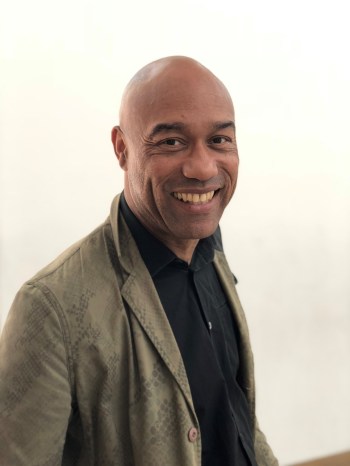 The Institute of Fine Arts invites you to a lecture by Dr. Gus Casely-Hayford, Director of the V&A East, a new museum and collection center in London. This virtual program takes place on Monday, 21 March 2022, at 2pm (Eastern Time).
Advanced registration is required–and available here.
A curator and historian who writes, lectures, and broadcasts widely on culture, Dr Gus Casely-Hayford, OBE, Prof by Practice, SOAS, University of London (the leading Higher Education institution in Europe specializing in the study of Asia, Africa, and the Near and Middle East), is the founding Director of V&A East, a museum and collection center presently under construction. He was previously the Director of the Smithsonian National Museum of African Art.
Over the course of his career, Casely-Hayford has been a constant champion for the arts. He has presented two television series of The Lost Kingdoms of Africa for the BBC (and wrote the companion book), two television series of Tate Britain: Great Art Walks for Sky, and has worked for every major British TV channel. His TED talk on Islamic culture has been viewed more than a million times. Former Executive Director of Arts Strategy, Arts Council England (Britain’s major arts funder) and ex-Director of the Institute of International Contemporary Art, he has offered leadership to both large and medium scale organizations. Dr Casely-Hayford has lectured widely on art and culture, including periods at Sotheby’s Institute, Goldsmiths, Birkbeck, City University, University of Westminster, and SOAS. He has advised national and international bodies on heritage and culture including the United Nations and the Canadian, Dutch, and Norwegian Arts Councils. In 2005 he deployed these leadership, curatorial, fundraising, and communications skills to organize the biggest celebration of Africa Britain has ever hosted with Africa 2005 when more than 150 organizations put on over 1000 exhibitions and events to showcase African culture.
Amongst a range of honors, he has been awarded a King’s College cultural fellowship for service to the arts and a SOAS Honorary Fellowship for service to Africa. He speaks widely, gave a SOAS Centenary lecture, judged the Art Fund’s British Museum of the Year award, advised the Royal Shakespeare Company on their production of Hamlet, and is a member of English Heritage’s ‘Blue Plaques Group’.
This program is made possible with generous funding from the Paul Lott Lectureship.

Internal render view of the central public collection hall in new V&A East Storehouse at Here East, designed by Diller Scofidio + Renfro. © Diller Scofidio + Renfro, 2018.
◊ ◊ ◊ ◊ ◊
From the V&A:
One of the world’s most significant new museum projects, V&A East will comprise two sister sites currently under construction in Queen Elizabeth Olympic Park, London. Opening at Here East in 2024, V&A East Storehouse offers a new immersive experience, taking visitors behind the scenes and providing unprecedented public access to V&A collections. A short walk across the park, opening in 2025, V&A East Museum celebrates global creativity and making relevant to today’s world. Both sites are part of East Bank, the Mayor of London’s £1.1 billion Olympic legacy project, which will create a new arts, innovation and education hub in Stratford’s Queen Elizabeth Olympic Park. . . .
Additional information is available here»
Exhibition | Flora Yukhnovich: Thirst Trap

Flora Yukhnovich, I’ll Have What She’s Having, 2020, oil on linen, 170 × 220 cm. Estimated to sell for £60,000–£80,000, the painting sold for £2,253,500 (Sotheby’s London, 14 October 2021).
◊ ◊ ◊ ◊ ◊
After only a handful of solo exhibitions, beginning in 2017, the British artist Flora Yukhnovich (b. Norwich 1990) has recently emerged as a leading contemporary painter, receiving coverage in both visual arts media and the popular press. The New York Times recently included her in a piece about speculators hoping to to ‘flip’ art at auction (in October, her painting I’ll Have What She’s Having sold at Sotheby’s for $3.1million).
I note Yukhnovich here at Enfilade because of her engagement with eighteenth-century painting, an engagement she attributes to Mary Sheriff. In a 2020 interivew with Immediations, published by The Courtauld, Yukhnovich references both Fragonard: Art and Eroticism (University of Chicago Press, 1990) and Enchanted Islands: Picturing the Allure of Conquest in Eighteenth-Century France (University of Chicago Press, 2018).
As Yukhnovich describes her artistic development during the interview:
“I then began looking at decorative design. At first it was about the very flatness of it, which I really enjoyed. Then it became about the ways in which paint itself can do things, like create drop shadows, or the different ways in which paint can be used to construct space. It became apparent to me that I was gravitating toward these things because they were related to femininity in a way, but they also all happened to be derived from a Rococo aesthetic. When I found [Sheriff’s] book on Fragonard, I realised that a lot of the Rococo seemed to tap into all these different elements that I had been looking at. The aesthetic of the Rococo feels very familiar to me, and there are lots of things that I, as a woman and also as a girl growing up, interacted with which seem to have a Rococo sensibility to them. I do not feel like that about many other art historical movements. That is why I landed on it. It was about a lot of different interests coming together.”
–CH

Flora Yukhnovich, Siren Song, 2022.
◊ ◊ ◊ ◊ ◊
From the press release for the the exhibition now on view in London at Victoria Miro:
Flora Yukhnovich: Thirst Trap
Victoria Miro, London, 1–26 March 2022
Flora Yukhnovich is acclaimed for paintings that, fluctuating between abstraction and figuration, transcend painterly traditions to fuse high art with popular culture and intellect with intuition. While in the past she has adopted the language of Rococo, dynamically reimagining aspects of works by eighteenth-century artists such as Tiepolo, Boucher, Lancret, and Watteau, new paintings draw upon various depictions of the Roman goddess Venus in mythology, art history, and contemporary culture. Rather than focus on individual points of reference, each work synthesises a multitude of influences that convey the shifting representations and significations of Venus herself. Here the Venus who embodies idealised female form and is goddess of love, maternal care, sexual reproduction, and erotic desire, meets the Venus of violent origin and hybrid gender—promiscuous and vengeful.
In Greco-Roman mythology, Venus emerges fully formed when Cronus throws Uranus’s dismembered testicles into the sea; she is carried to land from the boiling spume in a shell. The artist says, “I was immediately drawn to the idea of her body being made of water… this fluidity of form feels like a very painterly concept to me, a bit like creating seemingly solid figures out of wet paint. There is a tendency for water and the sea to be spoken about as female—fluid and soft but also capricious and destructive. I like the potential for strength or force in that association and it’s something I try and bring to these paintings.”
Travelling back and forth through art, mythology and philosophy, and echoing Venus’s storied representations through time, Yukhnovich’s references are revealed to be equally as fluid. One influence is Rubens’s The Feast of Venus, 1636–37, in the collection of the Kunsthistorisches Museum, Vienna, which depicts the festivities of Veneralia—the ancient Roman festival celebrated on 1 April to honour Venus Verticordia, an epithet that alludes to the goddess’s ability to change hearts from lustful to chaste. Venus as an embodiment of propriety contrasts with her promiscuity in another source painting, Boucher’s Mars and Venus Surprised by Vulcan, c.1754, in the Wallace Collection, which captures the moment when Vulcan, on hearing of his wife’s infidelity with Mars, ensnares the adulterous couple in a golden net, inviting other gods to enjoy their humiliation.
Such divergent attributes are enfolded with allusions in contemporary culture, from Federico Fellini’s La Dolce Vita to Doja Cat, which demonstrate the enduring potency of Venus as symbol and spirit. In Yukhnovich’s paintings these references are never revealed explicitly. Rather, they are conveyed compositionally or chromatically: variation is a driving force, her virtuosic mark-making—ranging from delicate flourishes to dramatic and muscular brushstrokes—heightens a sense of rhythmic sensuality. Bubbles—by definition one substance contained by another—are a recurring motif in these works; effervescent, capricious, unstable, or transformative, they denote changing states that mirror Venus’s turbulent arrival in mythology and her ever-shifting presence in culture thereafter. Paint, in Yukhnovich’s hands, becomes the perfect vehicle to conjure the multiplicity of a subject which, characterised by flux and transformation, is as elusive as it is seductive.
Born in 1990, Flora Yukhnovich completed her MA at the City & Guilds of London Art School in 2017. She had her first solo exhibition at Brocket, London, in December 2017 and has recently exhibited at Parafin, London, GASK, the Gallery of the Central Bohemian Region, Czech Republic, the Jerwood Gallery Hastings, and at Blenheim Walk Gallery, Leeds Arts University, UK. Previous solo exhibitions with Victoria Miro include The Venice Paintings and Barcarole, both held in 2020. Collections include Government Art Collection and The David Roberts Art Foundation. In 2018 she completed The Great Women Artists Residency at Palazzo Monti, Brescia. Work by the artist will feature in the survey exhibition Impressionism: A World View; Yukhnovich’s painting will be exhibited in galleries dedicated to ‘Contemporary Neo-Impressionists’, on view at The Nassau County Museum of Art, NY, from 19 March to 10 July 2022. In 2023 Yukhnovich will be the first artist to take part in a new series of solo exhibitions responding to the collections of The Ashmolean, Oxford, titled Ashmolean NOW.
Call for Papers | Tracing Material Cultures in Early America
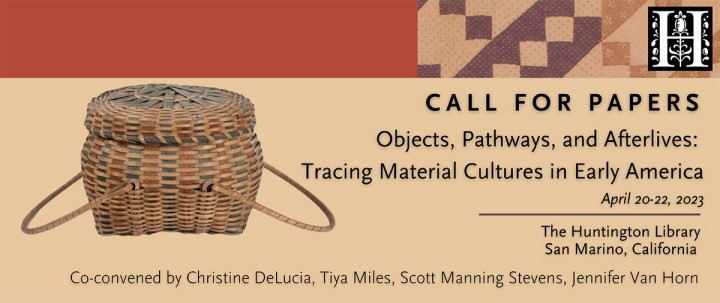
As announced by CAA:
Objects, Pathways, and Afterlives: Tracing Material Cultures in Early America
The Huntington Library, Art Museum, and Botanical Gardens, San Marino, 20–22 April 2023
Organized by Christine DeLucia, Tiya Miles, Scott Manning Stevens, and Jennnifer Van Horn
Proposals due by 15 May 2022
This two-and-a-half-day symposium in April 2023 at the Huntington Library will articulate new pathways forward in American material cultures, broadly defined in terms of subject matter, hemispheric geography, and time period (from roughly 1500 to 1860). We invite holistic thinking about existing fault lines in object study and the generative spaces around issues of power, absence, representation, labor, hybridity, and materiality. Recognizing that ‘early’ America itself has been contested in productive ways, we ask what work ‘early’ American objects can help effect along the lines of contemporary visual sovereignty as well as cultural preservation and knowledge production.
As critical reckonings with the enduring legacies of white supremacy and settler colonialism that shaped early America continue to impact communities today, we seek to create a space for creative learning to investigate: How do we do this work? How do we interpret this work with and for multiple publics? How can we better engage younger community members and college students with materials collected by museums? What through-lines can museums elucidate between historical materials and contemporary Indigenous and African American artists and knowledge keepers?
Symposium participants can engage with the Huntington’s Fielding Collection of Early American Art as a resource and point of departure, but talks do not have to respond directly to works in the collection.
We invite proposals for 20–30 minute papers addressing these themes from people in many fields, including but not limited to African Diaspora, Archaeology, Art History, History, Indigenous Studies, Material Culture, and Museum Studies. Cross-disciplinary and comparative studies are also welcome. To submit, please email abstracts of no more than 200 words, along with a short (2 page) CV, to objectspathwaysafterlives@huntington.org by 15 May 2022.
Travel and accommodations will be provided for speakers arriving from outside the Los Angeles area, and meals will be provided for all. Graduate students outside the Los Angeles area who want to attend the conference are welcome to apply for grants to cover travel and lodging. To be considered, email objectspathwaysafterlives@huntington.org a 300-word statement detailing your research interests and outlining how attending the conference will further your scholarly or career development, along with a short (2-page) CV by 15 May 2022.
Online Lecture | Susan Lahey on Chinese Porcelain in Canada
From Events in the Field:
Susan Lahey | Chinese Porcelain in Canada in the 18th and 19th Centuries: Examples in Nova Scotia and Quebec Collections
Online, Canadian Society of Decorative Arts, 3 April 2022, 3pm (EDT)
 Did you know there are more than 69,000 fragments of Chinese blue and white porcelain in the archaeological collection of Nova Scotia’s Fortress of Louisbourg? Or that Chinese famille rose porcelains were imported to Canada from the famous Imperial kilns of Jingdezhen? Join Asian art expert Susan Lahey, MA, ISA CAPP, for a visually engaging presentation exploring Chinese porcelain in museum collections from Quebec and Nova Scotia. Not only will she examine the history of when and how these pieces arrived in Canada, but also provide a brief background on the development of blue and white in China. The significance of these porcelain wares and the symbolism of decoration depicted on them will be discussed in a way that is entertaining to a broad audience of both Western and Chinese porcelain connoisseurs alike. Sunday, 3 April 2022, 3pm (EDT).
Register here»
Susan Lahey, MA, ISA CAPP, is a certified, professional appraiser with more than two decades of experience, specializing in Chinese decorative and fine art. Ms. Lahey holds an Honours BA in Chinese Studies from the University of Toronto; an MA in Classical Chinese Literature from the University of British Columbia; and a Post-Graduate Diploma with Distinction in Asian Art from the School of Oriental & African Studies/Sotheby’s in London, England.
CSDA/CCAD Sundays are regular online events hosted by the Canadian Society of Decorative Arts (csda-ccad.org) featuring a wide range of makers, collectors and other topics of interest to lovers of the decorative arts and crafts.
Conference | Fragile Splendour
From Haughton International:
Fragile Splendour: Prestige, Power, and Politics from the Medici to the Present Day
The British Academy, Carlton House Terrace, London, 29–30 June 2022
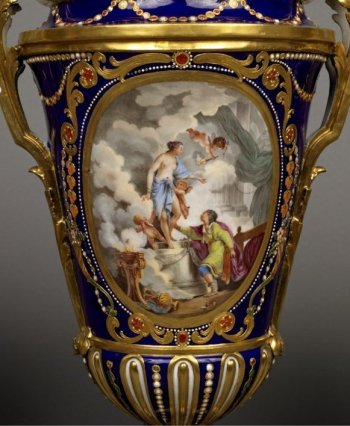
Vase ‘E de 1780’ Sèvres Porcelain Manufactory, 1781 (London: Wallace Collection C334 004).
We have great pleasure in announcing that this year’s Haughton International Seminar, entitled Fragile Splendour: Prestige, Power & Politics from the Medici’s to the Present Day, will again take place at The British Academy, 11 Carlton House Terrace, on Wednesday 29th and Thursday 30th June. Each year we draw together eminent international speakers to share their knowledge and passion with an appreciative audience. Information regarding this exciting seminar can be viewed on our website here. Tickets can be purchased online via this link. We look forward to welcoming you in June.
Cost of the two-day seminar: £110 (inc VAT). Cost of the two-day seminar including champagne reception and dinner at The Athenaeum on Wednesday, 29th June: £190 (inc VAT). Student tickets for the two-day seminar (on production of ID): £60 (inc VAT). Booking in advance through the website is essential due to limited numbers. The box office opens on Tuesday, 1st March. Below is a preliminary programme (subject to change).
W E D N E S D A Y , 2 9 J U N E 2 0 2 2
8.45 Registration
9.15 Welcome Address
9.30 Morning Session
• Gregory Irvine — The Art of War, the Arts of Peace: Patronage and Production of Luxury Crafts for the Samurai
• Timothy Schroder — Diplomatic Gifts in Gold
• Mathieu Deldicque — Prestige Despite Disfavour: The Prince de Condé and Chantilly Porcelain
• Helen Jacobson — The Art of Giving: Diplomacy at the Bourbon Court
1.00 Lunch Break
2.15 Afternoon Session
• Timothy Wilson — The Medici and Maiolica in the Time of the Florentine Republic
• Amin Jaffer — Attributes of Splendor: Jewels and the Projection of Power in Royal India
3.55 Face-to-Face: Rosalind Savill in Conversation with Brian Haughton
4.45 Q&A Session
6.30 Drinks Reception at The Athenaeum Club (for dinner guests only)
7.15 Dinner (dress code is smart with ties for gentlemen; no denim or training shoes)
T H U R S D A Y , 3 0 J U N E 2 0 2 2
9.00 Arrival
9.15 Morning Session
• Samuel Wittwer — Polishing the Crown: The Influence of Artists and Scholars on Royal Berlin Porcelain Orders
• Leslie Greene Bowman — Thomas Jefferson at Monticello: Prestige, Power, and the ‘Peculiar Institution’ of Slavery
• Eva Stroeber — For Sultans, Grand Dukes, and German Princes: Chinese Porcelain as Diplomatic Gift
• Rose Kerr — How Chinese Emperors Used Ceramics to Support their Power and Prestige
1.00 Lunch Break
2.15 Afternoon Session
• Johann Kräftner — Rebuilding a Collection: 20 Years of Working with Palaces, Paintings, Sculpture, Furniture, and Porcelain
• Julia Weber — Augustus the Strong and the ‘Red Porcelain’ from Saxony
• Judy Rudoe — Jewellery, Politics, and National Identity: Princess Alexandra and Her Wedding Gifts
4.30 Q&A Session
New Book | Chiswick House Gardens
From Liverpool UP:
David Jacques, Chiswick House Gardens: 300 Years of Creation and Re-creation (Liverpool: Liverpool University Press, 2022), 248 pages, ISBN: 978-1800856219, £40.
 The grounds at Chiswick House are amongst the most iconic of all the historic gardens of Europe. In the 1720s they reflected Lord Burlington’s innovative ideas on Palladianism and antique gardens, whilst the area transformed by William Kent to give a rustic appearance in the early 1730s has been recognised as one of, or perhaps the, birthplace of the landscape garden. The grounds were periodically brought to the forefront of taste, reaching another high point as the venue for spectacular garden parties under the 6th Duke of Devonshire. As a garden of many periods it has given rise to passionate national debates since World War II on the principles of restoration, and as a public park it has been an important project assisted by the National Lottery Heritage Fund. Its renewed high state of keeping and its tranquil beauty belies its ‘deep’ history of intellectual debate, social tensions and practical difficulties.
The book concentrates on the four main periods when Chiswick gardens were in the national spotlight, two when being in the forefront of taste and two concerning the restorations, the first being in the 1950s when the whole question of garden restoration was entirely new. The second restoration, on and off since 1988 intersects with the development of a philosophical stance and national policy on the restoration of parks and gardens. There is much of interest for art and architectural historians, garden historians, social historians and those local and international visitors who enjoy the finest public park in West London.
David Jacques is an independent scholar and part-time lecturer at the Institute for Historical Research.
C O N T E N T S
Foreword
Acknowledgements
Image Credits
About the Book
Abbreviations
1 ‘His Lordship’s Fine Genius’
2 ‘A Picture of Watteau’
3 English Palladianism
4 The Public Park Initiative
Appendix A: The Owners of Chiswick House Gardens
Appendix B: The Head Gardeners at Chiswick House
Appendix C: Chronology
Notes
Bibliography
Index
Print Quarterly, March 2022
The long eighteenth century in the latest issue of Print Quarterly:
Print Quarterly 39.1 (March 2022) . .
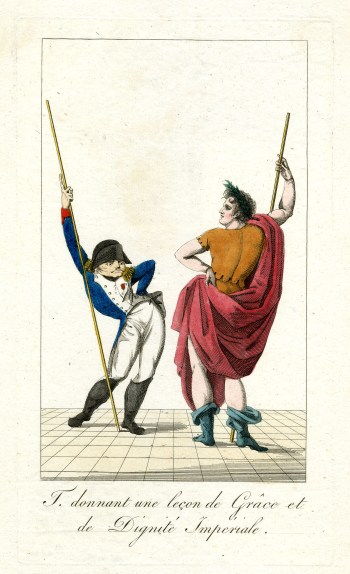
Charles Elie, T[alma] donnant une leçon de grâce et de dignité impériale (T[alma] giving a lesson in grace and imperial dignity), 1814, hand-coloured etching, 244 x 142 mm (London: British Museum).
A R T I C L E S
Antony Griffiths, “The Publication of Caricatures in Paris in 1814 and 1815, Part I: The Established Printsellers, Genty and Martinet,” pp. 31ff.
Two articles by Antony Griffiths on ‘The Publication of Caricatures in Paris in 1814 and 1815’—Part 1 in the March 2022 issue and Part 2 forthcoming—discuss the publication of caricatures in Paris during two years in which there were four regimes in power, and two occupations by foreign armies—a period which led to an unprecedented outpouring of social and political satire. Many works of great quality were produced, but most have only a title and do not reveal the names of the producers. The articles discuss how publishers and artists dealt with the political upheavals and identify some of the many participants who entered the field in these years. Part 1 deals with the caricatures published by members of the established print trade in Paris, and in particular Aaron Martinet and the newcomer Genty, who has previously been misidentified.
R E V I E W S
• Mark McDonald, Review of Juan Agustín Ceán Bermúdez, El Churriguerismo: discurso inédito (Alicante: Biblioteca Virtual Miguel de Cervantes, 2019), p. 79.
• Diana Greenwald, Review of Madeleine Viljoen, Nina Dubin and Meredith Martin, Meltdown! Picturing the World’s First Bubble Economy (Turnhout: Harvey Miller, 2020), p. 80.
• Ann V. Gunn, Review of John Bonehill, Anne Dulau Beveridge, and Nigel Leask, eds., Old Ways New Roads: Travels in Scotland 1720–1832 (Edinburgh: Birlinn, 2021), p. 81.
• Marcia Reed, Review of Troy Bickham, Eating the Empire: Food and Society in Eighteenth-Century Britain (London: Reaktion, 2020), p. 84.
• Nigel Tattersfield, Review of Graham Williams, Thomas Bewick Engraver & the Performance of Woodblocks (Kent: Florin Press, 2021), p. 86.
• Janis A. Tomlinson, Review of Mark McDonald et al., Goya’s Graphic Imagination (New York: The Metropolitan Museum of Art, 2021), p. 102.
Exhibition | A Shared Passion for Drawing
From:
Le partage d’une passion pour le dessin
Palais des Beaux-Arts, Paris, 22 March — 30 April 2022

Jean-Baptiste Greuze, Head of a Frightened Child, red chalk on beige paper (Beaux-Arts de Paris, acquired in 2013).
L’exposition dévoile un ensemble de 90 dessins, entrés dans les collections de l’École grâce à la générosité de l’association « Le Cabinet des amateurs de dessins des Beaux-Arts de Paris ». Le parcours, organisé à l’occasion des 15 ans de l’association, est présenté par écoles (italienne, nordique et française) à travers les siècles. Des œuvres d’Eugène Delacroix, Jean-Honoré Fragonard, Jean-Baptiste Greuze, Gerrit Van Honthorst, Giuseppe Penone ou encore Simone Peterzano sont ainsi à découvrir.
Les Beaux-Arts de Paris conservent la plus belle collection de dessins de France, après celle du musée du Louvre. Cette collection continue aujourd’hui encore de s’enrichir grâce à une politique d’acquisitions conçue à des fins pédagogiques ; ainsi que par des dons de professeurs, de jeunes artistes, et de l’association « Le Cabinet des amateurs de dessins des Beaux-Arts de Paris ».
Le partage d’une passion pour le dessin (ENSBA, 2017), 282 pages, ISBN: 978-2840565093, 39€.
5th Annual Ricciardi Prize from Master Drawings
From Master Drawings:
Fifth Annual Ricciardi Prize from Master Drawings
Submissions due by 15 November 2022
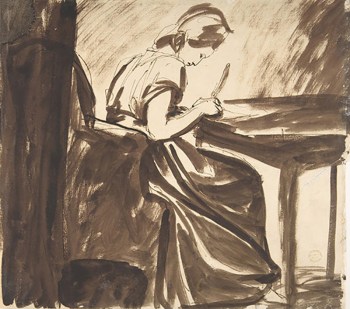
George Romney, Lady Seated at a Table (recto); pen and brown ink, brush and brown wash (NY: The Metropolitan Museum of Art, 11.66.3).
Master Drawings is now accepting submissions for the Fifth Annual Ricciardi Prize for Young Scholars. The winner will receive a cash award of $5,000. The prize is given for the best new and unpublished article on drawings (of any period) by a scholar under the age of 40. The winning submission will be published in a 2023 issue of Master Drawings and will be featured at our annual symposium.
For additional information about essay requirements and how to apply, visit the Master Drawings website, where you can also learn about the broad range of research by past winners of the prize.
Exhibition | Piranesi: A Dream of Stone and and Ink
Now on view at the Mazarin Library:
Piranèse et son empreinte : un rêve de pierre et d’encre
Bibliothèque Mazarine, Paris, 1 March — 14 May 2022
Curated by Yoann Brault with Olivier Thomas and Érik Desmazières
 Figure emblématique de cette « Académie de l’Europe » qu’est Rome au 18e siècle, Piranèse (1720–1778) occupe une place singulière dans notre héritage artistique et notre culture visuelle. Certes, il n’est pas seul à avoir fait accéder l’architecture figurée, réelle ou fictive, à un genre de plein droit. Mais cet artiste au génie impétueux et tourmenté, par la souplesse de sa technique, par ses effets dramatiques dans l’arrangement des lumières, ses disproportions et perspectives inattendues, a produit un univers visuel d’une puissance poétique inégalée.
Piranèse a nourri la veine française du néoclassicisme, et les efforts redoublés de ses fils ont permis de diffuser son oeuvre et d’étendre son influence depuis Rome ou Paris. Mais, après un demi-siècle de fascination, les productions de son génie n’ont pas échappé à l’usure de la curiosité et du goût. Dès la Restauration, les artistes du nouveau siècle se détournent de son empreinte. Bien qu’ici ou là tel amateur célèbre encore la « vigueur » de sa manière, on brocarde bientôt un oeuvre « improvisé avec facilité par l’imagination plutôt que produit par l’étude et par le temps » (Alfred Maury).
Cette déprise n’est pourtant pas totale. La poésie de ses planches, qui a tant et si précocement influencé l’art et la littérature préromantique, fait de Piranèse un passeur inopiné et, de ses Prisons, un motif obsédant que l’on retrouve en Angleterre puis en France, de Thomas De Quincey à Théophile Gautier. Il faut attendre l’entre-deux-guerres pour que le graveur recouvre la faveur des spécialistes, du public et des artistes qui y puisent à nouveau. Peut-être parce que son exploration inquiète du passé, son attrait pour le sublime et la démesure, pour la perte et la détresse, rejoignent les obsessions de notre temps.
Exposition organisée par les bibliothèques Mazarine et de l’Institut de France
Commissariat : Yoann Brault, avec la collaboration d’Olivier Thomas (bibl. de l’Institut)
Conseiller artistique et scientifique : Érik Desmazières (Académie des Beaux-Arts)










 Enfilade
leave a comment