New Book | Animating the Antique
From Penn State UP:
Sarah Betzer, Animating the Antique: Sculptural Encounter in the Age of Aesthetic Theory (University Park: Pennsylvania State University Press, 2022), 272 pages, ISBN: 978-0271088839, $125.
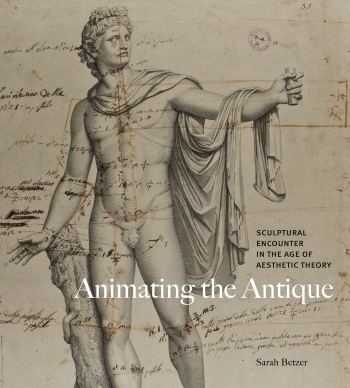 Framed by tensions between figural sculpture experienced in the round and its translation into two-dimensional representations, Animating the Antique explores enthralling episodes in a history of artistic and aesthetic encounters. Moving across varied locations—among them Rome, Florence, Naples, London, Dresden, and Paris—Sarah Betzer explores a history that has yet to be written: that of the Janus-faced nature of interactions with the antique by which sculptures and beholders alike were caught between the promise of animation and the threat of mortification.
Examining the traces of affective and transformative sculptural encounters, the book takes off from the decades marked by the archaeological, art-historical, and art-philosophical developments of the mid-eighteenth century and culminates in fin de siècle anthropological, psychological, and empathic frameworks. It turns on two fundamental and interconnected arguments: that an eighteenth-century ontology of ancient sculpture continued to inform encounters with the antique well into the nineteenth century, and that by attending to the enduring power of this model, we can newly appreciate the distinctively modern terms of antique sculpture’s allure. As Betzer shows, these eighteenth-century developments had far-reaching ramifications for the making and beholding of modern art, the articulations of art theory, the writing of art history, and a significantly queer Nachleben of the antique.
Bold and wide-ranging, Animating the Antique sheds light upon the work of myriad artists, in addition to that of writers ranging from Goethe and Winckelmann to Hegel, Walter Pater, and Vernon Lee. It will be especially welcomed by scholars and students working in eighteenth- and nineteenth-century art history, art writing, and art historiography.
Sarah Betzer is Professor of Art History at the University of Virginia and the author of Ingres and the Studio: Women, Painting, History, also published by Penn State University Press.
Exhibition | Antoine Coypel and the Theater of Troy
Now on view at the Musée des Beaux-Arts de Tours:
Le Théâtre de Troie: Antoine Coypel, d’Homère à Virgile
Musée des Beaux-Arts de Tours, 22 January — 17 April 2022
 L’exposition, présentée au musée des Beaux-Arts de Tours, en partenariat avec la Bibliothèque nationale de France, est une invitation à redécouvrir Antoine Coypel (1661–1722), peintre du roi Louis XIV et du régent Philippe d’Orléans. Aucune exposition monographique concernant Coypel n’a vu le jour jusqu’à présent, mais la connaissance de l’artiste a été récemment enrichie grâce à l’apparition sur le marché de l’art d’oeuvres inédites, à la redécouverte de tableaux que l’on croyait perdus et à la restauration de décors monumentaux, tel le plafond de l’hôtel d’Argenson, sur le point d’être révélé au public aux Archives Nationales. Sans prétendre à l’exhaustivité, l’exposition est une invitation à redécouvrir la personnalité attachante et la carrière prolifique d’Antoine Coypel, ainsi que les grands textes de l’Antiquité, d’Homère et de Virgile, ayant nourri son inspiration.
Autour de La Colère d’Achille et des Adieux d’Hector et Andromaque de Tours, une cinquantaine d’oeuvres des XVIIIᵉ et XIXᵉ siècles (tableaux, estampes, dessins, sculptures, objets d’art et planches gravées) sont réunies, grâce au prêt exceptionnel de la Bibliothèque nationale de France, du château de Versailles, des musées du Louvre, de Rennes, d’Angers, d’Arles, du Mobilier national et de l’École des Beaux-Arts de Paris.
Point d’orgue de l’exposition, la galerie d’Énée du Palais-Royal, chef-d’oeuvre d’Antoine Coypel aujourd’hui disparu, renaît au travers d’estampes spectaculaires de la Bibliothèque nationale de France. Les recherches approfondies menées pour reconstituer ce grand décor ont également permis de concevoir une maquette numérique de la galerie, en partenariat avec le musée Fabre de Montpellier, qui offre pour la première fois une proposition de reconstitution virtuelle en 3D très aboutie.
Une riche programmation culturelle (cycle de conférences, visites, spectacles de danse, musique, théâtre, cycle de péplums à la cinémathèque de Tours, cours d’histoire de l’art tout public, etc.) accompagnera toute la durée de cette exposition.
Le théâtre de Troie: Antoine Coypel, d’Homère à Virgile (Paris: Lienart éditions, 2022), 192 pages, ISBN: 978-2359063547, 23€.
Exhibition | La Fabrique des passions
Now on view at the Musée des Beaux-Arts de Tours:
La Fabrique des passions
Musée des Beaux-Arts de Tours, 17 December 2021 — 28 March 2022
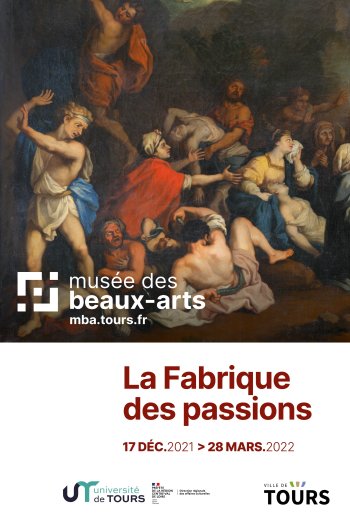 À partir du Serpent d’Airain (anonyme, 17ᵉ siècle) d’après Charles Le Brun, l’exposition La Fabrique des passions propose d’appréhender ce thème dans les arts du 17ᵉ au 19ᵉ siècle. Conformément à la pensée de René Descartes (Traité des passions, 1649), dont Charles Le Brun s’est inspiré, la passion—aujourd’hui synonyme d’émotion—se traduit comme l’expression incontrôlable d’un état affectif qui soumet l’âme et le corps. En 1668, Charles Le Brun, peintre du roi Louis XIV, donne une conférence à l’Académie royale de peinture et de sculpture dans laquelle il définit des modèles types d’expression des différentes passions.
Le parcours de l’exposition construit à partir d’oeuvres issues des réserves comporte trois entrées thématiques :
• les origines des passions dans les sources bibliques et mythologiques
• le théâtre comme nouvelle source d’inspiration des passions héroïques
• l’individualité des passions à travers les portraits et les études de têtes.
Origines des passions
Les origines des passions, observées à la fois d’un point de vue théorique, esthétique, religieux et historique, sont illustrées par trois oeuvres. Le Serpent d’Airain d’après Charles Le Brun, oeuvre maîtresse de l’exposition, présente les prémisses de la codification des passions. Les émotions—telles que l’admiration, l’effroi ou le ravissement—sont mises au service de la narration pour toucher le spectateur. Outre le travail sur l’expressivité des visages et des corps, l’intensité des couleurs participe à cette exaltation des émotions. Les origines des passions sont explorées à travers les thèmes fondateurs de la Bible. Aussi, pour mieux émouvoir, les artistes puisent-ils dans la culture du spectateur. Caïn et Abel (anonyme, 19ᵉ siècle), qui décrit le premier meurtre de l’histoire de l’humanité dans l’Ancien Testament, montre la brutalité de la passion débordante assimilée à la jalousie. La mythologie fournit d’autres sujets iconographiques propices à la mise en scène des passions à l’instar d’histoires légendaires de la Rome antique. L’Enlèvement d’une Sabine (anonyme, 19ᵉ siècle) d’après le chef-d’oeuvre du maniériste Jean de Bologne (16ᵉ siècle), sert ainsi de support plastique à la fabrique moderne d’une nouvelle esthétique des passions. Ici, la peur et la violence charnelle sont évoquées avec force.
Passions héroïques
Le théâtre, qui revisite la culture littéraire classique et savante aux 17ᵉ et 18ᵉ siècles, s’impose comme une nouvelle source d’inspiration de la figuration des passions héroïques. Les scènes de groupe, comme Les Funérailles de Pallas d’après Antoine Coypel (Louis Desplaces, 17ᵉ siècle), présentent une multitude de personnages qui incarnent le deuil, la tristesse et la désolation. Avec sa composition du dessin Briséis enlevée à Achille (18ᵉ siècle), Gaudar de Laverdine sublime les passions par un jeu de théâtralité des corps et des mouvements. Cléopâtre (huile sur toile, anonyme, 17ᵉ siècle) représente quant à elle la passion héroïque des femmes fortes, tout comme Polyxène (gouache, Guillaume Goudin, 18e siècle), princesse troyenne qui se sacrifie à la suite de la disparition de son bien-aimé.
Portraits et passions
Les portraits favorisent la focalisation progressive sur l’individualisation des émotions. À la suite du concours de têtes ouvert à l’initiative du Comte de Caylus (membre de l’Académie né en 1692 et mort en 1765), les études se consacrent désormais à la seule expressivité du visage. Jean-Baptiste Greuze apparaît comme l’archétype de l’artiste traitant de la tête d’expression (Tête de jeune femme, 18ᵉ siècle, copie), thème qui eut un grand succès à Paris et qui trouva également un écho à Tours comme en témoigne l’oeuvre d’Auguste Vinchon (Étude de femme, épisode de l’histoire de Venise, 19ᵉ siècle). L’exposition se conclut par un dessin d’Étienne-Pierre-Adrien Gois (plume et encre, 2ᵉ moitié du 17e siècle). L’autoportrait central, affichant une profonde expression méditative et introspective, est entouré de douze visages féminins et masculins, montrant la diversité des passions humaines. Les caricatures associées aux citations apportent un caractère comique et moralisateur à la lecture de l’image.
Entre théorie académique, théâtralisation et interprétation plus personnelle de la palette des émotions, ces oeuvres illustrent donc la manière dont les artistes se sont confrontés à la difficile codification des passions.
Commissariat
Andy Bodin, Alice Brozzoni, Emeline Chassine, Zoé Machado-Formiga, Marine Nabon, Elodie Poinha, Jurgen Poirier, Clara Roig, étudiant.e.s en Master 2 histoire de l’art, séminaire Pratique de l’exposition, à l’Université de Tours.
Lucie Gaugain, Maître de conférences en Histoire de l’art médiéval à l’Université de Tours, membre du CeTHiS, EA 6298
Delphine Rabier, ATER en Histoire de l’art moderne à l’Université de Tours, chercheur associé au CESR, UMR 7323
Coordination
Hélène Jagot, directrice des Musées-Château de Tours
Virginie Dansault, médiatrice, chargée des publics
Jessica Degain, conservatrice du patrimoine en charge des collections XVIIᵉ–XIXᵉ siècles
Catherine Pimbert, régisseuse des collections
New Book | Queen Hedwig Eleonora and the Arts
From Routledge:
Kristoffer Neville and Lisa Skogh, eds., Queen Hedwig Eleonora and the Arts: Court Culture in Seventeenth-Century Northern Europe (New York: Routlege, 2021), 248 pages, ISBN: 978-1472489609 (hardback), $160 / ISBN: 978-1032097244 (paperback), $49.
 As queen consort and dowager, Hedwig Eleonora (1636–1715) held a unique position in Sweden for more than half a century. As the dominant collector and patron of art and architecture in the realm, she left a strong mark on Swedish court culture. Her dynastic network among the Northern European courts was extensive, and this helped to make Sweden a major cultural center in Northern Europe in the later seventeenth century. This book represents the first major scholarly publication on the full range of Hedwig Eleonora’s endeavours, from the financing of her court to her place within a larger princely network, to her engagements with various cultural pursuits, to her public image. As the contributors show, despite her high profile, political position, and conspicuous patronage, Hedwig Eleonora experienced little of the animosity directed at many other foreign queens and regents, such as the Medici in France and Henrietta Maria in England. In this way, she provides a model for a different and more successful way of negotiating the difficulties of joining a foreign court; the analysis of her circumstances thus adds a substantial dimension to the study of early modern queenship. Presenting much new scholarship, this volume highlights one extremely significant early modern woman and her imprint on Northern European history, and fosters international awareness of the importance of early modern Scandinavia for European cultural history.
Kristoffer Neville is Associate Professor of Art History at the University of California, Riverside. Lisa Skogh is Project Co-Investigator in the Research Department at the Victoria and Albert Museum in London.
C O N T E N T S
1 Kristoffer Neville (University of California, Riverside) and Lisa Skogh (Victoria and Albert Museum), Introduction: Queen Hedwig Eleonora and the Arts
2 Jill Bepler (Herzog August Library, Wolfenbüttel), ‘The Queen of the North’: Hedwig Eleonora and Her German Family in Paint and Print
3 Gabriele Ball (Herzog August Library, Wolfenbüttel), Queen Hedwig Eleonora’s Societal Network within the Tugendliche and the Fruchtbringende Gesellschaft
4 Björn Asker (National Archives, Stockholm), Hedwig Eleonora as Dowager Queen and Administrator
5 Lisa Skogh (V&A Museum), The Pretiosa Cabinet at Ulriksdal Palace
6 Kjell Wangensteen (Princeton University), Hedwig Eleonora as Patron of David Klöcker Ehrenstrahl
7 Mikael Ahlund (Uppsala University Art Museums), The Wilderness inside Drottningholm: David Klöcker Ehrenstrahl and the Northern Nature at the Court of Hedwig Eleonora
8 Lars-Olof Larsson (Christian-Albrecht-University, Kiel), David Klöcker Ehrenstrahlʼs Portraits of Hedwig Eleonoraʼs Siblings: Invention and the Presentation of the Family
9 Lars Ljungström (Royal Collections, Stockholm), Hedwig Eleonora and Building as a Princely Pursuit
10 Kristoffer Neville (University of California, Riverside), Hedwig Eleonora and the Practice of Architecture
11 Anders Jarlert (Lund University), Hedwig Eleonora, Lund University, and the Learned
12 Mara Wade (University of Illinois, Urbana-Champaign), Ballet, Kunstkammer, and the Education of Princess Hedwig Eleonora at the Gottorf Court
13 Maria Schildt (Uppsala University), Hedwig Eleonora and Music at the Swedish Court, 1654–1726
14 Helen Watanabe-O’Kelly (Oxford University), Hedwig Eleonora in Print: From ‘Citronat’ to ‘Wundermutter’
New Book | The Art and Culture of Scandinavian Central Europe
A book that I should have noted several years ago; the ebook appeared in 2021. –CH. From Penn State UP:
Kristoffer Neville, The Art and Culture of Scandinavian Central Europe, 1550–1720 (University Park: Pennsylvania State University Press, 2019), 256 pages, ISBN: 978-0271082257, $90.
 Politically and militarily powerful, early modern Scandinavia played an essential role in the development of Central European culture from the sixteenth to the eighteenth century. In this volume, Kristoffer Neville shows how the cultural ambitions of Denmark and Sweden were inextricably bound to those of other Central European kingdoms. Tracing the visual culture of the Danish and Swedish courts from the Reformation to their eventual decline in the eighteenth century, Neville explains how and why they developed into important artistic centers. He examines major projects by figures largely unknown outside of Northern Europe alongside other, more canonical artists—including Cornelis Floris, Adriaen de Vries, and Johann Bernhard Fischer von Erlach—to propose a more coherent view of this part of Europe, one that rightly includes Scandinavia as a vital component. The seventeenth century has long seemed a bleak moment in Central European culture. Neville’s authoritative and unprecedented study does much to change this perception, showing that the arts did not die in the Reformation and Thirty Years’ War but rather flourished in the Baltic region.
Kristoffer Neville is Associate Professor of Art History at the University of California, Riverside. He is the author of Nicodemus Tessin the Elder: Architecture in Sweden in the Age of Greatness and coeditor of Queen Hedwig Eleonora and the Arts: Court Culture in Seventeenth-Century Northern Europe.
C O N T E N T S
List of Illustrations
Preface and Acknowledgments
Introduction
1 Gothicism in Germania
2 Reform and Reformation
3 Frederik II and the Arts in Denmark in the Later Sixteenth Century
4 Christian IV
5 Minerva’s World
6 Two Queens
7 Absolutism
Epilogue: The Romantic North
Notes
Bibliography
Index
Call for Papers | Marine Worlds of the 18th Century

After Jacques Étienne Victor Arago, Vue de Notre-Dame De bon Voyage (Rade de Rio de Janeiro), 1825
(Wikimedia Commons)
◊ ◊ ◊ ◊ ◊
From the Call for Papers:
18th DNS Seminar: The Marine Worlds of the Long Eighteenth Century
Australian Catholic University, Melbourne, 7–9 December 2022
Proposals due by 1 August 2022
The Australian and New Zealand Society for Eighteenth-Century Studies (ANZSECS) and the Australian Catholic University invite you to the 18th David Nichol Smith (DNS) Seminar for Eighteenth-Century Studies.* In 2022, the DNS will be held on 7–9 December at the ACU Fitzroy Campus in Melbourne. It will convene in-person, but will also feature a digital hub hosting a suite of provocations from colleagues around the world. We are delighted to announce that the seminar will include three keynotes: Lynette Russell, ARC Laureate Professor at Monash University; Kevin Dawson, Associate Professor of History at UC Merced; and Miranda Stanyon, ARC DECRA Research Fellow in the School of Culture and Communication at the University of Melbourne.
We welcome proposals that address our theme The Marine Worlds of the Long Eighteenth Century. We seek to explore and understand the experiences, knowledges, and spaces of the sea and undersea from 1650 to 1850. We are particularly keen to highlight and interrogate how the ‘blue humanities,’ and the environmental humanities in general, are in conversation with the study of the eighteenth century across disciplines.
Topics may include
• human-animal relationships in eighteenth-century oceans
• more-than-human oceans
• ideas and practices exploring ocean depths and sea surfaces
• oceanic lives: Indigenous, Black, gendered, plebeian, mercantile, imperial
• queering the eighteenth-century ocean
• feminist, subaltern, or decolonial knowledges of the marine
• seacraft design and representation
• maritime wrecks, disasters, and salvage operations
• reinterpretations of piracy and seaborne conflict
• marine and maritime labours, both free and unfree
• sensing seascapes: sights, sounds, tastes, and smells
• marine genres / oceanic forms
• aquatic sports, leisure, and culture
• relations between eighteenth-century studies and the blue humanities
• marine geographies, or ‘thalassographies,’ in formation, relation, and conflict
• philosophies and practices of sub/marine science
• sea-languages of the long eighteenth century
• submergence, diving, and drowning
• marine worlds of coasts and shores
• objects, things, and oceanic materialisms
• marine memories, testimonies, and archives
We are seeking proposals for panels, workshops, and roundtables (see below). We are happy to help prospective applicants make connections between people in order to form or participate in a session. If this proves impossible, we will of course then accept a 200-word abstract for an individual paper. We are pleased to offer some travel bursaries to postgraduate students or unemployed scholars to assist in the cost of travel to Melbourne. If you would like to be considered for a travel grant, please indicate so in your proposal and include a three-page CV. Please email proposals to dns.xviii@gmail.com by Monday, 1 August 2022.
S E S S I O N V A R I E T I E S
Panel of 90 minutes — 4 × 15-minute papers with a chair. Please submit a proposal with a title that covers your broad topic, the name and email of the main correspondent for the panel, the names of the four speakers, and 4 × 100-word abstracts (one for each prospective paper). You are welcome also to include a chair, or we can arrange one for you.
Panel of 60 minutes — 2 × 15-minute papers with a commentator. Please submit a proposal with a title that covers your broad topic, the name and email of the main correspondent for the panel, the names of the two speakers, and 2 × 100-word abstracts (one for each prospective paper). Please also arrange for a commentator who will reflect for 10 minutes on the paired papers.
Workshop of 60 minutes — This will involve group discussion of 2 × pre-circulated new works-in-progress. Please submit a proposal with a title, the name and email of the main correspondent for the workshop, and the names of the two scholars who will pre-circulate their article/chapter-length drafts for discussion, as well as a 100-word abstract for each. You are welcome also to include a chair-discussant, or we can arrange one for you.
Roundtable of 90 or 60 minutes — This has an open format but must include only short talks by participants that all speak to a central question or issue within the field of eighteenth-century marine studies. Please submit a proposal with a title that signals the key problem, a 200-word abstract for the roundtable, the name and email of the main correspondent/moderator for the roundtable, and the names of all the other participants.
As with previous DNS conferences, we aim to pursue a publication of some work arising from the seminar. We are already in talks with two interested publishers.
Convenors: Kristie Flannery, Kate Fullagar, Killian Quigley
* Inaugurated in 1966 by the National Library of Australia, the DNS is the leading forum for eighteenth-century studies in Australasia. It brings together scholars from across the region and internationally who work on the long eighteenth century in a range of disciplines, including history, literature, Indigenous studies, art and architectural history, philosophy, theology, the history of science, musicology, anthropology, archaeology, and studies of material culture.
New Book | The Sun King at Sea
From The Getty:
Meredith Martin and Gillian Weiss, The Sun King at Sea: Maritime Art and Galley Slavery in Louis XIV’s France (Los Angeles: Getty Research Institute, 2022), 256 pages, ISBN 978-1606067307, $60.
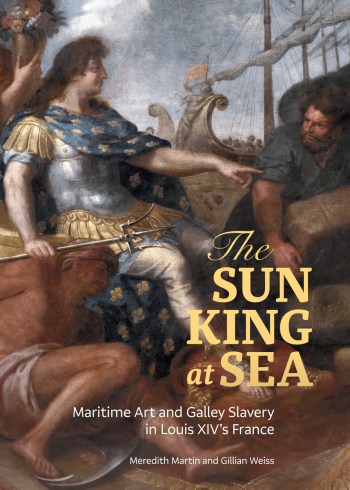 This richly illustrated volume, the first devoted to maritime art and galley slavery in early modern France, shows how royal propagandists used the image and labor of enslaved Muslims to glorify Louis XIV.
Mediterranean maritime art and the forced labor on which it depended were fundamental to the politics and propaganda of France’s King Louis XIV (r. 1643–1715). Yet most studies of French art in this period focus on Paris and Versailles, overlooking the presence or portrayal of galley slaves on the kingdom’s coasts. By examining a wide range of artistic productions—ship design, artillery sculpture, medals, paintings, and prints—Meredith Martin and Gillian Weiss uncover a vital aspect of royal representation and unsettle a standard picture of art and power in early modern France.
With an abundant selection of startling images, many never before published, The Sun King at Sea emphasizes the role of esclaves turcs (enslaved Turks)—rowers who were captured or purchased from Islamic lands—in building and decorating ships and other art objects that circulated on land and by sea to glorify the Crown. Challenging the notion that human bondage vanished from continental France, this cross-disciplinary volume invites a reassessment of servitude as a visible condition, mode of representation, and symbol of sovereignty during Louis XIV’s reign.
Meredith Martin is associate professor at New York University. She is an art historian specializing in French art, architecture, empire, and intercultural exchange from the late seventeenth to early nineteenth centuries. Gillian Weiss is professor at Case Western Reserve University. She is a historian specializing in early modern France, its relations with the Islamic world, and Mediterranean slavery.
C O N T E N T S
Acknowledgments
Author’s Note
Abbreviations
Introduction
1 Turks at Work: Building the Marseille Arsenal
2 Port to Palace: Mediterranean Dominance at Paris and Versailles
3 Civility and Barbarism: Enslaved Turks in Maritime Ceremonies and Manuals
4 Spectacles of Suffering: Galley Slaves and Plague
Epilogue
Illustration Credits
About the Authors
Index
Exhibition | Arte Sacra: Roman Catholic Art from Portuguese India
Now on view at NOMA:
Arte Sacra: Roman Catholic Art from Portuguese India
New Orleans Museum of Art, 13 March 2020 — 15 May 2022
Curated by Robert J. Del Bontà

Our Lady of the Rosary, 18th century, wood, with polychrome and gilt, 36 inches high (Collection Dr. Siddharth K. Bhansali).
In the centuries following the arrival of Francis Xavier, a Catholic missionary, in 1542, the state of Goa in western India became the administrative and economic center of a Portuguese empire that extended west to Africa and east to Malaysia, China, and Japan. The vast trade networks established by the Portuguese and Spanish allowed not only for the spread of Christianity, but also an unprecedented artistic exchange within these colonial empires. Works of art and valuable materials traveled between Spain, Portugal, and their colonies, leading to the development of new visual traditions informed by European imagery and local idioms.
European missionaries brought with them paintings, sculpture, and devotional objects for use in their evangelization efforts. Sculptures of saints and apostles, the Virgin Mary, Christ, and angels, made of wood and ivory, such as those seen in Arte Sacra, were created by Goan artists from Hindu and convert families. Initially based upon European prototypes, over time many works came to marry Christian imagery and symbols with local traditions. These works not only graced the interiors of European-style churches in Goa, but were also exported to Europe for use in religious establishments and for private devotion.
This exhibition, from the collection of Dr. Siddharth Bhansali, a New Orleans-based physician, reveals both the global influence of European seventeenth- and eighteenth-century styles, as well as the transformation of these styles in the hands of local artists creating a new visual tradition.
Robert J. Del Bontà, guest curator of Arte Sacra: Roman Catholic Art from Portuguese India, is an independent scholar of Indian art, who received his PhD from the University of Michigan in 1978. He has published numerous articles, contributed to scholarly publications, and curated exhibitions for the Berkeley Art Museum, the Portland Art Museum, and the University of Michigan Museum of Art. He provides a video tour of the exhibition here.
New Book | Who’s Black and Why?
Forthcoming from Harvard UP:
Henry Louis Gates, Jr. and Andrew Curran, eds., Who’s Black and Why? A Hidden Chapter from the Eighteenth-Century Invention of Race (Cambridge: Belknap Press, 2022), 320 pages, ISBN: 978-0674244269, $30 / £24 / €27.
 The first translation and publication of sixteen submissions to the notorious eighteenth-century Bordeaux essay contest on the cause of ‘black’ skin—an indispensable chronicle of the rise of scientifically based, anti-Black racism.
In 1739 Bordeaux’s Royal Academy of Sciences announced a contest for the best essay on the sources of ‘blackness’. What is the physical cause of blackness and African hair, and what is the cause of Black degeneration, the contest announcement asked. Sixteen essays, written in French and Latin, were ultimately dispatched from all over Europe. The authors ranged from naturalists to physicians, theologians to amateur savants. Documented on each page are European ideas about who is Black and why.
Looming behind these essays is the fact that some four million Africans had been kidnapped and shipped across the Atlantic by the time the contest was announced. The essays themselves represent a broad range of opinions. Some affirm that Africans had fallen from God’s grace; others that blackness had resulted from a brutal climate; still others emphasized the anatomical specificity of Africans. All the submissions nonetheless circulate around a common theme: the search for a scientific understanding of the new concept of race. More important, they provide an indispensable record of the Enlightenment-era thinking that normalized the sale and enslavement of Black human beings.
These never previously published documents survived the centuries tucked away in Bordeaux’s municipal library. Translated into English and accompanied by a detailed introduction and headnotes written by Henry Louis Gates, Jr., and Andrew Curran, each essay included in this volume lays bare the origins of anti-Black racism and colorism in the West.
Henry Louis Gates, Jr., is the author of numerous books and has written extensively on the history of race and anti-Black racism in the Enlightenment. His most recent works include Stony the Road and The Black Church. He is the Alphonse Fletcher University Professor and Director of the Hutchins Center for African and African American Research at Harvard University.
Andrew S. Curran is a leading specialist of the Enlightenment era and the author of The Anatomy of Blackness and Diderot and the Art of Thinking Freely. He is the William Armstrong Professor of the Humanities at Wesleyan University.
C O N T E N T S
Preface: Who’s Black and Why?
Note on the Translations
I. The 1741 Contest on the ‘Degeneration’ of Black Skin and Hair
Introduction
1 Blackness through the Power of God
2 Blackness through the Soul of the Father
3 Blackness through the Maternal Imagination
4 Blackness as a Moral Defect
5 Blackness as a Result of the Torrid Zone
6 Blackness as a Result of Divine Providence
7 Blackness as a Result of Heat and Humidity
8 Blackness as a Reversible Accident
9 Blackness as a Result of Hot Air and Darkened Blood
10 Blackness as a Result of a Darkened Humor
11 Blackness as a Result of Blood Flow
12 Blackness as an Extension of Optical Theory
13 Blackness as a Result of an Original Sickness
14 Blackness Degenerated
15 Blackness Classified
16 Blackness Dissected
II. The 1772 Contest on ‘Preserving’ Negroes
Introduction
1 A Slave Ship Surgeon on the Crossing
2 A Parisian Humanitarian on the Slave Trade
3 Louis Alphonse, Bordeaux Apothecary, on the Crossing
Select Chronology of the Representation of Africans and Race
Notes
Acknowledgments
Credits
Index
New Book | Born in Blackness
From Norton:
Howard French, Born in Blackness: Africa, Africans, and the Making of the Modern World, 1471 to the Second World War (New York: Liveright: 2021), 512 pages, ISBN: 978-1631495823, $35.
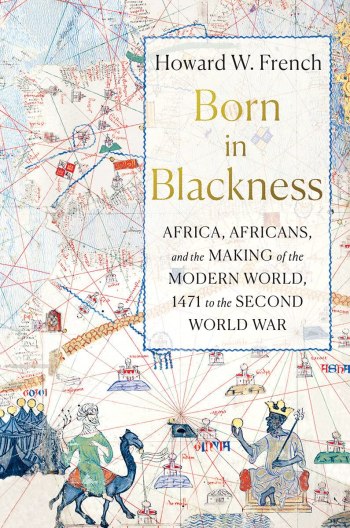 Traditional accounts of the making of the modern world afford a place of primacy to European history. Some credit the fifteenth-century Age of Discovery and the maritime connection it established between West and East; others the accidental unearthing of the ‘New World’. Still others point to the development of the scientific method, or the spread of Judeo-Christian beliefs; and so on, ad infinitum. The history of Africa, by contrast, has long been relegated to the remote outskirts of our global story. What if, instead, we put Africa and Africans at the very center of our thinking about the origins of modernity?
In a sweeping narrative spanning more than six centuries, Howard W. French does just that, for Born in Blackness vitally reframes the story of medieval and emerging Africa, demonstrating how the economic ascendancy of Europe, the anchoring of democracy in the West, and the fulfillment of so-called Enlightenment ideals all grew out of Europe’s dehumanizing engagement with the ‘dark’ continent. In fact, French reveals, the first impetus for the Age of Discovery was not―as we are so often told, even today―Europe’s yearning for ties with Asia, but rather its centuries-old desire to forge a trade in gold with legendarily rich Black societies sequestered away in the heart of West Africa.
Creating a historical narrative that begins with the commencement of commercial relations between Portugal and Africa in the fifteenth century and ends with the onset of World War II, Born in Blackness interweaves precise historical detail with poignant, personal reportage. In so doing, it dramatically retrieves the lives of major African historical figures, from the unimaginably rich medieval emperors who traded with the Near East and beyond, to the Kongo sovereigns who heroically battled seventeenth-century European powers, to the ex-slaves who liberated Haitians from bondage and profoundly altered the course of American history.
While French cogently demonstrates the centrality of Africa to the rise of the modern world, Born in Blackness becomes, at the same time, a far more significant narrative, one that reveals a long-concealed history of trivialization and, more often, elision in depictions of African history throughout the last five hundred years. As French shows, the achievements of sovereign African nations and their now-far-flung peoples have time and again been etiolated and deliberately erased from modern history. As the West ascended, their stories―siloed and piecemeal―were swept into secluded corners, thus setting the stage for the hagiographic ‘rise of the West’ theories that have endured to this day.
“Capacious and compelling” (Laurent Dubois), Born in Blackness is epic history on the grand scale. In the lofty tradition of bold, revisionist narratives, it reframes the story of gold and tobacco, sugar and cotton―and of the greatest ‘commodity’ of them all, the twelve million people who were brought in chains from Africa to the ‘New World’, whose reclaimed lives shed a harsh light on our present world.
Howard W. French is a professor at the Columbia University Graduate School of Journalism. Prior to joining the Columbia faculty, in 2008, he was a reporter and senior writer for The New York Times, where he worked as a foreign correspondent for more than two decades. During this time, French served as the paper’s bureau chief in Shanghai, Tokyo, Abidjan and Miami (covering Central America and the Caribbean).










 Enfilade
leave a comment