Call for Papers | Marine Worlds of the 18th Century

After Jacques Étienne Victor Arago, Vue de Notre-Dame De bon Voyage (Rade de Rio de Janeiro), 1825
(Wikimedia Commons)
◊ ◊ ◊ ◊ ◊
From the Call for Papers:
18th DNS Seminar: The Marine Worlds of the Long Eighteenth Century
Australian Catholic University, Melbourne, 7–9 December 2022
Proposals due by 1 August 2022
The Australian and New Zealand Society for Eighteenth-Century Studies (ANZSECS) and the Australian Catholic University invite you to the 18th David Nichol Smith (DNS) Seminar for Eighteenth-Century Studies.* In 2022, the DNS will be held on 7–9 December at the ACU Fitzroy Campus in Melbourne. It will convene in-person, but will also feature a digital hub hosting a suite of provocations from colleagues around the world. We are delighted to announce that the seminar will include three keynotes: Lynette Russell, ARC Laureate Professor at Monash University; Kevin Dawson, Associate Professor of History at UC Merced; and Miranda Stanyon, ARC DECRA Research Fellow in the School of Culture and Communication at the University of Melbourne.
We welcome proposals that address our theme The Marine Worlds of the Long Eighteenth Century. We seek to explore and understand the experiences, knowledges, and spaces of the sea and undersea from 1650 to 1850. We are particularly keen to highlight and interrogate how the ‘blue humanities,’ and the environmental humanities in general, are in conversation with the study of the eighteenth century across disciplines.
Topics may include
• human-animal relationships in eighteenth-century oceans
• more-than-human oceans
• ideas and practices exploring ocean depths and sea surfaces
• oceanic lives: Indigenous, Black, gendered, plebeian, mercantile, imperial
• queering the eighteenth-century ocean
• feminist, subaltern, or decolonial knowledges of the marine
• seacraft design and representation
• maritime wrecks, disasters, and salvage operations
• reinterpretations of piracy and seaborne conflict
• marine and maritime labours, both free and unfree
• sensing seascapes: sights, sounds, tastes, and smells
• marine genres / oceanic forms
• aquatic sports, leisure, and culture
• relations between eighteenth-century studies and the blue humanities
• marine geographies, or ‘thalassographies,’ in formation, relation, and conflict
• philosophies and practices of sub/marine science
• sea-languages of the long eighteenth century
• submergence, diving, and drowning
• marine worlds of coasts and shores
• objects, things, and oceanic materialisms
• marine memories, testimonies, and archives
We are seeking proposals for panels, workshops, and roundtables (see below). We are happy to help prospective applicants make connections between people in order to form or participate in a session. If this proves impossible, we will of course then accept a 200-word abstract for an individual paper. We are pleased to offer some travel bursaries to postgraduate students or unemployed scholars to assist in the cost of travel to Melbourne. If you would like to be considered for a travel grant, please indicate so in your proposal and include a three-page CV. Please email proposals to dns.xviii@gmail.com by Monday, 1 August 2022.
S E S S I O N V A R I E T I E S
Panel of 90 minutes — 4 × 15-minute papers with a chair. Please submit a proposal with a title that covers your broad topic, the name and email of the main correspondent for the panel, the names of the four speakers, and 4 × 100-word abstracts (one for each prospective paper). You are welcome also to include a chair, or we can arrange one for you.
Panel of 60 minutes — 2 × 15-minute papers with a commentator. Please submit a proposal with a title that covers your broad topic, the name and email of the main correspondent for the panel, the names of the two speakers, and 2 × 100-word abstracts (one for each prospective paper). Please also arrange for a commentator who will reflect for 10 minutes on the paired papers.
Workshop of 60 minutes — This will involve group discussion of 2 × pre-circulated new works-in-progress. Please submit a proposal with a title, the name and email of the main correspondent for the workshop, and the names of the two scholars who will pre-circulate their article/chapter-length drafts for discussion, as well as a 100-word abstract for each. You are welcome also to include a chair-discussant, or we can arrange one for you.
Roundtable of 90 or 60 minutes — This has an open format but must include only short talks by participants that all speak to a central question or issue within the field of eighteenth-century marine studies. Please submit a proposal with a title that signals the key problem, a 200-word abstract for the roundtable, the name and email of the main correspondent/moderator for the roundtable, and the names of all the other participants.
As with previous DNS conferences, we aim to pursue a publication of some work arising from the seminar. We are already in talks with two interested publishers.
Convenors: Kristie Flannery, Kate Fullagar, Killian Quigley
* Inaugurated in 1966 by the National Library of Australia, the DNS is the leading forum for eighteenth-century studies in Australasia. It brings together scholars from across the region and internationally who work on the long eighteenth century in a range of disciplines, including history, literature, Indigenous studies, art and architectural history, philosophy, theology, the history of science, musicology, anthropology, archaeology, and studies of material culture.
New Book | The Sun King at Sea
From The Getty:
Meredith Martin and Gillian Weiss, The Sun King at Sea: Maritime Art and Galley Slavery in Louis XIV’s France (Los Angeles: Getty Research Institute, 2022), 256 pages, ISBN 978-1606067307, $60.
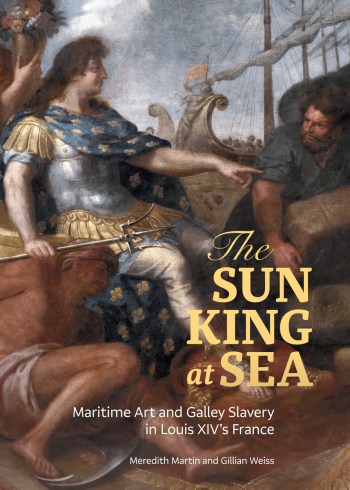 This richly illustrated volume, the first devoted to maritime art and galley slavery in early modern France, shows how royal propagandists used the image and labor of enslaved Muslims to glorify Louis XIV.
Mediterranean maritime art and the forced labor on which it depended were fundamental to the politics and propaganda of France’s King Louis XIV (r. 1643–1715). Yet most studies of French art in this period focus on Paris and Versailles, overlooking the presence or portrayal of galley slaves on the kingdom’s coasts. By examining a wide range of artistic productions—ship design, artillery sculpture, medals, paintings, and prints—Meredith Martin and Gillian Weiss uncover a vital aspect of royal representation and unsettle a standard picture of art and power in early modern France.
With an abundant selection of startling images, many never before published, The Sun King at Sea emphasizes the role of esclaves turcs (enslaved Turks)—rowers who were captured or purchased from Islamic lands—in building and decorating ships and other art objects that circulated on land and by sea to glorify the Crown. Challenging the notion that human bondage vanished from continental France, this cross-disciplinary volume invites a reassessment of servitude as a visible condition, mode of representation, and symbol of sovereignty during Louis XIV’s reign.
Meredith Martin is associate professor at New York University. She is an art historian specializing in French art, architecture, empire, and intercultural exchange from the late seventeenth to early nineteenth centuries. Gillian Weiss is professor at Case Western Reserve University. She is a historian specializing in early modern France, its relations with the Islamic world, and Mediterranean slavery.
C O N T E N T S
Acknowledgments
Author’s Note
Abbreviations
Introduction
1 Turks at Work: Building the Marseille Arsenal
2 Port to Palace: Mediterranean Dominance at Paris and Versailles
3 Civility and Barbarism: Enslaved Turks in Maritime Ceremonies and Manuals
4 Spectacles of Suffering: Galley Slaves and Plague
Epilogue
Illustration Credits
About the Authors
Index
Exhibition | Arte Sacra: Roman Catholic Art from Portuguese India
Now on view at NOMA:
Arte Sacra: Roman Catholic Art from Portuguese India
New Orleans Museum of Art, 13 March 2020 — 15 May 2022
Curated by Robert J. Del Bontà

Our Lady of the Rosary, 18th century, wood, with polychrome and gilt, 36 inches high (Collection Dr. Siddharth K. Bhansali).
In the centuries following the arrival of Francis Xavier, a Catholic missionary, in 1542, the state of Goa in western India became the administrative and economic center of a Portuguese empire that extended west to Africa and east to Malaysia, China, and Japan. The vast trade networks established by the Portuguese and Spanish allowed not only for the spread of Christianity, but also an unprecedented artistic exchange within these colonial empires. Works of art and valuable materials traveled between Spain, Portugal, and their colonies, leading to the development of new visual traditions informed by European imagery and local idioms.
European missionaries brought with them paintings, sculpture, and devotional objects for use in their evangelization efforts. Sculptures of saints and apostles, the Virgin Mary, Christ, and angels, made of wood and ivory, such as those seen in Arte Sacra, were created by Goan artists from Hindu and convert families. Initially based upon European prototypes, over time many works came to marry Christian imagery and symbols with local traditions. These works not only graced the interiors of European-style churches in Goa, but were also exported to Europe for use in religious establishments and for private devotion.
This exhibition, from the collection of Dr. Siddharth Bhansali, a New Orleans-based physician, reveals both the global influence of European seventeenth- and eighteenth-century styles, as well as the transformation of these styles in the hands of local artists creating a new visual tradition.
Robert J. Del Bontà, guest curator of Arte Sacra: Roman Catholic Art from Portuguese India, is an independent scholar of Indian art, who received his PhD from the University of Michigan in 1978. He has published numerous articles, contributed to scholarly publications, and curated exhibitions for the Berkeley Art Museum, the Portland Art Museum, and the University of Michigan Museum of Art. He provides a video tour of the exhibition here.
New Book | Who’s Black and Why?
Forthcoming from Harvard UP:
Henry Louis Gates, Jr. and Andrew Curran, eds., Who’s Black and Why? A Hidden Chapter from the Eighteenth-Century Invention of Race (Cambridge: Belknap Press, 2022), 320 pages, ISBN: 978-0674244269, $30 / £24 / €27.
 The first translation and publication of sixteen submissions to the notorious eighteenth-century Bordeaux essay contest on the cause of ‘black’ skin—an indispensable chronicle of the rise of scientifically based, anti-Black racism.
In 1739 Bordeaux’s Royal Academy of Sciences announced a contest for the best essay on the sources of ‘blackness’. What is the physical cause of blackness and African hair, and what is the cause of Black degeneration, the contest announcement asked. Sixteen essays, written in French and Latin, were ultimately dispatched from all over Europe. The authors ranged from naturalists to physicians, theologians to amateur savants. Documented on each page are European ideas about who is Black and why.
Looming behind these essays is the fact that some four million Africans had been kidnapped and shipped across the Atlantic by the time the contest was announced. The essays themselves represent a broad range of opinions. Some affirm that Africans had fallen from God’s grace; others that blackness had resulted from a brutal climate; still others emphasized the anatomical specificity of Africans. All the submissions nonetheless circulate around a common theme: the search for a scientific understanding of the new concept of race. More important, they provide an indispensable record of the Enlightenment-era thinking that normalized the sale and enslavement of Black human beings.
These never previously published documents survived the centuries tucked away in Bordeaux’s municipal library. Translated into English and accompanied by a detailed introduction and headnotes written by Henry Louis Gates, Jr., and Andrew Curran, each essay included in this volume lays bare the origins of anti-Black racism and colorism in the West.
Henry Louis Gates, Jr., is the author of numerous books and has written extensively on the history of race and anti-Black racism in the Enlightenment. His most recent works include Stony the Road and The Black Church. He is the Alphonse Fletcher University Professor and Director of the Hutchins Center for African and African American Research at Harvard University.
Andrew S. Curran is a leading specialist of the Enlightenment era and the author of The Anatomy of Blackness and Diderot and the Art of Thinking Freely. He is the William Armstrong Professor of the Humanities at Wesleyan University.
C O N T E N T S
Preface: Who’s Black and Why?
Note on the Translations
I. The 1741 Contest on the ‘Degeneration’ of Black Skin and Hair
Introduction
1 Blackness through the Power of God
2 Blackness through the Soul of the Father
3 Blackness through the Maternal Imagination
4 Blackness as a Moral Defect
5 Blackness as a Result of the Torrid Zone
6 Blackness as a Result of Divine Providence
7 Blackness as a Result of Heat and Humidity
8 Blackness as a Reversible Accident
9 Blackness as a Result of Hot Air and Darkened Blood
10 Blackness as a Result of a Darkened Humor
11 Blackness as a Result of Blood Flow
12 Blackness as an Extension of Optical Theory
13 Blackness as a Result of an Original Sickness
14 Blackness Degenerated
15 Blackness Classified
16 Blackness Dissected
II. The 1772 Contest on ‘Preserving’ Negroes
Introduction
1 A Slave Ship Surgeon on the Crossing
2 A Parisian Humanitarian on the Slave Trade
3 Louis Alphonse, Bordeaux Apothecary, on the Crossing
Select Chronology of the Representation of Africans and Race
Notes
Acknowledgments
Credits
Index
New Book | Born in Blackness
From Norton:
Howard French, Born in Blackness: Africa, Africans, and the Making of the Modern World, 1471 to the Second World War (New York: Liveright: 2021), 512 pages, ISBN: 978-1631495823, $35.
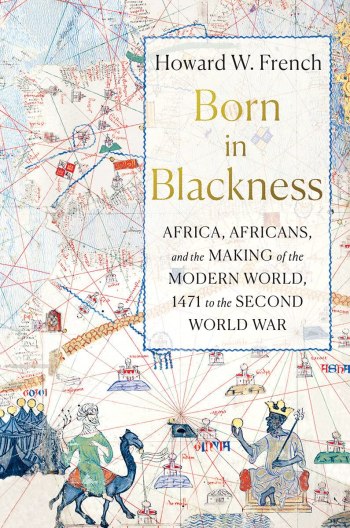 Traditional accounts of the making of the modern world afford a place of primacy to European history. Some credit the fifteenth-century Age of Discovery and the maritime connection it established between West and East; others the accidental unearthing of the ‘New World’. Still others point to the development of the scientific method, or the spread of Judeo-Christian beliefs; and so on, ad infinitum. The history of Africa, by contrast, has long been relegated to the remote outskirts of our global story. What if, instead, we put Africa and Africans at the very center of our thinking about the origins of modernity?
In a sweeping narrative spanning more than six centuries, Howard W. French does just that, for Born in Blackness vitally reframes the story of medieval and emerging Africa, demonstrating how the economic ascendancy of Europe, the anchoring of democracy in the West, and the fulfillment of so-called Enlightenment ideals all grew out of Europe’s dehumanizing engagement with the ‘dark’ continent. In fact, French reveals, the first impetus for the Age of Discovery was not―as we are so often told, even today―Europe’s yearning for ties with Asia, but rather its centuries-old desire to forge a trade in gold with legendarily rich Black societies sequestered away in the heart of West Africa.
Creating a historical narrative that begins with the commencement of commercial relations between Portugal and Africa in the fifteenth century and ends with the onset of World War II, Born in Blackness interweaves precise historical detail with poignant, personal reportage. In so doing, it dramatically retrieves the lives of major African historical figures, from the unimaginably rich medieval emperors who traded with the Near East and beyond, to the Kongo sovereigns who heroically battled seventeenth-century European powers, to the ex-slaves who liberated Haitians from bondage and profoundly altered the course of American history.
While French cogently demonstrates the centrality of Africa to the rise of the modern world, Born in Blackness becomes, at the same time, a far more significant narrative, one that reveals a long-concealed history of trivialization and, more often, elision in depictions of African history throughout the last five hundred years. As French shows, the achievements of sovereign African nations and their now-far-flung peoples have time and again been etiolated and deliberately erased from modern history. As the West ascended, their stories―siloed and piecemeal―were swept into secluded corners, thus setting the stage for the hagiographic ‘rise of the West’ theories that have endured to this day.
“Capacious and compelling” (Laurent Dubois), Born in Blackness is epic history on the grand scale. In the lofty tradition of bold, revisionist narratives, it reframes the story of gold and tobacco, sugar and cotton―and of the greatest ‘commodity’ of them all, the twelve million people who were brought in chains from Africa to the ‘New World’, whose reclaimed lives shed a harsh light on our present world.
Howard W. French is a professor at the Columbia University Graduate School of Journalism. Prior to joining the Columbia faculty, in 2008, he was a reporter and senior writer for The New York Times, where he worked as a foreign correspondent for more than two decades. During this time, French served as the paper’s bureau chief in Shanghai, Tokyo, Abidjan and Miami (covering Central America and the Caribbean).
Exhibition | The Regency Wardrobe at the Royal Pavilion
From the press release for the exhibition:
The Regency Wardrobe at the Royal Pavilion
Royal Pavilion, Brighton, 19 March — 11 September 2022
 At the Royal Pavilion a display of costumes inspired by Regency history tell stories of seafront promenading, grand balls and musical evenings. Each unique piece is created by artist Stephanie Smart, using only paper and thread. The Regency Wardrobe is a collection of imagined garments whose design reflects the fashion, style, and history of the Regency era. With decoration directly inspired by aspects of its interiors, ball gowns, walking dresses, parasols, and bags bring life to the beautiful rooms of the Royal Pavilion.
The centrepiece of the exhibition is a new dress created for the Royal Pavilion and on display in the magnificent Music Room. Symphony of Stars is a stunning life-sized court dress inspired by the architecture of the Music Room and the Chinese wallpaper in the palace. Stars made of rolled paper decorate the border of the train, platinum in colour in honour of the platinum Jubilee of Queen Elizabeth II
The show taps into the current obsession with Regency fashion inspired by hit Netflix series Bridgerton, which returns this year and will fascinate fans of Jane Austen and Georgette Heyer. The exquisite and complex nature of the items on display spans the divide between historic research, fine art, and costume design to create unique works of art which are enhanced by the glorious setting of the Royal Pavilion.
Artist Stephanie Smart said: “The Regency Wardrobe has taken nearly three years to design and make. Throughout that the decoration and history of the Royal Pavilion has been a corner stone of my research. I’m very excited to be seeing the pieces on display in rooms that sum up the possibilities of the time and would have been known intimately by the Prince Regent himself.”
CEO of RPMT Hedley Swain said: “We are so pleased to have these beautiful, ethereal works of art at the Royal Pavilion, particularly as some of them were directly inspired by the interiors where they will now be on show. Stephanie’s creations not only complement the Regency history of the Royal Pavilion but add to its magical nature.”
In 2017 Stephanie formally established The House of Embroidered Paper, a unique fashion house/fine art studio. Each piece produced is a work of paper textiles, created using only paper and thread—inspired by period and place, history and story.
Developing her use of paper as a medium for garment construction, with embroidered and applied decoration, The Regency Wardrobe is Stephanie’s second major collection. It includes pieces which re-interpret the popular two-dimensional Regency art form of the paper cut silhouette as three-dimensional garments. Each one linked to a real woman from the time. By working closely with volunteers from The Regency Town House Heritage Centre, Hove and with special access to The Royal Pavilion Stephanie has created a collection that’s broader in scope in terms of its relationship to a particular area, and historical era, than any she has worked on previously.
Whilst the collection as a whole reflects social and cultural influences from the longer Regency era (1795 to 1837) and celebrates the bicentennial of the end of the formal Regency in 1820 the finale piece Symphony of Stars links directly to the year in which it will be displayed, 2022. Stars made of rolled paper decorate the border of the train, they are platinum in colour in honour of the platinum Jubilee of Queen Elizabeth II and placed in lieu of the notes of a symphony by British astronomer William Herschel, the bicentennial of whose death it is this year.
In order to inform her understanding of the pieces she makes Stephanie visits museum stores and private collections to see real garments from different periods of history. These are documented on her website under the title ‘The Hidden Wardrobe’.
Stephanie began working with heritage sites in 2016 when she began her collection titled Maison de Paier. As inspiration she collected stories from some of the present residents of the Grade 1 listed Elizabethan mansion, Danny House in Hurtspierpoint, Sussex. With WWII veterans amongst their number and with the history of the house itself to draw on, this collection included a 17th-century court dress, a 1950s swing dress, and a pair of gauntlets. The Victorian era dress from this collection Lady of the House can be seen on the Royal Pavilion’s upper floor. Based on that experience Stephanie has set up an ongoing research project The Talking Wardrobe with the ambition of collating stories over time from individuals regarding garments once worn as a basis for her future work. Stephanie’s work has twice been featured on the BBC’s South East Today.
New Book | Narrative, Catastrophe, and Historicity
From Liverpool UP:
Jessica Stacey, Narrative, Catastrophe, and Historicity in Eighteenth-Century French Literature (Oxford: Oxford University Studies in the Enlightenment, 2022), 384 pages, ISBN: 978-1800856004, £65 / $100.
 Voltaire Foundation in association with Liverpool University Press
How do communities tell and retell stories of catastrophe to explain their own origins, imagine their future, and work for their survival? This book contends that such stories are central to how communities claim a position within history. It explores this question, so vital for our present moment, through narratives produced in eighteenth-century France: a tumultuous period when a new understanding of a properly ‘modern’ national history was being elaborated. Who gets to belong to the modern era? And who or what is relegated to a gothic, barbarous or medieval past? Is an enlightened future assured, or is a return to a Dark Age inevitable? Following barbarians, bastards, usurpers, prophets and Revolutionary martyrs through stories of catastrophes real and imagined, the book traces how narrative temporalities become historicities: visions of the laws which govern the past, present and future. Ultimately it argues that the complex temporality of catastrophe offers a privileged insight into how a modern French historical consciousness was formed out of the multiple pasts and possible futures that coexisted alongside the age of Enlightenment. Further, examining the tension between a desire to place the imagined community definitively beyond catastrophic times, and a fascination with catastrophe in its revelatory or regenerative aspect, it offers an important historical perspective on the presence of this same tension in the stories of catastrophe that we tell in our own multiple, tumultuous present.
Jessica Stacey is a Career Development Fellow in French at The Queen’s College, Oxford and has a PhD from King’s College London. Her research interests include catastrophe and time, civilisation and barbarism, story and community; she has also published on Antillean volcanoes and queer readings of Rousseau.
C O N T E N T S
List of Illustrations
Preface and Acknowledgements
A Note on Translations
Introduction: Authors of Catastrophe
• A brief history of catastrophe
• Orders of time, regimes of historicity
• Chapter outlines
1 Bringing Catastrophe: Barbare (br)others, in and around the Encyclopédie
• Civilisation and its barbare catastrophes: from Deluge to Babel
• The barbare speaks: from scholastic Latin to French
• Seeking a constant referent: can language be fixed?
• Génie, énergie, poésie: grounds for a positive barbare
• Conclusion
2 Suffering Catastrophe: Legitimate and illegitimate lines in Baculard d’Arnaud’s medievalist works
• The usurper’s world: ‘Everything tends directly to the catastrophe’
• Genres of catastrophe, or drames nationaux
• The crisis of ‘Salisbury’ and the catastrophe of ‘Varbeck’
• ‘The crusades are assuredly one of the most important revolutions of the human spirit’: ‘Le sire de Créqui’
• Medieval aesthetics as site of resistance and source of anxiety
• Conclusion
3 Prophesying Catastrophe, Predicting Utopia: The time travellers of Mercier’s prose tableaux
• Temporal belonging and exclusion in the tableau
• Ruination and destruction
• Conclusion
4 Witnessing Catastrophe as Revelation: Doing time with Latude and Sade, modern martyrs
• Narrative contested: ‘a single day has carried us into a new age’
• A troubling martyr: the body and the book
• The libertine body, Sade’s book: temporality to historicity?
• Conclusion
Conclusion
Works Cited
Pre-1900 works
Paintings
Post-1900 works
Index
Call for Papers | Castrations: Between History and Gender Studies
From the Call for Papers:
Castrations: Entre histoire et études de genre
Université d’Angers, 17–18 November 2022
Organized by Nahema Hanafi and Nathalie Branchu
Proposals due by 31 March 2022
In association with of the ANR JCJC program Les castrats: Expériences de l’altérité au siècle des Lumières ANR-21-CE41-0001
Depuis la seconde moitié du 20e siècle, la castration humaine—qui dans sa définition large concerne une ablation totale ou partielle des organes sexuels et reproducteurs—a fait l’objet de travaux historiques allant des castrations antiques assyriennes ou de la dynastie Chang aux castrations chimiques contemporaines. Des figures singulières ont émergé, comme celle des eunuques ottomans, des castrats italiens ou encore des Skoptzy, témoignant de la grande diversité des pratiques et des motivations, mais aussi de la nature même de la castration opérée.
A la suite de ces premiers travaux—qui ont documenté les dimensions religieuses, politiques, culturelles, socioéconomiques, artistiques, scientifiques ou pénales de la castration—ce colloque invite à penser, dans un temps long allant de l’Antiquité à la période contemporaine, une histoire des castrations renouvelée par les perspectives des études de genre. S’il valorise une appréhension diachronique de ce phénomène, le colloque est ouvert à une pluralité de regards disciplinaires permettant d’analyser la castration comme un phénomène à la fois vécu et représenté. Il s’agit, sans se limiter non plus à une aire socioculturelle spécifique, d’interroger la manière dont la castration questionne les normes de genre des sociétés où elle est pratiquée, participant ainsi à leurs (re)définitions.
Une des approches peut être celle de revisiter les historiographies de la castration concernant la psychanalyse par exemple ou des figures très commentées—telles que l’eunuque oriental—à partir d’une lecture genrée et volontiers intersectionnelle invitant à saisir les rapports de pouvoir en jeu, les dimensions symboliques tout comme les capacités d’action ou de contrainte que la castration présuppose. La castration féminine, finalement marginale dans les productions historiques, mérite également d’être pensée, au même titre que les effets de la castration masculine sur les rapports sociaux de sexe.
Au fil des siècles, la castration a été investie, mobilisée et travaillée par divers champs de connaissances et de pratiques (scientifiques, religieuses, juridiques, artistiques…) dont il s’agira de restituer à la fois la diversité et les points de rencontre. La façon dont la castration change de nom et acquiert ou perd en légitimité en fonction de celles et ceux qui la réalisent ou sur qui elle est réalisée, constitue un angle d’approche particulièrement heuristique.
On s’intéressera donc autant aux castrations humaines qu’à celles qui touchent les autres animaux, mais aussi les végétaux. La manière dont la castration participe à la (re)définition des frontières entre espèces constitue effectivement un questionnement important. Qu’y a-t-il de commun entre la castration du maïs, la stérilisation du chat et l’orchidectomie ou l’ovariectomie pratiquées dans le champ médical ? En quoi ces usages et les représentations associées mobilisent-elles le genre, mais témoignent aussi d’autres rapports sociaux imbriqués ?
On prêtera également une attention particulière aux motivations de la castration et à la place des individus concernés : la castration est-elle subie, attendue, désirée ? Quels effets produit-elle ? Est-elle appréhendée comme une violence, une libération, une transformation du corps et de ses potentialités ? On s’intéressera donc autant aux pouvoirs de contrainte—notamment présents pour la stérilisation forcée des personnes en situation de handicap ou dans les usages génocidaires—qu’aux dynamiques émancipatoires que peuvent receler des pratiques liées à la spiritualité ou à des parcours de transition (chirurgie génitale).
Outre les questionnements larges déployés ci-dessus, les propositions de communication pourront se référer à un ou plusieurs de ces angles d’analyse :
• Usages et justifications : modes de justification ou discours d’opposition à la castration ; controverses et mobilisations ; usages thérapeutiques, juridiques, criminels, religieux et spirituels, politiques, littéraires, psychanalytiques, métaphoriques ; impositions ou émancipations…
• Castration, reproduction et sexualité : normes de genre, masculinités et féminités post-castration ; représentations érotiques ; politiques eugénistes ; pratiques génocidaires ; stérilité ; biopolitiques ; usages et gestion du vivant ; domestication/domination et castration…
• Matérialités : devenir des organes ; rituels et ritualisation ; mises à distance ; traces et mémoire de la castration ; incidences physiques et morales…
• Acteurs et actrices : professionnel·les ou non de la castration(chirurgiens, bourreaux, vétérinaires, barbiers, soignant·es, tortionnaires, auto-castrations…) ; méthodes de castration (symbolique, chirurgicale, chimique…) ; représentations métaphoriques des castratrices et castrateurs et des castré·es…
• Expériences : expériences subjectives de la castration ; trajectoires sociales post- castration ; manières de (se) nommer ; perception de soi et rapports aux normes de genre ; modes de présentation au monde ; stratégies de contournement ou de subversion ; prérogatives sociales ou discriminations…
Les propositions de communication sont attendues pour le 31 mars 2022 à l’adresse suivante : nahema.hanafi@univ-angers.fr. Elles devront comporter une brève notice bio-bibliographie ainsi qu’une présentation de la communication envisagée précisant l’ancrage (pluri)disciplinaire, les enjeux historiographiques, l’approche méthodologique ainsi que les matériaux mobilisés (800 à 1000 mots). A l’issue du colloque, des publications sont envisagées, moins sous la forme d’actes de colloque que de numéros de revue thématiques et/ou d’un ouvrage pensé collectivement. Les retours du comité scientifique auront lieu à la fin du mois d’avril 2022. Le colloque aura lieu les 17 et 18 novembre 2022 à l’Université d’Angers.
Comité scientifique
Jean-Christophe Abramovici, Francesca Arena, Anne Carol, Hervé Guillemain, Nahema Hanafi, Cynthia Kraus, Rafael Mandressi, David Niget, Elodie Serna
New Book | Domestic Space in Britain, 1750–1840
From Bloomsbury:
Freya Gowrley, Domestic Space in Britain, 1750–1840: Materiality, Sociability, and Emotion (London: Bloomsbury Publishing, 2022), 272 pages, ISBN: 978-1501343360, £80.
 Between 1750 and 1840, the home took on unprecedented social and emotional significance. Focusing on the design, decoration, and reception of a range of elite and middling class homes from this period, Domestic Space in Britain, 1750–1840 demonstrates that the material culture of domestic life was central to how this function of the home was experienced, expressed, and understood at this time. Examining craft production and collection, gift exchange and written description, inheritance and loss, it carefully unpacks the material processes that made the home a focus for contemporaries’ social and emotional lives.
The first book on its subject, Domestic Space in Britain, 1750-1840 employs methodologies from both art history and material culture studies to examine previously unpublished interiors, spaces, texts, images, and objects. Utilising extensive archival research; visual, material, and textual analysis; and histories of emotion, sociability, and materiality, it sheds light on the decoration and reception of a broad array of domestic spaces. In so doing, it writes a new history of late 18th- and early 19th-century domestic space, establishing the materiality of the home as a crucial site for identity formation, social interaction, and emotional expression.
Freya Gowrley is Lecturer in History of Art and Liberal Arts at the University of Bristol.
C O N T E N T S
List of Plates
List of Figures
Acknowledgements
Introduction
Part I: Representation
1 ‘My Anecdotes of This Social Neighbourhood’: The Thick Description of Caroline Lybbe Powys
2 Publishing John Wilkes’s ‘Villakin’: Reception and Reputation at Sandham Cottage
Part II: Movement
3 Material Translations, Biographical Objects: Craft(ing) Narratives at A la Ronde
4 ‘A Little Temple, Consecrate to Friendship and the Muses’: Romantic Friendship and Gift-Exchange at Plas Newydd, Llangollen
Part III: Ownership
5 ‘I Love Her as My Own Child’: Inheritance, Extra-Illustration, and Queer Familial Intimacies at Strawberry Hill
Conclusion: Materialising Loss
Bibliography
Index
Exhibition | Nuestra Casa

Installation view of Nuestra Casa: Rediscovering the Treasures of the Hispanic Society Museum & Library (2022). Shown is Francisco de Goya’s The Duchess of Alba, 1796–97.
◊ ◊ ◊ ◊ ◊
From the press release for the exhibition (with dates listed for variations of the exhibition in other locations). . .
Nuestra Casa: Rediscovering the Treasures of The Hispanic Society Museum & Library
Museo Nacional del Prado, Madrid, 4 April — 10 September 2017
Palacio de Bellas Artes, Mexico City, 25 June — 25 September 2018
Albuquerque Museum, 10 November 2018 — 31 March 2019
Cincinnati Art Museum, 25 October 2019 — 19 January 2020
Museum of Fine Arts Houston, 1 March 2020 — 3 January 2021
The Hispanic Society Museum & Library, New York, 17 February — 17 April 2022
Art Gallery of Ontario, Toronto, 8 June — 10 October 2022
Royal Academy of Arts, London, 21 January — 10 April 2023
Curated by Madeleine Haddon
The Hispanic Society Museum & Library (HSM&L) is pleased to present Nuestra Casa: Rediscovering the Treasures of The Hispanic Society Museum & Library, revealing hidden gems from the expansive, permanent collection of the museum that includes more than 750,000 objects. Curated by Dr. Madeleine Haddon, the exhibition is on view from 17 February until 17 April 2022. The objects featured in Nuestra Casa help to illuminate the wide array of arts, literature, and history of the Iberian Peninsula and Latin America from antiquity to modern day. During the museum’s recent renovation, a selection of these works toured the world, from the Museo Nacional del Prado in Madrid and the Museo del Palacio de Bellas Artes in Mexico City to the Albuquerque Museum, the Cincinnati Art Museum, and most recently the Museum of Fine Arts Houston. Now, with the opening of the HSM&L’s newly renovated exhibition space in the East Building Gallery, these objects will come home for the first time in five years before many of them continue on to the Art Gallery of Ontario and the Royal Academy of Art in London.
 The return of these objects to the HSM&L has prompted a re-examination of the works within the collection that have been historically defined as its masterpieces. The exhibition comes during a moment in which it is necessary for our traditional art historical and aesthetic hierarchies to be reassessed in order to make way for a new art history that fully incorporates the diverse populations to whom our public institutions belong. Nuestra Casa: Rediscovering the Treasures of The Hispanic Society Museum & Library shows that the HSML’s collection extends much beyond the artwork of El Greco, Goya, and Sorolla, for which it has historically been known, to masterpieces within a range of mediums by relatively unknown Latin American artists, at times still unidentified, who have previously received little recognition.
To evaluate and present these works through a new lens, the HSM&L brought on a guest curator for this exhibition, Dr. Madeleine Haddon has also written essays for the forthcoming exhibition catalogues Murillo: From Heaven to Earth (2022) at the Kimbell Art Museum and Travel, Respond, Assemble: Isabella Stewart Gardner (2023) at the Isabella Stewart Gardner Museum. Prior to MoMA, she was a Teaching Fellow at the University of Edinburgh in Edinburgh, Scotland. Dr. Haddon completed her PhD at Princeton University where her dissertation, “Local Color: Race, Gender, and Spanishness in European Painting, 1855–1927,” focused on the preoccupation with the intersection between race and color in 19th- and early 20th-century Spanish and French painting. Dr. Haddon received a Fulbright Award in support of her dissertation research in Madrid at the Museo del Prado and Museo Reina Sofia.
“Nuestra Casa only scratches the surface in terms the breadth of treasures that visitors will be able to come to the HSM&L to see once the museum fully reopens it doors, says Dr. Haddon. “Visitors will leave with an understanding of the HSM&L as the most significant collection in the United States in which to encounter and learn about the rich and diverse cultural heritage of the Spanish- and Portuguese-speaking world.”
The works featured in Nuestra Casa—many of which have previously not been featured regularly at the Museum—range in origin from Spain and Mexico to Puerto Rico, Peru, and beyond, all in chronology from the 10th to 20th centuries. These works include the 19th-century watercolors of Pancho Fierro and Miguel Viladrich Vilá’s The Man from Montevideo (1923–25), which represent people of color and the racial diversity of colonial Latin America. Additionally, the exhibition will showcase works that have always been considered among HSM&L’s masterpieces, such as Francisco de Goya’s Duchess of Alba (1797) and Diego Velázquez’s Portrait of a Little Girl (c. 1638–42).
Nuestra Casa shows that the HSM&L is itself as a treasure to be discovered within New York City’s vibrant Washington Heights neighborhood. The exhibition will leave visitors with a better understanding of the museum and its unparalleled collection that addresses nearly every aspect of cultures in Spain, Portugal, Latin America, and the Philippines, while also providing a rare opportunity to encounter and learn about the rich, diverse cultural heritage of the Spanish and Portuguese-speaking world through art and object.
Gloria de España: Tesoros del museo y la biblioteca de la Hispanic Society
Tesoros de la Hispanic Society of America (Madrid: Museo Nacional del Prado, 2017), 448 pages, ISBN: 978 -8484804079, 35€.
Mitchell Codding, Treasures From the Hispanic Society Museum & Library (Madrid: Ediciones El Viso, 2019), 376 pages, ISBN: 978-0875351643, £50 / $65.










 Enfilade
leave a comment