Registration is open for a limited in-person audience. Bard Graduate Center requires proof of vaccination and photo identification to enter the building. Guests are required to wear masks regardless of vaccination status. This talk will also be available on Zoom (register here). A link will be circulated to registrants by 4pm on the day of the event. This event will be live with automatic captions.
Art Market | Court, Epic, Spirit: Indian Art, 15th–19th Century
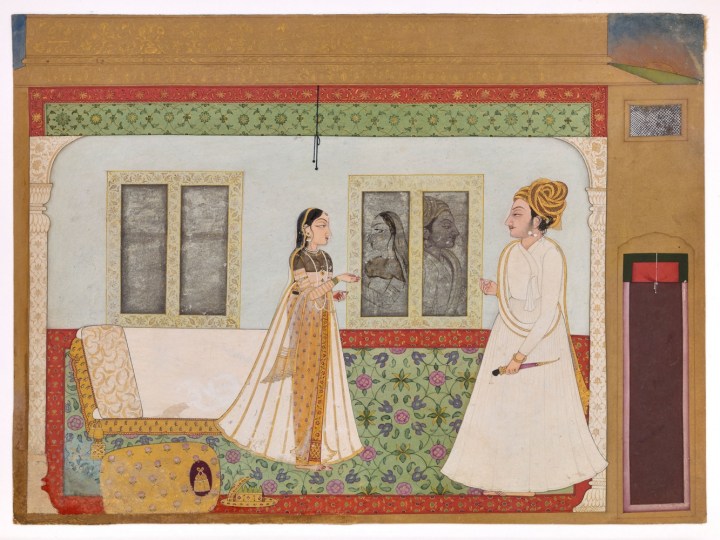
Return of the Unfaithful Lover, Khandidta Nayika, ca. 1720, Nurpur, opaque pigment and gold on paper, 20 × 26 cm.
◊ ◊ ◊ ◊ ◊
From Luhring Augustine:
Court, Epic, Spirit: Indian Art, 15th–19th Century
Luhring Augustine Tribeca, New York, 26 January — 24 March 2022
Luhring Augustine, in association with Francesca Galloway, is pleased to present Court, Epic, Spirit: Indian Art, 15th–19th Century, a show of historical artworks from India opening on January 26. It marks the first time that Luhring Augustine has partnered with the London-based gallery Francesca Galloway, internationally renowned in the field of Indian art. Court, Epic, Spirit presents a variety of artworks including textiles, paintings, and courtly objects. The title of the exhibition refers to three key lenses through which to view the arts of India. With these organizing principles as a guide, these exceptional and iconic works of art can be more fully considered and understood.
A fine and grand 17th-century panel from a lavish royal tent is among the exhibition’s featured objects. The panel is part of an important group thought to have been produced in the Deccan, a region of central India. For both Rajput and Mughal rulers, tents were immensely important, especially to the latter given the nomadic lifestyle required to govern their vast empire.
Indian painting is above all a storytelling medium, created to illustrate epic texts. These narratives, and the paintings that accompanied them were an integral aspect of the region’s cultural traditions throughout this period. A work of particular importance in the exhibition is a recently discovered 16th-century painting from the early Imperial Mughal manuscript of the great epic, the Hamzanama (‘Story of Hamza’), one of the supreme achievements of Indian art. Commissioned by a young Emperor Akbar, it is the only known folio depicting this episode and represents a significant addition to the scholarship, not least because it was painted by Dasvant, a master artist in the Imperial atelier.
Also significant to the artistic output of the region were artworks focusing on worship—some depicting and enabling acts of revery, and some imbued with spiritual power. Hindu ragamala paintings depict verses that in turn evoke a mode of music. Through a very unusual group of 17th-century ragamala paintings, most likely from the northern Deccan, the connection between sound, image, and spirit can be explored. Their wild sense of color and proportion, coupled with stark architecture and sumptuous textiles, lend these paintings an assured and individual aesthetic. Another highlight of the show will be a masterpiece of painting on cloth illustrating Dana Lila, or Krishna playfully demanding a toll from the gopis. This type of Deccani pichhvai, a painted cotton temple cloth, is rare, with only a handful of examples in museum collections around the world.
An additional highlight of the exhibition is the facade of a magnificent late 18th- or early 19th-century Mughal-style pleasure pavilion, a large-scale architectural marvel. The pavilion, installed at our Bushwick location, is available to view by appointment. Court, Epic, Spirit: Indian Art, 15th–19th Century will be on view at the Tribeca location through 24 March 2022 and will be accompanied by an illustrated catalogue.
Exhibition | Falcons: The Art of the Hunt
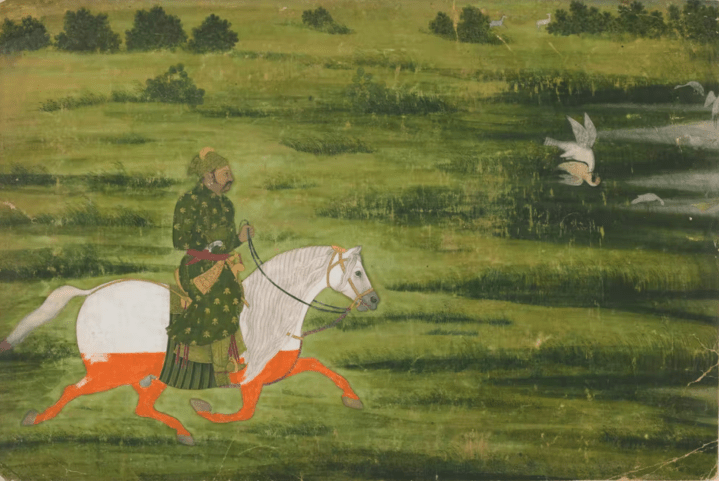
A Mounted Man Hunting Birds with a Falcon, early 18th century, Mughal Dynasty
(Washington, DC: National Museum of Asian Art, gift of Charles Lang Freer, F1907.212)
◊ ◊ ◊ ◊ ◊
Now on view at the Freer Gallery:
Falcons: The Art of the Hunt
National Museum of Asian Art, Smithsonian Institution, Washington: DC, 15 January — 17 July 2022
Swift, fierce, and loyal, falcons have been celebrated for millennia. In ancient Egypt, they were closely associated with Horus, the god of the heavens. By the early eighth century in Syria, falcons were being trained to become skillful hunters at the royal courts. The art of falconry soon spread across the rest of the Islamic world, to the Byzantine empire in the west, and to the east as far as China. It is still practiced in many societies today, especially in the Arab world. A selection of paintings and objects from ancient Egypt to China offers a glimpse into the fascinating world of falcons.
New Book | Pictorial Silks: Chinese Textiles
Distributed by The University of Chicago Press:
Kikki Lam, ed., Pictorial Silks: Chinese Textiles from the UMAG Collection (Hong Kong: HKU Museum and Art Gallery, 2021), 96 pages, ISBN: 978-9887470717, $25.
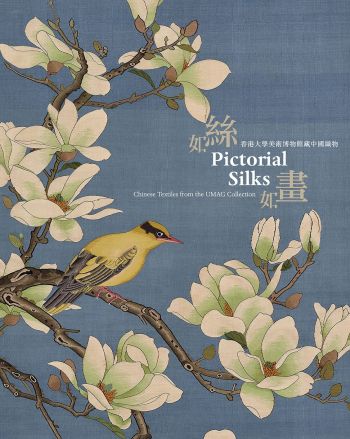 A showcase of silks from the Qing dynasty to the mid-twentieth century.
Prized by Chinese and foreign merchants as an essential commodity along a vast trade network, silk served multiple roles throughout the ancient world: as fabric for garments, as a form of currency and method of tax payment, and as a medium and subject matter for artists and the literati. Over the centuries, silk fabrics have remained synonymous with beauty and are still intertwined throughout Chinese art and literature. As showcased in this highly illustrated book, the Hong Kong University Museum and Art Gallery’s silk textile collection encompasses a diverse range of subjects and formats that include hanging scrolls, framed panels, banners, and robes from the Qing dynasty to the mid-twentieth century. Each artwork exemplifies the sophisticated craftsmanship of the artisan, as well as the collective stories of the Qing dynasty’s textile industry.
Kikki Lam is a research assistant at the University Museum and Art Gallery at the University of Hong Kong.
C O N T E N T S
Foreword
Threading Colour: Chinese Silk Textiles from the UMAG Collection
Kesi Silk Tapestry
Cixiu Embroidery
Glossary
Bibliography
Exhibition | From Afar: Travelling Materials and Objects

Now on view at the Louvre, a wide-ranging exhibition (geographically and temporally) that includes eighteenth-century objects:
From Afar: Travelling Materials and Objects
Musée du Louvre, Paris, 22 September 2021 — 4 July 2022
Organized by Philippe Malgouyres and Jean-Luc Martinez

Ivory Statuette of a Peddler, German, 1702–03, elephant tusk, diamond, silver gilt, and enamel, 8.4 cm high (Paris: Musée du Louvre). More information, with additional views, can be found here.
For its sixth season, the Petite Galerie offers a journey through time and around the world with the exhibition From Afar: Traveling Materials and Objects—complementing a cycle of exhibitions at the museum dedicated to discoveries and explorations of lands near and far: Paris–Athens: The Birth of Modern Greece, 1675–1919 in September and Pharaoh of the Two Lands: The African Story of the Kings of Napata in the spring.
Through materials and objects, the exhibition describes exchanges between distant worlds—including ancient exchanges often more extensive than explorations in the 16th century. From deepest antiquity, carnelian, lapis lazuli, ebony, and ivory circulated along trade routes, and these materials were even more precious because they came from afar. Their value was enriched by the myths surrounding their origins. Not only stones, shells and plants travelled between continents; so did live animals, often for political ends. The populace as well as artists discovered ostriches, giraffes, and elephants. Man-made objects followed the same routes. Beyond Europeans’ well-known yen for the exotic, the exhibition shows that these multiple round trips wove a more complex history: forms, techniques, and themes intertwined to create new objects, reflecting all the complexity of our world as it could be perceived in Europe from the late Middle Ages on.
The exhibition was organized by Philippe Malgouyres, curator at the Department of Decorative Arts, Musée du Louvre, and Jean-Luc Martinez, honorary president of the Musée du Louvre.
Philippe Malgouyres and Jean-Luc Martinez, with Florence Dinet, Venus d’ailleurs: Matériaux et objets voyageurs (Paris: Musée du Louvre / Éditions du Seuil, 2021), 192 pages, ISBN: 978-2021456264, €32.
New Book | Danish Silver, 1600–2000
Distributed by The University of Chicago Press:
Lise Funder, Danish Silver, 1600–2000 (Copenhagen: Museum Tusculanum Press, 2021), 292 pages, ISBN: 978-8763545853, $60.
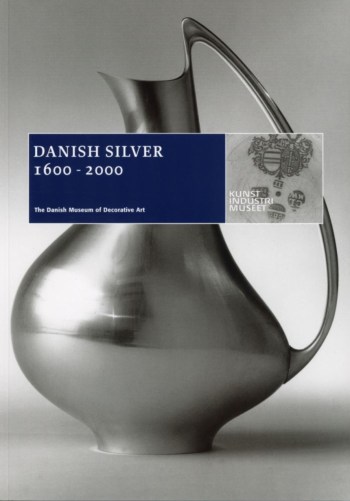 An illustrated catalog of Denmark’s cutlery through the ages. Replete with nearly four hundred images, Danish Silver 1600–2000 is the first international collection to showcase the rich artistry of Danish cutlery.
C O N T E N T S
Preface
About the Catalogue
Danish Silver: 17th, 18, and 19th Centuries
Silver Marking
Catalogue
17th Century
18th Century
19th Century
Danish Silver: 20th Century
Catalogue
20th Century
Select Bibliography
Exhibitions of Danish Silver in the Danish Museum of Decorative Art
Index of Names
Lecture | Charlotte Vignon on the Renovation of the Sèvres Museum

From the BGC:
Charlotte Vignon, Rebuilding the City of Ceramic: Projects for the Renovation of the Sèvres Museum
The Françoise and Georges Selz Lectures on 18th- and 19th-Century French Decorative Arts and Culture
Online and in-person, Bard Graduate Center, New York, 1 March 2022
Charlotte Vignon will be speaking in the Françoise and Georges Selz Lectures on Eighteenth- and Nineteenth-Century French Decorative Arts and Culture on Tuesday, March 1 at 6 pm. Her talk is entitled “Rebuilding the City of Ceramic: Projects for the Renovation of the Sèvres Museum.”
The Sèvres Museum was created in 1824 by Alexandre Brongniart (1770–1847), then the director of the Porcelain Manufactory of Sèvres. At its beginning, it was considered as a technical resource, a conservatory of materials and techniques intended to inspire craftsmen and artists working at the prestigious French manufactory by providing them with varied examples of ceramic from many periods and places. Thanks to further acquisitions from the second half of the nineteenth century, the collection gradually became an encyclopedic museum offering a comprehensive overview of the history of ceramics.
Today, the Sèvres Museum brings together a collection of more than 50,000 ceramic objects from prehistory to the present, principally from Europe but also including important examples from Asia, America, Africa, and Oceania. This lecture will unveil current plans for a major renovation of the museum, which will both transform its displays and highlight its historical and physical links to the Sèvres Porcelain Manufactory. A true national treasure, Sevres seeks to contribute to the world of tomorrow by balancing today’s quest for instantaneity and start-ups with a new art of living that affirms the values of artistic creativity, scientific experimentation, and cultural diversity.
Charlotte Vignon is Director of the French National Museum of Ceramics located at Sèvres, just outside Paris (Musée national de céramique de Sèvres). Previously, she was Curator of Decorative Arts at The Frick Collection in New York for more than ten years. She has held fellowships at The Metropolitan Museum of Art, The Cleveland Museum of Art, and The Frick Collection, where she was an Andrew W. Mellon Curatorial Fellow. Vignon organized several exhibitions at The Frick Collection: Exuberant Grotesques: Renaissance Maiolica from the Fontana Workshop (2009); Turkish Taste at the Court of Marie-Antoinette (2011); White Gold: Highlights from the Arnhold Collection of Meissen Porcelain (2011); Gold, Jasper, and Carnelian: Johann Christian Neuber at the Saxon Court (2012); Precision and Splendor: Clocks and Watches at The Frick Collection (2013); Pierre Gouthière: Virtuoso Gilder at the French Court (2016); Fired by Passion: Masterpieces of Du Paquier Porcelains from the Sullivan Collection (2017); Masterpieces of French Faience: Selections from the Sidney R. Knafel Collection (2018); and Elective Affinities: Edmund de Waal at The Frick Collection (2019). She is the author of numerous articles and essays on European decorative arts, including sixteenth- to nineteenth-century ceramics, tapestries, furniture, and architecture, as well as the history of the art market and collecting in the United States. Vignon is also the author of Duveen Brothers and the Market for Decorative Arts, 1880−1940, as well as Gouthière’s Candelabras, with Edmund de Waal, both published in 2019.
Exhibition | Jacques Louis David: Radical Draftsman
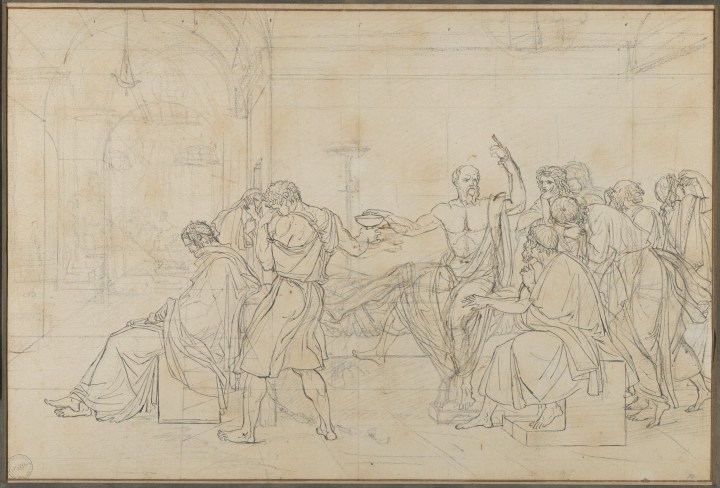
Jacques Louis David, The Death of Socrates, ca. 1786, pen and black ink, over black chalk, touches of brown ink, squared in black chalk, sheet: 11 × 16 inches (New York: The Metropolitan Museum of Art, 2015.149).
◊ ◊ ◊ ◊ ◊
From the press release for the exhibition:
Jacques Louis David: Radical Draftsman
The Metropolitan Museum of Art, New York, 17 February — 15 May 2022
Organized by Perrin Stein
Regarded in his time as the most important painter in France, Jacques Louis David (1748–1825) produced major canvases that shaped the public’s perceptions of historical events in the years before, during, and after the French Revolution. Drawings were the primary vehicle by which he devised and refined his groundbreaking compositions. Jacques Louis David: Radical Draftsman is the first exhibition devoted to works on paper by this celebrated and influential artist. Through some 80 drawings and sketches from the collections of The Met and numerous private and institutional lenders from the United States and abroad—including rarely loaned or newly discovered works—visitors will see the progress of his ideas as he worked to create his masterful paintings. A highlight of the exhibition will be a work in The Met collection, The Death of Socrates (1787)—David’s most important painting in America—which will be displayed along with preparatory drawings that reveal his years-long thought process and planning.
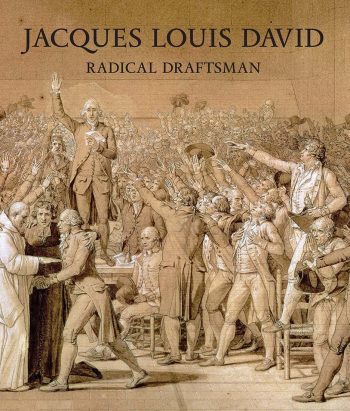 The exhibition—the first to focus on David’s preparatory studies—looks beyond his public successes to chart the moments of inspiration and the progress of ideas, both artistic and psychological. The works will be presented chronologically, starting with David’s early training in Rome. Sketches from this period represent the vast store of motifs that he mined for decades thereafter, including for his most famous paintings.
The works David submitted to the Salons after returning to France heralded a powerful new neoclassical style that drew its inspiration from classical antiquity. Paintings like The Oath of the Horatii (1784) and The Death of Socrates (1787) won instant acclaim and buttressed his growing reputation as leader of the French school. Several drawings on view demonstrate the artist’s struggles to heighten the psychological impact and create a more powerful overall composition.
Rebelling against the constraints of France’s centralized monarchy in its waning days, David embraced the changes wrought by the Revolution of 1789. His most ambitious project—a depiction of the Oath of the Tennis Court, the event in which representatives of different classes of French society pledged to draft a constitution to counterbalance the absolute authority of the king—was never completed. The exhibition will feature a large presentation drawing that is one of David’s supreme achievements, deftly redeploying the language of the classical past to imbue a contemporary event with the drama and gravitas of a history painting.
David’s support of the more radical faction of the fledgling Republic led to his imprisonment. After his release, he attempted to regain dominance of the French school by exploring themes of national reconciliation through historical subjects like The Intervention of the Sabine Women (1799). Eventually, David reclaimed the spotlight through his support of Napoleon Bonaparte. David’s magisterial canvas memorialized the glittering spectacle in Notre Dame cathedral that marked Napoleon’s ascent from successful general to crowned emperor of France in 1804.
After a string of military defeats led to Napoleon’s downfall and the restoration of the Bourbon monarchy in 1816, David—a former regicide who had lent his talents to gilding the emperor’s image—was banished. He went into exile and spent his final decade working in Brussels.
Jacques Louis David: Radical Draftsman was organized by Perrin Stein, Curator in the Department of Drawings and Prints. The exhibition is accompanied by a catalogue, published by The Metropolitan Museum of Art and distributed by Yale University Press. A related installation, In the Orbit of Jacques Louis David: Selections from the Department of Drawings and Prints, on view 20 January – 10 May 2022, focuses on David’s legacy through works by his pupils and contemporaries (Gallery 690).
Perrin Stein, with contributions by Daniella Berman, Philippe Bordes, Mehdi Korchane, Louis-Antoine Prat, Benjamin Peronnet, and Juliette Trey, Jacques Louis David: Radical Draftsman (New Haven: Yale University Press, 2022), 308 pages, ISBN: 978-1588397461, $65.
Display | In the Orbit of Jacques Louis David
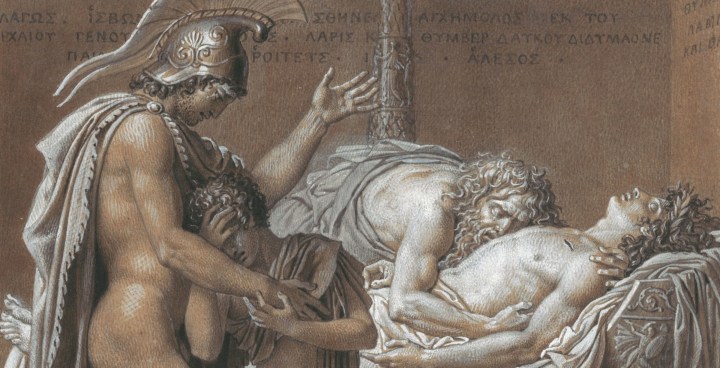
Anne Louis Girodet-Trioson, The Mourning of Pallas (detail), ca. 1790–93, pen and brown ink, brush and gray and brown wash, heightened with white (New York: The Metropolitan Museum of Art, 1996.567).
◊ ◊ ◊ ◊ ◊
Now on view at The Met:
In the Orbit of Jacques Louis David: Selections from the Department of Drawings and Prints
The Metropolitan Museum of Art, New York, 20 January — 31 May 2022
The Department of Drawings and Prints boasts more than one million drawings, prints, and illustrated books made in Europe and the Americas from around 1400 to the present day. Because of their number and sensitivity to light, the works can only be exhibited for a limited period and are usually housed in on-site storage facilities. To highlight the vast range of works on paper, the department organizes four rotations a year in The Robert Wood Johnson, Jr. Gallery. Each installation is the product of a collaboration among curators and consists of up to one hundred objects grouped by artist, technique, style, period, or subject.
This installation highlights the broad range of accomplishments of artists working at the same time as French painter Jacques Louis David (1748–1825). Whether they emulated his manner or sought their own paths, shared his political beliefs or condemned them, artists of this period could hardly escape the impact of David’s work.
Works on view by David’s peers, pupils, and rivals explore the creativity and capacity for transformation that marked this vital period that spanned the last years of the French monarchy, the Revolution, the rise of Napoleon, and ultimately, the restoration of the Bourbon monarchy. The fast pace of political change accentuated the intertwined nature of art and politics, which permeated all levels of artistic production—from large-scale paintings to the decorative arts and fashion—as this selection of drawings and prints attests.
This display complements the exhibition Jacques Louis David: Radical Draftsman (17 February – 15 May 2022).
Call for Papers | The Horse and the Town and Country House

George Stubbs, Lord Torrington’s Hunt Servants Setting out from Southill, Bedfordshire, ca. 1765–68
(The Bute Collection at Mount Stuart)
◊ ◊ ◊ ◊ ◊
From the Call for Papers:
The Horse and the Town and Country House: Art, Politics and Mobility
Institute of Continuing Education, Madingley Hall, University of Cambridge, 18–19 November 2022
Proposals due by 31 March 2022
Building on the successful 2018 Attingham Trust Study Programme The Horse and the Country House, this conference interrogates the place of the horse in the town and country house. From sporting art and memorabilia, riding dress and horse tack, carriage design and liveries, stables and stable servants, mobility and horseracing, we seek to explore the ways in which the horse was central to the social, cultural, economic, and political functions of the town and country house. We invite proposals for 20-minute papers that engage with any aspect of the topic, especially papers that offer case studies of specific houses, across periods and geographical locations. We are keen for papers that open up new methodological approaches for the study of the horse and the country house, such as from fashion, curatorial, animal, postcolonial, LGBTQ+, and feminist perspectives. We welcome papers from emerging and established scholars highlighting new research, and from those working across a broad range of disciplines.
Suggested topics include the following:
• Sporting art and the domestic interior
• Sporting art and horse and human pedigree
• Horse riding, politics, and sociability
• Horse racing and global networks of trade
• Dress and the materiality of riding
• Equine connoisseurship
• The role of the horse in mobility studies
• Travel between town and country
• Horse-drawn carriage design, significance, and use
• Stable architecture, horse tack, and stable culture
• Interpretation of stables and equine spaces in the country house
Please send a 250-word abstract and 50-word speaker biog. to elizabeth.jamieson@attinghamtrust.org
by 31 March 2022. The successful papers will be selected in April by the academic conference advisory committee comprising Tabitha Barber (Tate Britain), Dr Oliver Cox (TORCH), Christopher Garibaldi (University of Cambridge), Dr Michaela Giebelhausen (Courtauld Institute), Dr Lydia Hamlett (ICE), and Elizabeth Jamieson (Attingham Trust).
New Book | The Story of the Country House
From Yale UP:
Clive Aslet, The Story of the Country House: A History of Places and People (Yale University Press, 2021), 256 pages, ISBN: 978-0300255058, $25.
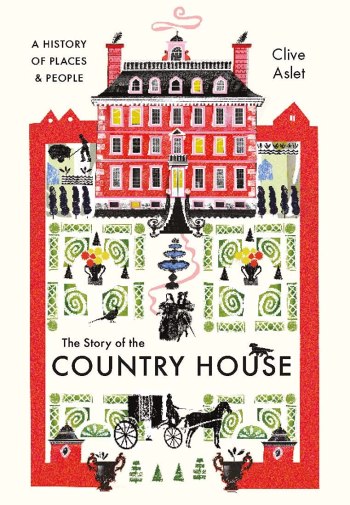 The Story of the Country House is an authoritative and vivid account of the British country house, exploring how they have evolved with the changing political and economic landscape. Clive Aslet reveals the captivating stories behind individual houses, their architects, and occupants, and paints a vivid picture of the wider context in which the country house in Britain flourished and subsequently fell into decline before enjoying a renaissance in the twenty-first century. The genesis, style, and purpose of architectural masterpieces such as Hardwick Hall, Hatfield House, and Chatsworth are explored, alongside the numerous country houses lost to war and economic decline. We also meet a cavalcade of characters, owners with all their dynastic obsessions and diverse sources of wealth, and architects such as Inigo Jones, Sir John Vanbrugh, Robert Adam, Sir John Soane, and A.W.N. Pugin, who dazzled or in some cases outraged their contemporaries. The Story of the Country House takes a fresh look at this enduringly popular building type, exploring why it continues to hold such fascination for us today.
Clive Aslet is a writer, commentator, historian, editor, and academic. He has written around twenty books on architecture and history and was editor of Country Life magazine from 1993 to 2006.
C O N T E N T S
Acknowledgments
Introduction
Prologue
1 Medieval
2 Tudor and Elizabethan
3 Early Stuart
4 Commonwealth to Queen Anne
5 Early Georgian
6 Mid-Georgian
7 Regency to William IV
8 Early and High Victorian
9 Turn of the Century
10 Between the Wars
11 Post-War: Recovery and Boom
12 Now
Further Reading
Index










 Enfilade
leave a comment