New Book | Chatsworth, Arcadia, Now
This book was published in the UK in the fall by Penguin, with a US release scheduled for March from Rizzoli. (I’m always interested in the decision to use different covers for British and American audiences. -CH)
John-Paul Stonard, foreword by The Duke and Duchess of Devonshire, with photographs by Victoria Hely-Hutchinson, Chatsworth, Arcadia, Now: Seven Scenes from the Life of an English Country House (New York: Rizzoli Electa, 2022), 420 pages, ISBN: 978-0847871414, $65.
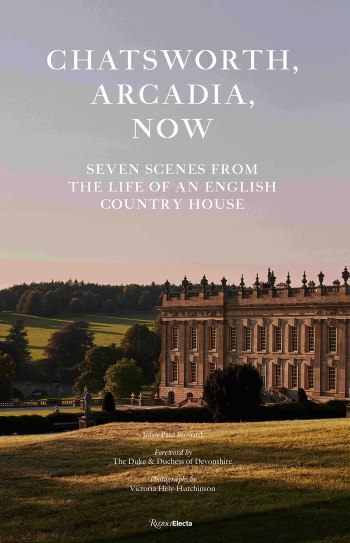 No place embodies the spirit of the English country house better than Chatsworth. From best-selling books such as Georgiana: Duchess of Devonshire and Chatsworth: The House by Deborah Mitford, the late Dowager Duchess of Devonshire, American audiences have long been transfixed by this remarkable place and its extraordinary collection of art and decorative objects.
Today, Chatsworth’s facade is newly cleaned and its windows freshly gilded. The forward-looking current Duke of Devonshire, who likes to say that “everything was new once,” has redone the public and private rooms. This tour-de-force volume is his telling of the story of Chatsworth through seven historical periods accompanied by stunning photo-graphic portraits of the house, its collections, and the grounds.
Chatsworth contains countless treasures from Nicolas Poussin’s Et in Arcadia Ego and Antonio Canova’s Endymion to seminal modern works by Lucian Freud and David Hockney. Though filled with works from different time periods, the collection represents the very best of the “new” from each artistic era.
John-Paul Stonard is an art historian educated at the Courtauld Institute of Art and contributes to the London Review of Books and Times Literary Supplement. The Duke and Duchess of Devonshire reside at Chatsworth, home to the family since 1549. Victoria Hely-Hutchinson is a photographer whose work has appeared in Dazed & Confused, The New Yorker, Vanity Fair, Vogue, and The Wall Street Journal Magazine.
New Book | A History of Arcadia in Art and Literature
Distributed by The University of Chicago Press and Paul Holberton:
A History of Arcadia in Art and Literature: Volume I, Earlier Renaissance (London: Ad Illisum, 2021), 500 pages, ISBN: 978-1912168255, $60 / Volume II, Later Renaissance, Baroque, and Neoclassicism (London: Ad Illisvm, 2021), 500 pages, ISBN: 978-1912168262, $60.
 A History of Arcadia in Art and Literature is an unprecedented exploration of the pastoral through the close examination of original texts of classical and early and later modern pastoral poetry, literature, and drama in ancient Greek, Latin, Italian, French, Spanish, Portuguese, Dutch, German, and English, as well as of a wide range of visual imagery. The book is an iconographic study of Renaissance and Baroque pastoral and related subject matter, with an important chapter on the eighteenth century, both in the visual arts, where pastoral is poorly understood, and in words and performance, about which many false preconceptions prevail.
The book begins with Virgil’s use of Theocritus and an analysis of what basis Virgil provided for Renaissance pastoral and what, by contrast, stemmed from the medieval pastourelle. Paul Holberton then moves through a remarkable range of works, addressing authors such as Petrarch, Tasso, Guarino, Lope de Vega, Cervantes, and Shakespeare, and artists such as Giorgione, Claude, Poussin, Watteau, Gainsborough, and many more. The book serves simultaneously as a careful study, an art book full of beautiful reproductions, and an anthology, presenting all texts both in the original language and in English translation.
Online Symposium | Museum, Research, and Discovery
From the symposium flyer:
Museum, Research, and Discovery
Online, Masterpiece London, 15–16 February 2022
 Masterpiece London is delighted to host a programme of digital debate and discussion, co-organised by the Fair and writer and critic Thomas Marks, to bring together preeminent museum curators and conservators with the leading figures in the art and antiques trade, with the aim of encouraging constructive discussion, networking, and the exchange of knowledge and practical advice.
Museums, Research and Discovery is the sixth in a series of events that Masterpiece London launched in 2018—and which since 2020 have fully embraced the possibilities of digital discussion, with recent online events focusing on conservation, artistic materials, and the history of colour. This spring the focus is on museums as sites of discovery, exploring how research within museums can engender a greater understanding of their holdings; and how new forms of collaboration between museums, as well as between museums and the public, stand to bring new information about collections to light.
Over two days, experts will offer a range of perspectives on how museums and archives make art-historical discoveries possible—and how innovative collaborations and technologies are opening new pathways for collections-based research. What is the role of research in preparing exhibitions, conservation projects or making acquisitions, say, and how far does the potential for discovery motivate such activities? How are research findings in museums best communicated to the public? And how might the sharing of archives and digitised collections, and new modes of analysing them, give rise to fresh art-historical discoveries in the future?
As ever at the Masterpiece Symposium, attendees will be invited to participate in the discussion during the break-out sessions that follow the panels—with the aim of sharing knowledge and ideas. “This event builds on our online programme, which has aimed to foster better understanding of works of art,” says Philip Hewat-Jaboor, Chairman of Masterpiece London. “The sixth Masterpiece Symposium will continue this thread by celebrating how museums enable art-historical research and communicate it to the public—and how museum collections offer opportunities to develop new methods of research.”
Register for the Masterpiece Symposium here»
Knowing Collections
Tuesday, 15 February 2022
Panel Discussion: 5pm (BST), Break-out Sessions: 6pm–6.30pm (BST)
This session will explore how research within museums allows for the reconsideration of individual works or types of work, be that their facture, authorship, meaning, provenance or wider cultural significance. The conversation will cover the relationship between research and: display; conservation; exhibition-making; digitisation; and acquisitions. To what extent are collections rediscovered, in some sense, by successive generations of curators and conservators?
Panellists
Paola D’Agostino | Director, Musei del Bargello, Florence
Helen Jacobsen | Executive Director, The Attingham Trust
Francesca Whitlum-Cooper | Associate Curator, National Gallery, London
Katie Ziglar | Director, Ackland Art Museum, The University of North Carolina at Chapel Hill
Moderated by Thomas Marks | Associate Fellow, Warburg Institute, London
Modes of Discovery
Wednesday, 16 February 2022
Panel Discussion: 5pm (BST), Break-out Sessions: 6pm–6.30pm (BST)
This session will focus on how the sharing of objects, images and data between institutions, and between them and the public, can lead to types of discovery that might not otherwise be possible. The conversation will explore collaboration between collections; institutional transparency about provenance and other types of information; the possibilities for public participation in research; and how new technologies such as machine learning and computer vision might generate new ways of understanding museum collections. What might we discover in and about museum collections in the not-too-distant future?
Panellists
MacKenzie L. Mallon | Specialist, Provenance, The Nelson-Atkins Museum of Art, Kansas City
Rebecca Roberts | Project Coordinator, Arcadia MAHSA, and Research Associate, Fitzwilliam Museum, Cambridge
Pip Willcox | Head of Research, The National Archives, Kew
Louisa Wood Ruby | Head of Research, The Frick Art Reference Library, New York and
Chair, PHAROS: The International Consortium of Photoarchives
Moderated by Thomas Marks | Associate Fellow, Warburg Institute, London
Exhibition | Materials of Empire: Colonial Narratives, 1700–1860
Now on view at Rienzi:
Materials of Empire: Colonial Narratives, 1700–1860
Rienzi, The Museum of Fine Arts, Houston, 15 January — 31 July 2022

Portuguese, Earrings from a Parure, ca. 1780–1820, emeralds, diamonds, and yellow gold with silver overlay (Museum of Fine Arts, Houston, the Rienzi Collection).
Materials of Empire: Colonial Narratives 1700–1860 explores objects from the Rienzi Collection that shed light on the links between Europe, Africa, the Americas, and India. This small exhibition examines the stories objects reveal as well as conceal, and places them within the context of entangled legacies and experiences of empire.
Exploration, war, scientific expeditions, and religious missions feature prominently in the history of Europe during the 18th and 19th centuries. These factors fueled an age of discovery in which thousands of ships transported explorers, merchants, and migrants from Europe to far-reaching destinations.
Vessels bound back to Europe carried cargo such as gold, silver, sugar, and tobacco. The ships also transported millions of enslaved men, women, and children from Africa to points across the empires to serve as labor in the cultivation of the new materials. Every crossing brought new encounters and confrontations between people and ways of life, resulting in a complex cultural landscape.
Rienzi, the MFAH house museum for European decorative arts, presents special exhibitions twice a year.
Online Seminar Series | Neoclassicism, Race, and Empire

From TORCH:
Neoclassicism, Race, and Empire
Online, The Oxford Research Centre in the Humanities, March 2022
Charmaine Nelson (NSCAD University)
Wednesday, 2 March, 4.00–5.30pm GMT (11am EST), register here»
Anne Lafont (L’École des Hautes Études en Sciences Sociales)
Wednesday, 16 March, 4.00–5.30pm GMT (12pm EST), register here»
Louis Nelson (University of Virginia)
Wednesday, 30 March, 4.00–5.30pm BST (11am EST), register here»
This three-part series examines the intersection between neoclassicism and questions of race, colonisation, empire-building, and national identity. With a focus on the British and French Atlantic worlds from the eighteenth century onwards, but with attention to a broader geographical field, we will ask how classical ideas and forms were invoked in art, architecture, and aesthetics in ways that intersected with colonial expansion, the assertion of imperial power, and the development of racial ideologies. Through a series of seminars led by pioneering scholars in this field—Charmaine Nelson, Anne Lafont, and Louis Nelson—we will explore the stylistic phenomenon of ‘neoclassicism’ within its broadest political and cultural contexts, while discussing the longer historiographical legacy of self-consciously classical art made in the modern age of empire. Registration is required for each online talk.
Please note that in the USA and Canada, the session on 16 March starts an hour later than the others, because the clocks go forward on different dates.
The Stories a House Can Tell
In my mind, I’ve returned repeatedly over the past few weeks to this recent story from The Washington Post. Fascinating material for conceiving of history as a recovery process of things lost (or purposely obscured) and material culture as a means of making sense of where past and present meet. It was my first introduction to Jobie Hill’s Saving Slave Houses project. -CH
Joe Heim, “An Old Virginia Plantation, a New Owner, and a Family Legacy Unveiled,” The Washington Post (22 January 2022).

Sharswood in Gretna, Va., was built in the middle of the 19th century and at one point was the hub of a sprawling plantation. The Pittsylvania County property now consists of 10½ acres. Out of the frame behind the large tree at right is a cabin that may have been used by enslaved people as a kitchen and laundry for the main house as well as a residence. (Heather Rousseau for The Washington Post)
. . . It wasn’t until after Fredrick Miller bought Sharswood in May 2020 that its past started coming into focus. That’s when his sister, Karen Dixon-Rexroth and their cousins Sonya Womack-Miranda and Dexter Miller doubled down on researching their family history.
What neither Fredrick Miller nor his sister knew at the time was that the property had once been a 2,000-acre plantation, whose owners before and during the Civil War were Charles Edwin Miller and Nathaniel Crenshaw Miller.
Miller. . . .
As the puzzle pieces connected, a clearer picture emerged. Sarah Miller, great-grandmother to Fredrick, Karen and Dexter, and great-great-grandmother to Sonya, died in 1949 at 81. From her death certificate, they learned that Sarah’s parents were Violet and David Miller.
The 1860 Census does not list enslaved people by name, only by gender and age. In the 1870 Census, however, Violet and David Miller lived just a short distance from Sharswood. Between the many documents that the descendants of Sarah Miller have obtained, the fragments of family oral history they’ve sewn together and the proximity of the family to the plantation, they are certain that Violet and David Miller were among those enslaved at Sharswood. . . .
For Fredrick Miller, the 10.5-acre-estate he’d purchased for $225,000 ended up not being just a future gathering spot for the family, but also its first traceable point in the United States—an astonishing revelation for him. It also left him thinking about family history and the absence of that history for many people like him. . . .
There were 12 houses for enslaved people on the plantation, determined Doug Sanford, a retired professor of historic preservation at the University of Mary Washington, who has been documenting former homes of the enslaved across Virginia with Dennis Pogue, an associate research professor at the University of Maryland and retired archaeologist. . . .
The dilapidated cabin behind the main house at Sharswood isn’t visible from the road. A humble structure with a central chimney dividing two rooms, it feels almost hidden. But Sarah Miller’s descendants have focused their attention on it.
What the family learned from ongoing research by Sanford and Pogue and by Jobie Hill, a preservation architect who started the Saving Slave Houses project in 2012, is that the cabin was built before 1800, probably as the main house on the property, and then was divided into a duplex before 1820. From then on, they said, it probably served as a kitchen and laundry for the main house and a living space for some who were enslaved at Sharswood. . . .
The full article is available here»
Exhibition | Flesh and Bones: The Art of Anatomy
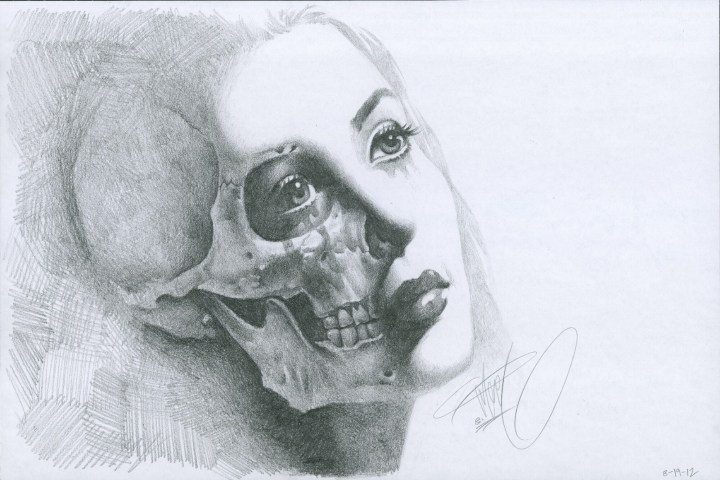
Love & Hate, 19 August 2012, OG Abel (Abel Izaguirre), graphite on paper, 12 1/2 × 19 1/2 × 3 inches (Los Angeles: Getty Research Institute, 2013.M.8. Gift of Ed and Brandy Sweeney © OG Abel).
◊ ◊ ◊ ◊ ◊
From the press release for the exhibition opening this month at The Getty:
Flesh and Bones: The Art of Anatomy
Getty Research Institute, Getty Center, 22 February — 10 July 2022
Curated by Monique Kornell
Featuring works of art from the 16th century to today, the Getty Research Institute exhibition Flesh and Bones: The Art of Anatomy explores the theme of anatomy and art and the impact of anatomy on the study of art.
“Flesh and Bones celebrates the connection between art and science and the role of art in learning,” said Mary Miller, director of the Getty Research Institute. “This exhibition draws on the Getty Research Institute’s rich and varied holdings to tell the story of two disciplines that have long been intertwined. I believe visitors will find meaningful connections with the way artists and scientists have inspired one another for centuries.”
 From spectacular life-size illustrations to delicate paper flaps that lift to reveal the body’s interior, the body is represented through a range of media. In Europe, the first printed anatomical atlases, introduced during the Renaissance, provided new visual maps to the body, often composed of striking images. Landmarks of anatomical illustration such as the revolutionary publications of Vesalius in the 16th century and Albinus in the 18th century are represented as well as little-known rarities such as a pocket-size book of anatomy for artists from over 200 years ago. The exhibition, which explores important trends in the depiction of human anatomy and reflects the shared interest in the structure of human body by medical practitioners and artists, is organized by six themes: Anatomy for Artists; Anatomy and the Antique; Lifesize; Surface Anatomy; Three Dimensionality; and The Living Dead. The last looks at the motif of the representation of the dead as living, with skeletons and anatomized cadavers capable of motion rather than inert on a dissecting table.
“Artists not only helped create these images but were part of the market for them, as anatomy was a basic component of artistic training for centuries,” said exhibition curator Monique Kornell. “Featuring selections from the GRI’s impressive collection of anatomy books for artists as well as prints, drawings, and other works, this exhibition looks at the shared vocabulary of anatomical images and at the different methods used to reveal the body through a wide range of media, from woodcut to neon.”
For artists of the modern era, anatomy is often a medium of expression and a signifier of the body itself, rather than purely an object of study. Robert Rauschenberg’s Booster (1967) and Tavares Strachan’s Robert (2018) are two life-size anatomical portraits as well as symbols of the passing nature of life. Echoing the composite prints of Antonio Cattani’s remarkable life-size anatomical figures from the 1700s in the exhibition, Booster is a fractured self-portrait based on X-rays of the artist that have been joined together.
Strachan’s Robert is not an exact likeness of the man it immortalizes, Major Robert Henry Lawrence Jr., the first African American astronaut, who tragically died in a training accident. In choosing to represent the hidden interior of the body in neon and glass, Strachan, a former GRI artist in residence, makes visible the unique history of Lawrence, while demonstrating an inner structure that equalizes all people.
Anatomists and artists have approached the problem of how best to describe the body’s complex and invisible interior with a variety of representational strategies, ranging from the graphic to the sculptural and, recently, the virtual. From paper-flap constructions that allow viewers to lift and peer under layers of flesh to stereoscopic photographs that mimic binocular perception and project anatomical structures into space, three-dimensionality was inventively pursued in the pre-digital age to cultivate an understanding of anatomy as a synthetic whole.
The exhibition is curated by Monique Kornell, guest curator; guest assistant professor, Program in the History of Medicine, Cedars-Sinai Hospital, Los Angeles, and is accompanied by a richly illustrated publication.
Monique Kornell, with contributions by Thisbe Gensler, Naoko Takahatake, and Erin Travers, Flesh and Bones: The Art of Anatomy (Los Angeles: Getty Research Institute, 2022), 249 pages, ISBN 978-1606067697, $50.
Exhibition | Grand Design: 17th-Century French Drawings
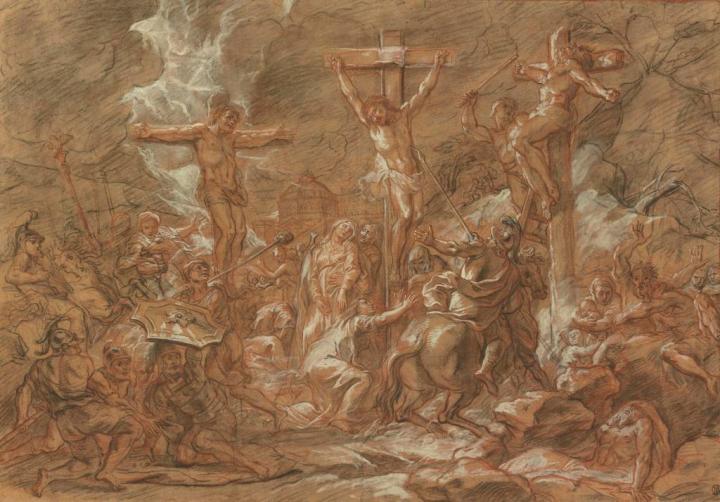
Antoine Coypel, The Crucifixion, 1692, red and black chalk with white gouache heightening on beige paper, 41 × 58 cm
(Los Angeles: The J. Paul Getty Museum, 88.GB.41)
◊ ◊ ◊ ◊ ◊
From the press release for the exhibition now on view at The Getty:
Grand Design: 17th-Century French Drawings
Getty Center, Los Anageles, 8 February — 1 May 2022
Curated by Emily Beeny
Presenting the Getty Museum’s collection of 17th-century French drawings in its entirety for the first time, Grand Design: 17th-Century French Drawings addresses the emergence of a distinctly French school of art and explores the role that drawing played in the process.
“Today we recognize drawings by Nicolas Poussin and Claude Lorrain as landmark achievements of 17th-century European art,” says Timothy Potts, Maria Hummer-Tuttle and Robert Tuttle Director of the J. Paul Getty Museum. “But in fact, drawing lay at the heart of all artmaking in 17th-century France, from the decoration of palaces and churches to the illustration of books. Drawing was where it began.”
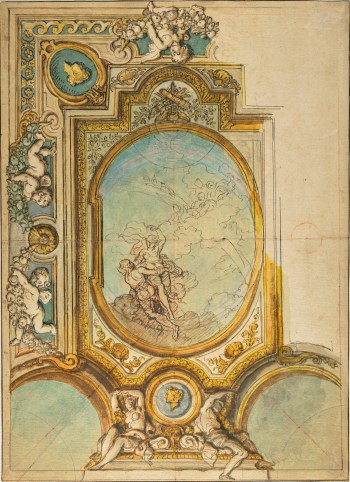
Charles de la Fosse, Studies for a Ceiling Decoration with the Apotheosis of Psyche (detail), ca. 1680, pen and black ink and brush and watercolor over red chalk on paper, 26 × 36 cm (Los Angeles: The J. Paul Getty Museum, 2001.47).
French art came into its own during the 17th century, often called the Grand Siècle, or Great Age, of France. This period witnessed a series of violent political upheavals at home, the first stages of colonial expansion overseas, and the rise of authoritarian absolute monarchy. This turbulent century fostered artistic activity on a scale previously unimagined. Expatriate French artists achieved fame in Rome; a Royal Academy of Painting and Sculpture was founded in Paris; and vast building projects—most notably, the Palace of Versailles—employed whole generations of artists.
This exhibition includes drawings made by Jacques Callot, Simon Vouet, Nicolas Poussin, Claude Lorrain, Charles Le Brun, Hyacinthe Rigaud, and many others. These artists made drawings for many different purposes: designs for ceiling paintings, altarpieces, sculptures, and prints; landscape sketches made outdoors; and nude studies drawn in the studio.
“Drawing helped 17th-century French artists make sense of the world around them, think through compositional ideas, and prepare finished works,” explains Emily Beeny, curator of the exhibition. “Each of these sheets invites us into its author’s creative process, whether observing nature, capturing a portrait likeness, designing a print, or preparing a painting.”
Grand Design: 17th-Century French Drawings is curated by Emily Beeny, curator in charge of European paintings at the Fine Arts Museums of San Francisco, and former associate curator of drawings at the Getty Museum. This exhibition is presented concurrently with another exhibition focused on 17th-century French art: Poussin and the Dance.
The checklist is available as a PDF file here»
Installation | In Dialogue
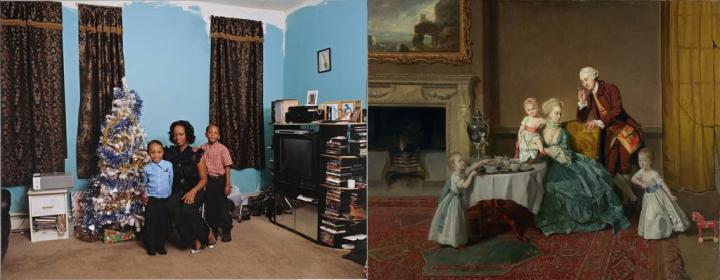
Left: Coulson Family, 2008, by Deana Lawson, pigment print, 33 × 43 inches (Getty Museum, 2021.53.2. © Deana Lawson). Right: John, Fourteenth Lord Willoughby de Broke, and His Family, ca. 1766, by Johann Zoffany, oil on canvas, 40 × 50 inches (Getty Museum, 96.PA.312).
◊ ◊ ◊ ◊ ◊
Closing this weekend at The Getty:
In Dialogue
Getty Center, Los Angeles, 9 November 2021 — 13 February 2022
In Dialogue is a series of temporary installations in the Museum’s permanent collection galleries. This presentation places photographs made during the past fifty years by five women from Japan, Mexico, and the United States in conversation with European paintings, decorative arts, and sculptures created predominantly by men before 1900. Through compelling and sometimes unexpected juxtapositions, these installations invite visitors to engage with diverse perspectives and recurring themes across different media, styles, cultures, and time periods. Look for photographs by Diane Arbus, Chris Enos, Deana Lawson, Asako Narahashi, and Daniela Rossell, in the North, East, and South Pavilions.

Left: Pink Roses, 1980, by Chris Enos, Polaroid dye diffusion print, 24 × 21 inches (Getty Museum, 84.XP.465. © Chris Enos). Right: Vase of Flowers, 1722, by Jan van Huysum, oil on panel, 32 × 24 inches (Getty Museum, 82.PB.70).
New Book | Masculinity and Danger on the Grand Tour
Distributed by The University of Chicago Press:
Sarah Goldsmith, Masculinity and Danger on the Eighteenth-Century Grand Tour (London: University of London Press, 2021), 200 pages, ISBN: 978-1912702213 (cloth), $55 / ISBN: 978-1912702220 (paper), $35.
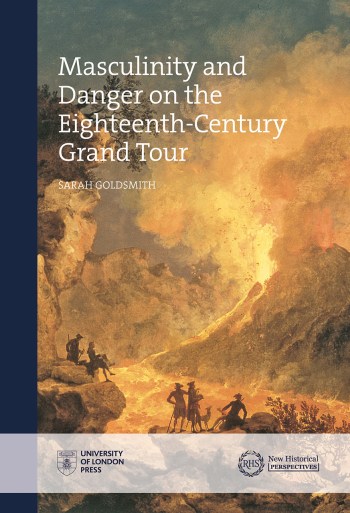 The Grand Tour, a customary trip through Europe undertaken by British nobility and wealthy landed gentry during the seventeenth and eighteenth centuries, played an important role in the formation of contemporary notions of elite masculinity. Through an examination of testimonies written by Grand Tourists, tutors, and their families, Sarah Goldsmith argues that the Grand Tour educated young men in a wide variety of skills, virtues, and vices that extended well beyond polite society.
Goldsmith demonstrates that the Grand Tour was a means of constructing Britain’s next generation of leaders. Influenced by aristocratic concepts of honor and inspired by military-style leadership, elite society viewed experiences of danger and hardship as powerfully transformative and therefore as central to constructing masculinity. Scaling mountains, volcanoes, and glaciers, and even encountering war and disease, Grand Tourists willingly tackled a variety of perils. Through her study of these dangers, Goldsmith offers a bold revision of eighteenth-century elite masculine culture and the critical role the Grand Tour played within it.
Sarah Goldsmith is a lecturer in urban and material culture history at the University of Edinburgh, having previously held a Leverhulme Early Career Research Fellowship at the University of Leicester.
C O N T E N T S
Acknowledgements
Introduction
1 Hazarding Chance: A History of Eighteenth-Century Danger
2 Military Mad: War and the Grand Tour
3 Wholesome Dangers and a Stock of Health: Exercise, Sport, and the Hardships of the Road
4 Fire and Ice: Mountains, Glaciers, and Volcanoes
5 Dogs, Servants, and Masculinities: Writing about Danger and Emotion on the Grand Tour
Conclusion
Appendix
Bibliography
Index










 Enfilade
leave a comment