Exhibition | Ingres avant Ingres
The exhibition, on view at the Musée des Beaux-arts, Orléans, closed January 9. Philip Bordes’s review of the show appeared in the January issue of The Burlington. Here’s the information for the catalogue, published by Le Passage.
Mehdi Korchane, ed., Ingres avant Ingres: Dessiner pour peindre (Paris: Le Passage, 2021), 240 pages, ISBN: 978-2847424638, 35€.
 Catalogue d’exposition sous la direction de Mehdi Korchane, responsable des arts graphiques des musées d’Orléans, avec une préface d’Adrien Goetz et des contributions de Laurence Clivet, Yvan Coquinot, Sidonie Lemeux-Fraitot, François-René Martin, Éric Pagliano, Louis-Antoine Prat, Alice Thomine-Berrada et Florence Viguier-Dutheil.
Ce livre examine la production graphique du jeune Ingres et, ce faisant, propose de suivre l’éclosion progressive de son génie, de l’enfance jusqu’à son départ pour Rome, en 1806. La maestria éblouissante du peintre du XIXe siècle est telle que ses premières années retiennent rarement l’attention. Or, elles constituent une aventure artistique en soi, au cours de laquelle la singularité de l’artiste se manifeste principalement dans l’exercice du dessin. Si la formation académique se fonde depuis toujours sur cette pratique, premier moyen de connaissance et de perfectionnement dans l’imitation de la nature, son expérimentation par Ingres prend une dimension exhaustive révélatrice de son ambition. Première œuvre de virtuosité, le portrait de Jean Charles Auguste Simon (1802-1803), conservé au musée des Beaux-Arts d’Orléans, montre comment l’élève de David se prépare à être peintre au moyen du crayon. Mais le dessin est aussi accompli comme une discipline autonome aux finalités multiples et dans laquelle la modernité se fait jour jusque dans les plus insignifiantes expressions. En analysant ce parcours, l’ouvrage tente de redonner une cohérence à un corpus souvent parasité par les attributions abusives et le dilemme des datations. Il examine aussi les fonctions du dessin dans la pratique du peintre en devenir.
New Book | Making Ideas Visible in the Eighteenth Century
Distributed by Rutgers UP:
Jennifer Milam and Nicola Parsons, eds., Making Ideas Visible in the Eighteenth Century (Newark: University of Delaware Press, 2022), 240 pages, ISBN: 978-1644532324 (cloth), $120 / ISBN: 978-1644532331 (paperback), $35. Also available as an ebook and PDF.
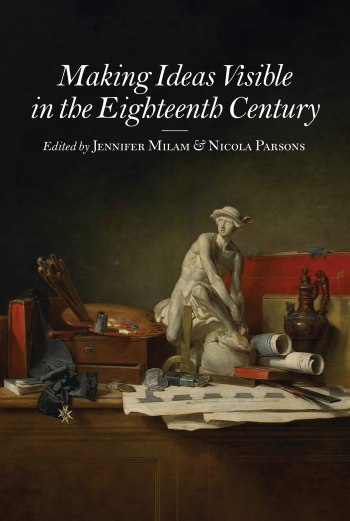 This volume considers how ideas were made visible through the making of art and visual experience occasioned by reception during the long eighteenth century. The event that gave rise to the collection was the 15th David Nochol Smith Seminar in Eighteenth-Century Studies, which launched a new Australian and New Zealand Society of Eighteenth-Century Studies. Two strands of interest are explored by the individual authors. The first four essays work with ideas about material objects and identity formation, suggesting how the artist’s physical environment contributes to the sense of self, as a practicing artist or artisan, as an individual patron or collector, or as a woman or religious outsider. The last four essays address the intellectual work that can be expressed through or performed by objects. Through a consideration of the material formation of concepts, this book explores questions that are implicated by the need to see ideas in painted, sculpted, illustrated, and designed forms. In doing so, it introduces new visual materials and novel conceptual models into traditional accounts of the intellectual history of the Enlightenment.
Jennifer Milam is the Pro Vice Chancellor (Academic Excellence) at the University of Newcastle in Callaghan, Australia. Her books on rococo art include Historical Dictionary of Rococo Art, Fragonard’s Playful Paintings, and an edited collection Women, Art and the Politics of Identity in Eighteenth-Century Europe.
Nicola Parsons is a senior lecturer in English at the University of Sydney in Australia. She is the author of Reading Gossip in Early Eighteenth-Century England.
C O N T E N T S
List of Illustrations
Acknowledgements
Jennifer Milam (University of Newcastle) and Nicola Parsons (University of Sydney), Introduction: The Potential Visibility of Ideas in Enlightenment Art and Aesthetics
1 David Maskill (Victoria University of Wellington), A Good Address: Living at the Louvre in the Eighteenth Century
2 Jessica Priebe (University of Sydney), Inventing Artifice: François Boucher’s Collection at the Louvre
3 Matthew Martin (University of Melbourne), Continental Porcelain Made in England: The Case of the Chelsea Porcelain Factory
4 Jennifer Milam (University of Newcastle), Planting Cosmopolitan Ideals: Thomas Jefferson’s Poplar Forest
5 Jessica L. Fripp (Texas Christian University), Growing Old in Public in Eighteenth-Century France: Marie-Thérese Geoffrin and Marie Leszczynska
6 Wiebke Windorf (University of Düsseldorf), French Funeral Monuments of the Ancien Régime as Products of Individual Artistic Solutions
7 Melanie Cooper (University of Adelaide), Meeting the Locals: Mythical Images of the Indigenous Other in the Eighteenth and Nineteenth Centuries
8 Jennifer Ferng (University of Sydney), Infernal Machines: Designing the Bomb Vessel as Transnational Technology
Notes on the Contributors
Index
Call for Articles | Spring 2023 Issue of J18: Cities
From Call for Proposals for J18:
Journal18, Issue #15 (Spring 2023) — Cities
Issue edited by Katie Scott and Richard Wittman
Proposals due by 15 March 2022; finished articles will be due by 1 September 2022
Art and architectural histories have traditionally approached the city in terms of the monuments and structures of its built environment and the distribution of its spaces. But the city is also, after all, its people: people who occupied and inhabited buildings, shared spaces and resources, and invested in or were inspired by ideas, labor, and beliefs. How did the city make room for that sharing? How did it inhibit it? Institutional structures—those of religion, politics, the economy, of ‘police’ in the broadest early-modern sense—played an essential part in fostering conditions in which social life occurred. How exactly did that fostering happen in the eighteenth century, and what were its intended and unintended consequences? At the same time, urban dwellers, whether elite or subaltern, continually use, transform, exploit, or otherwise make a city their own; the social forms an essential context for such appropriations. How were the limits and possibilities of social life in the eighteenth-century city defined, regulated, and sustained? In what ways did different constituencies represent those limits and possibilities, and discuss and debate them? How were they made visible, made audible, made legible? And how did different categories of labor shape and support a city’s social life?
We invite proposals that engage with the questions asked above, directly addressing relations between built forms and social bodies. These are some themes that are, we feel, raised by the topic: boundaries (walls, ditches) and the exclusion or protection of the faiths, nations, and trades they helped shape; bridges and the connections they cemented between neighborhoods, markets, spaces of leisure, etc.; infrastructure (roads, water, lighting, refuse collection) and the support it gave to the lived experience of the city; beauty and the collective aspiration to care and conservation, and also to better worlds that it proposed. We welcome contributions that consider actual spaces and communities and also ones that reflect critically on projects, both unrealized and utopian. We are open to essays that take as their objects of study built form, the representation of built form and the city generally, and urban material culture (e.g. guidebooks, street maps, shoes, carriages, walking sticks).
Issue Editors
• Katie Scott, Courtauld Institute of Art
• Richard Wittman, University of California, Santa Barbara
Proposals for issue #15 Cities are now being accepted. The deadline for proposals is 15 March 2022. To submit a proposal, send an abstract (250 words) and brief biography to the following three addresses: editor@journal18.org; katie.scott@courtauld.ac.uk; and rwittman@arthistory.ucsb.edu. Articles should not exceed 6000 words (including footnotes) and will be due by 1 September 2022. For further details on submission and Journal18 house style, see Information for Authors.
Lecture | James Middleton on Mexican Court Clothing
Tomorrow (Thursday) from BGC:
James Middleton | ‘But She’s Wearing It Backwards’: Understanding and Misunderstanding an Eighteenth-Century Mexican Court Gown
Online (Zoom), Bard Graduate Center, New York, 3 February 2022, 12.15 (ET)
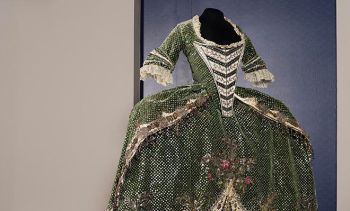
Museo Nacional de Historia. Photo by Omar Dumaine.
This talk will explore the history of a late eighteenth-century Mexican gown since its donation to Mexico’s Museo Nacional de Historia in 1900. The opulent, deep green silk-velvet and ivory satin dress with lavish silver embroidery has long been recognized as one of the most elaborate garments surviving from the colonial Americas, but has only recently been identified as a traje de corte—a court gown, one of four extant New Spanish garments to be so identified—made according to the etiquette requirements of the Spanish royal court. It has been exhibited in many guises, with and without its stomacher and/or train, and paired with radically different pannier and hoop variations. The genesis of the talk’s title is the gown’s first published appearance, in the 1988 book, La historia de Mexico a través de la indumentaria, in which it was correctly identified as a court gown, but misidentified as a Velázquez-era infanta dress and photographed worn backwards by a live model.
Middleton will be using this extant dress, as well as other extant garments in paintings, as a means of reflecting on some of the questions posed by the existence of court clothing in Spanish America. Who wore gowns like this? Were they required for functions of the viceregal court of Mexico City as they were for the court of Madrid, or were they aspirational garments worn for social display by the nouveau riche nobles of New Spain? The presentation will consist of photographs and analyses of extant and painted garments, as well as contemporary texts that document New Spanish tailoring practices and textile commerce, to investigate the little-understood phenomenon of court culture in the Americas.
James Middleton is an independent scholar working on dress in the Spanish-Colonial Americas circa 1520–1820. He has lectured and published on the subject in the US (Metropolitan Museum of Art, Los Angeles County Museum of Art, Denver Art Museum, et al.), Mexico (Museo Nacional de Historia, Museo Nacional de Arte), Colombia (Universidad de los Andes), and England (Society of Dress Historians). His particular interest in this subject dates from the early 1990s, when he first saw the dress that is this presentation’s focus in the conservation lab of the Museo Nacional de Historia, two weeks after having bought a copy of La historia de Mexico a través de la indumentaria.
This event will be held via Zoom. A link will be circulated to registrants by 10am on the day of the event. This event will be live with automatic captions. Registration is available here.
Call for Papers | Egypt in Early Modern Antiquarian Imagery
From ArtHist.net, which includes the German version of the CFP:
Egypt in Early-Modern Antiquarian Imagery
Ägypten in der frühneuzeitlichen antiquarischen Bildwelt
Online Workshops on 5 May, 2 June, 7 July 2022
Proposals due by 11 March 2022
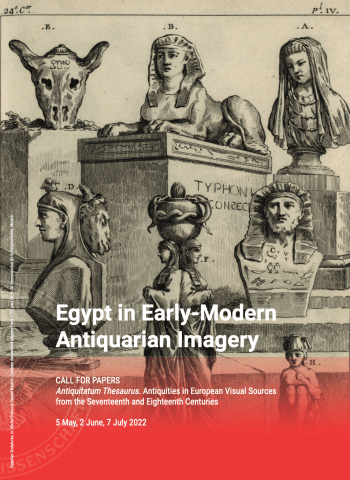 In 2022, Egyptology celebrates important historical events that number among the highlights in the exploration of the culture and civilization of the country by the Nile. In 1822, Jean-François Champollion succeeded in deciphering the hieroglyphics, the hieratic and the demotic scripts, by working primarily with the Rosetta Stone. In 1922, the British archaeologist Howard Carter discovered the tomb of the Pharaoh Tutankhamun in the Valley of the Kings.
The academy research project “Antiquitatum Thesaurus” would like to contribute to the international discourse and, in three half-day digital workshops in the summer semester of 2022 (5 May / 2 June / 7 July), draw attention to some central questions of the early-modern reception of Egypt, which preceded the events mentioned above.
How did contacts with the land of the pharaohs and their culture come about, and what image of it was conveyed? What role did aegyptiaca play in collections of antiquities, cabinets des curiosités or Wunderkammern? How were Egyptian or Egyptianising artefacts visually documented and discussed?
Before Napoleon’s great military expeditions and the subsequent scientific explorations of the country, when the number of travellers to the Levant was still manageable, the perception and understanding of Egypt far from the Nile had to rely primarily on easily portable objects. These had found their way to the other side of the Mediterranean at different times and along different routes. Finally, the study of ancient Greek and Roman authors, who transmitted their own mediated version of history and Egyptian culture, should not be underestimated.
Besides religious motivations, commercial and political activities or the desire to explore that lost or forgotten civilization, discoveries in Europe also stimulated further interest in Nilotic culture. Archaeological finds in Italy, France, Spain, German countries and Britain brought to light artefacts from the Roman imperial period. Through them people assimilated and adapted aspects of Egyptian religion, culture or aesthetics. They were collected together with artefacts from Egypt both as curiositates and as objects of study.
In the course of the early-modern period, a broad spectrum of antiquarian knowledge about Egypt was formed on the basis of these heterogeneous and today often not yet fully tangible foundations, and illustrated by an accompanying world of images.
The project “Antiquitatum Thesaurus” takes on the digital recording and indexing of antiquities in the graphic sources of the 17th and 18th centuries. It has begun this process with the subject area: “Egypt: On the Search of Origins.” Selected, representative illustrated printed works and drawing volumes dedicated to the material legacy of Egypt—or what was considered to be Egyptian—will be analysed. In addition to identifying the illustrated artefacts and architectural works, whether still preserved today or not, the project also aims to describe the methods of recording and conveying the mostly three-dimensional objects on paper, i.e. in a two-dimensional space. Furthermore, digital processing opens up possibilities for recognizing and illustrating spatial, temporal and personal chains within the transmission of knowledge and images across the widely scattered source material.
The subject areas of the three workshops include:
• The protagonists: A consideration of the circulation of artefacts through intermediaries, antiquarians and collectors as well as their reception and representation in drawings and printed works. Particular attention will be paid to how these figures were interconnected between c. 1600 and 1750.
• Multifaceted Egypt: How was the imagery or the idea of Pharaonic Egypt changed or complemented by small-scale artefacts such as amulets, jewellery and funerary objects alongside the familiar monumental evidence such as obelisks or sphinxes?
• The history of reception: What was the basis for the depictions of the many aegyptiaca in the graphic volumes of the time: direct observation or copies based on earlier publications? How exactly did the exchange of drawings and prints, descriptions etc. take place among the members of the European république des lettres?
We plan 20-minute talks in German or English. We kindly ask you to send an abstract relating to the aforementioned topics—alternative proposals are also welcome—of maximum 500 words in German, English, Italian, or French including a short CV to: thesaurus(at)bbaw.de by 11 March 2022. Please indicate the language in which you would like to speak. An answer will be given by 18 March 2022.
Call for Papers | Greek and Gothic Revivals, 1750–1850
From ArtHist.net:
The Greek Revival and the Gothic Revival, 1750–1850
Wrocław, Poland, 13–15 October 2022
Proposals due by 30 March 2022
The University of Wrocław Institute of Art History would like to invite you to participate in a conference to be held 13–15 October 2022. We are accepting proposals for individual papers on all subjects related to various artistic and cultural expressions of the Greek Revival and Gothic Revival styles in Europe and North America. The time frame we wish to focus on is from 1750 to 1850, that is the first, ‘romantic’ phase of the development of both styles, considered in the context of the idea of ‘revivalism’ as a phenomenon that marked art of various epochs, but unique in the precise period indicated, not only because of its size, but also its reference to specific moments in the past. The coexistence and interpenetration of both trends (there were, after all, artists creating their works in both the Greek Revival and Gothic Revival styles) justifies their joint discussion within the framework of an international group of researchers.
Issues we wish to discuss include
• Reasons for the popularity of both phenomena and their nature (so-called Gothicism and, so to speak, the dialectical revitalisation of Greek Antiquity)
• Greek Revival and Gothic Revival monuments as carriers of specific ideas and their role in awakening the historical consciousness of European societies
• Greek Revival and the Gothic Revival: from the Ideal to the Real
• Analysis of specific realisations and trends—monuments that are characteristic, outstanding, but also unknown, forgotten, and located in poorly explored areas, whose analysis will reveal previously unknown aspects of both discussed trends
Proposals that do not directly address the issues identified above are also welcomed.
Individual presentations should be no longer than 20 minutes. The official languages of the conference are English and German. The conference will open with a reception in the evening of Wednesday, 12 October. Over the next three days (Thu–Sat), conference contributors’ papers will be presented.
The call for papers is open until 30 March 2022. Contribution proposals—including your name, institution, presentation title, and a 150-word abstract—should be emailed to agata.kubala@uwr.edu.pl (Greek Revival) and romuald.kaczmarek@uwr.edu.pl (Gothic Revival). The conference fee of €120 (€90 for PhD candidates) includes meals (lunch Thu–Sat and dinner Thu–Fri), conference materials, and a post-conference double-blind, peer-reviewed publication. For updates including detailed information on the conference venue and program, please check this website.
Hope to see you in Wrocław!
Organizing Committee
• Dr hab. Prof. UWr Romuald Kaczmarek (University of Wrocław Institute of Art History)
• Dr hab. Agata Kubala (University of Wrocław Institute of Art History)
• Agata Stasińska, M.A. (University of Wrocław Institute of Art History)
Scientific Committee
• Prof. dr hab. Ewdoksia Papuci-Władyka (Institute of Archaeology at the Jagiellonian University in Krakow)
• Prof. dr. Ruurd B. Halbertsma (National Museum of Antiquities in Leiden, Leiden University)
• Prof. Dr. Klaus Niehr (Universität Osnabrück und Akademie der Wissenschaften zu Göttingen)
• Dr hab. Barbara Arciszewska (University of Warsaw Institute of Art History)
• Dr hab. Jerzy K. Kos (University of Wroclaw Institute of Art History)
New Book | Europe Divided: Huguenot Refugee Art and Culture
From the V&A:
Tessa Murdoch, Europe Divided: Huguenot Refugee Art and Culture (London: Victoria & Albert Museum, 2022), 320 pages, ISBN: 978-1838510121, £40 / $55.
 This richly illustrated book focuses on the extraordinary international networks resulting from the diaspora of more than 200,000 refugees who left France in the late 17th century to join communities already in exile spread far and wide. Indeed, George Washington (along with 20 other presidents) was a descendant of Huguenots. First-generation Huguenot refugees included hundreds of trained artists, designers, and craftsmen. Beyond the French borders, they raised the quality of design and workshop practice, passing on skills to their apprentices, sons, godsons, cousins, and to successive generations, who continued to dominate output in the luxury trades. Although silver and silks are the best-known fields with which Huguenot settlers are associated, their significant contribution to architecture, ceramics, design, clock and watchmaking, engraving, furniture, woodwork, sculpture, portraiture, and art education provides fascinating insight into the motivation and resolve of this highly skilled diaspora. Thanks to a sophisticated network of Huguenot merchants, retailers, and bankers who financed their production, their wares reached a global market.
Tessa Murdoch is research curator of the Gilbert Collection at the V&A.
C O N T E N T S
Author’s Preface
Introduction
Maps
1 The Huguenot Diaspora
2 The Reception of Huguenot Artists, Craftsmen, and Designers in the British Isles
3 The Huguenots as Educators
4 Decorative Painters
5 Huguenot Architects and Engineers
6 Huguenot Metalsmiths
7 Carvers, Gilders, Cabinetmakers, and Upholsterers
8 Huguenot Sculptors in France and Beyond
9 The Taste for Porcelain and Ceramic Manufacture in Britain and Ireland
10 Huguenot Goldsmiths and Silversmiths in the British Isles, 1550–1780
11 Huguenot Watchmakers and Jewellers: The Manufacture and International Market for Luxury Goods
12 Printmakers and Sellers: Design, Ornament, and Reproductive Prints
13 Huguenots and Portraiture: Allegiance, Identity, Loyalty, and Memory
Acknowledgments
Timeline
Notes & References
Bibliography
New Book | A Biographical Dictionary of British and Irish Engravers
From Yale UP:
David Alexander, A Biographical Dictionary of British and Irish Engravers, 1714–1820 (London: Paul Mellon Centre for Studies in British Art, 2022), 1120 pages, ISBN: 978-1913107215, $125.
 This biographical dictionary of engravers working on copper encompasses both those who produced fine art prints, and also those who engraved book illustrations for medical, technical, and literary works, all of which played a more important part than is usually realised in spreading information in the age of Enlightenment. Some 3,000 biographical entries draw on much unpublished information, researched over four decades, notably records of apprenticeship, genealogy, insurance, and bankruptcy as well as newspaper advertisements and contemporary accounts.
This is the first reference work to cover all engravers working on copper in Britain and Ireland 1714–1820. Many biographical entries describe celebrated engravers producing ‘fine art’ prints of paintings, which spread knowledge about living and dead artists. However, this book also builds up a more complex picture of the occupation of printmaking and includes engravers, many previously unresearched, who engraved ephemeral material, such as trade cards, bank notes, and satirical prints as well as the images that spread knowledge across literary, geographical, historical, topographical, medical, and technical fields.
David Alexander is a historian and honorary keeper of British prints at the Fitzwilliam Museum, Cambridge, and a member of the editorial board of Print Quarterly.
New Book | Hawkers, Beggars, and Quacks: ‘The Cries of London’
A new edition of this mainstay of eighteenth-century publishing was recently released by the Bodleian Library and distributed by The University of Chicago Press:
Sean Shesgreen, Hawkers, Beggars and Quacks: Portraits from ‘The Cries of London’ (Oxford: Bodleian Library Publishing, 2021), 240 pages, ISBN: 978-1851245512, $55.
 Seventy-four striking portraits of men and women on the margins of London society in the seventeenth century—including street vendors and petty criminals.
“Buy my Dish of great Eeles, Any Old Iron take money for, Twelve Pence a Peck Oysters, Buy my fat Chickens, Fair Lemons & Oranges.”
At the end of the seventeenth century, Marcellus Laroon (1653–1702) became well known for a series of drawings that illustrated London’s marginal men and women: street vendors, hustlers, and petty criminals. This set of drawings came to be known as The Cries of London after the shouts and cries vendors used to hawk their wares. Hawkers, Beggars, and Quacks presents seventy-four of Laroon’s striking portraits. Following an illustrated introduction that contextualizes The Cryes of London, each portrait is beautifully reproduced with a commentary on the individual street-seller and their trade. These commentaries provide a wealth of detail about each seller’s dress, the equipment they used to ply their trade, their own diets, and the diets of those they served. Drawing on historic material found in the British Library’s Burney Collection of English newspapers, Hawkers, Beggars and Quacks provides a fascinating insight into the men and women who made their livelihood—legally and illegally—on the streets of England’s capital.
Sean Shesgreen is emeritus professor of English and formerly a Presidential Professor at Northern Illinois University.
PhD Opportunity | The Material Culture of Saltram, 1725–1840
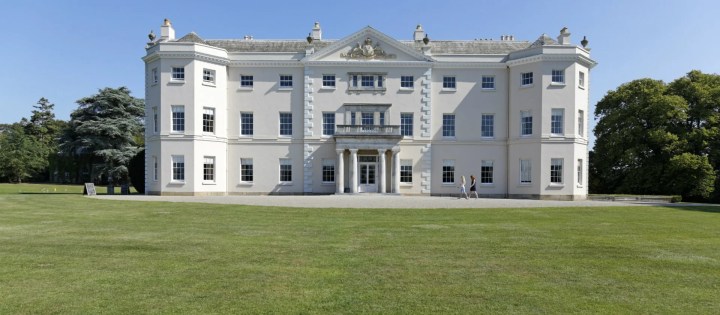
Saltram House, near Plymouth in Devon, England; in 1957 the house was donated by the Parker family to the National Trust (Photo: National Trust). More information is available here.
◊ ◊ ◊ ◊ ◊
From the project description:
Global Connections and Local Contexts: The Material Culture of Saltram, c.1725–1840
Applications due by 20 February 2022
The global links of country houses have attracted considerable attention in recent years, but the furore over colonialism has tended to overshadow the supply and materiality of global goods and the ways in which these artefacts were integrated into a wider array of goods of local and European provenance. Saltram, with its mix of British, European, and global objects, forms a perfect collection through which to explore these issues.
The project explores global-local interaction through the belongings and consumption practices of the Parker family in the period 1725–1840. Perhaps best known for its Robert Adam interiors and Reynolds paintings, Saltram also has a range of Asian objects, including Chinese wallpapers and porcelain, and items of high quality European furniture and porcelain, as well as a large collection of mahogany furniture made in British workshops. These combine with a varied archival collection that is especially rich in family correspondence.
The project seeks to entangle the global with the local by exploring the consumption practices and motivations of the Parker family. This will provide a better understanding of the significance of global goods as one part of the material culture of the country house, set within the context of locality, domestic space, and family relations, the broader influences of taste and fashion, and the commercial worlds of international trade and manufacturing.
The project is framed by four key research questions:
1. What was the origin of goods within the collection and what were the routes of supply through which they came to Saltram? This allows the shifting relative importance of global goods to be assessed and places the house at the centre of local, national, European and global networks of supply.
2. What were the material and behavioural contexts in which these things were displayed, used and consumed? This means: assessing where things were located in the house and garden, how were they used and by whom; and exploring the history of display.
3. How were individual and assemblages of objects linked to personal identity and how did they reflect and shape the character of the house? What motivations underpinned the consumption of these goods, and what meaning did they hold for their owners?
4. How can these tangled histories be related to visitors to include and engage local and diverse audiences? This involves understanding and evaluating audience expectations and engagement.
The student is encouraged to define their own doctoral research project within these broad parameters. The research results will inform a range of public-facing outputs at Saltram. Indeed, a core aim of the project is to identify ways to quickly embed new research findings into public programming and the student will work closely with the engagement as well as the curatorial team. The project thus has the potential to make an important contribution to how the National Trust at Saltram tells a greater variety of stories to more diverse audiences. The student will receive training from the curatorial and conservation team on object handling and the NT’s collections management system and from the engagement team on audience engagement and partnership working.
Candidate Requirements
In addition to our standard entry requirements, applicants should have:
• Masters in an appropriate discipline at merit or distinction OR equivalent experience working in the heritage sector
• Knowledge of the history/arthistory/heritage of the English country house
• Experience of undertaking research using archives or material objects
• Ability to work independently, as an effective part of a team, and with members of the public
• The student will need to be willing and able to travel between Manchester and Saltram
This opportunity includes fees funding plus an annual stipend at the Research Council minimum rate (set by UKRI), which for 2021/22 is £15,609 per annum for home and overseas applicants.
Interested applicants should contact are welcome to contact Professor Jon Stobart for an informal discussion. For application details, please consult the project description available as a PDF file here. The closing date is 20th February 2022.










 Enfilade
leave a comment