Online Study Day | Joshua Johnson: Conversations and New Discoveries
This online study day is held in conjunction with the the exhibition, which closes January 23:
Joshua Johnson: Conversations and New Discoveries
Online, Washington County Museum of Fine Arts, Hagerstown, Maryland, 14 January 2022.

Joshua Johnson, Portrait of Benjamin Franklin Yoe and Son Benjamin Franklin You Jr., 1809, oil on canvas mounted onto hardboard, 37 × 26 inches (Hagerstown: WCMFA, Gift of F. Sydney Cushwa).
The exhibition Joshua Johnson: Portraitist of Early American Baltimore presents a rare opportunity for Johnson scholars and art historians to study a significant group of Johnson’s works in one place.
Join WCMFA staff and colleagues Friday, January 14, for a day of intriguing, in-depth conversations about portraitist Joshua Johnson (ca. 1763–1824/25), one of the first professional African American artists. Joshua Johnson: Conversations and New Discoveries will be held from 9am to 4pm (EST) via Zoom. Organized in conjunction with the final days of the exhibition, this study day will address a variety of topics, including Johnson’s life and historical context in antebellum Maryland, his patrons, artistic style and technique, and connoisseurship. A broad range of speakers and special guests will offer unique perspectives and expertise about this fascinating artist in an informal, conversational format.
The first monographic presentation of the artist’s work since 1988, Joshua Johnson: Portraitist of Early American Baltimore contextualizes Johnson both historically and culturally and explores the key forms of natural symbolism represented in his paintings. Johnson was a freed slave who achieved a remarkable degree of success as a portraitist in his lifetime by painting affluent patrons in his native Baltimore such as politicians, doctors, clergymen, merchants, and sea captains. The exhibition is accompanied by a scholarly catalogue available for purchase from the museum.
To register for the study day, please email Donna Rastelli at drastelli@wcmfa.org or call 301.739.5727.
S C H E D U L E
9.00 Introduction by Sarah Hall (Director Washington County Museum of Fine Arts) with Opening Remarks by Kellie Mele (Director of Education for WCMFA)
9.30 Who Was Joshua Johnson? — David Terry (Associate Professor of History and Geography at Morgan State University) and Daniel Fulco (Agnita M. Stine Schreiber Curator at Washington County Museum of Fine Arts)
10.30 The Artist’s Patrons — Mark Letzer (President & CEO, Maryland Center for History and Culture), Stiles Colwill (Stiles T. Colwill Interiors), and Linda Crocker Simmons (Curator Emerita, Corcoran Gallery of Art)
11.15 Roundtable Discussion — This hour-long conversation features our panelists discussing Johnson’s influence and style, addressing his predecessors and contemporaries, some of whom are on view in a companion exhibition at the WCMFA.
12.15 Lunch Break
1.15 Johnson’s Cultural and Historical Context and Relationship to Baltimore Society — David Terry, Daniel Fulco, and Philippe Halbert (PhD candidate, Department of the History of Art, Yale University)
2.15 Connoisseurship: Technique, Materials, and Conservation. See the Yoe family portraits up close with Heather Smith (Conservator, Maryland Art Conservation), Sian Jones (Art Conservator), and Stiles Colwill.
3.15 Future Directions — In this concluding segment, panelists will discuss Johnson in public and private collections. Other topics include the art market as well as new research and directions in the field.
P A N E L I S T S
David Terry is Associate Professor of History and Geography at Morgan State University in Baltimore. He previously was the executive director of the Reginald F. Lewis Museum and was a research specialist in African American history for the Maryland State Archives. He holds a doctorate in history from Howard University, a Master of Arts in African American history from Morgan State University and a Bachelor of Arts in American studies from the University of Maryland-College Park.
Mark Letzer is the President and CEO of Maryland Center for History and Culture in Baltimore. Letzer is an expert in Maryland silver and decorative and fine arts. He became connected with MCHC when he was researching for his book, The Diary of William Faris: The Daily Life of an Annapolis Silversmith, which was published in 2003. In addition, he has written numerous articles on Maryland silver and decorative arts and lectured on the topic. Previously, he served as the Chief Development Officer for the Maryland Historical Society.
Anne Verplanck is Associated Professor of American Studies for Penn State-Harrisburg. She teaches courses in American art and visual culture, social and cultural history, American decorative arts and material culture, museum studies and heritage studies. Prior to becoming part of the Penn State-Harrisburg faculty she worked in the museum field for 30 years. She is the former Curator of Prints and Paintings at Winterthur Museum where she also served as Interim Director of Museum Collections and Interim Director of the Research Fellowship Program.
Linda Crocker Simmons has spent over 40 years in the museum field. Since 1998 she has held the title of Curator Emerita for the Corcoran Gallery of the Art. She has also worked with private and institutional clients including the Alice Ferguson Foundation at Hard Bargain Farm in Accokeek, Maryland. She holds a Bachelor of Arts in studio art and art history from American University; a Master of Arts in art history from the University of Delaware; a certificate in arts administration from Harvard University and remains a.b.d. for her PhD from the University of Virginia. She is an expert in the field of American painting from the end of the 18th century into the early 20th century.
Stiles Colwill has been the President and Chief Designer of Stiles Tuttle Colwill Interiors in Lutherville, Maryland, for nearly 30 years. Colwill also operates Halcyon House Antiques with New York City antiques firm John Rosselli & Associates. He previously served as a Board of Trustees for Baltimore Museum of Art where he served as chairman for five years. He also spent 16 years with the Maryland Historical Society.
Heather Smith is the Owner and Chief Conservator of Maryland Art Conservation LLC (formerly Art Conservation Services) in Baltimore. In 2005, she began her career with ACS after receiving her Master of Art Conservation at Queen’s University in Ontario, Canada, the previous year. She is a professional associate of the American Institute for Conservation.
Sian Jones is the previous owner of Art Conservation Services before retiring in 2018 after more than 30 years. She studied art conservation at the State University of New York at Oneonta, and studied art at Goucher College in Baltimore.
Phillipe Halbert is a doctoral candidate with the Department of History of Art at Yale University. He studies the intersection of art and identity in Colonial America and early modern Europe. For more than a decade he has been an independent museum consultant and has served as a guest curator at a variety of historic sites and museums. He has a Master of Philosophy in art history, criticism and conservation from Yale University and a Master of Arts in American material culture from the University of Delaware. He was a dual major in French and Francophone studies and history at The College of William and Mary where he received his undergraduate degree.
This exhibition is generously supported by grants from the following: National Endowment for the Arts (NEA), the Art Dealers Association of America (ADAA) Foundation, an anonymous donor, Mr. & Mrs. James N. Holzapfel, Dr. & Mrs. George E. Manger, the Heart of the Civil War Heritage Area (part of the Maryland Heritage Areas Authority), Maryland Marketing Partnership, Community Foundation of Washington County MD, Inc., Dr. & Mrs. Robert S. Strauch, and Mr. & Mrs. Thomas B. Riford.
Call for Papers | Reception of Art in 18th- and 19th-C Mantua
From ArtHist.net:
Opere in Viaggio: Reimpieghi, collezionismo, e nuove committenze a Mantova tra XVIII e XIX secolo
Istituti Santa Paola, Mantua 18-19 May 2022
Organized by Gabriele Barucca, Gigliola Gorio, and Debora Trevisan
Proposals due by 15 January 2022
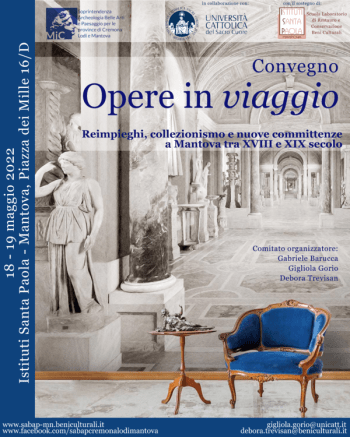 Through the analysis of significant and unpublished case studies, this conference will explore issues and dynamics related to the collecting and reuse of art objects in and around Mantua in the 18th and 19th centuries, during the crucial period between the fall of the Gonzaga and the beginning of Austrian domination. Proposals can be sent by art historians, numismatists, palethnologists, archaeologists, naturalists, and archivists—at any stage of their careers. Submissions should be sent to Gigliola Gorio (gigliola.gorio@unicatt.it) and Debora Trevisan (debora.trevisan@beniculturali.it) by the 15th of January 2022.
Organized by Gabriele Barucca, Gigliola Gorio, and Debora Trevisan, the conference is supported by the Soprintendenza Archeologia Belle Arti e Paesaggio per le province di Cremona, Lodi and Mantova in collaboration with the Catholic University of Milan and with the support of Istituti Santa Paola (Mantua).
More information, in Italian, is available here»
Call for Papers | Art and Friendship

Eustache Le Sueur, Réunion d’amis, ca. 1640, oil on canvas, 136 × 195 cm
(Paris: Musée du Louvre)
◊ ◊ ◊ ◊ ◊
From the Groupe de Recherche en Histoire de l’Art Moderne (GRHAM), where readers will find the French version of the Appel à communication:
Art et amitié aux XVIIe et XVIIIe siècles en Europe
Art and Friendship in 17th- and 18th-Century Europe
Salle Vasari, Institut national d’histoire de l’art (INHA), Paris, 14 June 2022
Organized by GRHAM and Charlotte Rousset
Proposals due by 31 March 2022
Following the pandemic which isolated all of us, magazines such as Courrier international and Philosophie magazine have dedicated their publications to friendship. This workshop intends on discussing this topical notion through the prism of cultural and social history in art. How did 17th– and 18th-century artists live and conceive friendship?
In her recent publication L’Amitié en France aux XVIe et XVIIe siècles: Histoire d’un sentiment[1], Aurélie Prévost reminds us that the term friendship for Modernists entails a large polysemy. It can refer to a feeling of benevolence, erotic love, harmony, or even a filial, marital, charitable, or religious affection. Furetière in his Dictionnaire even applies it to meat, stating “q’u’une viande n’a point d’amitié, pour dire, qu’elle est dure, infipide, ou degouftante”[2] [“A piece of meat is said to lack friendship when it is hard, flavourless or disgusting”].
Friendship is at the origin of many texts and maxims that constitute our cultural heritage today. Descartes, Kant, the Marquise de Sablé, Spinoza, Jean de La Fontaine, and the philosophers of the Enlightenment have all treated the notion of friendship in literature and philosophy. It can be passionate, like the one maintained by La Boétie and Montaigne, immortalized by the quote “Parce que c’était lui, parce que c’était moi” [“Because it was him, because it was me”], or experienced as a betrayal like the one that tore Diderot, Rousseau, Voltaire and D’Alembert when they were writing the Encyclopédie.
What about the art sector? What sort of relationship, whether friendships or rivalries, did 17th– and 18th-century painters, sculptors, architects, engravers, goldsmiths, miniaturists, medalists, and weavers have? What consequences did these have on their contemporary productions? Is it possible to map out united networks of artists through the link of friendship and joint creations?
Many artists made friendship the main subject of their work. Rembrandt van Rijn[3] depicted the story of David and Jonathan from the Book of Samuel in the 17th century. Arnold Houbraken, a Dutch engraver, depicted a personification of friendship[4] at the start of the 18th century. In France, in 1753, Jean-Baptiste Pigalle produced an allegory of friendship to mark the evolution of the relationship between Louis XV and the Marquise de Pompadour and to emphasize that she remained a beloved friend of the king after having been his mistress[5]. The painter François Boucher produced l’École de l’amitié[6] in 1760. One must also question the importance of portraits of friends and the character of these friendships. These can be between a painter and his patrons such as Antoine Watteau and Jean de Julienne[7] or between artists such as Jean-Honoré Fragonard and Marguerite Gérard[8].
How to make visible the feeling of friendship in a visual art piece? Is it possible to ‘read’ the emotions uniting loved ones through the medium of painting, engraving, or sculpting? How do gazes, gestures, and attitudes express this feeling? What visual devices does the artist use to convey this feeling of sincerity, trust, and commitment?
With this in mind, this workshop intends on exploring a wide variety of themes, such as:
• The cultural history of friendship/friendships
• Sociability (on the individual scale)
• Networks (on the collective scale)
• Quarrels and rivalries, even lawsuits created by a deteriorating friendship
• Friendships leading to artistic collaborations
• The representation of friendship in religious iconography
• Portraits of friends or patrons, conversation pieces, genre scenes, and allegories
• Patterns, symbols, gestures, and positions associated with the representation of friendship
• Objects representing friendship
• Letters of artists
• The fringes of friendship: hidden or forbidden love experienced through a friendship displayed in the eyes of all
Abstracts (up to 500 words, either in French or English), presenting a case study or a general discussion, together with a CV, should be sent to asso.grham@gmail.com and charlotte_rousset@hotmail.com by the 31st of March 2022. The workshop is organized by GRHAM and Charlotte Rousset (doctoral candidate at Lille University, laboratory IRHiS).
Notes
[1] Prévost, Aurélie, L’Amitié en France aux XVIe et XVIIe siècles : Histoire d’un sentiment, Louvain-La-Neuve, UCL, Presses Universitaires de Louvain, 2017, p. 17.
[2] Furetière, Antoine, « Amitié », Dictionnaire universel, La Haye et Rotterdam, Arnout & Reinier Leers, 1690.
[3] La Réconciliation de David et d’Absalon ou Les dieux de David et Jonathan, 1642, Huile sur bois, 73 × 62 cm, Saint-Pétersbourg, musée de l’Ermitage.
[4] Arnold Houbraken, Personnification de l’amitié, v. 1710–1715, gravure sur bois, 18 × 9 cm, Amsterdam, Rijksmuseum.
[5] Jean-Baptiste Pigalle, L’Amitié sous les traits de Madame de Pompadour, 1753, marbre, Paris, musée du Louvre.
[6] François Boucher, L’École de l’Amitié, 1760, huile sur toile, 113 × 146 cm, collection particulière.
[7] As illustrated by the work of François de Troy representing a portrait of Jean de Julienne holding a pencil holder and a portrait of his friend Watteau (1722, huile sur toile, 93 × 73 cm, Valenciennes, musée des Beaux-arts).
[8] Marguerite Gérard is portrayed several times by her brother-in-law Jean-Honoré Fragonard. He represents her at least twice (Jean-Honoré Fragonard, Portrait de Marguerite Gérard, v. 1778, dessin, plume, encre et lavis, 18 × 13 cm, Besançon, musée des Beaux-arts et d’Archéologie et Jean-Honoré Fragonard, Portrait de la belle-sœur du peintre, 2ème moitié du XVIIIe siècle, pierre noire, 13 cm de diamètre, Paris, département des Arts graphiques du musée du Louvre).
Selective Bibliography
• Alberti, Alessia, Rovetta, Alessandro, Salsi, Claudio, D’après Michelangelo, Venise, Marsilio, 2015.
• Cazes, Hélène (dir.), Topiques, Études Satoriennes – Topique de l’amitié dans les littératures françaises d’Ancien régime, Victoria, SATOR, 2015, vol. 1.
• Chapman, H. Perry, Jorink, Eric, Lehmann, Ann-Sophie, Ars Amicitiae: The Art of Friendship in the Early Modern Netherlands, Boston, Brill, 2020.
• Chittister, Joan, The Friendship of Women: The Hidden Tradition of the Bible, Saint-Laurent, Bellarmin, 2007.
• Florensky, Pavel, L’Amitié, Paris, Éditions Mimésis, 2018.
• Fripp, Jessica L., Portraiture and Friendship in Enlightenment France, Newark, University of Delaware Press, 2020.
• Goedt, Michel de, L’Amitié divine à l’école de Thérèse d’Avila, Toulouse, Éditions du Carmel, 2012.
• Heacock, Anthony, Jonathan Loved David: Manly Love in the Bible and the Hermeneutic of Sex, Sheffield, Sheffield Phoenix Press, 2011.
• Hoare, Alexandra, Salvator Rosa, Friendship and the Free Artist in Seventeenth-Century Italy, London, Turnhout, Harvey Miller, Brepols, 2018.
• Nardelli, Jean-Fabrice, Classical and Byzantine Monographs – Le motif de la paire d’amis héroïque à prolongements homophiles. Perspectives odysséennes et proche orientales, Amsterdam, Hakkert, 2004, n° 56.
• Olyan, Saul, Friendship in the Hebrew Bible, New Haven, Yale University Press, 2017.
• Petit, Jean-François, Saint Augustin et l’amitié, Paris, Desclée de Brouwer, 2007.
• Prévost, Aurélie, L’Amitié en France aux XVIe et XVIIe siècles : Histoire d’un sentiment, Louvain-La-Neuve, UCL, Presses Universitaires de Louvain, 2017.
• Rievaulx, Aelred de, Briey, Gaëtane de, L’Amitié spirituelle, Paris, Les Éditions du Cerf, 2019.
• Schnackenburg, Bernhard, Jan Lievens: Friend and Rival of the Young Rembrandt, with a Catalogue raisonné of his Early Leiden Work, 1623–1632, Petersberg, Michael Imhof Verlag, 2016.
• Vesely, Patricia, Friendship and Virtue Ethics in the Book of Job, New York, Cambridge University Press, 2019.
• Williams, Hannah, Académie Royale: A History in Portraits, Farnham, Ashgate, 2015.
NGS Acquires Rare Watercolour of a Black Milkmaid by David Allan
From the press release (18 November 2021), via Art Daily:
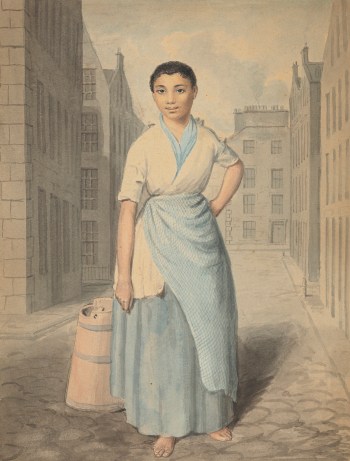
David Allan, Edinburgh Milkmaid with Butter Churn, ca. 1785–95, watercolour on paper, image size: 21 × 16 cm (Edinburgh: National Galleries of Scotland, D 5721, purchased 2019).
One of the earliest known images of a Black person by a Scottish artist has been acquired by the National Galleries of Scotland. Edinburgh Milkmaid with Butter Churn by David Allan (1744–1796) is a beautifully painted watercolour, which is both exceptionally rare and striking. It depicts a Black woman alone and centre stage at a time when Black sitters more often appeared as marginal or subservient figures in group portraits.
Looking directly at the viewer, the woman is shown in working dress, going about her daily duties and set against the backdrop of an elegant Edinburgh street. Her name and life story is unknown, but it is likely that she was a servant, a milkmaid, as suggested by the large vessel or butter churn shown beside her.
Modest in scale, the image is dated to the mid-1780s to early 1790s, a period when Allan created evocative drawings of ordinary people going about their daily lives in Edinburgh, such as soldiers, coalmen, fishwives, sedan chair porters, firemen, and officers of the city guard. These works, known as Allan’s ‘Edinburgh Characters’, suggest a background context for Edinburgh Milkmaid with Butter Churn, but they are generally sketched in a summary way, intended to capture character types, rather than specific personalities, and were often copied and duplicated. The Edinburgh Milkmaid, however, is highly detailed, precisely painted, and clearly a portrait of a specific person. It is hoped that further research may reveal more about the connection between the artist and the young woman and shed some light on her identity.
Director of European and Scottish Art at the National Galleries of Scotland, Christopher Baker, commented: “We are so pleased to bring this remarkable, rare, and extraordinary watercolour into Scotland’s national collection. It is an incredibly striking and special work, one which we believe will be enjoyed by many and, we hope, lead to new research on its background and most importantly the story of the woman depicted.”
Born in Alloa, David Allan was arguably the first Scottish artist to take contemporary life and customs from across the social hierarchy as a subject worthy of art. With the support of his patrons, Lord and Lady Cathcart of Shaw Park, near Alloa, he travelled to Italy around 1767 and remained there for a decade, painting historical pictures and portraits. He became interested in drawing scenes of street life, inspired by the popular print tradition of depicting street criers who called out to advertise their produce or trades. He sketched street vendors, aristocrats on the Grand Tour, coffee house scenes, dances, carnivals, and local costume in Rome and Naples and on a visit to the islands of Procida, Ischia, and Minorca.
These experiences led Allan to take a similar approach after his return to Scotland in 1779. He drew his subject matter from contemporary life, ranging from specific events such as The Ceremony of Laying the Foundation Stone of the New College of Edinburgh (1789) to timeless traditions and customs, such as A Highland Dance and The Penny Wedding. In 1786 Allan was appointed to a teaching post as Master of the Trustees’ Academy and he settled permanently in Edinburgh. The city and its inhabitants became a particular focus for this work. From about 1788 he developed the series of over twenty drawings of workers and traders; often referred to as his ‘Edinburgh Characters’, they typically show an individual or pair of figures with the tools of their trade, set against a simple architectural or rural background.
Allan’s subjects range from higher status figures, such as a Highland officer in uniform and officers of the Town Guard, to those who did the city’s heavy labour, such as the coalmen, chimney sweeps, porters, and water carriers. Female workers are represented by a fishwife, a salt vendor, and a lacemaker. The figures are drawn with strong outlines in ink to enable them to be traced easily, as Allan made multiple versions of his character drawings, several of which are held in the National Galleries of Scotland collection. He also reproduced his Edinburgh characters on a smaller scale as the cast that populate his landscape views of the Royal Mile, such as High Street from the Netherbow, made in 1793. Seen as a group, Allan’s street characters give a broad and fascinating insight into late 1780s Edinburgh as a living, working city.
Edinburgh Milkmaid with Butter Churn is one of several notable acquisitions highlighted in the recently published NGS Annual Review, covering the years 2019–2021. The painting will go on display at a later date following some conservation work, which is currently being prepared. With much still unknown about the painting, the Galleries would welcome information, comments, or feedback about it.
Exhibition | Turner in January
From the National Galleries of Scotland:
Turner in January
Scottish National Gallery, Edinburgh, 2–31 January 2022
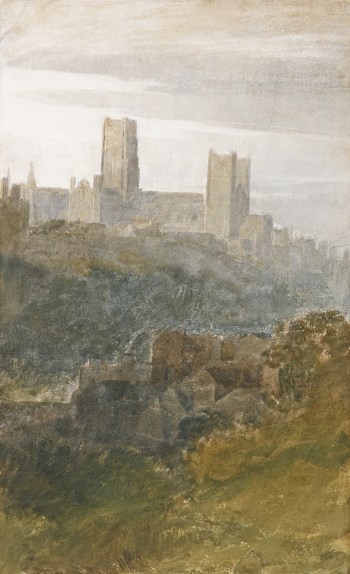
Joseph Mallord William Turner, Durham, 1801, watercolour over pencil on paper, 41 × 25 cm (Edinburgh: Scottish National Gallery).
The National Galleries of Scotland has presented an exhibition of the work of J.M.W. Turner every January for more than a century. This year’s exhibition will showcase all of the 38 watercolours by Turner that were given to the National Galleries of Scotland in 1900 by the art collector Henry Vaughan.
The exquisite works in the Vaughan bequest range from early wash drawings of the 1790s, to the colourful, atmospheric, and wonderfully expressive late works executed on visits to the Swiss Alps during the 1830s and 1840s.
Highlights of the bequest include a series of spectacular views of Venice such as The Piazzetta, Venice and Venice from the Laguna, which capture the drama and explosive skies of late summer Adriatic storms and demonstrate the artist’s consummate mastery of atmospheric lighting effects.
A booking for the Scottish National Gallery must be made in order to enjoy this exhibition.
More information on Henry Vaughan and the bequest is available here»
Exhibition | Alison Watt: A Portrait without Likeness

Alison Watt, Centifolia, detail, 2019, oil on canvas, 76 × 62cm
(Collection of the Artist, © Alison Watt)
◊ ◊ ◊ ◊ ◊
Closing this month at the Scottish National Portrait Gallery:
Alison Watt: A Portrait without Likeness
Scottish National Portrait Gallery, Edinburgh, 17 July 2021 — 9 January 2022
Curated by Julie Lawson
Alison Watt (born 1965) is widely regarded as one of the leading painters working in the UK today. This significant body of new work consists of sixteen paintings made in response to the practice of the celebrated eighteenth-century portrait artist Allan Ramsay (1713–1784) and are on show for the first time.
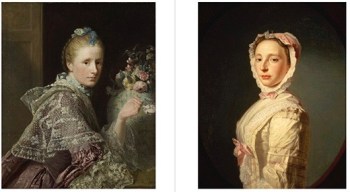
Left: Allan Ramsay, Portrait of the Artist’s Wife, Margaret Lindsay of Evelick, 1758–60, 74 × 62 cm (National Galleries of Scotland). Right: Allan Ramsay, Portrait of the Artist’s Wife, Anne Bayne, ca.1739, 68 × 55 cm (National Galleries of Scotland).
Alison Watt | A Portrait Without Likeness explores the artist’s continuing fascination with Ramsay’s portraits. Watt, most known for her beautiful and intricate large-scale paintings of drapery and folds, has long been an admirer of Ramsay’s portraits of women, in particular the intensely personal images of his first and second wives, Anne Bayne (died 1743) and Margaret Lindsay of Evelick (1726–1782). Both portraits reside in the Gallery’s collection and will be shown alongside Watt’s new work.
The exhibition is the fruit of a long period of study of Ramsay paintings, in addition to the drawings and sketchbooks from his extensive archive held by National Galleries of Scotland. Watt has said, “Looking into an artist’s archive is to view the struggle that takes place to make a work of art. A painting is a visual record of the inside of the artist’s mind. A painting is something that takes place over time; it is not static. To look at a work of art is to engage with an idea, and that is not a one sided activity. It’s more of a conversation.”
Alison Watt, Fortrose, 2019, oil on canvas, 61 × 46 cm (Collection of the Artist © Alison Watt).
A Portrait Without Likeness is accompanied by a publication featuring conversations between the artist and Julie Lawson, the Chief Curator of European, Scottish Art, and Portraiture at National Galleries of Scotland, who has curated the exhibition, as well as an essay from art historian Dr Tom Normand and a new work of short fiction by Booker Prize-nominated novelist Andrew O’Hagan.
Normand writes: “The fascination with flowers is uncommon within Watt’s oeuvre, but she has recently been engaged with the works of Allan Ramsay held in the Scottish National Portrait Gallery. Most particularly she has reflected upon his painting The Artist’s Wife, Margaret Lindsay of Evelick, painted between 1758 and 1760. This is an exquisite and mysterious portrait. At one level a tender study of his second wife, some thirteen years younger than the artist, at another a poignant essay on the enigma of human passion.”
Alison Watt, Julie Lawson, Tom Normand, and Andrew O’Hagan, Alison Watt: A Portrait without Likeness (Edinburgh: National Galleries of Scotland, 2021), 96 pages, ISBN: 978-1911054450, £20.
New Book | Scottish Portraiture, 1644–1714: David and John Scougall

From Brepols:
Carla van de Puttelaar, Scottish Portraiture, 1644–1714: David and John Scougall and Their Contemporaries, 2 vols. (Turnhout: Brepols, 2021), 756 pages, ISBN: 978-2503597270, €195.
This book is the first comprehensive publication on Scottish portraiture from the period 1644 to 1714, with an emphasis on the painters David Scougall (1625–1685) and his son John Scougall (1657–1737). It is based on in-depth art historical and archival research. As such, it is an important academic contribution to this thus far little-researched field. Virtually nothing was known about the Scougall portraitists, who also include the somewhat obscure George Scougall (active c. 1690–1737). Thorough archival research has provided substantial biographical information. It has yielded life dates and data on family relations and also has shown that David Scougall had two parallel careers: as a portrait painter and as a writer (solicitor). The legal community in which the Scougalls were embedded has been defined, as well as an extended group of sitters and their social, economic, and family networks. The book includes a catalogue raisonné of the oeuvre of David Scougall.
The most important contemporaries of the Scougalls were the portraitist L. Schüneman (active c. 1655/60–1667 or slightly later); his successor James Carrudus (active c. 1668–1683 or later), whose work is identified for the first time in this book; David Paton (c. 1650–in or after 1708); Jacob Jacobsz. de Wet (1641/42–1697); and Sir John Baptist Medina (1659–1710). Their lives and work are discussed. An extensive survey of Scottish portraits, with an emphasis on the work of the Scougall painters, is presented for the period 1644 to 1714. Numerous attributions to various artists and sitter identifications have been established or revised. An overview of the next generation is provided, in which the oeuvres and biographical details are highlighted of the principal portrait painters, such as William Aikman (1682–1731), Richard Waitt (1684–1733), and John Alexander (1686–1767). Numerous paintings have been photographed anew or for the first time and have been compared in detail, which had hardly been done before, while information is also included on technical aspects and original frames. The resulting data have been complemented by analysing the social and (art-) historical context in which the portraits were made. The works of the portrait painters in Scotland from this period, as this book shows, now form a solid bridge between the portraits painted prior to George Jamesone’s death in 1644 and those by the renowned Scottish painters of the eighteenth century.
Carla van de Puttelaar (b. 1967, Zaandam, The Netherlands) is an artist and art historian. She holds a PhD in art history from Utrecht University (2017). In 1996, she graduated from the Gerrit Rietveld Academy in Amsterdam. Since then, her photographic work has gained worldwide recognition, and has been exhibited and published extensively. Her skills as a photographer were an important asset in producing the illustrations with which this publication is so lavishly furnished.
C O N T E N T S
Volume 1 — The Scougalls and Their Circle
Abbreviations
Foreword
Acknowledgements
Introduction
Current State of Published Research on the Scougalls and Their Circle and the Appreciation of Their Work Through the Centuries
The Elder Scougall/Old Scougall and the Younger Scougall
Dates and Scarcity of Known Archival Material
Artistic Context: Painting in Scotland, the Start of a Portrait Tradition, c. 1575–1660
David Scougall (Edinburgh, 1625–1685), His Life and Career
Emerging from the Shadows
Father and Son, John (d. after 13 October 1627) and David (1625–1685)
Writer and Painter
Family Patrons
The Outset of a Career
Father and Son, David (1625–1685) and John (1657–1737)
The Advocate’s Close
The Profession of a Writer or Clerk in the Time of David Scougall
The Profession of a Painter in the Time of David Scougall
Possible Teachers and Family Creativity
Decline and Death
Skougall or Scougall
Personal Network, Legal Community, and Further Family Relations
John Scougall (Edinburgh, 1657–1737), His Life and Career
A Long and Prosperous Life
Becoming a Limner
Family Patrons
Increased Prosperity
Lack of Competition
1694: A Year of Important Changes
Decline in Skill and Death
David Scougall: The Oeuvre, Characteristics, Development, and Sources of Inspiration
The Outset of a Career
Core Works, the Basis for a Compilation of the Oeuvre
Associated Works
Miniatures or Pocket Pictures
Stylistic Features and Motifs
Consistency in Style
Late Works, 1675–1685
Technical Aspects of David Scougall’s Paintings
Technical Research and Painting Technique
Painting Materials
David Scougall as a Copyist
Costumes and Jewellery
Use of Motifs from Portraits by Other Painters
No Inventor, but Painting Real People
Production
Studio Practice and Legal Community
John Scougall: The Oeuvre, Characteristics, Development, and Sources of Inspiration
The Early Years
Indisputable Works
Associated Works
Use of Motifs from Portraits by Other Painters
Stylistic Features and Motifs
Technical Aspects of John Scougall’s Paintings
Technical Research and Painting Technique
John Scougall as a Copyist
Production
Mending and Washing
Studio Practice and Apprentices
George Scougall (b. 1670?, active c. 1690– c. 1737)
Lack of Biographical Data
In the Studio of John Scougall
Inadequate Traces of Work
Clients/Sitters
Nobility and Clergy
Clients and Religious Beliefs
Loyal Patrons
Bonding Portraits
Competition from Abroad
Ladies and Gentlemen
Portraying Children
Problems in Sitter Identification
Known Sitter, but Problem in Period and Handling
Portraits Telling the Truth?
Scougall’s Clients, Where Were They Based, and the Painter’s Studio
Backs and Frames
The Back of the Painting
Period Frames
Prices for Portraits and Frames
Prices for Portraits by David Scougall, 1664–1683
Prices for Portraits by John Scougall, 1674–1728
Prices for Frames
The Contemporaries of the Scougalls
John Michael Wright (1617–1694)
L. Schüneman (active c. 1655/60–1667 or shorty after)
James Carrudus (active 1671 or earlier–1683 or later)
David Paton (c. 1650–in or after 1708)
Thomas Murray (1663–1735)
Jacob Jacobsz. de Wet (1641/42–1697)
Portraits, Painters Unknown
Painters, Portraits Unknown
Sir John Baptist Medina (1659–1710)
The Next Generation
William Aikman (1682–1731)
Richard Waitt (1684–1733)
John Alexander (1686–1767)
John Smibert (1688–1751)
And Beyond
Summary and Conclusion
Appendices
Appendix I: The Scougall Family, Reconstruction of the Family Tree
Appendix II: Transcriptions of Various Archival Documents Concerning the Scougall Painters
Appendix III: The Mysterious Portrait of ‘John Scougall’
Appendix IV: Transcription of the Memoir by Sir John Clerk of Penicuik, 1st Baronet (1649–1722) of His Wife Elizabeth Henderson, Lady Clerk (1658–1683)
Volume 2 — Catalogue Raisonné of the Paintings by David Scougall (1625–1685)
Introduction
Glossary
Catalogue A: Authentic Works
Catalogue AW: Works Known Only from Written Sources
Catalogue B: Copies by David Scougall after Works by Others
Catalogue C: Doubtful Works
Catalogue D: Works Known Only through Copies and Prints
Catalogue E: Rejected Works
Concordance
Notes
Bibliography
Websites
Guides to Houses and Other Venues
Exhibitions
Inserted Details
Index
New Book | Uncommon Sense: Jeremy Bentham
From the University of Virginia Press:
Carrie Shanafelt, Uncommon Sense: Jeremy Bentham, Queer Aesthetics, and the Politics of Taste (Charlottesville: University of Virginia Press, 2022), 194 pages, ISBN: 978-0813946863 (hardcover), $95 / ISBN: 978-0813946870 (paperback), $32. Also available as an ebook.
 Infamous for authoring two concepts since favored by government powers seeking license for ruthlessness—the utilitarian notion of privileging the greatest happiness for the most people and the panopticon—Jeremy Bentham is not commonly associated with political emancipation. But perhaps he should be. In his private manuscripts, Bentham agonized over the injustice of laws prohibiting sexual nonconformity, questioning state policy that would put someone to death merely for enjoying an uncommon pleasure. He identified sources of hatred for sexual nonconformists in philosophy, law, religion, and literature, arguing that his goal of ‘the greatest happiness’ would be impossible as long as authorities dictate whose pleasures can be tolerated and whose must be forbidden. Ultimately, Bentham came to believe that authorities worked to maximize the suffering of women, colonized and enslaved persons, and sexual nonconformists in order to demoralize disenfranchised people and prevent any challenge to power.
In Uncommon Sense, Carrie Shanafelt reads Bentham’s sexual nonconformity papers as an argument for the toleration of aesthetic difference as the foundation for egalitarian liberty, shedding new light on eighteenth-century aesthetics and politics. At odds with the common image of Bentham as a dehumanizing calculator or an eccentric projector, this innovative study shows Bentham at his most intimate, outraged by injustice and desperate for the end of sanctioned, discriminatory violence.
Carrie D. Shanafelt is Associate Professor of Literature and Philosophy at Fairleigh Dickinson University.
Nationalmuseum Sweden Acquires Gold Box, Gifted by Gustav III

Gold box à deux couleurs, unknown maker, Hanau; guilloché and chased gold in two shades, diamonds, enamel; portrait of Gustav III by Johan Georg Henrichsen, ca. 1778 (Stockholm: Nationalmuseum, NMB 2799). The box sold at Sotheby’s in London on 10 November 2021 as part of the Gold Boxes, Silver and Ceramics sale (Lot 10).
◊ ◊ ◊ ◊ ◊
Press release (8 December 2021) from Sweden’s Nationalmuseum in Stockholm:
Nationalmuseum has acquired a unique gold box bearing a portrait by the court enameller, Johan Georg Henrichsen, of King Gustav III. The box was given by the king as a gift to John Mackenzie, a Scottish officer, when he retired from the Swedish army in 1778. Very few such tokens of royal favour have survived intact, which is what makes this gold box unique.
Jewel-encrusted portraits of the monarch were the most prestigious token of appreciation. The tradition developed at the French court in the 17th century and soon became a model for other European royal houses of the time. These portraits might take the form of a pendant or be mounted in a jewelled setting on the lid of a gold box. Queen Kristina was the first Swedish monarch to adopt this French fashion, which then flourished in the 18th century. Gustav III frequently handed out gold boxes as a sign of royal favour. Contemporary historical sources show that the king took a great personal interest in the design and gave detailed instructions. Sometimes the decoration consisted of his monogram in diamonds, and in other cases his portrait was framed with jewels.
Various specialist craftsmen collaborated to create the boxes. A silversmith would first produce the basic gold box, which would then be decorated by an engraver and adorned with gemstones by a jeweller. A miniaturist then added the portrait, while the case was produced by another specialist, often a bookbinder. There were practitioners of all these crafts in Gustavian Stockholm, but sometimes boxes were imported from Russia, Saxony or France. The gold box in question was made in Hanau, in the present-day German state of Hessen. It is oval in shape and is decorated with a guilloché (engine-turned) wave and circle pattern within a chased (embossed) border. It is also executed à deux couleurs: in a combination of two different gold alloys to produce colour variations. After the box reached Stockholm, the king’s portrait was set on the lid in a frame of diamonds with trailing vines.
The portrait is the work of Johan Georg Henrichsen (1707–1779), the last person in Sweden to hold the position of court enameller, to which he was appointed in 1773. He worked exclusively from originals in pastel or oil created by other artists such as Gustaf Lundberg or, in this case, Lorens Pasch the Younger. The colour palette was often intense, combined with clear use of pointillism. A lesser-known fact is that Henrichsen also produced coats of arms for patents of nobility, painted on parchment using miniature techniques.
The recipient of the gift was a Scottish adventurer: John Mackenzie, Lord Macleod, 4th Earl of Cromartie (1726–1789). He had been loyal to Charles Edward Stuart (Bonnie Prince Charlie), the Young Pretender, and was held prisoner after the British army defeated the Jacobites at the battle of Culloden in 1746. Two years later he was pardoned, but the family had its estates confiscated. In 1750 John Mackenzie joined the Swedish army, ending up as colonel of the Björneborg regiment.
“Mackenzie returned to Britain in 1778, having been granted a full amnesty, and had his estates restored. On the occasion of his departure from Sweden, he received this gold box from King Gustav III. It is one of the very few surviving examples from the time and will soon be on display in Nationalmuseum’s Treasury alongside a miniature portrait of Mackenzie,” explained Magnus Olausson, director of collections at Nationalmuseum.
Nationalmuseum receives no state funds with which to acquire design, applied art and artwork; instead the collections are enriched through donations and gifts from private foundations and trusts. The acquisition has been made possible by a generous donation from the Anna and Hjalmar Wicander Foundation.
New Book | Ogata Korin: Art in Early Modern Japan
From Yale UP:
Frank Feltens, Ogata Kōrin: Art in Early Modern Japan (New Haven: Yale University Press, 2002), 240 pages, ISBN: 978-0300256918, $60.
 A lush portrait introducing one of the most important Japanese artists of the Edo period
Best known for his paintings Irises and Red and White Plum Blossoms, Ogata Kōrin (1658–1716) was a highly successful artist who worked in many genres and media—including hanging scrolls, screen paintings, fan paintings, lacquer, textiles, and ceramics. Combining archival research, social history, and visual analysis, Frank Feltens situates Kōrin within the broader art culture of early modern Japan. He shows how financial pressures, client preferences, and the impulse toward personal branding in a competitive field shaped Kōrin’s approach to art-making throughout his career. Feltens also offers a keen visual reading of the artist’s work, highlighting the ways Korin’s artistic innovations succeeded across media, such as his introduction of painterly techniques into lacquer design and his creation of ceramics that mimicked the appearance of ink paintings. This book, the first major study of Korin in English, provides an intimate and thought-provoking portrait of one of Japan’s most significant artists.
Frank Feltens is Japan Foundation Associate Curator of Japanese Art at the Freer Gallery of Art and Arthur M. Sackler Gallery, Smithsonian Institution.
C O N T E N T S
Acknowledgments
Note to the Reader
Introduction
1 Before Painting: Ogata Kōrin and His Turn to Art
2 Of Poets and Flowers: Kōrin’s Early Paintings
3 Art and Family: Kōrin’s Lacquer Works and Hon’ami Kōetsu
4 Heading East: Kōrin in Edo
5 Beyond Ink: Ceramics by Kōrin and Kenzan
6 Toward the End: Kōrin’s Late Work
Epilogue
Notes
Bibliography
Index










 Enfilade
leave a comment