Exhibition | Gainsborough’s Pink Boy Conserved
Opening this spring at Waddesdon:
Thomas Gainsborough: The Pink Boy Conserved
Waddesdon Manor, Buckinghamshire, opening spring 2022

The Morning Room at Waddesdon Manor, with Thomas Gainsborough’s 1782 Portrait of Francis Nicholls (‘Pink Boy’), before cleaning.
Thomas Gainsborough’s Pink Boy, one of the most popular paintings at Waddesdon, is being cleaned this winter. A special display will reveal it anew, freed from a discoloured varnish, alongside three other Waddesdon Gainsboroughs that depict boys in so-called ‘Vandyke’ dress.
The Pink Boy is a more youthful counterpart of the famous Blue Boy (on exceptional loan to the National Gallery on London, 25 January – 15 May 2022 from the Huntington Library, Art Museum, and Botanical Gardens in San Marino, California). Like him, Pink Boy wears an 18th-century fancy-dress version of 17th-century clothes. The Pink Boy is as much a showpiece of Gainsborough’s skill, demonstrating its relationship to the art of the past and to modernity, as it is a portrait of the particular sitter, Master Francis Nicholls.
Portraits of Lord Alexander Douglas-Hamilton and Lord Archibald Hamilton demonstrate how Gainsborough used different types of ‘Vandyke’ costume and contrasting painting techniques to differentiate the relative rank and age of two aristocratic brothers. The portrait of the artist’s nephew and pupil Gainsborough Dupont is among his most intimate and scintillating works, conjuring the teenager’s individuality and inner consciousness as much as the shimmer of light on silk.
Exhibition | 100 Great British Drawings

William Blake, Hecate or The Night of Enitharmon’s Joy, 1795, planographic color print with pen and ink and watercolor on wove paper, 16 3/8 × 22 inches (San Marino: The Huntington Library, Art Museum, and Botanical Gardens).
◊ ◊ ◊ ◊ ◊
The exhibition opens this summer; the catalogue is scheduled to appear this month from Lund Humphries. From the press release (13 December 2021) . . .
100 Great British Drawings
The Huntington Library, Art Museum, and Botanical Gardens, San Marino, 18 June — 5 September 2022
Curated by Melinda McCurdy
Rarely seen highlights from The Huntington’s premier collection of British drawings and watercolors spotlight top artists working in the medium from the 17th to the mid-20th century.
100 Great British Drawings, a major exhibition at The Huntington Library, Art Museum, and Botanical Gardens, will trace the practice of drawing in Britain from the 17th through the mid-20th century, spotlighting The Huntington’s important collection of more than 12,000 works that represent the great masters of the medium. On view from June 18 until September 5, 2022, in the MaryLou and George Boone Gallery, the exhibition will feature rarely seen treasures, including works by William Blake, John Constable, Thomas Gainsborough, and J. M. W. Turner, as well as examples by artists associated with the Pre-Raphaelite Brotherhood and early 20th-century modernism. A fully illustrated catalog accompanies the exhibition, examining for the first time the strength and diversity of The Huntington’s British drawings collection, a significant portion of which has never been published before. The Huntington is the sole venue for the exhibition.
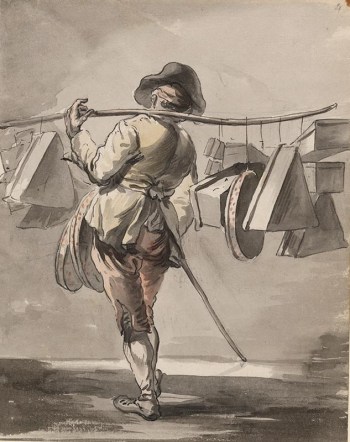
Paul Sandby, Band Box Seller, ca. 1760, brush and black ink and wash with red and yellow watercolor over traces of graphite on laid paper, 8 × 6 1/4 inches (San Marino: The Huntington Library, Art Museum, and Botanical Gardens).
“The Huntington is renowned for its incomparable collection of British art, ranging from 15th-century silver to the graphic art of Henry Moore, with the most famous works being, of course, our grand manner paintings,” said Christina Nielsen, Hannah and Russel Kully Director of the Art Museum at The Huntington. “Thomas Gainsborough’s Blue Boy and Thomas Lawrence’s Pinkie often serve as the poster boy and poster girl for the whole institution. But what most visitors do not realize is that The Huntington is also home to an extensive and remarkable collection of British drawings. This exhibition and catalog, the first to show the range of our British works on paper on such a scale, seek to fill that knowledge gap.”
Most of The Huntington’s British drawings collection, with a few notable exceptions, was established after the time of the institution’s founders, Henry and Arabella Huntington. Henry was an avid collector of rare books and manuscripts, and his wife, Arabella, was the force behind their collection of paintings and decorative art, but drawings did not factor largely into their art purchases. It was Robert R. Wark, curator of the art collections from 1956 to 1990, whose vision and tenacity established The Huntington as an outstanding repository of drawings made in Britain, where the art form was especially well developed, particularly in the late 18th to mid-19th century.
“Drawing is the most spontaneous and intimate of art forms, revealing the thoughts and mood of the artist through the stroke of a pen or touch of a brush dipped in watercolor,” said Melinda McCurdy, curator of British art, curator of the exhibition, and author of the catalog. “It is a practice especially associated with British artists, whose serious engagement with the medium is on vibrant display in the works we highlight in this exhibition.”

Matilda Conyers, Wallflower and Tulip, 1767, watercolor and opaque watercolor over traces of graphite with brown ink (est. iron gall) inscriptions on vellum, 9 × 6 1/4 inches (San Marino: The Huntington Library, Art Museum, and Botanical Gardens).
Organized chronologically, 100 Great British Drawings will explore portraiture, historical subjects, landscape, still life, botanical illustration, and caricature. The works on view will represent a full range of styles, including quick pencil sketches that candidly reveal artists’ creative processes, fluid pen-and-ink studies that approach the quality of finished works, and highly refined watercolor paintings.
The art of drawing first flourished in Britain in the late 17th century with an influx of artists coming from continental Europe, where the practice was commonly a part of artistic training. British artists also traveled abroad to view and copy the works of Europe’s old masters and contemporary artists. While portraiture was the most popular British art form at the time (as polished works by John Greenhill and Edmund Ashfield demonstrate in the exhibition), British artists eventually embraced a wide range of subjects, from landscape painting to history painting, a genre that appealed to such 18th-century titans as Thomas Gainsborough and George Romney.
Romney was unique among his peers in that he saw drawing as an end in and of itself, rather than merely a tool in preparation for oil painting. His Cimon and Iphigenia (early 1780s) was inspired by a tale from Boccaccio’s Decameron, and it captures the moment at which shepherd Cimon first spies his love, Iphigenia, asleep with two other women. Romney chose to depict Iphigenia in a sensual embrace with one of the women, using sweeping strokes of ink to imbue the scene with energy and passion. Cimon is barely present—cut off on the left of the frame—adding a suggestion of erotic voyeurism to Romney’s interpretation.
Even William Blake, famous for his unique imagination, betrays his European influences in Hecate or The Night of Enitharmon’s Joy (1795). Made by using a complex mix of printing techniques, drawing, and watercolor, Hecate depicts the witchlike mythological figure with musculature that recalls Michelangelo’s female forms, which were sketched from male nudes. By applying Michelangelo’s approach, Blake gives Hecate a powerful physique that suggests an unnatural, occult strength. The large-scale work is drawn from The Huntington’s William Blake collection, which was established by Henry Huntington himself and easily ranks among the most important Blake collections in the world.
 Most of the works in The Huntington’s British drawings collection are from the 18th and 19th centuries, when drawings and watercolors became popular commodities. Watercolors, though less forgiving than oil, allow artists to create luminous effects and are well suited to capturing the misty English climate. J. M. W. Turner was a master of these atmospheric effects. His Beaumaris Castle, Anglesey (ca. 1825–36) uses layered washes of color to create a soft fog that obscures people, horses, buildings, and ships, blending the line between sea and land. In its exploration of artistic techniques, the exhibition will look at the pigments and paper that artists used. Turner, for example, required a strong paper that could withstand his method, described by an eyewitness as first saturating the paper with wet paint. Then, “he tore … scratched … scrabbled at it in a kind of frenzy” until the image emerged as if by “magic … with all its exquisite minutia.”
By the mid-19th century, transparent watercolor technique gave way to an interest in opaque pigments or gouache, in keeping with a Victorian-era taste for sharp-focus realism. Many of the Victorian works in the exhibition were created as illustrations to poems or stories, including Samuel Palmer’s watercolor and gouache Lonely Tower (ca. 1881), which was inspired by John Milton’s Il Penseroso, and popular children’s book illustrator Kate Greenaway’s watercolor and graphite Now All of You Come Listen (ca. 1879). Some works from this period—such as those by artist Edward Burne-Jones, who was associated with the Pre-Raphaelites and collaborated with designer William Morris—demonstrate a turn away from realism toward pure “art for art’s sake,” a notion affiliated with the Aesthetic movement.
Drawings from the first half of the 20th century reveal the extraordinarily wide array of artistic styles that were emerging at the time. Many of The Huntington’s works from the period are by artists from the Slade School of Fine Art in London, where students studied abstraction, French Impressionism, Fauvism, Expressionism, Cubism, and Surrealism. A highlight of this group is Gwen John’s Two Hatted Women in Church (1920s), a work in water-based transparent paint that she made when living in France. John attended church there regularly, where she would draw the congregation, focusing less on the individuals and more on the shapes she saw in their clothing, their varying postures, and the chairs they sat on. John asserts her modernism in the painting, said McCurdy, as she “wittily juxtaposes two differently shaped hats, abbreviating such descriptive details as facial features and composing the image with bold black outlines and broad washes of muted tones.” The exhibition includes several other arresting 20th-century works on paper in various styles by such artists as David Bomberg, Paul Nash, and John Piper.
The 20th-century works combine with the others in 100 Great British Drawings to create a display that reveals the infinitely diverse aspects of “mark making,” said Ann Bermingham, professor emeritus of the history of art and architecture at the University of California, Santa Barbara, in her essay for the exhibition catalog. She concludes, “If The Huntington drawings speak to us over the distances of time and space, it is because they still hold in their linear grasp the thrill and promise of endless creativity.”
Originally part of The Huntington’s Centennial Celebration, this exhibition has been made possible by the generous support of Avery and Andrew Barth, Terri and Jerry Kohl, and Lisa and Tim Sloan. Support for this exhibition is provided by the Gladys Krieble Delmas Foundation. Support for the catalog is provided by Furthermore: a program of the J. M. Kaplan Fund.
Melinda McCurdy, Ann Bermingham, and Christina Nielson, Excursions of Imagination: 100 Great British Drawings from The Huntington’s Collection (London: Lund Humphries, 2022), 256 pages, ISBN: 978-1848224483, $45.
New Book | Fragonard’s Progress of Love
From D. Giles Ltd:
Alan Hollinghurst and Xavier Salomon, Fragonard’s Progress of Love (London: Giles, 2022), 112 pages, ISBN: 978-1911282983, £25 / $30.
 Fragonard’s Progress of Love, a series of 14 paintings, is considered by many to be the artist’s masterpiece. Jean-Honoré Fragonard (1732–1806) was commissioned in 1771 to complete four large canvases for the comtesse du Barry, for the pavilion at the Château de in Louveciennes outside Paris, built for her by her lover, Louis XV. By 1773 the canvases, The Pursuit, The Meeting, The Lover Crowned, and Love Letters, had been rejected by Du Barry and returned to the artist. In 1790 Fragonard moved the canvases to his cousin’s house, the Villa Maubert, in Grasse, and over the course of the year painted ten additional panels. Sold by the Maubert estate to the dealer Agnew’s in 1898, the works were finally purchased in 1915 by industrialist Henry Clay Frick. By May 1916 the panels were installed at Frick’s new mansion in New York in the present-day Fragonard Room.
In “The Garden and the Forest” author Alan Hollinghurst writes an immersive piece inspired by the dreamlike romantic story told in the panels. In “Fragonard’s Progress of Love” Xavier F. Salomon explores the fascinating and complex story behind their creation.
The Frick Diptych series is a series of books co-published by Giles with The Frick Collection, New York. Each volume in the series provides fresh insights into some of the Frick’s best known master works with an essay by an art historians paired with a contribution by a contemporary artists or writer.
Alan Hollinghurst is a novelist, poet, short story writer and translator. He is the recipient of numerous awards including the 2004 Booker Prize for The Line of Beauty.
Xavier F. Salomon is deputy director and Peter Jay Sharp Chief Curator at The Frick Collection, New York.
IDEAL Internship Grants from Decorative Arts Trust

Hermann-Grima House parlor and dining room, 1831
New Orleans
◊ ◊ ◊ ◊ ◊
From the press release (22 December 2021) . . .
The Decorative Arts Trust announces that four organizations will receive IDEAL Internship Grants for 2022: Drexel’s Lenfest Center for Cultural Partnerships/Atwater Kent Collection and the Museum of the American Revolution in Philadelphia, the Hermann-Grima + Gallier Historic Houses in New Orleans, and the High Museum of Art in Atlanta.
The primary objective of the IDEAL Internship program is to improve access to curatorial careers and mentorship for students of color as a path toward achieving comprehensive change in the museum field. The partners were selected based on the likely impact of the internships, which offer students consequential experience and stipends while providing the host organizations valuable contributions to curatorial projects and to meaningful discussions about inclusion, diversity, and equity.
• Drexel’s Lenfest Center for Cultural Partnerships will receive a second year of internship funding to hire an undergraduate student to assist with the development of two exhibitions highlighting objects from the Atwater Kent Collection.
• The Hermann-Grima + Gallier Historic Houses is creating a year-long internship for a local college student that will focus on the collection at the 1831 Hermann-Grima House, seeking narratives of invisible labor in fine and decorative arts as well as architectural elements to enhance the organization’s successful Urban Enslavement Tours.
• The High Museum will hire a summer intern to develop a gallery rotation after researching objects, rethinking narratives, and drafting labels while also generating a public outreach initiative through a gallery tour, social media campaign, or hosted event.
• The Museum of the American Revolution aims to hire a summer intern to increase awareness of the diverse communities that contributed to the Revolution through research into the permanent collection.
Visit each institution’s website and follow them on social media for updates about internship opportunities. The Trust is committed to offering IDEAL Internship funding in the coming years; visit the Trust’s website for more information.
Exhibition | Golden Age of Kabuki Prints
Opening this week at the AIC:
The Golden Age of Kabuki Prints
Art Institute of Chicago, 15 January — 10 April 2022 / 16 April — 26 June 2022

Katsukawa Shunshō 勝川 春章, The Actor Nakamura Nakazo I as Osada no Taro in the Play ‘Ima o Sakari Suehiro Genji’ (‘The Genji Clan Now at Its Zenith’), 1763–73, color woodblock print (hosoban), 31 × 14 (Chicago: AIC, Clarence Buckingham Collection, 1938.479).
The Kabuki theater district of 18th-century Edo (modern-day Tokyo) was one of the centers of urban life.
At the theater, people could escape the rigid confines of a society controlled by the shogunal government and watch their favorite actors perform in dramas that were often based on ancient historical events and myths. These were tales of murder, revenge, infamy, jealousy, and, sometimes even, redemption.
Along with the dramatic subject matter, Kabuki theater is characterized by its highly stylized postures, movements, hand gestures, facial expressions, even makeup. All these elements are exaggerated to heighten narrative impact. Perhaps the most renowned aspect of Kabuki is the mie, an emphatic pose struck by an actor at a crucial point in the action. Mie often comprise amplified scowls or dramatic twists of the face with crossed eyes and are accompanied by specific body posturing and particular hand and limb positions. Such intense expressions and poses made striking and popular subjects for prints.
The drama of Kabuki theater was most successfully conveyed in the prints of the Katsukawa School of artists because they captured the individual characteristics of each actor. Kabuki actors were the celebrities of their time, and prints depicting them found an eager audience in their fans. Founded by Katsukawa Shunshō (1726–1792), the Katsukawa school included several prominent artists, all of whom created portraits of actors performing in popular Kabuki plays in Edo, though almost all of these prints show the actors in a realistic setting—on the street or under a flowering tree—rather than on a stage. The best-known artists of the school, in addition to Shunsho, were Katsukawa Shunkō (1743–1812) and Shun’ei (1762–1819). This exhibition includes examples by all three of these artists and is drawn from the more than 700 Katsukawa School prints in the Art Institute’s collection.
This exhibition will consist of two rotations, the first running 15 January – 10 April 2022, and the second covering 16 April – 26 June 2022; the gallery will be closed April 11–15.
New Book | Rhapsodic Objects
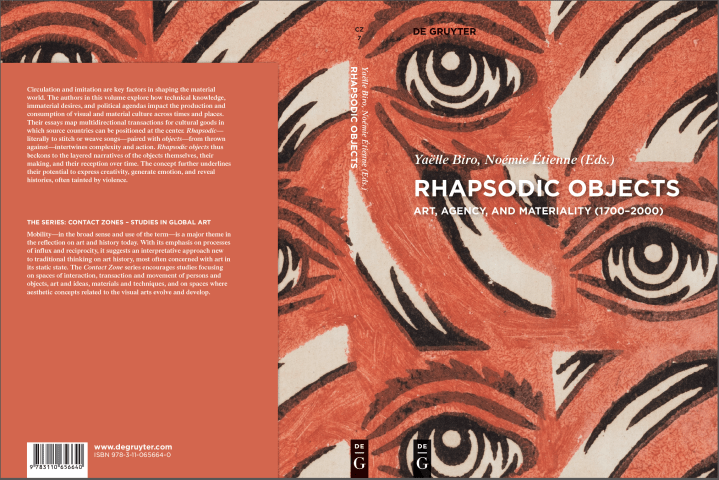
From De Gruyter:
Yaëlle Biro and Noémie Étienne, eds., Rhapsodic Objects: Art, Agency, and Materiality, 1700–2000 (Berlin: De Gruyter, 2022) 236 pages, ISBN: 97-83110656640, $80. Also available as a free PDF file from the publisher.
Circulation and imitation are key factors in shaping the material world. The authors in this volume explore how technical knowledge, immaterial desires, and political agendas impact the production and consumption of visual and material culture across times and places. Their essays map multidirectional transactions for cultural goods in which source countries can be positioned at the center. Rhapsodic—literally to stitch or weave songs—paired with objects—from thrown against—intertwines complexity and action. Rhapsodic objects thus beckons to the layered narratives of the objects themselves, their making, and their reception over time. The concept further underlines their potential to express creativity, generate emotion, and reveal histories—often tainted with violence.
Edited by Yaëlle Biro (Metropolitan Museum of Art) and Noémie Étienne (Universität Bern).
C O N T E N T S
Yaelle Biro and Noemie Etienne, Introduction
Part 1 | Interlaced Patterns
• Dorothy Armstrong, Wandering Designs: The Repossession of the ‘Oriental’ Carpet and Its Imaginary
• Aziza Gril-Mariotte, The Art of Printed Textiles: Selecting Motifs in the Eighteenth Century
• Chonja Lee, Chintzes as Printed Matter and Their Entanglement within the Transatlantic Slave Trade around 1800
Part 2 | Embedded Relationships
• James Green, Interpretations of Central African Taste in European Trade Cloth of the 1890s
• Helen Glaister, The Picturesque in Peking: European Decoration at the Qing Court
• Rémi Labrusse and Bernadette Nadia Saou-Dufrêne, Cultural Intersections and Identity in Algeria on the Eve of the French Invasion: The Case of the Bey Palace in Constantine
Part 3 | Crafted Identities
• Ashley V. Miller, ‘What Is Colonial Art? And How Can It Be Modern?’: Design and Modernity in France and Morocco, 1925
• Victoria L. Rovine, Crafting Colonial Power: Weaving and Empire in France and French West Africa
• Thomas Grillot, A World of Knowledge: Recreating Lakota Horse Effigies
• Gail Levin, Frida Kahlo’s Circulating Crafts: Her Painting and Her Identities
Authors
Picture Credits
New Book | Luisa Roldán
On this day (10 January) in 1706, Luisa Roldán died, as both a celebrated and impoverished artist. From the Getty Store:
Catherine Hall-van den Elsen, Luisa Roldán (Los Angeles: Getty Publications, 2021), 144 pages, ISBN 978-1606067321, $40.
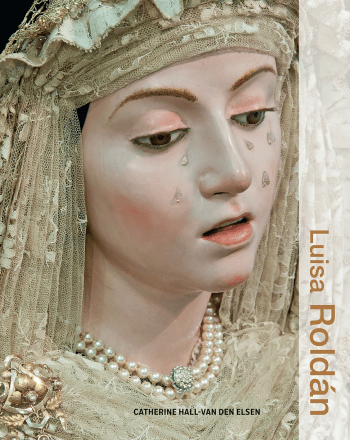 This initial book in the groundbreaking new series Illuminating Women Artists is the first English-language monograph on the extraordinary Spanish Baroque sculptor Luisa Roldán.
Luisa Roldán (1652–1706), also known as La Roldana, was an accomplished Spanish Baroque artist, much admired during her lifetime for her exquisitely crafted and painted wood and terracotta sculptures. Roldán trained under her father and worked in Seville, Cádiz, and Madrid. She even served as sculptor to the royal chambers of two kings of Spain. Yet despite her great artistry and achievements, she has been largely forgotten by modern art history. Written for art lovers of all backgrounds, this beautifully illustrated book offers an important perspective that has been missing—a deeper understanding of the opportunities, and the challenges, facing a woman artist in Roldán’s time. With attention to the historical and social dynamics of her milieu, this volume places Roldán’s work in context alongside that of other artists of the period, including Velázquez, Murillo, and Zurbarán, and provides much-needed insight into what life was like for this trailblazing artist of seventeenth-century Spain.
Catherine Hall-van den Elsen studied Spanish art at La Trobe University in Melbourne, Australia. She completed her MA and PhD on the life and work of Luisa Roldán.
C O N T E N T S
Series Foreword
Preface
Introduction
1 Women in Early Modern Spain
2 Sculpture in Early Modern Seville
3 Andalucía: Building a Career
4 Madrid: Challenge and Opportunity
5 Luisa Roldán through the Lenses of History
Chronology
Notes
List of Extant Works in Public and Church Collections
A Selection of Further Reading
Image Credits
Index
Call for Papers | Close Encounters: The Low Countries and Britain

Jacob Jordaens, A Maidservant with a Basket of Fruit, and Two Lovers, detail, 1629–35
(Glasgow: Kelvingrove Art Gallery and Museum)
◊ ◊ ◊ ◊ ◊
From the RKD:
Close Encounters: Cross-Cultural Exchange between the Low Countries and Britain, 1500–1800
RKD – Netherlands Institute for Art History, The Hague, 22 September 2022
Proposals due by 1 March 2022
The risks and challenges of migration are of compelling interest today. Over the last thirty years, research on early modern artists’ migration and on cultural exchange between the Low Countries and Britain has advanced rapidly, and has addressed many themes. The Dutch and Flemish artists’ communities in London, and the careers of individual artists at the English/British and Scottish courts, in particular, have received attention, as has the history of the collecting of Netherlandish art in the UK.

Gerrit van Honthorst, King Charles I, 1628 (London: NPG).
On 22 September 2022, a symposium at the RKD – Netherlands Institute for Art History will mark the launch of the heavily annotated and illustrated digital English language version of Horst Gerson’s chapter on ‘England’ from his Ausbreitung und Nachwirkung der holländischen Malerei des 17. Jahrhunderts of 1942 (The Dispersal and Legacies of Dutch 17th-Century Painting). For historians of Dutch 17th-century painting, in 1942, Gerson’s study of the integration of Dutch art in Britain was largely uncharted territory, although earlier British art historians, including Horace Walpole and C.H. Collins Baker, had been well aware of the involvement of Netherlandish migrants and visitors in art in the British Isles. The launch of the translated and annotated version of Gerson’s text marks the perfect occasion to discuss, contextualize, and rethink his original ideas in the light of present and developing knowledge.
The organizers welcome unpublished contributions on a broad range of areas relating to Dutch and Flemish artists, artisans and art production in Britain. These include: painting, drawing, graphic arts, tapestry, sculpture and architecture, collecting and the art market, as well as the contribution of Dutch and Flemish migrants to many forms of material culture.
Papers will be 20 minutes long, and might address the following themes and questions:
• Fresh approaches to the careers of practitioners from the Low Countries at the English/British and Scottish courts, and in UK urban centres (including monographic studies).
• How did those courts and urban centres function as hubs of cross-cultural exchange between individuals, and of production?
• Less-studied works by Dutch and Flemish artists and artisans who were active in Britain between 1500 and 1800.
• What were the workshop practices and techniques employed by Dutch and Flemish artists and artisans in Britain, and how did these inter-act with local artistic traditions and impact on technical and art literature?
• What were the social networks and professional relationships that linked and supported Netherlandish and British makers, art dealers and collectors?
• What was the market for Dutch and Flemish artistic goods in Britain, and how did it develop over time?
Please submit a preliminary title, abstract (max. 300 words) and a short CV to Angela Jager (jager@rkd.nl) and Rieke van Leeuwen (leeuwen@rkd.nl) before 1 March 2022. Speakers will be notified by 1 April 2022. Selected presentations will be considered for publication.
Close Encounters will be a hybrid symposium to allow for national and international COVID-19 restrictions. Speakers and attendees may choose whether to participate in person or online. For those presenters who decide to come to The Hague, travel and accommodation expenses will be covered (in consultation with the organization).
Academic Committee
Karen Hearn (University College London), Angela Jager (RKD), Sander Karst (University of Amsterdam), Rieke van Leeuwen (RKD), David A.H.B.Taylor (Independent; previously National Trust and National Galleries Scotland) and Joanna Woodall (Courtauld Institute of Art, London)
Online Publication | Gerson Digital
Published online and freely accessible by the Netherlands Institute for Art History, the RKD (Rijksbureau voor Kunsthistorische Documentatie) . . .
Gerson Digital — Dispersal and After-Effect of Dutch Painting of the 17th Century
 The series of Gerson Digital is a translated, critically annotated, and illustrated edition of Horst Gerson’s Ausbreitung und Nachwirkung der holländischen Malerei des 17. Jahrhunderts (Dispersal and After-Effect of Dutch Painting of the 17th Century, 1942/1983), supplemented with new articles on artistic exchange and transnational mobility of artists from the Low Countries in the early modern period. So far, the following volumes have been published:
1 Gerson Digital: Poland (2013/2014)
2 Gerson Digital: Denmark (2015)
3 Gerson Digital: Germany I (2017/2018)
4 Gerson Digital: Germany II (2018)
5 Gerson Digital: Italy (2019)
6 Masters of Mobility (2020)
ECCO for BSECS Members
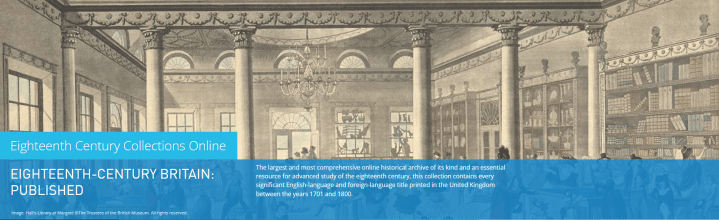
Gale is delighted to announce a partnership with the British Society of Eighteenth-Century Studies (BSECS). This partnership provides free access to Gale’s Eighteenth Century Collections Online (ECCO) for all non-affiliated members of the society. From 1 February 2022, any member of BSECS without an existing affiliation to a UK or Ireland higher education institution will be able to apply for access to this seminal resource at no cost.
Visit the Gale Blog for more details on the partnership with BSECS.
Information for ASECS members in North America accessing ECCO is available here»










 Enfilade
leave a comment