Exhibition | À la mode

Installation view of the exhibition À la mode: L’art de paraître au 18e siècle at the Musée d’arts de Nantes.
◊ ◊ ◊ ◊ ◊
Now on view at the Musée d’arts de Nantes; see particularly the ‘Exhibition in Pictures’:
À la mode: L’art de paraître au 18e siècle
À la mode: The Art of Appearance in the 18th Century
Musée d’arts de Nantes, 26 November 2021 — 6 March 2022
Musée des Beaux-arts de Dijon, 13 May — 22 August 2022
Curated by Sophie Lévy
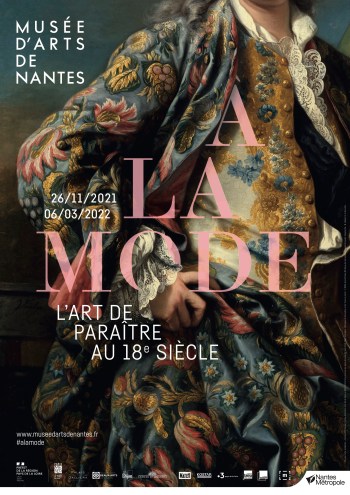 The exhibition À la mode: The Art of Appearance in the 18th Century juxtaposes iconic textile and pictorial items to reveal the reciprocal influences at play between the world of art and the birth of fashion in the 18th century. The exhibition brings together over 200 objects dating from the 18th century from major textile and fine art museums. Iconic paintings are displayed alongside precious textiles, never previously seen drawings, garments, and accessories, some of which have been restored especially for the exhibition.
The exhibition is a special collaboration with the Palais Galliera, musée de la Mode de la Ville de Paris, Paris Musées, and co-produced with the Musée des Beaux-arts de Dijon, which will host the exhibition from 13 May to 22 August 2022.
Chief Curator
• Sophie Lévy, Director and Curator of the Musée d’arts de Nantes
Scientific Curators
• Adeline Collange-Perugi, Curator of early art collections, Musée d’arts de Nantes
• Pascale Gorguet Ballesteros, Chief curator, 18th-Century Fashion and Dolls Department, Palais Galliera, musée de la Mode de la Ville de Paris
• Sandrine Champion-Balan, Chief curator, Collections Development Centre manager, Collections manager, head of modern collections for the curatorial team of the exhibition at the Musée des Beaux-Arts de Dijon
À la mode: L’art de paraître au 18e siècle (Ghent: Éditions Snoeck, 2021), 327 pages, ISBN: 978-9461617101, €35.

Lecture | Sarah Cohen on Sugar, Silver, and Slavery
Next month from BGC:
Sarah Cohen | Sugar, Silver, and the Bourbon Sucriers: Sweetening Slavery in 18th-Century France
The Françoise and Georges Selz Lectures on 18th- and 19th-Century French Decorative Arts and Culture
Online (Zoom), Bard Graduate Center, New York, 10 February 2022, 12.15 (ET)
Inseparable from the rise of sugar within the economies of international trade in eighteenth-century Europe was the Caribbean slave trade: in France, whose primary source of sugar for local consumption and re-export was its principal colony of Saint Domingue, the trade in enslaved persons swelled directly in tangent with the sugar business throughout the 1730s and beyond. But because all of the steps in harvesting and producing sugar, apart from some of the most elaborate refining processes, were carried out in the distant island colonies, such interdependency, to say nothing of the coerced labor it entailed, was invisible on the French dining table.

Paire de sucriers à poudre : esclaves chargés de cannes à sucre, 1730s (Paris: Musée du Louvre, photo by Daniel Arnaudet).
A startling exception to this submersion of the harsh facts of how sugar cane was harvested is found in a pair of silver sugar casters (sucriers) that depict a man and woman laboring beneath bundles of sugar cane, as if physically ‘delivering’ their sweet crystals for the elite dessert. Almost certainly made by the royal silversmith Claude II Ballin on commission for Louis-Henri, duc de Bourbon, the casters would have appeared among the duke’s many other worldly goods on display at the château of Chantilly in the 1730s. The harvesters would have been identifiable as an African woman and man through their carefully modelled physiognomies, which reflect incipient French understandings of racial type. Their bodies are cast in glistening, solid silver, while their hollowed burdens of bundled cane detach to dispense the powdered sweetener. Departing notably from typical examples of this type of luxury dispenser, whose baluster design references its placement and use on the table, rather than the sourcing of the product itself, the two large figures were also designed to occupy their own, unique place on a dessert or collation table. Cohen’s talk will explore the diverse implications of the sucriers within the context of international trade; the physical and cultural interconnections of sugar and slavery; and elite French practices of dining and festive entertainment in the early eighteenth century.
Registration is available here»
Sarah R. Cohen is Professor of Art History and Chair of the Department of Art and Art History at the University at Albany, SUNY. She is also a joint Professor in the Department of Women’s, Gender, and Sexuality Studies. Her research focuses on the body and sensory experience in art and culture from the sixteenth through eighteenth centuries, with a special emphasis on early modern France. Her books include Art, Dance and the Body in French Culture of the Ancien Régime (2000) and Enlightened Animals in Eighteenth-Century Art: Sensation, Matter, and Knowledge (2021). A third book, Picturing Animals in Early Modern Europe: Art and Soul, is forthcoming in 2022.
Online Symposium | Sea Machines

From the symposium website:
Sea Machines
Online, Daniels Faculty of Architecture, Landscape, and Design, University of Toronto, 4 February 2022
Organized by Christy Anderson and Jason Nguyen
Sea Machines is a one-day symposium (held on Zoom) that interrogates marine technology for the history and theory of architecture. From canoes and cargo ships to submarines and offshore drilling rigs, maritime vessels show how design has been employed to imagine, manoeuvre, conquer, and exploit the environments and ecosystems of the sea.
The sea has long been cast as the inverse of the habitable terracentric world. Depictions of storms, shipwrecks, and underwater monsters haunt the art and literature of coastal societies, serving as warnings to those who might venture into the blue expanse. Yet, across cultures and throughout history, humans have constructed elaborate structures to facilitate the crossing and even occupation of the ocean.
Recent scholarship in the blue humanities has shed light on the profound ways that oceans influence politics, economics, science, and culture. Aquatic environments have conditioned everything from human diets, artistic traditions, trade networks, and settlement patterns. Whereas architects and historians have studied harbours and ports, far fewer have looked at the vessels that traversed and inhabited the open water. These ‘sea machines’ signal the outer limits of a period and place’s techno-environmental imagination. What architectonic skills did designers, shipwrights, and navigators employ in the construction and operation of ocean structures? How did the forms and materials of water-based vessels speak to larger ideological and environmental forces, including those tied to colonization and slavery, capitalism, and the climate? And how might infrastructure linked to offshore extraction (e.g., fishing, pearl farming, coral and deep-sea mining, oil drilling, etc.) provide a specifically architectural way to evaluate the relationship between human and non-human entities across the land and sea divide?
Sea Machines brings together members of the Daniels Faculty and a diverse roster of internationally recognized scholars and practitioners with an interest in environmental history, technology, and design. The study of maritime spaces is timely and of wide interest for scholars and practitioners across the design disciplines, especially given the sea’s increasing precarity in the face of climate change. Ultimately, the symposium highlights the central role played by architecture in charting a future environmental and technological reality.
The event is free and open to the public. More information on the symposium and its speakers, including registration and Zoom information, is available here.
S C H E D U L E
10.00 Opening Remarks by Christy Anderson and Jason Nguyen
10.30 Session 1: Infrastructure
• Keller Easterling, ISO 1161
• Carola Hein, Oil on Water: The Global Petroleumscape and the Urbanization of the Sea
• Prita Meier, Below the Waterline: Dhows and the Politics of Heritage in the African Indian Ocean
11.30 Discussion
11.50 Lunch Break
1.00 Session 2: Culture
• Niklas Maak, Phalansteries at Sea: Fourier, Le Corbusier, and the Architecture of the Cruiseship
• Meredith Martin and Gillian Weiss, Sun King at Sea
• Elliott Sturtevant, Traveling the Heat Line: The ‘Great White Fleet’ as Climatic Media
2:00 Discussion
2.20 Break
2.30 Session 3: Energy
• Sara Rich, Naufragic Architecture in the Anthropocene
• Margaret Schotte, Water vs. Wood: Desalination Machines and the Shipboard Space, c. 1695
• Larrie Ferreiro, The Evolution of the Naval Architect, 1600–2000
3.30 Discussion
4.00 Closing Remarks by Christy Anderson and Jason Nguyen
Resource | New Decorative Arts Calendar Unveiled

From the press release (12 January 2022):
The Decorative Arts Trust Launches ‘Events in the Field’
The Decorative Arts Trust invites institutions to submit decorative arts programs and welcomes participants to browse listings on the new Events in the Field online calendar. Events in the Field, at eventsinthefield.com, features scholarly programs from dozens of art and history organizations. The calendar’s goal is to serve as a resource for those seeking to promote or find virtual or in-person decorative arts opportunities, from lectures and panel discussions to workshops and conferences.
“The Events in the Field initiative reinforces our effort to serve as a partner for the full breadth of the decorative arts community,” shares Matthew A. Thurlow, Executive Director of the Trust. “Whether you are a dedicated collector of 18th-century porcelain or an undergraduate student seeking an introduction to this field of study, Events in the Field will feature a range of opportunities that might not appear elsewhere. We are happy to provide this service to the field and hope the calendar will offer an opportunity to promote the excellent programs developed by colleagues from coast to coast.”
The generous 2022 Events in the Field sponsor is The Magazine Antiques, which celebrates its centennial this year.
The Decorative Arts Trust is a non-profit organization that promotes and fosters the appreciation and study of the decorative arts through exchanging information through domestic and international programming; collaborating and partnering with museums and preservation organizations; and underwriting internships, research grants, and scholarships for graduate students and young professionals. Learn more about the Trust at decorativeartstrust.org.
Author Talks | Highlighting New Books from the Mellon Centre
This spring, you’re invited to a series of talks by authors of books recently published by the Paul Mellon Centre. Each author will give a glimpse into their project, sharing insights about the process of researching, writing, and publishing their book. Each event consists of two talks of around 20 minutes each, followed by a discussion and Q&A session. All events take place from 18.30 to 20.00. More information, including booking details, is available from the Mellon Centre.

Henrietta McBurney and Joseph Viscomi | Illustrations and Illuminations
Online, 2 February 2022
In the first of these events, Henrietta McBurney will discuss her book Illuminating Natural History: The Art and Science of Mark Catesby, and Joseph Viscomi will speak about William Blake’s Printed Paintings. Together, the authors will consider how art and cultural histories tackle issues around illustration, copies, copying, and originality, as well as questions of professional status, authorial voice, and vision. The evening will be chaired by British Art Network convener, Martin Myrone. Register here»
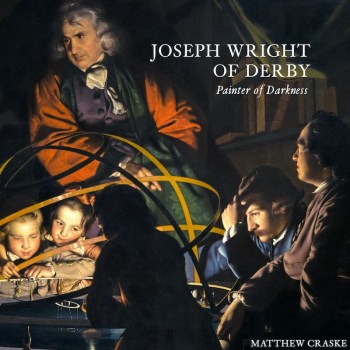
Matthew Craske and Martin Postle | In Darkness and In Light: Rethinking Joseph Wright of Derby
Online and in-person, Paul Mellon Centre, London, 16 February 2022
Join Matthew Craske, author of Joseph Wright of Derby: Painter of Darkness (published by the Paul Mellon Centre, 2020; winner of the 2021 William M. B. Berger Prize for British Art History) and Martin Postle, Senior Research Fellow at the Paul Mellon Centre, who is working on a catalogue raisonné on Joseph Wright of Derby’s paintings, for an evening of talks and discussion. Together, the authors will consider how the output of a single artist is rewritten and reimagined at different historical moments. The conversation will be chaired by PMC Director, Mark Hallett. Register here»

Petra ten-Doesschate Chu, Max Donnelly and Andrea Wolk Rager, | Aesthetic Encounters
Online, 9 March 2022
In the third of these events, Petra ten-Doesschate Chu and Max Donnelly will speak about their research for their book Daniel Cottier: Designer, Decorator, Dealer; and Andrea Wolk Rager will discuss The Radical Vision of Edward Burne-Jones (which will be published in May 2022). Together, the authors will consider new approaches to studying art, craft, and design of the nineteenth century and the intersection of art, social, and political history for creating richer understandings of the work of the artists and art workers they have researched. The conversation will be chaired by Liz Prettejohn. Register here»
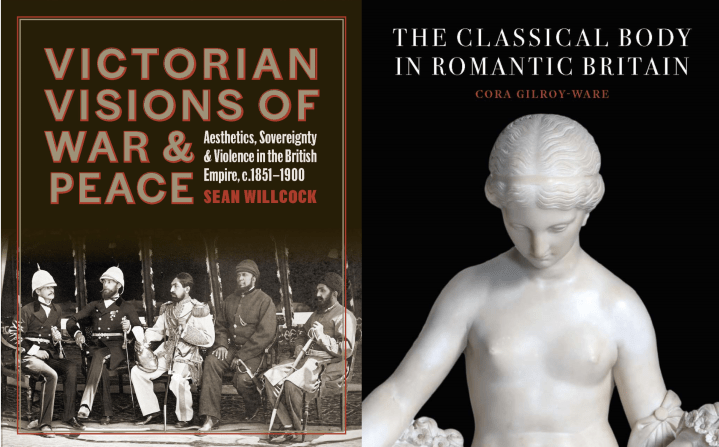
Cora Gilroy-Ware and Sean Willcock | War and Peace: Rethinking Aesthetics in the Age of Empire
Online and in-person, Paul Mellon Centre, London, 16 March 2022
In the fourth of these events, Cora Gilroy-Ware will speak about her research rethinking the sculpted body The Classical Body in Romantic Britain, and Sean Willcock will discuss Victorian Visions of War & Peace: Aesthetics, Sovereignty, and Violence in the British Empire. Together, the authors will consider how their research has questioned assumptions about aesthetics and style in the eighteenth and nineteenth centuries, researching overlooked artists, and discuss the intersections of the body, gender, race, and empire through their work on sculpture and photography. They will also talk about the process of turning a PhD thesis into a book manuscript. The conversation will be chaired by PMC Head of Research and Learning, Sria Chatterjee. Register here»
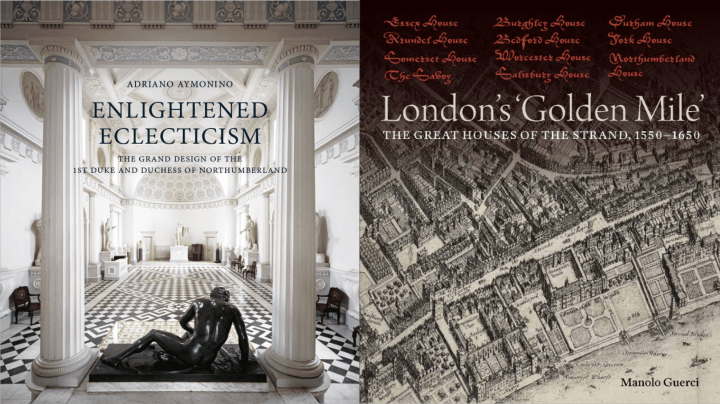
Adriano Aymonino and Manolo Guerci | Grand Designs and Great Houses
Online and in-person, Paul Mellon Centre, London, 23 March 2022
In the fifth and final of these events, Adriano Aymonino, author of Enlightened Eclecticism: The Grand Design of the 1st Duke and Duchess of Northumberland, and Manolo Guerci, author of London’s ‘Golden Mile’: The Great Houses of the Strand, 1550–1650, will come together to discuss discoveries made in writing their books about ambitious architectural commissions. They will consider the possibilities and the losses of the archive, issues around writing about designs of great scale (both extant and destroyed), and how to research campaigns of design, patronage and collecting stretching over a number of decades. The conversation will be chaired by Kate Retford. Register here»
Online Talk | Corey Brennan on the Villa Aurora
The sale of the Casino di Villa Ludovisi (Villa Aurora) has—understandably—generated lots of media attention (see the full announcement for press links), and at least some of the finds have involved the eighteenth century . . .
T. Corey Brennan, Inside the ‘World’s Most Expensive Home’: A Decade of Rutgers Research at the Villa Aurora in Rome
Online, 20 January 2022, noon (EST)
 The Villa Aurora in Rome—for precisely 400 years the home of the papal Boncompagni Ludovisi family—will go on auction this month with an asking price of $532 million dollars. Called by one leading art historian a “sort of seventeenth-century Sistine Chapel,” the Villa Aurora boasts famous mural art by more than a dozen major artists, including a unique 1597 ceiling painting by Caravaggio. In this richly illustrated talk, Professor Corey Brennan will discuss this landmark sale, his decade-long collaboration with the owners—†HSH Prince Nicolò and HSH Princess Rita Boncompagni Ludovisi—and the discoveries inside the Villa made with over two dozen Rutgers undergraduate students. This virtual presentation, open to the public, will take place on Thursday, 20 January 2022, 12:00–1:00pm (EST). Registration information is available here.
In Memoriam | Jonathan Brown (1939–2022)
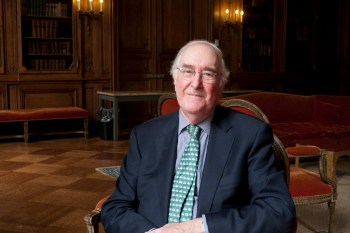 NYU’s Institute of Fine Arts mourns the loss of Jonathan Brown, who passed away at his home in Princeton, New Jersey on January 17, 2022, at the age of 82. Jonathan first joined the Institute in 1973 as its Director, a position he held for five years. He remained at the Institute as the Carroll and Milton Petrie Professor of Fine Arts until his retirement in 2017. A distinguished colleague and world-renowned scholar of Spanish and Viceregal Mexican art, his contributions to the field will live on for generations to come through his students and his noteworthy publications. Edward Sullivan, Robert Lubar-Messeri, and Richard Kagan have written a remembrance available here. A celebration of Jonathan’s life and work is planned for later in the spring.
Colloquium | The Myth of Versailles and European Courts
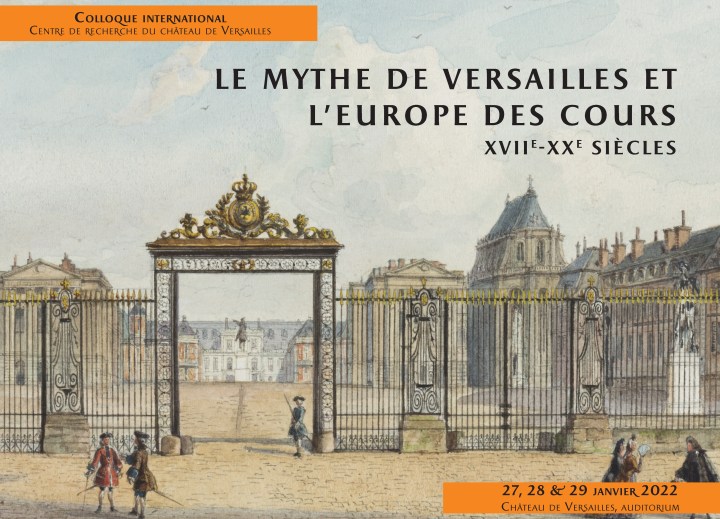
Schloss Versailles. Eingang zum Schloßhof. Album des vingt-deux vues de Versailles commandé par Louis II de Bavière à Jobst Riegel, aquarelle, 1876, V.2017.11. Château de Versailles.
◊ ◊ ◊ ◊ ◊
From Versailles and the conference programme:
The Myth of Versailles and European Courts, 17th–20th Centuries
Le mythe de Versailles et l’Europe des cours, XVIIe–XXe siècles
Auditorium du château de Versailles, 27–29 January 2022
Colloque international organisé par le Centre de recherche du château de Versailles dans le cadre de son programme de recherche « Identités curiales et le mythe de Versailles en Europe : perceptions, adhésions et rejets (XVIIIe–XIXe siècles) ». Il se tiendra les 27, 28 et 29 janvier 2022 à l’auditorium du château de Versailles. Les communications seront données en français et en anglais. Le colloque sera également diffusé en direct sur la chaîne Youtube du Centre de recherche du château de Versailles. L’accès à la retransmission ne nécessite pas d’inscription préalable.
J E U D I , 2 7 J A N V I E R 2 0 2 2
9.30 Accueil
9.35 Ouverture au nom du Centre de recherche du château de Versailles par Mathieu da Vinha, directeur scientifique
9.45 Introduction, Gérard Sabatier (professeur émérite, université de Grenoble II / directeur du programme CRCV « Identités curiales et le mythe de Versailles en Europe : perceptions, adhésions et rejets (XVIIIe–XIXe siècles) »)
10.00 Session I: La diffusion du mythe
Présidence de séance : Philip Mansel, président du Comité scientifique du Centre de recherche du château de Versailles / The Society for Court Studies
• Flavie Leroux (Centre de recherche du château de Versailles), Témoignages de visiteurs étrangers, XVIIe–XIXe siècles
• Johanna Daniel (Institut national d’Histoire de l’Art / Université Lyon 2), La vue d’optique, vecteur de diffusion du mythe versaillais dans la culture visuelle du XVIIIe siècle
• Sylvie Requemora-Gros (Aix Marseille Université), Le voyage encomiastique ou la fabrique du Songe de Versailles
12.30 Déjeuner
14.30 Session I: La diffusion du mythe, cont.
• Stefanie Leibetseder (chercheur indépendante, Berlin), Advertising or Demonizing the Myth? 18th-Century Travellers from Germany in Versailles
• Charles-Éloi Vial (Bibliothèque nationale de France / Sorbonne Université), Visiter Versailles sous l’Empire et la Restauration : musée, palais ou lieu de mémoire ?
16.00 Pause
16.15 Session II: Visiter Versailles, impressions personnelles
Présidence de séance : Marie-Christine Skuncke, professeur émérite de littérature, Uppsala Universitet
• Philip Mansel (Centre de recherche du château de Versailles / The Society for Court Studies), Versailles in England, from Charles II to George IV: Influences, Appropriations, and the Entente Cordiale
• Katarzyna Kuras (Université Jagellonne de Cracovie, Institut d’histoire), La famille Jabłonowski à Versailles au XVIIIe siècle. Impressions et inspiration
V E N D R E D I , 2 8 J A N V I E R 2 0 2 2
9.30 Session II: Visiter Versailles, impressions personnelles, cont.
• Ferenc Tóth (Centre de recherches en sciences humaines, Institut d’histoire, Budapest), Entre fascination et désillusion. Attitudes des nobles hongrois devant la cour de Versailles à l’époque des Lumières
• Éric Hassler (Université de Strasbourg), Versailles en Empire : les symptômes d’un mythe versaillais dans l’espace germanique dans la littérature de voyage germanique au XVIIIe siècle
• Sabrina Norlander Eliasson (Stockholm University, Department of Culture and Aesthetics), ‘A Landmark of the Transience of All Earthly Greatness, Glory, and Power!’ Versailles and the Myth of the Ancien Régime in the Writings and Collections of the Swedish Marquis Claes Lagergren (1853–1930)
12.00 Session III: La fabrique du faste
Présidence de séance : Maciej Forycki, maître de conférences en histoire moderne, Uniwersytet Adam Mickiewicz, Poznań
• Arianna Giorgi (Université de Murcie), en visioconférence, Habits, couleurs et boutons : mythe, rang et étiquette de la cour de Versailles chez les ducs d’Osuna
12.45 Déjeuner
14.30 Session III: La fabrique du faste, cont.
• Friedrich Polleroß (Université de Vienne, Institut für Kunstgeschichte), L’influence de Versailles à la cour de Vienne
• Thierry Franz (château de Lunéville / université de Lorraine), Lunéville au miroir de Versailles. La matérialisation du cérémonial à la cour de Lorraine, reflet d’un regard distancié sur le modèle français (1698–1737)
• Maureen Cassidy-Geiger (Independent Curator and Scholar, New York), en visioconférence, Versailles and Dresden: Myths and Models
• Raphaël Masson (Château de Versailles), L’univers versaillais de Louis II de Bavière : le cas de Linderhof
S A M E D I , 2 9 J A N V I E R 2 0 2 2
9.30 Session IV: Versailles en Europe : transferts culturels
Présidence de séance : Gérard Sabatier, professeur émérite, université de Grenoble II
• Dmitri Gouzévitch (EHESS / Centre d’Études des Mondes russe, caucasien et est-européen) et Irina Gouzévitch (EHESS / Centre Maurice Halbwachs), Le mythe de Versailles comme élément fondateur des « habits pour l’empire » de Pierre Ier : influence et parallélisme
• Andrea Merlotti (Reggia di Venaria, Centro studi delle Residenze Reali Sabaude), en visioconférence, Un mythe ambigu. Les « Versailles d’Italia » (XIX–XXe siècles)
• Jonathan Spangler (Manchester Metropolitan University), Between Habsburg and Bourbon: The Court of Lorraine as a Blended Model of Court Culture and a Symbol of Political Neutrality
• Pablo Vázquez Gestal (Boston University / CNRS / Sorbonne Université, Centre Roland Mousnier), Un mythe à deux sens. Versailles et les monarchies bourboniennes de l’axe méditerranéen (1715–1788)
Exhibition | Kehinde Wiley: The Prelude

Now on view at the National Gallery:
Kehinde Wiley: The Prelude
National Gallery, London, 10 December 2021 — 18 April 2022
Kehinde Wiley is an American artist best known for his portraits that render people of colour in the traditional settings of Old Master paintings. Most famously, in 2017, he was commissioned to paint Barack Obama, becoming the first Black artist to paint an official portrait of a president of the United States. Wiley’s work makes reference to the canon of European portraiture by positioning contemporary Black sitters, from a range of ethnic and social backgrounds, in the poses of the original historical, religious, or mythological figures. His images—as part quotation, part intervention—raise questions about power, privilege, identity, and above all highlight the absence or relegation of Black figures within European art.
In this exhibition, Wiley shifts his focus from one European tradition, Grand Manner portraiture, to another, landscape painting. Through new artworks—five paintings and a six-channel digital film—Wiley looks at European Romanticism and its focus on epic scenes of oceans and mountains, building relationships with the National Gallery’s collection of historical landscapes and seascapes by Turner, Claude, Vernet, and Friedrich. Like Wiley’s earlier paintings, this new work will look back at Old Masters as a way to create new connections and raise fresh questions.
Exhibition | Gainsborough’s Blue Boy
Opening this month at the National Gallery:
Gainsborough’s Blue Boy
National Gallery, London, 25 January — 15 May 2022
In the winter of 1922, Gainsborough’s The Blue Boy hung at the National Gallery in London for three weeks before it sailed across the Atlantic to its new home in California. It was a public farewell to a beloved painting. 100 years later (to the day), Gainsborough’s masterpiece returns to the Gallery to go on display in Trafalgar Square once again.
On a child-sized canvas, the young subject is dressed in a striking blue costume; he is bright-eyed yet serious, shy yet direct. The identity of the boy in blue is uncertain; more importantly, he is a stand-in for all boys and the idea of childhood. Through a series of high-profile exhibitions, widely published reproduction prints, and countless copies by artists down the ages, he has become one of Britain’s most beloved sons.
The Blue Boy represents the best of 18th-century British art. It is Gainsborough’s eloquent response to the legacy of Van Dyck and grand manner portraiture. It is a proud demonstration by Gainsborough of what painting can achieve. The popularity and influence of the painting have made it an icon, which has been quoted by contemporary artists and referenced in Hollywood films. After exactly 100 years, this exhibition reunites The Blue Boy with the British public and with the paintings that inspired it. This is the first time the painting has been loaned by The Huntington—it is a once-in-a-century opportunity to see this iconic work in the UK.
S E L E C T E D P R O G R A M M I N G
Paterson Joseph in Conversation
Friday, 18 February 2022, 6.30pm
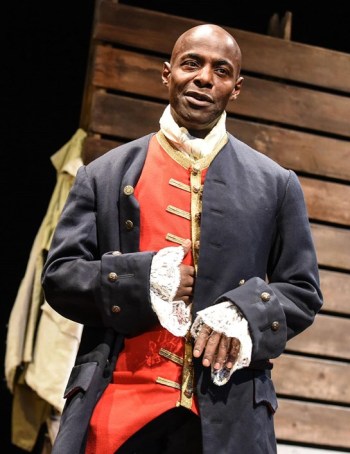
Paterson Joseph in the title role of his play Sancho: An Act of Remembrance, 2018 (Photograph by Robert Day).
Acclaimed actor and writer Paterson Joseph considers the legacies created by Gainsborough’s portraits of Ignatius Sancho and The Blue Boy. Joseph has extensively researched the 18th-century Black writer and composer Ignatius Sancho, whose portrait by Gainsborough is found in the National Gallery of Canada, Ottawa. In conversation with Christine Riding, the Jacob Rothschild Head of the Curatorial Department, Joseph will explore the narratives created through Gainsborough’s work, revealing a portrait of 18th-century Britain and how it is remembered today.
Paterson Joseph is an actor and writer. His work includes stints at the National Theatre and the Royal Shakespeare Company as well as roles in Peep Show, Timeless, Noughts and Crosses, and Vigil. Films include The Beach, Aeon Flux, and In The Name of the Father. He is the author of the monodrama Sancho: An Act of Remembrance and Julius Caesar and Me: Exploring Shakespeare’s African Play. His debut novel The Secret Diaries of Charles Ignatius Sancho will be published in October 2022 by Dialogue Books.
Curator’s Introduction: Gainsborough’s Blue Boy
Monday, 28 February 2022, 1.00pm
Join Christine Riding, the Jacob Rothschild Head of the Curatorial Department, for this lunchtime talk to learn more about this iconic image of childhood, which has been a source of inspiration for contemporary artists and referenced in Hollywood films. A recording will be available on Youtube.










 Enfilade
leave a comment