Exhibition | Traveling in Style: A Coach Restored

Beekman Family Coach, ca. 1770, made in England; wood (ash and spruce by analysis), iron, and leather. 8 feet × 13 feet × 52 inches
(New-Historical Society, Gift of Gerard Beekman 1911.25)
◊ ◊ ◊ ◊ ◊
Now on view at the New-York Historical Society:
Traveling in Style: A Coach Restored
New-York Historical Society Museum & Library, 2 July 2021 — 20 February 2022
The Beekman Family Coach returns to the New-York Historical Society on 2 July 2021. Over the past year, this rare coach—one of only three horse-drawn vehicles used in 18th-century America to survive in original condition—was painstakingly restored to its 1790s appearance through a generous grant from the Institute of Museum and Library Services.
New York merchant James Beekman purchased the coach in 1771 for £138. An expensive luxury that became the crown jewel in his fleet of carriages, the coach was repainted at least five times between 1771 and the 1790s.
Conservator Brian Howard and his team meticulously restored the coach, beginning with the removal of a thick layer of old varnish applied during the mid 20th century. Underneath lay five layers of historic paint, including a light celadon green color from the 1790s that is again visible today. Among other surprises, conservators discovered that the interior of the cab retained most of its original fixtures and materials—wood benches and storage lockers, wool wall coverings, carpeting, and coach lace, enameled Russian leather trim, and flax insulation.
Conservation and display of the Beekman Family Coach is being supported in part by a Federal Save America’s Treasures grant administered by the Institute of Museum and Library Services.
Exhibition | France and Russia: Ten Centuries Together

Pierre-François Drais, snuffbox, made in Paris between 1776 and 1789, with portraits added sometime between 1814 and 1830; gold, enamel, and lapis lazuli, mounted with miniatures in watercolour on ivory (London: V&A, 905-1882). The portraits depict Marie Antoinette and her children Marie-Thérèse-Charlotte (1778–1851), the Dauphin Louis (1781–1789), and Louis-Charles the future Louis XVII (1785–1795), along with a sculptured bust of Louis XVI.
◊ ◊ ◊ ◊ ◊
From the press release for the exhibition:
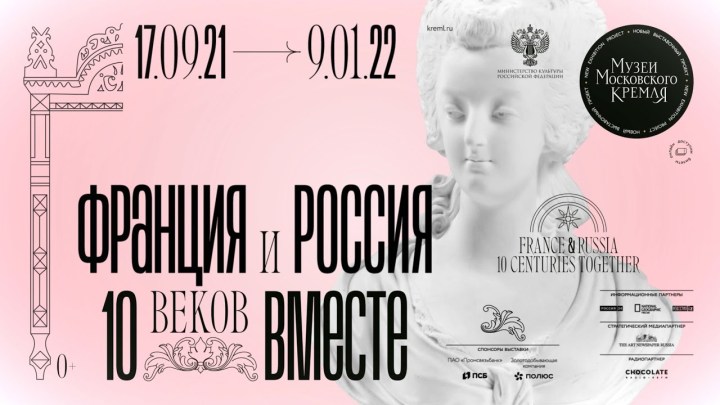
France and Russia: Ten Centuries Together / Франция и Россия: 10 веков вместе
Exhibition Halls of the Patriarch’s Palace and the Assumption Belfry, Moscow, 7 September 2021 — 9 January 2022
The Moscow Kremlin Museums present the exhibition France and Russia: Ten Centuries Together as part of the cross-cultural year between Russia and France, highlighting their interregional cooperation. The project, dedicated to the centuries-long history of cultural and diplomatic relations between the two countries, showcases over two hundred artifacts: memorial objects, archival documents, and artworks from national Russian and European museums. The exhibition explores the history of Russian-French relations through intertwining fates of outstanding personalities including prominent statesmen, scientists, writers, artists, and craftsmen. The chosen approach aims at reconstructing the character of the relationship between the two countries as an immediate, multifaceted, somewhat contradictory, but an ultimately fruitful process for both parties.
 The show opens with a unique charter, dating back to 1063 and recalling the important political event of the 11th century: the dynastic marriage of Princess Anna Yaroslavna, daughter of the Great Prince Yaroslav the Wise, to King Henry I of France. The charter, provided by the National Library of France, is believed to be the only surviving document that bears the handwritten sign of the cross and monogram of King Philip I with his mother’s authentic signature ‘ANA RHNA’ (Queen Anne) placed underneath in Cyrillic letters. Visitors are also afforded the rare opportunity of seeing the Reims Gospel—a unique illuminated manuscript of great cultural and historical significance. Generously offered for the exhibition by the Municipal Library of Reims, it will take centre stage among the key objects on display.
Among the later period pieces featured in the exhibition is a drawing by artist J. Desmarets capturing Peter I and Louis XV in Paris on 11 May 1717 and presented to the Soviet leaders as a diplomatic gift in 1944 to commemorate the visit of Charles de Gaulle, the Chairman of the Provisional Government of the French Republic, to Moscow. The development of the 18th-century political dialogue between Russia and France is chronicled through paintings and sculptures, weapons, textiles, and jewellery commissioned for the Russian Imperial Court from famous French masters or created by prominent French artists invited to Russia. The passion for French art is evidenced by luxurious tapestries, the ceremonial dress of the young Emperor Peter II, the exquisite lacework adorning the gowns of Russian monarchesses, the pieces from the silver Paris set owned by Empress Elizaveta Petrovna, and magnificent weapons, including a pair of pistols belonging to Emperor Peter II and made by the Arquebusier du Roi (royal gunmaker) Jean-Baptiste Laroche.
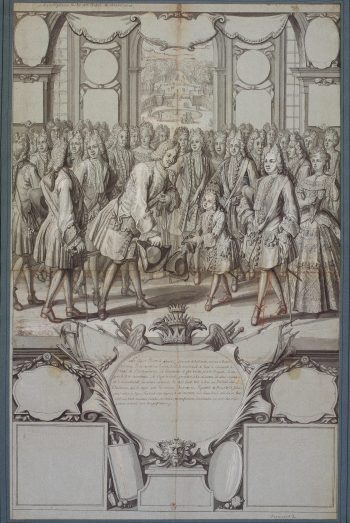
J. Desmarets, Peter I and Louis XV in Paris on 11 May 1717, 1717, ink, watercolour, red chalk, and gouache on tinted paper (Moscow Kremlin Museums)
Portraits from the collection of the Pushkin State Museum of Fine Arts recreate a gallery of outstanding political and cultural figures from the reigns of Empresses Elizaveta Petrovna and Catherine the Great. The section on Catherine the Great’s reign showcases pieces from the legendary Orlov porcelain service executed by the Parisian silversmiths Jacques and Jacques-Nicolas Roettiers along with the precious desk clock with inkstand—the work of a Parisian master—that belonged to the Empress. Unique pieces from the collection of the Pavlovsk Museum and Heritage Site will hark back to Grand Duke Pavel Petrovich and Grand Duchess Maria Feodorovna’s tours of Europe. The years preceding the Great French Revolution are epitomised by the rare memorial objects and are captured in the portraits painted by Élisabeth Vigée-Le Brun, Queen Marie-Antoinette’s favourite artist.
A special section of the exhibition is devoted to relations between Russia and France during the reign of Emperor Alexander I. Here, visitors will see a magnificent cased set of weapons made by the famous French gunsmith and bladesmith Nicolas-Noël Boutet—the gift presented to the Russian governor-general of Paris, Baron Fabian Gottlieb Fürst von der Osten-Sacken from the grateful Parisians. Another highlight is the Olympic porcelain service produced at the Sèvres porcelain factory and presented in 1807 by Napoleon to the Emperor Alexander I in commemoration of the Treaty of Tilsit. The star of the Order of the Holy Spirit, awarded to Alexander I by King Louis XVIII after the former’s victory over Napoleon and the restoration of the monarchy in France, is another showpiece not to miss! The exhibition introduces visitors to the history of ‘Russian Nice’ and feature stories of the World Exhibition that took place in Paris in 1867. It also offers insights into the process of strengthening of Franco-Russian friendship and formation of the Franco-Russian Alliance at the turn of the 19th century.
Participating Institutions
The Moscow Kremlin Museums, the Palaces of Versailles and Trianon, Victoria and Albert Museum, the National Museums of Castles Malmaison and Bois-Préau, National Library of France, the Reims Municipal Library, the State Tretyakov Gallery, the Pushkin State Museum of Fine Arts, the Shchusev State Museum of Architecture, the State Hermitage, Museum and Heritage Site ‘Pavlovsk’, the Russian State Library, the Archive of the Russian Academy of Sciences, the Russian State Archive of Ancient Documents
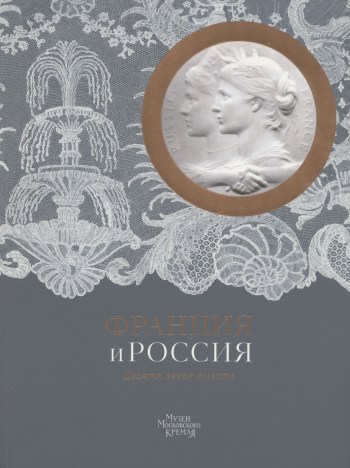
Svetlana Amelekhina et al. Frantsiia i Rossiia: Desiat’ vekov vmeste / Франция и Россия: 10 веков вместе (Moscow: Muzei Moskovskogo Kremlia, 2021), 383 pages, ISBN: 978-5886783872. Available here»
New Book | Les ébénistes de la Couronne sous le règne de Louis XIV
From Bib des Arts:
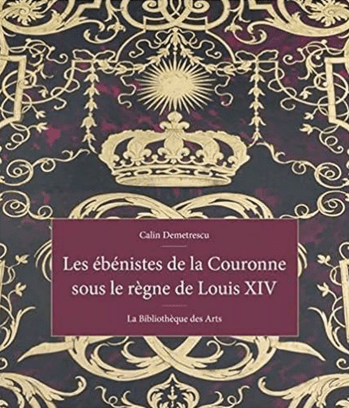
Calin Demetrescu, Les ébénistes de la Couronne sous le règne de Louis XIV (Lausanne: La Bibliothèque des Arts, 2021), 448 pages, ISBN: 978-2884532273, €59 / $94.
Cet ouvrage est le fruit d’un travail de recherche mené sur plus de dix ans. Par un dépouillement de nombreux documents d’archives, la plupart inédits, l’auteur révèle des aspects méconnus de la biographie des artisans ayant œuvré pour le Garde Meuble de la Couronne et pour les Bâtiments du Roi. Cette approche donne vie aux relations de travail—et de famille—au sein d’une véritable nébuleuse d’artisans (menuisiers ébénistes, bronziers, ornemanistes) français et étrangers, catholiques venus d’Italie et protestants venus des pays du nord de l’Europe.
Une méthode de travail originale, fondée sur l’approche des séries analogiques, a permis des identifications et des attributions d’œuvres majeures : notamment à Alexandre-Jean Oppenordt, par exemple, dont la possible collaboration avec André-Charles Boulle est ici mise en évidence. Outre une étude des œuvres de Domenico Cucci déjà connues, l’auteur propose également une révision des attributions à Pierre Golle ainsi qu’une nouvelle chronologie de l’œuvre d’André- Charles Boulle. Plus de 400 illustrations en couleur documentent utilement la démarche de l’auteur de cette somme qui comblera tous les admirateurs du Grand Siècle et qui sera un outil de travail indispensable pour les conservateurs de musée comme pour les antiquaires et les collectionneurs.
Auteur d’articles et d’ouvrages sur les styles Louis XIV et Régence, Calin Demetrescu, historien d’art, ancien conservateur des musées de la Ville de Bucarest et collaborateur scientifique du département des objets d’art du musée du Louvre pendant plusieurs années, est l’un des spécialistes connus et réputés pour ses recherches et publications relatives aux ébénistes et au mobilier des XVIIe et XVIIIe siècles. Ses découvertes dans le domaine ont permis des avancées notables dans les connaissances sur les ébénistes de cette période, dont ceux faisant l’objet de cette remarquable étude. Sa thèse sur le sujet reçut le Prix Georges-Nicole de la Société d’Histoire de l’Art français.
Journées d’étude | The Rediscovered Colors of Aubusson Tapestries
From ArtHist.net:
Les Couleurs retrouvées des Tapisseries d’Aubusson
Online, Aubusson, 17–18 January 2022
Ces journées d’étude seront l’occasion de partager les premiers résultats d’une recherche pluridisciplinaire originale menée dans le cadre du programme Aubusson: Les couleurs retrouvées des tapisseries fines d’Aubusson (XVIIIe siècle) — Culture matérielle: conception, production, caractérisation, altération et conservation soutenu par la Région Nouvelle Aquitaine. Centrées sur l’étude d’un exemple, une tapisserie récemment acquise par la Cité internationale de la Tapisserie à Aubusson, elles convoquent l’histoire naturelle, l’histoire sociale, l’histoire de l’art, les sciences physiques et chimiques, les sciences du patrimoine et les nouvelles technologies afin de renouveler la connaissance des objets analysés. Le propos touche donc à l’identification des choses représentées, à l’examen des processus d’élaboration et des stratégies de production des tapisseries, à reconsidérer les techniques de tissage et les matériaux utilisés par la constitution d’une base de données des différents supports et par l’analyse non invasive des colorants. Il s’agit aussi de poser des diagnostics de conservation et de présentation des collections et de tenter une restitution numérique des couleurs d’origine.
These study days will be an opportunity to share the first results of an original multidisciplinary research conducted within the framework of the Aubusson program: Les couleurs retrouvées des tapisseries fines d’Aubusson (XVIIIe siècle) — Culture matérielle: conception, production, caractérisation, altération et conservation, supported by the Région Nouvelle Aquitaine. Focusing on the study of an single example, a tapestry recently acquired by the Cité internationale de la Tapisserie in Aubusson, they bring together natural history, social history, art history, physical and chemical sciences, heritage sciences, and new technologies in order to renew the knowledge of the analyzed objects. The aim is to identify the things represented in the tapestry, to examine the tapestry elaboration process and production strategies, and to reconsider the weaving techniques and the materials used through the constitution of a database of the different supports and by the non-invasive analysis of the dyes. It is also a question of diagnosing the conservation and presentation of the collections and attempting a digital restitution of the original colors of the tapestry.
Comité Scientifique
Alice Bernadac, Pascal-François Bertrand, Floréal Daniel, Aurélie Mounier, Audrey Nassieu Maupas, Bruno Ythier
Pour le 17/01 : https://us06web.zoom.us/j/87245772303
872 4577 2303 / pas de code secret
Pour le 18/01 : https://us06web.zoom.us/j/86846013778
868 4601 3778 / pas de code secret
1 7 J A N V I E R 2 0 2 2
9.00 Ouverture par Emmanuel Gérard, Directeur de la Cité internationale de la Tapisserie, et Introduction par Pascal-François Bertrand
10.00 Session 1 | Sciences Naturelles: ReprÉsenter la Nature
• Cécile Aupic — Identification de la flore dans la Verdure aux armes de Brühl
• Jacques Cuisin — Les animaux dans la Verdure aux armes de Brühl
11.00 Session 2 | Histoire Sociale: Approche Socio-Écomonique
• Koenraad Brosens — Le marché de la verdure en Europe
• Ute Koch — Heinrich von Brühl et les tapisseries de son château de Brody
12.00 Pause déjeuner
14.00 Visite des ateliers, Jean-Marie Dor
15.30 Session 3 | Histoire de l’Art: Peindre et Tisser des Paysages
• Ingrid de Meuter — Les verdures flamandes, 1640–1750
• Charissa Bremer David — Les verdures de la Manufacture de tapisserie de Beauvais, 1690–1740
• Camilla Pietrabissa — La peinture de paysage en France dans la première moitié du XVIIIe siècle
• Benjamin Perronet — Dessins de paysage autour d’Oudry et de Boucher
• Élodie Pradier — Jean-Baptiste Oudry et la question de la couleur
1 8 J A N V I E R 2 0 2 2
9.00 Session 4 | Sciences Physiques et Chimie
• Aurélie Mounier, Hortense de La Codre, et Floréal Daniel — Mise au point d’une méthodologie spécifique, sans contact, pour l’identification des colorants et textiles
• Hortense de La Codre, Rémy Chapoulie, Laurent Servant, et Aurélie Mounier — Manufactures Royales de Tapisseries françaises (Gobelins, Beauvais, Aubusson) : entre sources écrites et réalité matérielle. Application de méthodes spectroscopiques non-invasives à l’étude de trois tapisseries du XVIIIe siècle
10.00 Session 5 | Sciences du Patrimoine: Restauration et Muséologie
• Alice Bernadac, Carole Redais (Langlois Tapisseries), et Jean-Marie Dor — La restauration de la Verdure aux armes de Brühl
• Alice Bernadac — Présenter la Verdure aux armes de Brühl dans les salles de la Cité de la Tapisserie (dans les salles)
11.30 Session 6 | Technologies Numériques
• Loïc Espinasse, Pascal Mora, Michael Rouca, et François Daniel — Restituer virtuellement les couleurs de la Tapisserie aux armes de Brühl
12.00 Conclusion
• Bruno Ythier
Resource | Black Craftspeople Digital Archive

Peter Bentzon, Teapot, 1817–29, Philadelphia, silver and wood (Washington, DC: Smithsonian National Museum of African American History and Culture, 2010.14). Born in the early 1780s in the West Indies, Peter Bentzon was a free man of color. He apprenticed as a silversmith in Philadelphia and then traveled to St. Croix where he opened his own silver shop. In 1817, Bentzon returned to Philadelphia and continued to work as an independent silversmith.
◊ ◊ ◊ ◊ ◊
Press release (14 December 2021) from The Decorative Arts Trust:
The Decorative Arts Trust is pleased to announce that the Black Craftspeople Digital Archive (BCDA) has been named the 2021 recipient of the Prize for Excellence and Innovation.
Founded in 2019, the BCDA brings together scholars, students, museums, and archives professionals and the public to collaborate and spread the story of Black craftspeople. To date, blackcraftspeople.org includes archival information and a searchable map with information about 960 black craftspeople involved in 45 trades in the South.
The BCDA originally began as a project by Dr. Tiffany Momon, inspired by her research into John ‘Quash’ Williams, an enslaved and later free Black master carpenter responsible for the carpentry and joinery work on the c. 1750 Charles Pinckney Mansion in Charleston, South Carolina. Tiffany now serves as the BCDA Founder and Co-Director with Dr. Torren Gatson as BCDA’s Co-Director and Publications and Special Projects Director.
Prize funding will support the BCDA Object Database, which will provide scholarship documenting the ancestry, historical timelines, and narratives of these craftspeople within the context of the larger decorative arts field.
The BCDA Instagram account is available here»
 In addition to the BCDA’s award, The Trust was able to provide funding to two other finalists. Bayou Bend Collection and Gardens will receive a grant to underwrite the stipend of a research fellowship for the William J. Hill Texas Artisans and Artists Archive devoted to seeking objects that represent a broader range of the state’s cultural history. The Historic Albany Foundation will receive a grant to develop a series of workshops with the Cultural Heritage Agency of the Netherlands as part of the preservation and adaptive reuse of the Van Ostrande-Radliff House.
◊ ◊ ◊ ◊ ◊
The Decorative Arts Trust Prize for Excellence and Innovation was established in 2019 to recognize scholarly endeavors to advance the public’s appreciation of decorative arts, fine arts, architecture, or landscape design. The Trust is eager to highlight a broad range of projects–by no means restricted to digital database projects–and encourages institutions pursuing innovative initiatives of all types to submit nominations, which are accepted through June 30 annually.
The Decorative Arts Trust is a non-profit organization that promotes and fosters the appreciation and study of the decorative arts through exchanging information through domestic and international programming; collaborating and partnering with museums and preservation organizations; and underwriting internships, research grants, and scholarships for graduate students and young professionals.
New Book | Facing Georgetown’s History
From Georgetown UP:
Adam Rothman and Elsa Barraza Mendoza, eds., with a foreword by Lauret Savoy, Facing Georgetown’s History: A Reader on Slavery, Memory, and Reconciliation (Georgetown: Georgetown University Press, 2021), 368 pages, ISBN: 978-1647120962, $30.
 A microcosm of the history of American slavery in a collection of the most important primary and secondary readings on slavery at Georgetown University and among the Maryland Jesuits
Georgetown University’s early history, closely tied to that of the Society of Jesus in Maryland, is a microcosm of the history of American slavery: the entrenchment of chattel slavery in the tobacco economy of the Chesapeake in the seventeenth and eighteenth centuries; the contradictions of liberty and slavery at the founding of the United States; the rise of the domestic slave trade to the cotton and sugar kingdoms of the Deep South in the nineteenth century; the political conflict over slavery and its overthrow amid civil war; and slavery’s persistent legacies of racism and inequality. It is also emblematic of the complex entanglement of American higher education and religious institutions with slavery.
Important primary sources drawn from the university’s and the Maryland Jesuits’ archives document Georgetown’s tangled history with slavery, down to the sizes of shoes distributed to enslaved people on the Jesuit plantations that subsidized the school. The volume also includes scholarship on Jesuit slaveholding in Maryland and at Georgetown, news coverage of the university’s relationship with slavery, and reflections from descendants of the people owned and sold by the Maryland Jesuits.
These essays, articles, and documents introduce readers to the history of Georgetown’s involvement in slavery and recent efforts to confront this troubling past. Current efforts at recovery, repair, and reconciliation are part of a broader contemporary moment of reckoning with American history and its legacies. This reader traces Georgetown’s “Slavery, Memory, and Reconciliation Initiative” and the role of universities, which are uniquely situated to conduct that reckoning in a constructive way through research, teaching, and modeling thoughtful, informed discussion.
Adam Rothman is a professor in Georgetown University’s Department of History. He is the author of Beyond Freedom’s Reach: A Kidnapping in the Twilight of Slavery, which was named the Humanities Book of the Year by the Louisiana Endowment for the Humanities and received the American Civil War Museum’s book award. He is also the author of Slave Country: American Expansion and the Origins of the Deep South and the coauthor of Major Problems in Atlantic History. He served on Georgetown’s Working Group on Slavery, Memory, and Reconciliation in 2015-16, and is currently the principal curator of the Georgetown Slavery Archive. He was a Distinguished Visiting Scholar at the John W. Kluge Center at the Library of Congress in 2018, where he created the podcast African-American Passages: Black Lives in the 19th Century.
Elsa Barraza Mendoza is a PhD candidate in history at Georgetown University and the assistant curator of the Georgetown Slavery Archive. She is a former Fulbright-Garcia Robles fellow. Her research has been supported by the Cushwa Center for the Study of American Catholicism and the Omohundro Institute of Early American History and Culture. She is currently writing her dissertation on the history of slavery on Georgetown’s campus.
Lauret Savoy is the David B. Truman Professor of environmental studies at Mount Holyoke College, where she explores the marks of history on the land. The author of Trace: Memory, History, Race, and the American Landscape, she also descends from people enslaved by Jesuits.
C O N T E N T S
Acknowledgments
Editors’ Note
Foreword, Lauret Savoy
Introduction, Adam Rothman
Part 1 | History
Essays
1 Craig Steven Wilder, War and Priests: Catholic Colleges and Slavery in the Age of Revolution
2 Robert Emmet Curran, ‘Splendid Poverty’: Jesuit Slaveholding in Maryland, 1805–38
3 Elsa Barraza Mendoza, Catholic Slave Owners and the Development of Georgetown University’s Slave Hiring System, 1792–1862
4 James O’Toole, Passing: Race, Religion, and the Healy Family, 1820–1920
Documents
5 Enslaved People Named in a Deed, 1717
6 A Sermon on the Treatment of Slaves, 1749
7 Edward Queen Petitions for Freedom, 1791
8 Isaac Runs Away from Georgetown College, 1814
9 A Jesuit Overseer Calculates the Cost of Slave Labor, 1815
10 Baptism of Sylvester Greenleaf at Newtown, 1819
11 Fr. James Ryder, SJ, Criticizes Abolitionism, 1835
12 The Society of Jesus Sets Conditions on the Sale of the Maryland Slaves, 1836
13 Articles of Agreement between Thomas Mulledy, Henry Johnson, and Jesse Batey, 1838
14 A Jesuit Priest Witnesses Anguish at Newtown, 1838
15 Bill of Sale for Len, 1843
16 A Jesuit Priest Reports on the Fate of the Ex-Jesuit Enslaved Community in Louisiana, 1848
17 Aaron Edmonson, the Last Enslaved Worker at Georgetown, 1859–62
18 Labor Contract at West Oak Plantation, Iberville Parish, Louisiana, 1865
19 Photograph of Frank Campbell, ca. 1900
Part 2 | Memory and Reconciliation
Essays
20 Ira Berlin, American Slavery in History and Memory and the Search for Social Justice
21 Ta-Nehisi Coates, The Case for Reparations
22 Alondra Nelson, The Social Life of DNA: Racial Reconciliation and Institutional Morality after the Genome
The Working Group
23 Matthew Quallen, Slavery’s Remnants, Buried and Overlooked
24 Toby Hung, Student Activists Sit in outside DeGioia’s Office
25 Report of the Georgetown University Working Group on Slavery, Memory, and Reconciliation, to the President of Georgetown University
26 James Martin, SJ, How Georgetown is Coming to Terms with Slavery in Its Past
The GU272 Descendants
27 Rachel L. Swarns, 272 Slaves Were Sold to Save Georgetown. What Does It Owe Their Descendants?
28 Rachel L. Swarns and Sona Patel, ‘A Million Questions’ from Descendants of Slaves Sold to Aid Georgetown
29 Terry L. Jones, Louisiana Families Dig into Their History, Find They Are Descendants of Slaves Sold by Georgetown University
30 Cheryllyn Branche, My Family’s Story in Georgetown’s Slave Past
31 Rick Boyd, Many in Slave Sale Cited by Georgetown Toiled in Southern Maryland
Reconciliation and Reparation
32 Remarks of Sandra Green Thomas at Georgetown University’s Liturgy of Remembrance, Contrition, and Hope
33 Remarks of Fr. Timothy Kesicki, SJ, at Georgetown University’s Liturgy of Remembrance, Contrition, and Hope
34 Terrence McCoy, Her Ancestors Were Georgetown’s Slaves. Now, at Age 63, She’s Enrolled There-as a College Freshman
35 Marc Parry, A New Path to Atonement
36 Jesús A. Rodríguez, This Could Be the First Slavery Reparations Policy in America
37 Javon Price, Changing Perceptions on the GU272 Referendum
Epilogue, Elsa Barraza Mendoza
Timeline
Further Reading
Index
Emma’s Songbooks: Rediscovered Music for Nelson

Songbook once owned by Lady Hamilton, which has a cantata composed by G.G. Ferrari and dedicated to Lord Nelson
(Museum of London, 31.17/2)
◊ ◊ ◊ ◊ ◊
From the Museum of London:
Emma’s Songbooks: Rediscovered Music for Nelson
Online, Museum of London Docklands, recording available 21 December 2021 — 11 January 2022
In partnership with the Guildhall School of Music & Drama, the Museum of London Docklands brings to life songs dedicated to Horatio Nelson’s naval victories, recently rediscovered in Emma Hamilton’s songbooks by Museum of London librarian Lluis Tembleque Terés. Terés kicks off the event with a presentation on his finds and their historical context, after which Christopher Suckling, Head of Historical Performance at the Guildhall School of Music & Drama, will give an insight onto the music world at the beginning of the 19th century. Following the talks, performers from the School will play the four rediscovered pieces, along with a number of other relevant scores. Finally, Terés will show items from the Museum collections connected to Lady Hamilton and Lord Nelson—all in the immersive surroundings of the Museum of London Docklands.
Please note that this will be a recording of the live event, which took place on December 11. You will have seven days to access the recording from the date you select as part of the ticket purchase process.

Songbook once owned by Emma Hamilton, here shown by Museum of London librarian Lluis Tembleque Terés
(Museum of London, 31.17/2; photo by John Chase)
◊ ◊ ◊ ◊ ◊
From the press release (via Art Daily) . . .
A recording of an old sea song, one of four recently rediscovered pieces of music paying tribute to Nelson, has been released today by the Museum of London. Brought to life by musicians from Guildhall School of Music & Drama, it marks the first performance of the piece in over 200 years. The extraordinary discovery was made last year by Museum of London librarian Lluis Tembleque Teres who discovered it amongst songbooks belonging to Nelson’s lover, the actress and model Emma Hamilton.
It is thought the song was sung after the battle of Cape St Vincent (1797) and transcribed by Nelson after hearing it chanted by his crew. The lyrics have been known about since a letter from Nelson to William Douglas, 4th Duke of Queensberry, was sold at auction in 2013—the only other known reference to the song. The new discovery points to the addition of new music and a chorus by the Duke, a notorious society figure, whose reputation for gambling and horse racing has long overshadowed his musical ability. A personal friend of Emma Hamilton, his authorship of the piece is recorded in Emma’s own hand.
Lluis Tembleque Teres, librarian, Museum of London, said, “The song was written by Nelson’s crew in one of his early victories. It is fascinating how, some four years later and already a national hero, he recovers the lyrics and sends them to the Duke of Queensberry, almost as if showing off his early successes. The Duke then adds music and a chorus, and gifts the manuscript to Emma Hamilton, thus allowing us exactly 220 years later to relive Nelson’s fame while performing it.”
Dr Christopher Suckling, Head of Historical Performance at the Guildhall School of Music & Drama, said, “Equally as extraordinary is that a man of the Duke of Queensberry’s position should take the time and take the effort to compose at least two pieces of music in Nelson’s honour. That he should choose to express himself through this least gentlemanly of arts speaks to both his strength of feeling for Nelson and his sensibility towards the Admiral’s relationship with Emma Hamilton.”
The original manuscripts reflect the different manner in which music was experienced at the turn of the nineteenth century, its empty staves typical of a time when music could be played by any combination of available musicians. Amongst the upper classes, the function of domestic music was largely seen as a way to kill time and despite some contemporaries considering social music making to be the embodiment of morality, playing and composing was not held in high regard.
The release follows a special one-off live performance of all four songs at the Museum of London Docklands on 11th December, which will be available to watch in full as an online event starting Tuesday, 21 December 2021.
A free copy of the sea song is available for download here»
New Book | The Power of Pastiche
From Clemson UP, with distribution by Liverpool UP and OUP:
Alison DeSimone, The Power of Pastiche: Musical Miscellany and Cultural Identity in Early Eighteenth-Century England (Clemson: Clemson University Press, 2021), 336 pages, ISBN: 978-1942954774, $120 / £90.
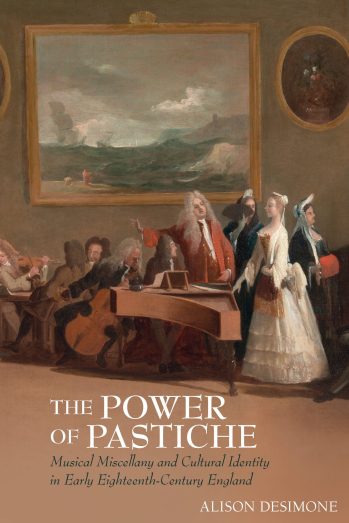 In eighteenth-century England, ‘variety’ became a prized aesthetic in musical culture. Not only was variety—of counterpoint, harmony, melody, and orchestration—expected for good composition, but it also manifested in cultural mediums such as songbook anthologies, which compiled miscellaneous songs and styles in single volumes; pasticcio operas, which were cobbled together from excerpts from other operas; and public concerts, which offered a hodgepodge assortment of different types and styles of performance. I call this trend of producing music through the collection, assemblage, and juxtaposition of various smaller pieces as musical miscellany; like a jigsaw puzzle (also invented in the eighteenth century), the urge to construct a whole out of smaller, different parts reflected a growing desire to appeal to a quickly diversifying England. This book explores the phenomenon of musical miscellany in early eighteenth-century England both in performance culture and as an aesthetic. Musical miscellany, in its many forms, juxtaposed foreign and homegrown musical practices and styles in order to stimulate discourse surrounding English musical culture during a time of cosmopolitan transformation.
Alison DeSimone is Assistant Professor of Musicology at the University of Missouri-Kansas City. She co-edited, with Matthew Gardner, Music and the Benefit Performance in Eighteenth-Century Britain (Cambridge University Press, 2019). She has published articles in the A-R Online Anthology, Händel-Jahrbuch, and Early Modern Women. Her article “‘Equally Charming, Equally Too Great’: Female Rivalry, Politics, and Opera in Early Eighteenth-Century London” won the 2018 Ruth Solie Prize for an Outstanding Article on British Music from the North American British Music Studies Association. She is currently an associate editor of The Eighteenth Century: Theory and Interpretation.
C O N T E N T S
Acknowledgments
List of Figures
List of Musical Examples
List of Tables
Introduction
1 The Performance of Miscellany in Variety Concerts, 1700–1711
2 ‘An Assemblage of Every Kind’: The Pasticcio Opera Tradition as Miscellany
3 Shaping English Identity in the Songbook iscellany
4 Composition, Cosmopolitanism, and Musical Miscellany
5 Variety in Criticism and Aesthetics in Eighteenth-Century England
Notes
Index
New Book | Echo’s Chambers: Architecture and the Idea of Acoustic Space
From the University of Pittsburgh Press:
Joseph Clarke, Echo’s Chambers: Architecture and the Idea of Acoustic Space (Pittsburgh: University of Pittsburgh Press, 2021), 320 pages, ISBN: 978-0822946571, $60.
 A room’s acoustic character seems at once the most technical and the most mystical of concerns. Since the early Enlightenment, European architects have systematically endeavored to represent and control the propagation of sound in large interior spaces. Their work has been informed by the science of sound but has also been entangled with debates on style, visualization techniques, performance practices, and the expansion of the listening public. Echo’s Chambers explores how architectural experimentation from the seventeenth through the mid-twentieth centuries laid the groundwork for concepts of acoustic space that are widely embraced in contemporary culture. It focuses on the role of echo and reverberation in the architecture of Pierre Patte, Claude-Nicolas Ledoux, Carl Ferdinand Langhans, and Le Corbusier, as well as the influential acoustic ideas of Athanasius Kircher, Richard Wagner, and Marshall McLuhan. Drawing on interdisciplinary theories of media and auditory culture, Joseph L. Clarke reveals how architecture has impacted the ways we continue to listen to, talk about, and creatively manipulate sound in the physical environment.
Joseph L. Clarke is assistant professor of art history at the University of Toronto and a licensed architect. His scholarship explores how modern architecture has defined itself as a discipline through particular techniques, theories, and representational conventions.
C O N T E N T S
Acknowledgments
Note on Translations
Introduction: ‘The Night Shall Be Filled with Music’
1 Domesticating Echo: Clamors in Print
2 Spaces Heard and Seen: Constructing Acoustic Naturalism
3 The Catacoustic Imagination: Enchantment by Immersion
4 Redeeming the Senses: The Acoustics of Total Art
5 Listening Out of Place: Modern Architecture and acoustique électronique
Conclusion: On Further Reflection
Notes
Bibliography
Index
New Book | Inessential Colors: Architecture on Paper
From Princeton UP:
Basile Baudez, Inessential Colors: Architecture on Paper in Early Modern Europe (Princeton: Princeton University Press, 2021), 288 pages, ISBN: 978-0691213569, $65.
 The first comprehensive account of how and why architects learned to communicate through color
Architectural drawings of the Italian Renaissance were largely devoid of color, but from the seventeenth century through the nineteenth, polychromy in architectural representation grew and flourished. Basile Baudez argues that colors appeared on paper when architects adapted the pictorial tools of imitation, cartographers’ natural signs, military engineers’ conventions, and, finally, painters’ affective goals in an attempt to communicate with a broad public.
Inessential Colors traces the use of color in European architectural drawings and prints, revealing how this phenomenon reflected the professional anxieties of an emerging professional practice that was simultaneously art and science. Traversing national borders, the book addresses color as a key player in the long history of rivalry and exchange between European traditions in architectural representation and practice.
Featuring a wealth of previously unpublished drawings, Inessential Colors challenges the long-standing misreading of architectural drawings as illustrations rather than representations, pointing instead to their inherent qualities as independent objects whose beauty paved the way for the visual system architects use today.
Basile Baudez is assistant professor of architectural history in the Department of Art and Archaeology at Princeton University. His books include Architecture et tradition académique and A Civic Utopia: Architecture and the City in France, 1765–1837.
C O N T E N T S
Introduction
Prologue: Architectures in Black and White
1 Imitative Colors
2 Conventional Colors
3 Affective Colors
Conclusion: The Anxiety of the Architect
Appendix: The Draftsman’s Tools
Acknowledgments
Notes
Bibliography
Index
Image Credits










 Enfilade
leave a comment