Journal18, Fall 2021 — The ‘Long’ 18th Century?
From J18:
Journal18, Issue #12 (Fall 2021) — The ‘Long’ 18th Century?
Edited by Sarah Betzer and Dipti Khera
 A R T I C L E S
• Architectural ‘Worlding’: Fischer von Erlach and the Eighteenth-Century Fabrication of a History of Architecture — Sussan Babaie
• Enlightenment as Thought Made Public: Joshua Reynolds’s Portrait of a Black Man — Andrei Pop
• Britain, Empire, and Execution in the Long Eighteenth Century — Meredith Gamer
• Maritime Media in the Long Eighteenth Century — Maggie M. Cao
• Poq’s Temporal Sovereignty and the Innuit Printing of Colonial History — Bart Pushaw
C O N V E R S A T I O N S
• The Mughals, the Marathas, and the Refracted Long Eighteenth Century, A Dialogue — Chanchal Dadlani and Holly Shaffer
• Teaching the ‘Long’ Eighteenth Century, A Conversation and Resources — Eleanore Neumann, with Anna Arabindan-Kesson, Nebahat Avcıoğlu, Emma Barker, Sarah Betzer, Ananda Cohen-Aponte, Dipti Khera, Prita Meier, Nancy Um, and Stephen Whiteman
Issue Editors
Sarah Betzer, University of Virginia
Dipti Khera, New York University and Institute of Fine Arts
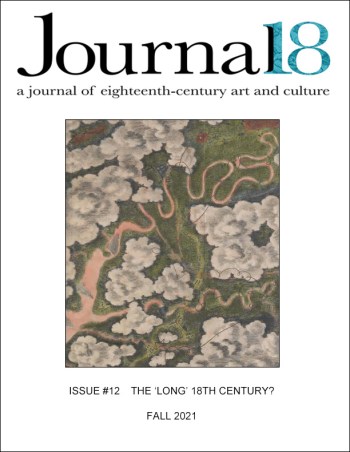
Cover image: Thomas Baldwin, Detail from A Balloon Prospect from Above the Clouds. Engraving, Plate III, from Airopaidia: Containing the Narrative of a Balloon Excursion (London,1786).
Exhibition | Les Adam: La Sculpture en Héritage
Now on view at the Musée des Beaux-Arts de Nancy:
Les Adam: La Sculpture en Héritage
Musée des Beaux-Arts de Nancy, 18 September 2021 — 9 January 2022
Curated by Pierre-Hippolyte Pénet and Guilhem Scherf
 Originally from Nancy, the Adam family is the largest dynasty of French sculptors of the 18th century. Over three generations, its members worked in Rome, Paris, Versailles, and Berlin in the service of the Pope and European monarchs such as Louis XV, Louis XVI, Frederick II of Prussia, and Catherine II of Russia. This the first retrospective devoted to them brings together one hundred masterpieces from national and international institutions as well as from private collections, bearing witness to the Adam family’s virtuosity at the heart of Europe during the Enlightenment.
Originaire de Nancy, la famille Adam est la plus grande dynastie de sculpteurs français du XVIIIe siècle. Sur trois générations, ses membres déploient leurs talents auprès des plus grands mécènes et participent à plusieurs chantiers majeurs. Formés en Lorraine dans le contexte d’essor artistique des règnes des ducs Léopold et Stanislas, Jacob Sigisbert Adam, ses trois fils Lambert Sigisbert, Nicolas Sébastien et François Gaspard ainsi que leurs neveux Sigisbert François, Pierre Joseph et Claude Michel dit Clodion, œuvrent à Rome, Paris, Versailles ou Berlin au service du pape et des monarques européens comme Louis XV, Louis XVI, Frédéric II de Prusse ou Catherine II de Russie. Première rétrospective à leur être consacrée, l’exposition réunit cent chefs-d’œuvre issus d’institutions nationales, internationales mais aussi de collections particulières. Permettant de dévoiler plusieurs sculptures prestigieuses inédites qui témoignent de la virtuosité de la famille Adam au cœur de l’Europe des Lumières, elle est accompagnée d’un catalogue de référence sur le sujet.
Commissariat: Pierre-Hippolyte Pénet, conservateur du patrimoine chargé des collections du XVe au XVIIIe siècle, palais des ducs de Lorraine – Musée lorrain, et Guilhem Scherf, conservateur général du patrimoine, adjoint au directeur du département des Sculptures, musée du Louvre.
The full press packet is available here»
Pierre-Hippolyte Pénet and Guilhem Scherf, eds., Les Adam: La Sculpture en Héritage (Paris: Snoeck Édition, 2021), 343 pages, ISBN: 978-9461616234 35€.
New Book | Enduring Presence: William Hogarth’s Afterlives
From Peter Lang:
Caroline Patey, Cynthia Roman, and Georges Letissier, Enduring Presence: William Hogarth’s British and European Afterlives, 2 vols. (Bern: Peter Lang, 2021), 674 pages, ISBN: 978-1800791558, £60 / $91.
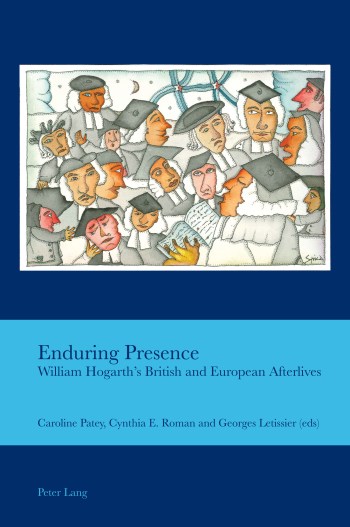 Long after his death in 1764, William Hogarth is still our contemporary. Far from leading a secluded existence in museums and academies, his legacy of vibrant images and provocative ideas remains a powerful source of inventiveness and inspiration for the artists of today, as once for those of yesterday, be it on page, stage, canvas, or digital formats.
After approaching the artist by way of his challenging aesthetic philosophy and his resistance to normative categories, this two-book set considers Hogarth’s pioneering sense of performativity, which has long made him the treasured interlocutor of actors and playwrights, from David Garrick to Bertolt Brecht, or Nick Dear. His work has permeated film, television, the graphic novel, art, and narrative, which all bear witness to his versatile and powerful use of images and its resonance in the modern and contemporary age. Brimming as it is with energy, plenty, affliction, entropy, and empathy, Hogarth’s contradictory universe of chaos and beauty is in tune with ours and resonates vividly with contemporary passions and struggles. The twenty-eight essays in this collection chart the teeming legacies of William Hogarth and explore the ways in which his works and ideas were and are revisited and appropriated in the UK and across Europe. For the eighteenth-century artist lives on as an unforgotten presence, whose invigorating and challenging memory energizes multiple expressive forms, including drama, visual arts, literature, film, graphic novels, and TV serials.
Caroline Patey is Professor of English Literature at the Università degli Studi in Milan, Italy. Her research interests include Renaissance culture, late Victorian literature, Modernism, and the interactions between art, museums, and literature. Cynthia E. Roman is Curator of Prints, Drawings, and Paintings at the Lewis Walpole Library, Yale University. Her research interests include the production, circulation, and collecting history of prints in eighteenth-century Britain. Georges Letissier is Emeritus Professor of English Literature at Nantes University, France. His field of speciality is nineteenth-century literature (Charles Dickens, George Eliot) and contemporary British fiction (Will Self, Graham Swift, Sarah Waters, and Jeanette Winterson).
British Art Studies, November 2021
The latest issue of BAS:
British Art Studies 21 (November 2021)
Redefining the British Decorative Arts, Guest Edited by Iris Moon

Michelle Erickson, Cauldron, from the series Ply-MYTH, 2019, wheel thrown with lifecast shell and industrial artifacts, made from indigenous North Carolina woodfired stoneware with copper wash, 16 × 19.5 inches (Collection of the artist). Additional information is available here»
“Decorative arts place pressure upon the hierarchies inherent in British aesthetics, and by extension British culture, from the enlightenment to the present day. The specters of history and the possibilities of the future haunt in equal measure this special issue of British Art Studies, which challenges readers to rethink the British decorative arts. Through a series of thought-provoking articles by artists, curators, scholars, and a scientist, the issue asks readers to question their assumptions about the decorative arts, and by extension, the notions of belonging, possession, and home that such arts have helped to shape in British culture. Issues of race and identity, empire and nation, and collective and subjective desires, far from being alien aspects of the decorative arts, have long gestated within the discourses of taste and aesthetics that emerged in tandem with Britain’s rise as a center of capitalism. Many of the articles have as their touchstone the eighteenth century, when London became the finance capital of the world . . . ” (from Iris Moon’s introductory article).
A R T I C L E S
• Unhomely: Redefining the British Decorative Arts, by Iris Moon
• England Am I? Elizabethan Clothing, Gender, and Crisis in Virginia Woolf’s Between the Acts, by Sarah Bochicchio
• Microorganisms, Microscopes, and Victorian Design Theories, by Ariane Varela Braga
• Tarnished Silver: Interpreting the Material Culture of the Atlantic Slave Trade Negotiations of 1715, by Max Bryant
• Cherokee Unaker, British Ceramics, and Productions of Whiteness in Eighteenth-Century Atlantic Worlds, by R. Ruthie Dibble and Joseph Zordan
• Defining a New Femininity? Josiah Wedgwood’s Portrait Medallions of Sarah Siddons and his Femmes Célèbres by Patricia F. Ferguson
• Classical Histories, Colonial Objects: The Specimen Table Across Time and Space, by Freya Gowrley
• Serving as Ornament: The Representation of African People in Early Modern British Interiors and Gardens, by Hannah Lee
• Ruth Ellis’s Suit, by Lynda Nead
• Colonial Trash to Island Treasure: The Chaney of St. Croix, by Jessica Priebe
• In the Flesh at the Heart of Empire: Life-Likeness in Wax Representations of the 1762 Cherokee Delegation in London, by Ianna Recco
F E A T U R E S
• The Chelsea Porcelain Case, British Galleries, The Metropolitan Museum of Art, convened by Iris Moon
• Unpacking Wedgwood: An Interview with Roberto Visani, by Caitlin Meehye Beach
• Wild Porcelain, cover collaboration with Michelle Erickson
• What’s in a Label? Revising Narratives of the Decorative Arts in Museum Displays, convened by Iris Moon
• Another Crossing: Artists Revisit the Mayflower Voyage, by Glenn Adamson
• In Sparkling Company: Presenting Eighteenth-Century Britain in Western New York State, by Christopher Maxwell
Iris Moon is an assistant curator of European ceramics and glass in the European Sculpture and Decorative Arts Department at the Metropolitan Museum of Art, where she recently participated in the reinstallation of the British Galleries. She has taught at Pratt Institute and The Cooper Union and her research on European decorative arts and architecture has been supported by fellowships from the Metropolitan Museum of Art, the Clark Art Institute, and the Getty Research Institute. Her new book, Luxury after the Terror, will be published in spring 2022 by Penn State Press.
West 86th, Spring–Summer 2021
From West 86th:
West 86th: A Journal of Decorative Arts, Design History, and Material Culture 28.1 (Spring–Summer 2021)
Aaron M. Hyman and Dana Leibsohn, “Lost and Found at Sea, or a Shipwreck’s Art History”
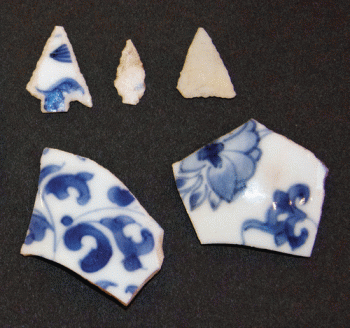
Makers’ names no longer known, arrowheads, 18th or 19th century, porcelain (Tillamook, Oregon: Tillamook County Pioneer Museum).
Abstract: To be lost and found at sea: What kinds of thinking does the shipwreck prompt? This essay pursues this question by centering fragmented remains—large beeswax blocks and Chinese porcelain ware—from the Santo Cristo de Burgos, a Spanish galleon lost while traveling from Manila to Acapulco at the end of the seventeenth century. By considering how durable commodities were recovered and reimagined, primarily by Indigenous inhabitants of the Oregon coast, this essay reflects upon the kinds of histories that can be written around and because of wrecked ships. Tacking between past and present, we use the Santo Cristo de Burgos to draw out the lineaments of a shipwreck’s art history, bringing into focus three interrelated themes, each critical to the material histories of wrecks: the interpretive recalcitrance of cargo, the reframing of value through recovery, and the production of material surplus in the watery depths.
Online Roundtable | The Animation of Decorative Arts in 18th-C France
From The Met:
The Animation of Decorative Arts in Eighteenth-Century France
Online, 14 December 2021, 6.00pm (Eastern Time)
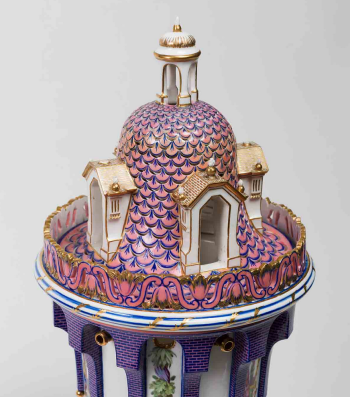 Presented in conjunction with the exhibition Inspiring Walt Disney: The Animation of French Decorative Arts, on view at The Metropolitan Museum of Art from 10 December 2021 until 6 March 2022, this live event takes place online. Watch on YouTube or Facebook (no login required).
Discover how furniture and decorative arts came to life in the literature, dance, and theater of eighteenth-century France, a theme later explored and elaborated by Disney in the classic animated film Beauty and the Beast.
• Wolf Burchard, Associate Curator, European Sculpture and Decorative Arts, The Met
• Alicia Caticha, Assistant Professor, Department of Art History, Weinberg College of Arts and Sciences, Northwestern University
• Sarah Lawrence, Iris and B. Gerald Cantor Curator in Charge, European Sculpture and Decorative Arts, The Met
• Meredith Martin, Associate Professor of Art History, Department of Art History, and Institute of Fine Arts, New York University
• David Pullins, Associate Curator, European Paintings, The Met
Reimagining the Ballet des Porcelaines
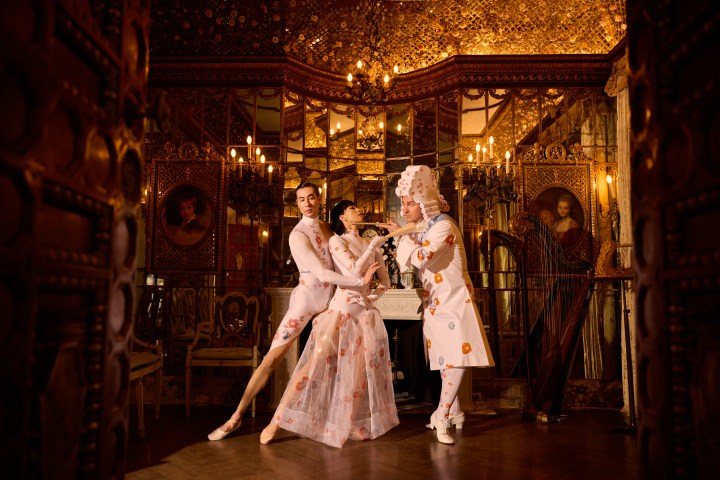
The Ballet des Porcelaines cast in the Venetian Room, Albertine Headquarters, Cultural Services of the French Embassy, NYC. From left to right: Daniel Applebaum (Prince); Georgina Pazcoguin (Princess); Tyler Hanes (Sorcerer). Photo by Joe Carrotta.
◊ ◊ ◊ ◊ ◊
As part of the media preview of the exhibition Inspiring Walt Disney: The Animation of French Decorative Arts at The Metropolitan Museum of Art, guests were given a special chance to see the first performance in centuries of the Ballet des Porcelaine. A publication, noted below, is forthcoming. Additional information about the performance, including credits, is available here.
The original Ballet des Porcelaines, written by the comte de Caylus and staged around 1740 at a château outside of Paris, was based on an Orientalist fairy tale in the same literary milieu as Beauty and the Beast (1740). The story tells of an Asian sorcerer who lives on a ‘Blue Island’ and transforms anyone who dares to trespass into porcelain cups, vases, and other wares. When the sorcerer turns a captive prince into a teapot, a princess comes to rescue her lover by stealing the sorcerer’s wand and turning him into a pagod, an eighteenth-century version of a porcelain bobblehead. Displayed today in museums like The Met, pagods were collectible trinkets that inspired Oriental caricatures in the performing arts. European choreographers mimicked the features and gestures of these porcelain figures, which persist in such iconic, problematic productions as The Nutcracker’s “Chinese Tea” dance.
Scheduled Performances
6 December 2021, The Metropolitan Museum of Art, New York
2–3 March 2022, The University of Chicago
18–19 March 2022, Princeton University
16–17 June 2022, Waddesdon Manor
19–21 June 2022, Royal Pavilion, Brighton
25–26 June 2022, Capodimonte, Naples
28–29 June 2022, Palazzo Grassi, Venice
2–3 July 2022, Sèvres Museum, Paris
Meredith Martin, with contributions by Phil Chan and Charlotte Vignon, Reimagining the Ballet des Porcelaines (Turnhout: Harvey Miller/Brepols, 2022).
In addition to the performance and the book, many readers will find this recorded conversation fascinating as well:
Phil Chan and Meredith Martin, hosted by the Center for Ballet and the Arts at NYU, “Reimagining the Ballet des Porcelaines: A Story of Magic, Desire, and Exotic Entanglement,” YouTube, posted 9 November 2021, 63 minutes.
Phil Chan and Meredith Martin have reimagined this lost Baroque work with an all-Asian American creative team, aiming to make it meaningful and relevant for a multiracial and contemporary audience. This talk explores their process and performance plans and features performances by Martha Graham Principal Dancer Xin Ying and actor, singer, dancer, choreographer Tyler Hanes.
◊ ◊ ◊ ◊ ◊
Note (added 15 December 2021) — The posting has been updated to include the cast photo by Joe Carrotta.
At Colnaghi | Naples

Presepe, made in Naples, mid-18th century to early-nineteenth century, oil painted terracotta, carved wood, painted glass, shaped wire, tin, and cork, with stitched silks and linen, 113 × 173 × 108 inches (private collection).
◊ ◊ ◊ ◊ ◊
From the press release, via Art Daily, for the exhibition at Colnaghi, London:
Naples
Colnaghi, London, 3 December 2021 — 25 February 2022
Opening in conjunction with London Art Week (3–10 December), Colnaghi presents a special exhibition showcasing the enduring creative legacy of Old Master artists and artisans from Naples, marking the first exhibition in London devoted to the Italian city and its arts in over forty years. As the centrepiece of Naples, Colnaghi, together with Dario Porcini, present a magnificent 18th-century crèche, known in Italian as a presepe, a monumental nativity scene traditional to Baroque Naples. The exhibition also features a selection of religious, landscape, and still-life paintings by some of the greatest artists who worked in the city during the 17th and 18th centuries and served as inspiration for the craftsmen of the presepe, including Jusepe de Ribera, Luca Giordano, and Massimo Stanzione. Naples is on view at Colnaghi from 3 December 2021 through the festive season, until 25 February 2022.
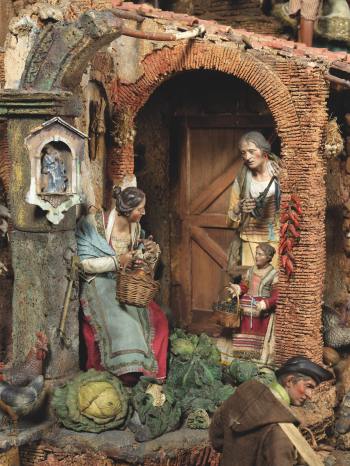 “Our winter exhibition in London transports our visitors to Baroque Naples and will feature important paintings by masters of the period, as well as a monumental presepe,” says Chloe Stead, Senior Global Director of Colnaghi. “Boldly transgressing artistic hierarchies, presepi unite different media and techniques to realise extraordinarily elaborate and exuberant nativity scenes that provide incredible glimpses into life in Naples at the time. Our presepe, created during the golden age of these works, is one of the most important examples outside Italy and reflects all the vitality and craftsmanship for which the Italian city is still known.”
The recreation of nativity scenes with modelled figures and animals during Christmastime was widespread throughout Italy in the 13th and 14th centuries. By the 18th century, what originally had been a relatively simple temporary tableaux underwent a transformation in Naples into highly dramatic and theatrical creations, often monumental in scale. These crèches combined traditional sacred elements of nativity scenes—the Holy Family, wise men, angels, and shepherds—with aspects of contemporary Neapolitan life—rowdy tavern scenes, processing musicians, and bawdy market shopkeepers—in dazzling displays of artistic techniques.
The presepe at Colnaghi, dating from the 18th century, is one of the very few and finest of these masterpieces of the Italian Baroque outside Naples. Crafted from oil painted terracotta, carved wood, painted glass, shaped wire, tin, and cork, with stitched silks and linen to recreate the detailed fashions of the time, the presepe stages the sacred scene in a true-to-life Neapolitan setting and measures a remarkable 340 × 445 cm.
Carmine Romano, translated by Gordon Pole and Caroline Paganussi, The 18th-Century Neapolitan Crèche: A Masterpiece of Baroque Spectacle (Naples: Porcini, 2021), 175 pages, ISBN: 978-8894136470. Available as a PDF file here»
Other exhibition highlights include:
• Two paintings by Jusepe de Ribera, including an Ecce Homo, signed by the artist and dated to 1644 and considered a high point of Neapolitan Baroque art; and Saint John the Baptist, 1630s, which showcases the bold gesture and a melancholic landscape typical of this artist.
• The Penitent Magdalene from the early 1640s by Massimo Stanzione, considered a great rival to Ribera. Signed with an elegant monogram, this well-preserved picture with its vivid, jewel-like sky is particularly unusual example of the artist’s work on copper.
• Two large-scale canvases by the celebrated artist of the later Baroque period, Luca Giordano, who was trained by Ribera. The Triumph of Galatea from the artist’s Roman period, ca. 1675–77, and Shepherds with their Herd (The Riches of the Earth), 1684, both reflect the artist’s ability to express the drama and pathos of religious and mythological subjects.
• Still lifes of fish, crustaceans and other seafood by Giuseppe Recco and his daughter Elena Recco from the 17th century, including two loans from the collection of Lord and Lady Rosse that have never before been presented outside of the dining room of Birr Castle.
• Landscape paintings by Antonio Joli, lent by Lord Montagu from Palace House, Beaulieu, presenting views of Naples-one depicting the Palazzo Reale and Castel Nuovo, and the other a view of the Largo di Palazzo at Carnival time. The works were commissioned by an ancestor of Lord Montagu during his Grand Tour.
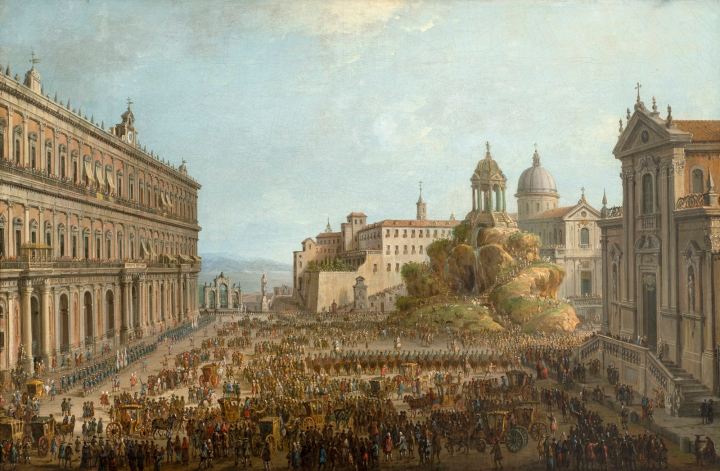
Antonio Joli, Naples, A Festival with a Cuccagna at the Largo di Palazzo, ca. 1756–58, oil on canvas, 19 x 30 inches (Collection of Lord Montagu of Beaulieu). More information on the painting and the cuccagna tradition of ephemeral architecture is available here.
Exhibition | Bordeaux-les-Bains: Les bienfaits de l’eau
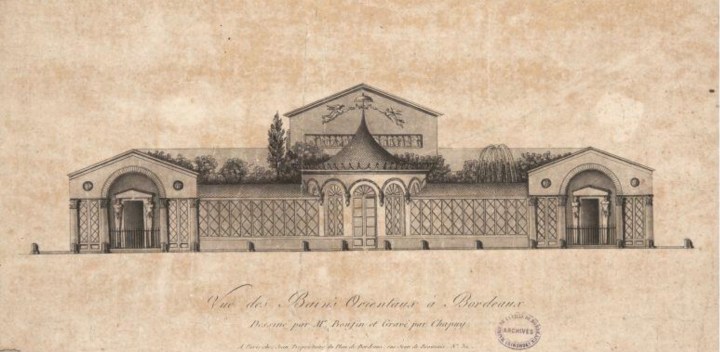
Chapuy after Bonfin, Vue des Bains Orientaux à Bordeaux, ca. 1798, engraving
(Archives Bordeaux Métropole)
◊ ◊ ◊ ◊ ◊
Now on view at the Bordeax Archives, along with this online component:
Bordeaux-les-Bains: Les bienfaits de l’eau, 18e–20e siècle
Archives Bordeaux Métropole, 19 May 2021 — 25 February 2022
Tour à tour convoitée, redoutée, maltraitée, domestiquée, l’eau—un des quatre éléments naturels de la culture occidentale—redevient au XVIIIe siècle un élément fondamental de l’hygiène. Ce bien naturel précieux multiplie les usages au fil du temps : l’eau qui lave, l’eau qui soigne, l’eau qui fortifie, l’eau qui délasse. Et si l’histoire de Bordeaux est intimement liée à celle de son fleuve, c’est bien l’eau qui en constitue l’essence même.
Depuis l’Antiquité, les Bordelais se baignent dans la Garonne. Au XVIIIe siècle, les pratiques évoluent et les techniques se développent : des bains flottants sur le fleuve aux bains-douches dans les quartiers, des établissements d’hydrothérapie à la natation en piscine. C’est à la découverte de cette histoire méconnue que vous invitent les Archives Bordeaux Métropole autour d’une sélection de documents de toutes natures, témoignages d’une incroyable aventure humaine et collective. L’artiste Laurent Valera propose un contrepoint contemporain avec une nouvelle série d’œuvres en dialogue avec les documents d’archives.
Frédéric Laux and Jean-Cyril Lopez, Bordeaux-les-Bains: Les bienfaits de l’eau, XVIIIe–XXe siècle (Archives Bordeaux Métropole, 2021), 96 pages, ISBN: 978-2360622870, 12€.
Print Quarterly, December 2021
The eighteenth century in the latest issue of Print Quarterly:
Print Quarterly 38.4 (December 2021) . . .
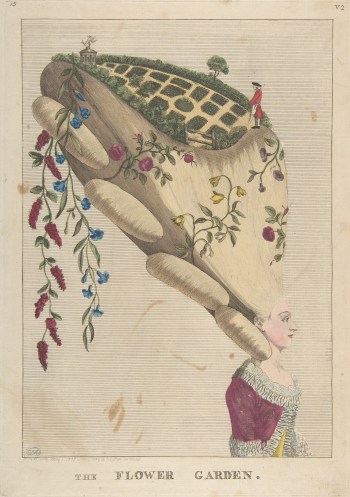
Matthew Darly, The Flower Garden, 1777, etching and engraving with watercolour, 35 × 25 cm (New York: The Metropolitan Museum of Art).
Elizabeth L. Block, Review of Luigi Amara, The Wig: A Hairbrained History, translated by Christina MacSweeney (Reaktion Books, 2020), p. 436.
Elizabeth Block gives an overview of the 33 brief chapters of Luigi Amara’s The Wig: A Hairbrained History. The chapter “Towering Hairdos” looks at the expensive and impractical styles of wigs in the years before the French Revolution, whilst “Dressing Up Justice” focuses on William Hogarth’s The Bench, 1758–64, an engraving depicting bewigged magistrates. Block praises this work for its entertaining and enjoyable qualities, but highlights its lack of academic rigour, suggesting at the end works to turn to for a more scholarly treatment of the subject.
Richard Taws, Review of the exhibition catalogue William Blake, edited by Martin Myrone and Amy Concannon (Tate, 2019), p. 438.
Reviewing the catalogue for the exhibition William Blake, held at Tate Britain in 2019–20, Richard Taws discusses the book’s five chapters covering the artist’s early artistic milieu, his career as printmaker, his relationship with patronage and display, and his reclamation by a younger generation of artists. It is noted that in the authors’ attempt to demythologise Blake, they are successful in creating a “Blake for all,” who satisfies both a specialist and popular audience.










 Enfilade
leave a comment