Call for Articles | Mobility, Art and Religion in the Hispanic World
From the Call for Articles:
Special Issue of Religions (2023), Mobilization of Art and Religion in the Hispanic World: The Intersections of Race, Religion, Gender, and Objects c. 1500–1800
Guest edited by C. Cody Barteet and Alena Robin, with Iraboty Kazi
Proposals due by 30 May 2022; completed manuscripts due by 1 February 2023
In recent years, academic interest in the movement of people, objects, and ideas has risen significantly, driven by the desire to develop a fuller understanding of history and our current globalized world (Beaudry and Paron 2013, Corcoran-Tadd, Hung et. al. 2021). These interests have forced us to reconsider knowledge, art, spatial, religious, and historical formations, prior to, during, and after the colonial era, as we have recognized for several decades now that colonialism was formalized and transgressed by virtually all peoples involved (Hofman and Keehnen 2018). Further, objects, styles, concepts, and other material artifacts traversed oceans and continents (Callligaro, Chiappero et. al. 2019, Hamann 2010, Hyman 2017). We look to consider the intersections of Hispanic cultural traditions with European (whether Jewish, Islamic, Catholic, or Protestant), Indigenous/First Nations, Afro-Latin American/Afro-Caribbean, and Asian-Latin American in a developing global world. By considering the mobility of peoples, objects, themes, and other social constructs throughout the global Spanish territories, we explore the intersection of disparate religious traditions to consider the formation of new cultural knowledges and practices through the appropriation, assimilation, commodification, fetishization, marginalization, and hybridization of objects and practices.
We invite contributors to submit their research in English for consideration for publication in a special issue of the journal Religions. Please note that there is a two-stage submission procedure. We will first collect a title and short abstract (maximum 250 words), 5 keywords, and a short bio (150 words), by 1 May 2022, via email to Dr. Cody Barteet (cbarteet@uwo.ca), Iraboty Kazi (ikazi3@uwo.ca), and Dr. Alena Robin (arobin82@uwo.ca). Before 30 May 2022, we will invite selected abstracts to be submitted as 7000- to 9000-word papers for peer review by 1 February 2023. Journal publication is expected in mid- to late 2023, depending on the revision time needed after peer review. Each article will be published open access on a rolling basis after successfully passing peer review.
C. Cody Barteet
Guest Editor
Associate Professor, Department of Visual Arts, Western University, London, ON N6A 3K7, Canada
Interests: Hispanic American art and architecture; early modern visual culture; race, gender, religious art and architecture
Iraboty Kazi
Guest Editor Assistant
Department of Visual Arts, Western University, London, ON N6A 3K7, Canada
Interests: Spanish American colonial art; New Spain; religious art; heritage protection; Latin American art in Canada
Alena Robin
Guest Editor
Associate Professor, Department of Visual Arts, Western University, London, ON N6A 3K7, Canada
Interests: Spanish American colonial art; New Spain; religious art; heritage protection; Latin American art in Canada
Note (added 4 April 2022) — The posting was revised with a new deadline, extended from May 1 to May 30.
Exhibition | Dressing with Purpose in Scandinavia

From left to right: Eva Aira and Inga Lajla Aira Balto in gávttit from Jåhkåmåhkke and Kárášjohka; Sven Roos in Gagnefsdräkt and Lars-Erik Backman in Leksandsdräkt; Fatima Aakhus and Randi Myrum in Setesdalsbunader. (Photos by Carrie Hertz).
◊ ◊ ◊ ◊ ◊
From the Museum of International Folk Art:
Dressing with Purpose: Belonging and Resistance in Scandinavia
Museum of International Folk Art, Santa Fe, 12 December 2021 — 19 February 2023
Dress helps us fashion identity, history, community, and place. Dress has been harnessed as a metaphor for both progress and stability, the exotic and the utopian, oppression and freedom, belonging and resistance. Dressing with Purpose examines three Scandinavian dress traditions—Swedish folkdräkt, Norwegian bunad, and Sámi gákti—and traces their development during two centuries of social and political change across northern Europe.
 By the 20th century, many in Sweden worried about the ravages of industrialization, urbanization, and emigration on traditional ways of life. Norway was gripped in a struggle for national independence. Indigenous Sami communities—artificially divided by national borders and long resisting colonial control—rose up in protests that demanded political recognition and sparked cultural renewal. Within this context of European nation-building, colonial expansion, and Indigenous activism, traditional dress took on special meaning as folk, national, or ethnic minority costumes—complex categories that deserve reexamination today. In this exhibition, visitors will be introduced to individuals who adapt and revitalize dress traditions to articulate who they are, proclaim personal values and group allegiances, strive for sartorial excellence, reflect critically on the past, and ultimately, reshape the societies they live in.
This project is supported in part by the National Endowment for the Arts. Additional support comes from Barbro Osher Pro Suecia Foundation and Swedish Council of America.
Carrie Hertz, ed., Dressing with Purpose: Belonging and Resistance in Scandinavia (Bloomington: Indiana University Press, 2021), 258 pages, ISBN: 978-0253058577, $30.
Dedication
Acknowledgements
Map of Scandinavia
A Note on Terms and Place Names
Foreword, Khristaan Villela
Introduction: Can We Talk about Traditional Dress?, Carrie Hertz
Part I. Folkdräkt in Sweden
1 Swedish Folkdräkt, Carrie Hertz
2 They Are at Peace Here, Like Old Friends in Their Caskets: Traditional Dress Collections as Heritage-making, Lizette Gradén
Part II. Bunad in Norway
3 Norwegian Bunad, by Carrie Hertz
4 Headdress and Hijab: Bunad in Multicultural Norway, Camilla Rossing
5 The Transnational and Personalized Bunad of the Twenty-First Century, Laurann Gilbertson
Part III. Gákti in Sápmi
6 Sámi Gákti, Carrie Hertz
7 The Legacy of Ládjogahpir: Rematriating Sápmi with Foremother’s Hat of Pride, Eeva-Kristiina Harlin and Outi Pieski
Conclusion: The Future of Traditional Dress, Carrie Hertz
Bibliography
List of Contributors
Index
Call for Papers | Thinking Europe Visually
From ArtHist.net (6 December 2021), which includes the CFP in French . . .
Thinking Europe Visually / L’Europe par l’image et en images
IMAGO Center at the Ecole Normale Supérieure, Paris, 9–10 June 2022
Organized by Béatrice Joyeux-Prunel and Léa Saint-Raymond
Proposals due by 15 March 2022
“If I had to do it again, I would start with culture”: this statement, often erroneously attributed to Jean Monnet, suggests that Europe as a political and economic construct remains, in the absence of a shared culture, nothing but a hollow shell, empty and soulless. This conference aims to question the disillusioned position which holds that there is no meaningful common European culture, and to do so through images.
One way to visualize the potential existence and limits of a European cultural base is indeed to trace the circulation of images—be they works of art, press images, posters, photographs, or even motifs and patterns—in the region, from antiquity through to the present day. What are the images that have circulated most widely in Europe? Are they specific to Europe or are they already globalized? What was their visual and symbolic impact? Is there a ‘visual culture’ specific to Europe and, if so, what might be its distinctive ‘patterns’? This conference will attempt to question the existence, history, contours, and impact of this ‘Europe of images’—from an art historical and visual studies perspective, as well as in historical, anthropological, and geopolitical terms.
Interested contributors are invited to send proposals (400 words maximum) for a 20-minute presentation, along with a short CV in the same document. Proposals should be sent to Prof. Béatrice Joyeux-Prunel (Beatrice.Joyeux-Prunel@unige.ch) and Dr. Léa Saint-Raymond (lea.saint-raymond@ens.fr) by 15 March 2022. The conference will take place 9–10 June 2022 in Paris (France) and will be hosted by the Imago Center at the Ecole normale supérieure, 45 rue d’Ulm, in collaboration with the project Visual Contagions at the University of Geneva (Switzerland).
Art Bulletin of Nationalmuseum Stockholm 27.1
Published in November by the Nationalmuseum, with a selection of eighteenth-century topics listed below:
 The Art Bulletin of Nationalmuseum Stockholm is a journal devoted to art history. It is published in English twice a year with a content that ranges from older master paintings to contemporary design. This, the first part of Volume 27, focuses primarily on acquisitions in 2020. The journal is published through DiVA (a publishing system for research publications and student essays and a digital archive for long-term preservation of publications), with all articles available for free download here.
Editors: Ludvig Florén, Magnus Olausson, and Martin Olin.
Editorial Committee: Ludvig Florén, Carina Fryklund, Eva-Lena Karlsson, Helena Kåberg, Ingrid Lindell, Magnus Olausson, Martin Olin, Daniel Prytz, and Cilla Robach.
A R T I C L E S
Magnus Olausson and Martin Olin, “Two Large Covered Beakers with Filigree Ornamentation by Rudolf Wittkopf.”
The two filigree beakers with covers in silver gilt, made by Rudolf Wittkopf (d. 1722) in Stockholm in 1698, are not only notable examples of Swedish goldsmiths’ work from the end of the 17th century, their history also tells of a dramatic diplomatic episode in the history of relations between Sweden and Russia. The beakers were among the presents given to Tsar Peter I by the ambassadors of the Swedish king Charles XII, in the autumn of 1699.
Daniel Prytz, “A Seated Amour: A Drawing by Charles-Joseph Natoire Related to his Painting Apollo and Clytie for the Royal Palace in Stockholm.”
A drawing of a seated Amour by Charles-Joseph Natoire (1700–1777), recently acquired by the Nationalmuseum, can be said to underline the central role of the art of drawing in his oeuvre. In the present article it is posited that it was created as a finished work onto itself and should be viewed as an example of the possibilities Natoire found primarily in drawing.
Daniel Prytz, “The Vatican from the Road to Ponte Mola: A Drawing by the Amateur Artist and Patron of the Arts Sir George Howland Beaumont.”
Sir George Howland Beaumont (1753–1827) was one of the most prominent British amateur artists and important patrons of the arts of his time. The present article concerns a formerly anonymous 18th-century drawing acquired by the Nationalmuseum, here decisively attributed to Beaumont. The work is a concrete example of the artistic output of this influential judge of taste and perfectly reflects both his position in society and his artistic connoisseurship.
Micael Ernstell, “A Writing Bureau from Magistrate Asplind’s Workshop: A Gift from a Friend.”
A writing bureau dating from 1810–20 by the ornamental painter Johan Nils Asplind (1756–1820), has been generously donated to the Nationalmuseum by Margareta Leijonhufvud through the Friends of the Nationalmuseum. Asplind was active in Falun between 1779 and 1820. He produced ornamental paintings for various manor houses and on furniture he ordered from local cabinetmakers, to which he selected suitable designs from a range of originals. The writing bureau has united the influences of Chinese lacquerwork, the painting of the French rococo, and Gustavian furniture design.
Magnus Olausson, “In the Shadow of Horace Vernet: A Swedish Artist in 1820s Paris.”
This article is about the Swedish artist Alexander Clemens Wetterling’s (1796–1858) encounter with the art and artists of Paris in 1826–27. It introduces us to artistic training in the city, to important networks, and to Wetterling’s take on the struggle between Classicists and Romantics at the famous Salon of 1827. The article is based on a combined reading of Wetterling’s letters and several of the study drawings by him from his stay in Paris, recently acquired by the Nationalmuseum.
Daniel Prytz, “Shepherd Playing his Flute: A Proposed Attribution of a Painting Long in the Collections of the Nationalmuseum to Bernhard Keilhau, Called Monsù Bernardo.”
Bernhard Keilhau (1624–1687) must surely be viewed as one of the foremost artists hailing from Scandinavia, from any century. However, he is largely unknown in Sweden and there are no previous works in the collections of the Nationalmuseum attributed to this artist. The present article concerns a proposed attribution to Keilhau of a work long in the collections of the Museum and with the provenance of the Marshall of the Royal Court Martin von Wahrendorff (1789–1861).
Stephen Lloyd, “A Double-Sided Portrait Miniature Attributed to Sir Henry Raeburn (1756–1823).”
A striking and meticulously painted double-sided portrait miniature of an older man on one side and a younger man on the other side was gifted by the collector Consul Hjalmar Wicander to the Nationalmuseum in 1927 as being a work from the later 18th-century English School. By careful comparison with a small group of other miniatures and drawings this double-portrait is now presented as a significant work from the 1780s Scottish School and indeed a significant youthful achievement from the early career in Edinburgh of the great Enlightenment portraitist in oils, Sir Henry Raeburn (1756–1823).
Exhibition | Anna Dorothea Therbusch
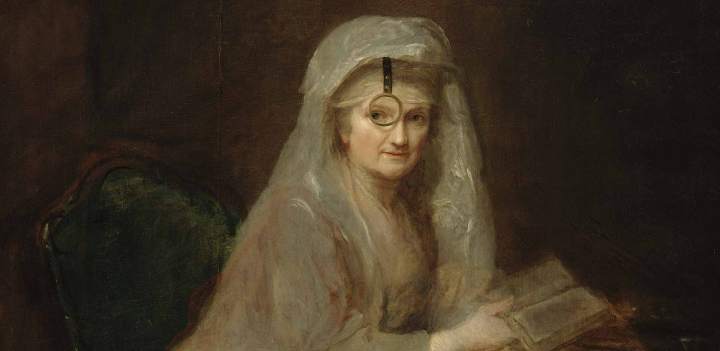
Anna Dorothea Therbusch, Self-Portrait, detail, ca. 1782, 154 × 118 cm
(Berlin: Gemäldegalerie)
◊ ◊ ◊ ◊ ◊
Now on view at the Gemäldegalerie:
Anna Dorothea Therbusch: A Berlin Woman Artist of the Age of Enlightenment / Eine Berliner Künstlerin der Aufklärungszeit
Gemäldegalerie, Berlin, 3 December 2021 — 10 April 2022
Born in Berlin three hundred years ago, Anna Dorothea Therbusch (1721–1782) went on to become one of the most important women artists of the eighteenth century. To mark the tercentenary of her birth (23 July), the Gemäldegalerie is honouring this extraordinary artist and forerunner of women’s emancipation with a special exhibition featuring key works from the Staatliche Museen zu Berlin’s own collections.
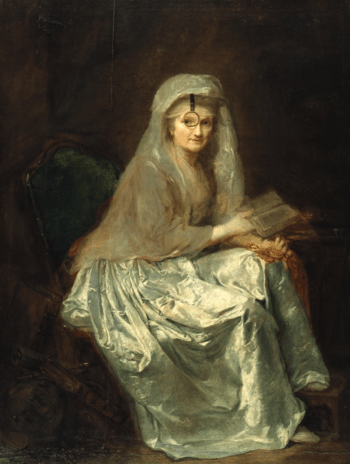 The daughter of the Prussian court painter Georg Lisiewsky, Anna Doroethea received her initial artistic instruction from her father, alongside her siblings. As the wife of an innkeeper and mother of five children, however, her artistic abilities lay idle for decades. In her forties, though, she dedicated herself to painting with great vigour, and in 1767 she was one of the few women to be accepted into Europe’s most important art school of the time, the Académie Royale de Peinture et de Sculpture in Paris. After returning to her hometown, she became a highly sought-after portrait painter, producing likenesses of figures such as Henriette Herz, Frederick the Great, and the doctor Christian Andreas Cothenius, one of the most important chroniclers of the Age of Enlightenment.
Two branches of the Staatliche Museen zu Berlin—the Gemäldegalerie and the Alte Nationalgalerie—boast works by this great local artist, and each has provided museums across the city with permanent loans, with Therbusch’s work on display at the Bode-Museum, the Kunstgewerbemuseum, and at the Jewish Museum Berlin.
One of the painter’s best-known works is a large-format self-portrait from around 1782 in which Therbusch presents herself as a scholar and elegant figure of note. She appears as an approachable and intelligent interlocutor, interested in both objects and her conversation partner, as indicated by the book in her hand and her frontal gaze. Centred around this important painting, the exhibition presents nearly all of Therbusch’s works from the Staatliche Museen zu Berlin. Complemented by key works from her contemporaries, the show provides a comprehensive overview of her oeuvre, her professional milieu, and more broadly the age in which she lived.
Online Talk | Mia Jackson on Boulle and Prints
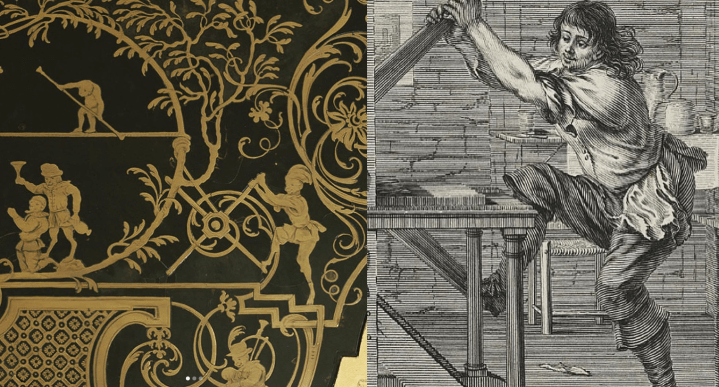
Left: André-Charles Boulle, detail of a table, veneered in turtleshell and brass, with gilt-bronze mounts, ca. 1705 (London: The Wallace Collection, F56). Right: Abraham Bosse, ‘Cette figure vous montre comme on Imprime les planches de taille douce…’, 1642, etching (London: British Museum, R,8.15).
◊ ◊ ◊ ◊ ◊
This Sunday from The Furniture History Society:
Mia Jackson | André Charles Boulle as a Maker, Designer, and Publisher of Prints
The Furniture History Society Online Lecture, 5 December 2021,7pm (GMT) / 2pm (EST)

André-Charles Boulle, table, veneered in turtleshell and brass, with gilt-bronze mounts, ca. 1705 (London: The Wallace Collection, F56).
André-Charles Boulle’s interest in print-making was not limited only to his vast collection of works on paper. The cabinet-maker also designed, made, and sold prints and used print-making techniques in the workshop. Drawing on her doctoral research, Mia Jackson will explore Boulle’s role in print-making, print-publishing, and print-selling. She will discuss Boulle’s series of prints of furniture designs, which her research into publishing history allows her to date more precisely. She will also discuss Boulle’s print design for the Confraternity of St Anne at Carmes-Billettes, and the numerous copperplates that he owned and from which he sold impressions. Dr Jackson’s talk is free to members and £5 for non-members (via this link with code AVUJEN).
Mia Jackson (@theboullelady) has been Curator of Decorative Arts at Waddesdon Manor since 2017. She studied French and Philosophy at Oxford University and then earned an MA in eighteenth-century French decorative arts at the Courtauld Insitute of Art. Her doctoral thesis entitled “André-Charles Boulle (1642–1732) and Paper: Prints and Drawings in the Workshop of an Ébéniste du Roi” was completed at Queen Mary University of London in 2016. She previously worked in the Prints and Drawings Department at The British Museum, at The Wallace Collection, and at English Heritage. She worked on the Riesener Project with The Wallace Collection and the Royal Collection, and is currently preparing a series of exhibitions on Alice de Rothschild with her colleagues at Waddesdon Manor.
Exhibition | Thomas Gray

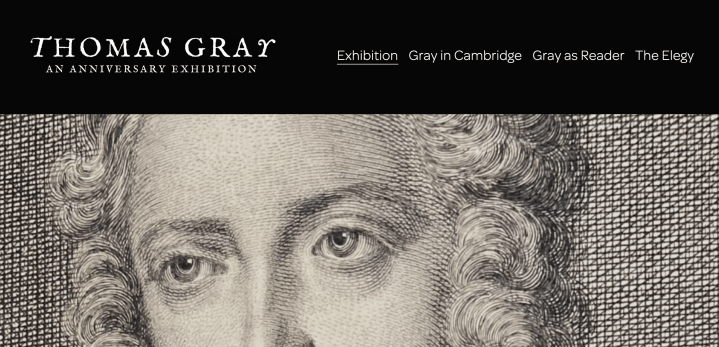
The exhibition closes soon, but I note it here particularly to draw your attention to the online component, mounted by Daniel McKay: it’s the most compelling virtual book exhibition I’ve ever seen.
Thomas Gray: An Anniversary Exhibition
Ward Library, Peterhouse, Cambridge, 8 November — 13 December 2021
Curated by Scott Mandelbrote
To mark the 250th anniversary of Thomas Gray’s death, the 270th anniversary of the publication of “Elegy Written in a Country Churchyard,” and the 305th anniversary of his birth.
Thomas Gray was born on 26 December 1716 and died on 30 July 1771. On 15 February 1751, one of the leading contemporary publishers of literary works, Robert Dodsley, hurried into print an edition of an Elegy wrote in a Country Church Yard, which subsequently became one of the most reprinted, anthologised, translated, and imitated poems in any language. It was one of barely more than a dozen poems that Gray allowed to be printed in his lifetime.
This exhibition considers Gray’s life and work from the perspective of the holdings of the two Cambridge Colleges with which he was associated from 1734, when he entered Peterhouse, until his death, which occurred shortly after he was taken ill at dinner in Pembroke. The exhibition focusses on three defining themes in Gray’s life and reputation: his relationship with Cambridge and the effect on him and on his work of the friends and enemies he made at the University; his activity as a reader, in particular as a user of the libraries of his two Colleges; and the publishing phenomenon of the “Elegy,” his most significant poem and one steeped in his appreciation and emulation of classical tradition, as well as his sense of place and of English history and the history of English poetry.
Call for Papers | Midwest Art History Society 2022, Houston

Work at the MFAH Sarofim Campus concluded with the opening in November 2020 of the Nancy and Rich Kinder Building (shown above). Designed by Steven Holl Architects, the structure houses art produced after 1900 and moves the MFAH up to the twelfth largest art museum in the world (in terms of gallery space). Photo: Richard Barnes, Museum of Fine Arts, Houston.
◊ ◊ ◊ ◊ ◊
From the Call for Papers:
48th Annual Conference of the Midwest Art History Society
Museum of Fine Arts, Houston and Menil Collection, 10–12 March 2022
Proposals due by 15 December 2021
Head south to Bayou City for the 48th annual conference of the Midwest Art History Society. The conference will be held in Houston, Texas, in close proximity to world-class art collections and cultural sites. Participate in engaging sessions at one of the most impressive art institutions in the nation, the Museum of Fine Arts, Houston (MFAH), on Thursday and Friday, March 10 and 11, with special sessions and visits to the Menil Collection and other area institutions on Saturday, March 12.
On Thursday evening, MAHS members are invited to a keynote lecture, “Re-presenting Afro-Atlantic Histories,” presented by Kanitra Fletcher, Associate Curator, African American and Afro-Diasporic Art, Modern and Contemporary Art at the National Gallery of Art in Washington, DC. Dr. Fletcher will examine Afro-Atlantic Histories, the largest international exhibition effort to date to treat the Black Atlantic as an area of cultural exchange and transformation between Africa and the Americas (MASP, São Paulo and MFAH).
Established in 1900, the Museum of Fine Arts, Houston holds a growing encyclopedic collection of more than 70,000 objects spanning from antiquities to the present. The museum’s Susan and Fayez S. Sarofim main campus comprises a number of important museum buildings and their collections, including the newly opened Nancy and Rich Kinder Building designed by Steven Holl Architects (2020) to house 20th- and 21st-century collections. The MFAH is also home to two house museums, a repertory cinema, two libraries, public archives, and facilities for conservation and storage, as well as the International Center for the Arts of the Americas (ICAA), a leading research institute for 20th-century Latin American and Latino art.
Conference attendees are encouraged also to explore the Lillie and Hugh Roy Sculpture Garden and the beautiful works in the Brown Foundation, Inc, Plaza, which provides views of downtown Houston. Just across the street, the Contemporary Arts Museum, Houston offers visitors an opportunity to view exemplary work by living artists. Established in 1948 and housed today in a space designed by Gunnar Birkerts in 1972, the museum exhibits work by local and global living artists and organizes thought-provoking arts programming to educate and inspire audiences.
Close to the Museum District are spectacular sites of downtown architecture and green spaces, interspersed with a vibrant collections of museum spaces including the Asia Society Texas Center, the Buffalo Soldiers National Museum, the Czech Center Museum Houston, Diverseworks, Holocaust Museum Houston, Houston Center for Contemporary Craft, Houston Museum of African American Culture, Lawndale Art Center, the Jung Center, Children’s Museum of Houston, Houston Museum of Natural Science, the Houston Zoo, and the Health Museum.
The Houston skyline is distinguished by a host of striking buildings, varying from the Houston City Hall, constructed by the Works Progress Administration following the Great Depression in the 1930s, to the 1999 postmodern ‘Skyscraper of the Century’ Williams Towers designed by Philip Johnson. Green spaces include the Discovery Green, an area famous for its restaurants, food trucks, and free community events varying from yoga to concerts and arts shows; and Herman Park, home of the Houston Zoo and trails leading to a small lake with pedal boats and a Japanese Zen Garden.
Beyond the Museum District, the nearby Montrose neighborhood developed in 1911, offers visitors diverse dining and shopping options. In the 1980s, it was the center of the gay community and today is a demographically diverse area with renovated mansions, bungalows with wide porches, and cottages located along tree-lined boulevards. More recently (in 2009), Montrose was named one of the ‘ten great neighborhoods in America’. The world-class art collections of Dominique and John de Menil are housed in the Menil Collection in the heart of Montrose. The impeccable Renzo Piano building features matchless galleries of Surrealist art, as well as later modern and contemporary art, arts of Africa, Oceania and Latin America, and important temporary exhibitions. The Menil campus also contains the Rothko Chapel, a museum building dedicated to the art of Cy Twombly, and the new Menil Drawing Institute with its own display and study spaces.
Conference presentations are expected to be under twenty minutes. Proposals of no more than 250 words and a two-page CV should be emailed to the chairs of individual sessions by Friday, 15 December 2021. Chairs are to submit finalized panels for their sessions by 10 January 2022.
◊ ◊ ◊ ◊ ◊
A selection of sessions of potential interest for eighteenth-century scholars is listed below (with the full listing available here).
Drawings and Prints, I
Chair: Cheryl Snay (Curator of European Art, Snite Museum of Art, University of Notre Dame), csnay@nd.edu
This session invites new research or perspectives on early modern American and European drawings and prints from the fifteenth to the nineteenth century.
Graduate Student / Early Career Workshop: Museum Work — Skills, Applications, Opportunities
Chairs: Rex Koontz (University of Houston) and Christine Bentley (Missouri Southern State University), rkoontz@uh.edu and bentley-c@mssu.edu
Provenance Studies
Chair: Jon Evans (University of Houston), jevans@uh.edu
Textiles / Fashion
Chair: Erica Warren (The Art Institute of Chicago), ewarren2@artic.edu
Decolonizing Art History
Chair: Lauren DeLand (Savannah College of Art and Design), delan104@umn.edu
Art History Pedagogy
Chairs: Beth Merfish and Sarah Costello (University of Houston-Clear Lake), merfish@uhcl.edu
Socially Engaged Art History Round Table
Chairs: Cindy Persinger (California University of Pennsylvania) and Azar Rejaie (University of Houston Downtown), persinger@calu.edu and rejaiea@uhd.edu
African Art and Art of the African Diaspora
Chair: Felicia Mings (Curator, Art Gallery of York University), mings@yorku.ca
Art of the Indigenous Americas: Ancient and Modern
Chair: Rex Koontz (University of Houston), rkoontz@uh.edu
Between the Local and Global: Art of the Americas
Chair: Cristina Gonzalez (Oklahoma State University), cristina.gonzalez@okstate.edu
Asian Art
Chair: Jennifer Lee (School of the Art Institute of Chicago), jlee241@saic.edu
Early Modern Art (15th–18th Centuries)
Chair: Elizabeth Carroll (San Jose State University), elizabeth.carroll@sjsu.edu
Recent Acquisitions in the Midwest
Chair: Cheryl Snay (Snite Museum of Art, University of Notre Dame), csnay@nd.edu
Technical Art History
Chair: Amy Morris (University of Nebraska at Omaha), ammorris@unomaha.edu
Undergraduate Art History Session
Chair: Paula Wisotzki (Loyola University), pwisots@luc.edu
Faculty members who have received outstanding research papers from undergraduate students within the past two academic years are invited to submit them for inclusion in our eighth annual Undergraduate Research Session. These papers should explore specific art historical research questions. In all cases, a faculty member (usually the submitter) must serve as a mentor and accompany the undergraduate student to the annual conference. Submissions should include the complete paper of no more than 2500 words, a 250-word abstract, and the student’s resume. In the event that the paper is accepted, undergraduate student presenters and faculty mentors are expected to pay membership and conference fees.
Exhibition | Afro-Atlantic Histories
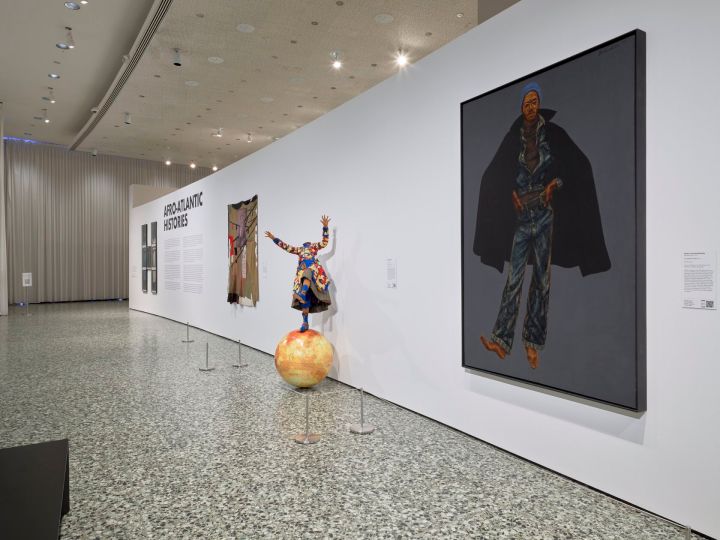
From the press release (21 October 2021) for the exhibition:
Afro-Atlantic Histories
Museu de Arte de São Paulo, 28 June — 21 October 2018
Museum of Fine Arts, Houston, 24 October 2021 — 17 January 2022
National Gallery of Art, Washington, DC, 10 April — 17 July 2022
Los Angeles County Museum of Art, TBD
U.S. Tour Curated by Kanitra Fletcher
This fall the Museum of Fine Arts, Houston, will debut the U.S. tour of Afro-Atlantic Histories, an unprecedented exhibition that visually explores the history and legacy of the transatlantic slave trade. Initially organized and presented in 2018 by the Museu de Arte de São Paulo (Histórias Afro-Atlânticas), the exhibition comprises more than 130 artworks and documents made in Africa, the Americas, the Caribbean, and Europe from the 17th to the 21st centuries.
 In collaboration with MASP and the National Gallery of Art in Washington, DC, the MFAH will present Afro-Atlantic Histories at its Caroline Wiess Law Building from Sunday, 24 October 2021, through Monday, 17 January 2022. The exhibition will then travel to the National Gallery of Art to be on view in its West Building from Sunday, 10 April, through Sunday, 17 July 2022, with the Los Angeles County Museum of Art and additional venues confirmed to follow.
“Afro-Atlantic Histories recasts the traditional telling of the colonial history of the Western hemisphere within the vast web of the transatlantic slave trade over three centuries,” commented Gary Tinterow, Director, Margaret Alkek Williams Chair, MFAH. “It is an essential reexamination, one that the MFAH and the National Gallery have distilled from its expansive, original presentation in Sao Paulo in 2018 to focus on forgotten perspectives under the theme of histórias.”
“The National Gallery is honored to partner with the Museu de Arte de São Paulo and the Museum of Fine Arts, Houston, to bring Afro-Atlantic Histories to the United States. In the nation’s capital, this exhibition will shed light on the many histories that are crucial to our understanding of the legacy of slavery across the Americas,” said Kaywin Feldman, Director of the National Gallery of Art. “Through works made by artists across five centuries, Afro-Atlantic Histories will also celebrate the ongoing influence of the African diaspora on both sides of the Atlantic.”
Afro-Atlantic Histories dynamically juxtaposes works by artists from 24 countries, representing evolving perspectives across time and geography through major paintings, drawings and prints, sculptures, photographs, time-based media art, and ephemera. The range extends from historical paintings by Frans Post, Jean-Baptiste Debret, and Dirk Valkenburg to contemporary works by Ibrahim Mahama, Kara Walker, and Melvin Edwards.
The U.S. tour further builds on the exhibition’s overarching theme of histórias—a Portuguese term that can encompass both fictional and non-fictional narratives of cultural, economic, personal, or political character. The term is plural, diverse, and inclusive, presenting viewpoints that have been marginalized or forgotten.
The exhibition unfolds through six thematic sections that explore the varied histories of the diaspora:
• Maps and Margins illustrates the beginnings of the slave trade as it unfolded across the Atlantic between Africa, the Americas, and Europe. Highlights include artworks that reference the widely reproduced British Abolitionist document Description of a Slave Ship (1789), an illustration that clinically detailed a slave ship’s cargo hold; Aaron Douglas’s painting Into Bondage (1936), a powerful portrayal of the moment when a group of Africans are taken to a slave ship bound for the Americas.
• Enslavements and Emancipations examines how the abuses of commercial slavery triggered rebellion, escape, and Abolitionist movements. Theodor Kaufmann’s On to Liberty (1867) portrays women and children fleeing through the woods—a scene that Kaufmann, who served as a Union Solider during the American Civil War, witnessed firsthand. Torturous practices are addressed in works that range from The Scourged Back, the widely published 1863 photograph by McPherson & Oliver, to the 2009 etching Restraint, a powerful image of a silhouetted figure in an iron brindle, by American artist Kara Walker. Samuel Raven’s Celebrating the Emancipation of Slaves in British Dominions, August 1834 (c. 1834) presents a romanticized tribute to emancipation; Ernest Crichlow’s portrait of Harriet Tubman honors the fearless liberator and ‘conductor’ of the Underground Railroad.
• Everyday Lives features images of daily life in Black communities during and after slavery, in realistic and romanticized views. Among 20th-century artists, American Clementine Hunter and Brazilian Heitor dos Prazeres depict field work and friendships. American Romare Bearden draws inspiration from the rhythmic and improvised staccato of jazz and the blues, using shifts in scale, breaks in color, and disarranged perspectives for his depiction of a sharecropper in the monumental collage Tomorrow I May Be Far Away (1967). The pastoral painting Landscape with Anteater (c. 1660), by the Dutch artist Frans Post, places enslaved laborers and indigenous peoples in an idyllic Brazilian landscape.
• Rites and Rhythms features works about celebrations and ceremonies in the Americas and the Caribbean. Often re-creating African traditions, these rites became channels for worship and communication. Twentieth-century Uruguayan artist Pedro Figari frequently portrayed his country’s Candombe dances, which originated with descendants of enslaved Africans. Dominican artist Jaime Colson’s lively Merengue (1938) pays homage to his country’s national dance and music, a blend of Afro-Caribbean rhythms and African movements. Other works in this section of the exhibition explore Carnival, African-based religions, and the historical Black presence in Christianity.

Dalton Paula, Zeferina, 2018.
• Portraits spotlights Black leaders of the 18th and 19th centuries who have not traditionally been memorialized in historical American and European portraiture. Dalton Paula’s Zeferina (2018), commissioned for the original presentation at MASP, provides a face to an influential slave rebellion leader who was arrested and sentenced to death before she could be commemorated. Other historical and more contemporary works feature ordinary people, invented figures, and the artists themselves, including Self-Portrait (as Liberated American Woman of the ’70s) (1997) by Cameroonian photographer Samuel Fosso, an unconventional work that challenges our understanding of self-portraiture.
• Resistances and Activism examines the continuing fight for freedoms. Banners, flags, and textiles referring to histories of resistance across the Afro-Atlantic invoke cultural, political, religious, and artistic identities. Me gritaron negra (They shouted black at me) (1978), a video by Venezuelan artist Victoria Santa Cruz, is a powerful renunciation of colorism and racism through poetry and dance inspired by the artist’s own history. Other works in this section draw attention to Black activism, including Glenn Ligon’s painting Untitled (I Am a Man) (1988), inspired by signs carried in the 1968 Memphis Sanitation Workers’ Strike, which protested unsafe working conditions and low wages; and March on Washington (1964), a rare figurative painting by Alma Thomas that recalls her experience attending the storied demonstration.
The U.S. tour is curated by Kanitra Fletcher, Associate Curator of African American and Afro-Diasporic Art at the National Gallery of Art. Adriano Pedrosa, Artistic Director; Ayrson Heráclito, Curator; Hélio Menezes, Curator; Lilia Moritz Schwarcz, Adjunct-Curator of Histories; and Tomás Toledo curated the exhibition at the Museu de Arte de São Paulo. At the National Gallery, the curatorial team also includes Molly Donovan, Curator of Contemporary Art, and Steven Nelson, Dean of the Center for the Advanced Study in the Visual Arts.
In Washington, DC, the curators are working closely with an external advisory group of local leading historians and art historians: Ana Lucia Araujo, Professor of History, Howard University; Nicole Ivy, Assistant Professor of American Studies, George Washington University; Kevin Tervala, Associate Curator of African Art, Baltimore Museum of Art; Kristine Juncker, Special Assistant to the Director, National Museum of African Art; and Michelle Joan Wilkinson, Curator, Smithsonian National Museum of African American History and Culture.
Adriano Pedrosa and Tomás Toledo, eds., with additional contributions by Ayrson Heráclito, Deborah Willis, Hélio Menezes, Kanitra Fletcher, Lilia Moritz Schwarcz, and Vivian Crockett, Afro-Atlantic Histories (New York: DelMonico Books / Museu de Arte de São Paulo, 2021), 400 pages, ISBN: 978-1636810027, $70.
Exhibition | The Abyss: Nantes and the Atlantic Slave Trade, 1707–1830

L’abîme: Nantes dans la traite atlantique et l’esclavage colonial, 1707–1830 as installed at the Musée d’histoire de Nantes (Photo by David Gallard). The graphic elements on the wall and the floor are taken from an eighteenth-century document, signed by participants in the slave trade, that depicts La Marie Séraphique, a slave ship that in 1769 transported 312 captives to Cap-Français.
◊ ◊ ◊ ◊ ◊
Now on view at the Musée d’histoire in Nantes (there is also a Google Arts & Culture site, “Nantes and the Atlantic Slave Trade,” with related objects from the museum).
The Abyss: Nantes’s Role in the Slave Trade and Colonial Slavery, 1707–1830
L’abîme: Nantes dans la traite atlantique et l’esclavage colonial, 1707–1830
Musée d’histoire de Nantes, Château des ducs de Bretagne, 16 October 2021 to 19 June 2022
Curated by Krystel Gualdé

Plan, Profile, and Layout of the Ship ‘The Séraphique Marie’ of Nantes, outfitted by Mr Gruel, for Angola, under the command of Gaugy, who dealt in Loango . . ., 1770 (Musée d’histoire de Nantes).
Still today, historians are unable to agree on the number of victims resulting from the transatlantic slave trade. With so many documents missing, it is impossible to arrive at an exact figure; and yet, the difference in final totals does not vary in terms of tens or hundreds or thousands—but in millions. How can a phenomenon so tragic and fundamental divide those who study it to such a degree? It would appear that the number, as staggering as it may be, does not explain the problem sufficiently. Moreover, what would we ultimately know if we arrived at a definite number? Would we know how many men, women, and children died during the wars and raids that led to their captivity? Would we have a better idea of how an entire city and its surrounding region could justify using the colonial system and slave trade as a means to accumulate unprecedented wealth? Would we be able to imagine the close ties between the transatlantic slave trade and the early Industrial Revolution? Would we understand, if only for an instant, how horrible it must have been to no longer be autonomous, to stop being considered human and be relegated to the status of a material good, to disappear without leaving any trace or memory? The exhibition provides an opportunity to hold the collections of the Musée d’histoire up to the light, revealing the invisible but ever-present traces of the men and women who were victims of the colonial system. Beyond the economic and commercial perspective commonly offered, this exhibition reveals the complex reality of a city so deeply involved in the slave trade.
Krystel Gualdé, est directrice scientifique du Musée d’histoire de Nantes et du Mémorial de l’esclavage. Spécialiste de la traite atlantique et de l’esclavage colonial, elle engage le musée dans de nombreux partenariats et réseaux scientifiques au niveau national comme international (Conseil d’orientation de la Fondation pour la mémoire de l’esclavage ; Projet SLAFNET – Slavery in Africa: A Dialogue between Europe and Africa). Elle est par ailleurs membre du Global Curatorial Project porté par le Center for the Study of Global Slavery at the Smithsonian’s National Museum of African American History and Culture (NMAAHC) et le Center for the Study of Slavery and Justice à l’université Brown aux Etats-Unis.
Krystel Gualdé, L’abîme: Nantes dans la traite atlantique et l’esclavage colonial, 1707–1830 (Rennes: Presses Universitaires de Rennes), 320 pages, ISBN: 978-2906519794, 30€.
A preview of the book is available here»
The dossier de presse is available here»










 Enfilade
leave a comment