Exhibition | Hidden Hands: Invisible Workers in Industrial England

Worcester Porcelain Manufactory, gilding attributed to Charlotte Hampton, Covered Dessert Tureen and Ladle from the ‘Bostock’ Service, ca. 1785–90, soft-paste porcelain (Museum of Fine Arts, Houston, the Rienzi Collection, Museum purchase funded by Mr. and Mrs. Harris Masterson III).
◊ ◊ ◊ ◊ ◊
Now on view at Rienzi:
Hidden Hands: Invisible Workers in Industrial England
Rienzi, The Museum of Fine Arts, Houston, 1 September 2021– 2 January 2022
The introduction of new materials and technological innovation in the 18th century sparked an increased demand for luxury objects and useful wares made of ceramics, glass, and metals. These technologies and techniques allowed manufacturers to create wares to appeal to a broader and more diverse audience. The Industrial Revolution affected not only how objects were made but also the organization of labor in workshops and factories. Behind famous names such as Josiah Wedgwood and Worcester Porcelain was a diverse, yet mostly unseen and nameless workforce composed of large numbers of women and children who were involved in various aspects of production and manufacture. Hidden Hands: Invisible Workers in Industrial England focuses on the many hands involved in the production of these wares. The exhibition also challenges established ideas about craftsmanship and artistic authorship.
Rienzi, the MFAH house museum for European decorative arts, presents special exhibitions twice a year.
Opinion | Time to Rethink Chinoiserie

Thomas Chippendale, Chinese Chairs, 1753; black ink, gray ink, and gray wash (New York: The Metropolitan Museum of Art, 20.40.1.23). From The Met’s online description: “Preparatory drawing for Thomas Chippendale’s Gentleman and Cabinet Maker’s Director. Published in reverse as plate XXIII in the 1754 and 1755 editions. The plate is reworked and renumbered as plate XXVII in the 1762 edition. In the new version the arm chair on the right (left in the print) is left unaltered, while the chair back of the chair in the middle is changed and the chair on the left (right in the print) is changed completely.”
◊ ◊ ◊ ◊ ◊
The following op-ed was published online at Elle Decor in May with a version also appearing in the October issue of the print magazine. It’s the sort of essay that I’ve been hoping to find for a few years now, one that bridges the scholarship of the past two decades with contemporary design practice, particularly as promoted by shelter magazines. I suspect that it could be useful pedagogically as a way to connect the historical origins of the material to present-day decorating trends. –CH
Aileen Kwun, “Opinion: It’s Time to Rethink Chinoiserie,” Elle Decor (27 May 2021). From pagoda motifs to floral wallpaper, chinoiserie has always openly borrowed from Asian visual culture. But is it harmful? A design writer and reporter asks the AAPI design community to weigh in.
Foo dogs. Ginger jars. Yin-yang tables. Pagoda motifs, fiery dragons, and bamboo stalks. See it in architecture, gardens, interiors, furnishings, products, graphic motifs, and at just about every scale of design. Chinoiserie, a genre of reproduction design dating back to 17th- and 18th-century Western Europe, has had a long history. From Louis XIV’s decor at Versailles to Ettore Sottsass’s pagoda-topped postmodern shelving, Westernized versions of Asian motifs have long been a mainstay of interior design. . . .
As a style of decor, chinoiserie is ubiquitous, even beautiful. But as an Asian American, chinoiserie has never sat well with me—as a motif or as a word—and, to varying degrees, I’m not the only one. “My reading of chinoiserie is that it’s ‘Asian’ in facsimile,” the architect Michael K. Chen says. “The way that chinoiserie is deployed in interiors is something that I am a little reflexively allergic to. As a component of a ‘traditional’ interior, it seems to highlight the question: Whose tradition are we talking about?” . . .
The full essay is available here»
Call for Papers | Water / Landscapes: Ecologies of the Fluid
From the posting at ArtHist.net (which includes the German version) . . .
Water / Landscapes: Ecologies of the Fluid, circa 1800
Wasser / Landschaften: Ökologien des Fluiden um 1800
A Conference of the Rhine-Main-Universities Initiative Romantische Ökologien
7–9 July 2022, Research Center, Bad Homburg
Proposals due by 30 November 2021
Wherever literary, pictorial, musical, or even horticultural depictions of the landscape are to be found in the Romantic period, there too, is the element of water: whether in sweeping and meandering streams or artfully arranged ponds and waterfalls within landscape gardens; mirror-smooth coastal and lake-surfaces reflecting the sun- or moonlight (either with summer brightness or in eerier shades); from wind-whipped sea tides and ocean waves; whispering brooks brimming with whimsical trout, or rivers like the Rhine, Main, Neckar, Thames, Seine, or Nile, welcome-beacons to all prospective barge- and ship-farers and invitations to imagine, paint, and compose poetry. Water-surfaces, water elements, and water spectacles are constitutive to a Romantic understanding of ‘landscape’.
Through these waterscapes of Romanticism—and more generally, those from the years around 1800—a (proto-)ecological understanding of the interplay between inorganic and organic entities in locally defined spaces comes into view and is first articulated. The connection nonetheless remains to be investigated further. To be sure, the Environmental Humanities have recognized the literature, philosophy, and science around 1800 as originators of modern ecological theorems and environmental consciousness. Nonetheless, the role that can be attributed to water—to the biotopes and conditions of existence attached to it—is still unclear. This is all the more astonishing as discussions and imaginations of the significance of water for life and the living in general, and specifically for the reciprocal, developmental, and transformative relationships between organisms and water (and hydrogen), was certainly encouraged by both the natural sciences (physics, geology, and in philosophy/ies of nature) as well as in literature and the arts around 1800 more generally. In particular, the realization that life and living forms not only consolidate in water, but that medial approaches are simultaneously necessary to make these interdependencies and interrelationships visible is decisive—Andersen’s fairy tale of water drops (Danish: Vanddraaben, 1847) beneath the magnifying glass brings this into view in a particularly impressive way.
Moreover, water landscapes help bring together the constantly interwoven levels of the semiotic and the material, of sonic and the phonetic (linguistic), and of literal and metaphorical meaning: Within landscape poems, the splash, bubble, spring, flood, flow, rush, and surge are not only the acts of waterworks and water surfaces; rather, diverse actors, their distinct modes of being and movement, become entangled and affected by each other, as they converge, mingle, and disperse again. Animals, plants, air, soil, and light make up an ensemble, which is brought into contact and co-constituted by water. Its activity and vitality, much like any form of landscape, is made possible only through water. More pointedly, the period from about 1750 to 1850 launches epistemological and aesthetic formations which recognize that without water, landscapes and living forms are unthinkable and unrepresentable.
The conference explores the ecological dimensions of the fluid in the period around 1800, taking the concept ‘water|landscapes’ as its point of departure. The focus will consist of various ‘water sites’, ranging from rain-bearing cloud formations to water puddles and bogs to river courses and marine spaces. It will bring into play extremely heterogenous aesthetic programs (e.g., the sublime or the locus amoenus), genres (idylls, river and seafaring ballads, garden poems, landscape prose and landscape painting discourse, nature essays, etc.) places (national and international, fantastic and realistic etc.), times, and traditions (Greek and Germanic mythology, Middle Ages). The basic thesis of the conference is that Romantic literatures and images stage, reflect, and negotiate the interplay of (living) elements and beings around/in water.
We are interested in contributions that inquire into historical knowledges about and aesthetic approaches to water, aquatic habitats, and habitats in the period around 1800, especially as relating to theories, figures of thought, and forms of representation of the ecological. Points of departure and catalysts for research can be found not only in the field of Romantic Ecocriticism but also in Hydro-Criticism and the Blue Humanities. European and International Romanticism is thereby an important, though not exclusive, reference point. Our interest is in the diversity of representations and theories surrounding water and its proto-ecological dimensions around 1800; all proposals that focus on water|scapes in text, as image, or as a jumping-off point for discussions between 1750 and 1850 are welcome.
Please send your abstract (max. 500 words) for a 25-minute talk and short bio and bibliographical notes in one single document to all three organisers (borgards@lingua.uni-frankfurt.de; middelhoff@em.uni-frankfurt.de; thums@uni-mainz.de) until 30 November 2021. A publication of selected talks is planned. The conference is scheduled as an in-presence event at the Research Center’s Villa Reimers in Bad Homburg. Travel and accommodation costs can—if needed—be reimbursed.
Organisers
Prof. Dr. Roland Borgards (Goethe-University Frankfurt)
Prof. Dr. Frederike Middelhoff (Goethe-University Frankfurt)
Prof. Dr. Barbara Thums (Johannes Gutenberg-University Mainz)
Contact
Frederike Middelhoff (W1-Professur für Neuere Deutsche Literatur mit dem Schwerpunkt Romantikforschung)
Goethe-Universität Frankfurt
Institut für deutsche Literatur und ihre Didaktik
Campus Westend // IG-Farben-Haus // Postfach 17
Norbert-Wollheim-Platz 1
60323 Frankfurt am Main
middelhoff@em.uni-frankfurt.de
Selected Bibliography
Alaimo, Stacy. “Oceanic Origins, Plastic Activism, and New Materialism at Sea.” In Material Ecocriticism, ed. Serenella Iovino, Serpil Oppermann. Bloomington 2014, pp. 186–203.
Böhme, Hartmut (ed.). Kulturgeschichte des Wassers. Frankfurt am Main 1988.
Böhme, Hartmut. “Wolken, Wasser, Stein. Zur Ästhetik der Landschaft, in: semina rerum (1999), pp. 1–7.
Briški, Javor und Irna Marija Samide (eds.). The Meeting of Waters: Fluide Räume in Literatur und Kultur. Munich 2015.
Bunzel, Wolfgang (ed.). Romantik an Rhein und Main: Eine Topographie. Darmstadt 2014.
Costlow, Jan, Yrjö Haila, Arja Rosenholm (eds.). Water in Social Imagination: From Technological Optimism to Contemporary Environmentalism. Ann Arbor 2017.
Cohen, Margaret and Killian Quigley (eds.). The Aesthetics of the Undersea. London, New York 2019.
Davies, Jeremy. “Romantic Ecocriticism: History and Prospects.” In Literature Compass (2018), pp. 1–15.
Deloughrey, Elisabeth. “Towards a Critical Ocean Studies for the Anthropocene.” In English Language Notes 57:1 (2019), pp. 22–36.
Detering, Heinrich. “Der Weiher als Ökosystem.” In: id.: Holzfrevel und Heilsverlust: Die ökologische Dichtung der Annette von Droste-Hülshoff. Göttingen 2021, pp. 46–60.
Goodbody, Axel and Berbeli Wanning (ed.). Wasser – Kultur – Ökologie: Beiträge zum Wandel mit dem Wasser und zu seiner literarischen Imagination. Göttingen 2008.
Garde-Hansen, Joanne. Media and Water: Communication, Culture, and Perception. London, 2021.
Görner, Rüdiger. “‘Hörst du das Alphorn überm blauen See?’ Aquafine Zeichen in der Lyrik Anette von Droste-Hülshoffs.” In Jahrbuch des Franz-Michael-Felder Archivs 20 (2019), pp. 16–29.
Häusler, Wolfgang. “Zwischen Naturwissenschaft, Heiliger Schrift und Historie. Beobachtungen zur Funktion des Wassers im Wer Adalbert Stifters.” In Jahrbuch des Adalbert-Stifter-Instituts 16 (2009), pp. 101–114.
Honold, Alexander. “Zwischen Wasser und Poesie. Brentanos Stromkreislauf.” In Gabe, Tausch, Verwandlung. Übertragungsökonomien im Werk Clemens Brentanos, ed. Ulrike Landfester. Würzburg 2009, pp. 127–141.
Jacobs, Mary. Romantic Things: A Tree, a Rock, a Cloud. Chicago 2012.
Jue, Melody. Wild Blue Media: Thinking through Seawater. Durham 2020.
Kramer, Anke. “Hydrographie der Zeit. Erlebte Zeit bei Annette von Droste-Hülshoff, Henri Bergson und Johannes Müller.” In ZwischenZeiten. Zur Poetik der Zeitlichkeit in der Literatur der Annette von Droste-Hülshoff und der ‚Biedermeier‘-Epoche, ed. Cornelia Blasberg and Jochen Grywatsch. Hannover 2013, pp. 189–209.
Kramer, Anke. “Elementargeister und die Grenzen des Menschlichen. Agierende Materie in Fouqués Undine.” In: Mensch – Maschine – Tier: Entwürfe posthumaner Interaktionen (= Beiheft PhiN 10/2016), ed. Christa Grewe-Volpp, Evi Zemanek, pp. 104–124. http://web.fu-berlin.de/phin/beiheft10/b10t08.pdf.
Kraß, Andreas. Meerjungfrauen: Geschichten einer unmöglichen Liebe. Frankfurt am Main 2010.
McKusick, James. Green Writing: Romanticism and Ecology. Basingstoke 2000.
Pape, Walter (ed.). Romantische Metaphorik des Fließens: Körper, Seele, Poesie. Tübingen 2007.
Ritson, Katie. “The View from the Sea: The Power of a Blue Comparative Literature.” In Humanities 9/3/68 (2020) https://doi.org/10.3390/h9030068.
Ritson, Katie. The Shifting Sands of the North Sea Lowlands: Literary and Historical Imaginaries. London 2018.
Robbins, Nicholas. “Ruskin, Whistler, and the Climate of Art in 1884.” In Ruskin’s Ecologies: Figures of Relation from Modern Painters to the Storm-Cloud, ed. Kelly Freeman Thomas Hughes. London 2021, pp. 203–223.
Exhibition | Simon Watson: Portrait of a House

From Dublin’s Kevin Kavanagh gallery and Dürer Editions:
Simon Watson: Portrait of a House
Kevin Kavanagh, Dublin, 14–30 October 2021
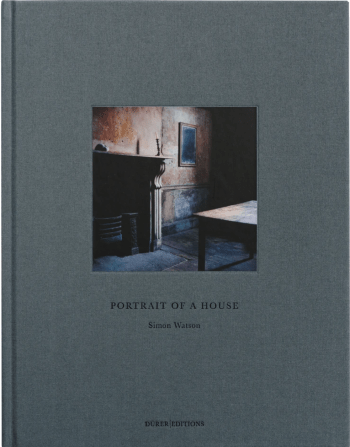
In Portrait of a House, Watson explores an eighteenth-century Georgian house on Dublin’s storied Henrietta Street. The house (Number Twelve) has a history of transformation, from the grand city home of wealthy merchants to the inner-city tenement dwelling for the poverty stricken. In a gentle Proustian fashion, the house reveals a quiet melancholy and the slow passing of time. The photographs were made over several years. The work is intended to be a poetic and intimate portrait.
 For over 30 years Simon Watson has exhibited his photographs in Europe and the U.S. including solo shows at the late Richard Anderson Gallery in New York and the Auschwitz Museum in Poland. More recently he has shown his paintings at the Galerie Rideau de Fer in France. His work is included in museums and in public and private collections worldwide. Watson has been a regular contributor to The New York Times T Magazine, W Magazine, Vogue, and Vanity Fair. His recent book The Lives of Others was published by Rizzoli in 2020.
Simon Watson, Portrait of a House (Dürer Editions, 2021 ), 64 pages, ISBN: 978-1838314309 , first edition of 1000 copies, €45; special edition of 50, €350; limited edition of 10, €750; collector edition of 5, €1850.
New Book | The Best Address in Town: Henrietta Street
From Four Courts Press:
Melanie Hayes, The Best Address in Town: Henrietta Street, Dublin and Its First Residents, 1720–80 (Dublin: Four Courts Press, 2021), 312 pages, ISBN: 978-1846828478, €30 / $40.
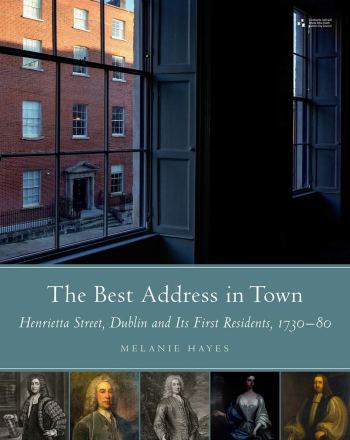 Once Dublin’s most exclusive residential street, Henrietta Street was, throughout the eighteenth century, home to the country’s foremost figures from church, military, and state. Here, in this elegant setting on the north side of the city, peers rubbed shoulders with property tycoons, clerics consorted with social climbers, and celebrated military men mixed with the leading lights of the capital’s beau monde, establishing one the principle arenas of elite power in Georgian Ireland. Looking behind the red-brick facades of the once-grand Georgian town houses, this richly illustrated volume—commissioned by Dublin City Council Heritage Office in conjunction with the 14 Henrietta Street museum—focuses on the people who originally populated these spaces, delineating the rich social and architectural history of Henrietta Street during the first fifty years of its existence. By weaving the fascinating and often colourful histories of the original residents around the framework of the buildings, in repopulating the houses with their original occupants, and by offering a window into the lives carried on within, this book presents a captivating portrait of Dublin’s premier Georgian street, when it was the best address in town.
Melanie Hayes is an architectural historian, specialising in Ireland’s eighteenth-century architectural and social history. She was an academic researcher during the development of the 14 Henrietta Street museum by Dublin City Council, and continues to be involved with the museum. Melanie currently works as a research fellow on an Irish Research Council laureate project, CRAFTVALUE, at Trinity College Dublin, exploring a new skills-based perspective on the architecture of Britain and Ireland from 1680 to 1780.
New Book | 14 Henrietta Street: Georgian Beginnings, 1750–1800
From the 14 Henrietta Street museum:
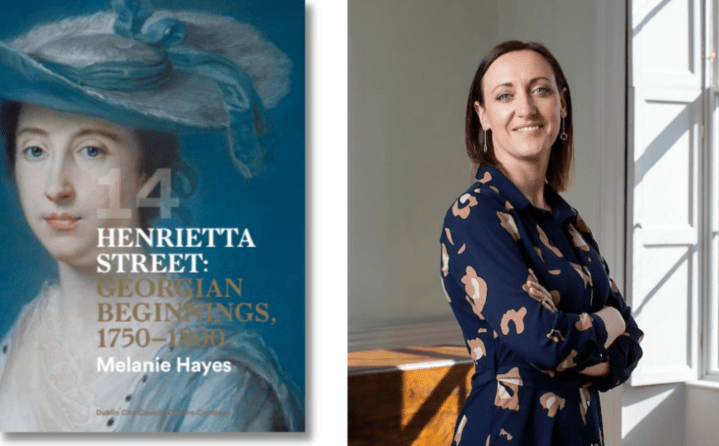
Melanie Hayes, 14 Henrietta Street: Georgian Beginnings, 1750–1800 (Dublin: Dublin City Council Culture Company, 2021), ISBN: 978-0995744660, €18.
In 1800 Henrietta Street was one of the most elegant and elite addresses in all of Georgian Dublin, home to some of the most powerful members of the Anglo-Irish ruling class. 14 Henrietta Street: Georgian Beginnings explores the early history of the house, its first residents—the Molesworths, Bowes, and O’Brien families—and the lives lived behind the red brick facade. This book is one of three new publications commissioned by the 14 Henrietta Street museum that uncover the lives of the people who lived at the house and the surrounding areas.
Melanie Hayes is an architectural and cultural historian, specialising in Ireland’s eighteenth-century architectural and social history. Melanie was part of the historian research team at 14 Henrietta Street, and continues to be involved as a historian for the museum. Dr Hayes currently works as a post-doctoral research fellow, on an Irish Research Council advanced laureate project, CRAFTVALUE, at Trinity College Dublin.
Exhibition | On Stage! Costume Designs
From the press release for the exhibition:
On Stage! Costume Designs from the Edmond de Rothschild Collection
Louvre, Paris, 28 October 2021 – 31 January 2022
Curated by Jérôme de La Gorce, Mickaël Bouffard, and Victoria Fernández Masaguer
 The Edmond de Rothschild Collection boasts 1,644 sumptuous costume designs for balls, ballets, masquerades, and operas given in France from the reign of François I to that of Louis XIV. Acquired in the late 19th century by Baron de Rothschild, they constitute an extraordinary resource for understanding the world of spectacle during the Ancien Régime. The exhibition showcases a hundred of the finest pieces from this unique corpus.
Cette exposition réunit une sélection d’une centaine de feuilles provenant de l’un des plus importants fonds de dessins d’habits de spectacle, celui des volumes de Costumes de fêtes, de ballets et de théâtre au temps de Louis XIV offerts par le baron Edmond de Rothschild (1845–1934) au musée du Louvre. Leur richesse permet de dévoiler la diversité d’invention des artistes qui habillèrent les divertissements montés à la Cour de France et de Lorraine du milieu du XVIe siècle à l’aube du XVIIIe siècle : le Primatice, Jacques Bellange, Daniel Rabel, Henri Gissey et Jean Berain notamment. Les véritables ouvrages textiles ayant disparu pour la plupart, ces dessins sont des sources inestimables pour l’histoire du costume, de la danse, de la musique et des spectacles en France durant cette période.
Divisée en quatre sections, cette exposition consacre une première salle à l’atelier du dessinateur de costumes qui entend explorer la transmission de modèles entre les différentes générations d’artistes et les spécificités techniques propres à ce type de dessin. Le parcours propose ensuite de suivre les principaux genres spectaculaires représentés dans ces recueils, qui correspondent aux intérêts de l’un des plus grands collectionneurs de dessins de fêtes et divertissements de la fin du XVIIe et du début du XVIIIe siècle, Claude Pioche, sieur Du Rondray (1660/1665–1733), à qui une partie des feuilles assemblées dans ces volumes aurait appartenu :
Les divertissements équestres : les costumes des cavaliers et des chevaux deviennent l’un des attraits majeurs de ces compétitions destinées tant à prouver la valeur que la galanterie des concurrents dans la lice. Par leur magnificence et l’émerveillement qu’ils suscitent, ils contribuent à l’affirmation du pouvoir.
Les bals, ballets et mascarades : dans la seconde moitié du XVIe siècle, un caractère à la fois bizarre et poétique guide les artistes qui produisent des « habits de masques » pour les bals et mascarades. Au temps de Louis XIII, le sérieux et le grotesque se mêlent aux influences mythologiques, exotiques et bucoliques, codes que le ballet de Cour et la comédie-ballet se réapproprient au cours du XVIIe siècle.
Les tragédies en musique : ce nouveau genre musical français réunit une multitude de chanteurs, danseurs, musiciens et acrobates qu’il est nécessaire d’habiller harmonieusement. C’est le défi que relève le créateur des Menus Plaisirs Jean Berain, en faisant preuve d’une invention sans pareil dans la variation des coupes, des couleurs et des ornements.
Grâce à une campagne de restauration conduite par l’atelier de restauration du département des Arts graphiques du musée du Louvre, l’ensemble du corpus de dessins de costumes, soit 1644 feuilles, a été restauré et remonté dans des papiers de conservation neutre.
Commissaires de l’exposition
• Mickaël Bouffard, chargé de recherche, Centre d’Étude de la Langue et des Littératures Françaises (CELLF)
• Jérôme de La Gorce, directeur de recherche émérite, CNRS
• Victoria Fernández Masaguer, chargée d’études documentaires, département des Arts graphiques, musée du Louvre
Jérôme de La Gorce, Mickaël Bouffard, et Victoria Fernández Masaguer, En scène! Dessins de costumes de la collection Edmond de Rothschild (Paris: Louvre éditions / Lienart, 2021), 232 pages, ISBN: 978-2359063240, 29€.
Exhibition | The Salem Witch Trials: Reckoning and Reclaiming

Trunk, made perhaps in Boston or London, 1670; wood, seal skin, iron (Salem: Peabody Essex Museum, Gift of George Rea Curwen, 1898, 3970; photograph by Kathy Tarantola ). The trunk belonged to Jonathan Corwin (1640–1718), one of the magistrates involved in the 1692 trials; Corwin resided at the building in Salem now known as the Witch House (the only surviving structure with direct ties to the trials).
◊ ◊ ◊ ◊ ◊
From the press release (24 August 2021) for the exhibition:
The Salem Witch Trials: Reckoning and Reclaiming
Peabody Essex Museum, Salem, Massachusetts, 18 September 2021 — 20 March 2022
Curated by Lydia Gordon, Dan Lipcan, and Paula Richter
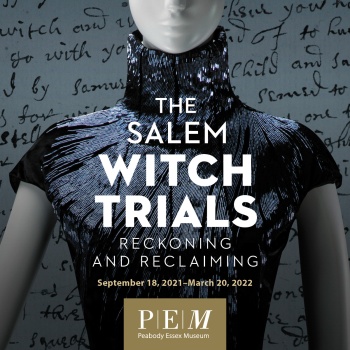
This fall, the Peabody Essex Museum (PEM) presents a new exhibition about the tragic events and lasting legacy of the 1692 witch trials. The Salem Witch Trials: Reckoning and Reclaiming dives into the circumstances that fueled the crisis while recognizing the individuals who rose to defend those unjustly accused. The exhibition features authentic 17th-century court documents and objects as well as two compelling contemporary responses made by artists with direct ancestral links to the trials. Fashion by Alexander McQueen and photography by Frances F. Denny revive the impact of Salem’s historical trauma and provide a new perspective on a centuries-old story.
“More than 300 years after the Salem witch trials, the personal tragedies and grave injustices that occurred still provoke reflection as we continue to reckon with the experiences of those involved,” said Dan Lipcan, the Ann C. Pingree Director of PEM’s Phillips Library and one of the exhibition co-curators. “Thanks to these artists’ mining of Salem’s painful history, we are able to put these events into context with our lives today and imagine how we might courageously mold our communities moving forward while continually advocating for justice and tolerance.”
PEM holds the world’s largest collection of Salem witch trials materials, including more than 500 original documents on deposit from the Massachusetts Supreme Judicial Court. Selections of these documents along with furnishings and personal objects help tell the tragic and true story of those accused, including a trunk that once belonged to Jonathan Corwin, the magistrate who resided at the 17th-century building in Salem that is today known as the Witch House.
 The exhibition opens with the power dynamics, fear and community tensions that plagued Salem in the summer of 1692. The extraordinary crisis involved more than 400 people and led to the deaths of 25 innocent people between June 1692 and March 1693. The panic grew from a society threatened by war and a malfunctioning judicial system in a geographical and cultural setting rife with religious conflict and intolerance.
The fashion designer Alexander McQueen’s Fall/Winter 2007 collection, In Memory of Elizabeth How, 1692, was based on his Salem research into his ancestor Elizabeth How, one of the first women to be condemned and hanged as a witch in July 1692. More than three centuries after How’s death, McQueen and Sarah Burton, now the creative director for the House of McQueen, visited Salem. Selections from the resulting intensely personal and autobiographical collection will be on view, including the form-fitting velvet press sample runway dress from PEM’s collection, with a starburst hand-sewn in iridescent gunmetal-gray bugle beads that radiates down the neckline and across the chest and shoulders. Set in context, nearby authentic documents help tell How’s story, from the initial complaint filed May 28, 1692 to the warrant for her arrest, her examination in court, testimony, indictment, pardon, and final restitution to her family in 1712.
“Alexander McQueen’s theatrical fashion show, featuring his powerful designs, reclaimed How’s power and memory from the false accusation that led to her unjust execution,” said exhibition co-curator, Paula Richter. “His visit to key sites in Salem and research into his ancestestry left a lasting impact on him. The resulting designs include symbols of witchcraft, paganism, magic and religious persecution.”

Frances F. Denny, Karen, (Brooklyn, New York), 2016, from Major Arcana: Portraits of Witches in America series, archival pigment print, 26 × 20 inches (Courtesy of the artist and ClampArt, New York, NY).
From a woman in hospital scrubs to a local Salem shop owner, photographer Frances F. Denny’s series Major Arcana: Portraits of Witches in America reclaims the meaning of the word ‘witch’ from its historical use as a tool to silence and control women. As a descendent of both accusers and the accused, Denny set out on a journey to discover modern-day witches. She encountered healers, artists and tarot readers, a vast spectrum of identities and spiritual practices. The exhibition features 13 portraits and accompanying personal essays, each revealing a fascinating glimpse into the contemporary spiritual movement.
“Frances Denny’s portraits not only claim agency for those who identify as witches, but they also diversify our perception of what a witch is,” said Lydia Gordon, PEM’s Associate Curator and exhibition co-curator. “What do witches even look like? These powerful portraits do not festishize, but rather reveal multidimensional, self-possessed individuals. They invite careful study and consideration and remind us that identity is most truthful when it is self defined.”
The Salem Witch Trials: Reckoning and Reclaiming is organized by the Peabody Essex Museum. Carolyn and Peter S. Lynch and The Lynch Foundation, Jennifer and Andrew Borggaard, James B. and Mary Lou Hawkes, Kate and Ford O’Neil, and Henry and Callie Brauer provided generous support. We also recognize the generosity of the East India Marine Associates of the Peabody Essex Museum.

Part of the Salem Witch Memorial, designed by Maggie Smith and James Cutler, dedicated 5 August 1992 (Photo by Kathy Tarantola/PEM).
Call for Papers | Exploring the Mental World of the Country House
From the Call for Papers:
Exploring the Mental World of the Country House
20th Annual Historic Houses International Conference
Centre for the Study of Historic Irish Houses and Estates, Maynooth University, 9–11 May 2022
Proposals due by 19 November 2021
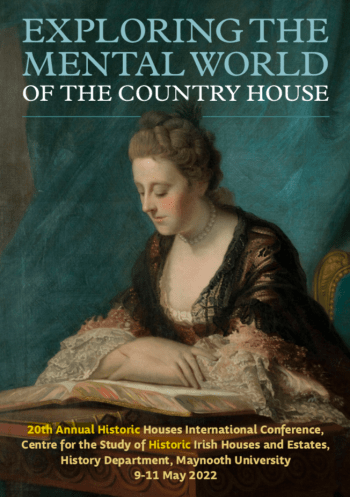 Country houses are masterpieces of material culture, they are triumphs of architecture, fine and decorative art, and landscape design, but they are also about the history and transmission of ideas.
In varying degrees their occupants (above and below stairs, indoors and outdoors) thought, conversed, read, and responded to their milieu through books, newspapers, as well as other media and forms of knowledge. In recent years country house libraries and archives have steadily revealed more evidence for how people in country houses fashioned themselves and their views of the world. In 2022 the Twentieth Annual Historic Houses Conference will examine the intellectual background to the country house. What is the meaning of all those volumes in bookcases, did they do more than just decorate a room? How were they acquired, read, and put to use?
By what means did elite society exchange ideas, absorb new trends, and engage in wider debate, especially when at home in the country? To what degree was this knowledge valued and displayed in terms of stylish library design, and how did houses preserve, or neglect, their books and other records? How did members of a household entertain or better themselves, what was popular to read with whom —men, women and children? The classics, natural history, literature, genealogy, fiction, and other subjects feature in many country house libraries, and very often a battered, plain copy of a publication will reveal more than the most pristine edition in a lavish ornamental binding. In what ways did books furnish minds as well as interiors?
Beyond the demesne walls how has the world of the country house been perceived and understood in fiction, poetry, drama and, more recently, film? How have these treatments shaped a wider understanding of the country house as a cultural and literary phenomenon? Exploring the Mental World of the Country House will examine these and other related questions, and mark the twentieth anniversary of the Centre; the conference is likely to be a mix of real and online proceedings. Papers on any of the above topics relating to country houses in Ireland, the UK, Europe, or further afield will be considered. Abstracts of no more than 400 words should be sent to Professor Terence Dooley and Professor Christopher Ridgway before 19 November 2021 at the following addresses: terence.a.dooley@mu.ie and cridgway@castlehoward.co.uk.
Online Course | British Furniture Making, 1660–1914

State Bed from Hampton Court Castle, ca. 1698 (New York: The Metropolitian Museum of Art, 68.217.1a), as installed in The Met’s newly renovated British Galleries. Photo by Coscia Joseph. As noted in the museum’s online entry: “In the style of Daniel Marot, this bed was made for Thomas, Baron Coningsby (1656–1729), for Hampton Court, Herefordshire, where it remained until 1925. The curtains, counterpane, headcloth, and some of the trims are modern copies of the originals.”
◊ ◊ ◊ ◊ ◊
From ArtHist.net:
Skill, Style, and Innovation:
British Furniture Making from the Restoration to the Arts and Crafts Movement
Online, The Furniture History Society, Wednesdays, 3 November — 1 December 2021
The Furniture History Society, UK, is organising a short course on British furniture makers from 3rd November to 1st December as part of its outreach and educational programme, for British and Irish Furniture Makers Online (BIFMO). Each week three speakers will consider the history of furniture makers and making in Britain. Beginning with the Baroque period, the course will move chronologically through the centuries to conclude in December with the Arts and Crafts movement. In addition to dealing with the output of specific furniture makers, this course aims to provide an integrated account of the furniture trade in the context of the cultural, technical, and industrial developments that occurred in Britain during these three and a half centuries, while also acknowledging other significant factors such as the role of the patron and the involvement of artists and designers. The talks bring to life the careers and work of some of the most important makers of their time—including Gerrit Jensen in the late seventeenth century; Giles Grendey, William Vile, Thomas Chippendale, and John Linnell in the eighteenth century; Thomas Hope, J. C. Crace, and Charles Robert Ashbee in the nineteenth century; as well as less well-known makers, firms of furniture makers, designers, and architects.
Tickets can be purchased for individual weeks or for the entire course at a saving. To purchase tickets, please go to the EventBrite page. This course will be recorded, and the link to the recording will be sent to ticket holders after the event, though please note that Max Donnelly will not be recorded. We are grateful to the Paul Mellon Centre and the Foyle Foundation for their support.
The course runs from 4.00 to 7.30pm (GMT) every Wednesday as follows:
Week 1 | November 3 — British Baroque Furniture, 1660–1715
• Wolf Burchard (Associate Curator, Metropolitan Museum of Art), British Baroque Furniture and Furniture Makers
• Amy Lim (Oxford University), The Baroque Interior: Furnishing the Great London and Country Houses
• John Cross (Furniture historian and maker, specialist on the Jamaican furniture trade), The London Trade, ca. 1660–1720
Week 2 | November 10 — The Early Eighteenth Century and the Furniture Trade, 1715–1760
• Adriana Turpin (FHS Project Manager for BIFMO, International Department, IESA), Furniture for the London Merchants
• Jeremy Howard (Buckingham University), Fantasy and Exuberance: English Rococo Furniture Makers as Craftsmen and Designers
• Norbert Gutowski (Independent furniture maker and restorer, former Subject Leader at West Dean College of Arts and Conservation, Sussex), Eighteenth-Century Furniture Techniques
Week 3 | November 17 — Architects, Furniture, and Patrons, 1760–1815
• Megan Aldrich (Department of Continuing Education, University of Oxford), The Furniture Maker and the Architect in the Palladian and Neoclassical Periods
• Lucy Wood (Independent furniture historian, formerly curator at the Lady Lever Art Gallery, Liverpool and the Department of Furniture, Textiles, and Fashion, Victoria & Albert Museum), London Furniture Makers in the Time of Chippendale
• Rufus Bird (Former Surveyor of the Queen’s Works of Art, Royal Collections), ‘As Refined and Classical as Possible’: George IV and Other Patrons of British Furniture Makers in the Regency Period, 1800–1830
Week 4 | November 24 — The Development of Furniture Firms, Historicism, and Reform, 1815–1860
• Max Bryant (University of Cambridge), Beyond Hope: Architects and Furniture in the Age of Historicism and Reform
• Ann Davies (MA Courtauld Institute of Art), Furniture for the Great Exhibition 1851
• Max Donnelly (Curator of Nineteenth-Century Furniture in the Department of Furniture, Textiles, and Fashion, Victoria & Albert Museum), Furniture at the London International Exhibition, 1862 — not included in the recording
Week 5 | December 1 — From Manufacture to the Arts and Crafts, 1860–1914
• Clive Edwards (Emeritus Professor of Design History, Loughborough University), Continuity and Change in Nineteenth-Century Furniture Production
• Matthew Winterbottom (Curator of Nineteenth-Century Decorative Arts, Ashmolean Museum, Oxford), At Home in Antiquity: Furniture Designed by Sir Lawrence Alma-Tadema
• Annette Carruthers (Former Curator, Decorative Arts, Leicester and Cheltenham Museums), Arts and Crafts Furniture Makers and Designers










 Enfilade
leave a comment