New Book | Philadelphia Stories
From Penn Press:
C. Dallett Hemphill, edited by Rodney Hessinger and Daniel Richter, Philadelphia Stories: People and Their Places in Early America (Philadelphia: University of Pennsylvania Press, 2021), 392 pages, ISBN 978-0812253184, $35 / £27.
 For the average tourist, the history of Philadelphia can be like a leisurely carriage ride through Old City. The Liberty Bell. Independence Hall. Benjamin Franklin. The grooves in the cobblestone are so familiar, one barely notices the ride. Yet there are other paths to travel, and the ride can be bumpy. Beyond the famed founders, other Americans walked the streets of Philadelphia whose lives were, in their own ways, just as emblematic of the promises and perils of the new nation.
Philadelphia Stories chronicles twelve of these lives to explore the city’s people and places from the colonial era to the years before the Civil War. This collective portrait includes men and women, Black and white Americans, immigrants and native born. If mostly forgotten today, banker Stephen Girard was one of the wealthiest men ever to have lived, and his material legacy can be seen by visiting sites such as Girard College. In a different register, but equally impressive, were the accomplishments of Sarah Thorn Tyndale. In a few short years as a widow she made enough money on her porcelain business to retire to a life as a reformer. Others faced frustration. Take, for example, Grace Growden Galloway. Born to an important family, she saw her home invaded and her property confiscated by patriot forces. Or consider the life of Francis Johnson, a Black bandleader and composer who often performed at the Musical Fund Hall, which still stands today. And yet he was barred from joining its Society. Philadelphia Stories examines their rich lives, as well as those of others who shaped the city’s past.
Many of the places inhabited by these people survive to this day. In the pages of this book and on the streets of the city, one can visit both the people and places of Philadelphia’s rich history.
C. Dallett Hemphill (1959–2015) was Professor of History at Ursinus College. Rodney Hessinger is Professor of History at John Carroll University. Daniel K. Richter is Roy F. and Jeannette P. Nichols Professor of American History at the University of Pennsylvania.
C O N T E N T S
Foreword, Daniel Richter
Introduction: Places and People, completed by Rodney Hessinger
Part I. For the Love of God: Three Colonial Men of Faith
Prologue, Daniel Richter
1 Anthony Benezet, completed by Jean Soderlund
2 Henry Muhlenberg, completed by Lisa Minardi
3 William White, completed by Sarah Barringer Gordon
Part II. Declaring Independence: Three Revolutionary Wives
Prologue, C. Dallett Hemphill
4 Grace Growden Galloway, completed by Judith Van Buskirk
5 Anne Shippen Livingston, completed by Susan Branson
6 Deborah Norris Logan, completed by Rodney Hessinger
Part III. Striving to Succeed: Three ‘Self-Made Men’ in the New Nation
Prologue, Rodney Hessinger
7 Charles Willson Peale, completed by Nenette Luarca-Shoaf
8 Stephen Girard, completed by Brenna O’Rourke Holland
9 Joseph Hemphill, completed by Sarah Rodriguez
Part IV. Pursuing an Inclusive America: Three Aspiring Antebellum Lives
Prologue, Rodney Hessinger
10 Francis Johnson, completed by Richard Newman
11 Sarah Thorn Tyndale, completed by Susan Klepp
12 William Darrah Kelley, completed by Andrew Shankman
Notes
Index
Acknowledgments
New Book | Boston’s Oldest Buildings and Where to Find Them
Distributed by The University of Chicago Press:
Joseph Bagley, Boston’s Oldest Buildings and Where to Find Them (Waltham, MA: Brandeis University Press, 2021), 248 pages, ISBN: 978-1684580392, $30.
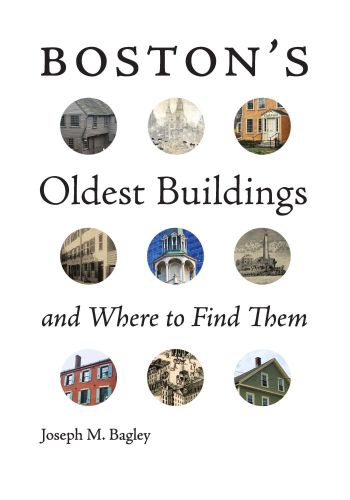 As Boston approaches its four-hundredth anniversary, it is remarkable that it still maintains its historic character despite constant development. The fifty buildings featured in this book all pre-date 1800 and illustrate Boston’s early history. This is the first book to survey Boston’s fifty oldest buildings and does so through an approachable narrative which will appeal to nonarchitects and those new to historic preservation. Beginning with a map of the buildings’ locations and an overview of the historic preservation movement in Boston, the book looks at the fifty buildings in order from oldest to most recent. Geographically, the majority of the buildings are located within the downtown area of Boston along the Freedom Trail and within easy walking distance from the core of the city. This makes the book an ideal guide for tourists, and residents of the city will also find it interesting as it includes numerous properties in the surrounding neighborhoods. The buildings span multiple uses from homes to churches and warehouses to restaurants. Each chapter features a building, a narrative focusing on its historical significance, and the efforts made to preserve it over time. Full color photos and historical drawings illustrate each building and area. Boston’s Oldest Buildings and Where to Find Them presents the ideals of historic preservation in an approachable and easy-to-read manner appropriate for the broadest audience.
Joseph M. Bagley is the city archaeologist of Boston, a historic preservationist, and a staff member of the Boston Landmarks Commission. He has worked for multiple local and state historic preservation offices, including the Maine Historic Preservation Commission and the Massachusetts Historical Commission.
New Book | Enlightened Eclecticism
Distributed by Yale UP:
Adriano Aymonino, Enlightened Eclecticism: The Grand Design of the 1st Duke and Duchess of Northumberland (London: Paul Mellon Centre for Studies in British Art, 2021), 400 pages, ISBN: 978-1913107178, £50 / $65.
 The central decades of the eighteenth century in Britain were crucial to the history of European taste and design. One of the period’s most important campaigns of patronage and collecting was that of the 1st Duke and Duchess of Northumberland: Sir Hugh Smithson (1712–1786) and Lady Elizabeth Seymour Percy (1716–1776). This book examines four houses they refurbished in eclectic architectural styles—Stanwick Hall, Northumberland House, Syon House, and Alnwick Castle—alongside the innumerable objects they collected, their funerary monuments, and their persistent engagement in Georgian London’s public sphere. Over the years, their commissions embraced or pioneered styles as varied as Palladianism, rococo, neoclassicism, and Gothic revival. Patrons of many artists and architects, they are revealed, particularly, as the greatest supporters of Robert Adam. In every instance, minute details contributed to large-scale projects expressing the Northumberlands’ various aesthetic and cultural allegiances. Their development sheds light on the eclectic taste of Georgian Britain, the emergence of neoclassicism and historicism, and the cultures of the Grand Tour and the Enlightenment.
Adriano Aymonino is senior lecturer and director of undergraduate programs, Department of History and History of Art, University of Buckingham.
Exhibition | Inspiring Walt Disney

Thanks to Kimberly Chrisman-Campbell for noting via Twitter this exhibition. In addition to the general information from The Met, see coverage at D23. . .
Inspiring Walt Disney: The Animation of French Decorative Arts
The Metropolitan Museum of Art, New York, 10 December 2021 — 6 March 2022
The Wallace Collection, London, 6 April — 16 October 20222
The Huntington Library, Art Museum, and Botanical Garden, San Marino, 10 December 2022 — 27 March 2023
Curated by Wolf Burchard
Pink castles, talking sofas, and a prince transformed into a teapot: what sounds like fantasies from Walt Disney Animation Studios’ pioneering animations were in fact the figments of the colorful salons of Rococo Paris. The Met’s first-ever exhibition exploring the work of Walt Disney and the Walt Disney Animation Studios’ hand-drawn animation will examine Disney’s personal fascination with European art and the use of French motifs in his films and theme parks, drawing new parallels between the studios’ magical creations and their artistic models.
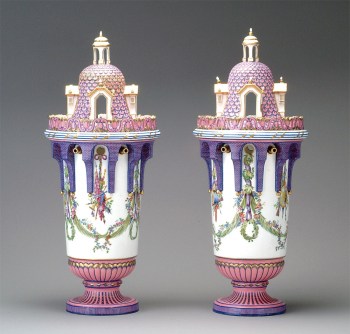
Sèvres Manufactory, pair of covered pots pourris vases in the form of towers (vases entourrés), ca. 1762; soft-paste porcelain (San Marino: The Huntington Library, Art Museum, and Botanical Gardens).
Forty works of 18th-century European decorative arts and design—from tapestries and furniture to Boulle clocks and Sèvres porcelain—will be featured alongside 150 production artworks and works on paper from the Walt Disney Animation Research Library, Walt Disney Archives, Walt Disney Imagineering Collection, and The Walt Disney Family Museum. Selected film footage illustrating the extraordinary technological and artistic developments of the studios during Disney’s lifetime and beyond will also be shown.
The exhibition will highlight references to European visual culture in Disney animated films, including nods to Gothic Revival architecture in Cinderella (1950), medieval influences on Sleeping Beauty (1959), and Rococo-inspired objects brought to life in Beauty and the Beast (1991). Marking the 30th anniversary of Beauty and the Beast’s animated theatrical release, the exhibition is organized by The Metropolitan Museum of Art and The Wallace Collection. The catalogue is distributed by Yale University Press.
The press release is available here»
Wolf Burchard, Inspiring Walt Disney: The Animation of French Decorative Arts (New York: The Metropolitan Museum of Art, 2021), 240 pages, ISBN: 978-1588397416, $50.
◊ ◊ ◊ ◊ ◊
Note (added (9 December 2021) — The posting was updated to include information for the catalogue, London dates, and the link to the press release.
Note (added 6 June 2022) — The posting was updated to include The Huntington as a venue.
The Burlington Magazine, June 2021

Charles-Louis Clérisseau, Traou en Dalmathia, 1757
(Paris: Bibliothèque nationale de France)
◊ ◊ ◊ ◊ ◊
The eighteenth century in this month’s issue of The Burlington . . .
The Burlington Magazine 163 (June 2021) — Works of Art on Paper
A R T I C L E S
• Ana Šverko, “Clérisseau’s Journey to Dalmatia: A Newly Attributed Collection of Drawings,” pp. 492–502.
A collection of 136 hitherto anonymous drawings of Italy, Istria and Dalmatia in the Bibliothèque nationale de France, Paris, is here attributed to Charles-Louis Clérisseau. The drawings, which include a group made during his journey from Venice to Diocletian’s Palace in Split with Robert Adam in 1757, further expand our understanding of Clérisseau as the forerunner of a new generation of traveller-painters.
• Tony Barnard, “Trading in Art: Antonio Cesare di Poggi (1744–1836),” pp. 492–502.
With the help of his English wife, Hester, the Italian artist A.C. Poggi forged a career in London as a portrait painter, a retailer of fans, a dealer principally in drawings and publisher of prints. Poggi’s successes and failures reflect changing fashions and fortunes in the capital’s competitive art world between his arrival in England c.1770 and departure for the Continent in 1801.
• Christopher White, “Reminiscences of the British Museum Print Room, 1954–65,” pp. 492–502.
The author’s first job, as Assistant Keeper with responsibility for the Northern schools in the Department of Prints and Drawings at the British Museum, London, introduced him to a distinguished group of curators and an occasionally eccentric band of visitors. The department’s focus was emphatically on drawings, where major acquisitions could be made by sharp-eyed scholars in the salesrooms.

Fan portraying George III and his family at the Royal Academy of Arts exhibition in 1788, made by A.C. Poggi incorporating a print by Pietro Antonio Martini after J. H. Ramberg, ca. 1790, engraved and hand-coloured paper with carved and pierced ivory sticks and guards, width when open 38.4 cm (London: Victoria and Albert Museum, T.56-1933).
◊ ◊ ◊ ◊ ◊
R E V I E W S
• Elizabeth Pergam, “The Frick Reframed,” pp. 536–39. On the plain, grey walls of the Modernist Breuer building, New York, some of the most famous works from the Frick Collection shine in a new light.
• Yuriko Jackall, Review of the exhibition catalogue Une des Provinces du Rococo: La Chine Rêvée de François Boucher, ed. by Yohan Rimaud and Alastair Laing (In Fine éditions d’art and Musée des beaux-arts et d’archéologie de Besançon, 2019), pp. 539–41.
• Jonathan Yarker, Review of the exhibition Turner’s Modern World (Tate Britain, 2020–21), pp. 541–44.
• Amanda Dotseth, Review of the exhibition publication Museo del Prado 1819–2019: Un lugar de memoria, ed. by Javier Portús et al (Prado, 2018), pp. 546–49.
• Simonetta Prosperi Valenti Rodinò, Review of Les dessins de la collection Mariette: Écoles italienne et espagnole, by Pierre Rosenberg et al, 4 vols., (Somogy, 2019), pp. 550–51.
• Oliver Tostmann, Review of Die Zeichnungen des Giovan Battista Beinaschi aus der Sammlung der Kunstakademie Düsseldorf am Kunstpalast, ed. by Sonja Brink and Francesco Grisolia (Imhof Verlag, 2020), pp. 556–57. [Beinaschi lived between 1636 and 1688, but Tostmann notes in passing points of his eighteenth-century reception.]
• Christoph Martin Vogtherr, Review of L’ Art et la manière: Dessins français du XVIIIesiècle des musées de Marseille, ed. by Luc Georget and Gérard Fabre (Silvana Editoriale, 2019), pp. 557–58.
Exhibition | Turner’s Modern World
Now on view at Tate Britain (with versions of the exhibition soon coming to Fort Worth and Boston). . .
Turner’s Modern World
Tate Britain, London, 28 October 2020 — 12 September 2021
Kimbell Art Museum, Fort Worth, 17 October 2021 — 6 February 2022
Museum of Fine Arts, Boston, 2022
 One of Britain’s greatest artists, J.M.W. Turner (1775–1851), lived and worked at the peak of the industrial revolution. Steam replaced sail; machine-power replaced manpower; political and social reforms transformed society. Many artists ignored these changes, but Turner faced up to these new challenges. This exhibition will show how he transformed the way he painted to better capture this new world.
Beginning in the 1790s, when Turner first observed the effects of modern life, the exhibition follows his fascination with the impact of industrialisation. It shows how he became involved in the big political questions of the time: campaigning against slavery and making paintings that expressed the horrors of the Napoleonic Wars.
This landmark exhibition will bring together major works by Turner from Tate and other collections, including The Fighting Temeraire (1839) and Rain, Steam and Speed (1844). It will explore what it meant to be a modern artist in his lifetime and present an exciting new perspective on his work and life.
David Blayney Brown, Amy Concannon, and Sam Smiles, eds., Turner’s Modern World (New York: Rizzoli Electa, 2021), 240 pages, 978-1849767132 (hardcover), £40, $55 / ISBN: 978-1849767125 (paperback) £25.
This monograph is tied to the first exhibition to highlight Turner’s contemporary imagery—the most exceptional and distinctive aspect of his work. Rather than making claims for Turner as a proto-modernist, it explores what constituted modernity during his lifetime and what it meant to be a modern artist. Turner’s career spanned the Napoleonic Wars, the rise of the British Empire, the birth of finance capitalism and modern industrialization, as well as political, scientific, and cultural advances that transformed society and shaped the modern world. While historians have long recognized that the industrial and political revolutions of the late eighteenth century inaugurated far-reaching change and modernization, these were often ignored by artists as they did not fit into established categories of pictorial representation. This publication shows Turner updating the language of art and transforming his style and practice to produce revelatory, definitive interpretations of modern subjects.
David Blayney Brown is Senior Curator, Tate Britain. Amy Concannon is Curator, Tate Britain. Sam Smiles is Emeritus Professor of Art History, University of Plymouth, and Programme Director, Art History and Visual Culture, University of Exeter.
New Book | Ephemeral Spectacles, Exhibition Spaces
From Amsterdam UP:
Dominique Bauer, Camilla Murgia, eds., Ephemeral Spectacles, Exhibition Spaces, and Museums, 1750–1918 (Amsterdam: Amsterdam University Press, 2021), 300 pages, ISBN: 978-9463720908, €109 / $124.
 This book examines ephemeral exhibitions from 1750 to 1918. In an era of acceleration and elusiveness, these transient spaces functioned as microcosms in which reality was shown, simulated, staged, imagined, experienced, and known. They therefore had a dimension of spectacle to them, as the volume demonstrates. Against this backdrop, the different chapters deal with a plethora of spaces and spatial installations: the Wunderkammer, the spectacle garden, cosmoramas and panoramas, the literary space, the temporary museum, and the alternative exhibition space.
Dominique Bauer is Assistant Professor of History at the Faculty of Architecture, University of Leuven, Belgium, and a member of the Centre d’Analyse Culturelle de la Première Modernité at the Université Catholique de Louvain. Camilla Murgia is Junior Lecturer in History of Art at the University of Lausanne.
C O N T E N T S
Camilla Murgia, Introduction: Staging the Temporary: The Fragile Character of Space
I. The Department Store
1 Amy McHugh and Cristina Vignone, ‘One Need Be Neither a Shopper Nor a Purchaser to Enjoy’: Ephemeral Exhibitions at Tiffany & Co., 1870–1905
2 Kathryn A. Haklin, Enclosed Exhibitions: Claustrophobia, Balloons, and the Department Store in Zola’s Au Bonheur des Dames
II. Spectacles
3 Susan Taylor-Leduc, Jardins-Spectacles: Spaces and Traces of Embodiment
4 Camilla Murgia, Parading the Temporary: Cosmoramas, Panoramas, and Spectacles in Early Nineteenth-Century Paris
5 Juliet Simpson, Portable Museums: Imaging and Staging the ‘Northern Gothic Art Tour’ – Ephemera and Alterity
III. At the Intersection of Literature and the Built Environment
6 Dominique Bauer, The Elusiveness of History and the Ephemerality of Display in Nineteenth-Century France and Belgium: At the Intersection of the Built Environment and the Spatial Image in Literature
7 Li-hsin Hsu, The ‘Phantasmatic’ Chinatown in Helen Hunt Jackson’s ‘The Chinese Empire’ and Mark Twain’s Roughing It
IV. The Museum and Alternative Exhibition Spaces
8 Stefanie Jovanovic-Kruspel, ‘Show Meets Science’: How Hagenbeck’s ‘Human Zoos’ Inspired Ethnographic Science and Its Museum Presentation
9 Emanuele Pellegrini, The Last Wunderkammer: Curiosities in Private Collections between the Nineteenth and Twentieth Centuries
10 Nirmalie Alexandra Mulloli, The Impact of Alternative Exhibition Spaces on European Modern Art before World War I
Index
HECAA Emerging Scholars’ (Virtual) Meet-and-Greet
HECAA Emerging Scholars’ (Virtual) Meet-and-Greet
Thursday, 1 July 2021, 5.30–6.30pm (EDT)
Historians of Eighteenth-Century Art and Architecture (HECAA) is pleased to announce the first Emerging Scholars’ (Virtual) Meet-and-Greet. Come meet other HECAA emerging scholars* and chat casually about your work and about what kind of programming or resources you would like HECAA to put together to serve this constituency.
Please register here:
https://nyu.zoom.us/meeting/register/tJUvd-qtqD4pHdIm4F3fkrj1l869FAAuf6er
After registering, you will receive a confirmation email containing information about joining the meeting. If you cannot join this meet-up but have ideas or concerns to share, please reach out to Daniella Berman, At-Large Board Member/Graduate Student Representative: daniella.berman@nyu.edu. Please circulate widely to colleagues and students. This meet-up is open to non-HECAA members interested in getting a sense for our community.
* There’s no cut-off for this emerging scholars’ group; please self-identify as you see fit!
Online Talks | NDENCA, Series 4, May–July 2021
From NDENCA (click for lots more information on speakers and presentation abstracts).
New Directions in Eighteenth- and Nineteenth-Century Art (NDENCA)
Series 4: May–July 2021
Organised by Freya Gowrley and Madeleine Pelling
New Directions in Eighteenth- and Nineteenth-Century Art (NDENCA) is a digital seminar series aimed at championing new scholarly voices working across visual and material cultures in this period. It aims to take a global perspective, and in particular welcomes contributions by scholars from minority groups. Series 4 seminars take place on Mondays, via Zoom and are open to all. To book tickets, please email us at, ndencaseminar@gmail.com.
Papers are available on our YouTube channel for up to one month after their live session.
P R O G R A M M E
24 May 2021
1) Caroline McCaffrey-Howarth (Visiting Research Fellow, University of Leeds, Curator, 17th- and 18th-Century Ceramics and Glass, V&A Museum), Sèvres-mania’ and the Standardisation of Ceramics Connoisseurship
7 June 2021
2) Amara Thornton (Honorary Research Associate, UCL Institute of Archaeology), Caribbean Collections Histories: Archaeology and Empire
14 June 2021
3) Nat Reeve (PhD Candidate, Royal Holloway, University of London), Queer Tombs and Reframing Doom: Elizabeth Siddal and Georgiana Burne-Jones’s Unfinished Collaborative Project
21 June 2021
4) Emily Doucet (University of Toronto), Illuminating Infrastructures: Nadar’s Underwater Photography and the Expansion of Marseille’s Modern Port
28 June 2021
5) Miguel Angel Gaete (PhD Candidate, University of York), Territorial Fantasies, Sexual Nuances, and Savage Energy: Orientalism and Tropicality in Eugène Delacroix and Johann Moritz Rugendas
5 July 2021
6) Kate Heller (Research Associate, Art Institute of Chicago), Wrought(-Iron) Boundaries: A Victorian Ecology of Thomas Jeckyll’s Norwich Gates
12 July 2021
7) Camilla Pietrabissa (Postdoctoral fellow, IUAV University of Venice), Drawing in 18th-Century Venice: The Origins of the Veduta and the Modern Culture of Spectacle
19 July 2021
8) Samuel Raybone (Lecturer in Art History, Aberystwyth University), Global Impressionism and the Idea of Wales
26 July 2021
9) Cabelle Ahn (PhD Candidate, Harvard University), Drawing Site-Specificity: The 1797 Exhibition of Drawings in the Louvre
New Book | Interest and Connection in the Eighteenth Century
From the U of Virginia Press:
Jacob Sider Jost, Interest and Connection in the Eighteenth Century: Hervey, Johnson, Smith, Equiano (Charlottesville: University of Virginia Press, 2020), 204 pages, ISBN 978-0813945040 (cloth), $55 / ISBN 9780813945057 (paperback) $28 / ISBN 978-0813945064 (ebook), $28.
 Can a single word explain the world? In the British eighteenth century, interest comes close: it lies at the foundation of the period’s thinking about finance, economics, politics, psychology, and aesthetics. Interest and Connection in the Eighteenth Century provides the first comprehensive account of interest in an era when a growing national debt created a new class of rentiers who lived off of interest, the emerging discipline of economics made self-interest an axiom of human behavior, and booksellers began for the first time to market books by calling them ‘interesting’. Sider Jost reveals how the multiple meanings of interest allowed writers to make connections—from witty puns to deep structural analogies—among different spheres of eighteenth-century life.
Challenging a long and influential tradition that reads the eighteenth century in terms of individualism, atomization, abstraction, and the hegemony of market-based thinking, this innovative study emphasizes the importance of interest as an idiom for thinking about concrete social ties, at court and in families, universities, theaters, boroughs, churches, and beyond. To ‘be in the interest of’ or ‘have an interest with’ another was a crucial relationship, one that supplied metaphors and habits of thought across the culture. Interest and Connection in the Eighteenth Century recovers the small, densely networked world of Hanoverian Britain and its self-consciously inventive language for talking about human connection.
Jacob Sider Jost is Associate Professor of English at Dickinson College and author of Prose Immortality, 1711–1819 (Virginia).
C O N T E N T S
Introduction
1 The Whig Theory of Mind: Influence and Interpretation in Lord Hervey
2 The Variety of Human Wishes
3 Professor Smith
4 Interesting Narratives
Conclusion: Reigning Words and Glorious Revolutions
Acknowledgments
Notes
Bibliography
Index










leave a comment