Call for Papers | Reproductive Prints in the 18th and 19th Centuries
From the Call for Papers:
La Storie dell’Arte Illustrata e la Stampa di Traduzione, 18 e 19 Secolo
(Online, via MS Teams) Università di Chieti Gabriele d’Annunzio, Chieti, 10–11 June 2021
Proposals due by 25 January 2021 (for papers in Italian or English)
“E per le Arti poi l’incisione è quel che la stampa è per le scienze”
–Francesco Milizia, Dizionario di Belle Arti del Disegno (Bassano: Giuseppe Remondini, 1797)
La Cattedra di Storia della Critica d’arte del Dipartimento di Lettere Arti e Scienze Sociali, Università degli Studi “G. d’Annunzio” di Chieti – Pescara terrà una giornata di studi dedicata alla stampa di traduzione e storia dell’arte. Se gli studi sugli artisti incisori e lo sviluppo di un mercato di stampe europeo vivace e ben delineato hanno visto un crescente interesse negli ultimi anni per i secoli XVII– XVIII e XIX, l’indagine rimane ancora aperta per la stampa di traduzione utilizzata a corredo della storiografia artistica di quei secoli.
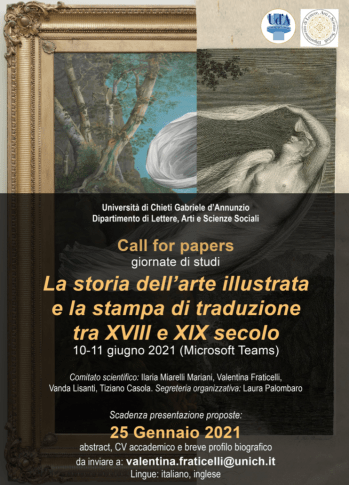 Partendo dall’affermazione dell’incisione di traduzione a contorno semplice nel Dizionario di Belle Arti del Disegno di Francesco Milizia (1797), la giornata di studi si propone di presentare nuove ricerche sull’utilizzo delle incisioni e delle stampe per lo studio della storia dell’arte, esplorando le tematiche seguenti pur non limitandosi solo ad esse, anzi auspicandone un ampliamento sia in termini geografici che cronologici:
• singoli contributi su artisti, disegnatori e incisori
• singoli contributi su album o raccolte di stampe ed incisioni
• il mercato delle stampe di traduzione e dei libri d’arte illustrati: stamperie, librai, mercanti e collezionisti
• stampa di traduzione e studio dell’arte: trattati, cataloghi, recueils, quotidiani a stampa, riviste d’arte, descrizioni, letteratura periegetica illustrata
• illustrare per promuovere: i cataloghi di vendita delle collezioni
• nascita e sviluppo delle monografie d’artista illustrate
• stampa di traduzione per la storia della letteratura
Le proposte di partecipazione alla giornata di studi dovranno pervenire all’indirizzo valentina.fraticelli@unich.it in forma di abstract (350–500 parole, con titolo e parole chiave), ed essere accompagnate da CV e affiliazione accademica o breve profilo biografico (300 parole) entro il 25/01/2021. Le giornate di studio si svolgeranno sulla piattaforma Microsoft Teams; gli interventi selezionati, di cui è prevista la pubblicazione, avranno una durata di circa 20-30 minuti e verranno presentati online. Lingue: italiano, inglese. Per ulteriori informazioni contattare la dott.ssa Valentina Fraticelli all’indirizzo email valentina.fraticelli@unich.it.
Comitato scientifico: Ilaria Miarelli Mariani, Valentina Fraticelli, Tiziano Casola, Vanda Lisanti
Segreteria organizzativa: Laura Palombaro
Metropolitan Museum Journal 2020
The 2020 issue of the Metropolitan Museum Journal is now available at The University of Chicago Press website and The Met Store. PDF’s are available for free on MetPublications. Of particular note for dix-huitièmistes:
Metropolitan Museum Journal 55 (2020)
R E S E A R C H N O T E S
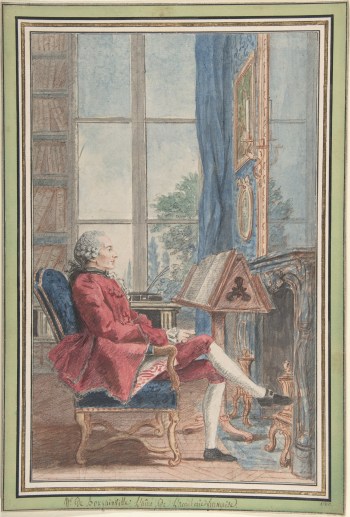
Carmontelle, Portrait of Jean-Pierre de Bougainville, ca. 1760, watercolor over graphite and black and red chalk, 30 × 19 cm (New York: The Metropolitan Museum of Art, Gift of Mrs. Charles Wrightsman, 2004.475.6).
Margot Bernstein, “Carmontelle’s Telltale Marks and Materials,” pp. 135–44.
Bernstein addresses three portraits heretofore described as autograph works by the French amateur draftsman Louis Carrogis, called Carmontelle (1717–1806). She confirms the attribution of the Portrait of Jean-Pierre de Bougainville but cast doubts on the other two. As she notes in the conclusion, “The discoveries outlined here have enabled the present author to identify additional inauthentic Carmontelle portraits in public and private collections, including the Art Institute of Chicago and the National Gallery of Art, Washington, D.C.24 In fact, the majority of purported autograph replicas of Carmontelle portraits in international collections are not authentic. Most of these problematic works display technical issues that are consistent with those found in the Robert Lehman Collection drawings. . .” (142).
Daniel Wheeldon, “The Met’s German Keyed Guitar,” pp. 145–56.
In providing context, Wheeldon addresses the eighteenth century, too. As he writes in the introduction, “The keyed guitar at The Metropolitan Museum of Art, made in Germany in the mid-nineteenth century [89.4.3145], was part of the collection of musical instruments originally established by Mary Elizabeth Adams Brown in 1889. This guitar has long been worthy of greater attention, despite its being neither the most ornate example of nineteenth-century guitar making nor an object that fits into a clear tradition of guitar playing. The ingenuity of its design has been overshadowed by the instrument’s peculiarity, current state of deterioration, and plainness, and consequently it has entirely avoided academic coverage. As the only such instrument in a public collection, and one that bears two labels inside—’Matteo Sprenger / fece à Carlsruhe1 1843′, and ‘F. Fiala’—the Museum’s keyed guitar is essential to identifying and contextualizing (145) the sparse body of nineteenth-century literature on the topic. This article examines the history of the nineteenth-century keyed guitar using the Metropolitan Museum’s instrument as the basis for understanding the provenance of other instruments and establishing them within an historical narrative” (147).
◊ ◊ ◊ ◊ ◊
Note (added 6 January 2020) — Submissions for next year’s volume are due by 15 September 2021; more information is available from the 2020 issue, immediately after the table of contents.
Exhibition | Women Painters, 1780–1830

Elisabeth Louise Vigée Lebrun, Peace Bringing Back Abundance, detail, 1780
(Paris: Musée du Louvre)
◊ ◊ ◊ ◊ ◊
From the Musée du Luxembourg:
Peintres femmes, 1780–1830: Naissance d’un combat
Musée du Luxembourg, Paris, 3 March — 4 July 2021
Curated by Martine Lacas
Le Musée du Luxembourg met les femmes à l’honneur à l’occasion d’une exposition ambitieuse consacrée à celles qui ont ouvert la voie aux artistes féminines au XIXe siècle. L’exposition se concentre sur une période unique d’effervescence historique et culturelle, de 1780 à 1830, où les salons de peinture se multiplient et où les femmes gagnent progressivement en visibilité sur la scène artistique.
De grands noms d’artistes de l’époque viennent à l’esprit, à l’instar d’Elisabeth Vigée Le Brun. Grande portraitiste de l’Ancien Régime, elle fut peintre de la cour de France, de Marie-Antoinette et de Louis XVI. Mais l’exposition met aussi en avant des artistes moins connues, qui profitèrent des basculements politiques pour se faire une place dans le milieu artistique. En outre, cette mise en lumière est l’occasion d’en apprendre davantage sur les conditions sociales de l’époque et de voir comment ces femmes se sont aussi battues pour le droit de se former aux arts ou d’exposer leurs toiles. Les artistes présentées font ainsi figure d’actrices des mutations de l’art mais aussi des évolutions de la société du XIXe siècle.
Martine Lacas, ed., Peintres femmes, 1780–1830: Naissance d’un combat (Paris: Gallimard, 2021), ISBN: 978-2072906640. Details forthcoming
◊ ◊ ◊ ◊ ◊
An interview from December 2020 with curator Martine Lacas is available at Femmes d’Art Magazine.
AWA’s Conservation of Ferroni’s Pair of Hospital Paintings
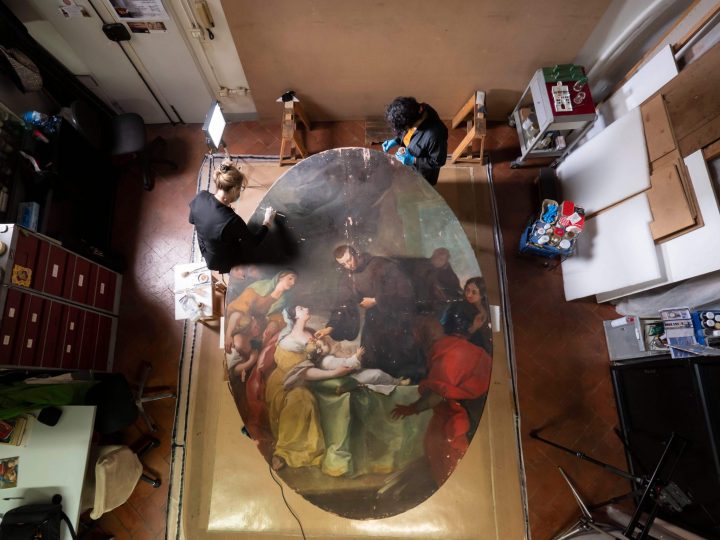
An aerial view of conservators in their studio with Saint John of God Heals Plague Victims (1756) by Violante Ferroni; its pendant Saint John of God Feeds the Poor is also being conserved. Photo by Francesco Cacchiani / Advancing Women Artists.
◊ ◊ ◊ ◊ ◊
On Saturday, Sylvia Poggioli reported for NPR on the work of AWA (Advancing Women Artists), including the conservation now in progress of Violante Ferroni’s two large oval canvases, painted for Florence’s San Giovanni di Dio, a former hospital founded in the fourteenth century: “‘Where Are The Women?’: Uncovering The Lost Works of Female Renaissance Artists,” NPR Weekend Edition (2 January 2021). Last month, Alexandra Kiely wrote on Ferroni’s pictures for Daily Art Magazine: “Healing Violante Ferroni’s Paintings at San Giovanni di Dio Hospital.” And the latest issue of the AWA newsletter includes an interview with conservator Elizabeth Wicks, who in the May issue shared these thoughts:
Elizabeth Wicks, “‘The Art of Healing’ Becomes Literal” Inside AWA (May 2020): 54–59.
In October 2019, we began conservation work on the first painting of our project ‘The Art of Healing’, Violante Ferroni’s large oval canvas painted in 1756 and entitled St. John of God Heals Victims of the Plague. . . When we learned that the monumental atrium of the former hospital where the painting is situated had been used as a place of triage for plague victims, it seemed like a calamity from a faraway era, disconnected from our more fortunate present-day lives. Now that we are fighting a global war against a virus, defined as a ‘modern-day plague’, my connection to the figures in the painting has become a deeply emotional one. I have never been surer about the power of art to connect and heal us all (54).
A conversation with AWA director Linda Falcone and Elisabeth Wicks is available on YouTube: “Restoration Conversations: Art Rescue in Progress” The Florentine (13 November 2020).
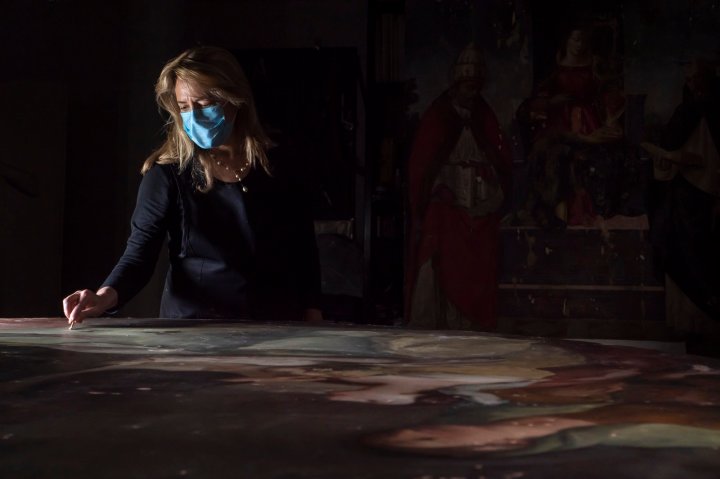
Conservator Elisabeth Wicks at work in her studio in Florence. Photo by Francesco Cacchiani / AWA
Xavier Salomon on Clodion’s Dance of Time
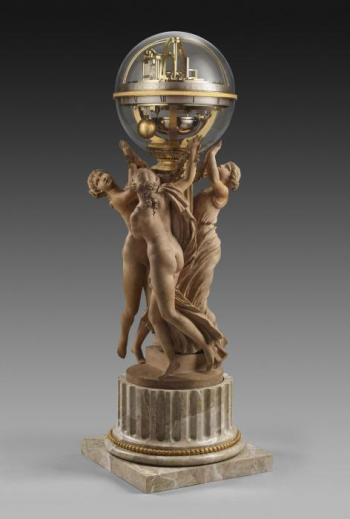
The Dance of Time, Three Nymphs Supporting a Clock, movement by Jean-Baptiste Lepaute, sculpture by Claude Michel Clodion, 1788, terracotta, gilt brass, and glass, H.: 41 inches (New York: The Frick Collection, bequest of Winthrop Kellogg Edey) Photo: Michael Bodycomb.
A very Happy New Year to all of you! I should have posted news of this brief talk earlier, but it will be available on YouTube whenever you might have the time and inclination to watch. I also point out the series more generally for those of you always looking for teaching resources. Past installments (typically 20 minutes) address paintings by Gainsborough, Stubbs, Romney, Tiepolo, Boucher, and Chardin, along with extraordinary decorative arts objects (and plenty of works beyond the eighteenth century). –CH
Xavier Salomon on Clodion’s Dance of Time
YouTube, 1 January 2021, 5pm (EST)
This week’s episode of Cocktails with a Curator toasts the new year with Deputy Director and Peter Jay Sharp Chief Curator Xavier F. Salomon as he examines a masterpiece of both sculpture and clockmaking: The Dance of Time, by Clodion (Claude Michel) and Jean-Baptiste Lepaute. In this 18th-century timepiece, three terracotta nymphs or Hours dance in a circle around an exquisite mechanism enclosed in a glass globe. The Frick has one of the country’s most important collections of clocks, many of which came to the museum through a gift from Winthrop Kellogg Edey. Welcome 2021 by raising a Metropolitan cocktail—Happy New Year!
New Book | Marking Time
From Yale UP:
Edward Town and Angela McShane, eds., with essays by Glenn Adamson, Justin Brown, Edward Cooke, Gavi Levy Haskell, Nathan Flis, Angela McShane, and Keith Wrightson, Marking Time: Objects, People, and Their Lives, 1500–1800 (New Haven: Yale Center for British Art, 2020), 512 pages, ISBN: 978-0300254105, $65.
 The period from 1500 to 1800 brought extraordinary transformations to the society of Britain and the lives of those within its colonial reach. Many of these changes—on both a societal and individual level—centered on how time was sensed, measured, and understood. This engaging volume explores these various relationships with time through a remarkably diverse collection of objects, each of which is inscribed with a specific date. The dates mark significant events in the lives of these objects and the people who made and owned them. From posy rings to pastry jiggers, teapots to tape measures, these more than 450 objects—and the stories they tell—offer a vivid sense of the lived experience of time, while providing a rich survey of the material world of early modern Britain. Small, humble, but often surprisingly moving and poignant, the objects in this book show that the things we live with say a great deal about who we are and how we make our marks in time.
Edward Town is head of collections information and access and assistant curator of early modern art at the Yale Center for British Art. Angela McShane is head of research development, the Wellcome Collection, London.
New Book | Portraiture and Friendship in Enlightenment France
Distributed by the University of Virginia Press:
Jessica Fripp, Portraiture and Friendship in Enlightenment France (Newark: University of Delaware Press, 2021), 240 pages, ISBN: 978-1644532027 (ebook), $70 / ISBN: 978-1644532010 (cloth), $70.
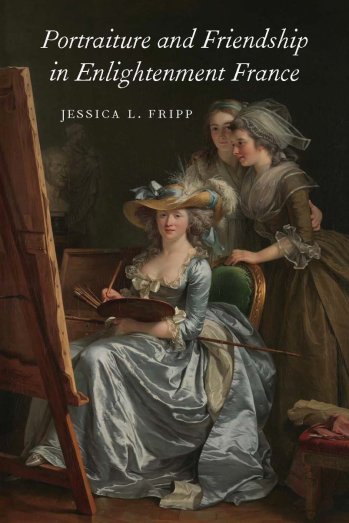 Portraiture and Friendship in Enlightenment France examines how new and often contradictory ideas about friendship were enacted in the lives of artists in the eighteenth century. It demonstrates that portraits resulted from and generated new ideas about friendship by analyzing the creation, exchange, and display of portraits alongside discussions of friendship in philosophical and academic discourse, exhibition criticism, personal diaries, and correspondence. This study provides a deeper understanding of how artists took advantage of changing conceptions of social relationships and used portraiture to make visible new ideas about friendship that were driven by Enlightenment thought.
Jessica L. Fripp is Assistant Professor of Art History at Texas Christian University.
C O N T E N T S
List of Illustrations
Acknowledgments
Introduction
1 Friendship in the Academy
2 Celebrating Celebrity
3 Re-Evaluating Rivalry
4 Friendship Abroad
Epilogue
Endnotes
Bibliography
Index
Exhibition | Beethoven Moves

Installation view of the exhibition Beethoven Moves, with John Baldessari’s Beethoven’s Trumpet (with Ear) Opus #132, 2007, resin, fiberglass, bronze, aluminum, electronics. Photo by Mark Niedermann for Tom Postma Design.
◊ ◊ ◊ ◊ ◊
Press release, via Art Daily (26 December 2020) for the exhibition:
Beethoven Moves / Beethoven Bewegt
Kunsthistorisches Museum Wien, 29 September 2020 — 24 January 2021
Curated by Andreas Kugler, Jasper Sharp, Stefan Weppelmann, and Andreas Zimmerman
The Kunsthistorisches Museum Vienna, in cooperation with the Archive of the Gesellschaft der Musikfreunde in Vienna, presents Beethoven Moves, an unusual homage to Ludwig van Beethoven (1770–1827), the great representative of the First Viennese School. Beethoven’s popularity remains unbroken, even 250 years after his birth. Beyond the music, his humanistic messages have influenced the history of art and culture. His early deafness shaped his image as a tragic genius.
 Beethoven’s universal and unique reception, the epochal significance of his music, and the perception of his deified persona create numerous points of entry. High and popular culture, commerce, and politics all form an inexhaustible reserve of inspiration and appropriation. The exhibition brings together paintings by Caspar David Friedrich, sketchbooks by William Turner, graphic works by Francisco de Goya, Anselm Kiefer and Jorinde Voigt, sculptures by Auguste Rodin, Rebecca Horn and John Baldessari, a video by Guido van der Werve, and a new work developed for the exhibition by Tino Sehgal—all of which are brought into dialogue with the music and persona of Beethoven. The exhibition thus provides a poetic reflection of the composer and his work, as masterpieces of fine art form connections with music and silence.
The elaborately staged exhibition does not present any artworks from the Kunsthistorisches Museum collection. However, it is shown in the Picture Gallery in the context of the art and culture of many centuries, hundreds of works that precede Beethoven’s lifetime and in some ways also lead up to it.
Beethoven is one of the great influential figures in the history of music and culture, not only in Vienna but also internationally. As the largest museum in Austria, the Kunsthistorisches Museum addresses the anniversary of his 250th birthday. Museums are treasure houses, part of the cultural consciousness and tourist magnets; but beyond that, they are also discursive spaces for reflection and confrontation, laboratories for fantasy and the connection of ideas. These aspects become particularly clear in this exhibition project curated by Andreas Kugler, Jasper Sharp, Stefan Weppelmann, and Andreas Zimmerman.
The sequence of rooms in the exhibition relates to Beethoven’s life only in a very general sense. Divided according to themes, they are conceived as a series of tableaux, each based on distinct compositional principles. Indeed, the interplay between the various architectural settings is rather like that between the movements of an orchestral work. And this diversity in the rooms is matched by the variety of the listening experiences on offer, the media of the artworks, and the approaches taken by the artists. Accordingly, visitors will not find any directions telling them how they should move through each room. For a true experience of Beethoven depends on paying heed to one’s inner voice—as when listening to music in general. As we strive to emotionally relive the relations between music, words, imagery, and movement, we should just let our body find its place within the surrounding space. Beethoven Moves is thus intended as an invitation to enter into a very personal encounter with the great composer.
In Room 1 Beethoven’s powerful music immediately captures the imagination of visitors to the exhibition: they hear two of the piano sonatas written by the composer, himself an accomplished concert pianist until he lost his hearing: the Waldstein Sonata (C major, op. 53) and his final Piano Sonata in C minor, op. 111. Beethoven’s original autographs of these compositions are also on show. All of Beethoven’s thirty-two piano sonatas are present in this room, albeit in two very different artworks; in her thirty-two complex drawings, Jorinde Voigt analyzes Beethoven’s compositions, while Idris Khan’s monumental work compiles the scores of all his piano sonatas to create a menacing block-like structure. In the centre of the room, two more contrary sculptures have entered into an equivocal dialogue: Auguste Rodin’s human figure (The Bronze Age in plaster) and Rebecca Horn’s enigmatic grand piano (Concert for Anarchy). The composer’s character, too, was contradictory and highly complex, something that clearly functioned as a source of his creativity: his temperament allowed him to produce works that continue to move people from all parts of the world.
Room 2 is dedicated to silence and stillness, Beethoven’s increasing hearing loss and the associated pain, isolation and reflectiveness. However, we also learn about his admirable ability not to resign himself to his fate but through his art to triumph over his affliction. Los Caprichos, the engravings by Francisco de Goya (1746–1828)—another great artist who lost his hearing—are like pictorial equivalents of the inner fragmentation experienced by the ailing Beethoven. Strictly speaking, all that remains of Beethoven’s thoughts and his art are pages covered with scores and words. Other objects can only serve a superficial cult of remembrance, things like his ear trumpet or a piece of the parquet floor from the house in which he died in 1827. This plain surface, however, also resembles a stage, reminding us that Beethoven and his music have been used for the most varied ends.
To this day, his personality and oeuvre continue to be reinterpreted in politics and propaganda; some worship Beethoven as a revolutionary innovator while for others he is a genius in whose reflected glory nationalist mindsets of all kinds may bask. A work by Anselm Kiefer bears witness to the fact that cultural achievements are still prone to be injected with political content. The reception of Beethoven ranges from the banning of his music to the numerous quotations from his works in popular culture.
In Room 3 we look at Beethoven and his attitude towards nature, which for him was a source of inspiration and strength, offering an escape from his cramped lodgings and the freedom of long country walks regardless of the weather. He would often stop abruptly to jot down some musical idea in one of the sketchbooks he always carried in his pocket. In this room, the colour tones of Caspar David Friedrich and William Turner engage with Beethoven’s tonal colours. They all belong to a generation who witnessed the French Revolution, a radical new awakening whose promises and hopes were quickly scotched by the subsequent Restoration period.
Two symphonies can be heard in this room, both of which are linked in contrasting ways to Napoleon. Beethoven’s anger at Napoleon crowning himself Emperor of the French in 1804 led the composer to scratch out Bonaparte’s name from the title page of his Third Symphony (Eroica). His Seventh Symphony premiered in 1813, just a few weeks after the Battle of Leipzig in which the allied armies of Austria, Prussia, Russia, and Sweden had decisively defeated the emperor. Contemporaries often associated Napoleon with the mythical Prometheus, and Beethoven too was frequently linked with the titan who brought fire to mankind. Prometheus is very much present in a painting by Jan Cossiers, but Guido van der Werve’s video can be read as a complementary reflection of this figure prepared to take a high risk to liberate man: it is the artist himself who walks towards us across the ice, a huge icebreaker in his wake. Threatened with failure, his solitary and heroic actions nonetheless bring forth beauty.
Room 4 brings us full circle to individual, personal encounters with Beethoven. A new work by Tino Seghal, created especially for this exhibition, is permanently installed and on show in this room.
Andreas Kugler, ed., Beethoven Moves (Berlin: Hatje Cantz, 2020), 224 pages, ISBN: 978-3775747493 (Engish edition), $55.
New Book | Practical Form
From Yale UP:
Abigail Zitin, Practical Form: Abstraction, Technique, and Beauty in Eighteenth-Century Aesthetics (New Haven: Yale University Press, 2020), 248 pages, ISBN: 978-0300244564, $65.
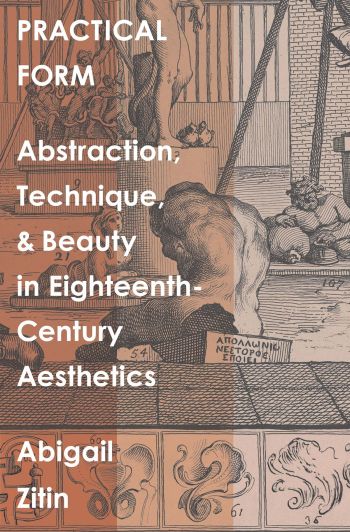 In this original work, Abigail Zitin proposes a new history of the development of form as a concept in and for aesthetics. Her account substitutes women and artisans for the proverbial man of taste, asserting them as central figures in the rise of aesthetics as a field of philosophical inquiry in eighteenth-century Europe. She shows how the idea of formal abstraction so central to conceptions of beauty in this period emerges from the way practitioners think about craft and skill across the domestic, industrial, and so-called high arts. Zitin elegantly maps the complex connections among aesthetics, form, and formalism, drawing out the understated presence of practice in the writings of major eighteenth-century thinkers including Locke, Addison, Burke, and Kant. This new take on an old story ultimately challenges readers to reconsider form and why it matters.
Abigail Zitin is associate professor of English at Rutgers University.
C O N T E N T S
Author’s Note
Introduction
1 ‘A Rough Unsightly Sketch’: Empiricism and the Sense of Form
2 The Figure of Practice
3 The Analysis of Beauty, I: Practical Formalism
4 The Analysis of Beauty, II: The Feminist Formalism
5 Making Art in the Third Critique
Epilogue
Notes
Acknowledgments
Index
Exhibition | Devoted: Art and Spirituality in Mexico and New Mexico

The Ascension of Christ, detail, late 18th–early 19th century, Mexico, oil on canvas with metal milagros (Dallas Museum of Art, The Cleofas and Celia de la Garza Collection, 1994.37.6).
◊ ◊ ◊ ◊ ◊
From the DMA:
Devoted: Art and Spirituality in Mexico and New Mexico
Dallas Museum of Art, 21 February 2021 — 22 January 2022
Historically, as well as in the present day, depictions of Christ, the Virgin Mary, and numerous saints and other figures have played a vital role in the ceremony and pageantry of Catholicism, acting as visual representations of beliefs and ideas, and serving as a focal point for devotion and prayer. Devoted: Art and Spirituality in Mexico and New Mexico features devotional works drawn from the DMA’s Latin American collection, exploring interrelated artistic traditions in the two regions. The exhibition spotlights the complexity and artistic qualities of these objects, which embody the active spiritual relationship between their creators, patrons, and communities.










 Enfilade
leave a comment