Notre Dame’s Snite Museum Awarded Lilly Grant
Press release (18 December 2020) from the Snite:

Anonymous, Nuestra Senõra de Guadalupe, 1729, Mexico, oil on canvas (South Bend: Snite Museum, 2002.01).
The University of Notre Dame has received a five-year, $2.4 million grant from Lilly Endowment Inc. through its Religion and Cultural Institutions Initiative to implement Inspiring Wonder: An Initiative on Religion, Spirituality, and Faith in the Visual Arts. Designed to invite diverse audiences into meaningful conversation, Inspiring Wonder will significantly advance the Snite Museum’s efforts to deepen its constituencies’ understanding of religion, spirituality, and faith in a deliberate and mission-driven way. Notre Dame is one of 18 organizations from across the United States receiving grants through the Lilly Endowment initiative. The group includes fine arts museums, historical societies and history museums, museums dedicated to serving children and families, and museums dedicated to particular locations and cultures.
“On behalf of the entire museum, I express our deepest gratitude to Lilly Endowment and their
Religion and Cultural Institutions Initiative,” said Joseph Becherer, director of the Snite Museum. “Such generosity is a profound investment in the future of the museum and countless lives that will be touched through education and programming. More than just faith in the future good work of this museum and University, this grant is a commitment to regional and national audiences through a deepened appreciation of and enlightenment through art that we can uniquely provide.”
The primary project component is the Museum Education Fellowship in Religion and Spirituality in the Visual Arts. The endowed, two-year fellowship will allow for the creation of innovative programming around religion and spirituality, and will help train the next generation of museum professionals and bring their fresh perspectives about museum education into the Inspiring Wonder initiative. This grant-funded work at the Snite Museum includes the development of two major thematic exhibitions, course development, research mini-grants, academic symposia, and strategic acquisitions during the grant period.
Lilly Endowment awarded grants totaling more than $43 million through the initiative. These grants will enable the organizations to develop exhibitions and education programs that fairly and accurately portray the role of religion in the U.S. and around the world. The initiative is designed to foster public understanding about religion and lift up the contributions that people of all faiths and diverse religious communities make to our greater civic well-being.
“Museums and cultural institutions are trusted organizations and play an important role in teaching the American public about the world around them,” said Christopher Coble, Lilly Endowment’s vice president for religion. “These organizations will use the grants to help visitors understand and appreciate the significant impact religion has had and continues to have on society in the United States and around the globe. Our hope is that these efforts will promote greater knowledge about and respect for people of diverse religious traditions.”
Lilly Endowment launched the Religion and Cultural Institutions Initiative in 2019 and awarded planning grants to organizations to help them explore how programming in religion could further their institutional missions. These grants will assist organizations in implementing projects that draw on their extensive collections and enhance and complement their current activities.
“The Snite was founded on the principle that art is essential to understanding human experiences and beliefs. To that end, it is committed to providing its patrons with opportunities to engage in informed dialogue with scholars, artists, and each other—or simply to spend time in silent communion with art,” Becherer said. “These efforts soon will be enhanced by the construction of the Raclin Murphy Museum of Art at Notre Dame, which is designed to be more community-facing and will have an active chapel at its heart. This is therefore an opportune moment for the museum to take a bold step forward in deepening its mission as a leader in engagement and education around art and religion, both on campus and in the broader region.”
New Book | Courtly Companions: Pugs and Other Dogs
From ACC Art Books:
Gun-Dagmar Helke and Hela Schandelmaier, Courtly Companions: Pugs and Other Dogs in Porcelain and Faience / Höfische Begleiter: Möpse und andere Hunde in Porzellan und Fayence (Stuttgart: Arnoldsche, 2020), 200 pages, ISBN: 978-3897906006, $85.
 In the 18th century pugs found their way onto the laps of noblewomen and, with this, into the portraits of contemporary rulers. Small and forever panting, the pug could not be put to use as a watchdog or a herding dog, but it compensated for this with its charm. The dog ultimately found its way onto porcelain and faience. Johann Joachim Kändler, the most significant modeler of the Meissen porcelain manufactory, designed over 60 variants of the pug between 1740 and 1760—standing, lying, scratching, and performing tricks. Kändler portrayed the pug belonging to Count Heinrich von Brühl in a splendid one-off, but he also produced models for serial production.
This southern German collection comprises over 150 ceramic pugs as well as other dogs. Moreover, they do not just appear individually; they may also be part of a courtly scene or decorate wares in the gallant style—accessories such as flacons, (snuff) boxes, and walking-stick handles. Text in English and German.
New Galleries of American Art to Open in Philadelphia
Looking ahead to next year at the Philadelphia Museum of Art:
New Galleries of American Art
Philadelphia Museum of Art, opening early 2021
A major re-installation devoted to the presentation of the museum’s extensive holdings of American Art spanning 1650 through 1840 will inaugurate the museum’s new 10,000 square foot suite of galleries for American Art, a distinctive feature of Frank Gehry’s Core Project of the Facilities Master Plan, which also includes new galleries for Contemporary Art, together adding more than 20,000 square feet of gallery space within the museum’s footprint.

Coffeepot, 1750–53, made by Philip Syng, Jr. (1703–1789) for Joseph Galloway (1731–1803), silver with wood handle, 12 inches high (Philadelphia Museum of Art, purchased with the John D. McIlhenny Fund, 1966).
The opening of these galleries in early 2021 will represent the first major expansion and reinterpretation of the museum’s renowned collection of American Art in over 40 years. Arranged chronologically and thematically, this new installation will showcase the rich diversity of cultures and creative traditions that contributed to the formation of early American artworks. New interpretations of this collection explore the artistic ties linking the Americas to Asia; the role of enslavement in the production and financing of art throughout the period; Philadelphia’s role as an influential cultural capital; and the stories and works of Black, women, and Indigenous artists, promoting the museum’s vision to bring the collection to life and advancing scholarship in the field.
The galleries begin by exploring how trade and colonization forcibly brought together Indigenous people, Europeans, and Africans, creating new cultures in the Americas. The first gallery contrasts the English Quaker culture of William Penn’s colony, as an outpost of the British empire, to the cultural traditions of the Lenape people in the Delaware Valley and the Spanish viceroyalty in Mexico. Another gallery explores how global connections were made and shaped by a network of trade that linked the Western hemisphere to Europe, Africa, and Asia. Further in, a gallery shows how some American artists developed a visual language based on the traditions of their European homelands. This gallery introduces painters John Singleton Copley, Charles Willson Peale, and Benjamin West, who demonstrated ambition, originality, and persistence in rising to international stature from provincial roots.
One gallery compares and contrasts the English and German cultures that thrived in both Philadelphia and southeastern Pennsylvania environs. Special displays highlight groups of miniatures, fraktur, and textiles to evoke the diversity and richness of domestic life.

Charles Willson Peale, Portrait of Yarrow Mamout (Muhammad Yaro), 1819, oil on canvas, 24 x 20 inches (Philadelphia Museum of Art, 2011-87-1).
The museum’s collection of the work of the Peale family—the most comprehensive in the country—includes a remarkable series of family portraits and representative works by America’s earliest professional women painters. The story of the Peale Museum, the country’s first public collection of art and natural history, will be told in portrait and still-life paintings and in cut silhouettes made by Moses Williams, an artist enslaved by the Peales.
One gallery explores Philadelphia’s role as the capitol of the new nation from 1790 to 1800, when Philadelphia led the country not only politically, but also through contributions to the development of a new and distinctively American sense of artistic style. Described as the Athens of America, the city reinterpreted the ancient classical past in its architecture and arts, drawing upon the legacy of democratic Greece and republican Rome to create a compelling visual language representative of the aspirations of the new nation.
Presidential China from 1780 to 1980 is displayed in new and beautifully-lit casework. Made for and used by United States presidents from George Washington to Ronald Reagan, the museum’s collection illustrates changes in national symbolism, the role of the presidency, and different modes of dining across three centuries.
The re-installation also addresses transformational changes beginning in the 19th century sparked by territorial expansion (and subsequent Indigenous displacement) industrialization and immigration. Serving this spirit of national ambition, a robust style of late classicism shaped the decorative arts, while technological developments made affordable production possible on a large scale. Philadelphia, with the largest free Black community in the country, was home to many Black artists. The natural world, seen as emblematic of American promise, sparked a new landscape tradition in Philadelphia in work by Thomas Doughty and Thomas Cole, fathers of the Hudson River School. The last section explores how European cultural traditions took on new forms in the young United States, especially through works created by the Pennsylvania Germans from about 1800 through 1850. On view will also be Edward Hicks’s Peaceable Kingdom, with its depiction of Penn’s treaty with the Indians, which revisits the mythology of Pennsylvania’s founding.
The reinstallation was planned by a cross-departmental curatorial team that has worked closely on the selection of works and contemporary understanding.
Curatorial Team
Kathleen A. Foster, Robert L. McNeil, Jr. Curator of American Art; Director, Center for American Art; David Barquist, Curator of American Decorative Arts; Alexandra Kirtley, The Montgomery-Garvan Curator of American Decorative Arts; Carol Soltis, Project Associate Curator; John Vick, Collections Project Manager; Rosalie Hooper, Collections Interpreter and Project Curatorial Assistant; with Jessica Todd Smith, Susan Gray Detweiler Curator of American Art and Manager of the Center for American Art; Elisabeth Agro, The Nancy M. McNeil Curator of American Modern and Contemporary Crafts and Decorative Arts.
Exhibition | Old Ways New Roads: Travels in Scotland, 1720–1832
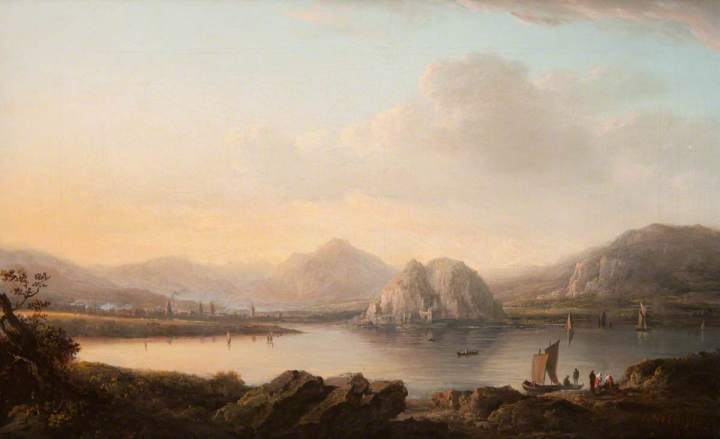
Alexander Nasmyth, Dumbarton Castle and Town with Ben Lomond, 1816, oil on canvas, 33 × 55 cm
(Glasgow: The Hunterian Art Gallery, University of Glasgow GLAHA_51732)
◊ ◊ ◊ ◊ ◊
Scheduled to open in January, the exhibition will instead be moved online with related programming soon to be announced (stay tuned); from The Hunterian:
Old Ways New Roads: Travels in Scotland, 1720–1832
(Online) The Hunterian Art Gallery, Glasgow, 29 January — 9 May 202
Curated by John Bonehill, Anne Dulau Beveridge, and Nigel Leask
Old Ways New Roads: Travels in Scotland 1720–1832 addresses the impact of Scotland’s new transport infrastructure on the development of travel, tourism and topographical descriptions of the nation between 1720 and 1832. Old Ways New Roads features paintings, prints, drawings, maps, manuscript tours, and other associated objects from The Hunterian and other public and private collections.
The laying out of new routes in the aftermath of the 1707 Act of Union and the 1715 Jacobite Uprising opened up Scotland (and especially the Highlands) not only to military occupation, but to the forces of commerce and trade and philosophical and scenic tourism. As a recent war zone, Scotland became imbued with aesthetic and topographical significance. Sites and places, old and modern, ruinous and thriving, were brought into view by travel along the military roads constructed by General George Wade and Major William Caulfield. Later, those designed by Thomas Telford under the aegis of the Commission for Highland Roads and Bridges, as well as canals and steam-boat routes, further opened up Scotland’s more inaccessible regions in the Romantic period. Old Ways New Roads traces how these dramatic ‘improvements’ to the Scottish landscape were variously documented, evaluated, planned, and imagined in word and image and more especially ‘framed up’ in terms of the experience of travel.
From Birlinn:
John Bonehill, Anne Dulau Beveridge, and Nigel Leask, eds., Old Ways New Roads: Travels in Scotland 1720–1832 (Edinburgh: Birlinn, 2021), 240 pages, ISBN: 978-1780276670, £20.
 In 1725 an extensive military road and bridge-building programme was implemented by the British crown that would transform 18th-century Scotland. Aimed at pacifying some of her more inaccessible regions and containing the Jacobite threat, General Wade’s new roads were designed to replace ‘the old ways’ and ‘tedious passages’ through the mountains. Over the next few decades, the laying out of these routes opened up the country to visitors from all backgrounds. After the 1760s, soldiers, surveyors, and commercial travellers were joined by leisure tourists and artists, eager to explore Scotland’s antiquities, natural history, and scenic landscapes and to describe their findings in words and images. Here, a number of acclaimed experts explore how the Scottish landscape was variously documented, evaluated, planned, and imagined in words and images. As well as a fascinating insight into the experience of travellers and tourists, the book also considers how they impacted on the experience of the Scottish people themselves.
C O N T E N T S
Foreword
Notes on Contributors
Acknowledgements
Introduction
1 Writing the Scottish Tour 1720–1830, Nigel Leask
SECTION 1 | The Theatre of War, John Bonehill
2 The Ethnology of the ‘Old Ways’ in Gaelic Scotland, Hugh Cheape
SECTION 2 | Antiquities, Nigel Leask
3 Natural History, Fredrik Albritton Jonsson
SECTION 3 | Custom and Improvement, John Bonehill
4 Roads, Bridges and Designed Landscapes on the Highland Circuit, Christopher Dingwall
5 Scotland’s Prospects, John Bonehill
SECTION 4 | Picturesque Prospects and Literary Landscapes, John Bonehill and Nigel Leask
6 Portable Knick-knacks or the Material Culture of Travel, Viccy Coltman
7 Panoramas and Landscape, Christina Young
8 Picturesque Tours of Wales and Ireland, Mary-Ann Constantine and Finola O’Kane
Bibliography
Photograph Credits
Index
◊ ◊ ◊ ◊ ◊
Note (added 6 January 2021) — The original posting did not include the contents.
New Book | Provenance Research Today
Now available as an e-book, with the paperback edition forthcoming from Lund Humphries:
Arthur Tompkins, ed., Provenance Research Today: Principles, Practice, Problems (London: Lund Humphries, 2021), 224 pages, ISBN: 978-1848222762, £30 / $50.
 Covering key aspects of provenance research for the international art market, this accessible publication explores a range of themes including challenges and best practice to considerations specific to Nazi looted art and the trade in illicit antiquities. Provenance research is a crucial component of any art-market transaction. Without a provenance it is often difficult to establish a work’s authenticity, its true value or who has legal title. Whether buying, selling or simply maintaining an artwork in either a private or a public collection, the days when a blind eye could be turned to the history (or the lack of a known history) of a work have long gone. Proper, thorough and effective provenance research is the minimum required and demanded in today’s art world—a world that is increasingly recognising the need for greater and more effective self-regulation in the face of fakes, forgeries and challenges to ownership or authenticity that are now commonplace.
Provenance Research Today is essential reading for a broad audience, from those studying to become part of the art world or professionals starting a career in provenance research, to collectors or would-be collectors, dealers, galleries, auction houses, police and art lawyers.
Arthur Tompkins is a District Court Judge based in Wellington, New Zealand. He is author of Plundering Beauty (Lund Humphries, 2018) and editor of Art Crime and Its Prevention: A Handbook for Collectors (Lund Humphries, 2016).
Exhibition | Sublime on the Small Scale
From The Morgan:
Sublime on the Small Scale
The Morgan Library & Museum, New York, 29 September 2020 — 12 September 2021

Gustaf Söderberg, The Grotto of Posillipo, Naples, 1820, oil on paper, irregularly cut, mounted to Masonite (Thaw Collection, Jointly Owned by The Metropolitan Museum of Art and The Morgan Library & Museum, Gift of Eugene V. Thaw, 2009).
In 1757, the British statesman and philosopher Edmund Burke published A Philosophical Enquiry into the Origin of Our Ideas of the Sublime and Beautiful, an aesthetic treatise that profoundly influenced artists across Europe well into the nineteenth century. Burke understood the Sublime as deriving from “whatever is fitted in any sort to excite the ideas of pain, and danger, that is to say, whatever is in any sort terrible…or operates in a manner analogous to terror.” He emphasized the powerful, even pleasurable, emotional response that could arise from the contemplation of such possibilities, particularly when considered from a place of safety.
Many artists turned to the natural world as their principal source of the Sublime, emphasizing its magnitude and power. While the Sublime is mostly associated with large-scale oil paintings intended to engulf and overwhelm viewers, artists frequently worked on a smaller scale to develop and experiment with their representations. They endeavored to render nature and its effects faithfully by sketching en plein air, particularly on their travels through dramatic landscapes. The oil sketches displayed here engage with a range of Sublime effects, from the impressive vastness of a mountain range and the thrill of rushing water to the terror of a raging storm.
Sublime on the Small Scale highlights works from the collection of oil sketches given jointly to The Morgan and The Metropolitan Museum of Art by Trustee Eugene V. Thaw.
Napoleon’s Barge, Newly Restored, Unveiled in Brest

Le Canot impérial de Napoléon, 1810, as installed at Brest, December 2020.
◊ ◊ ◊ ◊ ◊
Unveiled last week at the Musée de la Marine in Brest, as reported in the press release, via CNN (14 December 2020). . .
A spectacular imperial barge built for Napoleon Bonaparte has been unveiled at the Naval Museum in Brest, France, following a restoration project. Ten specialist restorers worked on the vessel, which was constructed in 1810, for two months prior to the opening of the new display on Friday [11 December 2020], according to a press release from the maritime museum. Visitors can appreciate the 62-foot barge from all angles, thanks to glass bays underneath and a mirror that hangs over the top.
Napoleon … ordered the secretive construction of the imperial barge in spring 1810, and it was first used to ferry him around during a visit to the French naval fleet at Antwerp later that year.
The original barge, which had fairly muted decorative elements including an eagle on the prow, was kept in Brest from 1814 onward. The more elaborate elements we see today—a figure of Neptune on the prow, figures at the bow carrying imperial weapons, and the large gold crown supported by four angels on the roof—were added in 1858 prior to a visit from Napoleon III and Empress Eugenie.
In 1943, the barge was moved from Brest to Paris under the protection of the occupying German forces to form part of the new Navy Museum. However, after an eight-day train journey, it was discovered that the doors of its new home, the Palais de Chaillot, were too small to fit the barge. It took two years to make a large gap in the wall of the building, and the barge was finally installed in August 1945.
In 2018, the barge was returned to Brest when the Paris museum closed for renovation.
Jean-Yves Besselièvre, manager of the Naval Museum in Brest, said the barge is one of the museum’s treasures and the only vessel of its kind preserved in France. The restoration is special, he said, because the barge wasn’t built to last a long time: “There is in fact a certain fragility to the object, but it has been perfectly managed by the restorers… and by the hauliers.”
◊ ◊ ◊ ◊ ◊
More information on the larger renovation of the Musée national de la Marine in Paris (scheduled to be completed in 2022) and the institution’s vision for the future is available from this press release.
New Book | Carmontelle’s Garden at Monceau
From Yale UP:
Carmontelle, Garden at Monceau, edited by Elizabeth Barlow Rogers and Joseph Disponzio, translated by Andrew Ayers, with an introductory essay by Laurence Chatel de Brancion and contributions from Joseph Disponzio, Florence Gétreau, David L. Hays, Elizabeth Hyde, Susan Taylor-Leduc, Caroline Weber, and Gabriel Wick (New Haven: Yale University Press, 2020), 196 pages, ISBN: 978-0300254686, $75.
 Carmontelle’s landmark publication, Garden at Monceau, beautifully reproduced to show the Parisian garden’s artistic and cultural importance before the French Revolution.
Originally published in 1779, Garden at Monceau is a richly illustrated presentation of the garden Louis Carrogis, known as Carmontelle, designed on the eve of the French Revolution for Louis-Philippe-Joseph d’Orléans, duc de Chartres. With its array of architectural follies intended to surprise and amaze the visitor, the garden was a setting for ancien régime social life. Carmontelle’s portrayal of his work in Garden at Monceau therefore serves as an expression of a key moment in the history of European landscape design, garden architecture, and social history. This facsimile edition, with its English-language text and reproductions of the original engravings, is accompanied by essays that interpret the landscape design and examine Carmontelle’s larger career as a painter and theater producer.
Elizabeth Barlow Rogers is the president of the Foundation for Landscape Studies, New York. Joseph Disponzio is a landscape architect with the New York City Department of Parks and Recreation.
Exhibition | Carmontelle (1717–1806)

Carmontelle, Self-Portrait, ca. 1762; graphite, watercolor, red chalk, and gouache on paper
(Chantilly: Musée Condé)
◊ ◊ ◊ ◊ ◊
From the Domaine de Chantilly:
Carmontelle (1717–1806), ou la Douceur de Vivre / And the Age of Pleasures
Musée Condé, Château de Chantilly, 5 September 2020 — 28 March 2021
Curated by Nicole Garnier
A playwright, draughtsman, and landscape architect, Louis Carrogis— known as Carmontelle—was a brilliant connoisseur whose many talents reflect the cultivated and cosmopolitan world in which he lived. The organizer of festivities for the Duke of Orléans, famous for his portraits and improvised comedies called Proverbes, Carmontelle designed the Parc Monceau in Paris for the Duke of Chartres and perfected transparencies or long rolls of paper depicting delightful landscapes.
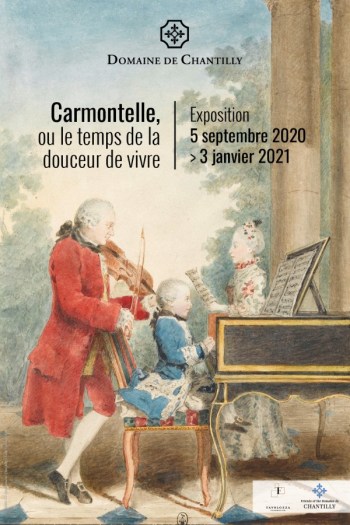 With sitters ranging from Mozart to Buffon, from Rameau to Baron Grimm, Carmontelle created a faithful portrait of mid-18th century Parisian society: princes of the blood, writers, philosophers, musicians, scientists, and elegant beauties of the ‘age of pleasures’—words coined by Talleyrand to describe the Ancien Régime. Thanks to Henri d’Orléans, Duke of Aumale (1822–1897), descendant of the Orléans who acquired the majority of this ensemble, the Condé museum at Chantilly has the best collection in the world of Carmontelle’s works with 484 drawn portraits and one transparency.
The son of a master cobbler, Louis Carrogis took the name ‘Carmontelle’ in 1744 after studying geometry. A topographer during the Seven Years’ War (1756–1763), he spent his spare time making portraits of the officers and organizing improvised comedies. In 1759, he entered the service of the Duke of Orleans as tutor to the young Duke of Chartres (1747–1793), the next Duke of Orléans and future Philippe Egalité; and from 1755 to 1784, he created ‘bad but accurate likenesses’ (Grimm) in gouache and watercolour of the entire court of the Orléans family at the Palais-Royal, Saint-Cloud, and Villers-Cotterêts. As an amateur draughtsman, Carmontelle preferred profile portraits for their ease of execution.
Nicole Garnier-Pelle, Carmontelle (1717–1806) ou le Temps de la Douceur de Vivre: Collection les Carnets de Chantilly n11 (Dijon: Éditions Faton, 2020), 96 pages, ISBN: 978-2878442779, €20.
Note: The exhibition, originally scheduled to close in January, has been extended until the end of March.
Mary D. Sheriff Travel and Research Award
Mary D. Sheriff Travel and Research Award
Applications due by 15 February 2021
Supporting feminist topics in eighteenth-century art history and visual culture
Award Amount: $2000
Eligibility: Doctoral candidates, early career scholars, and contingent faculty who are current members of the American Society for Eighteenth-Century Studies (ASECS) and the Historians of Eighteenth-Century Art and Architecture (HECAA).
Submission Materials: A 750-word description of the proposed project, a CV, and a budget (as a PDF file or MS Word doc). Please send submissions to MarySheriffAward@gmail.com.










 Enfilade
leave a comment