At Sotheby’s | Sassoon: A Golden Legacy

Front and back views of a parcel-gilt silver and enamel Torah Shield, signed and dated In Hebrew, Elimelekh Tzoref Of Stanislav, 1782, 8 inches high. Estimate $600–900,000. More information is available here.
◊ ◊ ◊ ◊ ◊
Sotheby’s press release:
Sassoon: A Golden Legacy, N10399
Sotheby’s, New York, 17 December 2020
Sotheby’s announced that it will present a dedicated auction of important Judaica from the legendary Sassoon family on 17 December in New York. Assembled over the course of more than a century by the fabled ‘Rothschilds of the East’, Sassoon: A Golden Legacy will present a treasure trove of gilded silver objects, rare Hebrew manuscripts, textiles, and family artifacts, ranging geographically from Western Europe to the Far East, with rarities dating from the 11th to the 20th centuries. The nearly 70 lots in the collection are monumental in their significance as a primary source on the history of Jewish life and culture, and of the legendary Sassoon family.
With roots in Baghdad, the Sassoons relocated in the 1830s to India, led by their patriarch David Sassoon who established Bombay as the seat of his vast trade empire. He went on to open branches of his company in China, Hong Kong, Singapore, and Rangoon and played a key role in the industrialization of the Far East. In the late 19th and early 20th centuries, much of this fabled family moved to England, entering British high society and distinguishing themselves in the fields of journalism, philanthropy, poetry, politics, and the patronage of the arts. Several members, most notably Reuben David Sassoon, Flora Sassoon, David Solomon Sassoon, and Solomon David Sassoon, were particularly avid collectors of items of Jewish interest.
This sale offers treasures that have descended in the family since its earliest days, with items assembled during their residencies in Baghdad, Bombay, Hong Kong, and the United Kingdom. An important group of objects comes from Philip Salomons, brother of the first Jewish Lord Mayor of London and one of the earliest collectors of antique Judaica. That collection was bought by Reuben David Sassoon, who augmented it and subsequently lent many of these items—including several offered for sale here—to the groundbreaking 1887 Anglo-Jewish Historical Exhibition at the Royal Albert Hall in London, the first exhibition broadly dedicated to Judaica. Many were shown again in 1906, but have not been seen in public for over a century.
“We are incredibly privileged to present the Sassoon collection,” said John Ward, Head of Sotheby’s Silver Department in New York. “Sotheby’s history with the Sassoons goes back to the early 20th century, when David Solomon Sassoon bought Jewish books and manuscripts in Bond Street in the early 1900s. Beginning in 1970, we have been honored to host an extraordinary series of sales for the family in Zurich, New York, London, and Tel Aviv. The pieces in this sale are not just the personal holdings of one of the world’s great Jewish families, they are significant works of art, and tell an important story of Jewish patronage, collecting, and scholarship.”
Sharon Liberman Mintz, Senior Consultant of Books and Manuscripts at Sotheby’s, stated: “The distinguished pedigree, superior quality, and historical importance of this collection leaves me breathless. Not only are the Silver and Hebrew manuscripts some of the finest objects to ever come to market, they are further distinguished by their unparalleled provenance to generations of members from this legendary family. Working with this collection has been among the highlights of my professional career.”
The Sassoon Collection is led by two highly important parcel-gilt silver Torah shields from the 18th century, representing the most important pieces of Judaic metalwork to appear at auction in a generation. These superb jewel-like works of art, probably made in Lemberg (Lviv)—an important 18th-century Jewish center in modern-day Ukraine—are not only extraordinary in their craftsmanship, but are now attributable to the Jewish silversmith, Elimelekh Tzoref of Stanislav. As Jews of Western Europe were, for the most part, barred from joining the guilds. this is an extraordinary document from the era of the Enlightenment, and the date and signature of the artist represent a proud proclamation of Jewish artistry. Although the artist’s name appears only on one shield, their matching and highly distinctive decoration allows us to attribute both to him, in addition to a similar third shield (now in the Israel Museum) that was offered by the Sassoons through Sotheby’s Tel Aviv in 2000, and which achieved the then record-breaking price of almost $800,000.
The shields were in the collection of Reuben David Sassoon, who lent them to the aforementioned 1887 Anglo-Jewish Historical Exhibition at the Royal Albert Hall. However, the full story and historic significance of these three works could not be deduced until now, when the two companion shields have appeared—for the first time since the historic 1906 Whitechapel exhibition Jewish Art and Antiquities. The two shields evoke in miniature the towering carved wooden Torah Arks of Eastern European synagogues and are intricately engraved on the backs: on one scenes from the story of Isaac are displayed in an exuberant rococo setting (estimate $600–900,000), and on the other the artist has engraved a highly detailed plan of the Holy Temple in Jerusalem from a birds eye perspective (estimate $500,000–800,000).

Italian gold Esther Scroll Case, 18th century. Estimate: $60,000–90,000.
Most of the manuscripts derive from the collection of the famous bibliophile David Solomon Sassoon, with examples showcasing the reach of Jewish culture. Among the important books and manuscripts in the collection are a small group of items related to the great Rabbi Joseph Hayyim of Baghdad (1834–1909)—one of the most prominent halakhic authorities and kabbalists of Iraqi Jewry in the 19th and 20th century. Often described as ‘the preeminent kabbalist of Baghdad’, and referred to as the ‘Ben Ish Hai’—after his most popular literary work, Sefer ben ish hai—he played an important role in simplifying and popularizing kabbalistic concepts and practices among the masses throughout the Middle East.
The star highlight is a Siddur, or daily prayer book, owned by Rabbi Joseph Hayyim of Baghdad (estimate $100,000–200,000). Containing the prayers for much of the liturgical year, accompanied by an anthologized Kabbalistic commentary, it is distinguished not only by the high quality of its penmanship and condition, but by the presence of several notes and comments written by the rabbi himself.
The collection also includes two pairs of Tefillin (phylacteries) that belonged to Rabbi Joseph Hayyim of Baghdad (estimate $150,000–250,000). Following the rabbi’s death in 1909, David Solomon penned a letter to the rabbi’s son wishing him consolation and asking him if he could gift his father’s tefillin as a memento. No other examples of tefillin belonging to R. Joseph Hayyim of Baghdad are known to exist.
The collection also features several Yemenite manuscript copies of works by Rabbi Moses Maimonides (Rambam; 1138–1204), one of the most illustrious Jewish figures of all time. Born in Cordoba, Spain, he fled persecution at the hands of the Almohads in the late 1140s, eventually moving first to Fez, Morocco, and later settling in Cairo, where he remained until his death. His reputation rests upon his excellence in a wide variety of fields. Not only was he a halakhist and communal leader of the first rank, he also wrote highly important works of medicine and Jewish philosophy that, like the rest of his oeuvre, achieved wide circulation.
This group is led by a copy of Rabbi Moses Maimonides’ Judeo-Arabic commentary on Seder mo‘ed, the second Order of the Mishnah (estimate $25,000–35,000). It is one of only ten known copies of Maimonides’ original Judeo-Arabic commentary on Seder mo‘ed from before the fifteenth century, and the only one remaining in private hands.
The sale also includes an exceptionally well executed and preserved Miniature Torah Scroll from the 19th century, outfitted with elegant silver-gilt and silk accoutrements (estimate $80,000–120,000). While most communal scrolls used in synagogues for ritual purposes are large and heavy, ones for private devotion tend to be diminutive and portable, allowing their owners not only to store them more easily, but also to transport them from place to place. Naturally, the degree of proficiency required to produce a small scroll like the present one was beyond the ability of most skilled scribes—making such scrolls highly rare and greatly prized.
Additional objects in the sale reflect the personal tastes, luxurious lifestyles and the international range of this legendary family. One finds pieces of family artifacts such as the magnificent silk robe Ezekiel ben Joshua Gubbay (1824–1896) wore upon his marriage to Aziza Sassoon (1839–1897) (estimate $2,000–4,000); the ketubbah used at the wedding of Reuben David Sassoon and Catherine Ezekiel, members of two of the greatest Baghdadi merchant families in India (estimate $10,000–20,000); a silver memorial plaque for Lady Anne Sassoon, wife of Sir Albert (Abdullah) David Sassoon (estimate $2,000–3,000); a signet ring used by David Solomon Sassoon (estimate $2,000–3,000), and a golden medal presented to Lady Rachel Sassoon Ezra by the Governor of Bengal in 1947 (estimate $1,000–1,500).
New Book | Divine Images: The Life and Work of William Blake
From Reaktion Books:
Jason Whittaker, Divine Images: The Life and Work of William Blake (London: Reaktion Books, 2021), 392 pages, ISBN: 978-1789142877, £25 / $35.
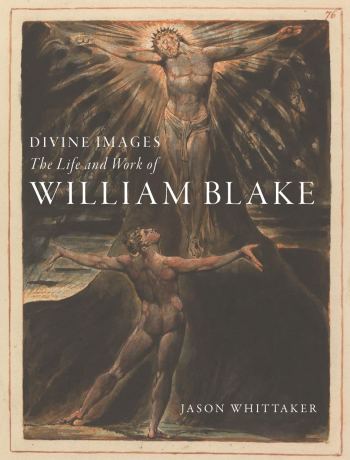 Although relatively obscure during his lifetime, William Blake has become one of the most popular English artists and writers, through poems such as ‘The Tyger’ and ‘Jerusalem’, and images including The Ancient of Days. Less well-known is Blake’s radical religious and political temperament, and that his visionary art was created to express a personal mythology that sought to recreate an entirely new approach to philosophy and art. This book examines both Blake’s visual and poetic work over his long career, from early engravings and poems to his final illustrations to Dante and the Book of Job. Divine Images further explores Blake’s immense popular appeal and influence after his death, offering an inspirational look at a pioneering figure.
Jason Whittaker is Head of the School of English and Journalism at the University of Lincoln. His books include William Blake and the Myths of Britain (1999) and Blake 2.0 (2012).
C O N T E N T S
Introduction: This World is a World of Imagination and Vision
1 Early Life and Work
2 Visions of Innocence
3 A New Heaven is Begun
4 Lambeth and Experience
5 A New System of Mythology
6 Night Thoughts and the Four Zoas
7 England’s Pleasant Land
8 Creating Systems
9 Final Visions
10 Death and Resurrection: The Legacy of William Blake
Bibliography
New Book | Metz royale et impériale: La cathédrale
From the École nationale supérieure d’architecture Paris-Malaquais:
Aurélien Davrius, Metz royale et impériale: La cathédrale, la mémoire et l’amnésie (Bordeaux: Éditions William Blake & Co, 2020), ISBN: 978-2841032303, 28€.
 Ville libre d’Empire, protectorat de facto du royaume France à partir de 1552, puis incorporée en 1648, Metz se voit annexée au Second Reich en 1871, avant de redevenir française en 1918. C’est l’histoire d’une ville de l’entre-deux qui se lit dans l’architecture messine. Le quartier de la Neue Stadt, bien sûr, rappelle ce passé germanique; la «gothisation» de la cathédrale à la fin du XIXe siècle aussi. Partant de l’exemple de l’entrée principale de la cathédrale Saint-Étienne remaniée par le Reich, cette étude vise à relever le caractère symbolique que Metz avait revêtu pour la monarchie française et qu’elle revêtit de nouveau, mais cette fois pour la monarchie impériale prussienne, au-delà du rôle purement stratégique qu’elle jouait pour les deux nations successives.
Louis XV, au milieu du Siècle des Lumières, chargea son architecte Jacques-François Blondel d’aménager les abords de la cathédrale, en créant trois places et en construisant un portique monumental, véritable ex-voto à la gloire du Prince, en style classique. Un siècle plus tard, Guillaume II fera démonter cette entrée, jugée trop française, pour effacer le souvenir de l’ancienne puissance dominante. C’est un portail néo-gothique qu’il fait édifier sur les dessins de son architecte Paul Tornow, digne de la haute culture du Second Reich. Le kaiser se fit représenter lui-même sous les traits du prophète Daniel, statue intégrée dans le décor du portail. Guillaume II tenta d’effacer et de remplacer Louis XV.
Afin de mieux comprendre les luttes de pouvoir entre France et Allemagne qui se nouèrent à Metz, à travers les œuvres d’architecture, cette étude se propose d’élargir la question à l’ensemble du contexte franco-allemand, de la fin du XVIIIe siècle au début du XXe. Les travaux de la cathédrale de Metz n’offrent qu’une pièce d’un puzzle beaucoup plus vaste, dont on peine à saisir tous les tenants et aboutissants. Il faut faire remonter cette rivalité à l’époque des armées napoléoniennes occupant et humiliant la Prusse, de la récupération de la figure de Vercingétorix par Napoléon III, de l’appropriation d’un certain style architectural par Guillaume II, mais aussi des chantiers d’achèvement des cathedrales de Cologne ou d’Ulm. Sur la base d’une riche iconographie, des articles de presse de l’époque ou encore de fonds archivistiques peu exploités, c’est un double portrait de la ville de Metz qui s’offre au lecteur: une ville à la fois royale et impériale.
S O M M A I R E
Partie I : Metz royale
• Metz et la politique royale d’embellissements
• Le portique de la cathédrale : un monument royal pour symboliser le Prince
• Un portique classique pour une cathédrale gothique
• Blondel théoricien et architecte d’un gothique des Lumières
Partie II : Metz impériale
• « Architecture allemande » (Goethe, 1772)
• Du gothique au classique, et retour : menaces sur l’œuvre de Blondel
• Paul Tornow, le « Viollet-le-Duc de Metz »
• Une gothisation du gothique
• Le Kaiser et l’équerre
• La fabrique d’un art national
• Gothique français contre gothique allemand : l’architecture comme enjeu national
The Rijksmuseum Fellowship Programme, 2021–22
The Rijksmuseum Fellowship Programme, 2021–22
Applications due by 17 January 2021
The Rijksmuseum welcomes international, independent research proposals that open new perspectives on the museum’s collection, its history, and activities. The purpose of the Rijksmuseum Fellowship Programme is to encourage and support scholarly investigation, and to contribute to academic discourses while strengthening bonds between the museum and universities. The programme enables highly talented candidates to base part of their research at the Rijksmuseum and offers access to the museum’s expertise, collections, library, and laboratories. Furthermore, the programme facilitates opportunities for Fellows to engage in workshops and excursions to encourage exchange of knowledge—both amongst themselves and the broader museum audience.
Please review the eligibility, funding, and application requirements by visiting the Rijksmuseum website. For the 2021–2022 academic year, candidates may apply for the following:
- Andrew W. Mellon Fellowship for research in art and cultural history. Apply here»
- Terra Foundation Fellowship for research in American Photography. Apply here»
- Johan Huizinga Fellowship for historical research. Apply here»
- Migelien Gerritzen Fellowship for conservation and scientific research. Apply here»
- Anton C.R. Dreesmann Fellowship for art historical research. Apply here»
The closing date for all applications is 17 January 2021, at 6:00pm (Amsterdam time/CET). No applications will be accepted after this deadline. All applications must be submitted online and in English. Applications or related materials delivered via email, postal mail, or in person will not be accepted. Selection will be made by an international committee in February 2021. The committee consists of eminent scholars in the relevant fields of study from European universities and institutions, and members of the curatorial and conservation staff of the Rijksmuseum. Applicants will be notified by 15 March 2021. All fellowships will start in September 2021.
For questions concerning the application procedure, contact the Coordinator of the Fellowship Programme (fellowships@rijksmuseum.nl).
New Book | The Marquis de Sade and the Avant-Garde
Sade died on this day, December 2, in 1814 at the Charenton Asylum; from Princeton UP:
Alyce Mahon, The Marquis de Sade and the Avant-Garde (Princeton: Princeton University Press, 2020), 296 pages, ISBN: 978-0691141619, £38 / $45.
 How the notorious author of The 120 Days of Sodom inspired the surrealists and other avant-garde artists, writers, and filmmakers
The writings of the Marquis de Sade (1740–1814) present a libertine philosophy of sexual excess and human suffering that refuses to make any concession to law, religion, or public decency. In this groundbreaking cultural history, Alyce Mahon traces how artists of the twentieth century turned to Sade to explore political, sexual, and psychological terror, adapting his imagery of the excessively sexual and terrorized body as a means of liberation from systems of power.
Mahon shows how avant-garde artists, writers, dramatists, and filmmakers drew on Sade’s ‘philosophy in the bedroom’ to challenge oppressive regimes and their restrictive codes and conventions of gender and sexuality. She provides close analyses of early illustrated editions of Sade’s works and looks at drawings, paintings, and photographs by leading surrealists such as André Masson, Leonor Fini, and Man Ray. She explains how Sade’s ideas were reflected in the writings of Guillaume Apollinaire and the fiction of Anne Desclos, who wrote her erotic novel, Story of O, as a love letter to critic Jean Paulhan, an admirer of Sade. Mahon explores how Sade influenced the happenings of Jean-Jacques Lebel, the theater of Peter Brook, the cinema of Pier Paolo Pasolini, and the multimedia art of Paul Chan. She also discusses responses to Sade by feminist theorists such as Simone de Beauvoir, Susan Sontag, and Angela Carter.
Beautifully illustrated, The Marquis de Sade and the Avant-Garde demonstrates that Sade inspired generations of artists to imagine new utopian visions of living, push the boundaries of the body and the body politic, and portray the unthinkable in their art.
Alyce Mahon is Reader in Modern and Contemporary Art History at the University of Cambridge. She is the author of Surrealism and the Politics of Eros, 1938–1968 and Eroticism and Art.
New Book | Joseph Wright of Derby: Painter of Darkness
From Yale University Press:
Matthew Craske, Joseph Wright of Derby: Painter of Darkness (London: Paul Mellon Centre for Studies in British Art, 2020), 368 pages, ISBN: 978-1913107123, £45 / $60.
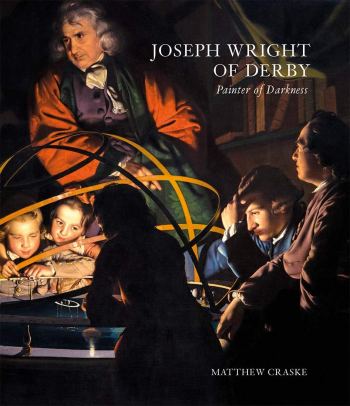 A revelatory study of one of the 18th century’s greatest artists, which places him in relation to the darker side of the English Enlightenment
Joseph Wright of Derby (1734–1797), though conventionally known as a ‘painter of light’, returned repeatedly to nocturnal images. His essential preoccupations were dark and melancholy, and he had an enduring concern with death, ruin, old age, loss of innocence, isolation, and tragedy.
In this long-awaited book, Matthew Craske adopts a fresh approach to Wright, which takes seriously contemporary reports of his melancholia and nervous disposition, and goes on to question accepted understandings of the artist. Long seen as a quintessentially modern and progressive figure—one of the artistic icons of the English Enlightenment—Craske overturns this traditional view of the artist. He demonstrates the extent to which Wright, rather than being a spokesman for scientific progress, was actually a melancholic and sceptical outsider, who increasingly retreated into a solitary, rural world of philosophical and poetic reflection, and whose artistic vision was correspondingly dark and meditative. Craske offers a succession of new and powerful interpretations of the artist’s paintings, including some of his most famous masterpieces. In doing so, he recovers Wright’s deep engagement with the landscape, with the pleasures and sufferings of solitude, and with the themes of time, history, and mortality. Joseph Wright of Derby emerges not only as one of Britain’s most ambitious and innovative artists, but also as one of its most profound.
Matthew Craske is reader in art history at Oxford Brookes University.
Online Conference | Discovering Dalmatia VI
From the Exposition project website:
Discovering Dalmatia VI — Watching, Waiting: Empty Spaces and the Representation of Isolation
Online, 3–5 December 2020
This year, the annual Discovering Dalmatia conference will take place virtually, over the course of three days. Watching, Waiting: Empty Spaces and the Representation of Isolation is inspired by the Institute of Art History’s project Exposition [Ekspozicija]: Themes and Aspects of Croatian Photography from the 19th Century until Today, financed by the Croatian Science Foundation. It represents the sixth annual Discovering Dalmatia conference, a programme offering a week of events in scholarship and research.
Inspired by the current situation, this interdisciplinary conference will be dedicated to the history and theory of representing empty space through the media of photography, film, and other artistic practices. The conference is likewise open to the themes of empty spaces, isolation, and loneliness from the perspective of other scholarly disciplines.
In addition to the conference, and as part of this year’s Discovering Dalmatia, an exhibition curated by Joško Belamarić will be launched at the Split City Museum, entitled Split and Diocletian’s Palace in the Work of Danish Painter Johan Peter Kornbeck.
This year’s programme will conclude with an online presentation of the book Discovering Dalmatia: Dalmatia in Travelogues, Images, and Photographs, edited by Katrina O’Loughlin, Ana Šverko and Elke Katharina Wittich (Zagreb 2019), which brings together articles that emerged from earlier Discovering Dalmatia conferences.
Please join us via Zoom:
Thursday, 3 December 2020
https://us02web.zoom.us/j/81939301537?pwd=dENUcEdKdXpmaG54Tk9Sd205amprZz09
Friday, 4 December 2020
https://us02web.zoom.us/j/81752813627?pwd=RVJOd2o5S0tnck5SdW1VckJ6dUliZz09
Saturday, 5 December 2020
https://us02web.zoom.us/j/83531036592?pwd=Q20ydUI5VDFSd2ZNM1E2N1Y1cWxGdz09
T H U R S D A Y , 3 D E C E M B E R 2 0 2 0
9.00 Introduction by Sandra Križić Roban and Ana Šverko
9.15 Session 1
Moderated by Sandra Križić Roban
• Stuart Moore and Kayla Parker, Separation Anxiety: Filming the Nicosia Buffer Zone, with projection of the film, Father-land
• Isabelle Catucci, A Land of Collective Solitude
• Marina Milito and Maria Angélica da Silva, Visualizing Emptiness over Emptiness: Leaving Home in Pandemic Times (Maceió, Brazil)
• Cristina Moraru, Empty Spaces, Illuminated Minds: Towards a Time Withdrawn from the Capital
• Luca Nostri, Existential Topography: Photographs of Lugo During the Lockdown / 6–18 April 2020
11.45 Break
12.15 Session 2
Moderated by Lana Lovrenčić
• Anna Schober de Graaf, Occupying Empty Spaces: Political Protest and Public Solidarity in Times of Social Distancing
• Bec Rengel, The Empty Plinth and the Politics of Emptiness
F R I D A Y , 4 D E C E M B E R 2 0 2 0
9.30 Session 3
Moderated by Lana Lovrenčić and Ana Šverko
• Elke Katharina Wittich, Silent Ruins
• Emily Burns, Emptying Paris: Edward Hopper in Paris, 1910 / 2020
• Marija Barović, Ston’s Voids
• Jessie Martin, Deconstructing Understandings of Emptiness: An Examination of Representations of Transitory Space and ‘Non-place’ in Photography
• Ruth Baumeister, The Power of Emptiness
• Dominik Lengyel and Catherine Toulouse, The Representation of Empty Spaces in Architecture
11.45 Break
12.35 Session 4
Moderated by Mirko Sardelić
• Asija Ismailovski, Empty Space as Artistic Strategy
• Marta Chiara Olimpia Nicosia, Species of Spaces, Species of Emptiness: Idleness and Boredom
• Anči Leburić and Laura John, Visualization as a Qualitative Procedure in the Representation of the Meanings of What We Are Researching in Space
S A T U R D A Y , 5 D E C E M B E R 2 0 2 0
9.00 Session 5
Moderated by Mirko Sardelić
• Martin Kuhar and Stella Fatović-Ferenčić, Empty Spaces in Photographs of Public Health Remnants in Dalmatia
• Klaudija Sabo, Representations of Quarantine and Space in Visual Culture
9.45 Break
10.00 Session 6
Moderated by Liz Wells
• Catlin Langford, Staging Isolation: Images of Seclusion and Separation
• Tihana Rubić, Ethnographies of Waiting, Ethnographies of Emptiness: Time and Space through Photography
• Meg Wellington-Barratt, Hierarchy of History: Curation of Photography during the Covid-19 Lockdown Period
New Book | Discovering Dalmatia
From Bookshop Dominović:
Katrina O’Loughlin, Ana Šverko and Elke Katharina Wittich, eds., Discovering Dalmatia: Dalmatia in Travelogues, Images, and Photographs (Zagreb: The Institute of Art History, 2019), 382 pages, ISBN: 978-9537875466, 180KN / £22.
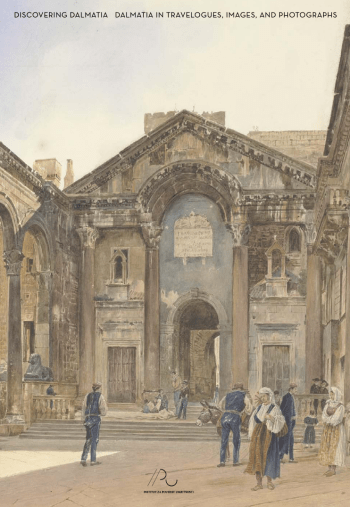 This book is the second to emerge from the conferences organised as a part of the Croatian Institute of Art History research project Dalmatia as a Destination of the European Grand Tour in the Eighteenth and the Nineteenth Century (Grand Tour Dalmatia), a project funded by the Croatian Science Foundation. Although this three-year project, which began in 2014, has officially concluded, this wonderful scholarly journey through histories of travellers’ perceptions of Dalmatia only continues—through the organisation of annual conferences under the collective title of Discovering Dalmatia, and in the ongoing conversations and discoveries of our research community. Our first publication, in 2017, was dedicated to Diocletian’s Palace through the prism of Robert Adam’s book Ruins of the Palace of the Emperor Diocletian in Spalatro in Dalmatia (London, 1764). In this volume we are pleased to present twelve essays which offer fragments for assembling a wider and richer picture of Dalmatia through maps, travelogues, images, and photographs from the sixteenth to the early twentieth centuries.
C O N T E N T S
Acknowledgments
• Ana Sverko, Preface: A Collage of Fragments
• Elke Katharina Wittich, On Towns and People: Traditions of Describing and Depicting Dalmatia and South-Eastern Europe from the Sixteenth to the Eighteenth Century
• Jean-Pierre Caillet, A French Humanist’s First Impressions of Istria and Dalmatia: The Account of a Voyage by Jacob Spon, 1678
• Colin Thom, ‘This Knotty Business’: The Making of Robert Adam’s Ruins of the Palace of the Emperor Diocletian (1764), Revealed in the Adam Brothers’ Grand Tour Correspondence
• Cvijeta Pavlović, Correctio descriptionis: Lovrić vs. Fortis
• Magdalena Polczynska, Who is Observing and Who Describing?: Travels to the Slavic Lands by Aleksander Sapieha
• Nataša Ivanović, Framed Views of Dalmatia
• Irena Kraševac, Views of Dalmatian Cities and Architectural Monuments for the Publication The Austro-Hungarian Monarchy in Words and Pictures – Volume Dalmatia
• Sanja Žaja Vrbica, Archduke Ludwig Salvator von Habsburg’s Travel Writing from the Region of Dubrovnik
• Hrvoje Gržina, Nineteenth-Century Dalmatia Inverted in the Camera: Photographic Glass Plate Negatives by Franz Thiard de Laforest
• Dragan Damjanović, Politics, Photography, and Architecture: The University of Vienna’s First Study Trip (Erste Wiener Universitätsreise) and Monuments on the Eastern Adriatic Coast
• Katrina O’Loughlin, Ana Šverko, Gertrude Bell’s Spring in Dalmatia, 1910
• Joško Belamarić, Ljerka Dulibić, Bernard Berenson’s Journey to Yugoslavia and along the Dalmatian Coast, 1936
Index
List of Illustrations
List of Contributors
New Digital Publication | Art & the Country House

From the Mellon Centre:
Martin Postle, ed., Art & the Country House, launched November 2020.
Explore the collections of Castle Howard, Doddington Hall, Mells Manor, Mount Stuart, Petworth House, Raynham Hall, Trewithen and West Wycombe through the Paul Mellon Centre’s new online publication Art & the Country House.
Involving research by over forty authors, Art & the Country House brings together detailed catalogues, document transcriptions, commissioned essays, films and an abundance of specially commissioned photography. Through its search facility, objects, artists, art works and bibliographies can be located and compared in new, productive, and more rapid ways.

Each of the houses has been carefully selected so as to ensure a broad range of research topics and to provide an appropriately varied set of examples, in terms of geographical location, scale, patterns of ownership, chronologies, collections and displays.
Essay topics include the evolution of customised picture galleries; the conscious preservation of the past; women’s collecting and display strategies; country houses as homes and tourist destinations; and the economic and political structures that underpinned the extravagant acquisition policies of the owners of so-called ‘power houses’.
Art & the Country House, as with all other Paul Mellon Centre digital publications, is open access.
Call for Papers | The Afterlife of the Mausoleum of Halicarnassus
From ArtHist.net:
Re-Conceiving an Ancient Wonder: The Afterlife of the Mausoleum of Halicarnassus, 1500–1850
RWTH Aachen University, 24–26 June 2021
Proposals due by 31 January 2021
The importance of the Mausoleum of Halicarnassus for European culture is revealed by its very name, which—in many languages—has become a noun signifying any sufficiently monumental tomb. However, the Mausoleum was destroyed during the Middle-Ages, and many aspects of its appearance remain uncertain, even since the excavation of its foundations in the 1850s. During the Early Modern Period, the main sources of information on this building were thus ancient texts, which were the only references concerning the Mausoleum’s dimensions and appearance. Accurately reconstructing architecture according to brief written descriptions, however, is an impossible task. Yet, despite this difficulty or perhaps due to the liberty it offered the imagination, numerous artists, architects and antiquaries took a keen interest in the monument during the timeframe 1500–1856, mainly using Pliny’s description to suggest reconstructions, devise pictorial representations and seek inspiration for new funerary projects or monumental public architecture.
This workshop aims to examine the afterlife of the Mausoleum during this period. Being an invisible reference, the monument left far more leeway to the imagination than other, existing ancient buildings that also attracted scholarly and artistic attention, such as the Pantheon. The Mausoleum’s invisibility entails that it is not the monument itself that will be investigated here, but rather the ensemble of texts, images and architectural projects referring to this central but unknowable model. Drawing upon recent developments in the methodologies of intermediality and temporality, the project aims to add a new dimension to this discussion by focusing on a precise case study examining the evolution of several key themes over a long period.
The following questions offer a common intellectual framework for the workshop. Further research themes suggested by participants, however, will naturally be welcomed.
• How did reconstructions engage with the Mausoleum’s invisibility and the intermedial relations that it entailed between architecture, text and image?
• What differences emerge between various groups (e.g. antiquarians, architects, painters) in their interpretations of the Mausoleum and in the motivation of their interest for this structure?
• How did the Mausoleum inspire actual buildings and serious architectural projects?
• Or, inversely, imaginary pictorial vistas and stage sets?
• How did the Early Modern reception of the Mausoleum engage with the different means of architectural quotation (shape, dimensions, ornaments)?
• Why did the Mausoleum generate particular interest within specific cultural contexts?
• How, when and to what extent was the funerary function of the Mausoleum emphasised?
• What did the Early Modern Period make of the Mausoleum’s insertion into an urban context and of its relation to the surrounding landscape?
• How is the Mausoleum discussed in general histories of architecture written during the period under consideration?
While we are interested in all proposals concerning the period 1500–1850, topics from the seventeenth and nineteenth century will be especially welcome, since they remain underrepresented amongst the several key speakers already selected.
We invite scholars to submit proposals (max. 1 page) for 20-minute talks that can later be developed into full-length book chapters. Abstracts should be sent to halicarnassus@ages.rwth-aachen.de until 31 January 2021.
The workshop will be held at RWTH Aachen University on 24–26 June 2021. Funding will be available for a partial reimbursement of participants’ expenses, thanks to a grant from the German Research Foundation (DFG).
The workshop will result in a collective publication—a coherent book, rather than a loose set of articles—retracing key issues regarding the afterlife of the Mausoleum throughout the timeframe under consideration. For this purpose, we strive for an open workshop format that fosters debate and concrete ideas for a collective publishing project. We sincerely hope that we will be able to meet in person, however, if the pandemic lasts until summer 2021 we will prepare an appropriate digital format for the workshop.
Organisational Committee
Prof. Dr. Anke Naujokat (RWTH Aachen University)
Dr. Desmond Bryan Kraege (AHO Oslo School of Architecture and Design)
Felix Martin M.Sc. (RWTH Aachen University)










 Enfilade
leave a comment