SAL’s Fight to Stay at Burlington House

From the Society of Antiquaries:
The Society of Antiquaries of London has launched a campaign to contest the rapidly escalating rental rates set by Government, in order to remain at Burlington House—its home for over 140 years.
A hub of discovery for the UK, the building houses thousands of unique artefacts, books, and works of art spanning centuries of human history, under the guardianship of the Society of Antiquaries. The result of nearly 300 years of acquisition, people come from all over the world to study the collections at Burlington House, where enthusiasts meet experts, and ideas are shaped in the Library and lecture room. From Burlington House, the Society runs regular public, educational and academic events, gives grants for research and conservation, and contributes to the formulation of public policy.
Since the 1870s, the Society has been based at Burlington House under a bespoke Government arrangement which has delivered immense public value as a hub of cultural and scientific discovery. Due to a change in Government accounting rules, the Society is now being effectively forced out because of rapidly escalating rents; already rent has increased by 3,100% since 2012.
After eight years spent attempting to seek a fair arrangement behind closed doors, the Society has now gone public to encourage the Government to recognise the immense value of the Society, its library and collections at Burlington House, and to find an affordable arrangement for the Society to remain.
By continuing an affordable tenancy for the Society at Burlington House, the Government can enable a new era of public engagement with our heritage. The Society is already making progress towards modernising to ensure the nation’s history that the Society represents both reflects and reaches a more diverse public—progress which has been slowed by the ongoing uncertainty over its future. Resolving this looming threat would mean the Society is able to continue its plans to further increase public engagement, and generate income which can be reinvested in exhibitions and activities in communities across the UK.
With the Society’s precious collection and public value activities there are options for the Government to recognise this value against that of the long-term tenancy. A 2019 assessment by PwC estimated that 78% (£4.2 million) of the total gross value delivered each year by the Society of Antiquaries (£5.4 million) would be at risk if the Society is forced to relocate. According to this, the Government is set to lose 44 times what it would gain through the current agreement (approximately £120,000 in income per year compared to £5.4 million in public value).
The uncertainty of the Society’s tenure has already restricted its contributions to society over the last eight years, with investment in the building and public engagement activities shelved, and resources instead directed at quietly appealing to the Government to agree an affordable solution.
Without resolution, relocation represents a major threat to the continued existence of the Society in its current form. Leaving Burlington House would require the prohibitively costly process of recreating the infrastructure to house its unique collections elsewhere, while moving fragile historical items en masse is a huge and extremely costly undertaking in itself. As a self-supporting charity, the Society is under enormous pressure to raise funds for alternative premises to house its unrivalled library, unique archive and historically significant museum collections where they would remain safe and ensure they are accessible to academics, students, and the historically curious public.
An almost unthinkable yet looming scenario is that the Society may have to sell items from its collection to fund new premises in order to appropriately house the rest of its artefacts, even outside of a major city. In such a scenario, it is possible the UK may see items of huge historical importance go overseas, and they may no longer be available for research or education purposes. If you wish to get in contact with us, please email saveBH@sal.org.uk. For press enquiries, please email saveBH@sal.org.uk. To follow our story on social media please follow the hashtag #SocAntiquaries. Click here for FAQs.
What You Can Do
1 Write to your MP
You can write to your local MP to ask for their support for the Society’s continued residency in Burlington House.
2 Raise awareness on social media
You can help to get the message out by using the hashtag #SocAntiquaries on social media channels. There are free-to-use images available here including Burlington house and our priceless collection of historical artefacts.
3 Share your Society story and submit a testimonial to be published on our website
We would love to hear your stories of how the Society has contributed to your interests, supported your research, or informed your thinking. Share your testimonial on what the Society means to you, and why you believe it should remain at Burlington House.
New Book | Piranesi Unbound
From Princeton UP:
Carolyn Yerkes and Heather Hyde Minor, Piranesi Unbound (Princeton: Princeton University Press, 2020), 240 pages, ISBN: 978-0691206103, £54 / $65.
 Why Piranesi’s greatest works weren’t his famous prints but rather the books for which he made them
A draftsman, printmaker, architect, and archaeologist, Giovanni Battista Piranesi (1720–1778) is best known today as the virtuoso etcher of the immersive and captivating Views of Rome and the darkly inventive Imaginary Prisons. Yet Carolyn Yerkes and Heather Hyde Minor argue that his single greatest art form—one that combined his obsessions most powerfully and that he pursued throughout his career—was the book. Piranesi Unbound provides a fundamental reinterpretation of Piranesi by recognizing him, first and foremost, as a writer, illustrator, printer, and publisher of books.
Featuring nearly two hundred of Piranesi’s engravings and drawings, including some that have never been published before, this visually stunning book returns Piranesi’s artworks to the context for which he originally produced them: a dozen volumes that combine text and image, archaeology and imagination, erudition and humor. Drawing on new research, Piranesi Unbound uncovers the social networks in which Piranesi published, including the readers who bought, read, and debated his books. It reveals his habit of raiding the wastepaper pile for cast-off sheets upon which to draw and fuse printed images and texts. It shows how, even after his books were bound, they were subject to change by Piranesi and others as pages were torn out and added.
The first major exploration of the lives of Piranesi’s books, Piranesi Unbound reimagines the full range of the artist’s creativity by showing how it is inextricably bound to his career as a maker of books.
Carolyn Yerkes is associate professor of early modern architecture at Princeton University and the author of Drawing after Architecture. Heather Hyde Minor is professor of art history at the University of Notre Dame. She is the author of Piranesi’s Lost Words and The Culture of Architecture in Enlightenment Rome.
Conference | Working Wood in the 18th Century
From Colonial Williamsburg:
Back to Work: Functional Furniture for Home and Shop
23rd Annual Working Wood in the 18th Century Conference
(Online), Williamsburg, Virginia, 14–17 January 2021
 The 23rd annual Working Wood in the 18th Century conference is going virtual. Join our expert woodworking tradespeople as well as a distinguished lineup of guests for live-streamed, on-demand, and Q&A sessions.
Work, in the 18th century, took many forms from gentry avocations to the daily vocations and labors of most people regardless of race, gender, or age. This year’s conference theme Back to Work: Functional Furniture for Home and Shop invites you to join us virtually as we explore furnishings, fixtures, and tools designed for work at home and in the shop.
Christopher Schwarz, renowned woodworker, author, and founder of Lost Art Press, joins us to explore period work holding techniques drawn from years of research into historical workbenches. He will also demonstrate techniques used for building the staked seating furniture that is nearly ubiquitous in images of early work environments. From out of the shop and into the home, Bob Van Dyke (woodworker, teacher, and founder of the Connecticut Valley School of Woodworking) will guide attendees through the construction and decoration of a Federal era lady’s work table for needlecrafts. Colonial Williamsburg’s master cabinetmaker, Bill Pavlak, demonstrates a mahogany writing table with a ratcheting top and a drawer that includes its own ratcheting writing surface—the perfect piece for writing, reading, and drawing. Apprentice cabinetmakers John Peeler and Jeremy Tritchler will straddle the line of fine furniture and workaday utility with an intricate mahogany apothecary’s chest from the London shop of Philip Bell.
Meanwhile, back in the shop Brian Weldy, journeyman-supervisor joiner, demonstrates the construction and use of a treadle lathe based on numerous period illustrations and surviving examples. Apprentice joiners Amanda Doggett, Scott Krogh, and Peter Hudson explore a handful of shop-made woodworking tools and fixtures. As to the people working within these long-ago shops, the significant presence and role of skilled black craftspeople (enslaved and free) has often been left out of the literature. Carpenters Ayinde Martin and Harold Caldwell along with coachman Adam Canaday will lead a panel discussion on black tradespeople from the past, how we can learn about them, and how we can interpret their stories today.
Architectural historian Jeffrey Klee will tie these disparate subjects together in an opening keynote that explores how we can understand work in the 18th century from the design, use, and evolution of buildings from within the Historic Area and beyond. In this same spirit, master carpenter Garland Wood and orientation supervisor Janice Canaday will look at the Randolph House Kitchen from the perspective of the enslaved carpenters who would have participated in its construction and the enslaved people who worked and lived within its walls.
Should you have questions regarding our Educational Conferences, Forums & Symposiums, please give us a call at 1.800.603.0948, or send us an email at educationalconferences@cwf.org. Registration for the 2021 Working Wood conference is now open.
Call for Papers | Food—Media—Senses
From ArtHist.net:
Food — Media — Senses
Philipps-Universität Marburg, 1–2 July 2021
Proposals due by 21 December 2020
The notion that eating is linked to sensuality is a commonplace. But once we take into consideration that during a meal all five senses can be involved, the relationship between eating and the senses becomes much more interesting. By eating we understand a cultural practice which includes the consumption of food as much as its preparation and presentation. Not only in the culinary art and fine dining of the last decades—for example, molecular cuisine—but also in the industrial processing of convenience food, trends of putting all five senses into relation to each other can be observed.
But this very aspect of sensuality is often ignored in the debates of the humanities or cultural science about eating and food, although aesthetics in the sense of aisthesis is one of its core subjects. Strangely enough, up until now there has been only little research on how eating relies on the interplay of the senses. This might generally be due to the fact that sensual experience has been held in high cultural regard only when initiating the creation of sense. The incorporation of the object of perception in no way seemed to be in a position to transcend the bodily, in the manner of the distanced sensory perceptions of seeing and hearing (Zechner 2013). We find here an implicit hierarchization which might be the reason for a lack of differentiated linguistic tools and of useful distinctions when it comes to tasting and smelling, the senses central to eating. While tools for capturing the visual and auditory already have been developed by scholars of musicology, art history, media studies or theater studies. A cultural science which is adequate to the cultural technique of designing food—as haute cuisine or as convenience food—is still lacking. Even the most recently booming food studies are only peripherally are concerned with the sensorially experienced aisthesis of dishes and, when concentrating on the socio-cultural functions of eating, fall back onto a wider perspective of cultural studies.
In order to acknowledge the material and media-related aspects of eating as a cultural praxis, the conference proposes to understand the various aspects of eating as a purposefully designed sensory experience. Thereby it aims to introduce, produce and discuss research tools commensurate with the sensuality of eating. First, we intend to develop ways of describing how the individual senses are addressed by food and to conceptualize their modes of interaction. As they design sensual experience the dishes prepared are to be considered as media themselves. They offer perceptive opportunities which are strongly formed by culture and in special ways address the sensory as much as sense. In addition, haute cuisine even works with textures, smells and taste nuances in an attempt to create meaning. Focusing the senses in combination with the concept of media and its heuristics is meant to permit a new perspective on dishes and eating.
The involvement of media in eating can be further differentiated. By an open concept of media—which could for instance be obtained from the ethnographic orientation of the actor-network theory—the constitutive roles of menu, cutlery, tableware and dining room can be taken into account without relegating them to the secondary role of ‘context’. In this sense, we have to describe the preparation and combination of food together with the specific choice of tableware, table decoration, furniture, interior design, music and, last but not least, the service to the table and additional media components. Also, the fine arts always have reflected on food, for example in the genre of the still life or, since Modernity, in interactive settings which take eating as a starting point for creating a Gesamtkunstwerk and reflect on the aesthetic and socio-cultural dimensions of food.
Finally, media come into play when representing and communicating eating in advance or afterwards. Under this aspect we may ask by which forms of linguistic expression, structure and imagery for example a cooking recipe is characterized, how film and television evoke the sensual experience of eating or how the oeuvre of a certain chef is represented in photo books. Complementary it has to be asked in which ways a whole media ensemble is grouped around food and its preparation, how such a media ensemble organizes perception and consequently directly feeds back onto the senses. The intrinsic logic of particular media and how it affects the presentation of food has to be taken into consideration, too.
The conference is conceived as an interdisciplinary exploration in which experts from media studies, art history, literature, sociology, ethnology, cultural studies and design studies come together for productive exchanges and share their special approaches such as gastrosophy, culinary studies and food studies. The following three thematic blocks can be defined:
1 Food as Medium
The first section focusses on the media-related qualities of eating, which is understood as a designed sensual experience. Food as a multisensory and multimodal object of perception as well as all related practices of preparation, presentation and consumption come into view. In contrast to the traditional approaches in the study of meals, we suggest an understanding of the preparation, presentation and consumption of food not as a cultural framing, but as a communicative practice which includes the meal’s design and its whole field of experience: which role is played by sensual experience when buying and preparing food? Which options are there to control the parameters of sensory experience during cooking? How is a meal arranged to let the eater have a certain experience? How is food semantically charged? Of course, specific associations are induced in food; but can we imagine other strategies as well? The analysis of happenings in the fine arts which perform and simultaneously reflect on the preparation of food as much as on its communal consumption can yield great insights. Art works not only use food and its staging as a vehicle for messages but can also convey its sociocultural implications and even reveal how the construction of culture works.
2 Food in Media
The representation of eating and the sensual experience connected to it has a long history: the interest in food’s colors and tactile surfaces is one of the major causes for the emancipation of the still life as a genre of its own. Cookbooks seek to demonstrate the preparation of meals as much as the expected pleasures by a variety of linguistic devices, specific layouts and images. Food photography in advertising and in cookbooks claims to visualize sensual experience. On product packaging, food photography can work like a serving suggestion inasmuch as it can trigger, in combination with color design etc., sensual associations. In addition, attention must be paid to the parameters of media-specific presentation and how they feed back on the cultural practice of eating. Photogenics and, recently, instagrammability highlight colorful and structured dishes. In what ways does a photogenic appearance indirectly impact on sensual experience? Visual communication as an applied science, at the service of the food industry, which deals with the relationship between packaging design and buying decisions, has to be taken into consideration.
3 Sociology and Culturality of Food
We want to explore how the sensuality of eating is treated in specific cultural contexts. It is not only about preferences—for example, for the bitter or the sour—but also about the involvement of the different senses in eating: in which cultural contexts is the sense of sight particularly emphasized? In which cultural contexts is the sense of touch addressed through texture? In addition to the findings of Claude Lévi-Strauss, not only the relation between the raw and cooked but also between the liquid, soft and solid plays a role. At this point, we would like to reflect on the sensuality of cultural and national identities. Following the discussion on a sociology of taste, as has been prominently guided by Pierre Bourdieu, we aim to identify how the relationship between sensual experience and social biography contributes to the formation of social identity. Sensual experience becomes understandable as basically socially formed; concurrently, the socio-cultural formation is recognized as a naturalized one when, for example, preferences of taste are regarded as being gender-based.
The conference is to be held July 1–2 at the Philipps-Universität Marburg in person or as a hybrid event. In view of the COVID pandemic, it is not yet possible to make definitive statements about the form of the event that can ultimately be realized. Accommodation will be financed by the organizers. Travel expenses will be covered or subsidized, depending on the cost. There are no conference fees. Proposals (of approx. 400 words) for a 25-minute presentation accompanied by a brief CV should be sent by 21 December 2020 to foodmediasenses@uni-marburg.de.
Organising committee: Christina Bartz (Paderborn), Jens Ruchatz (Marburg), Eva Wattolik (Erlangen)
New Book | The Closet
From Princeton UP:
Danielle Bobker, The Closet: The Eighteenth-Century Architecture of Intimacy (Princeton: Princeton University Press, 2020), 288 pages, ISBN: 978-0691198231, £38 / $45.
 A literary and cultural history of the intimate space of the eighteenth-century closet—and how it fired the imaginations of Pepys, Sterne, Swift, and so many other writers
Long before it was a hidden storage space or a metaphor for queer and trans shame, the closet was one of the most charged settings in English architecture. This private room provided seclusion for reading, writing, praying, dressing, and collecting—and for talking in select company. In their closets, kings and duchesses shared secrets with favorites, midwives and apothecaries dispensed remedies, and newly wealthy men and women expanded their social networks. In The Closet, Danielle Bobker presents a literary and cultural history of these sites of extrafamilial intimacy, revealing how, as they proliferated both in buildings and in books, closets also became powerful symbols of the unstable virtual intimacy of the first mass-medium of print.
Focused on the connections between status-conscious—and often awkward—interpersonal dynamics and an increasingly inclusive social and media landscape, The Closet examines dozens of historical and fictional encounters taking place in the various iterations of this room: courtly closets, bathing closets, prayer closets, privies, and the ‘moving closet’ of the coach, among many others. In the process, the book conjures the intimate lives of well-known figures such as Samuel Pepys and Laurence Sterne, as well as less familiar ones such as Miss Hobart, a maid of honor at the Restoration court, and Lady Anne Acheson, Swift’s patroness. Turning finally to queer theory, The Closet discovers uncanny echoes of the eighteenth-century language of the closet in twenty-first-century coming-out narratives.
Featuring more than thirty illustrations, The Closet offers a richly detailed and compelling account of an eighteenth-century setting and symbol of intimacy that continues to resonate today.
Danielle Bobker is associate professor of English at Concordia University in Montreal.
C O N T E N T S
List of Illustrations
Preface
Rooms for Improvement
1 The Way In
Favor
2 The Duchess of York’s Bathing Closet
Houses of Office
3 Lady Acheson’s Privy for Two
Breaking and Entering
4 Miss C—y’s Cabinet of Curiosities
Moving Closets
5 Parson Yorick’s Vis-a-vis
Coda: Coming Out
Acknowledgments
Appendix: Closets without Walls, 1550–1800
Notes
Bibliography
Index
Exhibition | Lines from Life: French Drawings
From The Clark—and please note next Thursday’s conversation with Ewa Lajer-Burcharth and Anne Leonard, the details of which are included below:
Lines from Life: French Drawings from the Diamond Collection
The Clark Art Institute, Williamstown, Massachusetts, 12 July — 13 December 2020
Curated by Kristie Couser
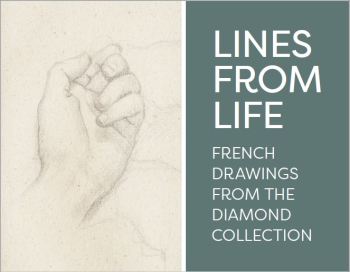 Nineteenth-century French figure drawings embody a conceptual tension between academic methods of drawing the human form and freer approaches that challenged those conventions. The curriculum of the state-sponsored École des Beaux-Arts (School of Fine Arts) in Paris and the esteemed Académie de France (French Academy) in Rome long considered drawings of the nude, studied and sketched live in the classroom, to be the ultimate measure of an artist’s skill. Modeled after ancient Greek and Roman sculpture and Renaissance examples, the predominantly white and male figure centered in works exploring historical, mythological, and religious themes was a physique that was not reflective of the diversity of human bodies. By midcentury many French artists—including those who originally trained in academic studios—signaled their creative independence with portraits and genre scenes representing ordinary and working people in natural poses. This exhibition traces transformations in figure drawing during a period in which these developing interests in Realism and contemporary life diverged from the idealism championed by public institutions.

François Louis Joseph Watteau (1758–1823), Sheet of Studies for ‘The Battle of Alexander’, ca. 1795; black chalk on off-white paper (The Clark Art Institute, Gift of Herbert and Carol Diamond, 2018.11.13).
The works on view span the nineteenth century and reveal the varied uses of figure drawing. Detailed studies addressing a model’s features and form commingle with swiftly drawn sketches that explore gesture and movement. Sheets bearing grid lines and handwritten annotations demonstrate the relationships between drawing and other media, including painting and printmaking. Many of these works illuminate the versatility of graphite, the primary instructional medium before the middle of the century. Compositions by artists associated with Realism, Impressionism, and other late nineteenth-century art currents evoke how the infusion of diverse media—chalk, charcoal, Conté crayon, and color pastel—often bolstered experimentation as artists increasingly depicted the people around them.
In celebration of the generous, ongoing gift of Herbert and Carol Diamond, this exhibition highlights works from the couple’s remarkable collection of more than 160 French drawings and sculptures, which they have assembled since 1964. The Diamonds’ particular fascination with the preparatory role of drawing broadens the Clark’s presentation of nineteenth-century French art—the cornerstone of the museum’s founding gift—and introduces works by artists not previously represented in the collection. Select figure studies from the Clark’s collection, which has continued to expand, join this display in the spirit of inviting a new look.
Lines from Life: French Drawings from the Diamond Collection is organized by the Clark Art Institute and curated by Kristie Couser, curatorial assistant for works on paper.
◊ ◊ ◊ ◊ ◊
Clark Connects with Ewa Lajer-Burcharth
(Online) Thursday, 6:00–7:00pm, 3 December 2020
Join Ewa Lajer-Burcharth for a conversation on nineteenth-century drawing and the role of the body image. Professor Lajer-Burcharth, whose research spans from eighteenth and nineteenth-century European art to contemporary art, as well as feminist and critical theory, will be in dialogue with Manton Curator of Prints, Drawings, and Photographs Anne Leonard.
Registration (required to receive Zoom log-in details) is available here.
Ewa Lajer-Burcharth is William Dorr Boardman Professor of Fine Arts in the Department of History of Art & Architecture at Harvard University. She specializes in eighteenth- and nineteenth-century French art and has written extensively on contemporary art.
New Book | Scenes and Traces of the English Civil War
From Reaktion Books:
Stephen Bann, Scenes and Traces of the English Civil War (London: Reaktion Books, 2020), 288 pages, ISBN: 978-1789142280, £40 / $60.
 The English Civil War has become a frequent point of reference in contemporary political debate. A bitter and bloody series of conflicts, it shook the very foundations of seventeenth-century Britain. This is the first attempt to portray the visual legacy of this period, as passed down, revisited, and periodically reworked over two and a half centuries of subsequent English history. Stephen Bann deftly interprets the mass of visual evidence accessible today, from ornate tombs and statues to surviving sites of vandalism and iconoclasm, public signage, and historical paintings of subjects, events, and places. Through these important scenes and sometimes barely perceptible traces, Bann shows how the British view of the War has been influenced and transformed by visual imagery.
Stephen Bann is Professor in the Department of History of Art at the University of Bristol. He is author of many books including Romanticism and the Rise of History (1995); Paul Delaroche: History Painted (Reaktion, 1997); and Jannis Kounellis (Reaktion, 2003).
C O N T E N T S
Introduction
1 Speaking Stones: Inscriptions of Identity from Civil War Monuments
2 A Kentish Family in Wartime: The Bargraves of Bifrons
3 Kings on Horseback: Charles I’s Statue at Charing Cross and Its Afterlife
4 Whig Views of the Past: Horace Walpole and Co.
5 Illustrating History: Visual Narratives from the Restoration to Hume’s History of England
6 Boots and All: Cromwell Evoked by James Ward and Paul Delaroche
7 French Genre for English Patrons: Paul Delaroche’s Charles I Insulted by the Soldiers of Cromwell
8 A Sense of an Ending: Problems of English History Painting in the Nineteenth Century
Chronology
Bibliography
Acknowledgements
List of Illustrations
Index
Exhibition | Alexander von Humboldt and the United States

Now on view at SAAM:
Alexander von Humboldt and the United States: Art, Nature, and Culture
Smithsonian American Art Museum, Washington, DC, 18 September 2020 — 3 January 2021
Organized by Eleanor Jones Harvey
Renowned Prussian naturalist and explorer Alexander von Humboldt was one of the most influential figures of the nineteenth century. He lived for 90 years, published more than 36 books, traveled across four continents, and wrote well over 25,000 letters to an international network of colleagues and admirers. In 1804, after traveling four years in South America and Mexico, Humboldt spent exactly six weeks in the United States. In these six weeks, Humboldt—through a series of lively exchanges of ideas about the arts, science, politics, and exploration with influential figures such as President Thomas Jefferson and artist Charles Willson Peale—shaped American perceptions of nature and the way American cultural identity became grounded in our relationship with the environment.
Alexander von Humboldt and the United States: Art, Nature, and Culture places American art squarely in the center of a conversation about Humboldt’s lasting influence on the way we think about our relationship to the natural world. Humboldt’s quest to understand the universe—his concern for climate change, his taxonomic curiosity centered on New World species of flora and fauna, and his belief that the arts were as important as the sciences for conveying the resultant sense of wonder in the interlocking aspects of our planet—make this a project evocative of how art illuminates some of the issues central to our relationship with nature and our stewardship of this planet.

Charles Willson Peale, Self-Portrait with Mastodon Bone, 1824, oil on canvas, 26 × 22 inches (New-York Historical Society, Purchase, James B. Wilbur Fund).
This exhibition will be the first to examine Humboldt’s impact on five spheres of American cultural development: the visual arts, sciences, literature, politics, and exploration, between 1804 and 1903. It centers on the fine arts as a lens through which to understand how deeply intertwined Humboldt’s ideas were with America’s emerging identity. The exhibition includes more than 100 paintings, sculptures, maps, and artifacts as well as a video introduction to Humboldt and his connections to the Smithsonian through an array of current projects and initiatives.
Artworks by Albert Bierstadt, Karl Bodmer, George Catlin, Frederic Church, Eastman Johnson, Samuel F.B. Morse, Charles Willson Peale, John Rogers, William James Stillman, and John Quincy Adams Ward, among others, will be on display. The installation features a digital exploration of Frederic Church’s famous landscape, Heart of the Andes (1859), enabling visitors to engage with the painting’s details in new ways. The wealth of detail is a painterly extrapolation of Humboldt’s plant geography map. The mountain at the center of the work, Chimborazo, was referred to as ‘Humboldt’s Mountain’. The narrated, 2.5D animated projection enables visitors to appreciate the connections between Church’s painting and Humboldt’s ideas.
The exhibition also includes the original ‘Peale Mastodon’ skeleton, on loan from the Hessisches Landesmuseum Darmstadt, with ties to Humboldt, Peale and an emerging American national identity in the early nineteenth century. Its inclusion in the exhibition represents a homecoming for this important fossil that has been in Europe since 1847, and emphasizes that natural history and natural monuments bond Humboldt with the United States.
Alexander von Humboldt and the United States: Art, Nature, and Culture is organized by Eleanor Jones Harvey, senior curator at the Smithsonian American Art Museum. A major catalogue, written by Harvey, accompanies the exhibition. The book shows how Humboldt inspired a network of like-minded individuals who would go on to embrace the spirit of exploration, decry slavery, advocate for the welfare of Native Americans and extol America’s wilderness as a signature component of the nation’s sense of self. Harvey traces how Humboldt’s ideas influenced the transcendentalists and the landscape painters of the Hudson River School, and laid the foundations for the Smithsonian, the Sierra Club, and the National Park Service.
Eleanor Jones Harvey, Alexander von Humboldt and the United States: Art, Nature, and Culture (Princeton: Princeton University Press, 2020), 448 pages, ISBN: 978-0691200804, £62 / $75.
New Book | Tokyo Before Tokyo
From Reaktion Books:
Timon Screech, Tokyo Before Tokyo: Power and Magic in the Shogun’s City of Edo (London: Reaktion Books, 2020), 240 pages, ISBN: 9781789142334, £25 / $40.
 Tokyo today is one of the world’s mega-cities, and the centre of a scintillating, hyper-modern culture—but not everyone is aware of its past. Founded in 1590 as the seat of the warlord Tokugawa family, Tokyo, then called ‘Edo’, was the locus of Japanese trade, economics and urban civilization until 1868, when it mutated into Tokyo and became Japan’s modern capital.
This beautifully illustrated book presents important sites and features from the rich history of Edo, drawn from contemporary sources such as diaries, guidebooks and woodblock prints. These include the huge bridge on which the city was centred, the vast castle of the shogun, sumptuous Buddhist temples, bars, kabuki theatres and the Yoshiwara, Edo’s famous red-light district.
Timon Screech is Professor in the History of Art at SOAS, University of London, and a Fellow of the British Academy. He is the author of many books, including Sex and the Floating World: Erotic Images in Japan, 1700–1820 (2nd edn, Reaktion, 2009).
C O N T E N T S
Introduction
1 The Ideal City
2 The Centre of the Shogun’s Realm
3 Edo as Sacred Space
4 Reading Edo Castle
5 The City’s Poetic Presence
6 A Trip to the Yoshiwara
Epilogue: From Edo to Tokyo
References
Selected Sources and Further Reading
General Bibliography
Acknowledgements
Photo Acknowledgements
Grinling Gibbons Society Looks to Tercentenary in 2021
The joys of thinking about next year! This announcement from the Grinling Gibbons Society:
Grinling Gibbons Society: Carving a Place in History
The Grinling Gibbons Society is a newly-formed membership organisation and charity at the centre of planning the celebration of Grinling Gibbons’ tercentenary in 2021.
 The Gibbons 300 festival is a collaborative venture involving a wide network of museums, houses and collections, supported by the Mercers’ and Drapers’ Companies, architects, present-day carvers, designers, practitioners and individuals with an interest in Gibbons and his remarkable legacy. The festival will combine a programme of public events, creative projects, education, research, and collaborative scholarship between museums, collections, and institutions. A key part of the programme will be an important loan exhibition of Gibbons’ work from August 2021, which will also consider sculptors, carvers, and artists who have been inspired by his innovative genius across the passage of three hundred years, right up to the present day. Exploring the living legacy of Gibbons is a vital part of the exhibition’s purpose, as is engagement with contemporary practice, in furthering the Society’s objectives of outreach, education, and making links across the UK.
To this end, the Society is developing two education projects: a Traineeship in stone and wood-carving, enabling the exchange of skills and expertise from master carvers to emerging artists; and a National Award (linked to the exhibition) for emerging craftspeople and carvers, providing a prestigious platform for showcasing their work, with exposure to public and professional recognition and expert feedback.
The vision for the Society now goes well beyond 2021–22 and its aim is that it will provide an ongoing platform and focus for continued scholarship, education, and enjoyment of seventeenth- and eighteenth-century carving and sculpture, and the figures and associates around Gibbons who remain obscure in the field of study.
If you are interested in becoming a member of the Grinling Gibbons Society, being involved in the tercentenary programme, or in supporting us financially, we would be delighted to hear from you. Please email grinlinggibbonssociety@gmail.com for more information and a membership form.
We are also looking for a Membership Secretary and Treasurer. Both posts offer exciting opportunities for those with an interest in Gibbons and in furthering his legacy, or with a broader interest in the history of carving and sculpture, to be part of a new and ambitious Society. For more information please email grinlinggibbonssociety@gmail.com.
Hannah Phillip
Programme Director
Grinling Gibbons Tercentenary 2021
REGISTERED CHARITY 1190987










 Enfilade
leave a comment