Online Lecture Series | Collecting Art in Imperial Russia
From Princeton’s REEES program:
Collecting Art in Imperial Russia
Online Lecture Series: Russian, East European and Eurasian Studies at Princeton, September 2020 — April 2021
Organized by Basile Baudez (Princeton University), Ekaterina Pravilova (Princeton University), and Catherine Phillips (European University, St. Petersburg)
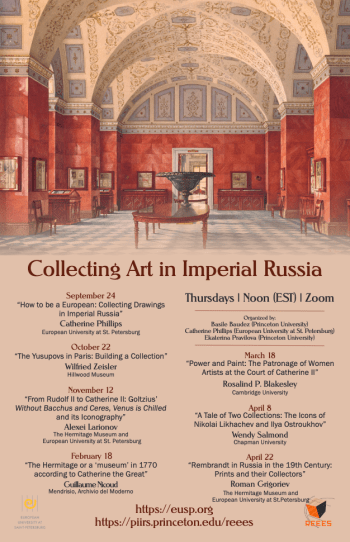 24 September 2020
Catherine Phillips (European University at St. Petersburg), How to be a European: Collecting Drawings in Imperial Russia
22 October 2020
Wilfried Zeisler (Hillwood Museum), The Yusupovs in Paris: Building a Collection
12 November 2020
Alexei Larionov (The Hermitage Museum and European University at St. Petersburg), From Rudolf II to Catherine II: Goltzius’ Without Bacchus and Ceres, Venus is Chilled and its Iconography
18 February 2021
Guillaume Nicoud (Mendrisio, Archivio del Moderno), The Hermitage, or a ‘Museum’ in 1770 according to Catherine the Great
18 March 2021
Rosalind Polly Blakesley (Cambridge University), Power and Paint: The Patronage of Women Artists at the Court of Catherine II
8 April 2021
Wendy Salmon (Chapman University), A Tale of Two Collections: The Icons of Nikolai Likhachev and Ilya Ostroukhov
22 April 2020
Roman Grigoriev (The Hermitage Museum and European University at St. Petersburg), Rembrandt in Russia in the 19th Century: Prints and their Collectors
All lectures take place online on Thursdays, beginning at noon and ending at 1:30pm.
Exhibition | Tantra: Enlightenment to Revolution
From the press release for the exhibition:
Tantra: Enlightenment to Revolution
The British Museum, London, 24 September — 24 January 2021
Curated by Imma Ramos
 A radical philosophy that transformed the religious, cultural, and political landscape of India and beyond is explored in a landmark new exhibition at the British Museum. Supported by the Bagri Foundation, Tantra: Enlightenment to Revolution charts the rise and spread of Tantra, a set of beliefs and rituals that first emerged in India around AD 500. The exhibition explores Tantra’s early medieval transformation of Hinduism and Buddhism, along with its links to the Indian fight for independence and the rise of 1960s counterculture in the West.
Tantra: Enlightenment to Revolution is the first major exhibition in the UK focusing on the history of Tantra and its global impact. It is the very first time the British Museum—which houses one of the biggest and most comprehensive collections of Tantric material in the world—will explore this subject in an exhibition. Over 100 objects will be on show, including masterpieces of sculpture, painting, prints, and ritual objects. Tantra’s impact is evident across Asia’s diverse cultural and religious traditions, but it remains largely unknown—or misrepresented—in the West. Little is known beyond its association to sex and yoga. The exhibition demonstrates that from its inception, Tantra has challenged political, sexual, and gender norms around the world and that it has always been linked to successive waves of revolutionary thought.
Tantra is a philosophy rooted in sacred instructional texts called ‘Tantras’. They take their name from the Sanskrit word ‘tan’, meaning ‘to weave’ or ‘compose’, and are often written in the form of a conversation between a god and goddess. The exhibition will feature four examples of some of the earliest surviving Tantras in the world, on loan from Cambridge University Library. Made in Nepal from around the 12th century, these texts outline a variety of rituals for invoking one of the many all-powerful Tantric deities, including through visualisations (imaginatively identifying with a deity) and yoga. Tantras often also described rituals that transgressed existing social and religious boundaries, such as sexual rites and engagement with intoxicants and the traditionally taboo. Such rituals affirmed all aspects of existence as sacred, including the body and the sensual, in order to achieve liberation and generate power. One example in the exhibition describes the benefits of actively engaging in sexual activity with a partner in order to ultimately transcend desire itself: ‘By passion the world is bound; by passion too it is released’.
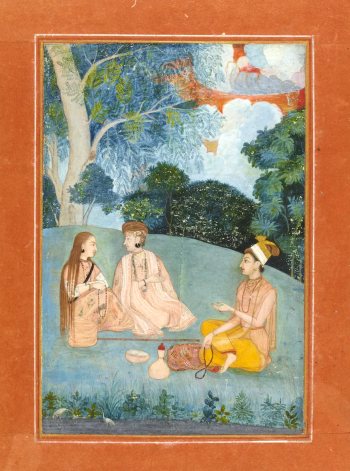
A woman visiting two Nath yoginis, North India, Mughal, ca. 1750 (London: The British Museum).
The exhibition particularly explores Tantra’s radical challenge to gender norms. The Tantric worldview sees all material reality as animated by Shakti—unlimited, divine feminine power. This inspired the dramatic rise of goddess worship in India and confronted traditional gender roles. Goddesses and female Tantric practitioners are featured prominently in the exhibition, ranging from a 9th-century sandstone temple relief from Madhya Pradesh depicting the ferocious goddess Chamunda dancing on a corpse, to an 18th-century courtly painting showing female gurus offering Tantric initiation. These depictions transcended conventional images of womanhood as passive and docile. A number of contemporary works by female artists will be on display, highlighting the ongoing relevance of Tantra’s impact on gender. These works harness Tantric goddesses through the bodies of real women, including Sutapa Biswas’ 1985 mixed media work Housewives with Steak-Knives, which evokes the Tantric goddess Kali in a modern feminist form.
Tantra also became a tool of revolution during the fight for India’s independence in the late 19th century. Indian revolutionaries in Bengal harnessed Tantra for its insurgent potential during colonial rule, reimagining goddesses such as Kali as symbols of an independent India rising up against the British. Visitors will see dramatic sculptures and artworks of Kali wearing garlands of decapitated heads, which successfully exploited British fears of the goddess as a bloodthirsty ‘demon mother’. In the exhibition the true meaning behind her symbolism, tied to both destructive power and maternal strength, will be decoded.
The final section of the exhibition focuses on the 20th century and Tantra’s modern re-imaginings in Asia and the West. In the 1960s and 1970s, Tantric ideas and imagery inspired global countercultural movements and had an important impact on the period’s radical politics. In Britain and the USA, Tantra was interpreted as a movement that could inspire anti-capitalist, ecological, and free love ideals. The Tantra-inspired psychedelic posters that plastered the streets of London and San Francisco during this time are on show, as well as paintings, photographs, and sculptures illustrating Tantra’s enduring influence in art and popular culture.
The exhibition is organized by Dr. Imma Ramos, a curator of the South Asia collections at the British Museum.
Imma Ramos, Tantra: Enlightenment to Revolution (London: Thames & Hudson, 2020), 288 pages, ISBN: 978-0500480625, £35 / $50.
Call for Papers | HECAA Emerging Scholars Showcase
From the Call for Papers:
HECAA Emerging Scholars Showcase
Online, 7 November 2020 and 6 February 2021
Applications due by 11 October 2020
 The Historians of Eighteenth-Century Art and Architecture (HECAA) invite emerging scholars studying art, architecture, and visual culture of the long eighteenth century (c. 1660–1830) around the globe, current graduate students (both MAs and PhDs), and those who have received their PhDs within the past five years, to participate in a virtual showcase to promote their research.
Each scholar will be given 3–5 minutes to present their work, followed by an open question and answer session. We will hold two sessions, one on Saturday, 7 November 2020 and one on Saturday, 6 February 2021, each lasting about 1.5 hours. Additional sessions may be added depending on interest. To apply, please fill out this form. Applications are due by Sunday, October 11 at midnight (EST). Please direct any questions to Dani Ezor, dezor@smu.edu.
Exhibition | Exotic Switzerland? Looking Outward
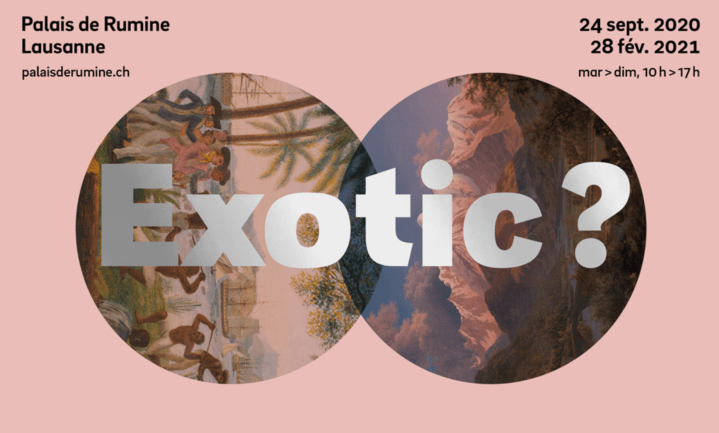
Opening next week at the Palais de Rumine:, with additional information, including programming, available here»
Une Suisse exotique? Regarder l’ailleurs en Suisse au siècle des Lumières
Exotic Switzerland? Looking Outward in the Age of Enlightenment
Palais de Rumine, Lausanne, 24 September 2020 — 28 February 2021
Organized by Noémie Étienne
What is exotic? How long has this word been used? How do we define what is exotic and what is not? Is Switzerland exotic? In Europe, the Enlightenment is a key period in building up this view, of which we are still the heirs. This era was that of both human rights and the quadrangular trade, including trade in enslaved people. It can be reread critically. Swiss history is often only considered within the borders of Europe, but the Swiss maintained close and complex ties with distant countries.
Why This Exhibition?
 This exhibition is the result of a collaboration between the team of Professor Noémie Étienne (Bern University, Swiss National Science Foundation) and the three museums of science and history of the Palais de Rumine. Exotic? will be presented in the large temporary exhibition rooms of the Palais. It offers a historical and critical perspective in order to understand the emergence of this view of the Other and the acts of classification that accompanied it. Indeed, nothing is ‘exotic’ in itself: exoticism is the product of representations, mediations, and translations, which assign a place to things and people in a given historical and political context. This exhibition depicts the image of a dynamic and complex Switzerland that became part of the world, mostly through individual initiatives. It also adds complexity to an idealised interpretation of the 18th century, which was certainly an era of great scientific and artistic innovation but also of the first economic globalisation, and colonisation.The issues of colonialism, power, gender, race and economy are at the heart of this exhibition, which aims at reflecting about Switzerland’s past, especially the careers of individuals who wished to take part in colonisation and international trade.
Who Were Swiss Travellers in the 18th Century?
Many Swiss People travelled beyond the borders, mostly individually. However, these journeys were often made under the aegis of a foreign crown and were often linked to economic, political, and religious networks that could go beyond the borders of the territory (Huguenot, banking, missionary, foreign service, and military networks). These travellers settled in the countries they visited and developed their careers in close cooperation with the peoples and territories concerned.The objects that were collected by artists and scientists in the 18th century were brought back to Switzeland and included in local collections. Two types of collection can be differentiated: on one hand, those made through intermediaries that accompanied British and French national explorations, and on the other hand those created directly by Swiss People. During these voyages, which lasted several years, the crews collected objects and specimens that they brought back to Europe and then traded or sold. At the same time, they kept travel journals and filled sketchbooks in which they described the objects and the contexts of what they collected as well as the peoples they encountered.
The nature of the objects that were collected by Swiss People has many commonalities with examples that can be studied in neighbouring countries. One of the characteristics was the use of collections for education, particularly due to the presence of cabinets in the Protestant Academies, such as in Lausanne and Zurich. This use was part of a pedagogical process that favoured a pragmatic view of things, and differentiated the cabinets of the Swiss Academies from the German ‘Wunderkammer’, the royal cabinets and the princely collections of European courts.
Innovation and Technology Transfer
The circulation of techniques and objects that came from the outside world promoted the development of new technologies all over Europe and especially in Switzerland. This was the case of the porcelain factories in Zurich and Nyon that produced for a local clientele. However, other factories that developed in Switzerland manufactured objects (watches, enamels) for export to China and Turkey. The cities of Basel, Geneva and Neuchâtel also produced printed textiles known as ‘Indian chintz’, imitating a technique used in India.
Is Switzerland Exotic?
Switzerland became gradually a subject of curiosity for travellers who were interested in its folklore and landscapes: it was therefore exotic for those who visited it. This movement was prepared from the 18th century onward by the inhabitants of the large cities: they built up an image of Alpine and rural cultures that was a great success and that can still be found today in advertising and in tourist marketing.
Public and Cultural Mediation
The exhibition aims at reaching all kinds of people, especially through a varied scientific and cultural programme, while putting forward a new approach to Swiss history. It will attempt to connect the images that were produced in the 17th and 18th centuries to imaginations by offering avenues for thinking about alterity today through a historical perspective and contemporary art (performances, sounds, images). In view of the sensitive subject, many mediation activities will accompany this exhibition: guided tours and workshops, of course, but also a play produced by high school students, short films made by the students of the Swiss film director Lionel Baier at the University of Art and Design ECAL, lectures in coffee grounds by the Women Telling The Future collective, lectures, and a partnership with the programme of the Vidy theatre.
Objects Displayed
The exhibition will bring together 150 pieces from more than 30 Swiss collections and cultural institutions. Most of these pieces are very rarely shown. The typologies of the objects are diverse: specimens of natural history, paintings, textiles, porcelains, non-European artefacts, archives, books and maps.
Contemporary Artists
There will be a selection of works by contemporary artists (Marie van Berchem, Fabien Clerc, Susan Hefuna, Senam Okudzeto and Uriel Orlow), giving a different perspective of the exhibited objects and of the more general aims of the exhibition.
Publications
The English edition of the catalogue is distributed in North America and Britain by The University of Chicago Press:
 Noémie Étienne with Claire Brizon, Chonja Lee, and Étienne Wismer, Une Suisse exotique ? Regarder l’ailleurs en Suisse au siècle des Lumières (Dijon: Les presses du réel, 2020), 376 pages, ISBN: 978-2889280520, 40€.
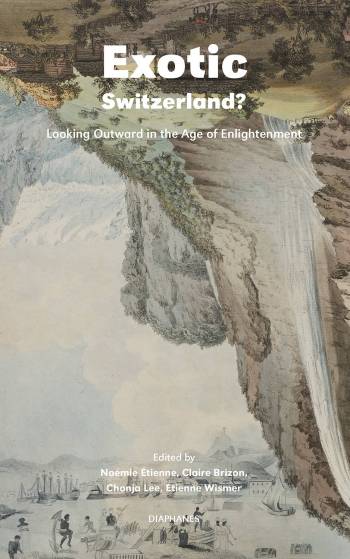
Noémie Étienne with Claire Brizon, Chonja Lee, and Étienne Wismer, Exotic Switzerland? Looking Outward in the Age of Enlightenment (Lausanne: Diaphanes, 2020), 256 pages, ISBN: 978-3035802276, $40.
Why is an object, an artwork, or a person deemed ‘exotic’? How is the gaze built upon those things or people who seem to belong to other regions or cultures? This notion is studied here in relation to a specific context: the Enlightenment era from the Swiss perspective. The publication brings together for the first time research from academics and specialists of the museum world in order to rethink this time period and this geography. It assembles contributions of essays as well as shorter texts centered on pictures, objects, books, and natural specimens from Swiss museum collections. ‘Exotic’, in this context, means that which comes from elsewhere and can be used and ‘improved’ for the benefits of European powers. This adjective invites us to reconsider both the long eighteenth century and the international history of Switzerland.
Noémie Étienne is professor of Early Modern Art History at the University of Bern. Claire Brizon is a doctoral student in art history at the University of Bern. Chonja Lee is a postdoctoral researcher at the University of Bern. Étienne Wismer is a doctoral student in art history at the University of Bern.
Susan Tallman on Art History’s Loose Canons

Willem van Haecht, Apelles Painting Campaspe, ca. 1630 (The Hague: Mauritshuis). Used as an illustration for Susan Tallman’s review in The New York Review of Books (24 September 2020).
◊ ◊ ◊ ◊ ◊
Note from the Editor
Thanks to all of you for your patience with postings that have grown far more irregular than I would have liked. My family and I have been well, though admittedly, diligence (generally) hasn’t been quite the virtue it was for me prior to COVID. I have good intentions of eventually resuming the regular rate of posts (more or less), though getting there may take some time (pandemic obviously continues to make regular parts of life, including teaching, more complicated). One realization I’ve had over the past few months: I’m much less excited generally about Enfilade in the absence of exhibitions. I don’t actually make it to that many exhibitions in a given year, a fraction of those listed on the site. And yet, exhibitions generate for me (even vicariously) lots of intellectual energy. To all of you who do that work in and with museums, I’m more grateful than ever. Thank you.
I experienced, however, a similar jolt of stimulation while reading the most recent issue of The New York Review of Books (24 September 2020). I love Susan Tallman’s review of Christopher Wood’s A History of Art History (Princeton UP, ) and Éric Michaud’s The Barbarian Invasions: A Genealogy of the History of Art (MIT Press, 2019). In addition to working as an engaging review, Tallman’s piece (“Who Decides What’s Beautiful?,” pp. 16–20) is one of the most concise, satisfying summaries of art history as a discipline I know of—effectively framing the discipline in relation to the ethical and moral stakes of this particular moment in time. Enfilade readers will likely find other reviews from the issue also of interest:
• David Bell on Maurice Samuels’s The Betrayal of the Duchess: The Scandal That Unmade the Bourbon Monarchy and Made France Modern (Basic Books, 2020).
• Kathryn Hughes on new studies of Wordsworth.
• Larry Wolff on Thomas Irvine’s Listening to China: Sound and the Sino-Western Encounter, 1770–1839 (University of Chicago Press, 2020).
• Leah Price on Anthony Grafton’s Inky Fingers: The Making of Books in Early Modern Europe (Belknap/Harvard UP, 2020) and Jordan Alexander Stein’s When Novels Were Books (Harvard UP, 2020).
–Craig Hanson
Fall Lecture Series | Piranesi Turns 300
From the series flyer:
Piranesi Turns 300: A Lecture Series
Zoom Presentations, Organized by the University of South Carolina
 To commemorate the tricentennial of Giovanni Battista Piranesi’s birth on 4 October 1720, the Digital Piranesi at the University of South Carolina is hosting a virtual lecture series in Fall 2020. RSVP to jbritton@mailbox.sc.edu for the zoom link.
Piranesi’s Lost Pages
Heather Hyde Minor (Professor, Art History, University of Notre Dame)
Thursday, 1 October 2020, 10am (EST)
Drawings were a part of Giovanni Battista Piranesi’s daily life in his studio. In his hands, scraps of wastepaper became designs for prints, a way to record the action in his workshop, and much more. Piranesi’s scrap paper pile reveals not only a fiercely talented artist at work but a book that went missing, one that he never released for sale. In this talk, we will make our way through the clues these recycled sheets present to find this lost volume.
The Complete Piranesi
Carolyn Yerkes (Professor, Art and Archaeology, Princeton University)
Thursday, 12 November 2020, 2pm (EST)
The Principle of Aesthetic Disinterest: Giovanni Battista Piranesi and the Lisbon Earthquake of 1755
Peter Parshall (formerly Curator, Old Master Prints, National Gallery of Art)
Thursday, 3 December 2020, 2pm (EST)
HECAA Pandemic Relief Fund, Give Today

Jean-Baptiste Lesueur (1749–1826), “Citoyennes de Paris faisant hommage de leurs bijoux à l’Assemblée Constituante, le 7 septembre 1789” (Citizens of Paris paying tribute with their jewels at the Constituent Assembly, 7 September 1789), gouache (Paris: musée Carnavalet).
◊ ◊ ◊ ◊ ◊
Historians of Eighteenth-Century Art and Architecture
Pandemic Relief Fund
Scholars of eighteenth-century art are facing unprecedented challenges this fall as we struggle to adjust to the realities of the global pandemic. The officers and board of Historians of Eighteenth-Century Art and Architecture (HECAA) have been working on developing resources to help our members cope with these challenges.
One thing is immediately clear — institutional funding for research is going to be in short supply this year. This is going to have the greatest impact on our graduate student and contingent faculty members. So our first priority was to create a new grant fund, and to raise and disburse money as quickly as possible to help our members.
HECAA has a proud tradition of supporting fellow members, especially emerging scholars. I experienced this personally as a graduate student — HECAA was my first intellectual home, and helped me imagine my career as a teacher and scholar. Every member of our board has a similar story. Will you join us in creating a Pandemic Relief Fund? Any and all gifts will help, but we’re going to set our sights high — let’s see if we can raise $4000 to award to applicants this fall.
Thanks in advance,
Amy Freund, President
with
Elizabeth Eager, Vice President
Amanda Strasik, Secretary
Monica Anke Hahn, Treasurer
Wendy Bellion, Board Member
Danielle Ezor, Board Member
Jessica Fripp, Board Member
Online Symposium | George IV and His Furniture, 1820 to 2020
From Eventbrite:
The 44th Annual Symposium of the Furniture History Society
George IV 1820 to 2020: Fresh Perspectives on the King’s Furniture
Online Webinar, 3–4 October 2020
S A T U R D A Y , 3 O C T O B E R — S E S S I O N O N E
16.30 Welcome by Christopher Rowell, Chairman of the FHS
16.35 Introduction by Sir Jonathan Marsden (Chair)
16.40 David Oakey, ‘Painting it and Putting Handsome Furniture Where Necessary’: George Prince of Wales’s Early Furnishing of Carlton House
17.10 Rufus Bird (Surveyor of The Queen’s Works of Art), Tatham & Co. at Carlton House
17.40 Cristina Alfonsín Barreiro (Collections Manager at Waddesdon Manor), The Vulliamys: From Clockmakers to Merchants of Luxury
18.10 Diana Davis, ‘Quite éblouissant’: George IV and the Anglo-Gallic Interior
18.40 Q&A
19.00 Summing Up by Sir Jonathan Marsden
S U N D A Y , 4 O C T O B E R — S E S S I O N T W O
16.30 Welcome by Christopher Rowell, Chairman of the FHS
16.35 Introduction by Sir Jonathan Marsden (Chair)
16.40 Kathryn Jones (Senior Curator at Royal Collection Trust), ‘Of the Utmost Beauty and Newest Fashion’: George IV and Modern Manufacturing
17.10 Alexandra Loske (Art Historian, Curator, and Editor), The Interior Decoration and Colouring of Brighton Pavilion
17.40 Helen Jacobsen (Senior Curator and Curator of 18th-Century French Decorative Arts, The Wallace Collection), Shared Tastes: George IV and the 3rd Marquess of Hertford
18.10 Michael Hall (Curator at Exbury House), George IV’s Legacy and the English Rothschilds
18.40 Q&A
19.00 Summing Up by Sir Jonathan Marsden
◊ ◊ ◊ ◊ ◊
Ticket prices (covering both days): £12 members, £5 members under 35 years, £20 non-members. Please use the this link for registration and payment. Attendees will be admitted from the waiting room into this Zoom Video Webinar from 16.00. Please make sure you are muted and your cameras are turned off. Each session will be followed by a round of Q&A. Please use the chat message box at the bottom of your zoom window to submit questions, and send messages to others. If you are using Zoom software, Zoom have increased their security and you may be required to install an update.
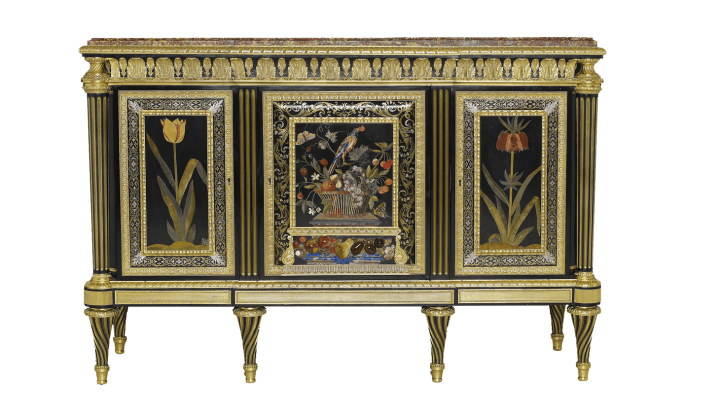
Image: Adam Weisweiler, Commode 1785–90; oak, ebony, hardstones, tortoiseshell, brass, pewter, mahogany, boxwood, purplewood, gilt bronze, brocatello marble; 100 × 150 × 48 cm (Royal Collection Trust, 2593; © Her Majesty Queen Elizabeth II 2020).
Junior Fellows Program | Fellows in Critical Bibliography
From the Rare Book School:
Rare Book School’s Andrew W. Mellon Society of Fellows in Critical Bibliography, 2021–23
Applications due by 2 November 2020
Rare Book School’s Andrew W. Mellon Society of Fellows in Critical Bibliography (SoFCB) invites applications for its 2021–23 cohort of junior fellows. The deadline is Monday, 2 November 2020.
Continuing the work of the Andrew W. Mellon Fellowship in Critical Bibliography (2012–17), this scholarly society works to advance the study of texts, images, and artifacts as material objects through capacious, interdisciplinary scholarship—and to enrich humanistic inquiry and education by identifying, mentoring, and training promising early-career scholars. Junior Fellows will be encouraged and supported in integrating the methods of critical bibliography into their teaching and research, fostering collegial conversations about historical and emerging media across disciplines and institutions, and sharing their knowledge with broader publics.
The fellowship includes tuition waivers for two Rare Book School courses, as well as funding for Junior Fellows to participate in the Society’s annual meeting and orientation. Additional funds are available for fellows to organize symposia at their home institutions, and fellows will have the option of attending a bibliographical field school to visit libraries, archives, and collections in a major metropolitan area. After completing two years in good standing as Junior Fellows, program participants will have the option to become Senior Fellows in the Society.
The Society is committed to supporting diversity and to advancing the scholarship of outstanding persons of every race, gender, sexual orientation, creed, and socioeconomic background, and to enhancing the diversity of the professions and academic disciplines it represents, including those of the professoriate, museums, libraries, archives, public humanities, and digital humanities. We warmly encourage prospective applicants from a wide range of disciplines, institutions, and areas of expertise.
For more information about diversity and the SoFCB, please visit the SoFCB Diversity & Outreach Committee’s Welcome Letter.
Inquiries about the SoFCB Junior Fellows Program can be directed to Sonia Hazard, SoFCB Selection Committee Chair, at shazard@fsu.edu, or Donna Sy, SoFCB Administrative Director, at rbs-mellon@virginia.edu.
Fellowships | Smithsonian American Art Museum, 2021–22
From SAAM:
Smithsonian American Art Museum Fellowships, 2021–2022
Applications due by 1 November 2020

The 2018–19 Smithsonian American Art Museum Fellows
The Smithsonian American Art Museum (SAAM) and its Renwick Gallery invite applications for research fellowships in the art and visual culture of the United States. Fellowships are residential and support full-time independent and dissertation research. SAAM is home to one of the largest and most inclusive collections of American art in the world. Housed in a National Historic Landmark building—shared with the National Portrait Gallery and the Archives of American Art—the museum is a short walk from other Smithsonian museums and libraries, the Library of Congress, the National Archives, and the National Gallery of Art. Regular lunchtime seminars, workshops, and symposia organized by SAAM’s Research and Scholars Center provide a forum for lively scholarly exchange and professional advancement.
The stipend for a one-year fellowship is $40,000 for predoctoral scholars and $55,000 for postdoctoral and senior scholars, with an allowance of up to $4,000 available for short research trips. Additional allowances may be provided to help with temporary relocation and the cost of health insurance. Senior-level recipients of the Terra Foundation Fellowships are eligible for an augmented stipend of $60,000 for the full year. The standard term of residency is twelve months, but terms as short as three months are available with prorated stipends. All fellowships must take place between June 1, 2021, and August 31, 2022. The Smithsonian Office of International Relations will assist with arranging J-1 exchange visas for fellowship recipients who require them.
November 1st is the application deadline. For a link to the application, general information, or research consultation visit AmericanArt.si.edu/fellowships or email SAAMFellowships@si.edu.










 Enfilade
leave a comment