Award Winning Exhibition | Spaces of Wonder, Wonder of Spaces
Recently announced by the Association of College and Research Libraries, with a full list of winners here. Congratulations, Christina Smylitopoulos! More information on the Bachinski / Chu Print Study Collection is available here.
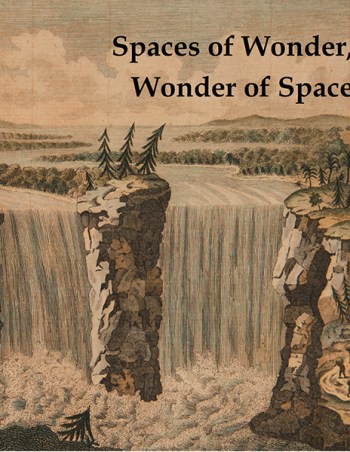
The exhibition catalogue Spaces of Wonder, Wonder of Space: Encountering the Eighteenth Century in Image, Object, and Text, edited by Christina Smylitopoulos, has been selected as a winner of the Katharine Kyes Leab & Daniel J. Leab Exhibition Award (Division Three) by the Association of College and Research Libraries (ACRL), Rare Books and Manuscripts Section (RBMS). This collaborative, multi-venue show was developed in conjunction with the 2018 Société canadienne d’étude du dix-huitième siècle / Canadian Society for Eighteenth-Century Studies conference held in Niagara Falls, Ontario, which was organized jointly by Mount Allison University (MAU; Sackville, New Brunswick) and the University of Guelph (Guelph, Ontario).
The show, which featured works from the Bachinski / Chu Print Study Collection and objects from the McLaughlin Library’s Archival & Special Collections and the Barker Museum of Veterinary History (October 2018 – April 2019) was funded by the Social Science and Humanities Research Council of Canada project Wonder in the Eighteenth Century (Christina Ionescu / Christina Smylitopoulos) and reflects the work of undergraduate students pursuing experiential learning opportunities, graduate students in Art/History, and faculty and curatorial colleagues from Mount Allison University the UofG’s College of Arts.
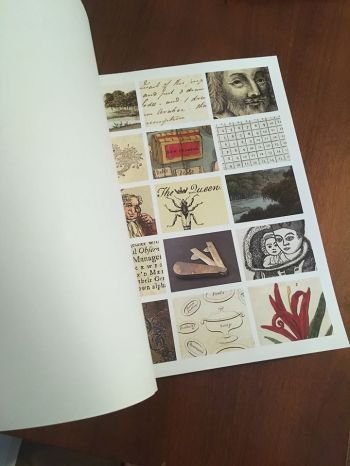 “The content and conceit of this publication is commendable. The central thesis concatenating the objects was compelling and original, offering a discussion not just of objects but also how they are perceived. The committee appreciated the collaborative approach to this topic, which gave space to a wide range of voices and approaches from students to faculty.” –Leab Awards Committee
Online Lecture | Amelia Rauser, Black Bodies and Neoclassical Whiteness
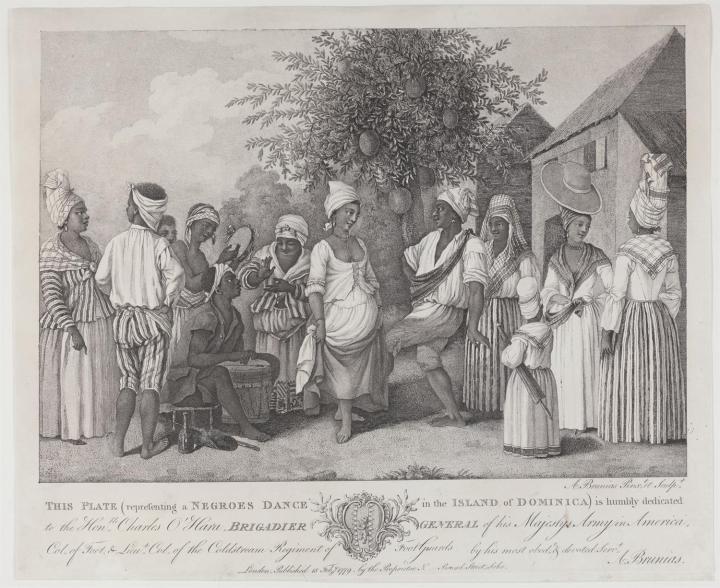
Agostino Brunias, ‘A Negroes Dance in the Island of Dominica’, 1779, engraving on laid paper
(Lewis Walpole Library, 779.02.15.01)
◊ ◊ ◊ ◊ ◊
From the Lewis Walpole Library:
Amelia Rauser, Black Bodies and Neoclassical Whiteness in the Age of Undress
Online lecture organized by the Lewis Walpole Library, 24 June 2020
Registration due by 22 June 2020
Women who wore the high-waisted, white muslin dress fashionable in the 1790s strove to participate in the elevated aesthetics of neoclassicism and to construe themselves as living statues, Pygmalions to their own Galatea. The dress articulated an anti-fashion stance that created space for women’s artistic expression. But neoclassical dress was also enmeshed with emergent concepts of race in the 1790s—not via a simple mapping of whiteness onto classicism, but rather, and perhaps unexpectedly, by invoking the plantation culture of the West Indies. In this talk, Dr. Amelia Rauser, Professor of Art History at Franklin & Marshall College, will argue that several elements of the neoclassical ensemble, including gold earrings, madras-cloth accessories, headwraps, and especially the materiality of muslin itself, specifically articulated the wearer’s racialized whiteness. Yet at the same time, the idea of metamorphosis inherent in the living statue undermined racial binaries and provided space to explore a spectrum of embodiment.
Dr. Rauser will be introduced by Joseph Roach, Sterling Professor Emeritus of Theater, Professor Emeritus of English, Yale University. Panel discussants Dr. Carolyn Day, Associate Professor of History, Furman University, and Dr. Jennifer Germann, Associate Professor and Department Chair, Art History, Ithaca College, will lead a Q&A. Registered attendees will be invited to submit questions and comments through chat.
The lecture is scheduled for Wednesday, 24 June 2020, at 1.00pm EDT; registration is required by Monday, 22 June 2020.
The talk presented in connection with the exhibition Artful Nature: Fashion and Theatricality, 1770–1830, which was co-curated by Laura Engel, Professor of English, Duquesne University, and Amelia Rauser. Other related online content includes:
• Artful Nature exhibition
• Keynote Lecture “Fashionable Friends: Glamour as Argument, 1770–1830,” delivered by Joseph Roach on 6 February 2020
• Exhibition video tour with the curators
Dr. Rauser’s new book, The Age of Undress: Art, Fashion, and the Classical Ideal in the 1790s, is now available from Yale University Press.
Call for Papers | Watteau and His Universe: Networks and Influences
From the Call for Papers (with the French version here) . . .
L’univers de Watteau: Réseaux et influences autour d’Antoine Watteau (1684–1721)
Musée de l’Armée – Hôtel National des Invalides, Paris, 17–18 November 2021
Proposals due by 15 October 2020
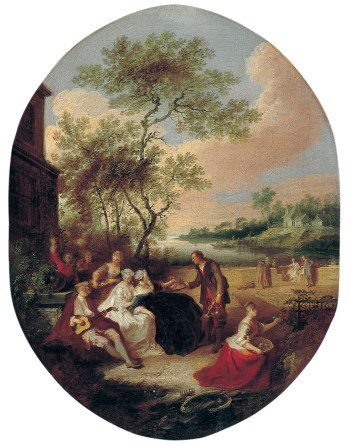
Pierre Antoine Quillard, The Four Seasons: Spring, ca. 1725–29, oil on canvas, 42.5 × 33.5 cm (Madrid: Colección Carmen Thyssen-Bornemisza en depósito en el Museo Nacional Thyssen-Bornemisza, inv. CTB.1930.90).
To commemorate the tricentenary of the death of Antoine Watteau (Valenciennes, 1684–1721, Nogent-sur-Marne), a two-day symposium will be held in Paris, at the Musée de l’Armée – Hôtel National des Invalides, in partnership with the Fine Arts Paris fair, 17–18 November 2021.
Since the major retrospective of 1984, several important publications have been produced. In 1996, Pierre Rosenberg and Louis-Antoine Prat co-signed the catalogue raisonné of Watteau’s drawings.1 In 2010, Christoph Martin Vogtherr conducted an extensive survey (historical and material) of French paintings by Watteau and his entourage in the collections of Prussian palaces,2 continued by an exhibition in the musée Jacquemart-André.3 Since 2014, Martin Eidelberg has been developing the Watteau and His Circle project, alongside the catalogue raisonné of his paintings: A Watteau Abecedario.
Eidelberg’s Watteau and His Circle project is the inspiration for this symposium. His research on artists who gravitated around Watteau, such as Pierre Antoine Quillard4 or Nicolas Lancret,5 together with the work of other scholars on those and other artists in the orbit of Watteau, have called into question the tradition of the solitary work of the artist. In 1932, Robert Rey was the first to consider Watteau’s followers as satellites, situating the artist as a central figure who set in motion an entire system around him.6 This term of satellites implies a notion of attraction and of concentric circles revolving around a central figure and occasionally crossing each other. However, within the framework of this symposium, this conception does not necessarily imply a hierarchy among the elements, but sees them interacting independently of their perceived importance. Masters, contemporaries, followers, friends, merchants, and collectors all took part in Watteau’s universe.
This symposium, Watteau and His Universe: Networks and Influences of Antoine Watteau (1684–1721), aims to study the figures gravitating around the painter who made him a central figure in eighteenth-century century French art.7 Close investigation of fellow painters, printmakers, merchants, collectors, amateurs, and friends is necessary in order to further our knowledge of Watteau. Communications will be expected to draw upon the works of art (drawings, paintings, etchings), so that they are exploited for their intrinsic value; the same goes for archival elements offering direct insight into the careers and interactions between Watteau and his universe.
The symposium will be divided into three parts:
1. Artists around Watteau
2. Watteau’s Social Milieu
3. Watteau on the Art Market: Collectors, Amateurs, Merchants
The symposium is organized in partnership with the international Fine Arts Paris fair (16–23 November 2021) and will be held in the auditorium of the Musée de l’Armée – Hôtel National des Invalides. Twenty-minute papers will be given in French and English (without translation). Since the organization of this symposium is a private initiative without public funding, please include at the end of your proposal your partner institution(s), your city of residence (in November 2021) and your ability or not to finance your trip. Requests for travel subventions will be studied on a case by case basis in order not to disadvantage students and independent researchers.
Publication of the symposium proceedings is planned within 12 months of the event. In order to speed up the publication process of the proceedings, upon notification of their acceptance, symposium participants will be asked to write their papers according to the established editorial standards. These will be forwarded with the approval notices.
Formatting
• Last name, first name, home institution
• Proposed title of the communication
• Summary of the proposal in 500 words (±10%, the count must appear at the end of the document)
• Illustrations (5 maximum, optional) – .word or .pdf document
• Proposals must be sent to watteau2021@gmail.com with the subject ‘NAME + Watteau 2021 Symposium’
For any questions, contact: Axel Moulinier (Doctoral student in History of Art, École du Louvre, University of Burgundy) via watteau2021@gmail.com.
Steering Committee
• Martin Eidelberg (Professor Emeritus, Rutgers University, New Jersey)
• Guillaume Faroult (Curator of 18th-century French paintings and British and American paintings, Paris, Louvre Museum)
• Margaret Morgan Grasselli (Visiting Lecturer, Department of History of Art and Architecture, Harvard University, and Visiting Senior Scholar for Drawings, Harvard Art Museums)
• Axel Moulinier (Doctoral student in History of Art, École du Louvre, Paris; University of Burgundy, Dijon)
• Louis-Antoine Prat (Art historian)
• Pierre Rosenberg, president (Member of the French Academy)
• Christoph Martin Vogtherr (Director General of the Foundation for Prussian Castles and Gardens Berlin-Brandenburg)
Notes
1 Rosenberg P. et L.-A. Prat, Antoine Watteau, 1684–1721: Catalogue raisonné des dessins (Paris and Milan: Gallimard-Electa, Leonardo Arte, 1996), 3 volumes.
2 Vogtherr C.M., Französische Gemälde, I: Watteau, Pater, Lancret, Lajoüe (Berlin: Akademie Verlag, coll.« Bestandskataloge der Kunstsammlungen », 2011).
3 Vogtherr C.M. and M. Tavener Holmes, De Watteau à Fragonard: Les fêtes galantes, exhibition catalogue, Paris, musée Jacquemart-André, 2014 (Paris, Culture Espaces, Fonds Mercator, 2014).
4 Eidelberg M., “P. A. Quillard, An Assistant to Watteau,” The Art Quarterly (1970): 39–70.
5 Eidelberg M., “The Young Lancret and Watteau,” in Watteau and His Circle, http://208.106.158.90/younglancret.htm.
6 Rey R., Quelques Satellites de Watteau: Antoine Pesne et Philippe Mercier, François Octavien, Bonaventure de Bar, François-Jérôme Chantereau, thèse complémentaire pour le doctorat ès lettres (Paris: Librairie de France, 1932).
7 Huyghe R., “L’Univers de Watteau,” (préface) in Adhémar H., Watteau sa vie, son oeuvre (Paris: P. Tisné, 1950).
Selective Bibliography
• Dacier É., A. Vuaflart, and J. Hérold, Jean de Jullienne et les graveurs de Watteau au XVIIIe siècle (Paris: Rousseau, 1922).
• Eidelberg M., “P. A. Quillard, An Assistant to Watteau,” The Art Quarterly (1970): 39–70.
• Eidelberg M., “Autour du nom de Quillard,” Bulletin de la Société de l’Histoire de l’Art Français (1979): 129–140.
• Eidelberg M., “Jean-Jacques Spoëde: Watteau’s ‘Special Friend’,” Gazette des beaux-arts (2000): 179–196.
• Eidelberg M., Watteau et la fête galante, exhibition catalogue, Musée des Beaux Arts de Valenciennes, 2004 (Paris and Valenciennes: Réunion des musées nationaux, Musée des beaux-arts de Valenciennes, 2004).
• Eidelberg M., Rêveries italiennes: Watteau et les paysagistes français au XVIIIe siècle, exhibition catalogue, Musée des Beaux Arts de Valenciennes, 2015-2016 (Gand: Snoeck, 2015).
• Glorieux G., A l’enseigne de Gersaint: Edme-François Gersaint, marchand d’art sur le pont Notre-Dame (1694–1750) (Paris: Champ Vallon, 2002).
• Glorieux G., “Michel-Joseph Ducreux (vers 1665–1715), marchand de masques de théâtre et d’habits de carnaval au temps de Watteau,” Bulletin de la Société de l’Histoire de l’Art Français de l’année (2007): 119–129.
• Moulinier A., “Les Satellites de Watteau,” Cahiers du dessin français (Paris: Galerie de Bayser, 2020).
• Moureau F. and M.M. Grasselli (dir.), Antoine Watteau (1684–1721): Le peintre, son temps et sa légende [colloque international, Paris, October 1984] (Paris and Genève: Champion, Slatkine, 1987).
• Rosenberg P., Watteau et son cercle dans les collections de l’Institut de France, exhibition catalogue, Chantilly, Musée Condé, 1996–1997 (Chantilly, Musée Condé, 1996).
• Sheriff M.D., ed., Antoine Watteau: Perspectives on the Artist and the Culture of His Time (Newark: University of Delaware, 2006).
• Vogtherr C.M., Französische Gemälde, I: Watteau, Pater, Lancret, Lajoüe (Berlin: Akademie Verlag, coll.« Bestandskataloge der Kunstsammlungen », 2011).
• Vogtherr C.M. and M. Tavener Holmes, De Watteau à Fragonard: Les fêtes galantes, exhibition catalogue, Paris, musée Jacquemart-André, 2014 (Paris, Culture Espaces, Fonds Mercator, 2014).
• Vogtherr C.M. and J. Tonkovich, Jean de Jullienne: Collector and Connoisseur (London: Wallace Collection, 2011).
• Wintermute A., Watteau and His World: French Drawing from 1700 to 1750, exhibition catalogue New York, Frick Collection, 1999–2000; Ottawa, National Gallery of Canada, 2000 (London and New York: Merrell Holberton Publishers, American Federation of Arts, 1999).
Call for Papers | Bodily Realities: Engaging the Discourse of Dis/Ability
From ArtHist.net:
Bodily Realities: Engaging the Discourse of Dis/Ability
46th Annual Cleveland Symposium for Graduate Students
Case Western Reserve University and the Cleveland Museum of Art, 30 October 2020
Proposals due by 17 July 2020 (extended from 26 June 2020)
The physical body is often a contested space for artists and art audiences, but one that offers abundant possibilities for exploring and expressing identity. Physical ability or disability is a key component of identity and can have a profound impact on artistic production, subject matter, and reception. Art can play a significant role in shaping the often problematic discourse surrounding this topic. Bodily Realities: Engaging the Discourse of Dis/Ability seeks to generate a dialogue about the relationship between ability and disability in the visual arts and art museums in an effort to understand the role of bodily differences in artistic practice, representation, and viewership. This symposium will address the ways in which the visual arts and artists either confirm or challenge the perceived dichotomy of the normative and non-normative physical body.
The Department of Art History and Art at Case Western Reserve University invites graduate students to submit abstracts for its 2020 Annual Symposium Bodily Realities: Engaging the Discourse of Dis/Ability. The Cleveland Symposium is one of the longest-running annual art history graduate symposia in the United States, organized by students in the joint graduate program with the Cleveland Museum of Art.
Petra Kuppers will provide the keynote address. Dr. Kuppers is a disability culture activist, a community artist, and a Professor of English, Women’s Studies, Theatre and Dance, and Art and Design at the University of Michigan. She also teaches on the low-residency MFA in Interdisciplinary Arts at Goddard College and leads The Olimpias, a performance research collective (www.olimpias.org). Thematically, her work encompasses disability studies, performance studies, critical theory and poetics, medical humanities, and the general fields of arts and expression, arts and health, and arts and community building. Her Disability Culture and Community Performance: Find a Strange and Twisted Shape (2011) explores arts-based research methods, and her most recent academic monograph is Theatre & Disability (2017). Her Studying Disability Arts and Culture: An Introduction (2014) is full of practical exercises for classrooms and studios. Her other academic books include Disability and Contemporary Performance: Bodies on Edge (2003), The Scar of Visibility: Medical Performance and Contemporary Art (2007), Community Performance: An Introduction (2007, second edition 2019), Somatic Engagement (2011), and Disability Arts and Culture: Methods and Approaches (2019).
This year’s symposium welcomes innovative research papers that explore the issues of ability and disability in and around the creation, reception, and circulation of the visual arts. Submissions may explore aspects of this theme as manifested in any medium as well as in any historical period and geographical location. Different methodological perspectives are welcomed.
Potential topics may include, but are not limited to:
• The role of physical disability in the construction of identities
• How the body relates to notions of normativity, abnormality, and hybridity
• Disability as a physical reality, but a social construct
• Stigmatization and stereotypes of the disabled body
• The fragmented, altered, disfigured, or modified body
• The body as a site of trauma, violence, pain, and/or effort
• The body’s relationship to health, illness, and recovery
• Clinical uses of art and artistic practice for disabled and non-disabled bodies
• The intersections of body and mind in the discourse of disability
• The power dynamics of ability and disability
• Accessibility in the art museum and cultural sites
• Interactions with disabled bodies through performance
• The body as subject and/or medium in performance art and body art
• The bias of ableism in art historical discourse
• The in/visibility of disability
• The Disability Arts and Culture Movement
Current and recent graduate students in art history and related disciplines are invited to submit a 350-word abstract and a CV to clevelandsymposium@gmail.com by Friday, 26 June 2020. Selected participants will be notified by the end of July. Paper presentations will be 20 minutes in length and should be accompanied by a PowerPoint presentation. Three papers will be awarded prizes.
Please note: Planning for this year’s symposium is already underway, but given the current situation with the COVID-19 pandemic, we understand that plans may need to be amended. Alternative arrangements are being made to transition to an online platform should an in-person symposium be infeasible.
Please direct all questions to Katie DiDomenico and Mackenzie Clark at clevelandsymposium@gmail.com.
New Book | The English Folly: The Edifice Complex
From Historic England and Liverpool UP:
Gwyn Headley and Wim Meulenkamp, The English Folly: The Edifice Complex (Historic England, 2020), 260 pages, ISBN: 978-1789621976 (hardcover), £60 / ISBN: 978-1789622126 (paperback), £30.
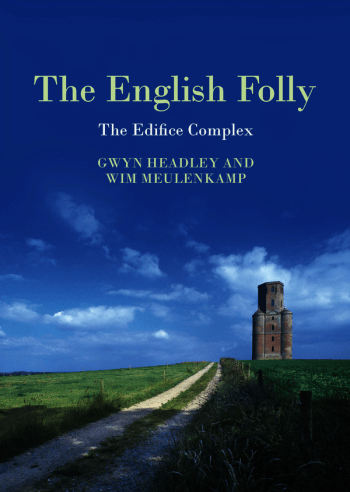 If this were a novel, the tales of astounding wealth, sexual perversion, murder, munificence, rape, insanity, brutality, slavery, religious mania, selfishness, snobbery, charity, suicide, generosity, theft, madness, wickedness, failure, and eccentricity which unfold in these pages would be too concentrated to allow for the willing suspension of disbelief. All these sins and virtues, and more, are displayed by the characters in this book, some exhibiting several of them simultaneously. Folly builders were not as we are. They never built what we now call follies. They built for beauty, utility, improvement; it is only we, struggling after them with our imperfect understanding, who dismiss their prodigious constructions as follies. Follies can be found around the world, but England is their spiritual home. Having written the definitive books on follies in Great Britain, Benelux, and the USA, Headley and Meulenkamp have turned their attention to the folly builders themselves, people so blinded by fashion or driven by some nameless ideology that they expended great fortunes on making their point in brick, stone and flint. Most follies are simply misunderstood buildings, and this book studies the motives, characters, decisions and delusions of their builders. If there was madness in their building, fortunately there was no method in it.
Gwyn Headley is Publisher at Heritage Ebooks, Managing Director at fotoLibra and Co-founder of The Folly Fellowship. Wim Meulenkamp is President of The DonderbergGroup: Foundation for Follies, Garden Ornaments and the Architecture of Amusement.
Online Lecture | Wolf Burchard on The Met’s New British Galleries
From The Furniture History Society’s Instagram account:
Wolf Burchard, The Metropolitan Museum of Art’s New British Galleries
Online Lecture, 14 June 2020
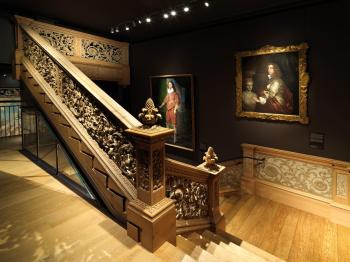
Installation view of the Met’s new British Galleries, featuring the 17th-century Cassiobury Staircase (Photo by Joseph Coscia, February 2020).
Please join us for the free-of-charge inaugural FHS online lecture via Zoom on Sunday, 14 June 2020, at 19.00 British Summer Time (14.00 Eastern Standard Time) with Dr. Wolf Burchard of the Metropolitan Museum of Art, entitled, “The Metropolitan Museum of Art’s New British Galleries.”
The Met’s renovated British Galleries, which opened earlier this year (for the museum’s 150th anniversary) now tell a nuanced story about Britain’s imperial past and its dealings with the rest of the world. Ten galleries, including three historic interiors, devoted to decorative arts and sculpture from the 16th to the 19th century have been completely reimagined. They present British art and design from a fresh perspective, exploring Britain’s creativity and entrepreneurship. The lecture is open to all; for links and passwords, please contact events@furniturehistorysociety.org. Information about joining the FHS is available here.
Wolf Burchard is responsible for British furniture and decorative works of art, with the exception of ceramics and textiles. Prior to joining The Met in 2019, he was furniture research curator at the National Trust of England, Wales, and Northern Ireland (2015–18) and curatorial assistant at the Royal Collection Trust (2009–14), where he co-curated the exhibition The First Georgians: Art & Monarchy, 1714–1760 at The Queen’s Gallery, Buckingham Palace (2014). He studied history of art and architecture at the universities of Tübingen, Vienna, and The Courtauld Institute of Art in London, from which he holds an MA and PhD. He is the author of The Sovereign Artist: Charles Le Brun and the Image of Louis XIV (2016), and sat on the executive committees of the Georgian Group (2014–19) and the Society for Court Studies (2011–17); he is a member of the council and editorial panel of the Furniture History Society.
Newly Installed British Galleries at The Met
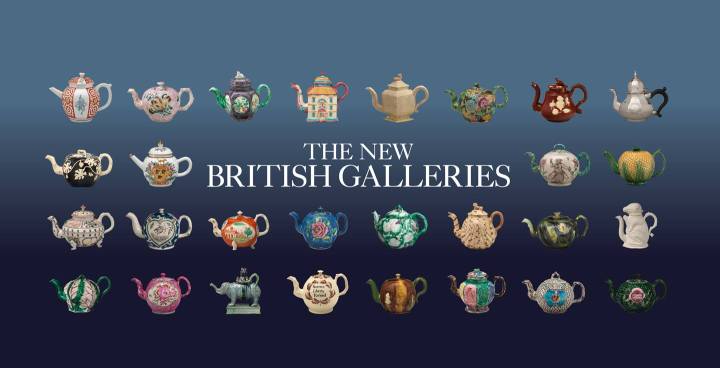
Press release (24 February 2020) from The Met, with the audio guide here:
A highlight of The Metropolitan Museum of Art’s 150th anniversary in 2020 is the opening of the Museum’s newly installed Annie Laurie Aitken Galleries and Josephine Mercy Heathcote Gallery—11,000 square feet devoted to British decorative arts, design, and sculpture created between 1500 and 1900. The reimagined suite of 10 galleries (including three superb 18th-century interiors) provides a fresh perspective on the period, focusing on its bold, entrepreneurial spirit and complex history. The new narrative offers a chronological exploration of the intense commercial drive among artists, manufacturers, and retailers that shaped British design over the course of 400 years. During this period, global trade and the growth of the British Empire fueled innovation, industry, and exploitation. Works on view illuminate the emergence of a new middle class—ready consumers for luxury goods—which inspired an age of exceptional creativity and invention during a time of harsh colonialism.
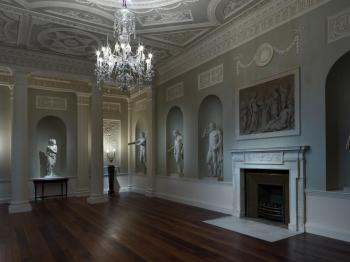
Installation view of The Met’s New British Galleries, Lansdowne Dining Room (Photo by Joseph Coscia, February 2020).
The British Galleries are reopening with almost 700 works of art on view, including a large number of new acquisitions, particularly works from the 19th century that were purchased with this project in mind. This is the first complete renovation of the galleries since they were established (Josephine Mercy Heathcote Gallery in 1986, Annie Laurie Aitken Galleries in 1989). A prominent new entrance provides direct access from the galleries for medieval European art, creating a seamless transition from the Middle Ages to the Renaissance. A 17th-century staircase with exquisite naturalistic carvings—brought to The Met in the 1930s from Cassiobury House, a now-lost Tudor manor—has been meticulously conserved and re-erected in the new galleries. Three magnificent 18th-century rooms from Kirtlington Park, Croome Court, and Lansdowne House have been transformed by new lighting and painstaking conservation and remain at the heart of the galleries.
“The Met’s extraordinary collection of British decorative arts is unparalleled on this side of the Atlantic, and the redesigned galleries will breathe new life into the collection in compelling and unexpected ways,” said Max Hollein, Director of The Met. “Especially on the occasion of The Met’s 150th anniversary, we are thinking deeply about the stories told in our galleries and how every object on display is an outstanding work of art but also embodies a history that can be read from multiple perspectives: a beautiful English teapot speaks to both the prosperous commercial economy and the exploitative history of the tea trade. The curators have created a new narrative for the galleries that sheds light on four centuries of extraordinary artistic achievement alongside the realities of colonial rule. The result is a thoughtful examination of the British Empire and its astonishing artistic legacy.”
Sarah Lawrence, the Iris and B. Gerald Cantor Curator in Charge of The Met’s Department of European Sculpture and Decorative Arts, said: “This ambitious narrative of bold creativity in an entrepreneurial society will have particular resonance in New York, where historic hubs of manufacture have recently been reinvigorated by new design practices and an innovative economy. The installation will demonstrate that this is a history that remains highly relevant, and that these extraordinary objects speak to us today with genuine eloquence.”
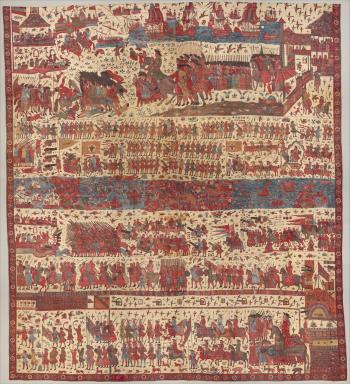
Hanging Depicting a European Conflict in South India, before 1763; Indian, Coromandel Coast, for British Market; cotton, plain weave (drawn and painted resist and mordant, dyed), 117 × 103 inches (New York: The Metropolitan Museum of Art).
Wolf Burchard, Associate Curator of British Furniture and Decorative Arts and lead curator for the new galleries, added: “One of the main reasons why The Met can justify having galleries of this scale dedicated solely to British art is that it is such an international story. It appears particularly timely to ask oneself the question of how best to convey Britain’s culture of creativity at a moment when the United Kingdom is reassessing its role on the European and global stage. We are reminded that the history of British art is far from an isolated one. For centuries, London’s flourishing economy encouraged the trading of foreign luxury goods and attracted countless artists and craftsmen from abroad, many of whom will be represented in The Met’s new British Galleries. Our aim is to present British decorative arts, sculpture, and design beyond royal and country house patronage, focusing on the ways craftsmen and manufacturers had to think outside the box, how to use new technologies, and how to market themselves. The galleries’ design creates an extremely stimulating new stage for our works of art to perform to their best of abilities and an excellent platform to shed new light on British art.”
The Collaboration
To create a narrative-rich setting that befits The Met’s impressive collection, the Museum collaborated with the design firm Roman and Williams Buildings and Interiors, recipient of the 2018 Sir John Soane Visionaries Award and 2014 National Design Award for Interior Design. This is the first museum project undertaken by the design firm, whose work—which ranges from homes and hotels to shops and a furniture collection—is characterized by a sensitivity to historical materials, period references, and the use of rich, layered colors. The stimulating partnership between these designers and The Met’s curators appropriately mirrors the collaborative spirit that developed between British designers, makers, and retailers.
The Narrative
From 1500 to 1900, Britain transformed itself from an isolated island nation into a dominant world power. Global trade stimulated wealth, created a cultural and economic elite beyond the aristocracy, broadened local tastes, and introduced new markets to resourceful British makers. Artists, manufacturers, and retailers—men and women—responded vigorously to these opportunities, developing new materials and technologies, adapting European and Asian styles, and taking bold, imaginative risks.
As early as the 16th century, Britain’s international trade produced a new class of professionals with luxury appetites and ready cash, exemplified in the first gallery’s carved oak paneling from Norfolk, commissioned by William Crowe, a merchant from Great Yarmouth. Foreign artisans started to arrive in England as the Protestant Crown sought to compete with the glories of papal Rome and the French courts. These foreigners had more formal training than their English peers, who still operated within the medieval guild system. Florentine Pietro Torrigiano (1472–1528) was just one of the many European artists and craftsmen who made their way across the English Channel and established themselves in Britain. His naturalistically painted terracotta bust, probably representing Cardinal John Fisher (executed for resisting Henry VIII’s Protestant Reformation), has just been conserved and greets visitors in the first gallery.
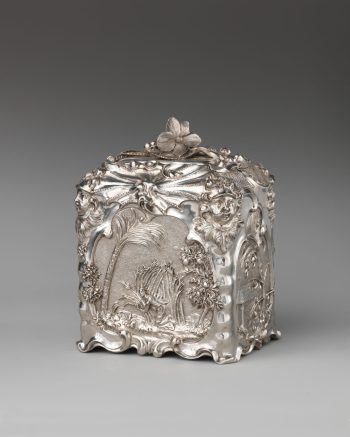
Paul de Lamerie (British, 1688–1751, active 1712–51), Silver Sugar Box, 1744/45 (New York: The Metropolitan Museum of Art).
In the 17th and 18th centuries, the British Empire’s expansion delivered excitement, curiosity, and ruthlessness. A gallery devoted to “Tea, Trade, and Empire” explores the period’s visual exuberance with 100 English teapots displayed in a pair of ten-foot-tall semicircular cases. Presiding over this display is a small but powerful figure of a merchant from 1719, modeled in China by the Cantonese artist Amoy Chinqua (active after 1716). Jaunty, prosperous, and proud, the East India Company entrepreneur who posed for this portrait represents the commercial interests that drove the expansion of the Empire. The goods they brought from China, India, and the West Indies included tea, sugar, coffee, and chocolate, as well as porcelain, cotton, mahogany, and ivory. Produced at great material and human cost, and then transported thousands of miles, these commodities were now affordable for a new middle class. The perimeter of this gallery examines the exploitation of both human and natural resources that accompanied that abundance.
With both the political and monetary power of British monarchs strictly curbed by Parliament, British artisans did not receive the same level of court patronage as their counterparts in Paris, Dresden, and St. Petersburg. Instead, 18th-century design in Britain was shaped by entrepreneurs who had the cleverness, technical expertise, and business acumen necessary to succeed. Nicolas Sprimont (1713–1771) founded the Chelsea Porcelain factory; James Cox (ca. 1723–1800) sold precious table ornaments, some for export to Turkey and China; Josiah Wedgwood (1730–1795) perfected the production of his pioneering pottery, achieving wide distribution within Continental markets; and Matthew Boulton (1728–1809) brought engineering skills to the manufacture of elaborate metalwork. All of these businessmen employed designers in the modern sense of the word: master sculptors, painters, architects, and draftsmen of immense skill and visual sophistication.
The final section of the galleries explores the massive shifts in scale, pace, and taste brought about by the Industrial Revolution during the 19th century. Once again, aesthetic and commercial priorities adapted to an immense new world of methods and customers. A highlight of this section are works acquired specifically for the new galleries, including a stunning marble portrait bust of literary giant Mary Shelley by Camillo Pistrucci, as well as objects by the visionary designer Christopher Dresser (1834–1904) that highlight his limitless creativity and mastery of industrial manufacturing in practically any medium imaginable. Examples by the great Gothic Revival designer A.W.N. Pugin (1812–1852) reveal his impassioned assertion of a national style. Other works represent movements against industrialization, revolts against labor abuses, and the demise of pure craft.
Support
Funding for the renovation included leadership commitments from Mr. and Mrs. Richard L. Chilton, Jr., Howard and Nancy Marks, the Estate of Marion K. Morgan, the Annie Laurie Aitken Charitable Trust, Irene Roosevelt Aitken, Mercedes T. Bass, Candace K. and Frederick W. Beinecke and The Krugman Family, Drue Heinz, Alexia and David Leuschen, Annette de la Renta, Kimba Wood and Frank Richardson, Denise and Andrew Saul, and Dr. Susan Weber.
Credits
The project’s curatorial team is led by Sarah Lawrence, the Iris and B. Gerald Cantor Curator in Charge, and Wolf Burchard, Associate Curator, both of The Met’s Department of European Sculpture and Decorative Arts. Prior to their arrival in early 2019, the project was overseen by Ellenor Alcorn (now Chair and Eloise W. Martin Curator of European Decorative Arts at the Art Institute of Chicago) and Luke Syson (now Director of the Fitzwilliam Museum in Cambridge, United Kingdom), with the assistance of Elizabeth St George (now Assistant Curator at the Brooklyn Museum).
Online Lecture | Cassidy-Geiger on Friedrich Christian’s Grand Tour

Rosalba Carriera, Portrait of the Elector Frederick Christian of Saxony), 1740, pastel on paper, 63.5 × 51.5 cm
(Dresden: Gemäldegalerie Alte Meister)
◊ ◊ ◊ ◊ ◊
From The French Porcelain Society:
Maureen Cassidy-Geiger, The Grandest of Tours: Fragile Diplomacy Meets the Grand Cure
Online Lecture, 13 June 2020
The French Porcelain Society continues its series of weekly online lectures with Maureen Cassidy-Geiger on the incredible two-year Grand Tour of the Elector Friedrich Christian of Saxony in the mid-eighteenth century. We hope you can join us on Saturday, 13 June 2020, 19:00pm (British Summer Time). Members will receive an email invitation with instructions on how to join the online lecture. If you want to join, please contact us for more details on FPSenquiries@gmail.com.
Elector Friedrich Christian of Saxony (1722–1763), who succeeded King August III in 1763 for just 74 days, was afflicted from birth with profound physical disabilities which prevented him from standing or walking without assistance and made simple tasks like eating and dressing difficult. The marriage of his sister Maria Amalia to the King of Naples in 1738 inspired their parents to send the fifteen-year-old heir to the throne on an impromptu journey to Italy for life-saving medical treatments. This exceptional two-year adventure was amply documented, allowing us to precisely reconstruct the prince’s route and daily experiences as he travelled from Dresden to Naples, Rome, Florence, Milan and Venice along pilgrimage routes and post roads, returning via his mother’s court capital, Vienna. Like the able-bodied Grand Tourists he met along the way, he also travelled incognito (‘Comte de Lusace’) with an entourage, enjoyed celebrity status, and collected art, relics, books and souvenirs for shipment home, many of them gifts from his hosts along the way. A selection was featured together with archival documentation in The Grand Cure / Die Grande Kur 1738–1740 (Staatliche Kunstsammlungen Dresden, 2018). In return, wagonloads of porcelain from the Royal Porcelain Manufactory at Meissen were shipped abroad to serve as thank yous from King August III and to celebrate the Naming Day of dowager Empress Wilhelmine Amalie, the prince’s grandmother. Many of these porcelain gifts have survived and were showcased in the exhibition and catalogue Fragile Diplomacy: Meissen Porcelain for European Courts, ca. 1710–63 (YUP/BGC, New York, 2007–08). Some were customized with coats of arms or apt painterly compositions, a few items were repurposed from Japanese Palace stock, and others were simply on hand and included in the shipments; the Meissen porcelain table service that accompanied the prince across Italy was understandably damaged and depleted from use at the lunches and dinners he routinely hosted so a replacement was sent via courier to meet him in Vienna, together with a selection of the king’s silver plate.
Maureen Cassidy-Geiger has twice driven the prince’s itinerary and has researched his sojourns in Naples, Rome, Venice and Vienna on various residential fellowships. Transcriptions of the travel diaries, composed mostly in French, and related research and documentation are posted on the website comtedelusace.wordpress.com.
Call for Papers | Curating, Care, and Community
From the British Art Network:
Curating, Care, and Community
Online Seminar, 3 September 2020
Proposals due by 26 June 2020
This online seminar will seek to explore how to care for others both within and beyond the curatorial community. The word curator derives from the Latin word curare, ‘to care’. Curators are charged with the physical and intellectual care of collections—the artworks, objects, and narratives found within cultural institutions. However, it is evident to the seminar organisers, a group of early career curators from a range of disciplinary backgrounds, that the concept of care within the sector must stretch beyond the guardianship of cultural heritage, to the care and concern for those everywhere. With this in mind, what role does ‘care’ play in a more holistic sense in a curators work? How do we care for each other, within both the institutional and local communities? Contributions are invited from across a range of disciplines, read the full abstract and find out more information here.
British Art Network (BAN) News
From the Paul Mellon Centre:
New British Art Network Convenor Appointed
The Paul Mellon Centre is delighted to announce that Dr Martin Myrone will be joining the staff at the Centre in the new role of Convenor of the British Art Network from 1 September 2020. The network, jointly led by Tate and the PMC, brings together over seven hundred specialists working on British art, including curators, researchers and academics, reflecting the combined strength of the UK’s public collections and curatorial expertise.
As Convenor, Martin will lead and develop the activities of this community in close collaboration with the British Art Network’s co-chairs Mark Hallett (Director of Studies at the Paul Mellon Centre) and Alex Farquharson (Director of Tate Britain).
Martin joins the PMC from his post as Senior Curator, Pre-1800 British Art at Tate Britain and is an art historian and curator of international standing. His many exhibitions at Tate Britain have included Gothic Nightmares in 2006, John Martin in 2011, British Folk Art in 2014, and most recently William Blake in 2019. His published work includes the 2005 monograph Bodybuilding: Reforming Masculinities in British Art 1750–1810 and the forthcoming Making the Modern Artist: Class, Culture and Art-Educational Opportunity.
British Art Networks Sub-Groups
British Art Network sub-groups focus on specific topics of British art. The programmes of activity are led and hosted by network members. Membership to the sub-groups is open to British Art Network members who have a professional research interest or specialism in the group subject area. The current sub-groups are:
• Black British Art
• British Art in Historic Houses
• British Drawings
• British Genre and Narrative Painting
• British Landscapes
• British Mural Painting, 1600–1750
• British Drawings
• British Genre and Narrative Painting
• British Landscapes
• British Mural Painting, 1600–1750
• British Women Artists, 1750–1950
• Contemporary Art in Scotland
• Group Work: Contemporary Art and Feminism
• Post-War Painting in Regional Collections
• Queer British Art
Join a Sub-Group here»
British Art Network Newsletter
The British Art Network circulates a newsletter three times a year, to keep members informed of upcoming events and opportunities relating to British art. The newsletter covers aspects of network activity alongside relevant external exhibitions and events, opportunities and scholarly articles.
Sign up here»










 Enfilade
leave a comment