New Book | Making the Modern Artist
Forthcoming this fall from the Paul Mellon Centre and Yale UP:
Martin Myrone, Making the Modern Artist: Culture, Class, and Art-Educational Opportunity in Romantic Britain (London: Paul Mellon Centre for Studies in British Art, 2020), 288 pages, ISBN: 978-1913107154, £45 / $60.
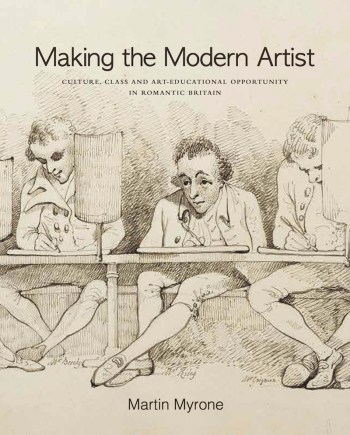 The artist has been a privileged figure in the modern age, embodying ideals of personal and political freedom and self-fulfillment. Does it matter who gets to be an artist? And do our deeply held beliefs stand up to scrutiny? Making the Modern Artist gets to the root of these questions by exploring the historical genesis of the figure of the artist. Based on an unprecedented biographical survey of almost 1,800 students at the Royal Academy of Arts in London between 1769 and 1830, the book reveals hidden stories about family origins, personal networks, and patterns of opportunity and social mobility. Locating the emergence of the ‘modern artist’ in the crucible of Romantic Britain, rather than in 19th-century Paris or 20th-century New York, it reconnects the story of art with the advance of capitalism and demonstrates surprising continuities between liberal individualism and state formation, our dreams of personal freedom, and the social suffering characteristic of the modern era.
Martin Myrone is senior curator of pre-1800 British art at Tate Britain, London.
New Book | Ugliness and Judgment: On Architecture in the Public Eye
From Princeton UP:
Timothy Hyde, Ugliness and Judgment: On Architecture in the Public Eye (Princeton: Princeton University Press, 2019), 232 pages, ISBN: 978-0691179162, $35 / £30.
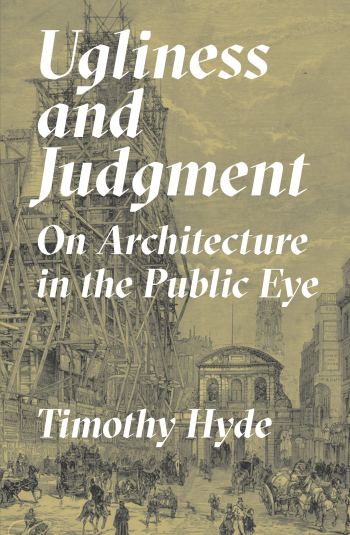 When buildings are deemed ugly, what are the consequences? In Ugliness and Judgment, Timothy Hyde considers the role of aesthetic judgment—and its concern for ugliness—in architectural debates and their resulting social effects across three centuries of British architectural history. From eighteenth-century ideas about Stonehenge to Prince Charles’s opinions about the National Gallery, Hyde uncovers a new story of aesthetic judgment, where arguments about architectural ugliness do not pertain solely to buildings or assessments of style, but intrude into other spheres of civil society.
Hyde explores how accidental and willful conditions of ugliness—including the gothic revival Houses of Parliament, the brutalist concrete of the South Bank, and the historicist novelty of Number One Poultry—have been debated in parliamentary committees, courtrooms, and public inquiries. He recounts how architects such as Christopher Wren, John Soane, James Stirling, and Ludwig Mies van der Rohe have been summoned by tribunals of aesthetic judgment. With his novel scrutiny of lawsuits for libel, changing paradigms of nuisance law, and conventions of monarchical privilege, he shows how aesthetic judgments have become entangled in wider assessments of art, science, religion, political economy, and the state. Moving beyond superficialities of taste in order to see how architectural improprieties enable architecture to participate in social transformations, Ugliness and Judgment sheds new light on the role of aesthetic measurement in our world.
Timothy Hyde is associate professor in the history and theory of architecture at the Massachusetts Institute of Technology. He is the author of Constitutional Modernism: Architecture and Civil Society in Cuba, 1933–1959.
Call for Papers | New Directions, Online Seminar Series
From ArtHist.net and the NDENCA website:
New Directions in Eighteenth- and Nineteenth-Century Art
Online Seminar Series, 15 June — 9 September 2020
Proposals due by 15 June 2020
This digital series of five online seminars (one every fortnight) seeks to showcase new and innovative research being undertaken on eighteenth- and nineteenth-century art and its histories. We invite contributions for papers investigating any aspect of the artistic, visual, and material cultures of this period and produced across the globe. Sessions will be hosted via video conferencing software and will take the form of a 40-minute seminar, with time following for questions. We welcome proposals from PhD researchers, early career academics, and museum professionals, particularly those from underrepresented groups. Please send abstracts of 300 words and short biographies to ndencaseminar@gmail.com by 15 June 2020. The series is organised by Dr Freya Gowrley and Dr Madeleine Pelling.
3rd Annual Ricciardi Prize from Master Drawings
From Master Drawings:
Third Annual Ricciardi Prize from Master Drawings
Submissions due by 15 November 2020
Master Drawings is now accepting submissions for the 3rd Annual Ricciardi Prize of $5,000! The deadline is 15 November 2020. The award is given to the best new and unpublished article on a drawings topic (of any period) by a scholar under the age of 40. The winning submission will be published in a 2021 issue of Master Drawings. The most recent prize winner’s work will appear in the summer 2020 issue of Master Drawings. More information is available here.
Call for Papers | British Art and Natural Forces
From PMC:
British Art and Natural Forces: A State of the Field Research Programme
Paul Mellon Centre, London, October–November 2020
Proposals for various formats due by 30 June 2020
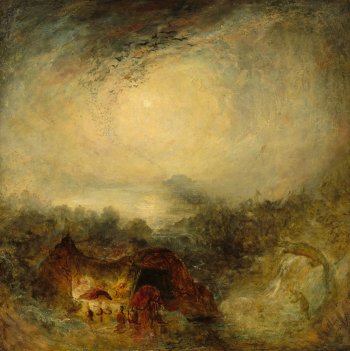
J.M.W. Turner, The Evening of the Deluge, ca. 1843, oil on canvas, 30 x 30 inches (London: National Gallery of Art, Timken Collection, 1960.6.40).
In the year 2020, the Paul Mellon Centre marks its 50th anniversary as an institution dedicated to the study of British art and architecture. It is a year in which artistic practice and the practice of art history have met with the unprecedented force of a global pandemic. In the midst of this crisis, the PMC is initiating a major, multi-part programme of research events that focuses on the encounter between artistic or art historical practice and the forces of the natural world, and places such encounters in both contemporary and historical perspectives.
In doing so, we hope not only to respond to the exigencies of the current moment, but to foreground some of the most vital activities and conversations taking place within the field of British art studies. In recent years, scholars have concentrated with new intensity on the overlaps between artistic, geophysical, biological and ecological bodies of knowledge.
The theme also speaks to many of the new interdisciplinary collaborations that are currently shaping art-historical practice, which have seen scholars of the visual arts working across different subject-fields to explore natural histories, indigenous forms of knowledge, animal studies, concepts of the post-human and revitalized theorisations of the sublime.
Finally, the theme of this series exploits the astonishingly rich and diverse representations of natural forces found throughout the history of British art, from the Anglo-Saxon period to the present day. The programme will seek to explore such representations in the light of current debates and theoretical frameworks, and with the acknowledgement that human agency and reflexive awareness are natural forces in their own right.
We welcome proposals for 20-minute research papers dealing with any period or category of British art and visual culture, and that address the ways in which artistic or art-historical thinking and practice have shaped or been shaped by the encounter with natural forces, whether benign or cataclysmic, short- or long-term, visible or invisible. We also welcome proposals from artists and others whose contributions might take unexpected forms.
Schedule and Format
The events in this programme will be hosted over October and November of 2020. They may encompass virtual, in-person, audio, and print modes: the formats will be confirmed in the early autumn, and will take shape in line with UK government advice on public gatherings. Spanning eight weeks, the events will be sequential in character, and are designed to forge and facilitate a set of expansive conversations that unfold over time.
How to Submit
Please send proposals of 400 words maximum together with a short biography of no more than 100 words to events@paul-mellon-centre.ac.uk by 30 June 2020.
Online Public Lecture Course | Georgian Provocations
From PMC:
Georgian Provocations: Six Iconic Works of Art from Eighteenth-Century Britain
Paul Mellon Centre, London, 28 May — 9 July 2020
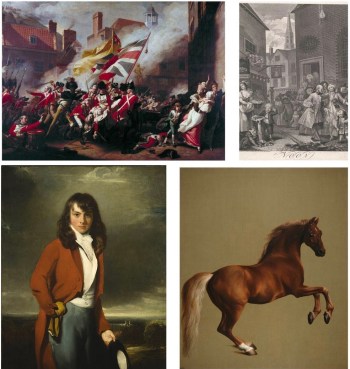 Georgian Provocations is a one-off summer public lecture course, delivered online, and designed to provide an accessible and stimulating introduction to the art of the period. In this series of six 30-minute lectures, Hallett and Postle focus on six seminal paintings from the Georgian era and investigate their contents, contexts, and impact. Together, they reveal many of the ideas and issues that coursed through British visual culture between the 1730s and the 1790s, and demonstrate the riches that continue to be gained from looking intensively at an individual work of art. Lectures will be released weekly from 28 May to 2 July at 3pm (GMT).
An associated conversation on July 9 will be streamed live via Zoom Webinar at 6pm (GMT), providing a Q&A session with series presenters Mark Hallett and Martin Postle, who will talk about the pictures they focused upon in their lectures and their respective approaches to discussing the works in question.
28 May 2020
Mark Hallett, Walking the Streets: William Hogarth’s The Four Times of Day by William Hogarth (1736–38)
4 June 2020
Martin Postle, Variations on a Theme: Richard Wilson’s The White Monk (ca. 1755–65)
11 June 2020
Martin Postle, All Done from Nature: George Stubbs’s Whistlejacket (1762)
18 June 2020
Martin Postle, The Artist as Intellectual: Joshua Reynolds’s Self-Portrait as President of the Royal Academy (1780)
25 June 2020
Mark Hallett, Displaying the Hero: John Singleton Copley’s The Death of Major Peirson (1784)
2 July 2020
Mark Hallett, Making an Impact: Thomas Lawrence’s Arthur Atherley (1792)
9 July 2020
Georgian Provocations: A Conversation, streamed live via Zoom Webinar at 6pm (GMT); register via Eventbrite here.
Call for Papers | SEASECS 2021, Ft. Myers
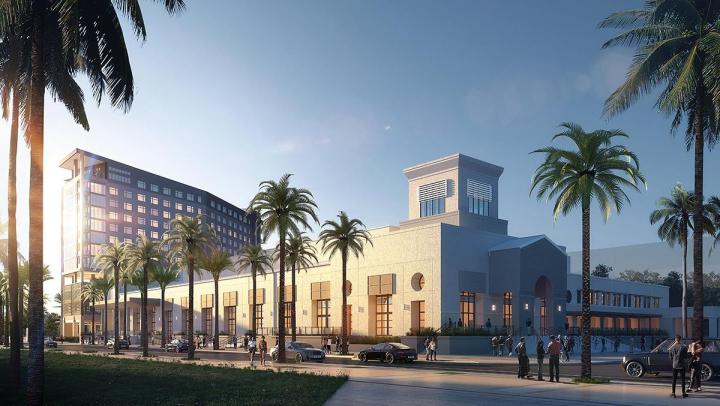
The Luminary & Co. Hotel, part of Marriott International’s Autograph Collection, is a new hotel, scheduled to open summer 2020.
◊ ◊ ◊ ◊ ◊
SEASECS 2021 — Oceans Rise, Empires Fall: Tidal Shifts in the Eighteenth Century
The Luminary & Co. Hotel, Ft. Myers, Florida, 18–20 February 2021
Session Proposals due by 15 June 2020
Individual Papers and Fully-formed Panels due by 15 October 2020
The 47th meeting of The Southeastern American Society for Eighteenth-Century Studies (SEASECS) will take place 18–20 February 2021 in Ft. Myers, Florida, a historically rich, culturally vibrant city also known as a winter getaway for its warm temperatures, tropical scenery, and beautiful shorelines. Situated on the gulf coast and the banks of the Caloosahatchee River, Ft. Myers has a distinct history informed by its relationship with land and water, which inspires our theme: “Oceans Rise, Empires Fall: Tidal Shifts in the Eighteenth Century.” At this time, we invite session proposals related to this theme or any aspect of the long eighteenth century. We welcome proposals for traditional panel and roundtable topics as well as innovative session formats.
Please send your session proposal including title, short description of the session format and topic, and your contact information, to Mary Crone-Romanovski at mromanovski@fgcu.edu by 15 June 2020. Submitted panel topics will be included on the general CFP for SEASECS 2021. Fully-formed panels and individual paper proposals will be due by 15 October 2020.
Decorative Arts Trust Awards 13 Research Grants
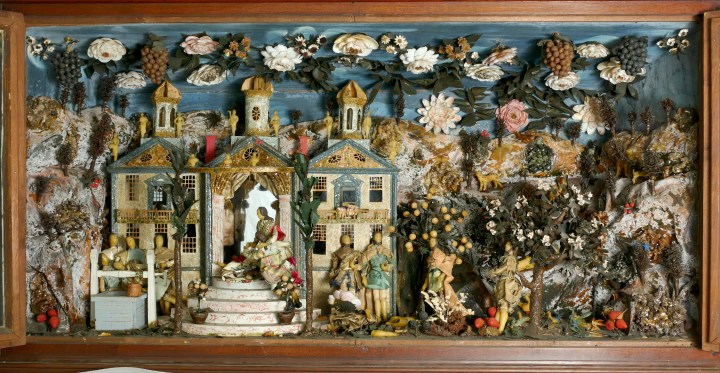
Grant recipient Isabella Rosner will research Quaker makers of shell and wax work boxes. Mary Morrison, wax and shellwork shadow box, 1769, Philadelphia (Chester County Historical Society).
◊ ◊ ◊ ◊ ◊
Press release (27 May 2020) from the Decorative Arts Trust:
The Decorative Arts Trust is pleased to announce the thirteen recipients of their 2020 Summer Research Grants, representing diverse cultures, materials, time periods, and geographies. Each year the Trust awards research grants to graduate students working on a Master’s thesis or PhD dissertation in a field related to the decorative arts. The Trust encourages projects that advance diversity in the study of American decorative arts. The word ‘summer’ may be a misnomer this year, as the Trust extended the terms of the grants to include travel through spring of 2021 due to potential restrictions related to the COVID-19 pandemic. The Trust also partners with other organizations to offer grants sponsored by the Marie & John Zimmermann Fund, the Decorative Arts Society of Orange County, and the Center for American Art.
The deadline to apply for Decorative Arts Trust Summer Research Grants is April 30 annually. For more information, visit decorativeartstrust.org or email thetrust@decorativeartstrust.org.
Kayle R. Avery
Winterthur Program in American Material Culture, Winterthur, University of Delaware
Avery will examine the digitization of modernist American concepts through the incorporation of Art Deco aesthetics in the BioShock video game franchise. His plans to study collections at the Metropolitan Museum of Art, the Cooper Hewitt Smithsonian Design Museum, and the New-York Historical Society’s Print Ephemera Collection.
Elizabeth S. Browne
Massachusetts Institute of Technology
Browne will travel to examine the archives of the Manufacture Nationale de Sèvres in France to study 18th-century French sculptor Clodion (Claude Michel) and the Sèvres’ serialization called the ‘Vases Clodion’.
Christina L. De León
Bard Graduate Center
De León will study the reinterpretation of the butaca by 20th-century designers Josef Albers and Clara Porset at the Albers Foundation in Bethany, Connecticut. Marie Zimmerman Grant.
Catherine Doucette
The Courtauld Institute of Art
Doucette will continue her study of a 19th-century tilt-top table, veneered with Jamaican woods and bearing images of the British Empire, made in Jamaica by the colony’s leading craftsman, Ralph Turnbull by visiting the Museum of Fine Arts, Boston, and the Yale Center for British Art.
Lamar Gayles
University of Illinois Chicago
Gayles will research the fabrication techniques and material mnemonics in the work of 20th-century Black American craftspersons by visiting collections in Alabama, Georgia, Chicago, and Washington, D.C.
Robert Gordon-Fogelson
University of Southern California
Gordon-Fogelson plans to research the work of mid-century designers Dave Chapman, George Nelson, and Walter Dorwin Teague as well as the Industrial Designers Society of America at the Research and Design Institute at Syracuse University’s Special Collections Research Center.
Cecilia Gunzburger
University of Virginia
Gunzburger will continue her study of the traditions and ornamental function of 16th-century European lace and related textiles at the Cleveland Museum of Art.
Cynthia Kok
Yale University
Kok will travel to the Museum of Fine Arts, Boston, and the Walters Art Museum in Baltimore to research snuffboxes made of mother-of-pearl, shell, and imitative materials and decorative styles.
Kayli Rideout
Boston University
Rideout will visit Richmond and Petersburg, Virginia to study ecclesiastical windows that Tiffany Studios was commissioned to create in memory of the Confederacy in the years between 1889 and 1925.
Isabella Rosner
King’s College London
Rosner will visit several collections in the Philadelphia region to understand more about Quaker women who made shell and wax work boxes.
Cambra Sklarz
University of California, Riverside
Sklarz will travel to Winterthur to examine ways that artists from approximately 1750 to 1860 incorporated waste or discarded goods into their decorative arts and practices. DARTS Grant.
Paige Weaver
University of South Carolina
Weaver will explore The Metropolitan Museum of Art’s Costume Institute and American Wing to evaluate a wide range of clothing, silver, and metalwork from the Reconstruction Era.
Xiaoyi D. Yang
Bard Graduate Center
Yang aims to continue her investigation of the circulation and consumption of Zhangzhou porcelains in Tokugawa-era commercial and cultural centers by visiting ceramic collections in Tokyo and Kyoto.
New Book | Beyond Aesthetics
From Yale UP:
Wole Soyinka, Beyond Aesthetics: Use, Abuse, and Dissonance in African Art Traditions (New Haven: Yale University Press in association with the Hutchins Center for African & African American Research, 2020), 160 pages, ISBN: 978-0300247626, $25.
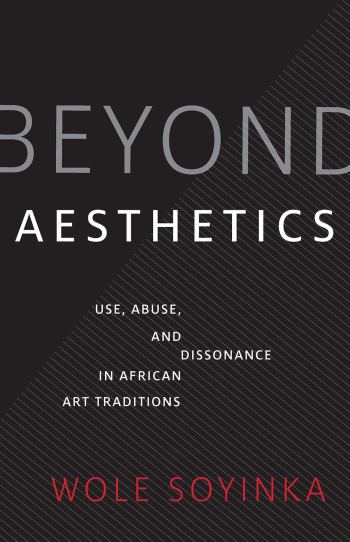 An intimate reflection on culture and tradition, creativity and power, that draws on a lifetime’s commitment to aesthetic encounter.
The playwright, poet, essayist, novelist, and Nobel Laureate Wole Soyinka is also a longtime art collector. This book of essays offers a glimpse into the motivations of the collector, as well as a highly personal look at the politics of aesthetics and collecting. Detailing moments of first encounter with objects that drew him in and continue to affect him, Soyinka describes a world of mortals, muses, and deities that imbue the artworks with history and meaning.
Beyond Aesthetics is a passionate discussion of the role of identity, tradition, and originality in making, collecting, and exhibiting African art today. Soyinka considers objects that have stirred controversy, and he decries dogmatic efforts—whether colonial or religious—to suppress Africa’s artistic traditions. By turns poetic, provocative, and humorous, Soyinka affirms the power of collecting to reclaim tradition. He urges African artists, filmmakers, collectors, and curators to engage with their aesthetic and cultural histories.
Wole Soyinka is a Nigerian playwright, poet, and political activist. He was awarded the Nobel Prize for Literature in 1986. His many publications include You Must Set Forth at Dawn and Of Africa.











 Enfilade
leave a comment