New Book | John Reeves
From ACC Art Books:
Kate Bailey, John Reeves: Pioneering Collector of Chinese Plants and Botanical Art (New York: ACC Art Books, 2019), 176 pages, ISBN: 978-1788840316, £35 / $50.
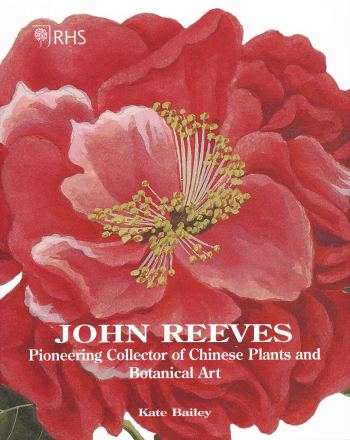 This is the story of John Reeves (1774–1856) and the Reeves Collection of botanical paintings, the result of one man’s single-minded dedication to commissioning pictures and gathering plants for the Horticultural Society of London.
Reeves went to China in 1812 and immediately on arrival started sending back snippets of information about manufactures, plants and poetry, goods, gods, and tea to Sir Joseph Banks. Slightly later, he also started collecting for the Society. But despite years of work collecting, labelling, and packing plants and organising a team of Chinese artists until he left China in 1831, Reeves never enjoyed the same degree of recognition as other naturalists in China. This was possibly because he had a demanding job as a tea inspector. Reeves himself never claimed to be a professional naturalist, and the plant collecting and painting supervision were undertaken in his own time. Furthermore, fan qui (foreign devils) were restricted to the port area of Canton and to Macau, so that plant-hunting expeditions further afield were impossible. Furthermore, Reeves never published an account of his life in the country, unlike Clarke Abel and Robert Fortune, but he left us some letters, notebooks, drawings, and maps.
The collection is held at the Royal Horticultural Society’s Lindley Library in Vincent Square, London. It is a magnificent achievement. Not only are the pictures accurate and richly coloured plant portraits of plants then unknown in the West, but they stand as a record of plants being cultivated in nineteenth-century Canton and Macau. In John Reeves: Pioneering Collector of Chinese Plants and Botanical Art, Kate Bailey reveals John Reeves’s life as an East India Company tea inspector in nineteenth-century China and shows how he managed to collect and document thousands of Chinese natural history drawings, far more than anyone else at the time.
Kate Bailey started working life as a reluctant solicitor. At the age of 54, on the strength of a magazine article about a paper conservator, she abandoned the law and enrolled at Camberwell College of Arts for a degree in paper conservation. After obtaining an M.A. and being accepted for a Ph.D., for three years Kate stalked Reeves in libraries, museums, and auction houses while at the same time drawing on her own childhood memories of Singapore and Hong Kong in the early 1950s. A post-doctoral year at the V&A followed, working on a collaborative project into the pigments found on Chinese export paintings using the Reeves pictures for comparison. Then came a request for a book to bring the work of a modest, dedicated East India Company tea inspector and his band of skilfull Chinese painters to a wider audience. Kate continues to research, write, and lecture on Reeves and related art-botanical subjects.
C O N T E N T S
Letter to the Reader
Acknowledgments
Introduction
1 Mr Reeves’ Drawings
2 Mr Reeves Sails to China
3 Mr Reeves Arrives in Canton
4 Mr Reeves Writes to Sir Joseph Banks
5 Mr Reeves Goes Plant Hunting in Macao
6 Mr Reeves Commissions Drawings
7 Mr Reeves Collects Plants
8 Mr Reeves Creates a Collection
Endnotes
Index of Plants
General Index
New Book | Jane Austen’s England
From ACC Art Books:
Karin Quint, Jane Austen’s England: A Travel Guide (New York: ACC Art Books, 2019), 320 pages, ISBN: 978-1788840354, $20.
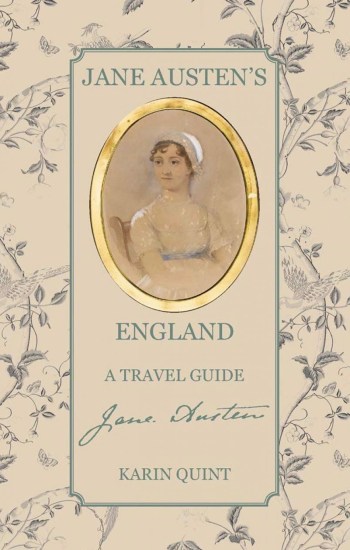 Walk in Jane Austen’s footsteps with this unique travel guide—the first book to explore England in relation to its most beloved Regency author. Rambling across the rolling fields of Hampshire, along the bustling streets of London, and around the golden crescents of Bath, Jane Austen’s England is the perfect companion for any Janeite planning a pilgrimage.
Functionally arranged by region, each chapter tracks down the most iconic scenes from both the big and little screen, as well as the key destinations where Jane lived, danced, and wrote. Descriptions of each location are interspersed with biographical anecdotes and local history. Subsections focus on various stately homes that have been featured in every adaptation of every novel, from the beloved Pride and Prejudice television series (1995, Jennifer Ehle and Colin Firth) to Pride and Prejudice and Zombies (2016). With a compilation of websites, seasonal opening hours, and tour details, this compact book contains everything you need to immerse yourself in Austen.
Karin Quint discovered Austen aged 20, when she picked up Pride and Prejudice at a flea market. She later realized that she was reading one of the best-loved novels in English literature, and her obsession only grew from there. As well as being a professional journalist and photographer, Quint is an ambassador for the Jane Austen Literacy Foundation. She has co-written two other travel guides about Wales and Scotland.
Call for Papers | Virtuosity: Ethics and Aesthetics of the Technical Gesture
From ArtHist.net (where the posting also includes the French version) . . .
Virtuosity: Ethics and Aesthetics of the Technical Gesture from the Middle Ages to the 19th Century
Virtuosités. Éthique et esthétique du geste technique du Moyen Âge au XIXe siècle
Institut national d’histoire de l’art, Paris, 14–16 January 2021
Proposals due by 30 May 2020
Technical skills and gestures have already been the subject of collective work aimed at studying them in their ethnological, anthropological, economic, technical or sociological dimension [Brill 2002, De Beaune 2013B, Bouillon, Guillerme Piernas 2017, Joulian, D’Onogrio 2006]. On one hand, industrial procedures for the most recent periods have been well studied by contemporary historians who have examined in particular their constitution, their dissemination and, more generally, the technical or cultural history of these industrial procedures [for instance Baudet 2004 or journals like the Revue d’histoire de la sidérurgie published in Nancy since 1960]. For earlier periods, on the other hand, the point of view most often adopted by historians and art historians to deal with the history of technology since the 1950s in particular was first that of historians of work and production [for instance Coquery, Hilaire-Perez, Sallmann, Verna 2004]. Few of them have considered technical gestures and know-how as historical objects, submitted to various cultural regimes.
This situation is all the more damaging as recent research trends are increasingly focusing on the material and physical constraints of production processes. This is the case of the history of medieval art, in which the growing number of works claiming to be based on the archéologie du bâti has contributed to reconfiguring the historiographical panorama of the discipline by introducing—or at least displaying—a renewed interest in the processes [Hartmann-Virnich, Boto-Varela, Reveyron 2012]. This is just as much the case for the history of 17th- and 18th-century architecture, about which research prospects have been broadened by the development of the history of construction [for instance Carvais, Guillerme, Nègre, Sakarovitch 2012]. However, despite these recent developments and even if art historians can only consider it necessary to summon the material constraints of artistic and craft production, the work of historians, philosophers, anthropologists or sociologists who have taken an interest in gesture and technical practices is only marginally taken into account.
Therefore, the ambition of this conference is to provoke the meeting and dialogue of different approaches to the technical gesture, departing from a category of gestures that one can call virtuoso. This refers to the attitude of discreetly drawing the attention to the act itself of the production; virtuosity being considered as the primacy given to a metatechnique («the technique of producing forms that produce effects») [Klein 1970, 393, note 1 and Klein 1960-62, 152, 154 et 215, chapter «La Maraviglia»]. The phenomenon will be examined in the field of the construction studies, but also in all the arts and crafts of pre-industrial times (from painting to music and dance, through the art of gardens, cabinet work, goldsmith or textile). One hope to see whether, for example, the remarks and observations gathered on this phenomenon by cognitive or anthropological sciences can be historicized in order to shed light on our knowledge of the virtuoso technical gesture, its status and its social or cultural value and, thus, in order to nurture the historian’s reflection.
Different converging themes could be used to develop an exchange on these issues:
• Discourses and rhetoric on technical virtuosity and virtuoso craftsmanship practices [Suthor 2010, Nègre 2019a]. What do theorists, critics and the public in general think about the demonstrations of skill and the resulting artefacts? How do practitioners talk about it themselves?
• The definitions and the different aspects of these preindustrial virtuoso practices (creation, restoration); the types of virtuosities (perfection of execution, search for complexity, search for variety, mastery of extreme scales, speed of execution, etc.) [Kris, Kurz 2010, 95-101. Nègre 2019B. Guillouët 2019] ; the characteristics of the objects.
• The cultural and social consequences as well as the effect of «address» of the virtuoso technical gesture, for «internal» or «external» use [De Beaune 2013a].
• The transmission of «incorporated» know-hows [as defined by Barel 1977] or formalized through drawings and models. What role does the technical challenge play in the training curriculum of the craftsmen (through provocations, competitions, masterpieces, etc.)? And in innovation? How studio/workshop secrets and formalized know-how interact or clash (or not)?
• The practical conditions for the dissemination of these skills as well as the cultural constraints of their transmission (normalization of the gesture, mediation through processes…) and the criteria for virtuoso distinction [Metzner 1998]; the representations of virtuosity in manuals, collections and prints such as the ones collected by Jacques Doucet now held at the INHA. These last questions raise the role of technical perfection in aesthetic delight [Gell 1992] like did André Leroi-Gourhan’s idea of a «functional aesthetics» [Gell 1992. De Beaune 2013a].
• Case studies: some papers could also focus on the analysis of technical gestures through specific objects and their material and archival study (for instance in the case of some conservation–restoration case studies).
Proposals for papers should be sent by May 30th to Jean-Marie Guillouët (jmguillouet@gmail.com) and Valérie Nègre (valerie-negre@wanadoo.fr) in the form of a summary of a maximum of 2,000 characters. They must be accompanied by a short one-page CV.
The conference will be held at the Institut national d’histoire de l’art with the support of the INHA, the Institut d’histoire moderne et contemporaine (Paris) and the Centre François Viete (Nantes)
Organizing committee // Comité d’organisation
Jean-Marie Guillouët (Université de Nantes) Valérie Nègre (Université Paris 1 Panthéon- Sorbonne)
Pauline Chevalier (INHA)
Sigrid Mirabaud (INHA)
Scientific Committee // Comité scientifique
Nicolas Adell (Université Toulouse Jean Jaurès) Gil Bartholeyns (Université de Lille 3 – IRHiS) Philippe Bernardi (Lamop)
Anne-Laure Carré (Cnam)
Sven Dupré (Utrecht University)
Patricia Falguières (Ehess)
André Guillerme (Cnam, chaire unesco)
Liliane Hilaire-Pérez (Université de Paris, Ehess) Antoine Picon (Harvard University)
Pamela Smith (Columbia University)
Victor A. Stoichita (Centre de recherche en ethnomusicologie)
Nicola Suthor (Yale University)
Journal18, #9 Field Notes (Spring 2020)
The ninth issue of J18 is now available (and be sure to check out the latest offerings in J18’s Notes & Queries). . .
Journal18, Issue #9: Field Notes (Spring 2020)
Issue Editor: Amy Freund
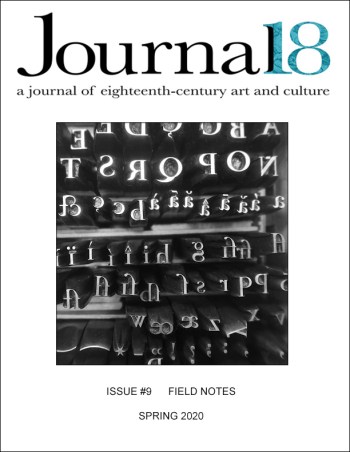 How do we understand the field of eighteenth-century art today? What are its objects of study, and how do we think, write, and teach about them? Where, and when, do we locate ‘the eighteenth century’? This issue of Journal18, emerging from a conference organized by the Historians of Eighteenth-Century Art and Architecture (HECAA) in Dallas, TX (November 2018), maps out the questions and approaches driving the field today, and proposes new directions for its future.
HECAA was established in 1993 at a vibrant moment in the evolution of the ‘new’ art history in the United States, in an effort to carve a place for the study of eighteenth-century art in a discipline that had only just begun to acknowledge it. A quarter of a century later, buoyed by a membership that had increased ten-fold and an utterly transformed publishing landscape (including the founding of Journal18), an anniversary conference was convened at an exciting but also challenging moment in the field. Hosted by the Department of Art History at Southern Methodist University, the HECAA at 25 conference convened 160 scholars of eighteenth-century art to survey its history, present current research and pedagogical initiatives, and consider possible trajectories for its future.
These Field Notes take two different forms. Four research essays by emerging scholars who presented their work at the conference—on French typefaces, Korean folding screens, British ceiling painting, and American veneer furniture—showcase new scholarly directions. A parallel roundtable discussion by conference participants brings to light the most pressing issues facing, and defining, the present and future of the field—among them the importance of place and the possibilities of a ‘global eighteenth century’, the turn toward materiality and material culture, the centrality of the work of female artists, and the impact of the digital humanities on teaching and scholarship.
–Amy Freund, Southern Methodist University
A R T I C L E S
The Bignon Commission’s Measured Bodies: Inventing Typeface and Describing the Mechanical Arts under Louis XIV
Sarah Grandin
Tactile Vision in Eighteenth-Century Korean Still-Life, or Ch’aekkŏri
Irene Choi
A New Golden Age: Politics and Mural Painting at Chatsworth
Laurel O. Peterson
The Nature of American Veneer Furniture, circa 1790–1810
Jennifer Y. Chuong
R O U N D T A B L E
Reflections on HECAA at 25: A Roundtable Discussion
Jeffrey Collins, Elisabeth Fraser, Elizabeth Mansfield, Amelia Rauser, Kristel Smentek & Wendy Bellion, Paris Spies-Gans, Nancy Um, and Amy Freund
Cover image: Steel type punches of the romain du roi, Cabinet des poinçons de l’Imprimerie nationale, Douai. © Photo by Sarah Grandin.
Call for Papers | Cultures visuelles des spectacles marginaux
From ArtHist.net:
Représentation(s): Cultures visuelles des spectacles marginaux, XVIIIe–XIXe siècles
Université de Lausanne, 12–13 November 2020
Proposals due by 31 May 2020
Le XVIIIe et le XIXe siècle ont connu un développement jusqu’alors inédit dans la multiplication et la diversification des spectacles. En parallèle et parfois en concurrence avec les théâtres institutionnels voient le jour et se développent un grand nombre d’autres formes non institutionnelles et marginales de spectacles: petits théâtres contournant avec inventivité les limitations et interdictions imposées par le système des privilèges, spectacles hybrides, «spectacles de curiosités», c’est-à-dire tous les spectacles «mineurs» qui ne sont pas considérés par l’autorité publique comme du théâtre, ou encore théâtres de société, organisés par des particuliers et soustraits aux circuits commerciaux et à l’industrie du spectacle.
Les recherches récentes ont redonné une dignité à ces formes marginales de spectacle, mettant en lumière leur intérêt pour l’histoire culturelle, mais également pour l’évolution du goût et de l’esthétique qui touchent toute la production des époques concernées. Ces recherches se sont principalement orientées d’une part sur l’étude de répertoires, formes et auteurs, d’autre part sur la nature des lieux investis par les représentations, dans leur double dimension d’espace scénique et d’espace social.
Ce colloque veut proposer une nouvelle approche, transversale et interdisciplinaire, à ces formes de spectacle en interrogeant la notion de représentation dans sa matérialité concrète et visuelle et dans le double sens qu’historiens et philosophes s’accordent pour donner au terme.
Premièrement, dans son acception plus spécifiquement liée au monde du théâtre, la représentation sera envisagée au sens de «fait de donner un spectacle, plus particulièrement de jouer une pièce de théâtre devant un public» (TLF) et par extension au sens de spectacle lui-même dans toutes ses composantes qui tombent sous les sens, comme «monstration d’une présence», et «présentation publique d’une chose ou d’une personne (1)».
Deuxièmement, la représentation sera considérée comme «présentification d’une absence au moyen d’un langage» littéraire ou pictural chargé de faire «apparaître une absence par le recours à des signes qui en tiennent lieu (2)». Cette deuxième approche permettra de compléter et d’interpréter la première, car, comme le rappelle le sociologue Alex Gagnon, «c’est parce que les représentations ne sont pas ce qu’elles représentent (les langages ne se confondent jamais avec les réalités qu’ils cherchent à décrire) qu’elles peuvent contribuer, précisément, à façonner et à construire ce dont elles tiennent lieu (3)».
(1) Roger Chartier, «Pouvoirs et limites de la représentation. Marin, le discours et l’image» [1994], dans Au bord de la falaise. L’histoire entre certitudes et inquiétude (Paris: Albin Michel, «Histoire», 1998), p. 174
(2) Alex Gagnon, «Représentation», dans Anthony Glinoer et Denis Saint-Amand (dir.), Le lexique socius.
(3) Ibid.
La réflexion embrassera donc les axes suivants:
1. Matérialité des spectacles
C’est entre XVIIIe et XIXe siècle que commence lentement à émerger une idée de mise en scène (4). De nombreux aspects matériels qui restent largement à cataloguer et à analyser témoignent de ce mouvement également sur les petites scènes non institutionnelles: les costumes, les décors — ou éventuellement leur absence, dont la signification sera à interpréter — les tentatives d’effets d’éclairages, les objets de scène, les accessoires et éventuels «effets spéciaux» y sont d’autant plus significatifs qu’ils sont en général artisanaux, bricolés, inventifs. Cet aspect de création «avec les moyens du bord», de flexibilité et d’hybridité des scènes et des effets spectaculaires rapproche et réunit théâtres de société, spectacles de curiosités et «petits théâtres» publics. Il est donc intéressant de les analyser en parallèle, en faisant émerger similitudes, différences, jeux d’inspirations mutuelles et éventuellement différences avec l’esthétique et les pratiques des théâtres institutionnels (5). Quels sont les éléments et les pratiques communes? Comment ces spectacles contournent-ils le manque de moyens? Réprésentent-ils un terrain favorable à l’innovaton et à l’expérimentation? Il sera ainsi question d’étudier les conditions matérielles et les contraintes concrètes auxquelles les promoteurs des petits théâtres ou les organisateurs de spectacles de société doivent faire face pour l’établissement de leurs projets. La mise en place d’une représentation théâtrale fonctionne d’une certaine manière comme une petite entreprise dans laquelle les tâches sont réparties, standardisées et hiérarchisées. Il s’agira donc d’étudier la manière dont cette répartition se fait et dont elle opère dans la consrtuction du spectacle lui-même. Y a-t-il des figures polyvalentes ou assiste-t-on à une spécialisation progressive, sur l’exemple des grands théâtres publics? Sur quels éléments mise-t-on en particulier pour attirer et fidéliser un public, que ce soit un public payant ou un cercle d’habitués pour les scènes de société?
(4) Voir Roxane Martin, L’Émergence de la notion de mise en scène dans le paysage théâtral français, 1789–1914 (Paris, Classiques Garnier, 2014) et «La Mise en scène théâtrale au XIXe siècle», dossier de la revue Romantisme 2020.2, à paraître.
(5) Sur les scènes institutionnelles voir notamment Marie Bouhaïk-Gironès, Olivier Spina, Mélanie Traversier (dir.), Mécanique de la représentation. Machines et effets spéciaux sur les scènes européennes, XVe–XVIIIe siècles, dossier de la Revue d’Histoire du théâtre, 2018.2.
2. Perception et réception
La question du public et de la consommation de ce genre de spectacles amène à développer une autre série de questionnements complémentaires, à savoir les aspects liés à la perception et à la réception de ces spectacles. Le dénominateur commun qui réunit ces formes de spectacles non institutionnels est lié à leur statut de scènes mineures qui cherchent leur identité et leurs publics spécifiques aux marges des grandes entreprises destinées à fédérer des centaines, voire des milliers de spectateurs.
Néanmoins, et c’est probablement là leur plus grande valeur, ces spectacles témoignent d’une vie culturelle et de tendances liées à un contexte quotidien. Tendances moins formelles, moins formatées, plus immédiates et plus inventives que celles qui régissent le fonctionnement des grands théâtres. Nous souhaitons nous interroger sur les modalités et les critères qui permettent à ces spectacles non institutionnels d’être perçus, compris et «consommés» par le public. Comment se positionnent-ils face à la concurrence, si concurrence il y a, des grands spectacles? Comment leurs représentations se matérialisent-elles et sur quelles références s’appuient-ils pour se construire?
On étudiera également les représentations que d’autres formes d’art et d’écriture donnent des ces pratiques. Le panorama, riche et varié, comprend des représentations en peinture ou en gravure de scènes, costumes et personnages ou acteurs et actrices de ces scènes marginales, comme dans le cas de la célèbre série de Daumier sur Les comédiens de société; la mise en texte dans des oeuvres de fiction, théâtrales ou romanesques, ou dans les écrits personnels, correspondances, mémoires ou journaux intimes; et encore, surtout au XIXe siècle, les échos dans la presse, qu’il s’agisse de comptes rendus de spectacles ou de chronique mondaine. Au-delà de la valeur historique et documentaire de ces productions, il faudra interroger la perception que les contemporains ont du phénomène des scènes marginales, la nature des représentations qu’ils en donnent, les éléments qui sont soulignés ou mis en valeur. Par exemple: est-ce que ces représentations sont plutôt sérieuses ou ironiques ? Plutôt appréciatives ou dépréciatives? Quels éléments des pièces jouées, des représentations ou du jeu des acteurs et des actrices retiennent le plus l’attention? Quelle valeur, quelle utilité ou quels dangers attribue-t-on à ces mêmes éléments?
Les propositions de contribution pourront s’inscrire dans les champs suivants, dont la liste est à considérer comme non exhaustive:
Émergence d’une idée de mise en scène
• Organisation de l’espace
• relevés de mise en scène
• didascalies descriptives et prescriptives dans les textes
• métiers techniques de la scène et leur spécialisation
• mise en place et mutation des conventions dramaturgiques
Matérialité de la scène
• importance des costumes
• costumes historiques vs de ville vs de fantaisie
• objets de scène et leur usage
• progrès techniques et machineries
• décors peints, décors construits/praticables, décors machinés, décors dépouillés/inexistants
• éclairages (de la scène, de la salle, éclairages modulables et effets d’ombres et lumières)
• «effets spéciaux» et effets d’optique
• application de l’optique au spectacle: lanternes magiques, théâtres d’ombres, «transparents», panoramas, dioramas, fantasmagories, pré-cinéma
Perception et réception
• stratégies commerciales
• rapport aux théâtres principaux
• pubic(s) cible
• témoignages de spectateurs
• comptes rendus dans la presse
• réprésentations littéraires (dans des romans, des mémoires, des physiologies etc.)
• iconographie
Organisation
Colloque en collaboration entre
Camilla MURGIA, Première Assistante, Université de Lausanne, Section d’Histoire de l’Art
Valentina PONZETTO, Professeure Boursière FNS/Université de Lausanne, Section de Français
Jennifer RUIMI, Chercheuse FNS Senior/Université de Lausanne, Section de Français
Calendrier
Les propositions de communication de 3000 signes maximum, accompagnées d’une courte biobibliographie, seront à envoyer avant le 31.05.2020 à: Representationsand2020@gmail.com
Retours du comité scientifique: fin juin 2020
Exhibition | Hidden Valuables: Early-Period Meissen Porcelains
The catalogue is published by Arnoldsche and distributed by ACC Art Books:
Hidden Valuables: Early-Period Meissen Porcelains from Swiss Private Collections
Musée Ariana, Geneva, 7 February — 6 September 2020
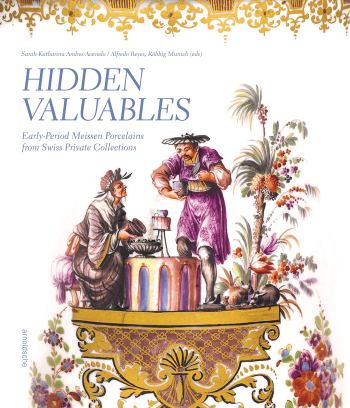 Switzerland is well-known for its host of remarkable collections of eighteenth-century European porcelain. Exemplary representatives of these are such extraordinary collector personalities as Albert Kocher or Dr Marcel Nyffeler. A number of these magnificent collections can be found today in Switzerland’s renowned institutions, and the ‘white gold’ from Saxony still fascinates Swiss connoisseurs. This exhibition is dedicated to their passionate collecting and exceptional treasures, while the catalogue is enriched with essays by renowned art historians and porcelain experts.
Sarah-Katharina Andres-Acevedo, Alfredo Reyes, and Röbbig München, eds., Hidden Valuables: Early-Period Meissen Porcelains from Swiss Private Collections (Stuttgart: Arnoldsche, 2020), 416 pages, ISBN 978-3897905863, £78 / $135.
New Book | A Passion for Porcelain
Published by the Gardiner Museum in association with Arnoldsche and distributed by ACC Art Books:
Karine Tsoumis and Vanessa Sigalas, eds., A Passion for Porcelain: Essays in Honour of Meredith Chilton (Stuttgart: Arnoldsche, 2020), 208 pages, ISBN: 978-3897905849, $50.
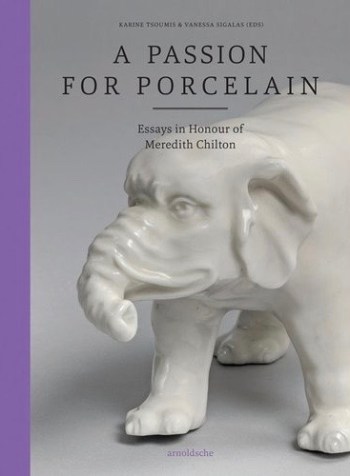 A Passion for Porcelain brings together papers delivered at an international symposium held in 2018 at Toronto’s Gardiner Museum in honour of Meredith Chilton, C.M., one of the foremost scholars and curators of eighteenth-century European porcelain. Authored by leading scholars in the field, the essays take us on a journey from France (Sèvres), to Japan via Boston, where we encounter both revered artists and anonymous makers, together with passionate collectors past and present. The contributions also explore the medium of porcelain in the context of artistic rivalry and gift exchange, as an object of fashion and scientific curiosity and as a symbol of status and power. Together, the essays reveal the versatility of the medium, changing perceptions, and endless possibilities for porcelain scholarship.
With contributions by Daniel Chen, Katharina Hantschmann, Peter Kaellgren, Sebastian Kuhn, Claudia Lehner-Jobst, Thomas Michie, Jeffrey Munger, Linda Roth, Rosalind Savill, Vanessa Sigalas, and Karine Tsoumis.
New Book | Porcelain Pugs
Published by Mercatorfonds and distributed by Yale UP:
Claire Dumortier and Patrick Habets, eds., with a foreword by Julia Weber, photography by Hughes Dubois, and contributions by A. Reyes, Ulrich Pietsch, Sarah K. Andres-Acevedo, Hans Ottomeyer, Roland Hanke, Marie-Laure de Rochebrune, and Barbara Beaucamp-Markowski, Porcelain Pugs: A Passion, The T. & T. Collection (Brussels: Mercatorfonds, 2020), 224 pages, ISBN: 9780300246537, $60.
 A superb collection of 18th-century porcelain pugs is showcased here alongside historical and artistic context for the beautiful objects.
A treasure trove for dog-lovers and porcelain enthusiasts alike, this book celebrates a collection of more than 100 porcelain pugs, most of which were designed in the mid-18th century by Johann Joaquim Kändler, the eminent modeler in the Meissen porcelain factory in Germany. Stunning new photography of the objects is accompanied by essays that place the figures in their historical and artistic context. Pugs were introduced to Europe in the late 16th or early 17th century and quickly gained popularity among the European aristocracy thanks to the animals’ even temperament and sociability. In 1740, a secret society called the Order of the Pug was established as an offshoot of the Freemasons; the pug was selected to represent the society due to its reputation for reliability, trust, and steadfastness. Also featured here is a survey of pug imagery in contemporary European decorative arts, including on snuff-boxes, flasks, and cane handles.
Claire Dumortier is honorary curator of the ceramics collections of the Royal Museum of Art and History in Brussels. Patrick Habets is emeritus professor of the Catholic University of Louvain.
Notes & Queries
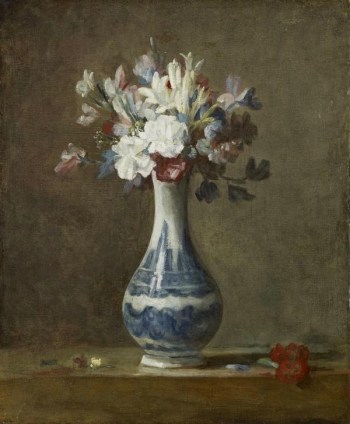
Jean-Baptiste Siméon Chardin, A Vase of Flowers, early 1760s, oil on canvas, 45 × 37 cm (Edinburgh: Scottish National Gallery, NG1883; purchased with the aid of the Cowan Smith Bequest Fund 1937).
My ‘note from the editor’ resulted in many kind words of support—in the comments section and in my inbox. Thanks so much! It also led to what I take to be a very clever idea from Joan Coutu, Professor of Art History and Visual Culture at the University of Waterloo. Observing that many of us find ourselves cut off from our regular research resources, she suggests that we might use Enfilade to identify needs, which the community might in turn be well-resourced to meet. This sort of thing happens often on Listservs, though often at the expense of annoying emails tied to a narrow, specific thread of interest. It would seem that the size and expertise of Enfilade’s readership should be well-suited to address lots of scholarly questions related to the long eighteenth century.
As a way to test the water, I would propose, using this posting as a Notes & Queries Page. Readers are welcome to send requests my way (CraigAshleyHanson@gmail.com), and I’ll add them here. If it’s a huge success, then great, and if it goes nowhere that’s fine, too. Feel free to treat it as a kind of ‘community classified page’. If you’re asking a question, please be sure to include an email address. Perhaps you’re looking for a specific article or a few pages from a book. Perhaps you have a question about online-teaching. Perhaps you’re wondering how best to contact a curator. General news items are also welcome: particularly as related to any major resources that might be foregoing their usual subscription firewalls (The Index of Medieval Art just announced that it will go open-access until 1 June 2020; here’s hoping that others follow suit). Anything that feels like it could be communicated in a sentence or two (rather than deserving its own posting) is potentially fair game. In addition to emailing me directly, you’re welcome to leave requests in the comments section; I’ll move them to to the posting, where people are more likely to notice them. Also, if you read Enfilade postings only as they’re delivered to your inbox, you’ll need to visit the website to see how this posting develops. –CH
N O T E S & Q U E R I E S
Requests
• Hope Saska writes (24 March): I’d love to hear from educators who have used their museums and special collections in their teaching presentations. I’m also keen to brainstorm ways we can work together to innovate in teaching from collections. Of course, nothing compares to firsthand experiences with objects, but many of us in academic art museums/special collections are eager to continue to share our collections. And many of us are eager to participate in instruction, much as we do in study room visits. I’d love feedback and can be reached at: hope.saska@colorado.edu.
Hope Saska, PhD
Curator of Collections and Exhibitions
CU Art Museum | Visual Arts Complex
University of Colorado | Boulder
Resources
• For $100 per annum, The York Society Library offers E-memberships for individuals primarily interested in taking advantage of the Library’s significant collection of electronic resources. The E-membership category provides remote and onsite access to the Library’s full array of electronic resources, including e-books, digital magazines, audiobook downloads, electronic databases, and event recordings.
• As Kee Il Choi notes (9 April): Jane Eyre, a collaboration with Bristol Old Vic, filmed by National Theatre Live at London’s National Theatre, is available via YouTube from now until 16 April. It’s followed by weekly offerings that include Treasure Island, Twelfth Night, and One Man, Two Guvnors. More information is available here.
• Open Culture, is a clearinghouse for free culture and educational media on the web with lots of audio books, online courses, MOOCs, films, etc.
• As Theresa Machemer writes in the Smithsonian Magazine (1 April 2020), “Last week, the nonprofit Internet Archive launched a National Emergency Library featuring 1.4 million digitized books from the last century, all freely available for download without the usual one-at-a-time reader restriction. Presented as a generous move in service of students and educators who no longer have access to their local libraries—many of which have closed in response to the COVID-19 pandemic—the announcement was initially met with praise. But backlash from authors and publishers has since framed the collection differently, presenting it as internet piracy that violates intellectual property laws.” Jill Lepore, writing in The New Yorker (26 March 2020) was one of the early voices of praise, while The Authors Guild offered an emphatic statement condemning the NEL (27 March 2020).
• Kee IL Choi writes (28 March): The New York Public Library has opened up a lot of its databases, including JStor (NYPL cards required for full access).
• We’re now in the second week (25 March) of The Metropolitan Opera’s free encore presentations from the company’s Live in HD series; eighteenth-century works were last week; this week is Wagner. From the Met’s website: “each performance [is] available for a period of 23 hours, from 7:30pm EDT until 6:30pm the following day. The schedule will include outstanding complete performances from the past 14 years of cinema transmissions, starring all of opera’s greatest singers.” -Craig Hanson
• Cristina Sofia Martinez writes: I have been compiling a number of free online resources for my students that others may also find useful. Very best, and keep safe! -Cristina
Libraries/Research/Books free resources on Muse during Covid-19.
Open-Access JSTOR Materials accessible to the public.
Le Guggenheim offre ses livres d’art, as noted at Vice.
La BnF choisit de rendre accessible gratuitement à tous l’ensemble de l’offre de son site de presse, RetroNews. Grace à toutes les ressources de presse que le site propose, vous pouvez à la fois relire l’histoire et la faire découvrir à vos enfants ou vos élèves. Tous les articles, vidéos, documents audio produits par les équipes de journalistes, chercheurs et universitaires sont consultables gratuitement pendant le confinement. Ils retracent et analysent les événements de la petite et de la grande histoire couverts par la presse de l’époque. Pour y accéder, il suffit de se créer un compte personnel. Toutes les données seront supprimées à l’issue de l’abonnement gratuit.
The Czech National Library has made its 206,000-title archive available online for free.
Virtual Tours of Twelve Famous Museums, via Travel + Leisure.
Nine Dazzling Art Experiences You Can Have From the Comfort of Your Home, via Artnet News.
A Five-Hour, One-Take Cinematic Tour of Russia’s Hermitage Museum, via Open Culture.
Watch Free IDFA Movies (International Documentary Film Festival Amsterdam).
4200 Rare Feature Films to Watch for Free and Legally at APAR.
‘Quarantine Soirees’: Classical Music and Opera to Stream at Home, via The Guardian.
Philharmonie de Paris, an exclusive concert each evening at 20:30.
Completed Requests (archive)
• Sharon Goodman writes (27 March): Would anyone be able to scan me a copy of plate 77 of C.H. Tatham’s Etchings, Representing the Best Examples of Ancient Ornamental Architecture; Drawn from The Originals In Rome, And Other Parts of Italy, During The Years 1794, 1795, And 1796 please? Unfortunately, this publication is not online to my knowledge. My email is: sgoodman@christies.com.
◊ ◊ ◊ ◊ ◊
Note (29 March 2020) — The original version of this posting appeared 25 March 2020; it’s updated based on incoming requests.
New Book | Becoming America
Distributed by Yale UP (portions of the collection have been on view at The Huntington since October 2016) . . .
James Glisson, ed., with contributions by John Demos, Jonathan and Karin Fielding, Robin Jaffee Frank, James Glisson, Stacy Hollander, Christina Nielsen, Sumpter Priddy, Elizabeth V. Warren, and David Wheatcroft, Becoming America: Highlights from the Jonathan and Karin Fielding Collection of Folk Art (San Marino: The Huntington Library, Art Collections, and Botanical Gardens, 2020), 264 pages, ISBN: 9780300247565, $50.
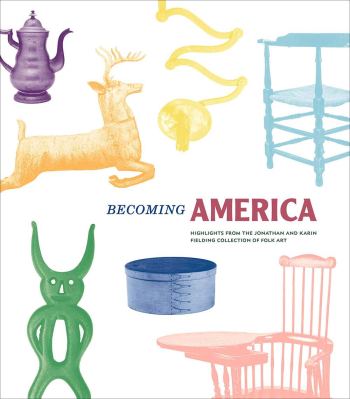 Becoming America offers a multifaceted view of one of the foremost collections of 18th- and 19th-century American folk and decorative art from the rural Northeast. Essays by leading specialists discuss the culture of furniture workshops, exuberant painted decoration, techniques of sewing and quilting, and poignant stories about the families depicted in the portraits. The collection itself includes Shaker boxes, a beaded Iroquois hat, embroidered samplers, metalwork, scrimshaw, handwoven rugs, ceramics, and a weather vane. The majority of these works have never before been published. With lively essays and profuse illustrations, this handsome volume brings to life the aesthetic of early Americans living in the countryside and is an essential exploration of the period’s taste and style.
James Glisson is interim chief curator of American art at The Huntington. Jonathan Fielding is the former director of the Los Angeles County Department of Public Health and Distinguished Professor at UCLA. Karin Fielding is a trustee of the American Folk Art Museum in New York.










 Enfilade
leave a comment