Mei Mei Rado Named Costume & Textile Curator at LACMA
Starting this month at LACMA:
 Los Angeles County Museum of Art (LACMA) has appointed Mei Mei Rado as the new Associate Curator of Costume and Textiles. Dr. Rado received her M.A. from the University of Chicago and her Ph.D. from the Bard Graduate Center in New York. She specializes in the history of both Western and Eastern Asian textiles and dress from the eighteenth to the twentieth centuries, with a focus on intercultural exchanges. She is currently working on her book manuscript The Empire’s New Cloth: Western Textiles at the Eighteenth-Century Qing Court, which was supported by a postdoctoral grant from the American Council of Learned Societies.
Dr. Rado was awarded the J. S. Lee Memorial Fellowship for Chinese Art at The Palace Museum in Beijing, a Predoctoral Fellowship at The Metropolitan Museum of Art in the Department of European Sculpture and Decorative Arts, and a Postdoctoral Fellowship at the Freer/Sackler Galleries (now the National Museum of Asian Art, Smithsonian Institution). Her contributions to exhibitions and exhibition catalogues include Interwoven Globe: Worldwide Textile Trade, 1500–1800, and China: Through the Looking Glass (Metropolitan Museum of Art, New York); Shanghai Glamour: New Women, 1910s–40s (Museum of Chinese in America, New York); Performing Images: Opera in Chinese Visual Culture (The Smart Museum, The University of Chicago); The 1930s: Elegance in an Age of Crisis (Museum of Fashion Institute of Technology, New York); and Far-Reaching Elegance: Magnificent Chinese Export Silk (China National Silk Museum, Hangzhou). From 2017 to 2019, she taught at The School of Art and Design History and Theory at Parsons School of Design in New York.
A selection of Dr. Rado’s publications can be found on her Academia site. Her forthcoming article “Fabric of Light, Surface of Displacement: Lamé and Its Shine in Early Twentieth-Century Fashion” will appear in an edited volume Materials, Practices and Politics of Shine in Modern Art and Popular Culture (Bloomsbury).
Exhibition | In Pursuit of the Picturesque

Samuel Daniell, Scene in Sitsikamma, Elephants with Herons at a Pool, color lithograph from African Scenery and Animals, 1804
(Princeton University Library, Promised Gift from the Collection of Leonard L. Milberg)
◊ ◊ ◊ ◊ ◊
Press release for the exhibition now on view at Princeton’s Firestone Library:
In Pursuit of the Picturesque
Firestone Library, Princeton University, 22 January — 1 March 2020
Curated by Stephen Ferguson, Jennifer Meyer, and Emma Sarconi
In Pursuit of the Picturesque, an exhibition featuring British color plate books published between 1776 and 1868, is on view at the Ellen and Leonard Milberg Gallery, located in the Firestone Library lobby, from January 22 until 1 March 2020. Showcasing selected items from the collection of Leonard L. Milberg (Princeton University Class of 1953), the exhibition includes nearly 40 large books with colorful, detailed imagery from the British Empire at the turn of the 19th century. This selection from Milberg’s collection of 115 color plate books portrays an expanding global empire at the advent of lithographic printing, which captured color and imagery with more beauty and ease than ever before.
Milberg has collected color plate books since the 1980s, though his love of art began in the 1950s. During his Army days in Alaska, he devoted his time to reading American art books. Milberg started collecting American prints, then discovered American printmakers who were English emigres, which led to his interest in British color plates. “They tell a wonderful story through pictures,” said Milberg. “If you take a book in your hands, you can hold Edward Lear’s parrots and hear the crackling of the old paper. It’s much different from a painting, which is only a visual experience.”
Princeton University Library’s Emma Sarconi, reference professional for Special Collections, who co-curated the exhibition with Stephen Ferguson, associate university librarian for external engagement, and Jennifer Meyer, curatorial assistant for Special Collections, said topics range from history to horticulture, from martial achievements to topographical scenery. “These color plates were not just beautiful objects,” explained Sarconi. “They also created a vision of empire that could be exotic, romantic, and picturesque.” To Milberg, “it satisfies traveling because the color plates cover all over the world, from the Mexican Yucatán, to the South Seas, from Sicily to South Africa.”
Beyond their beauty, the color plate illustrations were scientific, political, and historical knowledge during a period of British expansion. “Very often, the books reflect expeditions like Captain Cook’s voyages,” said Milberg, “with the naturalist historian, Sir Joseph Banks, reporting back to England’s Royal Society.” From the comfort of their homes, the British public could be transported to faraway lands through these lavish, vibrant prints, kindling national pride and patriotism. Meyer commented, “Love of the monarchy and British homeland, as well as pride of a powerful military and expanding global empire, are on full display in these volumes.” Moreover, the illustrations began to normalize far off places and the people who lived there, envoking a sense of enchantment and exocitism.
According to Sarconi, “At the same time that these images inspired the viewer, they did so by silencing the horrific aspects of colonial expansion, composed without signs of the struggle, strife, and subjugation that made the empire possible.”
In a gesture of great generosity, Milberg has promised to give his collection of color plate books to Princeton University Library. The promised gift will add greatly to the Library’s holdings of British art of this period and will be a new resource for students and scholars in art, cultural, and other fields of history.
Milberg declared in his 30th reunion book entry, “I have belatedly, but passionately discovered books, prints, and the Princeton University Rare Book Library.”
During the past 37 years, he has shared the fruits of this passion with our community, said Ferguson. Milberg’s gifts (13,000 items plus) range from 19th-century American prints and drawings to several book collections: American poetry, Irish poetry, prose, and theatre as well as two Judaica collections.
Research Lunch | Rebecca Tropp on the Picturesque and Country Houses
This spring at the Mellon Centre:
Rebecca Tropp, Accommodating the Picturesque: The Country Houses of James Wyatt, John Nash, and Sir John Soane, 1793–1815
Paul Mellon Centre for Studies in British Art, London, 20 March 2020

James Wyatt, Ashridge House, commissioned by the 7th Earl of Bridgewater.
Whilst much has been written about the development of Picturesque theory at the end of the eighteenth century, regarding both the landscape itself and prescriptions for the siting of buildings within it, these discussions have generally been limited to two-dimensional snapshots, such as those represented in Humphry Repton’s Red Books. This paper, based upon ongoing research for my doctoral dissertation, seeks to push beyond the visual to investigate some of the physical implications and repercussions of the Picturesque ideal—the intersection between the visual two-dimensional picture-plane and the practical three-dimensional architectural response—on the design and construction of country houses at the turn of the nineteenth century.
Focusing on the work of James Wyatt (1746–1813), John Nash (1752–1835), and Sir John Soane (1753–1837), and limiting my investigation to those country houses designed during the pivotal period from 1793 to 1815, I investigate two specific implications related to the lowering of the principal floor from piano nobile to ground level, as part of a general repositioning of the house within the landscape. First is the use of level changes within the ground floor—the inclusion of a few steps up or down in entrance halls or between rooms, as distinct from staircases between floors—considering some possible reasons for their incorporation and the purposes they served. Second, and sometimes connected to these level changes, is an increase in permeability between interior and exterior, through the use of full-length windows, loggias and attached conservatories—social/botanical spaces that were first incorporated into the design of the house during this period. Taken together, these developments furthered the evolving relationship between house and landscape and, as a result, the experience of moving through and between those spaces.
Research Lunches are a series of free lunchtime research talks. All are welcome, but please book a ticket in advance. 1:00–2:00pm, Seminar Room, Paul Mellon Centre.
Rebecca Tropp is a fourth-year PhD student in History of Art at St John’s College, University of Cambridge, working under the supervision of Dr Frank Salmon. She completed her MPhil in History of Art and Architecture at Cambridge in 2015, investigating recurring spatial arrangements and patterns of movement in the country houses of John Nash. Prior to commencing postgraduate studies in the UK, she received her bachelor’s degree from Columbia University in New York, where she majored in the History and Theory of Architecture.
Call for Papers | Cultivating Science in the Early Modern Garden
From the Call for Papers:
Cultivating Science in the Early Modern Garden, 16th–18th Centuries
National Library of Portugal, Lisbon, 20–21 July 2020
Organized by Denis Ribouillault and Ana Duarte Rodrigues
Proposals due by 30 April 2020
“[The knowledge of the Royal Society derived ] not onely by the hands of the Learned and profess’d philosophers; but from the Shops of Mechanicks; from the Voyages of Merchants; from the ploughs of Husbandmen; from the Sports, the Fishponds, the Parks, the Gardens of the Gentlemen.”
–Thomas Sprat, History of the Royal Society (London: J. Martyn and J. Allestry, 1667), p. 72.
Although the history of early modern gardens has benefited in recent decades from an increasingly wide range of methodologies, the role played by these spaces in the development of science has been the subject of a relatively small number of inquiries. A majority of them concentrates on botanical gardens and the history of botany (Baldassari 2017), though it is now recognized that mathematics, pneumatics or astronomy found in gardens a priviledge ground for experimentation and display (Fischer et al. 2016; Ferdinand 2016).
A primary aim of this workshop is to interrogate and document what we could call (anachronistically) ‘scientific practice’ in early modern European gardens. How were gardens used to advance scientific knowledge? Examples range from the growing of medicinal plants, astronomical observation, physical experiments and so forth. Gardens were also privileged places for teaching and for debates and discussion pertaining to the various branches of natural philosophy. Furthermore, we encourage scholars to pay attention to how this function of gardens as ‘academies’, as platforms for the production and display of knowledge, as stages of scientific sociability and as pedagogical tools, affected the gardens from a formal, artistic, iconographic and hermeneutic point of view. It is not just a matter of documenting and reconstructing what happened in gardens. More precisely, it is a question of showing how what happened in gardens can lead us to a renewed understanding of the physical appearance (at a given moment) of the gardens themselves. This calls for a fruitful—yet difficult-to-achieve—intermingling of the methodologies of the history of science and of the history of art under the aegis of garden history.
• Fabrizio Baldassarri and Oana Matei, eds., Gardens as Laboratories: A History of Botanical Sciences, Journal of Early Modern Studies 6.1 (Spring 2017).
• Juliette Ferdinand, From Art to Science: Experiencing Nature in the European Garden, 1500–1700 (Treviso: Zel Edizioni, 2016).
• Hubertus Fischer, Volker R. Remmert, and Joachim Wolschke-Bulmahn, eds., Gardens, Knowledge and the Sciences in the Early Modern Period (Basel, Birkhäuser, 2016).
Papers should be about 25 minutes long. Q&A and intensive discussion will follow each presentation. We intend to publish the proceedings of the workshop. Contributors’ travel and accommodation costs will be covered. Please send a proposal of 550 words max. with a title and a short bio to denis.ribouillault@umontreal.ca before April 30, 2020.
This event is sponsored by the research project led by Denis Ribouillault, Before the ‘Great Divide’: The Shared Language(s) of Art and Science in the Early Modern Period, funded by a SSHRC (Social Sciences and Humanities Research Council of Canada) Insight Grant (2019–2024) and the Centro Interuniversitário de História das Ciências e Tecnologia, University of Lisbon. The workshop will take place during the exhibition at the National Library Jardins Históricos em Portugal, organized by the Associação de Jardins Históricos and the landscape architect Teresa Andersen, with the collaboration of Ana Duarte Rodrigues, as part of the programme Lisboa Verde 2020. Visits of the exhibition and of relevant gardens and monuments are planned for the workshop participants.
Organizers : Denis Ribouillault (University of Montréal, Department of Art History) and Ana Duarte Rodrigues (University of Lisbon, Centro Interuniversitário de História das Ciências e Tecnologia).
Antwerp Summer School in Digital Humanities, 2020
From the University of Antwerp:
Antwerp Summer School in Digital Humanities: Making a Digital Edition, Basic Skills and Technologies
University of Antwerp, 29 June — 3 July 2020
Applications due by 16 March (early bird) or 6 April 2020
From 29 June to 3 July 2020, the University of Antwerp’s Centre for Digital humanities and literary Criticism (ACDC) is organising its third annual Summer School in Digital Humanities. The summer school will exist of an intensive 5-day entry level hands-on course on making digital scholarly editions. Over the course of the week, participants will gradually learn how to transcribe and describe textual cultural heritage documents in TEI-compliant XML, process their transcriptions using related X-technologies (Xpath and XSLT), and prepare them for the web. Specifically, participants will set up a Local Area Network of Raspberry Pi minicomputers to develop an eXist-db XML database for hosting and sharing their materials in the form of a digital scholarly edition.
As students will be introduced to these technologies step by step, the course requires no prior skills or knowledge – other than to complete a minor autodidactic exercise to make sure everyone has a basic understanding of some of the core technologies the course will build on (HTML, CSS, Command Line).
The organizers are happy to announce that the summer school’s keynote lecture will be presented by Dr. Elena Pierazzo, Professor of Digital Humanities at the University of Tours, at the Centre d’Études Superieures de la Renaissance where she directs the MA program in Digital Humanities and approaches to the digitisation of cultural heritage materials (Intelligence des Patronises). Professor Pierazzo has been the Chair of the Text Encoding Initiative for two mandates, and has served for two mandates in the TEI Technical Council and was involved in the TEI user-community, with a special interest in the transcription, edition and cataloguing of modern and medieval manuscripts. She was co-chairs the working group on digital editions of the European Network NeDiMAH and one of the scientist in chief for DiXiT a Marie Curie ITN devoted to the training of doctoral students to the practice of digital scholarly editing. And in 2019, she was invited by the ADHO (Alliance of the Digital Humanities Organisation) as the co-Chair of the Program Committee of the DH2019 in Utrecht. Although this lecture is part of the summer school’s official programme, the keynote will be organised in the context of the University of Antwerp’s platform{DH} Lecture Series, and opened up to the larger public.
Registration for the summer starts from €150 (early bird) and closes on Monday 6 April (regular). For more information on the application procedure, please visit our registration page.
As a training event, the summer school is organised in conjunction with CLARIAH-VL – a collaborative infrastructure project across Flemish universities to which ACDC and the platform{DH} are affiliated. We look forward to welcoming you in Antwerp this summer!
Public Lecture Course | Ceramics in Britain
This spring at the Mellon Centre:
Public Lecture Course, Ceramics in Britain, 1750 to Now
Paul Mellon Centre for Studies in British Art, London, Thursdays, 5 March — 2 April 2020
Registration opens 3 February 2020
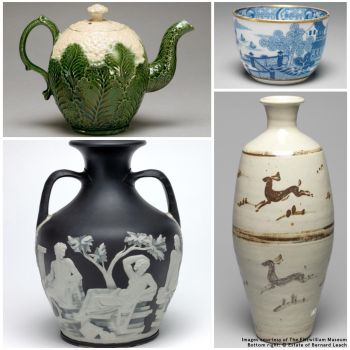 While the story of ceramics is a global one, Britain has played a leading role in the last three centuries, a period in which British invention has shaped developments and brought constant renewal to the industry. This course, delivered by experts in the subject, will explore five key influential developments in the history of British ceramics since the mid-eighteenth century, examining the multiple ways in which innovators, entrepreneurs and artists have reinvigorated the field. No prior art historical knowledge is necessary. There will be a brief drinks reception from 6:30 to 7:00pm. The lectures will begin promptly at 7:00pm.
Registration will open on 3 February at 10:00am on the Paul Mellon Centre website. Please note you will need to sign up for each week individually and in order to ensure consistency attendance, we overbook. If you find you can no longer attend after signing up, please let us know so your place can be offered to someone else. On the night, admission will be made on a first-come, first-served basis.
Thursday, 5 March
Patricia Ferguson (Project Curator, British Museum), Pots with Attitude: British Satire on Ceramics, 1750–1820
Thursday, 12 March
Catrin Jones (Chief Curator, Wedgwood Museum), Josiah Wedgwood: Experimentation and Innovation
Thursday, 19 March
Rebecca Wallis (Curator, National Trust, London and South East), ‘Blue China’: A Nineteenth-Century British Obsession
Thursday, 26 March
Simon Olding (Director of the Crafts Study Centre, University for the Creative Arts, Farnham), ‘Beyond East and West’: The Founding of British Studio Ceramics
Thursday, 2 April
Neil Brownsword (Artist and Professor of Ceramics, Staffordshire University), Obsolescence and Renewal: Reimagining North Staffordshire’s Ceramic Heritage
New Book | Built in Chelsea
Distributed in the USA and Canada by The University of Chicago Press:
Dan Cruickshank, Built in Chelsea: Three Centuries of Living Architecture and Townscape (London: Unicorn Publishing, 2020), 128 pages, ISBN: 978-1911604969, $30.
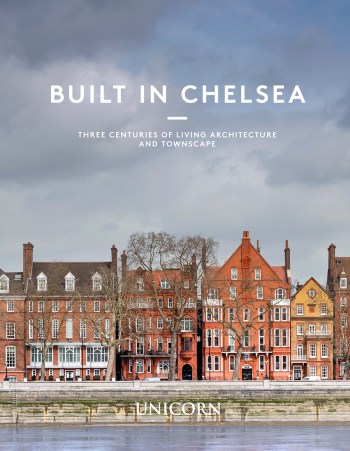 Among the myriad London districts, Chelsea has always held a special charm for residents and visitors alike. Spacious and gracious, with the River Thames as its dramatic background, it has played host to a unique history of artists, bohemians, and related civil causes.
Over the course of twelve chapters, Built in Chelsea: Three Centuries of Living Architecture and Townscape offers readers an opportunity to learn about key episodes of the area’s history. By using the region’s buildings and structures to mark the stages of change, it connects what can be physically seen on the street with the more hidden histories of the architects, patrons, and people who have made their lives in the area.
Author and architectural historian Dan Cruickshank points to the most crucial Chelsea locales—ranging from churches to military establishments, theaters to restaurants, and housing and shops—allowing readers to feel virtually at home. Cruickshank also notes how the spaces between buildings can be just as important as the buildings themselves. He shows how in recent years some exemplary regeneration projects have taken shape because Chelsea has had the benefit of landowners with long-term interests. Due to their unobtrusive management, Chelsea’s proprietors have improved the experiences of both residents and visitors, creating a model for districts elsewhere in London and beyond.
Dan Cruickshank is an honorary fellow of the Royal Institute of British Architects. The author of many books on British architecture, he has also made numerous well-received programs for the BBC, including Around the World in 80 Treasures, Adventures in Architecture, Britain’s Best Buildings, The Country House Revealed: The Intimate Histories of Britain’s Private Palaces, and Bridges That Built London.
Exhibition | Jacques-Louis David Meets Kehinde Wiley
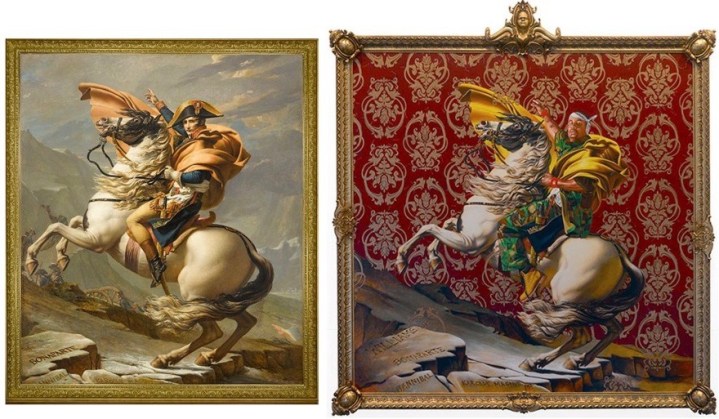
Jacques-Louis David, Napoleon Crossing the Alps, 1800–01, oil on canvas, 102 × 87 inches (Château de Malmaison); and Kehinde Wiley, Napoleon Leading the Army over the Alps, 2005, oil on canvas, 108 × 108 inches (Brooklyn Museum, Partial gift of Suzi and Andrew Booke Cohen in memory of Ilene R. Booke and in honor of Arnold L. Lehman, Mary Smith Dorward Fund, and William K. Jacobs, Jr. Fund, 2015.53), © Kehinde Wiley.
◊ ◊ ◊ ◊ ◊
Press release (via Art Daily) for the exhibition:
Jacques-Louis David Meets Kehinde Wiley
Château de Malmaison, 9 October 2019 — 6 January 2020
Brooklyn Museum, New York, January 24–May 10, 2020
Curated by Lisa Small and Eugenie Tsai
The Brooklyn Museum presents Jacques-Louis David Meets Kehinde Wiley, an exhibition pairing an iconic painting from the Museum’s collection—Kehinde Wiley’s Napoleon Leading the Army over the Alps (2005)—with its early nineteenth-century source image, Jacques-Louis David’s Bonaparte Crossing the Alps (1800–01). By displaying the two paintings together, in dialogue with each other for the first time, the exhibition explores how ideas of race, masculinity, representation, power, and agency have played out across the history of Western portraiture. The presentation is organized by the Brooklyn Museum in collaboration with the Château de Malmaison, where the original version of David’s portrait is permanently displayed. Before traveling to the Brooklyn Museum, the two paintings were on view at the Chateau de Malmaison (Kehinde Wiley Rencontre Jacques-Louis David).
David’s famous portrait was commissioned in 1800 by King Charles IV of Spain in an effort to win the favor of Napoleon Bonaparte, who was then First Consul of France. In the two centuries since its commission, Bonaparte Crossing the Alps has inspired numerous interpretations, but none seem to resonate in contemporary culture as much as Wiley’s large-scale version. In his Napoleon Leading the Army over the Alps, Napoleon is replaced with a Black man wearing camouflage fatigues and Timberland boots. By combining the role, stature, and implied historical legacy depicted in Bonaparte Crossing the Alps with visual markers of status from contemporary African American culture, Wiley challenges the art historical canon, critiquing how it has routinely overlooked the collective Black cultural experience.
David posed Napoleon in the tradition of equestrian portraits of historical commanders like Hannibal and Charlemagne, amplifying the grandeur of the portrait, which commemorated the First Consul and Reserve Army’s expedition through the Great Saint Bernard Pass, in the Alps. In the painting, Napoleon leads his soldiers from atop a rearing steed; in actuality he made this journey on the back of a mule. This is just one example of how Bonaparte Crossing the Alps constructed a strategic image of the General as a triumphant military leader while departing from historical accuracy.
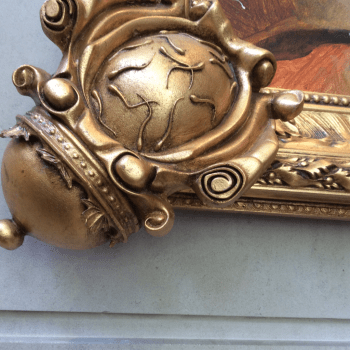 In Wiley’s interpretation, the artist replaced the Italian mountainside and ready infantry with a detailed background flooded with sperm cells. To this ensemble, he added an ornate gilded frame with testicular-shaped cartouches in each corner and crowned by a carved self-portrait emerging from yonic volutes. The result transforms and challenges the grand tradition of historical portraiture established by artists like David, calling attention to the long-standing blind spots of canonical Western painting and the need to redress historical biases. The work belongs to an ongoing series of Wiley’s titled Rumors of War, begun in 2005, which includes the artist’s latest work of the same name: a monumental equestrian bronze statue in New York’s Times Square, which was unveiled in September 2019 and is now in the collection of the Virginia Museum of Fine Arts.
Jacques-Louis David Meets Kehinde Wiley at the Brooklyn Museum marks the first display of David’s portrait in New York, and the first time the two works have been on view together in the United States. To highlight this important occasion, Wiley collaborated with the Brooklyn Museum on the exhibition design for the U.S. presentation. A video showing Wiley on the grounds of Malmaison also accompanies the project, incorporating the artist’s perspectives on how the Western canon, French portrait tradition, and legacies of colonialism influence his own practice. When displayed together, these two works highlight the importance of re-examining representations of power across two centuries and two cultural contexts.
The exhibition also features a selection of complimentary works by Wiley, including a small-scale version of the artist’s recent monumental equestrian statue, Rumors of War. Also on display is Houdon Paul-Louis, a 2011 bust by Wiley that is part of the Museum’s collection. Several works from the Museum’s collection are also on display to provide historical context for Napoleon, including a small bronze equestrian portrait by Antoine-Louis Barye, medals struck by the Emperor to commemorate his achievements, and British prints brutally satirizing him.
Jacques-Louis David Meets Kehinde Wiley is organized by the Brooklyn Museum and Musée national des châteaux de Malmaison et Bois-Préau. The Brooklyn presentation is curated by Lisa Small, Senior Curator, European Art, and Eugenie Tsai, John and Barbara Vogelstein Senior Curator, Contemporary Art, Brooklyn Museum.
◊ ◊ ◊ ◊ ◊
A booklet for the exhibition at the Châteaux de Malmaison, with brief essays by Emmanuel Delbouis and Élodie Vaysse, is available as a PDF file here (in French and English).
Lecture | David Pullins, On the Sofa and French Painting
Next month at BGC:
David Pullins, The Sofa: Furnishing Moral Tales in Eighteenth-Century French Painting
Bard Graduate Center, New York, 18 February 2019

Etched frontispiece from Le Sopha: conte moral (Paris: edition of 1774).
David Pullins will deliver a Françoise and Georges Selz Lecture on Eighteenth- and Nineteenth-Century French Decorative Arts and Culture on Tuesday, February 18, at 6pm. His talk is entitled “The Sofa: Furnishing Moral Tales in Eighteenth-Century French Painting.” The success of Crébillon fils’s exoticist novel The Sofa: A Moral Tale (1742) suggests the blend of celebrity and infamy that marked this relatively new furniture form, inspired by traditional Ottoman culture. Pullins’s talk links the sofa and its often opulent upholstery to the rise of new domestic spaces and new forms of bodily comportment, while tracing its innovation representations in images such as François Boucher’s Lady on her Daybed (1743) and Blonde Odalisque (1752), Gabriel de Saint-Aubin’s Private Academy (c.1755), and the contemporary genre subjects and tableaux de mode popularized by Nicolas Lancret and Jean-François de Troy.
David Pullins is an Associate Curator in the Department of European Paintings at The Metropolitan Museum of Art. He received his MA from the Courtauld Institute of Art and PhD from Harvard University with a dissertation that addressed the training and workshop practices of eighteenth-century French painters but which took many methodological cues from the study of the decorative arts. His research has been supported by the Metropolitan Museum of Art, Sir John Soane’s Museum, Dumbarton Oaks, and the Center for Advanced Study in the Visual Arts (CASVA). Previously an Assistant Curator at The Frick Collection, he has published in The Burlington Magazine, Journal of Art Historiography, Master Drawings, Oxford Art Journal, Print Quarterly, Zeitschrift für Kunstgeschichte, as well as exhibition catalogs and edited volumes including Renoir: Between Bohemia and Bourgeoisie: The Early Years (Kunstmuseum, Basel: 2011) and Histories of Ornament. From Global to Local, edited by Gülru Necipoğlu and Alina Payne (Princeton University Press: 2016).
This event will be livestreamed. Please check back to the BGC website the day of the event for a link to the video. To watch videos of past events please visit our YouTube page.
Call for Papers | Manufacturing the Past
From ArtHist.net:
Manufacturing the Past
European University at St. Petersburg, 8–10 October 2020
Proposals due by 20 April 2020
In 2018 the international conference History and Its Images, organized by the Department of Art History of the European University at St. Petersburg, was dedicated to Francis Haskell’s seminal book of the same title, which greatly influenced the study of the visualization of the past. In 2020 we will host a second conference on the representation of the past in the arts and visual culture. Among the questions to be discussed are: how the visual arts and visual culture produce images of the past, how these images were perceived by the different communities and how they were transformed by the national context of their production.
Current study of the visualization of history, the manufacturing of a collective past, rarely deals with the Islamic world, which, during over the last fifty years has been undergoing dramatic social change as new identities are constructed and the past reconsidered. We plan to have a special panel dealing with the issues of visual presentation of history in art in Islamic countries and with the role of art and architecture in this process. The conference will focus on the following interrelated panels:
Visualizing history and ideology
Propaganda and representation of history
The role of the visual arts in the invention of history
Visual art, history and the construction of national / identity
Visualizing history in the context of the historical culture
The function of historical knowledge in the artistic context
The influence of historical studies on the production of works of art
The role of works of art in the historical teaching
Images of the past and society’s conceptions of the past
Visualizing history and the question of evidence
Visualizing history and the issue of historical memory
Visualizing history in the art of Islamic countries
Visualizing history and Orientalism
We are happy to consider proposals on other themes and subjects remain relevant to the main topic of the conference.
The proposals for twenty minutes presentation should include the following information:
1. Information about participant (full name and academic status)
2. Contact information
3. Proposal (400 words)
Proposals should be sent to: visualizinghistory2020@gmail.com by 20 April 2020.
Working languages of the conference: Russian and English
Organizing committee: Ilia Dorontchenkov, Natalia Mazur, Vladimir Lapin, Anna Korndorf, Evgeniy Anisimov, Jean-Frédéric Schaub, Maria Chukcheeva
Please note that travel and accommodation expenses of the participants of the conference organizing committee are not able to cover. We are however able to give visas support for foreign participants (invitation letter).










 Enfilade
leave a comment