Enfilade

Exhibition | The Cloth that Changed the World

Posted in books, catalogues, exhibitions by Editor on January 29, 2020

Opening in April at the ROM:

The Cloth that Changed the World: India’s Painted and Printed Cottons
Royal Ontario Museum, Toronto, 4 April — 27 September 2020

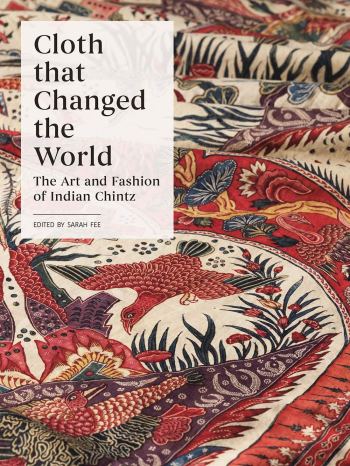
Made with novel cotton, vivid colours and exuberant design, the painted and printed cottons of India changed human history; they revolutionized art, fashion, and science wherever they went around the globe. Featuring pieces from the Museum’s world-renowned collection and several important international loans, this ROM original exhibition explores how over thousands of years India’s artisans have created, perfected, and innovated these printed and painted multicoloured cotton fabrics to fashion the body, honour divinities, and beautify palaces and homes.

Exploring the fascinating stories behind the making and trade of these glorious pieces past and present, The Cloth that Changed the World considers India’s textile innovations and their influences on fashion, trade, and industry around the world in places as far as Cairo, Japan, Sumatra, London, and Ottawa. They were the luxury fabric of their day, coveted by all, and one of the great inventions that drew foreigners to India’s shores hungry for more. Discover how through trade-routes, encounters, and exchange, these cloths connected cultures, inspired imitation and, quite literally, changed the world. Experience how India’s designers and makers today are innovating for new times and audiences.

Sarah Fee, ed., with a preface by Sven Beckert, Cloth that Changed the World: The Art and Fashion of Indian Chintz (New Haven: Yale University Press, 2020), 312 pages, ISBN: 978-0300246797, $50.

◊   ◊   ◊   ◊   ◊

This ROM blog posting from 6 July 2018 looks back to the museum’s 1970 exhibition:

The Origins of Chintz
Royal Ontario Museum, Toronto, 8 April — 28 May 1970

“Chintz… the exotic fabric from India that caught Europe’s fancy… So popular it was banned in England and France… Revolutionized Europe’s textile printing industry.”

Thus exclaimed the brochure that accompanied the ROM’s landmark exhibition, The Origins of Chintz, which opened in April, 1970, now nearly fifty years ago. Occupying the whole of the central ground gallery, known today as Currelly’s Court, the exhibition displayed nearly 100 towering examples of Indian ‘chintz’. . . .

Half of the one hundred objects displayed in the ROM exhibition Origins of Chintz came from the ROM’s own great holdings, particularly the 1934 donation from the estate of Harry Wearne (1852–1929), a British-born textile and wall paper designer. London’s Victoria & Albert (V&A) museum loaned almost forty treasures, including its unique ‘Garrick bed’: these Indian chintz bed coverings are famous both for their grandeur and for the impassioned letters that Mr. Garrick sent to customs officials in London begging for their return; the fabrics had been impounded during the aforementioned import ban on Indian chintz, meant to protect local British silk and linen weavers. A few additional masterpieces—including a seventeenth-century hanging from a Deccan Indian court palace—came on loan from the Metropolitan Museum of Art, the Cooper Hewitt Design Museum, and Austrian Decorative Art Museum of Vienna. . . .

The full posting is available here»
Exhibition | Artful Nature: Fashion and Theatricality, 1770–1830

Posted in exhibitions, lectures (to attend) by Editor on January 28, 2020

Opening next week at the Lewis Walpole Library:

Artful Nature: Fashion and Theatricality, 1770–1830
Lewis Walpole Library, Farmington, CT, 6 February — 22 May 2020

Curated by Laura Engel and Amelia Rauser

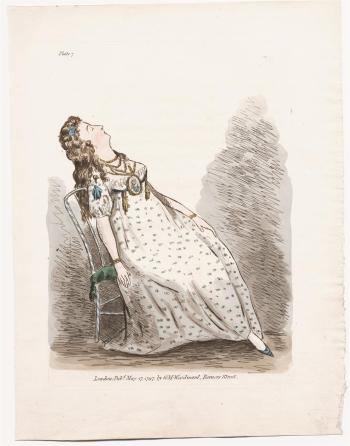
G. M. Woodward, ‘The Art of Fainting in Company’, 1797, hand-colored etching, Plate 7 from ‘An Olio of Good Breeding: With Sketches Illustrative of the Modern Graces!!’ (London, 1797).

Between 1770 and 1830, both fashionable dress and theatrical practice underwent dramatic changes in an attempt to become more ‘natural’. And yet this desire was widely recognized as paradoxical, since both fashion and the theater were longstanding tropes of artifice. In this exhibition, we examine this paradox of ‘artful nature’ through the changing conception of theatricality during these decades, as mirrored and expressed in fashionable dress. Theater and performance practices in the late eighteenth-century, including the vogue for private theatricals, reinforced the blurred lines between the theater and everyday life. Classical sculpture became a reference point for women, as its artistic excellence was acclaimed precisely because it seemed so ‘natural’. But when actresses, dancers, painters, or just regular fashionistas posed themselves as classical statues come to life, they acted as both Pygmalion and Galatea, both the genius artist and the living artwork. ‘Artful Nature’ refers simultaneously to the theatricality and deception typically attributed to fashionable women in the late eighteenth century, and at the same time to the potential survival strategies employed by women artists, authors, and actresses to craft their own parts. The exhibition is curated by Laura Engel, Professor of English at Duquesne University, and Amelia Rauser, Professor of Art History at Franklin & Marshall College.

P R O G R A M M I N G

Joseph Roach, Fashionable Enemies: Glamour as Argument, 1770–1830
Yale Center for British Art, New Haven, Thursday, 6 February, 5.30pm

Joseph Roach, Sterling Professor Emeritus of Theater and Professor Emeritus of English, Yale University, will deliver a keynote lecture in association with the opening of the exhibition Artful Nature: Fashion and Theatricality, 1770–1830.

Amelia Rauser and Laura Engel, Artful Nature
Lewis Walpole Library, Farmington, Wednesday, 13 May, 7.00pm

Amelia Rauser and Laura Engel, the curators of Artful Nature: Fashion and Theatricality, 1770–1830, discuss the exhibition. The talk is presented in collaboration with the Farmington Libraries. Space is limited, and registration is required.

Performance: Mary Berry’s Fashionable Friends
Cowles House, Lewis Walpole Library, Farmington, Friday, 15 May

Under the direction of Laura Engel, a performance based on Mary Berry’s Fashionable Friends, acted as an amateur theatrical at Strawberry Hill in November 1801, is planned for May 15, 2020 in the newly restored eighteenth-century Cowles House on the campus of The Lewis Walpole Library in Farmington, Connecticut.

Seminar | How to Write Articles for Publication

Posted in graduate students, opportunities by Editor on January 28, 2020

From ArtHist.net:

How to Write Articles for Publication
The Morgan Library & Museum, New York, 22 April 2020

Applications due by 2 March 2020

Join the editorial board of Master Drawings journal to learn strategies for translating your research into an article. A series of presentations will be followed by an interactive session in which participants will be divided into smaller groups to work closely with one of the journal’s editors. The seminar is open to 20 recent Ph.D. recipients and advanced graduate students in the history of art whose work focuses on drawings. The course takes place at The Morgan Library & Museum on Wednesday, April 22nd. The application deadline is March 2nd and should be submitted electronically with the subject header ‘Writing Seminar’ to administrator@masterdrawings.org. Participants will be notified by 1 April 2020. More information, as well as the online application form is available here. The seminar is made possible through the generous support of Baymeath Art Trust.

Call for Papers | Jewish Topographies

Posted in Calls for Papers by Editor on January 28, 2020

From ArtHist.net:

Jewish Topographies: 5th International Congress on Jewish Architecture
Technische Universität Braunschweig, 21–23 September 2020

Proposals due by 27 February 2020

Bet Tfila—Research Unit for Jewish Architecture in Europe will organize the conference Jewish Topographies: 5th International Congress on Jewish Architecture at the Technische Universität Braunschweig. The conference will focus on the meaning of the term ‘Jewish topography’ (jüdische Topographie) and also on how historical phenomena can be categorized both socially and culturally. Jewish residential areas and settlements, facilities of Jewish communities (such as synagogues, cemeteries, schools, or hospitals), or locations of companies and shops can form significant topographical networks in cities and landscapes. Jewish topographies stand in a spatial and social context with corresponding places of the non-Jewish population, in which different cultural, religious, or ethnic groups find their own spaces. Conflicts and cooperations, exclusions and limitations emerge in the spatial relationships between these locations and their respective urban and architectural design reflect the possibilities and expectations of the respective and related groups.

The conference aims at examining different levels of Jewish topographies: the spectrum of possible contributions ranges from macro studies to cross-region networks of Jewish communities or Jewish institutions and people (e. g., commercial networks, Verbandsfriedhöfe (association cemeteries)), to locations and facilities of the individual communities (e. g., Judengassen (Jews Lanes), eruv, DP-Camps), to micro studies of residential areas or individual facilities and buildings. Topographies of forced housing (such as ghettos, concentration camps, and Judenhäuser (Jewish houses) may also be discussed. Religious and profane places and objects will be viewed; synchronous and diachronic perspectives will also be welcomed. The focus of the conference is on developments after the Middle Ages. However, comparative studies on earlier epochs are as welcome as general theoretical and systematic studies, e. g., on symbolic, religious, and literary topographies. Ideas on how Jewish topographies can be appropriately researched, represented, and later conveyed may also be further subjects of discussion. The conference will be held in English.

Please send your abstract (max. 2400 characters) and your CV (max. 1200 characters) including your academic affiliation by 27 February 2020, to Dipl.-Ing. Mirko Przystawik (m.przystawik@tu-bs.de).

The academic board and the organizers will decide on acceptance by 12 March 2020. The publication of selected articles in the Bet Tfila’s Series of Publications is planned. The organizers endeavor to cover travel and accommodation costs for the speakers; this depends, however, on the approval of corresponding funding applications.

For any questions, please contact
Dipl.-Ing. Mirko Przystawik, m.przystawik@tu-bs.de
Dr.-Ing. Ulrich Knufinke, u-j.knufinke@tu-bs.de

Exhibition | Ukiyo-e Prints from the Mary Ainsworth Collection

Posted in books, catalogues, exhibitions by Editor on January 27, 2020

Katsushika Hokusai (Japanese, 1760–1849), Fuji in Clear Weather (Red Fuji), from the series Thirty-six Views of Mt. Fuji, early 1830s
(Allen Memorial Art Museum, Oberlin College, Ainsworth Bequest, 1950.711)

◊   ◊   ◊   ◊   ◊

Press release for the exhibition (via Art Daily). . .

Ukiyo-e Prints from the Mary Ainsworth Collection
Chiba City Museum of Art, 13 April — 26 May 2019
Shizuoka City Museum of Art, 8 June — 28 July 2019
Osaka City Museum of Fine Arts, 10 August to 29 September 2019
Allen Memorial Art Museum, Oberlin College, Ohio, 14 January — 14 June 2020

Curated by Kevin Greenwood

In 1950, the Allen Memorial Art Museum received a surprise gift of more than 1,500 Japanese woodblock prints featuring actors, courtesans, and landscapes of the ‘floating world’ of 17th- to 19th-century Japan. This bequest became a cornerstone of the Allen’s renowned Asian art collection, and 200 of the works traveled back to Japan last year for a tour of museums in Chiba (near Tokyo), Shizuoka, and Osaka. Now more than 100 of these prints are on view in Ukiyo-e Prints from the Mary Ainsworth Collection, an Oberlin exhibition that runs through June 14, 2020.

Mary Andrews Ainsworth (1867–1950) graduated from Oberlin College in 1889 and made her first sea voyage to Japan in 1906. The country had recently emerged from centuries of isolation and was beginning a period of rapid industrial development. Ainsworth, however, was attracted to an earlier Japan: that of the Edo period (1603–1868). In this more peaceful era, a world of entertainment arose—ephemeral pursuits made even more popular through the wide distribution of color woodblock prints known as ukiyo-e, or ‘pictures of the floating world’.

“The Ainsworth collection represents the history and evolution of Japanese woodblock printmaking, with high-quality examples of the major subjects, styles, and artists of ukiyo-e. Together, they convey much of the richness and complexity of Japan’s print tradition,” said Kevin R. E. Greenwood, the Allen’s Joan L. Danforth Curator of Asian Art. “We were approached by one of Japan’s leading ukiyo-e scholars to do this exhibition, which confirms the importance of Ainsworth’s collection,” he said. “In the process of working together, we discovered some impressions not known in any other collections.”

Ukiyo-e Prints from the Mary Ainsworth Collection is presented in four sections that span the history of the medium. Early prints (1680–1770) were monochrome, often with hand-coloring added; the carbon-black ink was made from pine soot. Around 1745, with the invention of a way to register, or align, wooden blocks, artists such as Ishikawa Toyonobu began printing in two colors: red and green. These benizuri-e prints, or ‘crimson-printed pictures’, sometimes included a third color, yellow, brown, or indigo. In the 1760s, Suzuki Harunobu was the first major producer of prints using more than three blocks.

The second part of the show, Beauties and Actors (1770–1800), includes works by Kitagawa Utamaro, Chobunsai Eishi, and other artists who helped to popularize the many theaters, tea houses, and celebrities of the pleasure district in Edo (now Tokyo). Ukiyo-e artists not only made prints for sale to Japan’s growing merchant class, but also were hired to produce posters and advertisements for theatrical performances.

The third section, Hokusai and Kuniyoshi (1780–1850), highlights the rise of landscapes in Japanese printmaking, which was due in part to the introduction of a chemical pigment called Prussian blue. Six prints from Katsushika Hokusai’s series Thirty-six Views of Mt. Fuji are included, along with Utagawa Kuniyoshi’s prints of bridges, ferries, and heroes from history and legend.

The final section (1830–1858) is devoted to prints by Utagawa Hiroshige I. Works by this prolific artist comprise more than half of the Ainsworth collection. The exhibition presents thirty-six works by Hiroshige I, including nine from his 1830s series Fifty-three Stations of the Tōkaidō and thirteen from his 1857 series One Hundred Famous Views of Edo—prime examples of some of the finest woodblock prints ever produced in Japan.

“This extensive exhibition and its accompanying catalogue have been years in coming to fruition,” said Andria Derstine, John G. W. Cowles Director of the Allen. “We are thrilled to present, for the first time in decades, such a large portion of our Ainsworth collection, both at the Allen and to enthusiastic audiences in Japan.”

Organized by Kevin R. E. Greenwood, Joan L. Danforth Curator of Asian Art, with Masako Tanabe and Marie Matsuoka, Chiba City Museum of Art; Saori Oishi, Shizuoka City Museum of Art; Eri Yoshida, Weikado Bunko Art Museum; Tatsuya Akita and Yasuko Kikuchi, Osaka City Museum of Fine Arts; Hiromi Sone, Mangosteen, Inc.; and Luoying Sheng ’20, AMAM curatorial assistant in Asian art education.

Call for Papers | Museum Networks and Museum History

Posted in Calls for Papers by Editor on January 26, 2020

From the Museums and Galleries History Group:

Museum Networks and Museum History
Royal Botanic Gardens, Kew, 16–17 July 2020

Proposals due by 6 March 2020

Networks have become an increasingly important part of the analytical toolkit used by historians of museums and collections. As scholars have moved away from narrative institutional histories, they have embraced the study of social and material networks as approaches which expand understandings of museums. In Chris Gosden and Frances Larson’s words, museums can then be seen as “innumerable sets of connections between people and objects …[which] extend over time and through space.” Such approaches have themselves been fuelled by the growth of similar ideas such as Actor Network Theory and object biographies.

These new approaches have been especially useful in recovering forms of agency beyond those of powerful institutional actors, especially curators, and have highlighted the contributions of, for example, object creators and mediators, informants and collecting assistants, as well as, sometimes, of objects themselves. They have drawn attention to the formation of new social identities and forms of expertise; have shown the extent of material flows around the world in relation to museums; revealed the role of affect and the relational in museum history; and encouraged closer attention to the different physical properties of things. There have, though, been some differences of emphasis on whether networks in museum history are a useful metaphor, a set of statistical analyses, or a theoretical model.

This conference seeks to take critical stock of the role of networks in understanding the history of museums and collections. It welcomes proposals which use networks of various sorts as tools of analysis, or which engage with the methodological/theoretical issues raised by networks and/or the rejection of network approaches. It is keen to see proposals which interrogate approaches from other disciplines. Contributions may respond to (but are not limited to):
• Networks of museum donors and makers
• Networks and empire; networks and power
• Professional networks and modern identities
• Global and transnational networks
• Networks and the role of indigenous knowledge
• Affect and the role of materiality
• Actor Network Theory and museum/collection history
• Networks of museums, collections, people, objects
• Museum practice and museum networks
• The limits of networks as analytical tools

Submissions may be for individual papers, panels of three papers, or posters. Paper proposals should be for papers of twenty minutes’ length. Proposals should be 250 words maximum and include a title as well as the name, contact details and affiliation (if applicable) of the speaker. Panel proposals should consist of a panel title, proposals for three papers, along with a rationale for the panel theme, and contact details and affiliations (if applicable) of all participants. Please indicate whether you will provide a chair for your session or not (it does not matter which). Poster proposals are also welcomed. Please follow proposal guidelines for papers while indicating clearly that a poster is proposed. All the above proposals should be sent to contact@mghg.info by 6 March 2020. Please note all speakers and poster presenters will be expected to pay the conference registration fee, but we aim to keep the fee as low as possible.

New Book | Christopher Wren: In Search of Eastern Antiquity

Posted in books by Editor on January 25, 2020

From Yale UP:

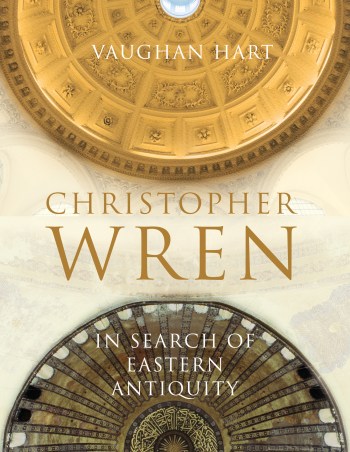
Vaughan Hart, Christopher Wren: In Search of Eastern Antiquity (London: Paul Mellon Centre for Studies in British Art, 2020), 240 pages, ISBN: 978-1913107079, £45 / $60.

In this revelatory study of one of the great architects in British history, Vaughan Hart considers Christopher Wren’s (1632–1723) interest in Eastern antiquity and Ottoman architecture, an interest that would animate much of his theory and practice. As the early modern understanding of antiquity broadened to include new discoveries at Palmyra and Persepolis, Wren disputed common assumptions about the European origins of Classical and Gothic architecture, tracing these building traditions not to the Greeks or Germans but to the stonemasons of the biblical East. In a deft analysis, Hart contextualizes Wren’s use of classical elements—columns, domes, and cross plans—within his enthusiasm for the East and the broader Anglican interest in the Eastern church. A careful study of diary records reappraises Wren’s working relationship with Robert Hooke (1635–1703), who shared in many of Wren’s theoretical commitments. The result is a new, deepened understanding of Wren’s work.

Vaughan Hart is a professor of architecture at the University of Bath.

New Book | The Tile Book

Posted in books by Editor on January 24, 2020

From Thames & Hudson:

Here Design, with an introduction by Terry Bloxham, The Tile Book: History, Pattern, Design (London: Thames & Hudson, 2019), 304 pages, ISBN: 9780500480250, £20 / $30.

This striking book gathers together an extensive collection of ceramic tiles from around the world and explores their rich history, purpose, and decorative qualities. For centuries, tiles have been used for both functional and aesthetic purposes on the façades and interiors of buildings. Found in a multitude of shapes, sizes, colors, and designs—ranging from complex geometrical Islamic patterns to figurative seventeenth-century delftware—tiles are among the most varied ceramic products. This luxurious source book, curated by the award-winning studio Here Design, is organized chronologically and features tiles in every variety of shape, displaying each individual tile type and its overall laid pattern in vivid color. Tiles are also shown in situ around the world and at different periods in their remarkable history. The Tile Book is a dazzling mosaic, with colors and patterns that will uplift and inspire.

Here Design is a multiaward-winning design studio in London. Their books include An Anarchy of Chilies, Herbarium, The Grammar of Spice, and Spectrum: Heritage Patterns and Colors.
Terry Bloxham is Assistant Curator of Ceramics and Glass at the Victoria and Albert Museum.

Call for Articles | Special Issue of ‘Quart’ on Travelling and Art

Posted in Calls for Papers by Editor on January 24, 2020

From ArtHist.net:

Travelling and Art in Europe in the 17th and 18th Centuries
Quart, The Quarterly of the Institute of Art History at the University of Wrocław 56 (June 2020)

Articles due by 1 March 2020

Europe in the 17th and 18th century was an area without sealed national borders and passports, which facilitated free movement of people, transfers of works of art, and the exchange of artistic ideas. Travellers were artists and art lovers, military and clerical, merchants and pilgrims; various works of art were transported across the borders, and thanks to the medium of printmaking, the latest trends and artistic novelties quickly spread across Europe. This dynamic circulation in the 17th and 18th centuries caused so many interesting artistic phenomena to take place in this area, which can today be of interest to researchers. Issue 56 of Quart—guest edited by Andrzej Kozieł—will therefore focus on art-related aspects of travel. Proposed topics of interest include:
• migrations and educational journeys of artists
• transfers of works of art and artistic ideas
• pilgrimage and art
• works of art in travellers’ accounts
• media disseminating works of art

Papersfrom 20,000 to 40,000 characters, in Polish or English, with up to 7 illustrationsshould be submitted in format specified in the guidelines to quart@uwr.edu.pl by 1 March 2020. The editors reserve the right to select given papers. All the submitted papers will be subject to a double-blind review, in line with COPE guidelines. Quart is a regularly published quarterly journal by the Institute of Art History of the University of Wroclaw. It is indexed in ERIH+, CEJSH and BazHum databases. It was awarded a grant under the ‘Support for 500 Scientific Journals’ Programme of the Ministry of Science and Higher Education. It is included in the list of scientific journals of the Ministry of Science and Higher Education as of 31.07.2019 with 20 points. The current number can be purchased in EMPiK chain stores. Archival issues are available in libraries and in a digitalized form at the Polona website.

Call for Papers | The Prospect of Improvement

Posted in Calls for Papers by Editor on January 24, 2020

From ArtHist.net:

The Prospect of Improvement: A Bluestocking Landscape
Hagley Hall, Worcester, 8–9 September 2020

Proposals due by 14 February 2020

A two-day conference at Hagley Hall, Worcestershire including a tour of the house and grounds supported by Elizabeth Montagu Correspondence Online [EMCO] and Paul Mellon Centre for Studies in British Art.

The Prospect of Improvement: A Bluestocking Landscape puts centre stage the patriotism and patronage of George Lyttelton first baron Lyttelton (1709–1773), a strangely shadowy figure yet a fascinating eminence grise behind the art and politics of his age. We will discuss the motivation behind his extensive remodelling of his grounds and the commissioning of local architect Sanderson Miller (1716–1780) in designing a new Hagley Hall. How can the ideas of other architects and landscape reformers from the midlands such as Sir Roger Newdigate (1719–1806), Sir Uvedale Price (1747-1829), and William Shenstone (1714-1763) be brought into dialogue with Miller’s project?

As EMCO is editing the correspondence of Lord Lyttelton’s friend and literary collaborator, critic Elizabeth Montagu (1718–1800), we will equally focus on eighteenth-century women’s management of estates, commissioning of art and architecture and writing associating rural retirement with moral improvement.

Plenary speakers
• Stephen Bending (University of Southampton), author of Green Retreats: Women, Gardens, and Eighteenth-Century Culture (2013)
• Markman Ellis (Queen Mary, University of London), author of The Coffee House: A Cultural History (2005)
• Joe Hawkins (Head of Landscape at Hagley)
• Steve Hindle (Huntington Library, California), W. M. Keck Foundation Director of Research

We invite delegates to participate in three panels on the following themes:
• Concepts of reform and improvement in architecture and rural life
• Female management of the country estate
• The symbolism of the garden in eighteenth-century art and literature

We also welcome papers on:
• Whig perceptions of the country and the city
• Portraiture, representations of the country house, and landscape painting
• Domesticating the picturesque: creating the grotto, the wilderness, and the waterfall
• Bluestocking crafts and collecting
• Botany, gardening, and girls’ education
• Agricultural reform and the rural poor
• The Lunar Society, provincial salons, and correspondence networks
• The politics of patronage
• Philanthropy and the religious revival

A selection of delegates will be invited to extend their papers into scholarly articles for a book-length special issue of the journal Eighteenth-Century Life, to be edited by Professor Markman Ellis.

Please send proposals for papers (no longer than 350 words) and requests for bursary application forms by 14th February 2020 to Jack Orchard by email: j.t.g.orchard@swansea.ac.uk or by post to: Dr. Jack Orchard, Department of English Literature and Creative Writing, Swansea University, Singleton Park, Swansea, SA2 8PP.

Registration

Conference Registration with Accommodation: £130
Conference Registration: £70
Accommodation will be arranged by EMCO at a local hotel, and both registration fees include two lunches at the conference and the conference banquet.

We reach out especially to early career researchers by offering six bursaries funded by the Paul Mellon Centre for British Art to doctoral students and unwaged ECRs with promising proposals for papers relevant to the conference theme. Each bursary holder is invited to review two panel sessions for a report on the conference to be published online at Elizabeth Montagu Letters and the Bluestocking Circle. Bursaries covering the conference fee and accommodation are available to six postgraduate students and unwaged early career researchers, who have papers accepted for presentation at the conference. ‘Unwaged’ scholars may be retired, unemployed, or unable to access institutional support for conference attendance. They are invited to make a personal statement in support of their application. Students’ bursary application forms must be accompanied by a statement from a supervisor which is signed on university headed paper and accompanied by the university stamp. The bursary award will be paid as a refund following attendance at the conference.