Call for Papers | Enlightening the Plates of the Encyclopédie
From the Call for Papers:
Enlightening the Plates of the Encyclopédie:
Perspectives and Research on the Recueil de planches, 1762–1772
Sorbonne University, Paris, 27–29 May 2021
Proposals due by 30 September 2020
For several decades and due to the impulsion provided by the pioneering work of Jacques Proust, John Lough, Richard N. Schwab and then Frank A. Kafker, the studies on the Encyclopédie, ou Dictionnaire raisonné des sciences, des arts et des métiers (1751–1772) by Diderot and D’Alembert proliferated. Many conferences, books and articles, including those published since 1986 in the review Recherches sur Diderot et sur l’Encyclopédie, testify to this. Easier access to the work thanks to digital editions (the one designed by the Redon company, commercially distributed since 2000, and then the ARTFL edition, freely accessible on the web) have also contributed to this dynamic. The online publication in 2017 of a first critical digital edition of the work (ENCCRE) is a new stage in the interest shown by historians from all disciplines in this essential monument of the Age of Enlightenment.
Despite the founding studies already cited, Madeleine Pinault-Sørensen’s seminal contributions and many other works dedicated to the 11 volumes of plates of the Encyclopedie, the latter remain far less known and studied than the 17 volumes of articles (1751–1765) that came before and refer to them, as if the illustrations and their relationship to the text, although considered as one of the most important innovations of the Encyclopedie, had in the end met less interest than the articles themselves.
Today, ENCCRE—thanks to its high-quality digitization of the engraved plates and its ability to directly relate illustrations and explanations—allows us to rediscover this iconographic treasure with a fresh eye and offers new resources for exploring it. More generally, new technologies encourage us to imagine specific ways of analyzing these illustrations, the explanations that accompany them, their reciprocal links, and their relationship with the volumes of articles. It is therefore essential to hold an international conference to review the research specifically dedicated to the plates of the Encyclopédie.
In this perspective, we launch a call for papers for the conference Les Planches de l’Encyclopédie en lumière which will be held over three days at Sorbonne University from 27 to 29 May 2021 and within the framework of which the common reflection will be organized around four main axes (hereafter, we will refer to the Recueil to designate the 11 volumes of the Recueil de planches sur les sciences et les arts, and to ‘series’ to designate each of the thematic chapters which constitute it, such as ‘Anatomie’, ‘Bouchonnier’, or ‘Draperie’). The questions addressed by each of the axes are not limitative:
1. The manufacture of the engraved plates and series of the Recueil, i.e. all the questions relating to the modalities of their intellectual manufacture and the history of their editorial production: what are the sources of the plates? How were they used (additions, modifications, arrangement)? Have preparatory drawings been preserved? To what extent do these elements shed light on the content of the plates and the intentions of their author(s)? Furthermore, what are the elements that make it possible to reconstruct and, possibly, date the stages of the making of a series?
2. The contributors of the plates, i.e. the Encyclopédie’s draftsmen and engravers: who are they? What place did their work for the Encyclopédie hold in their career? What role(s) have they played in the Encyclopédie? What is their contribution (explicit attributions and attribution hypotheses)? Do they differ from each other according to technical and/or stylistic criteria?
3. The explanations of the plates, i.e. all the questions relating to the ‘Explications’ which form the first part of each series of the Recueil before the corresponding engraved plates. This essential subject can be approached from several angles:
• authors: what do we know about the authors whose explanations bear the explicit signature? To what extent can we attribute to them the many unsigned plates in the book? Are they also contributors for articles on the same subjects?
• editor: question of Diderot’s role, not only as author of explanations, but also as editor of the entire collection (organization of the series, writing of the introductory pieces presenting the volumes, etc.): at the end of the detailed statement of volume II (1763), he states that he “reviewed all the arts and crafts [explanations] on the manuscript and on the plates”;
• relations with the engraved plates: different types of links between explanations and illustrations according to the series? Additional cross-references to the articles (with the effects of repetition, correction or replacement)? There is also the more general question of the relationship between text and image as the Encyclopédie establishes it and, sometimes, takes them up as a central theme.
It is also possible to study in this perspective the relations between articles and plates in a given field: concordance or not between the articles and the figures they describe? Possible replacement of the plates on which the articles were written and for what reasons? Questions which also refer to the problem of the manufacture of a series (axis n° 1), whether or not associated with the writing of the articles.
4. The place of the plates of the Encyclopédie in the history of illustration in the 18th century: can we situate the traditional and innovative parts of the Recueil in relation to the standards of the time, according to the weight, place, and roles of the illustrations in the book? According to the link that the plates maintain within the book with their explanations and the articles associated with them? To what extent can the book be considered as an illustrated corpus? More generally, to what extent the Recueil can be considered as a part of the history of the circulation of knowledge in the 18th century?
The proposed papers must necessarily fall within one or more of the previous axes. They may consist of a case study or address a more general issue.
Proposals should be sent before 30 September 2020 to enccre@gmail.com. Proposals will include a title and an abstract of about fifteen lines, supplemented by some general information: your status within your institution (and department if necessary), main research topics, list of publications related to the themes of the colloquium and/or the French 18th century. The languages of the conference are French and English.
Steering Committee
Alexandre Guilbaud, Sorbonne Université
Alain Cernuschi, Université de Lausanne
Malou Haine, Université Libre de Bruxelles
Christine Le Sueur, Université Claude Bernard Lyon 1 Alain Sandrier, Université de Caen Normandie
Scientific Committee
Alain Cernuschi, Université de Lausanne (responsible for the follow-up)
Malou Haine, Université Libre de Bruxelles (responsible for the follow-up) Emmanuel Boussuge, chercheur associé au CELLF (CNRS, Sorbonne Université) Thierry Depaulis, chercheur indépendant
Alexandre Guilbaud, Sorbonne Université
Charles Kostelnick, Iowa State University
Marie Leca-Tsiomis, Université Paris-Ouest Nanterre
Susan H. Libby, Rollins College
François Pépin, professeur agrégé au Lycée Louis le Grand
Stéphane Schmitt, CNRS, Archives Henri-Poincaré
Yann Sordet, Bibliothèque Mazarine
Pierre Wachenheim, Université de Lorrain
Exhibition | The Curator’s Bookcase
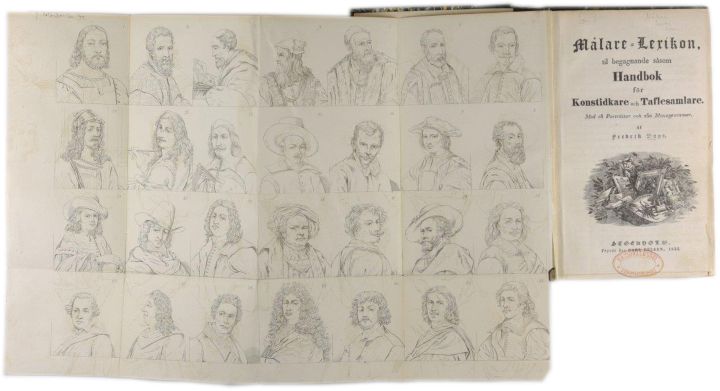
Fredrik Boye, Målare-lexikon til begagnande såsom handbok för Konstidkare och Taflesamlare, Painter’s Dictionary
(Stockholm, 1833)
◊ ◊ ◊ ◊ ◊
Now installed (if not on view) at the Nationalmuseum:
The Curator’s Bookcase: Stories from the Archives
Stockholm, Nationalmuseum, 19 February — 28 June 2020
Using examples from the Art Library’s older collection of books, The Curator’s Bookcase gives an insight into the emergence of art history as an academic discipline in the 19th century. General handbooks on art, biographies, and other examples of literature that kept the museum professionals of that time up to date are exhibited along with photographic reproductions from the Image Archive.
In the 19th century, art history emerged as an academic discipline. This took place in the first half of the century in Germany, and mid-century in Sweden and had a decisive impact on museum practices. Being an artist or a well-read connoisseur was no longer sufficient—academic studies were also required to become a curator. Thus, the museum practice was professionalised. The curators used a scientific approach to analyse, identify, and classify objects of art putting them in a historic context. The collections were presented chronologically and geographically in different schools. The Nationalmuseum gave the most space to the Italian, Dutch, French, and Swedish schools, which dominated the Royal collection donated in 1792 to the Museum, then known as the Royal Museum, one of the first public museums in northern Europe.
The growing interest in art history is reflected in the many books on this subject that were published and spread. Subjects of special interest were the Greco-Roman period and national ideals. Swedish museum curators had lively contacts with colleagues abroad, and it was part of their job to keep abreast with the latest research. The books displayed in this exhibition are from the Art Library’s older collection. They are mainly textbooks on art history, general handbooks, and monographic biographies. The books give an idea of the literature that would have been found in a curator’s bookcase. Several of these books are exquisitely and artistically bound and were published in limited, numbered editions. The exhibition also includes examples of older displays of the collections as photographic reproductions from the Image Archive.
The masterpieces of art have always been of great importance to museum professionals and artists. In the current exhibition on the 6th floor Inspiration: Iconic Works you can discover more about how contemporary artists have been inspired by the old masters. The Curator’s Bookcase is on display in the Old Library.
Sweden Nationalmuseum Acquires Two Drawings by Oudry
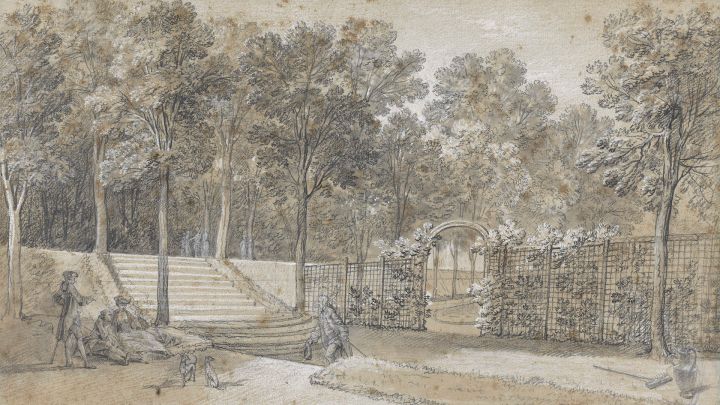
Jean-Baptiste Oudry, View of the Garden in Arcueil, Facing North with the Orangery Terrace and the Peak of the Forest Park or So-Called ‘Talus Cone’, 1744–47 (Stockholm: Nationalmuseum, NMH 55/2019).
◊ ◊ ◊ ◊ ◊
Press release (5 May 2020) from Sweden’s Nationalmuseum in Stockholm:
Nationalmuseum has acquired two drawings with views from the garden and park of Arcueil by the French Rococo master Jean-Baptiste Oudry. The drawings depict a geometrically landscaped garden with elements of a freer park in a state of picturesque decay. The artist presents both immediate visual impressions and more artfully elaborated ones. This type of landscape had previously been completely lacking from the museum’s large collection of works by Oudry.
Jean-Baptiste Oudry (1686–1755) has become known as one of the foremost artists of the French Rococo style. He began as a portrait painter but soon came to specialise in still life painting. His close friends and clients included the Swede Carl Gustaf Tessin, which is also why National museum has so many works by the artist in its collection. Oudry’s activities as a landscape painter are somewhat less known. At times, he is even said to have used a camera obscura in the production of his views.
Starting in 1740, Oudry began to make excursions to scenic Arcueil, located in the southern suburbs of Paris. The place was famous for its beautiful garden and park, which boasted a monumental aqueduct as a backdrop. Today, most of it has vanished or been rendered unrecognisable. The garden complex, which attracted artists such as Oudry, Boucher and Natoire, was created for the Prince of Guise between 1720 and 1730 by the architect Jean-Michel Chevotet. Among Chevotet’s fellow students at the French Academy of Architecture was the Swede Carl Hårleman, and both specialised in landscape architecture. Arcueil was transformed into an intimate formal garden in the spirit of Rococo, with geometric elements such as parterres, ponds and trellis works. The differences in terrain levels on the site created movement and vistas. It was thus also necessary to construct a variety of walls, terraces and stairs, which contributed to the special and complex character of the garden. There was also a wilder and more informal section with a picturesque touch.
It is therefore hardly surprising that Oudry was fascinated by Arcueil. He rented a house that was located directly adjacent to the property, which gave him many opportunities to draw various views. Most are believed to have been executed between 1744 and 1747. Many have an immediate character, revealing that they were drawn outdoors, on site. Others appear more elaborate. Over fifty such views are known to exist, two of which have now been acquired by Nationalmuseum. Of them, the view to the north with the orangery terrace and the peak of the forest park (or so-called ‘talus cone’), is among Oudry’s finest drawings from Arcueil. The artist has worked on a beige paper (which was probably originally blue) with black and white chalk, which he then smudged with a stump (an artist’s tool made of hard rolled paper or chamois leather). Then Oudry used a brush to add highlights in white gouache. In this way he managed to create fine contrasts between sunlit areas and other shady parts of the image. The figures are considered to have been drawn by another hand, perhaps Victoire Chenu or Jacques-Philippe Le Bas, who later (1776) engraved and published this view under the title Ancienne et première vue d’Arcueil.
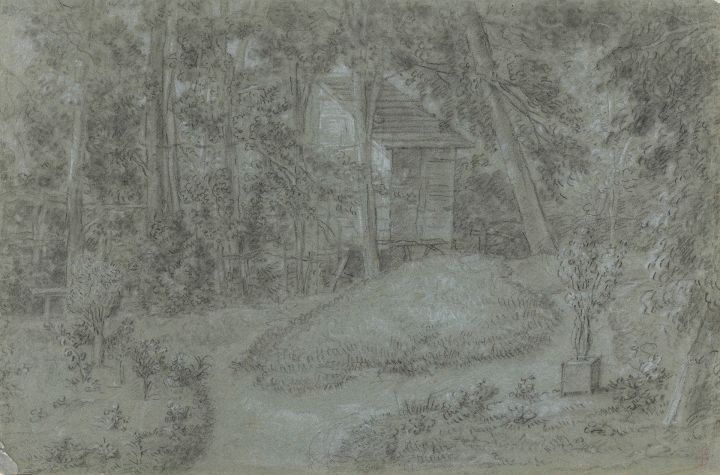
Jean-Baptiste Oudry, View of the Bosquet in the Garden of Arcueil with Promenade and Garden Shed, 1744–47
(Stockholm: Nationalmuseum, NMH 46/2018).
◊ ◊ ◊ ◊ ◊
While the view from the orangery terrace has the character of a completed drawing, or what Carl Gustaf Tessin called la manière très finie, Oudry’s second drawing is characterised by a seemingly immediate visual sensibility. It was create using chalk and faint white gouache highlights on a grey-blue paper, and reproduces a more informal part of the garden, a bosquet area with a promenade. In the background one can see a garden shed with a somewhat dilapidated fence. In this view, Oudry has depicted a pastoral scene which seems quite distant from the more formal environment of the previous drawing and thus appears to herald the parks of the late 18th century.
Nationalmuseum receives no state funding with which to acquire design, applied art, and artwork; instead, the collections are enriched through donations and gifts from private foundations and funds. The acquisitions have been made possible through a purchase using donations from the Wiros Foundation and the Hedda and Nils D. Qvist Memorial Fund.
Call for Essays | Women and the Art and Science of Collecting
From ArtHist.net:
Women and the Art and Science of Collecting: Eighteenth-Century Collecting Beyond Europe
Edited by Dr. Arlene Leis and Dr. Kacie Wills
Abstracts due by 1 July 2020, with case studies due by 31 October 2020 and longer essays due 1 December 2020
We are inviting chapter abstracts for a collection of essays designed for academics, specialists, and enthusiasts interested in the interrelations between art and science in women’s collections and collecting practices beyond Europe in the long 18th century. This volume will follow our forthcoming compendium on the topic entitled, Women and the Art and Science of Collecting in Eighteenth-Century Europe, published by Routledge. This book recovers women’s histories through numerous interdisciplinary discourses pertaining to the subject of collecting, and it examines their interests, methodologies, and practices in relation to cultures of art and science.
In the second volume, we continue this discussion and consider women’s relationships to collecting of European and non-European objects, gathered, exchanged, and displayed within colonies and with indigenous cultures beyond Europe. Responding to ideas about indigenous collecting raised by Nicholas Thomas, Jennifer Newell, Greg Dening, Anne D’Alleva, Adriana Craciun, Mary Terrall, and others, we also aim to consider intercultural exchanges and collections of objects relatively unknown to Europeans. European collecting often traces its roots to biblical mythologies, such as the stories of Adam (naming and owning) and Noah (rescuing and preserving). What are the histories of collecting beyond Europe? And in what ways did women actively participate in or challenge those stories?
We hope to explore a diverse range of theoretical contexts, such as art historical, material culture, feminist, social, performance, gender, colonial, archival, and literary. We welcome essays that take a material culture approach and are particularly keen on research that makes use of new archival resources. We encourage interdisciplinary perspectives and are especially interested in essays that reveal the way in which women’s collections outside of Europe participated in cultures of art and science.
The compendium will consist of around ten essays of 6,000–6,500 words (with footnotes), each with up to four illustrations. In addition to these more traditional essays, we are looking for shorter (circa 1,000 words) case studies on material objects of interest from the period. The subject of women’s collections and art and science is also central to these smaller contributions, and each will include one illustration.
We aim to address the following topics and questions:
• The practice of collecting as cultural construct
• Decolonizing collecting
• What motivated women to collect in places outside of Europe? What were they collecting? How were women’s collections beyond Europe similar or different to their European counterparts?
• Women’s travel, immigration, exploration and the mobility of objects
• Collaborations
• Classification, taxonomies and methodologies of collecting outside of Europe
• Religious collections
• Display
• Collecting for power and status
• Preservation, creation and learning
• The aesthetics of collecting beyond Europe
• Women’s exchanges/interactions with indigenous populations
• Collections formed as a means of making sense of the world
All inquiries should be addressed to Arlene Leis, aleis914@gmail.com or Kacie Wills, kacie.wills@gmail.com . Essay abstracts of 500 words and 300 word abstracts for smaller case studies are due July 1, 2020 and should be sent along with a short bio to: kacie.wills@gmail.com and aleis914@gmail.com. Finished case studies will be due October 31, 2020, and long essays will be due December 1, 2020.
New Book | The Edinburgh History of Reading
Spread across the volumes are essays addressing the long eighteenth century, including topics of illustrations and visual culture. From Edinburgh UP:
Mary Hammond and Jonathan Rose, eds., The Edinburgh History of Reading, 4 volumes (Edinburgh: Edinburgh University Press, 2020), 1512 pages, 978-1474478717, £350. [Each volume is also sold individually.]
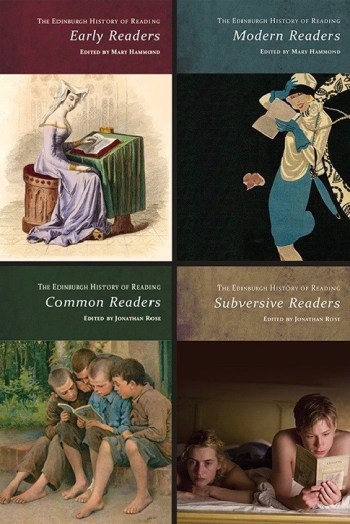 Bringing together the latest scholarship from all over the world on topics ranging from reading practices in ancient China to the workings of the twenty-first-century reading brain, the 4 volumes of The Edinburgh History of Reading demonstrate that reading is a deeply imbricated, socio-political practice, at once personal and public, defiant, and obedient. It is often materially ephemeral, but it can also be emotionally and intellectually enduring.
Volume Titles
Early Readers, edited by Mary Hammond, with contents listed here.
Early Readers presents a number of innovative ways through which we might capture or infer traces of readers in cultures where most evidence has been lost. It begins by investigating what a close analysis of extant texts from 6th-century BCE China can tell us about contemporary reading practices, explores the reading of medieval European women and their male medical practitioner counterparts, traces readers across New Spain, Peru, the Ottoman Empire and the Iberian world between 1500 and 1800, and ends with an analysis of the surprisingly enduring practice of reading aloud.
Modern Readers, edited by Mary Hammond, with contents listed here.
Modern Readers explores the myriad places and spaces in which reading has typically taken place since the eighteenth century, from the bedrooms of the English upper classes, through large parts of nineteenth-century Africa and on-board ships and trains travelling the world, to twenty-first-century reading groups. It encompasses a range of genres from to science fiction, music and self-help to Government propaganda.
Common Readers, edited by Jonathan Rose, with contents listed here.
Common Readers casts a fascinating light on the literary experiences of ordinary people: miners in Scotland, churchgoers in Victorian London, workers in Czarist Russia, schoolgirls in rural Australia, farmers in Republican China, and forward to today’s online book discussion groups. Chapters in this volume explore what they read, and how books changed their lives.
Subversive Readers, edited by Jonathan Rose, with contents listed here.
Subversive Readers explores the strategies used by readers to question authority, challenge convention, resist oppression, assert their independence and imagine a better world. This kind of insurgent reading may be found everywhere: in revolutionary France and Nazi Germany, in Eastern Europe under Communism and in Australian and Iranian prisons, among eighteenth-century women reading history and nineteenth-century men reading erotica, among postcolonial Africans, the blind, and pioneering transgender activists.
New Book | Tastemakers: British Dealers and the Anglo-Gallic Interior
Forthcoming from The Getty (in July) . . .
Diana Davis, The Tastemakers: British Dealers and the Anglo-Gallic Interior, 1785–1865 (Los Angeles: Getty Research Institute, 2020), 320 pages, ISBN: 978-1606066416, $65.
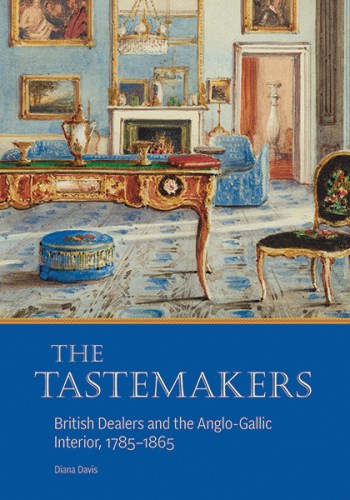 In this volume, Diana Davis demonstrates how London dealers invented a new and visually splendid decorative style that combined the contrasting tastes of two nations. Departing from the conventional narrative that depicts dealers as purveyors of antiquarianism, Davis repositions them as innovators who were key to transforming old art objects from ancien régime France into cherished ‘antiques’ and, equally, as creators of new and modified French-inspired furniture, bronze work, and porcelain. The resulting old, new, and reconfigured objects merged aristocratic French eighteenth-century taste with nineteenth-century British preference, and they were prized by collectors, who displayed them side by side in palatial interiors of the period.
The Tastemakers analyzes dealer-made furnishings from the nineteenth-century patron’s perspective and in the context of the interiors for which they were created, contending that early dealers deliberately formulated a new aesthetic with its own objects, language, and value. Davis examines a wide variety of documents to piece together the shadowy world of these dealers, who emerge center stage as traders, makers, and tastemakers.
Diana Davis specializes in the interface between collectors, dealers, and the art market in the late eighteenth and early nineteenth centuries.
C O N T E N T S
Acknowledgments
Note to the Reader
Introduction
Part 1 — Trade, Taste and Retail
1 ‘The Revised Taste of Louis the Fourteenth’
2 ‘Nos Amis, Les Enemies!: Britain and France
3 ‘The Wily Brocanteur‘
4 ‘The New Race of Connoisseurs’
Part 2 — The Dealer-Producer
5 Manufacturers of Antique Furniture
6 ‘Matt and Burnished Gold’
7 ‘China Painted and Gilt’
8 ‘A Burst of Splendour’: The Anglo-Gallic Interior
Conclusion
Appendix 1 Selected Dealer Biographies
Appendix 2 Sale Catalogs
Sources and Bibliography
About the Author
Illustration Credits
Index
Call for Papers | Piranesi @300
From the updated Call for Papers, which also includes Italian and French versions:
Piranesi @300
Rome, 27–30 January 2021
Proposals due by 31 July 2020 (extended from the original April deadline)
Organized by Mario Bevilacqua and Clare Hornsby
Concluding the year celebrating the 300th anniversary of the birth of Giovanni Battista Piranesi (1720–1778), this conference aims to reveal new aspects of his life and works, their contexts, and critical fortune, and we are seeking proposals for a comparison of interdisciplinary themes and innovative methodologies.
In the light of current uncertainties, we plan to host the conference both live in Rome and via online platforms to facilitate international participation.
Some ideas of themes that could be addressed:
Piranesi as Artist, Theorist, Entrepreneur, and Merchant
Many aspects of Piranesi’s life and work still remain in the shadows: we hope to discover new documentary data, new drawings, new interpretations, new networks.
Piranesi and History
The Mediterranean civilizations, the fall of the Empire, the Middle Ages and the Renaissance. Egypt, Etruria, Greece, Rome. From the fall of the Empire to the Renaissance. Piranesi and the texts of his books, the birth of archaeology, the philosophy of history in 18th-century Europe.
Piranesi: Europe, America, the World
Piranesi as ‘global’ artist. His lasting reputation—from Rome across 18th-century Europe—takes on different aspects in different European contexts: England, France, Germany, Russia—and in the more distant United States and Latin America, Australia and Japan, maintaining close yet changing relationships with art, literature, photography, and cinema.
Piranesi as Architect: Monument, City, Utopia
Though constantly designing, he was the architect of only one building, S. Maria del Priorato on the Aventine hill yet Piranesi always signed himself ‘architect’. His vision of Roman architecture and of the ancient metropolis states certainties and raises concerns about the dystopian future of the global city.
Piranesi in the Global 21st Century: New Methods for New Paths of Research
We can ask questions about Piranesi in the context of contemporary scenarios. His work continues to provoke reflection, inspire new projects and interpretations.
The languages of the conference are English, Italian, and French, and the event will be open to the public. We invite doctoral students, postdoctoral researchers, established scholars to submit proposals for papers that contain new research or use new approaches. These will fall into two groups:
1) 15-minute presentations on one event, object, or discrete theme
2) 30-minute presentations on wider issues
Please send a 250-word CV and an abstract in English, French, or Italian of either 500 words (for a 15-minute talk) or 1000 words (for 30-minute talk); the abstract should make clear the new content of the contribution. Submissions should be sent to Piranesi300@gmail.com by July 31st 2020. We plan to offer accommodation in Rome to speakers at the conference though we are not able to assist with travel costs. We propose to publish a volume of the papers of the conference.
Supporting Institutions
Centro Studi Cultura e Immagine di Roma / Biblioteca Nazionale Centrale
Istituto Centrale per la Grafica
The British School at Rome
Académie de France à Rome – Villa Médicis
Conference Organisers
Mario Bevilacqua and Clare Hornsby
Scientific Committee
Francesca Alberti (Académie de France à Rome), Fabio Barry (Stanford University), Mario Bevilacqua (Università degli Studi di Firenze, CSCIR), Clare Hornsby (British School at Rome), Giorgio Marini (Ministero Beni Culturali), Heather Hyde Minor (Notre Dame Rome), Susanna Pasquali (Sapienza Università di Roma), Frank Salmon (Cambridge University), Giovanna Scaloni (Istituto Centrale per la Grafica).
HECAA Launches New Website
 HECAA is pleased to announce its new website! To visit, go to hecaa18.org where you can explore exciting content like featured artworks, recently published member books, and resources for graduate students. All active members will have access to the HECAA forum, where you can share ideas, exchange teaching materials, and more.
And no worries: Enfilade will continue largely as it has up to now, including its affiliation with HECAA. It’s been clear—really since this site launched in 2009—that Enfilade’s audience overlaps with HECAA but is also much broader. The launch of the new HECAA site means that the organization now has the website it has long deserved. I’m delighted with the new site and look forward to how it will develop. Kudos to the officers (outgoing and incoming) and to the board members who have brought it to fruition.
I’m confident that many Enfilade readers would enjoy the additional resources and community that HECAA has to offer. Membership is affordable, with an annual student rate of $10 and a professional rate of $30. So please consider joining. And please keep checking in here.
–Craig Hanson
New Book | Restoring Williamsburg
Distributed by Yale University Press:
George Humphrey Yetter and Carl Lounsbury, Restoring Williamsburg (The Colonial Williamsburg Foundation, 2019), 296 pages, ISBN: 978-0300248357, $50.
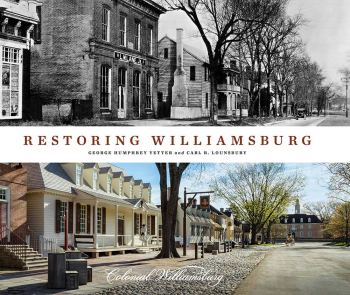 Today best known as the world’s largest ‘living history’ museum, Williamsburg was the capital of the colony of Virginia in the 1700s and the setting for key debates leading to the American Revolution. Inspired by growing interest in America’s colonial heritage, W. A. R. Goodwin, supported by John D. Rockefeller, Jr., initiated a major restoration in the 1920s and 1930s that has allowed visitors to see how Williamsburg looked in the 18th century. Restoring Williamsburg expands on Williamsburg Before and After, a now-classic book with more than 200,000 copies in print, offering an updated and nuanced look at the continuing process of restoration. In addition to capturing moments throughout the site’s transformation, the book offers important considerations about modern curatorial practices and changing approaches to historic preservation.
Lavishly illustrated with more than 350 photographs, watercolors, sketches, maps, and other illustrations, Restoring Williamsburg features new images from both before and after the restoration. This is an important contribution not only to architectural history and restoration practices but also to our understanding of the town that continues to inspire Americans to think about their history.
George Humphrey Yetter, who wrote Williamsburg Before and After, is the former associate curator of architectural drawings at the Colonial Williamsburg Foundation. Carl R. Lounsbury is the former Shirley and Richard Roberts Architectural Historian at the Colonial Williamsburg Foundation and currently teaches history at the College of William and Mary.
On Television and Online | Opening Up The Soane
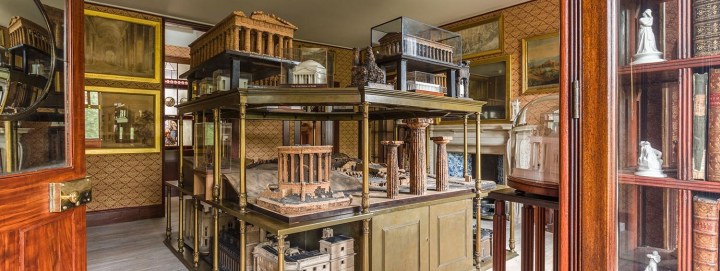
The three episodes of Opening Up The Soane will be uploaded to museum’s website a day after each episode airs on London Live.
• Episode 1, Restoring the Recesses — 20 April (airs 19 April, 8PM)
• Episode 2, Restoring the Private Apartments — 27 April (airs 26 April, 8PM)
• Episode 3, A Triumph of Restoration — 4 May (airs 3 May, 8PM)
You can watch the series live on London Live,Freeview 8 | Sky 117 | Virgin 159 | YouView 8
In the meantime, you can read about the Opening Up The Soane project, or explore the Museum online using Explore Soane. While the Soane Museum is temporarily closed, the institution is ever more reliant on your support to protect and maintain Sir John Soane’s house and collection.










leave a comment