Rijksmuseum Fellowship Programme, 2020–21
From the fellowship announcement:
The Rijksmuseum Fellowship Programme, 2020–21
Applications due by 19 January 2020
The Rijksmuseum welcomes international, independent research proposals which open new perspectives on the museum’s collection, its history, and activities. The purpose of the Rijksmuseum Fellowship Programme is to encourage and support scholarly investigation, and to contribute to academic discourses while strengthening bonds between the museum and universities. The programme enables highly talented candidates to base part of their research at the Rijksmuseum, and offers access to the museum’s expertise, collections, library, and laboratories. Furthermore, the programme facilitates opportunities for Fellows to engage in workshops and excursions to encourage exchange of knowledge—amongst both themselves and the broader museum audience.
Application and Procedure
Please review the eligibility, funding, and application requirements by visiting the Rijksmuseum website. For the 2020–2021 academic year, candidates can apply for:
• Andrew W. Mellon Fellowship for research in art and cultural history – apply here
• Terra Foundation Fellowship for research in American Photography – apply here
• Johan Huizinga Fellowship for historical research – apply here
• Migelien Gerritzen Fellowship for conservation and scientific research – apply here
• Anton C.R. Dreesmann Fellowship for art historical research – apply here
The closing date for all applications is 19 January 2020, at 6.00pm (Amsterdam time/CET). No applications will be accepted after this deadline. All applications must be submitted online and in English. Applications or related materials delivered via email, postal mail, or in person will not be accepted. Selection will be made by an international committee in February 2020. The committee consists of eminent scholars in the relevant fields of study from European universities and institutions, and members of the curatorial and conservation staff of the Rijksmuseum. Applicants will be notified by 15 March 2020. All Fellowships will start in September 2020. For questions concerning the application procedure, contact the Coordinator of the Fellowship Programme (fellowships@rijksmuseum.nl).
Call for Papers | Veiling the Body
From ArtHist.net:
Veiling the Body: Cloth, Skin, Membrane, Paper
The John Rylands Research Institute, University of Manchester, 11–12 June 2020
Proposals due by 20 January 2020
The word ‘veil’ most commonly connotes a piece of cloth worn on the body not primarily for warmth or protection, but as a symbol, usually of modesty or withdrawing from a public realm. In many cultures, veils have held a contradictory status of concealing the (most often female) body and of heightening the significance of exposure. In Europe, the word ‘veil’ and its cognates have also variously connoted: human skin and bodily membranes; draperies and curtains in religious and secular spaces; relics; and the separations between material and spiritual realms. In all contexts, the word points to secrecy and hiddenness, inflected with the potential for exposure and display.
Veiling the Body will bring together these themes in a cross-disciplinary workshop to explore the themes of secrecy and exposure, as well as the interrelations between the skin and membranes of our bodies, the cloths that cover them, and the materials with which we represent both. We welcome proposals on themes including, but not limited to:
• Religious veils and relics
• Anatomical and medical images of unveiling
• Spiritual or ethereal veils
• The resonances between skin and cloth
• Clothing, veiling and exposure of the body
• Images that veil, or work in unique ways to represent veils
• The material culture of veils, skin and membranes
With this workshop, we aim to make connections across disciplines, time periods and locations. We invite proposals for 20-minute papers from scholars across the arts and humanities, museum staff, and artists working on the themes of veils and bodies from any place and time. Proposals of no more than 250 words, along with a short bio, should be sent to veilingthebody2020@gmail.com by 20th January 2020. Travel and accommodation will be provided for speakers, and conference fee waivers will be available for attendees who do not have research budgets.
In addition to conference-style paper sessions, the workshop will include collections encounters with historic and contemporary material. The workshop will be held in the Historic Reading Room of the John Rylands Library in Manchester.
Call for Papers | Color Charts
From ArtHist.net:
Color Charts as Trading Zones between Science and Art, 1500–1800
9th International Conference of the European Society for the History of Science
Bologna, 31 August — 3 September 2020
Proposals due by 5 December 2019
This is a call for abstracts for a symposium proposal to be submitted to the 9th International Conference of the European Society for the History of Science (ESHS) that will be held in 2020 in Bologna.
The seminal role played by color in the progress of science, technology, industry, and commerce during the early modern period and enlightenment has never been thoroughly analyzed from a broad perspective. Today we tend to compartmentalize the historical investigation of color science, artisanal technology, and commercial endeavors as separate fields. However, historically, coloring substances represent a clear-cut intersection between these three worlds. The opening of communication channels between artisanal and academic worlds has been defined by Pamela O. Long as a “trading zone” (Long 2011). From the early modern period, the growing interest of natural philosophers in the processes of manufacturing pigments and dyestuffs and the ability to control their use with systematic and scientific approaches were fundamental factors in the technological and commercial advancements that are usually associated with the period. The tacit color knowledge of artisans was gradually traded to the sciences and popularized in dictionaries, encyclopedias, and academic journals.
Besides the publication of color recipes and mixing instructions as handbooks, this specific trading zone allowed the production of (colored) visual tools, like color charts, painting palettes, sample cards and pattern books, relating to color technology, color teaching, and color selling. These visual tools have been generally regarded as painters’ instruments and teaching aids for amateur painters, and only in few recent studies linked to the sciences (Lowengard 2006; Kuehni and Schwarz 2008; Bushart and Steinle 2015; Karliczek and Schwarz 2016). We propose a symposium which will focus on intersectional aspects of trading color-related information and knowledge, from chemistry through commerce to art, with a specific focus on color charts.
We invite historians of science and from other disciplines to submit cross-disciplinary papers discussing topics like:
• Color charts and raw materials relating to botany, zoology, mineralogy, pharmacy
• Color charts and experimenting and developing colors for dyeing, porcelain, enamel, watercolors, oil painting, glass manufacturing
• Color charts and scientific illustrations (cartography, petrography, zoology, botany, mineralogy)
• Color charts and color selling (color samplers, color cakes, color cases, color price and relating fraud)
• Color charts and teaching (paintings, printing, dyeing)
Please send your abstracts (300 words) with a cv (150 words) to Giulia Simonini (giulia.simonini@tu-berlin.de) by December 5, 2019.
Cited Literature
• Pamela O. Long, Artisan/Practitioners and the Rise of the New Sciences, 1400–1600 (Corvallis, 2011).
• Sarah Lowengard, The Creation of Color in Eighteenth-Century Europe (Gutenberg-e, 2006).
• Rolf G. Kuehni and Andreas Schwarz, Color Ordered: A Survey of Color Order Systems from Antiquity to the Present (New York, 2008).
• Magdalena Bushart and Friedrich Steinle, eds., Colour Histories: Science, Art, and Technology in the 17th and 18th Centuries (De Gruyter, 2015).
London Art Week Winter 2019
From the press release:
London Art Week Winter
London, 1–6 December 2019
 The galleries and auction houses of London Art Week throw open their doors for the third iteration of LAW Winter, from Sunday 1 to Friday 6 December 2019. Thirty-two special exhibitions and Old Master sales offer millennia of art at locations throughout Mayfair and St. James’s. Whilst the emphasis is on pre-contemporary works, art on display dates back as far as the days of ancient Greece and Rome through to the present time.
London Art Week is a wonderful excuse for collectors, curators and art lovers to explore many of the capital’s most illustrious commercial art galleries and spaces, and enjoy events and talks. All the works displayed are for sale, with prices starting below £1,000, and the expert dealers are on hand to share their knowledge. Like visiting a series of mini museums, following the London Art Week Winter 2019 map (drawn by artist Adam Dant) reveals rarely-seen medieval art from Spain, ‘giant leaf’ renaissance tapestries inspired by exotic plants of the New World, ground-breaking female artists of the 20th century, art influenced by the orient, and works by famous ‘blue chip’ artists of the 17th to 20th centuries. . . .
The ‘Bleu Celeste’ broth-bowl and cover with stand (Vincennes, 1755), one of only three known examples, is offered by Oliver Forge & Brendan Lynch Ltd, in connection with their exhibition Ottoman Patronage and European Merchandise: Works of Art from Turkey and France, 1530–1820 (the catalogue is available here).
The full LAW press release, with additional highlights is available here»
Call for Papers | Paintings, Peepshows, and Porcupines
From the Call for Papers:
Paintings, Peepshows, and Porcupines: Exhibitions in London, 1775–1851
The Huntington Library, Art Museum, and Botanical Gardens, San Marino, California, 17–18 September 2021
Organized by Jordan Bear and Catherine Roach
Proposals due by 1 April 2020
In 1820, the Romantic painter Théodore Géricault sent his now-famous image of a shipwreck, The Raft of the Medusa, by boat to London. There, it was shown at Bullock’s Egyptian Hall, a display space that also featured attractions as varied as live reindeer and Napoleon’s carriage, captured at Waterloo. This well-known episode was not an aberration or a Romantic eccentricity; it was, quite simply, business as usual. In many nineteenth-century cities, exhibiting outside of official art venues was not uncommon, nor was it necessarily an act of rebellion. Recent scholarship has challenged preconceptions about audience and cultural hierarchy in relation to Géricault’s Raft, but we are only beginning to understand the role of artworks within a broader culture of display.
This conference will assemble an international group of distinguished scholars to rethink some of our fundamental assumptions about exhibitions in the eighteenth and nineteenth centuries. It will focus on London as the center of an exhibitionary culture and as a hub of empire. It will consider a vibrant period of this culture, roughly from the opening in 1775 of the Leverian Museum, or Holophusikon, brimming with artifacts from Captain Cook’s voyages, to the staging in 1851 of the Great Exhibition, which inaugurated a new age of international shows.
The protagonist of many of the most influential art historical studies of recent decades has been the figure of the spectator, who has brought with her a revitalized engagement with the surprisingly varied modes of the reception of works of art. And while the foregrounding of the experience of the spectator, or ‘beholder’, or ‘observer’, has broadened the compass of the discipline considerably, we still hold a relatively orthodox view of the kinds of venues, events, and display practices that are deemed worthy of inquiry. Even as art historians have valorized the expressive possibilities of alternative exhibition spaces so central to avant-garde identity, the appearance of paintings in the precincts of commercial entertainment has, for many years, been consigned to a position of marginal curiosity in the history of art. Exhibition-makers are often characterized as either renegades or hucksters—as if aesthetically daring artists were not part of the market, or as if commercial displays could not contain works of aesthetic or cultural merit. Both the sheen of avant-garde rebellion and the tarnish of lucre continue to color approaches to eighteenth- and nineteenth-century displays.
Even the most adventurous of recent studies have not fully accounted for the most singular feature of the display of these works of art in the first decades of the century: their embeddedness in an exhibitionary landscape consisting of the richest imaginable array of artifacts, environments, and living creatures. Imperialist expansion and the need to justify it brought an increasingly wide range of objects to European urban centers. Moreover, these diverse displays were consumed in concert. They were part of a round of seasonal entertainments that might include viewing oil paintings in the morning and taxidermy in the afternoon—or viewing examples of both at a single venue. To recapture this context, talks given at this event will consider relationships among venues or trace the circulation of objects and visitors among multiple sites of display.
Speakers will include
• Ann Bermingham (University of California, Santa Barbara)
• Rosie Dias (University of Warwick)
• Meredith Gamer (Columbia University)
• Mark Hallett (Paul Mellon Centre for Studies in British Art)
• John Plunkett (University of Exeter)
We are now seeking additional speakers to join this roster. Early career scholars and scholars from underrepresented groups are especially encouraged to apply. We anticipate that papers will be 35–40 minutes in length, and will be presented to the Huntington’s larger scholarly community. The generous support of the Huntington’s Research Department will cover economy airfare, hotel accommodation, and incidental transport expenses for speakers. To apply, please send an abstract of 250 words and a CV to huntingtonconference2021@gmail.com by 1 April 2020.
Call for Applications | Masterclass on Wax-Resin Linings
From the programme flyer:
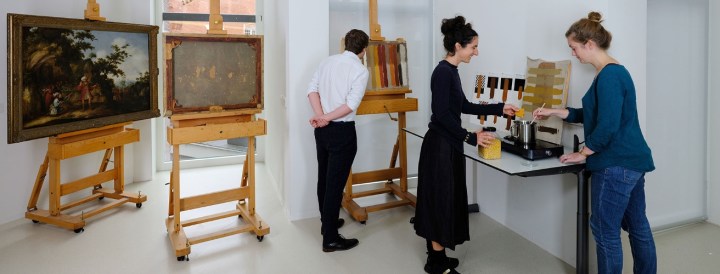
Conserving Canvas Initiative — The Dutch Method Unfolded: Masterclass on Wax-Resin Linings
University of Amsterdam, 29 June — 10 July 2020
Applications due by 14 December 2019
The Department of Conservation and Restoration of Cultural Heritage of the University of Amsterdam (UvA) is pleased to announce The Dutch Method Unfolded, a masterclass on wax-resin linings to be held at the UvA from 29 June to 10 July 2020. The two-week program is supported by the Getty Foundation as part of its Conserving Canvas initiative.
The goal of the masterclass is to disseminate knowledge on the history of wax-resin linings, a remedial conservation method invented in the Netherlands in the first half of the 19th century and extensively used by paintings conservators in Europe and abroad until the 1970s. The masterclass will also inform on the impact of wax-resin linings on the physical and material characteristics of paintings. Furthermore, it will provide a platform to share expertise and reflect on the consequences of the method for today’s conservation of lined paintings.
The masterclass is a joint initiative of the University of Amsterdam with the following Dutch museums: Frans Hals Museum, Amsterdam Museum, Mauritshuis, Rijksmuseum Amsterdam, Stedelijk Museum Amsterdam, and Van Gogh Museum, in collaboration with the Cultural Heritage Agency of the Netherlands (RCE) and the Stichting Restauratie Atelier Limburg (SRAL).
The masterclass is offered to a group of maximum 14 mid-career professionals in conservation including conservators of cultural heritage, art historians, curators, collection manager, and conservation scientists. The participants of the masterclass will receive funding for travel and accommodation.
The participants of the masterclass will be selected via an open call which closing date is 14 December 2019. Further information regarding registration and the program, is available here. For inquiries, please contact the program organization at wax-resin-fgw@uva.nl. Further information on the Getty’s initiative can be found here.
At Bonhams | Fine European Ceramics
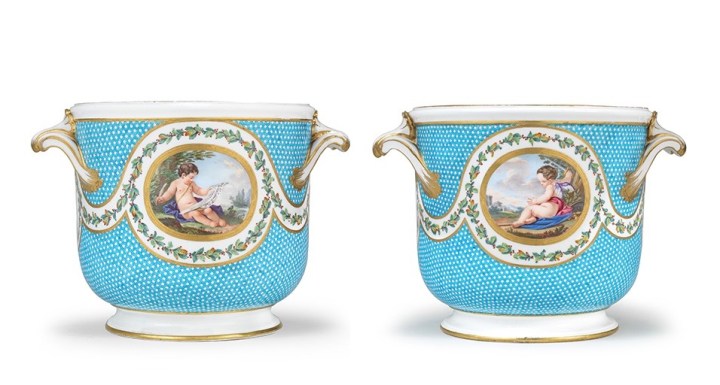
Pair of Sèvres bottle coolers (Seaux à bouteille) from a service for Madame du Barry, ca. 1770, each side reserved with a gilt-edged circular medallion depicting a seated putto in a landscape with attributes of Music, Poetry, War, and Peace–with the putto emblematic of Poetry holding a scroll with the inscription “Ode sur le mariage de M le Dauphin. le 16 May 1770” (Ode on the marriage of the Dauphin. the 16 May 1770).
◊ ◊ ◊ ◊ ◊
Press release, via Art Daily, for the sale at Bonhams:
Fine European Ceramics
Bonhams, London, 4 December 2019
An exceptionally rare pair of Sèvres bottle coolers from a service commissioned by Madame du Barry, the final maîtresse-en-titre of Louis XV, will be offered at Bonhams Fine European Ceramics sale in London on Wednesday, 4 December (lot 114). The pair is estimated at £60,000–80,000.
Madame du Barry (1743–1793) rose from humble origins as the illegitimate daughter of a seamstress to become the last, and with Madame de Pompadour, the greatest of the maîtresses-en-titre of Louis XV (The title refers to the chief mistress of the French Kings who enjoyed a semi-official position at court). Famed for her beauty among the ranks of high society courtesans, she caught the eye of Louis XV in 1768. The King procured a title for her through an arranged marriage with Comte Guillaume du Barry, and in 1769 she was officially presented to the court of Versailles. From then on she was regarded as the maîtresse-en-titre. Louis installed her in the Château de Louveciennes and in a suite of apartments directly below his own in Versailles itself. He also took the unusual step of including her in the private family gathering on the eve of the wedding of his son, the Dauphin and future Louis XVI, to Marie Antoinette.
The service was purchased by Madame du Barry in September 1770. Consisting of only 39 expensive and opulent pieces it was clearly intended as a status symbol, its use confined to intimate suppers with influential figures at court. An ode to the marriage of the Dauphin to Marie Antoinette inscribed on the coolers, can be interpreted as an attempt to curry favour and further cement her position at court. On Louis XV’s death in May 1774, du Barry was banished from court—Marie Antoinette famously disapproved of her, and for many years refused to acknowledge her presence. She eventually returned to Louveciennes, where she lived until her arrest in 1793 during the French Revolution. She was executed in December that year.
Bonhams Head of European Ceramics, Nette Megens said, “Pieces from this very select service made for Madame du Barry hardly ever appear on the market. There were only three bottle coolers in the service, and this pair offers collectors with a once in a lifetime opportunity.”

Lot 42 — Meissen silver-gilt mounted tankard with Chinoiserie decoration, ca. 1723–24.
Other highlights in the sale include:
• Lot 117 — A large Berlin porcelain vase given to Sir Andrew Buchanan by the King of Prussia, ca. 1859 (estimate £25,000–30,000). Distinguished 19th-century Scottish diplomat Sir Andrew Buchanan had an unusually wide-ranging career, and earned the gratitude not only of the British government, but also of the nations in which he served. The King of Prussia presented him with the magnificent Berlin vase; and the Danish king Frederick VII gave him a service of 18 plates by the Royal Copenhagen factory, with scenes after famous designs by Berthel Thorvaldsen. These are also in the sale (lot 121) , estimated at £10,000–15,000.
• Lot 42 — A rare Meissen silver-gilt mounted tankard with Chinoiserie decoration, ca. 1723–24 (estimate £20,000–30,000). This piece is from private European collection and shows the very best of chinoiserie painting and gilding on early Meissen porcelain.
• Lot 105 — A Nymphenburg Commedia dell’Arte figure of Mezzetin dressed as a Harlequin, ca. 1760–65 (estimate: £30,000–50,000). This figure is traditionally paired with another Commedia dell’Arte figure, Lalage, who holds a bowl and a spoon, ready to feed the ‘infant’ in Mezzetin’s arms (actually a monkey dressed as a baby).
New Book | The Mobility of People and Things
From Routledge:
Elisabeth A. Fraser, ed., The Mobility of People and Things in the Early Modern Mediterranean: The Art of Travel (New York: Routledge, 2019), 160 pages, ISBN: 978-1138488083, $150.
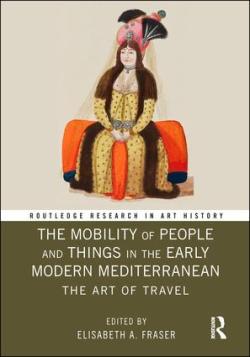 For centuries artists, diplomats, and merchants served as cultural intermediaries in the Mediterranean. Stationed in port cities and other entrepôts of the Mediterranean, these go-betweens forged intercultural connections even as they negotiated and sometimes promoted cultural misunderstandings. They also moved objects of all kinds across time and space. This volume considers how the mobility of art and material culture is intertwined with greater Mediterranean networks from 1580 to 1880. Contributors see the movement of people and objects as transformational, emphasizing the trajectory of objects over single points of origin, multiplicity over unity, and mutability over stasis.
Elisabeth A. Fraser is Professor of Art History at the University of South Florida, Tampa.
C O N T E N T S
List of figures
List of Plates
Chapter Abstracts
Elisabeth Fraser, Introduction
1 Sylvia Houghteling, ‘From Scorching Spain and Freezing Muscovy’: English Embroidery and Early Modern Mediterranean Trade
2 Meredith Martin and Gillian Weiss, A Tale of Two Guns: Maritime Weaponry between France and Algiers
3 Julia Landweber, Furnishing the Taste for Coffee in Early Modern France
4 Ashley Dimmig, Substitutes and Souvenirs: Reliving Polish Victory in ‘Turkish’ Tents
5 Elisabeth Fraser, The Ottoman Costume Album as Mobile Object and Agent of Contact
6 Leyla Belkaïd-Neri, Entangled Styles: Mediterranean Migration and Dress in Pre-Modern Algiers
7 Michèle Hannoosh, The Art of Wandering: Alexander Svoboda and Photography in the Nineteenth-Century Mediterranean
Contributor Biographies
Index
Exhibition | The Golden Age of English Painting
Press release for the exhibition:
The Golden Age of English Painting: From Reynolds to Turner
L’âge d’or de la peinture anglaise: De Reynolds à Turner
Musée du Luxembourg, Paris, 11 September 2019 — 16 February 2020
Curated by Martin Myrone and Cécile Maisonneuve
This exhibition, showing a selection of masterpieces from Tate Britain, highlights a key period in the history of painting in England, from the 1760s to around 1820, capturing the originality and diversity of the period. It takes visitors from the founding of the Royal Academy, with artists such as Reynolds and Gainsborough, to the turning point in the early 19th century, notably with Turner. The public will rediscover the great classics of British art here, all too rarely exhibited in France.
 The reign of George III was preponderant for British art, with the founding of the Royal Academy of Arts, of which Joshua Reynolds (1723–1792), was the first president at the height of his career. This period also saw Thomas Gainsborough (1727–1788) join the Academy. In their own ways, Reynolds and Gainsborough, both masters of portraiture, brought novel visual and intellectual innovations to the genre, honouring the great masters while reinventing the wheel. With signs of an artistic golden age booming, this movement was also supported by major players in trade and industry, and then by the king himself.
The exhibition tackles the confrontation of the two portrait painters, through full-length paintings and intimate studies of members of the royal family or personalities of the day. Reynolds’s intellectual ambitions contrast with Gainsborough’s pictorial ease. Redefining British art alone, they raised the next generation to new heights. A selection of major portraits by their competitors and/or followers, such as John Hopper, William Beechey, and Thomas Lawrence, recall the influence of these two precursors. The exhibition also addresses the themes of lineage, family, and home with the genre painting that gave birth to a new approach to childhood. Reynolds’s extraordinary portrait The Archers puts the concept of wilderness at the service of a heroic representation of the British ruling class, while Gainsborough, George Stubbs, and George Morland focus their attention on the picturesque, through paintings depicting everyday life, especially in rural areas.
With the political and commercial exploitation of overseas territories as the basis for artistic progress, part of the exhibition addresses the presence of Great Britain in India and the Caribbean. Another section discusses the tremendous growth of watercolour, which allowed many artists to stand out by meeting the needs of a new amateur society. The last part of the exhibition shows how British artists such as Henri Fuseli, John Martin, P.J. de Loutherbourg, and J.M.W. Turner sublimated narrative figuration, paving the way for a new conception of art as a support for the imaginary.
Amandine Rabier, L’âge d’or de la peinture anglaise (Paris: Gallimard / Réunion des musées nationaux, 2019), 56 pages, ISBN: 978-2072859595, 10€.
Call for Papers | Ordering Colours
From ArtHist.net:
Ordering Colours in 18th- and Early 19th-Century Europe
Technische Universität Berlin, Chair for the History of Science, 13–14 March 2020
Proposals due by 30 November 2019
The question of how to order colours reaches far back, but in the 18th century, particularly in its second half, we see a steeply increasing number of studies that indicates a broad and urgent interest in classifying colour. Quite diverse contributions from the sciences, arts, crafts, and trade created a diverse field of colour order research in the 18th century. The workshop will explore, examine, and discuss those efforts and hereby contribute to the history of color in 18th- and early 19th-century Europe. Proposals from other epochs are welcome when focussing on or crossing substantially the 18th or early 19th centuries; for instance the revival of antique knowledge/ ideas. While focussing on Europe, the workshop also welcomes studies of other cultural regions. The workshop will be opened by a keynote talk by Jose Luis Caivano (Buenos Aires).
According to the multidisciplinary historical approaches, we invite contributions from the history of arts, artisanry, economy, technology, science as well as scholars from restoration, cultural, and material studies. Work in progress contributions are as welcome as finalized results. There might be detailed case studies, but also comparative, long-term and cross-sectional studies on the history of materials, objects, practices, theories, or ideas. Through all the bewildering variety of colour research of that period, the focus of the workshop will be on the attempts of ordering or even systematizing colours.
Topics might include, among others
• Colour samples, colour ordered objects, colour selections, colour collections, and colour atlases
• Colour diagrams: illustrations, papertools
• Colour codes, colour nomenclatures, colour references, and colour systems
• Colour experiments
• Early colour print and the trichromatic idea
• Discussion about colour primaries
• Natural history and colour
• Mining, chemistry, and colour knowledge
• Colour materials: porcelain, dyes, Indian / inks
• Commercial and theoretical interest in colour orders: developers, producers, traders
• Exchange of colour knowledge and objects in Europe: networks, connectors, translators, hotspots, and peripheries.
Please send your proposal in English (up to 350 words) before 30th November 2019 to tanja.kleinwaechter@tu-berlin.de. Notification of acceptance will be given by 22nd December.










 Enfilade
leave a comment