Call for Articles | Ars Judaica
From ArtHist.net:
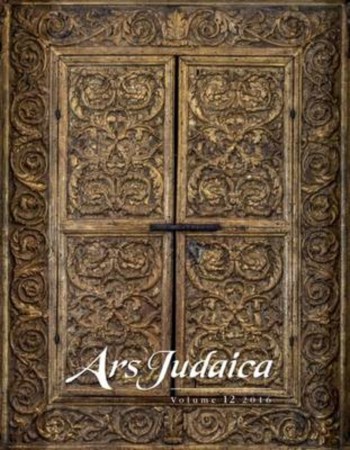 Ars Judaica: The Bar-Ilan Journal of Jewish Art calls for papers for its prospective volumes. Ars Judaica is delighted to announce it has made an agreement with Liverpool University Press to co-publish the journal from 2019. Liverpool University Press is an innovative academic publisher who combines a distinguished 120-year history and scholarly expertise with the forward-thinking mindset of the post-Gutenberg age.
Ars Judaica is an annual peer-reviewed publication of the Department of Jewish Art at Bar-Ilan University. It showcases the Jewish contribution to the visual arts and architecture from antiquity to the present from a variety of perspectives, including history, iconography, semiotics, psychology, sociology, and folklore. As such it is a valuable resource for art historians, collectors, curators, and all those interested in the visual arts. The ever-growing international community of Ars Judaica authors range from world-renown scholars to young, promising researchers. Ilia Rodov, the journal’s Editor-in-chief stressed: “It is our pleasure to be collaborating with Liverpool University Press to expand the activity of Ars Judaica, established in 2005 as the Michael J. Floersheim Memorial under its founding editor Bracha Yaniv. I am sure that our joint work with Liverpool University Press will be a significant contribution to the excellence of scholarly research and thought-provoking exchange of ideas regarding the visual dimensions of Jewish civilization”.
Clare Hooper, Head of Journals at Liverpool University Press said: “We are delighted to be working with the Department of Jewish Art at Bar-Ilan University to publish Ars Judaica. The journal is an extremely valuable resource to all scholars interested in the Jewish contribution to visual arts.”
The fifteenth volume of the journal and the first issue under the new publishing agreement will be published soon and will be fully available online. The Journal’s submission and style guidelines are available to download here. For more information, please see Ars Judaica’s website.
Exhibition | ‘To Arm Against an Enemy’
Press release (via Art Daily) for the exhibition:
‘To Arm Against an Enemy’: Weapons of the Revolutionary War
DeWitt Wallace Decorative Arts Museum, Colonial Williamsburg, 20 April 2019 — 2 January 2023

Silver hilted smallsword (detail), 1765–70; blade: 33 inches long, hilt: 7 inches long; silver, iron/steel, wood, enamel, and traces of gilding (Colonial Williamsburg).
Warfare is complex and sophisticated today, but in the 1700s, during the French and Indian and Revolutionary wars, weaponry and combat was far less so. The arms used by the combatants on all sides of these North American conflicts were an international jumble of firearms and bladed weapons. In ‘To Arm Against an Enemy’: Weapons of the Revolutionary War, opening on April 20, at the DeWitt Wallace Decorative Arts Museum, one of the Art Museums of Colonial Williamsburg, visitors will gain a deeper understanding of these instruments of war as the weapons take center stage. The exhibition, which will remain on view until January 2, 2023, will feature approximately 70 muskets, carbines and rifles, bayonets, pistols, and swords as used by Loyalists, American patriots, Hessians, and British ‘red coats’ in battles on land and at sea.
‘To Arm Against an Enemy’ opens to coincide with the anniversary of the Gunpowder Incident in which Virginia’s last royal governor, Lord Dunmore, gave orders on April 20, 1775, to remove 15 barrels of gunpowder from Williamsburg’s Magazine. Conducted under the cover of darkness, the mission was successful, outraging the residents of the city and adding fuel to the rapidly intensifying revolutionary fire. The exhibition will be complimented by two satellite exhibitions opening in 2021. The first of these will tell the story of arms in Williamsburg from 1699 to 1780, and the other will discuss artillery, ammunition and military accouterments of the period.
“At the Art Museums of Colonial Williamsburg, every exhibition helps to further the foundation’s mission of authentically telling America’s story,” said Ghislain d’Humières, executive director and senior vice president, core operations. “Its extensive collection of early weapons offers visitors an opportunity to learn more about an aspect of life in the colonies that is often overlooked. ’To Arm Against an Enemy’ promises to be illuminating.”
Prior to the French and Indian War (1754–63), when red-coated soldiers came across the Atlantic by the thousands and brought the first major influx of British military weaponry into the American colonies, the arms of the colonists were a mix of the obsolete, the old and the odd. Most firearms were privately owned and suited more for shooting game than for combat, while others were outdated foreign pieces captured in previous conflicts. A fresh wave of cutting-edge military arms arrived with the Revolutionary War, adding to the assortment of weapon types already in America.
“Over the last ninety years, Colonial Williamsburg has assembled one of the world’s most comprehensive collections of Revolutionary-era weaponry,” said Ronald Hurst, the foundation’s Carlisle H. Humelsine chief curator and vice president for collections, conservation and museums. “That gives us the rare opportunity to explore this subject in an unbiased fashion, from every partisan perspective: American, French, British, and Hessian.”
Among the highlights of the exhibition is an English silver hilted smallsword that was presented to Major General Nathanael Greene in 1781 by an unknown party, perhaps at the time he received command of the Southern Department of the Continental Army. Beginning as a private soldier in 1775, Greene had been promoted to major general in the Continental Army by the New York campaign of 1776 and became known as one of Washington’s best and brightest. Of classic smallsword form for the period (this example was made ca. 1765–70), all its elements are cast, chased and pierced. Decorative motifs include openwork scrolls, foliage, shells, lions, eagles, trophies and gorgon heads. At some point in the early to mid-19th century, this sword was memorialized by the addition of two plaquettes set onto the grip at the midpoint. Both are surrounded by an identical reeded bezel, the first of which frames a miniature enameled portrait of General Greene done after Charles Willson Peale’s famous likeness. The other appliqué is of engraved silver and bears the date and presentation to General Greene.
“More than just showcasing the weaponry of the French and Indian and Revolutionary Wars, “To Arm Against an Enemy” speaks to the progression of military technology and the tools that were used to secure American independence,” said Erik Goldstein, Colonial Williamsburg’s senior curator of mechanical arts and numismatics, who curated the exhibition.
Another featured weapon to be on view in ‘To Arm Against an Enemy’ is a British Pattern 1769 Land Service musket known as a ‘Brown Bess’. Few such muskets in Colonial Williamsburg’s collection show as much wear as this example. New at the onset of the war, it was originally issued to the freshly raised 71st Regiment of Foot, also known as Fraser’s Highlanders. This unit was two battalions strong and fought in almost every campaign of the Revolutionary War after arriving from Scotland in 1776. Part of the regiment disembarked in Savannah in late 1778, kicking off an extended period of extremely hard service in the South that culminated in defeat at Yorktown in 1781 and disbandment a few years later. This musket ended up in American hands after the war, further contributing to its worn condition over the ensuing decades.
A sword made between 1778 and 1780 at James Hunter’s Rappahannock Forge in Falmouth, Virginia, is another featured weapon in the exhibition with a fascinating history. By 1778, there was an explosion in the number of cavalry units fighting on both sides of the Revolutionary War. While the Loyalist light dragoons were largely equipped with swords made by James Potter of New York City, the Continental Army was left scrambling to arm their mounted troops. To fill the void, they turned to Hunter, whose industrial complex was capable of manufacturing these indispensable cavalry swords. While additional research is needed to determine which blades were actually forged at Hunter’s works, it seems that he used whatever blades he could obtain to fulfill his orders. For this sword, Hunter used a common three-fullered blade of European manufacture and mounted it with a hilt marked with an ‘H’, struck into the outside of the knucklebow. In addition to this stamp are the engraved marks ‘1 T PL D N 22’, meaning the weapon was number 22 in the first troop of Pulaski’s Light (or ‘Legion’ of) Dragoons. As part of the armament of Pulaski’s Legion in the Continental Army, this saber likely saw action at Savannah (1779) and the Siege of Charleston (1780). In addition, it may also have been used at Camden, Guilford Court House and the Siege of Yorktown after Pulaski’s unit was incorporated into Armand’s Legion under the command of French Colonel Charles Armand Tuffin.
Conference | Baroque to Neo-Baroque
From the Kunsthistorisches Institut in Florenz:
Baroque to Neo-Baroque: Curves of an Art Historical Concept
Kunsthistorisches Institut in Florenz – Max-Planck-Institut, Palazzo Grifoni Budini Gattai, Florence, 3–5 June 2019
Organized by Estelle Lingo and Lorenzo Pericolo with Alessandro Nova and Tristan Weddigen
 In recent decades there has been a notable revival of scholarly discourse on the baroque. The term ‘baroque’ emerged in the mid-eighteenth century as a pejorative designation for the dominant style of European art produced from c. 1600 to c. 1750. The critical valences the term possessed from the outset have endowed the ‘baroque’ with an afterlife in art history quite distinct from that of the Renaissance and one that it is now particularly timely to interrogate. This conference will bring together eminent and emerging scholars of seventeenth-century European art, colonial Latin American art, and modern and contemporary art to discuss and reassess the ‘baroque’ and the ways in which this concept is currently in play across these diverse subfields. Free admission until capacity is reached.
A cooperation of the Kunsthistorisches Institut in Florenz – Max-Planck-Institut and the Bibliotheca Hertziana, Max-Planck-Institut für Kunstgeschichte
M O N D A Y , 3 J U N E 2 0 1 9
15:00 Welcome and Introduction by Estelle Lingo, Lorenzo Pericolo, Alessandro Nova, and Tristan Weddigen
15:30 Keynote Address
• Alina Payne (Harvard University and Villa I Tatti)
16:50 The Formation of a Concept
Chair: Estelle Lingo
• Evonne Levy (University of Toronto), ‘Baroque’: Mnemosyne Atlas
• Brigid Doherty, Princeton University), ‘Das direkte Herauskommen aus dem Bilde, das Losgehen auf den Beschauer’: Wölfflin, Benjamin, and the Possibility of a ‘Neo-Baroque’ Sistine Madonna in Reproduction
T U E S D A Y , 4 J U N E 2 0 1 9
10:00 The European Baroque
Chair: Alessandro Nova
• Lorenzo Pericolo (University of Warwick), The Baroque Body as a Stylistic Paradox
• Celeste Brusati (University of Michigan), Painting Naturally in the Netherlands
• Estelle Lingo (University of Washington), Baroque Visuality between Perspective and the Photograph
15:00 The Colonial Baroque
Chair: Lorenzo Pericolo
• Jesús Escobar (Northwestern University), Baroque Classicism and Institutional Architecture in the Early Modern Spanish Empire
• Aaron Hyman (Johns Hopkins University), Toward a Notion of (Global, Colonial) Baroque Form
• Fernando Loffredo (New York University and The Cooper Union), The Baroque as National Identity: Aleijadinho in the Brazilian Cultural Imaginary
18:00 The Neo-Baroque
Chair: Tristan Weddigen
• Laura Moure Cecchini (Colgate University), Italian Fascism and the Baroque: Appropriation and Invention between 1922 and 1945
W E D N E S D A Y , 5 J U N E 2 0 1 9
9:30 The Neo-Baroque (continued)
Chair: Tristan Weddigen
• Amy Buono (Chapman University), Hidden Dreams of the Brazilian Baroque
• Jens Baumgarten (Universidade Federal de Sao Paulo), Invention of the Baroque and Discourses of the Neo-Baroque: Politics and Religion in Brazil and the Philippines
• Peter Krieger (Universidad Nacional Autónoma de México), Contemporary Neo-Baroque Architecture and Neo-Colonial Ideology: The Mexican Case
New Book | Sodomites, Pederasts, and Tribades
From Penn State UP:
Jeffrey Merrick, ed., Sodomites, Pederasts, and Tribades in Eighteenth-Century France: A Documentary History (The Pennsylvania State University Press, 2019), 272 pages, ISBN: 978-0271083353, $90.
 In this book, Jeffrey Merrick brings together a rich array of primary-source documents—many of which are published or translated here for the first time—that depict in detail the policing of same-sex populations in eighteenth-century France and the ways in which Parisians regarded what they called sodomy or pederasty and tribadism. Taken together, these documents suggest that male and female same-sex relations played a more visible public role in Enlightenment-era society than was previously believed.
The translated and annotated sources included here show how robust the same-sex subculture was in eighteenth-century Paris, as well as how widespread the policing of sodomy was at the time. Part 1 includes archival police records from the 1720s to the 1780s that show how the police attempted to manage sodomitical activity through surveillance and repression; part 2 includes excerpts from treatises and encyclopedias, published nouvelles (collections of news) and libelles (libelous writings), fictive portrayals, and Enlightenment treatments of the topic that include calls for legal reform. Together these sources show how contemporaries understood same-sex relations in multiple contexts and cultures, including their own. The resulting volume is an unprecedented look at the role of same-sex relations in the culture and society of the era.
The product of years of archival research curated, translated, and annotated by a premier expert in the field, Sodomites, Pederasts, and Tribades in Eighteenth-Century France provides a foundational primary text for the study and teaching of the history of sexuality.
Jeffrey Merrick is Professor Emeritus of History at the University of Wisconsin–Milwaukee. He is the author of Order and Disorder Under the Ancien Régime and coeditor of Family, Gender, and Law in Early Modern France, the latter also published by Penn State University Press.
C O N T E N T S
Preface
List of Abbreviations
Glossary
Introduction
Part I. Surveillance of the Parisian Subculture
A Reports from the Archives of the Bastille
B Reports of the Watch/Guard and the Commissaires
C Reports of the Swiss Guard in the Champs-Élysées and the Commissaires
D Reports of Commissaires Foucault and Desormeaux
Part II. Representations of Same-Sex Relations
E Gossip and Slander
F Tradition
G Enlightenment
H Fictions
Notes
Recommended Reading
Index
Display | Fans Unfolded
Now on view at The Fitzwilliam:
Fans Unfolded: Conserving the Lennox-Boyd Collection
The Fitzwilliam Museum, Cambridge, 5 March 2019 — 12 January 2020
Showcasing rare and exquisitely decorated fans from the collection of the Hon. Christopher Lennox Boyd, allocated to the Museum by H.M. Government in lieu of inheritance tax in 2015, this display reveals the techniques behind the making, investigation, and conservation of fans.
The collection of over 600 objects ranges in date from the 18th to the 20th centuries and in type from bejewelled and hand-painted court and wedding fans, to printed mass-produced advertising fans, aide-memoire fans, mourning fans and children’s fans. A conservation project generously funded by the Marlay group has allowed the museum to display a selection of these fragile but extraordinary objects for the first time.
Exhibition | William Blake
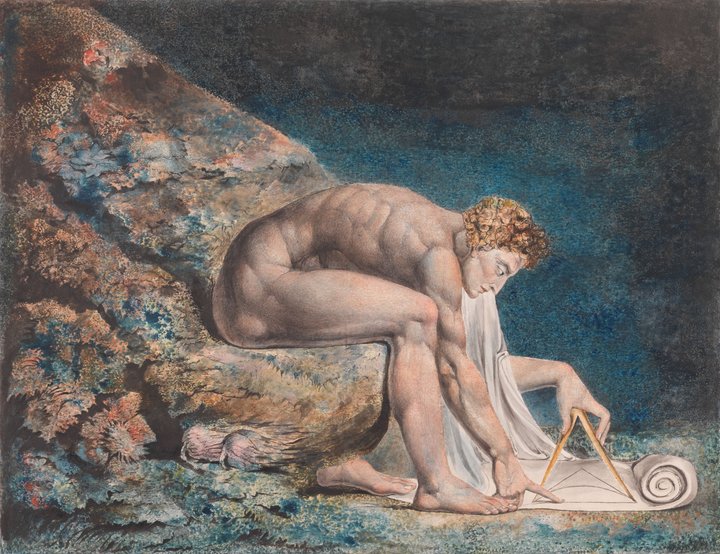
William Blake, Newton, 1795–c.1805, color print, ink and watercolour on paper
(London: Tate Britain)
◊ ◊ ◊ ◊ ◊
Press release (4 April 2019) for the exhibition:
William Blake
Tate Britain, London, 11 September 2019 — 2 February 2020
Curated by Martin Myrone and Amy Concannon
This autumn, Tate Britain will present the largest survey of work by William Blake (1757–1827) in the UK for a generation. A visionary painter, printmaker, and poet, Blake created some of the most iconic images in the history of British art and has remained an inspiration to artists, musicians, writers, and performers worldwide for over two centuries. This ambitious exhibition will bring together over 300 remarkable and rarely seen works and rediscover Blake as a visual artist for the 21st century.
 Tate Britain will reimagine the artist’s work as he intended it to be experienced. Blake’s art was a product of his tumultuous times, with revolution, war and progressive politics acting as the crucible of his unique imagination; yet he struggled to be understood and appreciated during his life. Now renowned as a poet, Blake also had grand ambitions as a visual artist and envisioned vast frescos that were never realised. For the first time, The Spiritual Form of Nelson Guiding Leviathan (c.1805–09) and The Spiritual Form of Pitt Guiding Behemoth (c.1805) will be digitally enlarged and projected onto the gallery wall on the huge scale that Blake imagined. The original artworks will be displayed nearby in a restaging of Blake’s ill-fated exhibition of 1809, the artist’s only significant attempt to create a public reputation for himself as a painter. Tate will recreate the domestic room above his family hosiery shop in which the show was held, allowing visitors to encounter the paintings exactly as people did in 1809.
The exhibition will provide a vivid biographical framework in which to consider Blake’s life and work. There will be a focus on London, the city in which he was born and lived for most of his life. The burgeoning metropolis was a constant inspiration for the artist, offering an environment in which harsh realities and pure imagination were woven together. His creative freedom was also dependent on the unwavering support of those closest to him, his friends, family, and patrons. Tate will highlight the vital presence of his wife Catherine who offered both practical assistance and became an unacknowledged hand in the production of his engravings and illuminated books. The exhibition will showcase a series of illustrations to Pilgrim’s Progress (1824–27) and a copy of the book The complaint, and the consolation Night Thoughts (1797), now thought to be coloured by Catherine.
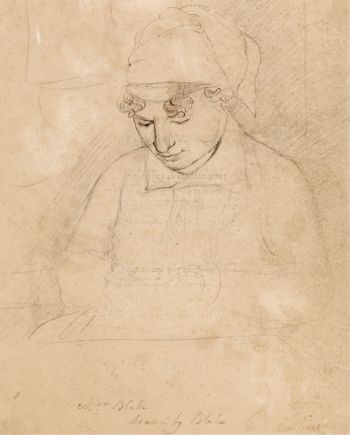
William Blake, Catherine Blake, 1805, graphite on paper (London: Tate Britain).
Blake was a staunch defender of the fundamental role of art in society and the importance of artistic freedom. Shaped by his personal struggles in a period of political terror and oppression, his technical innovation, and his political commitment, these beliefs have inspired the generations that followed and remain pertinent today. Tate Britain’s exhibition will open with Albion Rose (c.1793), an exuberant visualisation of the mythical founding of Britain, created in contrast to the commercialisation, austerity, and crass populism of the times. A section of the exhibition will also be dedicated to his illuminated books such as Songs of Innocence and of Experience (1794), his central achievement as a radical poet.
Additional highlights will include a selection of works from the Royal Collection and some of his best-known paintings including Newton (1795–c.1805) and Ghost of a Flea (c.1819–20). The latter work was inspired by a séance-induced vision and will be shown alongside a rarely seen preliminary sketch. The exhibition will close with The Ancient of Days (1827), a frontispiece for an edition of Europe: A Prophecy, completed only days before the artist’s death.
William Blake is curated by Martin Myrone, Lead Curator pre-1800 British Art, and Amy Concannon, Assistant Curator British Art 1790–1850. The exhibition will be accompanied by a catalogue from Tate Publishing (distributed by Princeton University Press), along with a programme of talks and events in the gallery.
Martin Myrone, ed., William Blake (London: Tate Publishing, 2019), 224 pages, ISBN: 978-0691198316, £43 / $55.
◊ ◊ ◊ ◊ ◊
Note (added 30 November 2019) — The original posting used the exhibition’s initial working title, William Blake: The Artist.
New Book | Romanticism and Illustration
From Cambridge UP:
Ian Haywood, Susan Matthews, and Mary Shannon, eds., Romanticism and Illustration (New York: Cambridge University Press, 2019), 360 pages, ISBN: 978-1108425711, $120.
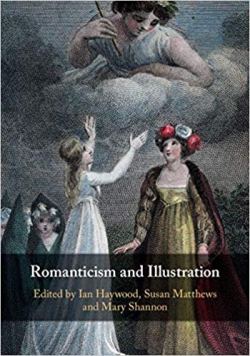 This collection of essays takes a fresh look at the important role of illustration in Romantic literature. The late eighteenth century saw an explosion of illustrated editions of literary classics and the emergence of a new culture of literary art, including the innovative literary galleries. The impact of these developments on the reading and viewing of literary texts is explored in a series of case studies covering poetry, historical texts, drama, painting, reproductive prints, magazines and ephemera. Romanticism and Illustration argues for a more detailed study of illustration which includes the context of a wider circulation of images across different media. The modern understanding of the word ‘illustration’ fails to convey the complex relationship between the artist, the engraver, the publisher, the text and the audience in Romantic Britain. In teasing out the implications of this dynamic cultural matrix, this book opens up a new field of Romantic studies.
C O N T E N T S
Figures
Notes on Contributors
Acknowledgements
Editors’ Introduction
Part I. Illustrating Poetry
1 Peter Otto, The Ends of Illustration: Explanation, Critique, and the Political Imagination in Blake’s Title-pages for Genesis
2 Sophie Thomas, ‘With a Master’s Hand and Prophet’s Fire’: Blake, Gray, and the Bard
3 Dustin Frazier Wood, Seeing History: Illustration, Poetic Drama, and the National Past
4 Martin Priestman, ‘Fuseli’s Poetic Eye’: Prints and Impressions in Fuseli and Erasmus Darwin
5 Susan Matthews, Henry Fuseli’s Accommodations: ‘Attempting the Domestic’ in the Illustrations to Cowper
6 Sandro Jung, Reading the Romantic Vignette: Stothard Illustrates Bloomfield, Byron, and Crabbe for The Royal Engagement Pocket Atlas
7 Maureen McCue, Intimate Distance: Thomas Stothard’s and J. M. W. Turner’s Illustrations of Samuel Rogers’s Italy
Part II. The Business of Illustration
8 Ian Haywood, Illustration, Terror, and Female Agency: Thomas Macklin’s Poets Gallery in a Revolutionary Decade
9 Luisa Calè, Maria Cosway’s Hours: Cosmopolitan and Classical Visual Culture in Thomas Macklin’s Poets Gallery
10 Mary Shannon, Artists’ Street: Thomas Stothard, R. H. Cromek, and Literary Illustration on London’s Newman Street
11 Brian Maidment, The Development of Magazine Illustration in Regency Britain: The Example of Arliss’s Pocket Magazine, 1818–1833
Coda, Martin Myrone, Romantic Illustration and the Privatization of History Painting
Bibliography
Index
Call for Papers | UAAC/AAUC 2019, Québec
From UAAC/AAUC:
Universities Art Association of Canada / l’association d’art des universités du Canada
Hilton Hotel, Québec, 24–27 October 2019
Proposals due by 31 May 2019
Every fall UAAC hosts Canada’s professional conference for visual arts based research by art historians, professors, artists, curators and cultural workers. The conference is held at a different location each year, normally at a Canadian university or college, and the sessions and panels address issues and subjects in art history, theory and practice from a variety of methodological approaches. We’re pleased to announce that UAAC-AAUC’s next conference will be held in beautiful Quebec City at the Hilton Hotel from October 24 to 27, 2019.
A selection of sessions potentially related to the eighteenth century, including the HECAA panel, is provided below. A full list of panels is available as a PDF file here.
◊ ◊ ◊ ◊ ◊
HECAA Open Session (Historians of Eighteenth-Century Art and Architecture)
Chair: Joan Coutu (University of Waterloo), joan.coutu@uwaterloo.ca
HECAA works to stimulate, foster, and disseminate knowledge of all aspects of visual culture in the long eighteenth century. This open session welcomes papers that examine any aspect of art and visual culture from the 1680s to the 1830s. Special consideration will be given to proposals that demonstrate innovation in theoretical and/or methodological approaches.
◊ ◊ ◊ ◊ ◊
Au préalable : œuvre(s) préparatoire(s) et processus créatif aux temps médiévaux et modernes
Chair: Audrey Adamczak (Institut catholique de Paris), audrey.adamczak@videoton.ca
Nous proposons d’interroger l’œuvre préparatoire du Moyen-Age et de la première modernité quels que soient sa forme, sa destination ou le médium utilisé, en privilégiant les études qui aborderont les processus de création mis en jeu pour générer et fabriquer une œuvre d’art, qu’elle soit individuelle ou collective : pratiques d’atelier, changements/modifications de la première intention de l’artiste, reprise ou réemploi d’un modèle antérieur, etc. Nous accorderons une attention toute particulière aux propositions touchant aux domaines souvent peu étudiés tels que la gravure, l’illustration, l’enluminure, l’art du vitrail, la sculpture et les arts décoratifs, l’architecture et le décor.
◊ ◊ ◊ ◊ ◊
What Was History Painting and What Is It Now?
Chairs: Jordan Bear (University of Toronto), jordan.bear@utoronto.ca; and Mark Phillips (Carleton University), Mark.Phillips@carleton.ca
The dominant visual language of European painting from the Renaissance to the nineteenth century, history paintings were formidable in their monumental scale, ambitious moral lessons, and intricate narratives. With the rise of modernist avant-gardes, the genre receded from the forefront of artistic production into the realm of nostalgia. Yet history painting cast a shadow that would subtly colour even the works that sought to displace it.
This session invites presentations that explore the fortunes of this distinctive mode of visual representation. Papers might engage with any number of themes, including the creation of an audience attuned to the genre’s didactic aims, the entry of history painting into the marketplace of commercial art and attractions, or the reimagination of the mode in response to the edicts of modern and contemporary art and decolonization. We are eager to investigate the genre in its full range of geographical and chronological variety, and to consider both the tradition and the vibrant ways in which it resonates through the art of the present.
◊ ◊ ◊ ◊ ◊
Exhibiting Animals in the Long Nineteenth Century
Chair: Elizabeth Boone (University of Alberta), betsy.boone@ualberta.ca
Animals, both wild and domesticated, were regularly exhibited during the long nineteenth century. They appeared on canvas and as sculpture in fine art exhibitions; as public art works marking fair grounds, parks, and zoos; mounted through the art of taxidermy; and live in circus performances and at agricultural fairs. Some animals—usually those known for their performance abilities, noteworthy value, or bloodlines—appear in named portraits, while others functioned as type, to evoke particular emotions, or to communicate societal values and attitudes about these non-human beings. This session invites papers from scholars interested in exploring the current state of animal studies and the representation of animals in an exhibitionary context.
◊ ◊ ◊ ◊ ◊
Domestic Encodings through Craft Objects
Chairs: Ruth Chambers (University of Regina), Ruth.Chambers@uregina.ca; and Mireille Perron (Alberta University of the Arts, former ACAD University), Mireille.Perron@acad.ca
Desire, fear, pleasure, projection, and uncertainty loom large in concepts of home and domesticity. Craft objects in particular have sustaining connections with home and with the production of domestic space; how and what kind of space is produced through crafted objects is of renewed concern for many historians, curators, craft persons, and artists. Examples of recent scholarship and practice include, but are not limited to: Craft, Space and Interior Design 1855–2005, Sandra Alfody ed.; Breaking and Entering: The Contemporary House Cut, Spliced, and Haunted, Bridget Elliott ed.; and the works of Ann Low, Laura Vickerson, Shannon Bool, Carmen Laganse, Amy Malbeuf, Luanne Martinau, Judy Chartrand, and Lindsay Arnold, to name but a few Canadian artists. Following, but not restricted to investigations of these leads, we will offer Craft practice, theory, discourse, and history as ways to uncover, transform, validate, and better understand our production of domesticity. All historical, methodological and material approaches are welcome.
◊ ◊ ◊ ◊ ◊
Making Sense of the Senses: Evaluating the Sensorium in Visual Culture
Chair: Samantha Chang (University of Toronto), samantha.chang@mail.utoronto.ca
The classification, discrimination, and individuation of the senses have long been a topic of discussion among scholars in the natural sciences, social sciences, and humanities. Although the paradigm of the five senses can be found in philosophical texts from Ancient Greece and China, the sensory categories defined differed significantly between the two regions. This disparity of sense perception informed the interdisciplinary field of sensory studies and following the sensory turn of the 1990s, led to a profusion of sense-specific subfields, especially those related to visual culture. While the invention of visual culture collapsed the hierarchy of high/low art (Berger 1972; Baxandall 1972; Alpers 1983), the proliferation of visual culture studies further entrenches the hierarchical division of the senses (Howes 2018). This panel seeks to explore interpretations of the sensorium in visual culture and evaluate the cultural and social connections/implications of the senses in art.
◊ ◊ ◊ ◊ ◊
On Performance, Exhibitions, and Archives
Chairs: Barbara Clausen (Université du Québec à Montréal), clausen.barbara@uqam.ca; and Erin Silver (University of British Columbia), erin.silver@ubc.ca
This panel, which springboards from Clausen’s research on performance’s representational politics as a hybrid art form in the tension field of the live and mediated, and Silver’s research on the superimposition of embodied movement and political movements, examines how these practices find their various modes of existence within and beyond the framework of the institutional spaces they occupy. Bridging the recent fervour for dance’s representational and political potential within gallery spaces, to performance’s status as one of the most dominantly promoted art forms today, this panel asks: how do movement- and performance-based practices operating at the intersection of the exhibition and the archive contribute to and shape concepts of agency, site specificity, and immediacy in the cultural sphere? We invite submissions in French and English that explore notions of the performative in relation to the museum and new formats of curating, archiving, and digital mediation.
◊ ◊ ◊ ◊ ◊
Séance Ouverte (Réseau Art et Architecture du 19e siècle) / Open Session (Research on Art and Architecture of the 19th Century)
Chairs: Peggy Davis (Université du Québec à Montréal), davis.peggy@uqam.ca; and Ersy Contogouris (Université de Montréal), ersy.contogouris@umontreal.ca
L’objectif du Réseau Art et Architecture du 19e siècle (www.raa19.com) consiste à promouvoir le renouveau des recherches globales et interdisciplinaires sur le 19e siècle en histoire de l’art et de l’architecture. Cette session ouverte invite des propositions théoriques ou des études de cas qui couvrent des corpus issus du long 19e siècle, de 1789 à 1914. Une attention particulière sera donnée aux propositions qui font ressortir de nouvelles problématiques ou des méthodologies novatrices.
The aim of the RAA19 (Research on Art and Architecture of the 19th century; http://www.raa19.com) is to encourage innovative studies of nineteenth-century art and architecture. This open session welcomes papers that examine theoretical issues or case studies that focus on any aspect of the art and architecture of the long nineteenth century, from 1789 to 1914. Special consideration will be given to papers that propose innovative issues or methodologies.
◊ ◊ ◊ ◊ ◊
Perspectives on the Dutch Golden Age
Chairs: Stephanie Dickey(Queen’s University), stephanie.dickey@queensu.ca; and Amy Golahny (Lycoming College), golahny@lycoming.edu
We propose a session on the historiography and reception of Dutch art produced in the period c. 1575–1700, exploring how artists, admirers, and critics have responded to the art of the period known as the ‘Dutch Golden Age’ from the seventeenth century to the present. We welcome case studies that reflect on, for example, theoretical appraisals of Dutch art and artists; literary adaptations of artists’ lives for the popular audience; print reproductions of Dutch painting in the eighteenth and nineteenth centuries; emulation of Dutch artists in nineteenth century France; the rediscovery of Vermeer; poetic responses to Dutch art; the changing reception of Rembrandt and other artists; Dutch art through the lens of methodologies such as feminism or post-colonialism; the collecting and connoisseurship of Dutch art in Canada and elsewhere; and other topics.
◊ ◊ ◊ ◊ ◊
Interconnections in the Long Nineteenth Century
Chairs: Mitchell Frank (Carleton University), mitchell.frank@carleton.ca; and Alison McQueen (McMaster University), ajmcq@mcmaster.ca
This panel invites papers that examine the significant roles assigned to visual culture in understanding global connections in the long nineteenth century (c.1789–1914). Connections between places and power relations raise important questions, and transnational approaches offer a means of disrupting histories, including those centred on national identities. Papers may consider the following questions: What roles did visual culture play in communicating, reinforcing, enacting, complicating, and/or disrupting imperial power structures and settler- colonial narratives? What issues of agency, or factors inhibiting agency, faced imperial subjects and/or citizens as creators, patrons, or spectators? How did they traverse or negotiate between geopolitical realms, such as the metropole, provinces, or colonies? How can the social history of art raise new questions about interconnections in the long nineteenth century? How does a transnational approach enrich and expand current conceptions of nineteenth-century art and reconceptualize its parameters? What does it promise and are there drawbacks?
◊ ◊ ◊ ◊ ◊
The Art of Camouflage
Chairs: Claudette Lauzon (Simon Fraser University), lauzon@sfu.ca; and T’ai Smith (University of British Columbia), tai.smith@ubc.ca
Camouflage is a technique of obfuscation that operates in the realm of visibility. Mimicking the patterns of its environment, an animal becomes at once transparent and opaque. A product of branding, the fashionista is constantly adapting, continuously changing and exchanging her appearance for another to fit the mode of her surroundings. The hoodie is at once a target, an icon of protest, and a method of hiding. Terrorists, sports fans, politicians, and bank robbers all wear baseball caps. Meanwhile, drones are disguised as hummingbirds. This panel will consider the art and politics of camouflage in material and online environments. We invite contributions that address camouflage from historical, theoretical, and/or artistic perspectives. Topics may include counter-surveillance and camouflage; the politics of race and opacity; camouflage in/and animal studies; visual cultures of war and conflict; costume and fashion; biometrics; and feminist strategies of invisibility.
◊ ◊ ◊ ◊ ◊
À la croisée des chemins : réflexions sur les relations interespèces en art
Chairs: Anne-Sophie Miclo (Université du Québec à Montréal), miclo.anne-sophie@courrier.uqam.ca; and Valérie Bienvenue (Université de Montréal), valerie.bienvenue@umontreal.ca
Si la part de l’animal non humain est considérable au sein du processus artistique, elle est cependant assez peu questionnée. Qu’il s’agisse de sa représentation, de sa présentation (vivant ou taxidermisé) ou encore de la composition même des œuvres (par le biais des colles, pinceaux et pigments), force est de constater que cet « autre » a maintes fois pris part à la création. Pourtant, son impact sur la relation humain/animal en art reste à reconnaître : comment les rapports interespèces sont-ils réfléchis par cette présence non humaine dans les œuvres? Par ailleurs, l’artiste qui « utilise » les animaux peut-il être vecteur de revendication ou de changement dans les façons d’interagir avec eux historiquement et maintenant? Ce panel, souhaitant ouvrir la question de l’animal en art à des angles d’approches des plus variés, invite à la réflexion à partir de n’importe quelles périodes historiques ou contextes culturels et géographiques.
◊ ◊ ◊ ◊ ◊
Environnements artificiels au 19e siècle (Séance du Réseau Art et Architecture du 19e siècle : RAA19)
Chairs: Étienne Morasse-Choquette (Université du Québec à Montréal), morasse-choquette.etienne@courrier.uqam.ca; and Christina Contandriopoulos (Université du Québec à Montréal), contandriopoulos.christina@uqam.ca
Le 19e siècle est marqué par l’instrumentalisation grandissante de la nature. Face à un monde devenu abstrait, l’art du paysage naturalise l’emprise sur le territoire en produisant des images fantasmatiques, sauvages ou primitivistes, alors que l’architecture émule les mécanismes de la nature par des moyens artificiels (jardins d’hiver, atmosphères contrôlées, éclairage artificiel, illusions spatiales). Si certaines tentatives relèvent d’intentions spirituelles ou purement poétiques, d’autres s’inscrivent dans une démarche rationaliste ou instrumentale. Dans tous les cas, l’expérience esthétique et l’imagination sont appelées à jouer un rôle de première importance. Cette séance invite les propositions d’études de cas variées et d’approches théoriques qui nous permettent de réfléchir à l’esthétisation de la nature durant le long 19e siècle. Qu’il s’agisse d’espaces ou d’images, comment les arts participent-ils à la création de « paradis terrestres » ou d’autres environnements artificiels ?
◊ ◊ ◊ ◊ ◊
The Art of Visualizing Others: Early Modern Cultural Encounters
Heather Muckart (Columbia College), muckart@mail.ubc.ca
The early modern period marks a moment of accelerated cultural contact, exchange, and trade. Despite this essential feature of the period, art historical studies that examine such encounters and the ways they were represented, negotiated, and understood though art and visual culture are only recently gaining traction. This session proposes to examine the representations that such encounters generated, as well as any preexisting works that informed such moments of contact. Papers are invited that examine one or more facets of this global network of early modern encounters and their related artworks and objects. Sites of contact can include, but are not limited to: the British Empire (including British America), First Nations, Ming or Qing China, Mughal or Maratha India, Safavid Persia, the Spanish Empire (including Spanish America), or the Venetian Republic. Papers that interrogate or challenge academic notions such as acculturation, appropriation, hybridity, and liminality are particularly encouraged.
◊ ◊ ◊ ◊ ◊
Artifacts and the Digital Archive
Barbara Rauch (OCAD University), brauch@faculty.ocadu.ca
This panel invites papers that address issues within the field of critical digital humanities. We will attend to contradictions and criticism in the field of digital humanities to further address the impact and politics of digital technologies on our diverse practices, i.e. art, design, craft, and media. While we have announced the era of the post-material, the post-digital, and the post-studio, contemporary practitioners find themselves returning to their studio, negotiating materiality, physical and digital that is, as we have declared data as material. Visualizing and/or materializing data, results in products; our objects demand exposure, documenting, and finally, storage. The boundary object, the hyper object, the emotive object all declare specific material research including the tacit knowledges that the maker inserts in the object. In particular, with digital objects and algorithmic work, the code that is embedded in the object is also an object, yet, how do we archive and narrate these distinct materials; we question further, does the digital archive provide for much diversity?
◊ ◊ ◊ ◊ ◊
Open Session: National Network for the Study and Promotion of Latino Canadian Art and Latin American Art in Canada
Chairs: Alena Robin (Western University), arobin82@uwo.ca; and Analays Hernandez (University of Ottawa), analays.alvarez@gmail.com
This open session welcomes proposals that seek to foster and disseminate knowledge in Canada of all aspects of Latino Canadian art and Latin American art, from pre-Columbian and colonial periods to modern and contemporary art. The objective of this session is to bring together collaborators and proposals for the creation of a national network for the study and promotion of Latino Canadian art and Latin American art in Canada. We accept proposals in French and English/Nous acceptons les propositions en français et en anglais.
◊ ◊ ◊ ◊ ◊
Museums and Celebrity Culture: Historical and Critical Perspectives
Chairs: Maria Silina (Université du Québec à Montréal), silina.maria@gmail.com; and Lynda Jessup (Queen’s University), lynda.jessup@queensu.ca
This session is a reflection on museums and the phenomenon of celebrity culture. Museums are institutions that channel celebrity culture as a part of the global creative industry and mass culture. Today, it is evidenced in the boom in blockbuster exhibitions and large-scale collaborations of museums with film and fashion industry. In history, too, exhibitions and artworks on display had already served as an attraction to the enlightened public. Museums are also celebrity institutions in their own right. There is an ongoing mutual interest between museum curators and celebrities from other cultural domains (Wes Anderson in Vienna, Beyoncé and Jay-Z at the Louvre). Finally, this evolution of museums raises new concerns for the strategic management (acquisition, public criticism) of artistic celebrities in museum collections in the time of the #MeToo movement, increasing calls to decolonize cultural institutions, and the vital importance of actively engaging underrepresented artists and communities into museums.
◊ ◊ ◊ ◊ ◊
Locating Textiles in Global Art Histories
Julia Skelly (Independent Scholar), julia.skelly232@gmail.com
In the introduction to Art History in the Wake of the Global Turn (2014), Aruna D’Souza writes that the book is meant to address some of the ways “that a global art history troubles, even explodes, the very concepts on which the discipline is based by forcing us to see differently, to recognize the unrecognizable, to authorize the formerly unacknowledged” (xxi). D’Souza’s words strike me as particularly resonant for the study of textiles. This session will highlight new scholarship on ‘global’ textiles, with ‘global’ signifying any location in the world not typically identified as an ‘art centre’. The objective of the session will be to demonstrate anew how we as art historians can ‘explode’ the very discipline of art history by rigorously studying textiles as well as makers from a range of global contexts. Papers may discuss textiles produced during any time period.
Seminar | Tim Clayton, Gillray in Grub Street
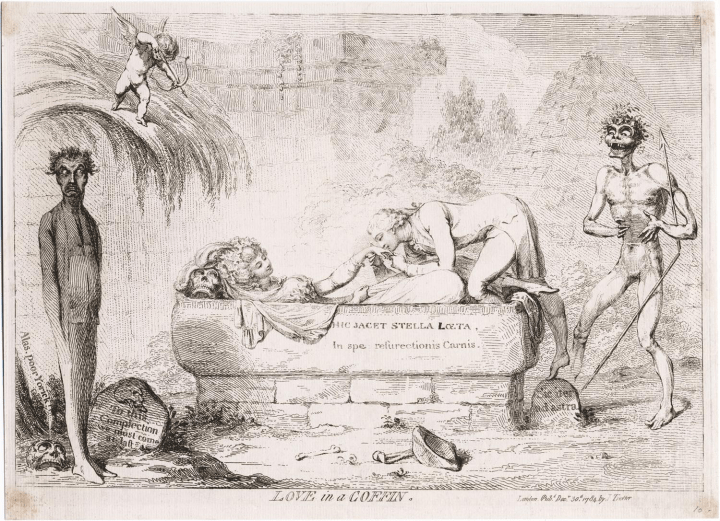
James Gillray, Love in a Coffin, 1784
(The Lewis Walpole Library)
◊ ◊ ◊ ◊ ◊
From the Mellon Centre:
Tim Clayton, Gillray in Grub Street: Some Episodes from the 1780s
Paul Mellon Centre for Studies in British Art, London, 22 May 2019
James Gillray is known for working with Hannah Humphrey from her shop in St James’s Street, but Hannah did not become his dominant publisher until 1791 and they did not move to St James’s Street until 1797. For the first thirteen years of his adult working life Gillray had a number of publishers and at times worked on the margins of what was legally acceptable. This paper addresses some of Gillray’s work during the 1780s with a view to introducing for discussion issues that have proved problematic in the consideration of graphic satire, including authorship and origination, size of editions and prices, and legal sanctions against caricatures. The evening begins with the presentation of the paper at 6:00, followed by discussion and then drinks and nibbles at 7:30.
Tim Clayton is an author and historian who has worked chiefly on print history and military history. His book The English Print 1688–1802 (1997) sought to trace the growth and themes of the London print trade in the eighteenth century; more recent work has concentrated on graphic satire and literary propaganda in Bonaparte and the British: Prints and Propaganda in the Age of Napoleon (2015) and This Dark Business: The Secret War against Napoleon (2018). He is currently working on a book provisionally entitled ‘James Gillray and the Business of Satire’.
Call for Essays | Museum Media(ting)
From ArtHist.net:
Museum Media(ting): Emerging Technologies and Difficult Heritage
Edited by Theopisti Stylianou-Lambert, Antigone Heraclidou, and Alexandra Bounia
Abstracts due by 15 July 2019; finished essays due by 15 January 2020
This edited volume with the working title Museum Media(ting): Emerging Technologies and Difficult Heritage examines theoretical approaches and case studies that demonstrate how emerging technologies can display, reveal, and negotiate difficult, dissonant, negative, or undesirable heritage. We are particularly interested in how emerging technologies in museums have the potential to reveal unheard or silenced stories, challenge preconceptions, encourage emotional responses, introduce the unexpected, and overall provide alternative experiences. By emerging technologies, we refer to contemporary advances and innovations in technology such as virtual reality, augmented reality, mixed reality, holograms, artificial intelligence, gamification, smart systems, etc.
How can museums, with the help of technology, manage to tell unheard stories, touch upon issues of difficult heritage, and narrate stories of unprivileged groups of people such as minorities, women, LGBT, immigrants, etc.? How can museums explore alternative sides of history, different from the political/ diplomatic/ military history which is the norm, such as social history, history of education, history of migration, etc., giving therefore emphasis not so much on the knowledge/ collection of information, but to multiperspectivity, inclusiveness, tolerance and social cohesion? How and to what extent the use of technology in museums/ art spaces, facilitates the understanding of issues dealing with contested history? How can emerging technologies provide not only cognitive experiences but also affective ones?
The volume may include chapters that deal with the following themes:
• Emerging technologies in museums
• Innovative interactive media/ installations
• Art and technology for difficult heritage
• Crowdsourcing/ participatory methods
• Oral histories and emerging technologies
• Deep mapping approaches
• Affective responses
• Cultural tourism and difficult or dark heritage
• Alternative experiences
• Evaluation studies of specific applications of emerging technologies applied to difficult heritage in museums
• Other themes related to the key questions of the call
The papers can be theoretical in nature or/ and explore specific case studies. We encourage proposals that demonstrate specific uses of emerging technologies in museums and other cultural sites as well as evaluation studies.
The volume will be edited by Theopisti Stylianou-Lambert (Cyprus University of Technology/ Research Centre on Interactive Media, Smart Systems and Emerging Technologies – RISE), Antigone Heraclidou (Research Centre on Interactive Media, Smart Systems and Emerging Technologies – RISE) and Alexandra Bounia (UCL Qatar/ University of the Aegean) and will be published by a well-known academic publisher.
To submit an abstract, please send a 500-word abstract (including references) and a short bio for each author (up to 70 words each) to theopisti.stylianou@cut.ac.cy and a.heraclidou@rise.org.cy by July 15th 2019. Applicants will receive a response within a month’s time. The selected authors will be expected to deliver a full paper (6000–8000 words) by January 15th 2020.










 Enfilade
leave a comment