Salon du Dessin 2019
From the press kit:
Salon du Dessin 2019
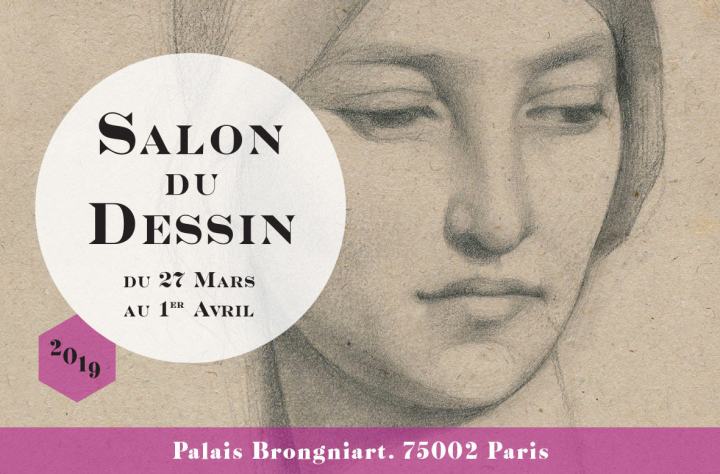
Palais Brongniart, Paris, 27 March — 1 April 2019
The eagerly anticipated Salon du Dessin will take place again this spring under the vaulted roof of Paris’s Palais Brongniart and will once again feature a selection of outstanding works on paper. among the 39 exhibitors from around the world will be four handpicked new galleries and two that are returning after an absence of a few years. Among the treasures on display will be rare drawings by egon schiele and Gustav Klimt, presented by the Austrian gallery Wienerroither & Kohlbacher, and a solo show of the work of contemporary artist Jean-Baptiste Sécheret on the stand of Galerie Jacques Elbaz. The German dealer Martin Moeller will celebrate 100 years of drawings from his country, while the Galerie de la Présidence features drawings by sculptors.

Juan Antonio Conchillos y Falcó, Academic Study, 1703; offered by Artur Ramon Art ($36,000).
The 28th edition of the art fair will also host two museum-level exhibitions. Festivities in Paris will feature drawings from the collection of the Musée Carnavalet-Histoire de Paris (currently closed for renovation until late 2019), while the Maison Chaumet will exhibit drawings of its jewelry in an exhibition on the theme of nature, curated by botanist Marc Jeanson, who worked on the magnificent exhibition Jardins at the Grand Palais in 2017.
Other highlights of the Salon du Dessin will be the presentation of the 12th Daniel and Florence Guerlain Drawing Prize and the return of a program of international symposia, which will focus on the performing arts this year. Drawing Week, a highly popular off-site event organized in partnership with over 20 museums and institutions, will offer access to graphic arts collections that are usually off-limits to the public.
W E D N E S D A Y , 2 7 M A R C H 2 0 1 9
Occupying the Stage: Sets and Costumes
Chair: Jean-Claude Yon (Professor at the University of Saint-Quentin-en-Yvelines)
• Emmanuelle Brugerolles (Curator General at the École Nationale Supérieure des Beaux-Arts, Paris), Georges Focus and the Theater: Sets and Staging
• Rudi Risatti (Curator at the Theatermuseum in Vienna), The Magic Space: Technical and Aesthetic Solutions in Baroque Scenography as Seen in Drawings from the Theatermuseum in Vienna
• Marc-Henri Jordan (independent art historian, doctoral student, University of Lausanne), The Royal Academy of Music in Search of Draftsmen and Painters: Identification of Decorative Drawings and Clothing, ca. 1780
• Catherine Join-Diéterle (Curator General, former director of the Musée Galliera, Paris), Theater Sets in the Romantic Era: A New Approach to the Stage Area
• Marine Kisiel (Painting Curator at the Musée d’Orsay), ‘A Unique System of Lines’: The Body in Space in the Work of Edgar Degas
• Mathias Auclair (Director of the Music Department at the Bibliothèque Nationale de France, Paris), The Stage Seen as a Painting: The Birth of Scenography at the Paris Opera, 1914–1972
T H U R S D A Y , 2 8 M A R C H 2 0 1 9
Occupying the City: Festivities and Ceremonies
Chair: Michel Delon (Professor at the University of Paris-IV Sorbonne)
• Franca Varallo (Professor at the university of Turin), Onorato Tiranti’s Il Laberinto de Groppi and Drawings for Festivities by Tommaso Borgonio
• Jérôme de La Gorce (Emeritus Research Director, CNRS- Centre André Chastel), Collections of Drawings Held in Paris and Madrid Illustrating Important Celebrations of the Marriage of Madame to the Infant of Spain, 1739
• Maria Ida Biggi (Director of the Centro Studi per la Ricerca Documentale sul Teatro Europeo Fondazione Cini, Venice), Le feste sull’acqua: Apparati per Napoleone
• Gaëlle Lafage (Postdoctoral Researcher, Université de Paris Sorbonne), Drawing as a Source of Study of Fireworks
• José de Los Llanos (Chief Curator, Head of the Musée Carnavalet’s Graphic art Department) and David Simonneau (Conservation Assistant, Musée Carnavalet Graphic art department), Festivals and Spectacles in the Collection of the Musée Carnavalet-Histoire de Paris, 17th–19th Centuries
Conference | 1802: Cultural Exchange between Paris and London

Thomas Girtin, View of Pont de la Tournelle and Notre Dame, etching and aquatint, from A Selection of Twenty of the Most Picturesque Views in Paris, and Its Environs (London, 1803), RB 400000, (San Marino: The Huntington Library, Art Collections, and Botanical Gardens).
◊ ◊ ◊ ◊ ◊
From the program for the upcoming conference:
1802: Cultural Exchange between Paris and London during the Peace of Amiens
The Huntington Library, Art Collections, and Botanical Gardens, San Marino, 17–18 May 2019
This interdisciplinary conference illuminates the movement of writers, artists, scientists, and cultural goods between Paris and London during the fourteen months of peace ushered in by the Treaty of Amiens, from March 1802 through May 1803—the first break in hostilities after a decade of Revolutionary warfare. Registration information is available here.
Funding provided by The Dibner History of Science Program at The Huntington
F R I D A Y , 1 7 M A Y 2 0 1 9
9:00 Registration and Coffee
9:30 Welcome by Steve Hindle (The Huntington) and Opening Remarks by Cora Gilroy-Ware (Isaac Julien Studio) and Paris Spies-Gans (Harvard University)
10:00 Session 1: Writers
Moderator: Kevin Gilmartin (California Institute of Technology)
• Susan Lanser (Brandeis University), Helen Maria Williams, Radical Sociability, and the Uneasy Peace of Amiens
• Kelly Summers (MacEwan University), Between Amiens and Amnesty: The Parisian Wanderings of the d’Arblays, c. 1802
12:00 Lunch
1:00 Session 2: Artists
Moderator: Hector Reyes (University of Southern California)
• Cora Gilroy-Ware (Isaac Julien Studio), Inferior Beauty: The (British) Artist’s Gaze on the Streets and in the Louvre
• Catherine Roach (Virginia Commonwealth University), ‘Great National Establishments’: Amiens and the Foundation of the British Institution
3:00 Break
3:15 Session 3: Publication
Moderator: Paula Radisich (Whittier College)
• Melinda McCurdy (The Huntington), Thomas Girtin’s Paris Venture
• Susan Siegfried (University of Michigan), Amelia Opie’s ‘Recollections of a Visit to Paris in 1802’
S A T U R D A Y , 1 8 M A Y 2 0 1 9
9:30 Registration and Coffee
10:00 Session 4: Intellectual Exchanges
Moderator: Alexander Statman (Dibner Long-Term Research Fellow, The Huntington)
• Dena Goodman (University of Michigan), French Scientists Cross the Channel: Peace and the Advancement of Knowledge, Industry, and Agriculture
• Joshua Ehrlich (University of Macau), Alexander Hamilton, Asian Knowledge, and Anglo-French Competition
12:00 Lunch
1:00 Session 5: Material Culture
Moderator: Mary Terrall (University of California, Los Angeles)
• Courtney Wilder (University of Michigan), Revolutions and Rivalries in the Printed Textile Trade before, during, and after the Peace of Amiens
• Renaud Morieux (University of Cambridge), The ‘Obscene’ and ‘Infamous’ Trade between Britain and Europe around the Peace of Amiens
3:00 Break
3:15 Session 6: Shaping the Narrative
Moderator: Nathan Perl-Rosenthal (University of Southern California)
• Simon Macdonald (Queen Mary University of London), The Argus, or London Review’d in Paris: Mediascape between France and Britain during the Peace of Amiens
• Paris Spies-Gans (Harvard University), ‘In this Country the Law is on my Side:’ Marie Tussaud, the Peace of Amiens, and the Formation of a Wax Empire
5:15 Closing Remarks by Cora Gilroy-Ware, Dena Goodman, and Paris Spies-Gans
New Book | Art Crossing Borders
From Brill:
Jan Dirk Baetens and Dries Lyna, eds., Art Crossing Borders: The Internationalisation of the Art Market in the Age of Nation States, 1750–1914, Series: Studies in the History of Collecting & Art Markets, Volume 6 (Leiden: Brill, 2019), 351 pages, ISBN: 978-9004291980, €127 / $153.
 Art Crossing Borders offers a thought-provoking analysis of the internationalisation of the art market during the long nineteenth century. Twelve experts, dealing with a wide variety of geographical, temporal, and commercial contexts, explore how the gradual integration of art markets structurally depended on the simultaneous rise of nationalist modes of thinking, in unexpected and ambiguous ways.
Jan Dirk Baetens (PhD, University of Leuven, 2011), is Assistant Professor at Radboud University Nijmegen. He has published widely on the nineteenth-century art market and on nineteenth-century historicism. He is preparing a book-length study on the Belgian history and historical genre painter Henri Leys.
Dries Lyna (PhD, University of Antwerp, 2010), is Assistant Professor at Radboud University Nijmegen. He has published on the art markets and material culture of eighteenth-century cities in the Low Countries, co-editing Concepts of Value in European Material Culture, 1500–1900 (2015). He is currently preparing a book on the rise of art auctions in the Austrian Netherlands.
C O N T E N T S
Acknowledgements
Figures
Contributors
• Jan Dirk Baetens and Dries Lyna, Towards an International History of the Nineteenth-Century Art Trade
• Jan Dirk Baetens and Dries Lyna, The Education of the Art Market: National Schools and International Trade in the ‘Long’ Nineteenth Century
• Bénédicte Miyamoto, ‘Directions to Know a Good Picture’: Marketing National School Categories to the British Public in the ‘Long’ Eighteenth Century
• Leanne Zalewski, Creating Cultural and Commercial Value in Late Nineteenth-Century New York Art Catalogues
• Barbara Pezzini, (Inter)national Art: The London Old Masters Market and Modern British Painting (1900–14)
• Camilla Murgia, The Artistic Trade and Networks of the Italian Community in London around 1800
• Lukas Fuchsgruber, Berlin – Paris: Transnational Aspects of French Art Auctions in the Middle of the Nineteenth Century
• Adriana Turpin, Appropriation as a Form of Nationalism? Collecting French Furniture in the Nineteenth Century
• Sharon Hecker, The Modern Italian Sculptor as International Entrepreneur: The Case of Medardo Rosso (1858–1928)
• Robert Verhoogt, Art Reproduction, and the Nation: National Perspectives in an International Art Market
• Pamela Fletcher and Anne Helmreich, Reframing the ‘International Art Market’
Index
Call for Manuscripts | Brill Series, History of Collecting & Art Market
History of Collecting & Art Market
Brill Book Series, Edited by Christian Huemer
Brill‘s ‘Studies in the History of Collecting & Art Markets’ is a peer-reviewed book series dedicated to original scholarship on the social, cultural, and economic mechanisms underlying the circulation of art. Over the last two decades interest in the formation, display, and dissolution of art collections increased tremendously; art markets, trade routes, and dealer networks became a rich field of interdisciplinary inquiry. Scholarship brought forth a lot of information about the flamboyant personalities to whom the possession of art was a lifestyle; regarding the ‘social life of things’, i.e. the provenance of individual artworks, many research gaps could be closed.
This shift in scholarly attention from the production side to the consumption side of the art world is also reflected in the emergence of specialized post-graduate courses offered by a number of institutions internationally, as well as an ever-increasing stream of exhibitions, conferences, and publications devoted to the subject. Brill‘s book series accommodates scholarly monographs, collections of essays, conference proceedings, and works of reference that engage in the broadly defined topic of art markets and collecting practices throughout history.
We invite scholars to submit their English language manuscript proposal for the book series to Liesbeth Hugenholtz, acquisitions editor at Brill (hugenholtz@brill.com) or to the series editor Christian Huemer (C.Huemer@belvedere.at).
Editor-in-Chief
Christian Huemer (Belvedere Research Center, Vienna)
Editorial Board
Malcolm Baker (University of California, Riverside), Ursula Frohne (Westfälische Wilhelms-Universität Münster), Daniela Gallo (Université de Lorraine, Nancy), Hans van Miegroet (Duke University, Durham), Inge Reist (The Frick Collection, New York – retired), Adriana Turpin (Institut d’Etudes Supérieures des Arts, London), Filip Vermeylen (Erasmus University, Rotterdam)
More information about the series is available here»
Nationalmuseum Acquires Three English Miniatures
Press release from Sweden’s Nationalmuseum in Stockholm:

Jeremiah Meyer, A Boy In Blue Coat, 1780s (Stockholm: Nationalmuseum, NMB 2737).
Nationalmuseum has acquired three English works by miniaturists Jeremiah Meyer, Ozias Humphry and John Cox Dillman Engleheart. The portraits in question are all examples of the blossoming of portrait miniatures as an art form from the mid-eighteenth to early nineteenth centuries. The acquisitions represent an important addition to the museum’s collection of portrait miniatures, which is one of the foremost in the world.
Despite the name, a portrait miniature is defined not by its format but by its materials and painting technique. The French word miniature refers to the technique of painting with red lead (minium). As in medieval manuscripts, this was applied to vellum. Around 1700 ivory also was used as a painting surface, and in about 1820 large-format ivory was first extracted with the veneer method. This was just before miniature painting lost the battle for portraiture to photography.
Jeremiah Meyer (1735–1789) provides a reminder of the important role played by foreign artists in the development of the art form in England. Born in Tübingen, Meyer was schooled in enamel painting in London by Saxon miniaturist Christian Friedrich Zincke. In recognition of his skills, in 1764 Meyer was appointed Miniature Painter to the Queen and Enamel Painter to the King, although his greatest contribution was to develop the use of ivory for portrait miniatures both technically and artistically. By using transparent watercolours, he was able to utilise the lustre of the ivory itself to make his portraits shimmer. At the same time, his style was distinctively graphic, with colouration given a subordinate role. Meyer exhibited great technical skill in building up his portraits, alternating short, intersecting lines with longer, unbroken strokes. By varying the grading and density of his lines, he was able to impart a variety of characteristics to skin, hair and clothing. The same applied to is handling of light and shade. All of this is clearly apparent in the newly acquired portrait of a youth in a blue coat. With a few judiciously placed highlights on the tip of the nose, lips and buttons, Meyer demonstrates his total control over his chosen medium. The uncommonly well-preserved skin tone seen here is rare in his work as the red pigment the artist favoured has often faded.

Ozias Humphry, Portrait of Suliman Aga Le Luna, 1782 (Stockholm: Nationalmuseum, NMB 2747).
In many ways, Ozias Humphry (1742–1810) was Meyer’s diametric opposite, both as an artist and a person. Colouration initially played a greater role in his work than line, a result of Humphry’s equal interest in oils and pastels. His blonde, warm tones have often been taken as an indication of a close relationship to pastels as an art form. For a while, it seemed as if Humphry would entirely abandon portrait miniatures; however, after an extended study trip to Italy he chose to concentrate on the form due to its better financial rewards. The striking portrait of Suliman Aga Le Luna, who visited London as a representative of the Regency of Tripoli, was painted in 1782 as a commission for Mary Bruce, Duchess of Richmond. This visit from afar was in connection with the British Government’s efforts to curtail the effects of piracy on their Mediterranean fleet. Two years later, Humphry travelled to India in the hope of earning considerable sums from painting portraits of maharajahs, but the trip proved to be a disappointment. On his return in 1787, his failing sight finally culminated in blindness, putting a premature end to his career.
John Cox Dillman Engleheart (1784–1862) was the nephew and apprentice of the more famous miniaturist George Engleheart. He first worked for his uncle, earning a living copying the older man’s works. In contrast to George Engleheart’s distinctive draughtsmanship, which distanced portrait miniatures from oil paintings, John developed a more refined technique, toning down visible brush strokes and using warmer colours. The recently acquired group portrait, probably of one the artist’s brothers-in-law with family, is testimony to John Engleheart’s own fine painting technique. Here, the artist has expended just as much energy in capturing the faces of the models as the inlays on the canapé. Painted in the 1820s, this large-scale portrait miniature of the Barker family demonstrates that, at that time, the art form had ambitions to measure itself against oil painting, both in terms of format and area.
New Book | Itch, Clap, Pox
From Yale UP:
Noelle Gallagher, Itch, Clap, Pox: Venereal Disease in the Eighteenth-Century Imagination (New Haven: Yale University Press, 2019), 288 pages, ISBN: 978-0300217056, $65.
 A lively interdisciplinary study of how venereal disease was represented in eighteenth-century British literature and art
In eighteenth-century Britain, venereal disease was everywhere and nowhere: while physicians and commentators believed the condition to be widespread, it remained shrouded in secrecy, and was often represented using slang, symbolism, and wordplay. In this book, literary critic Noelle Gallagher explores the cultural significance of the ‘clap’ (gonorrhea), the ‘pox’ (syphilis), and the ‘itch’ (genital scabies) for the development of eighteenth-century British literature and art. As a condition both represented through metaphors and used as a metaphor, venereal disease provided a vehicle for the discussion of cultural anxieties about gender, race, commerce, and immigration. Gallagher highlights four key concepts associated with venereal disease, demonstrating how infection’s symbolic potency was enhanced by its links to elite masculinity, prostitution, foreignness, and facial deformities. Casting light where the sun rarely shines, this study will fascinate anyone interested in the history of literature, art, medicine, and sexuality.
Noelle Gallagher is Senior Lecturer in Eighteenth-Century Literature and Culture at the University of Manchester. She is the author of Historical Literatures: Writing about the Past in England, 1600–1740.
Lecture | Kevin Salatino, Chasing Casanova
Next month at BGC:
Kevin Salatino, Chasing Casanova: Venice and the Grand Tour
Bard Graduate Center, New York, 3 April 2019
Kevin Salatino will speak at the Seminar in Renaissance and Early Modern Material Culture on Wednesday, April 3, at 6pm. His talk is entitled “Chasing Casanova: Venice and the Grand Tour.”
The Grand Tour was both finishing school and rite of passage for the British (male) aristocrat. As Samuel Johnson noted, “a man who has not been in Italy, is always conscious of an inferiority.” While Rome was “the great object,” Venice was an essential stop on the way. The floating city’s wondrous novelty, its reputation for license and luxury, and its much-touted devotion to liberty were compelling attractions for the Grand Tourist. Famous for its courtesans, its masked revelers, its mystery and secrecy, its appeal inevitably swung toward the sensual and the sexual. This talk addresses the British Grand Tourist’s experience of eighteenth-century Venice in the context of the erotic, through a close examination of that city’s art, as well as texts and cultural artifacts from both sides, Venetian and British.
Kevin Salatino is Chair and Curator of Prints and Drawings at the Art Institute of Chicago. He was previously Director of the Art Collections at the Huntington Library, Art Collections, and Botanical Gardens, San Marino, California; Director of the Bowdoin College Museum of Art, Brunswick, Maine; Curator and Head of the Department of Prints and Drawings at the Los Angeles County Museum of Art; and Curator of Graphic Arts at the Getty Research Institute. Salatino holds a BA from Columbia University and a PhD from the University of Pennsylvania. Among his publications are Incendiary Art: The Representation of Fireworks in Early Modern Europe (a revised French edition of which was recently published); Edward Hopper’s Maine; and Blue Boy and Company: European Art at The Huntington. He has published on artists as diverse as Henry Fuseli, Jacques-Louis David, Francisco Goya, Richard Pousette-Dart, and James Ensor, and has lectured extensively on subjects ranging from fireworks to the Grand Tour. Most recently, he curated the Art Institute exhibitions, Shockingly Mad: Henry Fuseli and the Art of Drawing; Gods and Superheroes: Drawing in an Age of Revolution; and Into the Void: Prints of Lee Bontecou.
Workshop | Antiquarian Science in the Scholarly Society
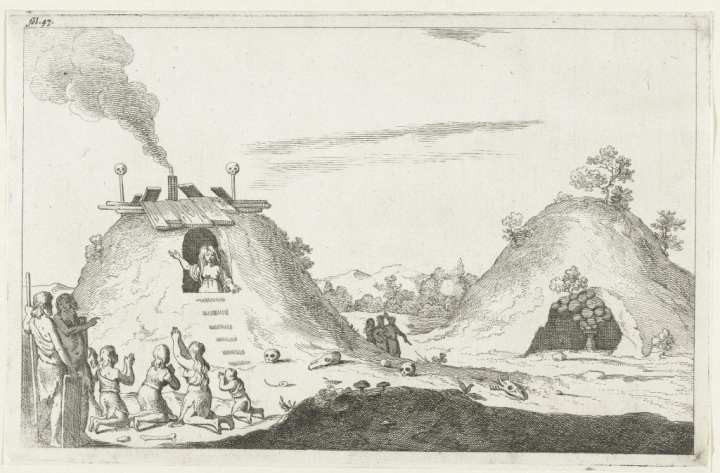
A Priestess Speaking from within a Prehistoric Barrow in Drenthe, from Johan Picardt, Korte beschryvinge van eenige vergetene en verborgene antiquiteten (Amsterdam 1660), f. 47 (Rijksmuseum, RP-P-OB-77.857).
◊ ◊ ◊ ◊ ◊
From the project website:
Antiquarian Science in the Scholarly Society
Society of Antiquaries of London, 1–2 April 2019
Organized by Vera Keller and Anna Marie Roos
This is workshop II of the AHRC International Networking Grant: Collective Wisdom: Collecting in the Early Modern Academy. What was the relationship between archaeological fieldwork or antiquarianism and learned travel or the Grand Tour? What does collecting on tour say about the manner and scale of personal and institutional contacts between London and the scientific world of the Continent? What tools of natural philosophy were utilised to understand buildings and artefacts? What were the implications of the collecting of ethnographic objects for political dominance and Empire?

Ex libris of Z. C. von Uffenbach (Amsterdam: Rijksmuseum, RP-P-2015-26-1860).
Speakers include Philip Beeley (Oxford), Dominik Collet (Oslo), Luke Edgington-Brown (East Anglia), Dustin Frazier Wood (Roehampton), Vera Keller (Oregon), Chantel Grell (Versailles), Clare Hornsby (British School at Rome), Stephanie Moser (Southhampton), Staffan Müller-Wille (Exeter), Cesare Pastorino (Berlin), Anna Marie Roos (Lincoln), Edwin Rose (Cambridge), Martin Rudwick (Cambridge), Kim Sloan (British Museum), Alexander Wragge-Morley (NYU), Elizabeth Yale (Iowa).
A working session using sources from the Society of Antiquaries Library and Museum will also be part of the programme. The Society’s library is Britain’s oldest major research library for archaeology, architectural history, decorative arts (especially medieval), material culture, and the historic environment. It contains books, archives, manuscripts, prints, and drawings. Its Accredited museum collection—which was formed before the introduction of public museums and galleries in the mid-18th century—contains prehistoric, classical and medieval antiquities, seal matrices and impressions, and paintings. Full fee: £100 including lunch. Student/Concessions: £50 including lunch.
M O N D A Y , 1 A P R I L 2 0 1 9
10:00 Registration
10:15 Welcome and Introduction by Vera Keller and Anna Marie Roos
10:20 Plenary Talk
• Stephanie Moser (Southampton) and Christian Hoggard (Aarhus), Visual Testimony: Images and Discipline-Building at the Society of Antiquaries of London
11:15 Egypt and ‘Scientific Antiquarianism’
Chair: Roey Sweet (University of Leicester)
• Chantal Grell (Université de Versailles), Tito Livio Burattini: A Seventeenth-Century Engineer and Egyptologist
• Anna Marie Roos (University of Lincoln), The First Egyptian Society, 1741–43
12:15 Lunch
1:00 The Republic of Letters, Scholarly Societies, and Antiquarianism (Seventeenth Century)
Chair: Lisa Skogh
• Vera Keller (University of Oregon), The Ottoman History of Letters
• Dominik Collet (University of Oslo), Weak Ties, Big Science: Challenges to ‘Blended Learning’ in Early Academic Collections
• Philip Beeley (University of Oxford), ‘The Antiquity, Excellence, and Use of Musick’: Ancient Greek Music and Its Reception in Late Seventeenth-Century Oxford
• Cesare Pastorino (Technische Universität, Berlin), The Features of Early Modern English Antiquarian Metrology
3:00 Coffee Break
3:15 The Republic of Letters, Scholarly Societies, and Antiquarianism (Eighteenth Century)
Chair: Jana Schuster (Cambridge)
• Dustin Frazier Wood (University of Roehampton), Antiquarian Science and Scientific Antiquarianism at the Spalding Gentlemen’s Society, 1710–55
• Clare Hornsby (British School at Rome), Winckelmann, the Descrizione della Villa dell’Em Alessandro Albani, and the Society of Antiquaries of London
4:15 Hands-On Session I
6:00 Reception
T U E S D A Y , 2 A P R I L 2 0 1 9
10:00 Registration
10:30 Plenary Talk
• Kim Sloan (British Museum), Sloane’s Antiquities: Providing a ‘Body of History’ through Beads, Bottles, Brasses, and Busts
11:30 Ruins and Remains
Chair: Caroline Barron (Birkbeck, University of London)
• Alexander Wragge-Morley (NYU), In Search of Lost Design: The Science of Ruins in the Seventeenth Century
• Elizabeth Yale (University of Iowa), Elf-Arrows and Origins: Antiquarian Collections and Human Descent
• Luke Edgington-Brown (University of East Anglia), The 1901 Excavation of Stonehenge and Its Connection to Antiquarian Research in Late Nineteenth-Century Japan
1:00 Lunch
2:00 Eighteenth-Century Natural History and Antiquarianism
Chair: Arthur MacGregor (Oxford)
• Martin Rudwick (University of Cambridge), Volcanoes and Vases: Naturalists, Antiquaries, and the Mobilisation of Images
• Staffan Müller-Wille (University of Exeter), Following Footsteps: Linnaeus in Lapland
• Edwin Rose (University of Cambridge), From Collection to Publication: Joseph Banks, Thomas Pennant, and Defining Natural History and Antiquarianism in Late Eighteenth-Century Britain
3:30 Coffee Break
4:00 Hands-On Session II
New Book | Martin Lister and his Remarkable Daughters
Distributed in North America by The University of Chicago Press:
Anna Marie Roos, Martin Lister and his Remarkable Daughters: The Art of Science in the Seventeenth Century (Oxford: Bodleian Library, 2019), 224 pages, ISBN: 978-1851244898, $40.
 A royal physician and fellow of the Royal Society, Martin Lister was an extraordinarily prolific natural historian with an expertise in shells and mollusks. Disappointed with the work of established artists, Lister decided to teach his daughters, Susanna and Anna, how to illustrate images of the specimens he studied. The sisters became so skilled that Lister entrusted them with his great work, Historiæ Conchyliorum, assembled between 1685 and 1692. This first comprehensive study of conchology consisted of more than one thousand copperplates of shells and mollusks collected from around the world. Martin Lister and his Remarkable Daughters reconstructs the creation of this masterwork, presenting original drawings, engraved copperplates, draft prints, and photographs of the finished books.
Susanna and Anna portrayed the shells of this collection not only as curious and beautiful objects, but also as specimens of natural history, rendering them with sensitivity and keen scientific empiricism. Beautiful in their own right, their illustrations and engravings reveal the early techniques behind scientific illustration and offer fascinating insight into the often hidden role of women in the scientific revolution.
Anna Marie Roos is a reader in the history of science and medicine at the University of Lincoln.
New Book | Jefferson on Display
From the University of Virginia Press:
G. S. Wilson, Jefferson on Display: Attire, Etiquette, and the Art of Presentation (Charlottesville: University of Virginia Press, 2018), 308 pages, ISBN: 978-0813941295, $30.
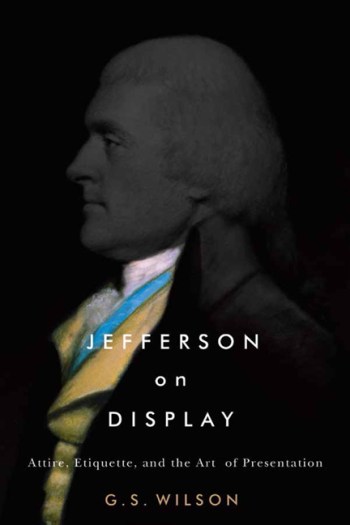 When we think of Thomas Jefferson, a certain picture comes to mind for some of us, combining his physical appearance with our perception of his character. During Jefferson’s lifetime this image was already taking shape, helped along by his own assiduous cultivation. In Jefferson on Display, G. S. Wilson draws on a broad array of sources to show how Jefferson fashioned his public persona to promote his political agenda. During his long career, his image shifted from cosmopolitan intellectual to man of the people. As president he kept friends and foes guessing: he might appear unpredictably in old, worn, and out-of-date clothing with hair unkempt, yet he could as easily play the polished gentleman in a black suit, as he hosted small dinners in the President’s House that were noted for their French-inspired food and fine European wines. Even in retirement his image continued to evolve, as guests at Monticello reported being met by the Sage clothed in rough fabrics that he proudly claimed were created from his own merino sheep, leading Americans by example to manufacture their own clothing, free of Europe.
By paying close attention to Jefferson’s controversial clothing choices and physical appearance—as well as his use of portraiture, architecture, and the polite refinements of dining, grooming, and conversation—Wilson provides invaluable new insight into this perplexing founder.
G. S. Wilson is Shannon Senior Historian at the Robert H. Smith International Center for Jefferson Studies, Monticello.
C O N T E N T S
List of Illustrations
Acknowledgments
Introduction
The European Experience
1 At the French Court and among the Literati
2 Remembering the Revolution
The Politics of the 1790s
3 Returning to a New America
4 Campaigning for Change
The Presidency
5 A New Presidential Profile
6 But Always the Cosmopolitan Gentleman
Retirement at Monticello
7 Contemplating Legacy
8 A Final Image
Epilogue
Notes
Bibliography
Illustration Credits
Index










 Enfilade
leave a comment