Exhibition | French Memories of the War for America
Press release (18 March 2019) for the exhibition:
Revolutionary Reflections: French Memories of the War for America
American Revolution Institute of the Society of the Cincinnati in Washington, D.C., 5 April — 27 October 2019
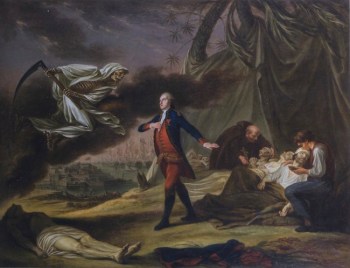
Nicolas-René Jollain, Allegorical Portrait of Thomas François Lenormand de Victot, 1783, oil on canvas, 90 × 117 cm (Washington: The Society of Cincinnati).
King Louis XVI sent thousands of French soldiers and sailors across the Atlantic to support the American War of Independence. It was an adventure none of them would forget. The special exhibition, Revolutionary Reflections: French Memories of the War for America, on view at the American Revolution Institute of the Society of the Cincinnati in Washington, D.C., from April 5 through October 27, 2019, explores how the king’s officers understood the American Revolution and their role in the achievement of American independence, and how they remembered the war in the years that followed—years of revolutionary upheaval in France that included the execution of the king and many of their brothers-in-arms.
Drawn from the Institute’s collections, along with loans from private collections, Revolutionary Reflections pairs the written recollections of French officers with life portraits of the writers, including masterpieces by the French artist Jean-Baptiste Greuze and the great Spanish portrait painter Vicente López y Portaña. Among the treasures on view will be the original manuscript memoir of General Rochambeau, who commanded the largest French army sent to America, along with his family’s annotated copy of the published work.
Another highlight of the exhibition is the long-lost portrait of the marquis de Saint-Simon, who commanded 4,000 French troops at Yorktown, together with Saint-Simon’s manuscript journal of the Yorktown campaign. The portrait was long owned by the marquis’ descendants, but was hidden during the Spanish Civil War and then long forgotten. The American Revolution Institute acquired it and brought it to Washington in 2018. The portrait has never been displayed in a formal exhibition in the United States. The journal—yet to be published in English—has never been displayed anywhere.
The most striking piece on view is a posthumous allegorical portrait of Thomas François Lenormand de Victot by Nicolas-René Jollain, painted in 1783. A French naval officer who died during the war, Lenormand is depicted opposing Death, portrayed as a skeleton in flight bearing a sickle. The Institute acquired this extraordinary painting in 2010.
The eight officers whose memories are featured in the exhibition were well-educated French nobles. They made sense of their wartime experiences through careful observation and documentation. Some were battle-tested veterans. Others, including the marquis de Lafayette, were young men when they arrived in America. The war for American independence was a defining event for all of them. Together their reflections remind us that historical memory is fragile, always shifting, and often very personal.
New Book | Grammars of Approach
From The University of Chicago Press:
Cynthia Wall, Grammars of Approach: Landscape, Narrative, and the Linguistic Picturesque (Chicago: The University of Chicago Press, 2019), 352 pages, ISBN: 978-0226467665 (cloth), $105 / ISBN: 978-0226467832 (paper), $35.
 In Grammars of Approach, Cynthia Wall offers a close look at changes in perspective in spatial design, language, and narrative across the late eighteenth and early nineteenth centuries that involve, literally and psychologically, the concept of ‘approach’. In architecture, the term ‘approach’ changed in that period from a verb to a noun, coming to denote the drive from the lodge at the entrance of an estate “through the most interesting part of the grounds,” as landscape designer Humphrey Repton put it. The shift from the long straight avenue to the winding approach, Wall shows, swung the perceptual balance away from the great house onto the personal experience of the visitor. At the same time, the grammatical and typographical landscape was shifting in tandem, away from objects and Things (and capitalized common Nouns) to the spaces in between, like punctuation and the ‘lesser parts of speech’. The implications for narrative included new patterns of syntactical architecture and the phenomenon of free indirect discourse. Wall examines the work of landscape theorists such as Repton, John Claudius Loudon, and Thomas Whately alongside travel narratives, topographical views, printers’ manuals, dictionaries, encyclopedias, grammars, and the novels of Defoe, Richardson, Burney, Radcliffe, and Austen to reveal a new landscaping across disciplines—new grammars of approach in ways of perceiving and representing the world in both word and image.
Cynthia Wall is professor of English at the University of Virginia. She is an editor of works by Bunyan, Defoe, and Pope, and the author of The Literary and Cultural Spaces of Restoration London and The Prose of Things: Transformations of Description in the Eighteenth Century, the latter also published by the University of Chicago Press.
C O N T E N T S
List of Illustrations
A Note on My Text
Acknowledgments
Introduction
1 The Architectural Approach
The etymology of ‘approach’ (n.s.)
The concept of approach (n.s. and v.): the ‘ancient’ and the ‘modern’ lines
The language of approach (v.): architectural and syntactical design
The traveler’s approach
The novelists approach
2 The Prepositional Building
The park gate lodge
The topographical view: angles and staffage
A Bridge to the next part: ‘A Village on, or across, the Thames‘
3 The Topographical Page
The typographical landscape
The letters on the page:
i. fonts
ii. capitals and italics
iii. catchwords
iv. pointing
4 The Grammar in Between
The rise of grammar
The rise of the preposition
Clarissa and the little words: the avenue and the approach
i. Richardson as printer
ii. Clarissa and prepositions
iii. Clarissa as prepostion
5 The Narrative Picturesque
Syntactical architecture in textual landscapes
i. Bunyan: “thinges . . included in one word”
ii. Defoe: “in a Word”
iii. Haywood: “In fine, she was undone”
The narrative picturesque
i. Radcliffe and the prepositional phrase
ii. Burney and the psychological interior
iii. Austen and the approach to the interior
Coda: A Topographical Page
Notes
Bibliography
Index
Workshop | The Mind in the Matter
From Eventbrite:
The Mind in the Matter: New Approaches to the Psychology of Collecting
Institute of Historical Research, London, 27 March 2019
Organised by the Society for the History of Collecting
Psychology informs us about what drives an individual to collect. In the Enlightenment, the human mind was often analysed and discussed by means of metaphors and analogies borrowed from the world of collecting. In the nineteenth-century, the stereotypes surrounding the monomaniac, eccentric or perverse collector was codified in the art press and through fiction. In the twentieth century, the topic was treated at length by scholars such as Werner Munsterberger, often working in an explicitly psychoanalytic framework. Whilst this Freudian approach has been subject to intense criticism in the past thirty years, many scholars continue to interpret collecting in terms of categories such as ‘lack’, ‘surrogacy’, ‘desire’ and ‘loss’.
Join us for a workshop that investigates the extent to which psychological models are still valid and necessary to understand collecting as a human activity. Is there a tension between the universalising psychological theories and the drive to study collecting historically? What sources are particularly useful or revealing for uncovering the collector’s motivations or relations to his objects? What can recent developments in psychology and neuroscience add to our understanding? How far can or should we enter the interior life of a collector, and what role does imagination play in communicating these insights to new audiences? And what are the meaningful alternatives, apart from opportunistic acquisitions; to a psychological approach of the study of collecting—can we ever escape from this way of thinking?
The workshop brings together six specialists working in different disciplines, who approach the ‘psychology of collecting’ from alternative perspectives, using historical case-studies and scientific models. Confirmed speakers include the pioneering historian of collecting Professor Susan Pearce; neuropsychologist Professor John Harrison; artist, collector and scholar Dr Jane Wildgoose; librarian and heritage expert Dr Tony Burrows; doctoral researcher into the collector Sir William Burrell, Isobel Macdonald; and contemporary art adviser Shaune Arp.
Organising committee: Tom Stammers, Adriana Turpin, Eleni Vassilika
Lecture | Caroline Winterer, Was There an American Enlightenment?
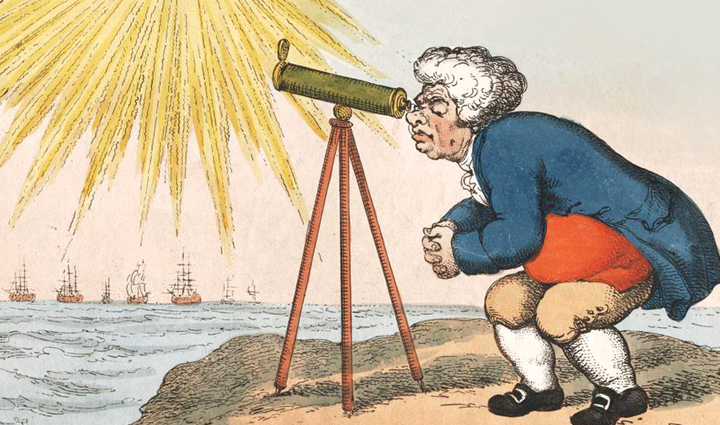
Thomas Rowlandson, after George Moutard Woodward, John Bull Making Observations on the Comet (detail), hand-colored etching, published by Thomas Tegg, 10 November 1807 (Farmington: Lewis Walpole Library). More information is available here.
◊ ◊ ◊ ◊ ◊
From the Lewis Walpole Library:
Caroline Winterer, Was There an American Enlightenment?
Yale Center for British Art, New Haven, 4 April 2019
The 24th Lewis Walpole Library Lecture will be delivered by Caroline Winterer, Anthony P. Meier Family Professor in the Humanities and Director, Stanford Humanities Center, on Thursday, April 4, beginning at 5:30 pm in the Yale Center for British Art Lecture Hall.
The American Enlightenment is often viewed as a singular era bursting with new ideas as the U.S. sought to assert itself in a new republic free of the British monarchy. In this talk, Stanford historian Caroline Winterer shows how the myth and romanticization of an American Enlightenment was invented during the Cold War to calm fears of totalitarianism overseas. She’ll then look behind the 20th-century mythology, rescuing a ‘real’ eighteenth-century American Enlightenment that is far different than the one we usually imagine.
Caroline Winterer is Anthony P. Meier Family Professor in the Humanities and Director of the Stanford Humanities Center. She is an American historian, with special expertise in American thought and culture. Her most recent book is American Enlightenments: Pursuing Happiness in the Age of Reason (2016). Winterer’s other books include The Mirror of Antiquity: American Women and the Classical Tradition, 1750–1900 (2007) and The Culture of Classicism: Ancient Greece and Rome in American Intellectual Life, 1780–1910 (2002).
Mauritshuis Acquires Pastel Portrait by Perronneau
Press release (18 March 2019) from the Mauritshuis:

Jean-Baptiste Perronneau, ‘Portrait of Jacob van Kretschmar’, 1754, pastel and crayon on paper, 60 × 45 cm (The Hague: Mauritshuis, Gift of Jonkheer F.G.L.O. van Kretschmar, 2018).
Last year the Mauritshuis received a generous gift from Jonkheer F.G.L.O. van Kretschmar: a magnificent pastel portrait from 1754 by the French artist Jean-Baptiste Perronneau (ca. 1715–1783). The portrait shows Jacob van Kretschmar of The Hague, the donor’s ancestor. The pastel, which had remained in the family, is a superb example of Perronneau’s work. Pastels are extremely sensitive to light, and so cannot be on permanent display, but from today the new acquisition will be exhibited for several months in Room 13.
Emilie Gordenker, Mauritshuis Director: “We are deeply grateful to Jonkheer van Kretschmar. The Mauritshuis has a small, but fine collection of eighteenth-century pictures—in particular pastels—and this acquisition enhances our holdings in this area significantly.”
Travelling Pastel Artists
The eighteenth century in the Netherlands is often described in art historical literature as the century of Cornelis Troost (1696–1750). The Mauritshuis has a unique collection of pastels by Troost, including the well-known NELRI series (a set of five humorous pastels). Troost was only one of many artists working at that time. The art world was extremely international in the eighteenth century and artists travelled throughout Europe. There were many foreign portrait painters working in the Netherlands for varying lengths of time. With the arrival of talented artists such as the Parisian Jean-Baptiste Perronneau, the Swiss Jean-Étienne Liotard (1702–1789) and the German Johann Friedrich August Tischbein (1750–1812), pastel portraits became popular in the Netherlands. Perronneau was the first foreign pastel artist to come and work in the Netherlands, and it was during his first stay that he produced the portrait of Van Kretschmar.
Today we know of some 45 portraits that Perronneau made in the Netherlands, thirty of which are pastels and the rest oil paintings. After his first visit in 1754, the artist regularly returned to the Netherlands, where he was extremely successful. Almost half of the extant Dutch portraits were created during Perronneau’s second stay in 1761 in Amsterdam and The Hague. He also made portraits of the young Orange prince William V and his sister Princess Wilhelmina Carolina at that time, but further commissions from the court never materialised. Perronneau died in 1783 in Amsterdam.
Portrait of Jacob van Kretschmar
Perronneau signed and dated the pastel in elegant letters in the top left-hand corner: “Perronneau / Peintre du Roy / en 1754 / à La Haye.” The composition of the portrait is simple, yet powerful. The 33-year-old military man Jacob van Kretschmar (1721–1792) is portrayed half-length. The loose, but convincing way in which Perronneau rendered the details in the powdered hair and the jabot—the frill of lace at the neck—demonstrate his great talent. The portrait’s appeal is further enhanced by the elegant, seemingly relaxed pose, the bright colours and the serene light. The blue tailcoat edged with gold thread stands out against the light background, where the blue of the paper still shimmers through.
About the Donor
The donor of the pastel by Perronneau is a well-known figure in the Dutch museum world. Jonkheer F.G.L.O van Kretschmar (1919–2019) was a Dutch art historian and genealogist. He was the director of the Iconographic Bureau for many years, which today forms part of the Netherlands Institute for Art History—RKD in The Hague. Van Kretschmar was of great value to the Iconographic Bureau—he saw to it that the institution did not solely concentrate on collecting documentation about Dutch portraits, but also focused on their scientific study. He also made a great personal contribution with his publications on Dutch portrait art—published over many decades—and the inventories he made of private collections of family portraits, usually depicting members of the aristocracy. Van Kretschmar’s great dedication to and keen interest in Dutch cultural heritage were recognised when he was awarded the silver museum medal on his retirement as director in 1984.
Presentation
The portrait of Jacob van Kretschmar will be on display in Room 13 until 7 July, along with a self-portrait by Cornelis Troost. An engaging pastel portrait of Wilhelmina of Prussia by Tischbein, one of several versions that is rarely on view and is still in its original frame, will also be in Room 13. The three pastels will be accompanied by a number of eighteenth-century painted portraits, including a portrait of a man by Troost and George van der Mijn’s portraits of Cornelis Ploos van Amstel and his wife. There could be no better setting for these works than this room with its eighteenth-century interior.
caa.reviews Seeks Editors, 2019–22
Worth noting that the Field Editor for Eighteenth-Century Art is one of the open positions; from CAA News:
caa.reviews Seeks Editor-in-Chief
Applications due by 1 April 2019
The caa.reviews Editorial Board invites nominations and self-nominations for the position of Editor-in-Chief for a three-year term, July 1, 2020–June 30, 2023. This term is preceded by one year of service on the editorial board as editor designate, July 1, 2019–June 30, 2020, and followed immediately by one year of service as past editor. Candidates should have published substantially in the field and may be academic, museum-based, or independent scholars; institutional affiliation is not required. An online journal, caa.reviews is devoted to the peer review of new books, museum exhibitions, and projects relevant to the fields of art history, visual studies, and the arts.
Working with the editorial board, the editor-in-chief is responsible for the content and character of the journal. The editor-in-chief supervises the caa.reviews Council of Field Editors, assisting them in identifying and soliciting reviewers, articles, and other content for the journal; develops projects; and makes final decisions regarding content.
The editor-in-chief attends the caa.reviews Editorial Board’s three meetings each year—held in New York in May and October and once at the Annual Conference in February—and submits an annual report to CAA’s Board of Directors. CAA reimburses the editor-in-chief for travel and lodging expenses for the two New York meetings in accordance with its travel policy, but the person in this position pays these expenses to attend the conference. The editor-in-chief also works closely with the CAA staff in New York and receives an annual honorarium paid quarterly.
Candidates must be current CAA members and should not be serving on the editorial board of a competitive journal or on another CAA editorial board or committee. Nominators should ascertain their nominee’s willingness to serve before submitting a name; self-nominations are also welcome. Please send a letter describing your interest in and qualifications for appointment, a CV, at least one letter of recommendation, and your contact information to: caa.reviews Editor-in-Chief Search, CAA, 50 Broadway, 21st Floor, New York, NY, 10004; or email the documents to Publications and Programs Editor Joan Strasbaugh, jstrasbaugh@collegeart.org. Deadline: April 1, 2019; finalists will be interviewed in early May.
caa.reviews Seeks Four Field Editors
Application due by 15 April 2019
In addition, CAA invites nominations and self-nominations for four individuals to join the caa.reviews Council of Field Editors for a three-year term July 1, 2019–June 30, 2022. An online journal, caa.reviews is devoted to the peer review of new books, museum exhibitions, and projects relevant to art history, visual studies, and the arts.
The journal seeks four field editors in the following areas:
- Design History
- Eighteenth-Century Art
- Architecture and Urbanism
- Theory and Historiography
Working with the caa.reviews editor-in-chief, the caa.reviews Editorial Board, and CAA’s staff editor, each field editor selects content to be reviewed, commissions reviewers, and considers manuscripts for publication. Field editors for books are expected to keep abreast of newly published and important books and related media in their fields of expertise, and those for exhibitions should be aware of current and upcoming exhibitions (and other related projects) in their geographic regions.
The Council of Field Editors meets yearly at the CAA Annual Conference. Field editors must pay travel and lodging expenses to attend the conference. Members of all CAA committees and editorial boards volunteer their services without compensation.
Candidates must be current CAA members and should not be serving on the editorial board of a competitive journal or on another CAA editorial board or committee. Nominators should ascertain their nominee’s willingness to serve before submitting a name; self-nominations are also welcome. Please send a cover letter describing your interest in and qualifications for appointment, a CV, and your contact information to: caa.reviews Editorial Board, CAA, 50 Broadway, 21st Floor, New York, NY 10004; or email the documents to staff editor Joan Strasbaugh, jstrasbaugh@collegeart.org. Deadline: April 15, 2019.
Call for Papers | Ceramics as Sculpture

Pierre Giovanni Volpato, Personification of the River Nile, ca. 1785–95, hard-paste biscuit porcelain, Giovanni Volpato’s Factory Rome, 30 × 59 × 30 cm (New York: The Metropolitan Museum of Art; Purchase, The Isak and Rose Weinman Foundation Inc. Gift, 2001.456).
◊ ◊ ◊ ◊ ◊
From the Call for Papers:
Ceramics as Sculpture, French Porcelain Society
Study Day, with Journal Issue to Follow
Masterpiece London, 28 June 2019
Abstracts for the Study Day due by 1 May 2019
Article Proposals for the Journal due by 24 May 2019, with finished drafts due by 30 September 2019
The French Porcelain Society is pleased to announce that it will be holding a study day entitled Ceramics as Sculpture, celebrating figurative art, at this year’s Masterpiece London, on Friday, 28 June 2019, 10:00–1:30. This conference aims to open up wider discussion about the contemporary and historical contexts for ceramic sculpture and its place within art history. It also seeks to underline the primacy of sculpture in all the decorative arts, bringing together scholars, curators, artists, and dealers working in the interconnected fields of ceramics and sculpture. The subject will be explored in more depth in The French Porcelain Society’s 2020 journal, the leading academic, peer-reviewed English-language publication on European ceramics and their histories, illustrated in full colour.
The Society invites submissions for 20-minute conference papers and/or 6,000-word journal articles. Topics for consideration may include, but are not limited to the following:
• Replication as a craft strategy
• Intersections between ceramics and sculpture
• Sculptors: Della Robbia, Kaendler, Bustelli, Falconet, Willems, Gricci, Carrier-Belleuse, Scheurich, et al.
• Collectors of porcelain sculpture and methods of display
• Curation and museum presentations or exhibitions of ceramic sculpture
• Impact of material on sculpture, i.e. biscuit porcelain
• Production techniques
• Silver, porcelain, and gilt bronze: a joined-up art
• Contemporary ceramics as sculpture, including practice-led approaches
• Sculpture in the digital age
Call for Papers for Study Day
Deadline: 1 May 2019, with successful notification by 7 May 2019
Please submit a summary of no more than 300 words with a short biography to Caroline McCaffrey-Howarth c.mccaffrey-howarth@leeds.ac.uk.
Call for Articles for Journal
Deadline: 24 May 2019, with successful notification by 7 June 2019
Submissions in the first instance should be a summary of no more than 500 words, with a brief description of the argument, a historiography and a note of the research tools and sources used. Please include a brief biography. The journal accepts articles in French as well as in English. The volume will comprise about 15 articles which will be peer reviewed by the editorial board and the FPS council of academic and museum specialists which includes: Dame Rosalind Savill, DBE, FBA, FSA (Curator Emeritus, The Wallace Collection, London); Oliver Fairclough, FSA; John Whitehead, FSA; Errol Manners, FSA; Patricia Ferguson; Dr. Diana Davis; and Caroline McCaffrey-Howarth (University of Leeds). Articles should be no more than 6,000 words in length excluding endnotes. Up to 15 high-resolution images per article will be accepted. Please send abstracts as an email attachment to Patricia Ferguson patricia.f.ferguson@gmail.com, Caroline McCaffrey-Howarth c.mccaffrey-howarth@leeds.ac.uk, and Diana Davis diana_davis@hotmail.co.uk, by 24 May 2019. If your abstract is accepted, articles and images will be due by 30 September 2019.
For more details about the Study Day and to book a place at £45, please visit the Society’s website.
Exhibition | Paper Revolutions: French Drawings
Opening next month at NOMA:
Paper Revolutions: French Drawings from the New Orleans Museum of Art
New Orleans Museum of Art, 10 April — 14 July 2019

Nicolas Lejeune, ‘Rejoicing at the Announcement of the Abolition of Slavery, 30 Pluviôse, Year II / 18 February 1794’, 1794, India ink and gouache on paper, 14 × 11 inches (New Orleans Museum of Art).
Paper Revolutions: French Drawings from the New Orleans Museum of Art traces the politics of draftsmanship in the eighteenth and nineteenth centuries. This selection features works on paper by celebrated painters Jacques-Louis David, Jean-Auguste-Dominique Ingres, and Eugène Delacroix, as well as lesser-known artists, such as Nicolas Lejeune.
The Age of Revolutions in France (1789–1870) was defined by political instability. In less than a century, wars and violent uprisings provoked radical changes in regime, from monarchy to republic to empire. This period also witnessed the emergence of new, hybrid styles of art: Neoclassicism, inspired by ancient Greece or Rome, mingled with Romanticism, distinguished by more fluid, expressive responses to nature. While navigating political shifts and experimenting with different forms, artists continued to draw obsessively—producing rough sketches, detailed studies, and independent works on paper.
Conference | Rome and Lisbon in the 18th Century
From the conference programme:
Rome and Lisbon in the 18th Century: Music, Visual Arts, and Cultural Transfers
Roma e Lisboa no século XVIII: música, artes visuais e transferências culturais
Biblioteca Nacional de Portugal, Lisbon, 28–29 March 2019
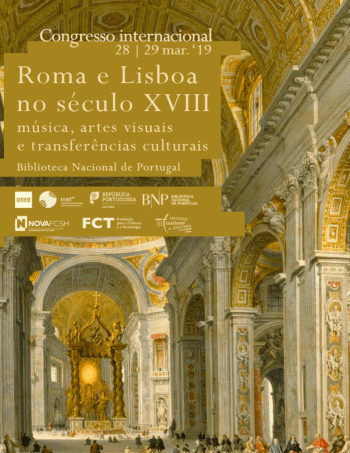 Political, diplomatic, cultural, and artistic relations—including music and the visual arts—between Rome and Lisbon in the 18th century have, at different times, aroused the interest of several scholars. However, these research fields have often been approached in parallel paths within the traditions of each of the disciplines, without establishing in most cases a true dialogue between the different areas of knowledge and disregarding cross-cutting issues. On the other hand, the study of artistic relations and cultural transfers presupposes an in-depth and up-to-date view of the historical and social context of each city in their own peculiarities. This international conference intends to promote new approaches to the history of music and the arts through multidisciplinary dialogue that involves different points of view.
T H U R S D A Y , 2 8 M A R C H 2 0 1 9
9.30 Opening Session
• Inês Cordeiro (Director of the BNP)
• Pilar Diez del Corral and Cristina Fernandes (conference board of directors)
10.00 Ceremonial and Diplomacy
Chair: Pilar Diez del Corral
• John E. Moore (Smith College, Northampton, Massachusetts), Obsequies for Peter II (1707) and John V (1751) in S. Antonio dei Portoghesi, Rome
• Rodrigo Teodoro de Paula (CESEM-NOVA FCSH), Imitando Roma: Música e outros sons no cerimonial fúnebre por D. João V (1750)
• Christopher M. S. Johns (Vanderbilt University, Nashville, Tennessee), Queen Maria I, Pope Pius VI, and the Sacred Heart of Jesus: Lisbon, Rome, and the Counter-Enlightenment
11.30 Coffee Break
12.00 Ceremonial and Diplomacy, continued
Chair: Pilar Diez del Corral
• Maria João Ferreira (CHAM – NOVA/FCSH – UAc), Da Roma pontifícia para a Lisboa joanina: Abordagem das encomendas de têxteis através da correspondência trocada entre José Correia de Abreu e Fr. José Maria da Fonseca Évora
• Rosana Brescia (CESEM – NOVA FCSH), ‘Teatro alla Moda’: Opera Costumes for Portuguese Royal Theatres during the Reign of D. José I
13.00 Lunch
14.30 Working for Portuguese Patrons: From Italy to Portugal
Chair: Manuel Carlos de Brito
• Giuseppina Raggi (CES – Universidade de Coimbra), Roma e le traiettorie artistiche di Filippo Juvarra e Domenico Scarlatti nella penisola iberica
• Ricardo Bernardes (CESEM/NOVA FCSH), Giovanni Giorgi (d. 1762) and the ‘Roman Musical Style’ in Lisbon in the First Half of the 18th Century
• Fabrizio Longo (MIUR), I solfeggi di Giovanni Giorgi (d. 1762), valide ed ispirate lezioni di violino
16.00 Coffee Break
16.30 Working for Portuguese Patrons: From Italy to Portugal, continued
Chair: Manuel Carlos de Brito
• Aline Gallasch-Hall de Beuvink (Universidade Autónoma de Lisboa/CIAUD/CICH), O arquitecto Giovanni Sicinio Galli Bibiena: novos contributos biográficos
• Marco Brescia (CESEM/NOVA FCSH), Niccolò Nasoni and Visual and Sound Symmetry on Portuguese Organs
17.30 Book Presentation
• Politics and the Arts in Lisbon and Rome: The Roman Dream of John V of Portugal (The Voltaire Foundation, 2019) for Pilar Diez del Corral
F R I D A Y , 2 9 M A R C H 2 0 1 9
9.30 Aristocratic Power and Performing Arts in Baroque Rome: Portuguese Connections
Chair: Rui Vieira Nery
• Teresa Chirico (Conservatorio di musica ‘S. Cecilia’ di Roma- Performart), l cardinale Pietro Ottoboni (1667–1740), i portoghesi e la musica
• Cristina Fernandes (INET-md, NOVA FCSH, PerformArt – Rome), ‘When in Rome, Do as the Romans Do’: Portuguese Cardinals’ Musical Patronage and Their Artistic Networks after the Conclave of 1721
• Diana Blichmann (PerformArt –Rome), Alessandro nell’Indie as Opera Event in Rome (1730) and Lisbon (1755): Examples of Different Multimedia Strategies for Staging Power
11.00 Coffee Break
11.30 Images, Treatises, and Books
Chair: James W. Nelson Novoa
• Alexandra Gago da Câmara (UAb / IHA / CHAIA ) + Carlos Moura (IHA- UNL), Uma imagem da Roma Pontifícia no fausto da Lisboa Joanina: Os azulejos do Terraço superior do Mosteiro de São Vicente de Fora
• João Cabeleira (Lab2PT, Escola de Arquitetura, Univ. De Minho), Perspectiva Pictorum et Architectorum: Science and Architectural Image Propagation
• Leonor Antunes (BNP, Lisboa), From Lisbon to Rome, Passing through Parma: Portuguese Artists and patrón Diplomats in Bodonian Editions
13.00 Lunch
14.30 From Portugal to Rome
Chair: TBA
• James W. Nelson Novoa (Otawa University, Canada), Forging Portuguese National Memory in 18th-Century Rome
• Maria Onori (Univ. di Roma ‘La Sapienza’), Dos Santos/De Sanctis: Notizie di un architetto lusitano a Roma dagli archivi romani
• Giada Lepri (Univ. di Roma ‘La Sapienza’), Un inedita committenza portoghese nella Roma del 700’: La vigna da Gama de Padua sulla via Salaria ed i suoi legami con l’ambiente architettonico romano dell’epoca
• Michela Degortes (ARTIS-UL), Giovanni Gherardo De Rossi and the Portuguese in Rome at the End of the 18th Century: Artistic Relations and Cultural Network
16.30 Coffee Break
17.00 Roman Taste for Lisbon Court
Chair: Maria João Albuquerque
• Fernando Miguel Jalôto (INET-md, NOVA FCSH), Antonio Tedeschi: An Italian Musician at the Court of John V
• Vicenzo Stanziola (Univ. degli Studi di Roma, Tor Vergata), Arte romana per Joao V: Il caso di Pietro Bianchi
18.00 Closing Session
• Guided tour of the library exhibition From Tagus to Tiber: Portuguese Musicians and Artists in Rome in the 18th Century
Scientific Committee
• Manuel Carlos de Brito (NOVA FCSH, Lisboa)
• Elisa Camboni (Accademia Nazionale di San Luca, Roma)
• Pilar Diez del Corral Corredoira (UNED, Madrid)
• Cristina Fernandes (INET-md, NOVA FCSH, Lisboa)
• Anne-Madeleine Goulet (CNRS, Projecto Performart-Roma)
• Teresa Leonor M. Vale (ARTIS, Universidade de Lisboa)
• Rui Vieira Nery (INET-md, NOVA FCSH/Fundação Gulbenkian, Lisboa)
Board of Directors
• Pilar Diez del Corral Corredoira
• Cristina Fernandes
New Book | Politics and the Arts in Lisbon and Rome
From Liverpool UP:
Pilar Diez del Corral Corredoira, ed., Politics and the Arts in Lisbon and Rome: The Roman Dream of John V of Portugal (Oxford: Voltaire Foundation/Oxford University Studies in the Enlightenment, 2019), 276 pages, ISBN: 978-1789620122, £65.
 Dealing with a complex king, this edited collection elucidates a monarch’s vision of Rome that deeply affected his political choices and cultural policy during the first half of the eighteenth-century. John (João) V of Portugal (1689–1750) became king in 1707 in a pivotal moment for the European balance of power. The Kingdom of Portugal was still demanding the same privileges as its powerful neighbours and the relation with Rome was considered a vehicle to obtain them. Arts and music had a special and unprecedented place in the king’s plans and this book approaches that dynamic from several interdisciplinary perspectives.
The unifying thread across this book’s chapters remains the omnipresence of Rome as a paradigm on several levels: political, religious, intellectual, artistic, and musical. Rather than providing an exhaustive analysis of the period as a whole, this study offers a fresh approach for English readers to this classic, but little known, topic in Portuguese national historiography.
Pilar Diez del Corral Corredoira is Ramón y Cajal Fellow based at the Art History department of the Universidad Nacional de Educación a Distancia (Madrid). She wrote a PhD on Classical Art and has widely published in international journals including The Burlington Magazine and Storia dell’Arte. Her current research focuses on Iberian cultural identities, artistic mobility, and diplomacy in Rome in the eighteenth century.










 Enfilade
leave a comment