Call for Papers | Character in Global Encounters with Architecture
This session is part of next year’s EAHN conference; the full Call for Papers is available here:
‘Character’ in Global Encounters with Architecture, 1700–1900
Session at the Conference of the European Architectural History Network, Aarhus, 17–21 June 2026
Chairs: Sigrid de Jong, Dominik Müller and Nikos Magouliotis
Proposals due by 19 September 2025
The eighteenth century was at once the period when Classical architecture was canonized in the Western world and beyond, and the moment when its supposedly universal ideal came into crisis. The study of competing practices and traditions of various medieval (Romanesque, Gothic, Byzantine) and vernacular architectures in Europe, and the allure of ‘Oriental’ styles (filtered through Turquerie and Chinoiserie) challenged the claims of Classicism, as did the encounters with different extra-European building traditions through travel and colonialism. These encounters prompted an avid preoccupation with cultural difference, as evidenced in Voltaire’s Essai sur les moeurs et l’esprit des nations (1756), Vico’s Principi di una scienza nuova d’intorno alla natura delle nazioni (1725–44), and Hume’s Of National Characters (1748).
Before the systematic global histories of architecture of the nineteenth century, and previous to the notion of style, Western authors employed a particular term to describe cultural specificity and difference: character. Stemming originally from the Greek word χαρακτήρ, its meaning evolved from the tool with which one carved signs on a wax or stone surface, over denoting these signs themselves, to the imprint these had on a reader or viewer. The distinctiveness of that impact, and the marks of identity of a whole culture in its environment and material culture, was encapsulated by its character. As such, from 1750 onwards the notion of character became ubiquitous in a variety of languages and was used in reference to people, buildings and landscapes, and shared across different genres of writing and scientific disciplines: from travel literature, political theory and ethnography, over treatises of art and architecture, to gardening manuals.
This session interrogates the architectural category of character in the globalizing world of the long eighteenth century, by zooming in on its meanings, implications, and complexities in moments of encounter between Western and non-Western cultures and architectures. We draw on recent inquiries into how Western travellers conceptualized non-Western architectures (Brouwer, Bressani, and Armstrong, Narrating the Globe, 2023), but also on works aiming to show how indigenous thinking conceptualized and criticized Western political and aesthetic norms (Graeber and Wengrow, The Dawn of Everything, 2021).
We are interested in instances of encounter addressing the following questions:
• How have Western accounts used the notion of character to describe non-Western architectures, building traditions, cultures, landscapes and places?
• How was the notion of character employed for architectures that challenged Western taxonomies and categorizations of architectural style?
• Which are the analogous notions in native languages that have been used to respond to encounters with Western architectures? How were these employed to process cultural specificity and otherness, and to describe, translate, acculturate or criticize Western cultural expressions (including mores and manners) from an indigenous perspective?
We welcome papers dealing with one or more of these questions in the period c. 1700–1900, across geographies. We are eager to discuss a variety of written, visual, and material sources, drawn from various disciplines, to expand the critical history of the term character beyond its well-established place in the history of European architectural theory.
Abstracts of no more than 300 words should be submitted by 19 September 2025 to sigrid.dejong@gta.arch.ethz.ch, nikolaos.magouliotis@gta.arch.ethz.ch, and mueller@arch.ethz.ch, along with the applicant’s name, email address, professional affiliation, address, telephone number, and a short curriculum vitae (maximum one page). Abstracts should define the subject and summarize the argument to be presented in the proposed paper. The content of that paper should be the product of well-documented original research that is primarily analytical and interpretative rather than descriptive in nature.
New Book | London: A History of 300 Years in 25 Buildings
Published last year by Yale UP, with a paperback edition due in September:
Paul Knox, London: A History of 300 Years in 25 Buildings (New Haven: Yale University Press, 2024), 448 pages, ISBN: 978-0300269208, $35.

A lively new history of London told through twenty-five buildings, from iconic Georgian townhouses to the Shard
A walk along any London street takes you past a wealth of seemingly ordinary buildings: an Edwardian church, modernist postwar council housing, stuccoed Italianate terraces, a Bauhaus-inspired library. But these buildings are not just functional. They are evidence of London’s rich and diverse history and have shaped people’s experiences, identities, and relationships. Paul L. Knox traces the history of London from the Georgian era to the present day through twenty-five surviving buildings. He explores where people lived and worked, from grand Regency squares to Victorian workshops, and highlights the impact of migration, gentrification, and inequality. We see famous buildings, like Harrods and Abbey Road Studios, and everyday places like Rochelle Street School and Thamesmead. Each historical period has introduced new buildings, and old ones have been repurposed. As Knox shows, it is the living history of these buildings that makes up the vibrant, but exceptionally unequal, city of today.
Paul Knox is an expert in the social and architectural history of London. Originally from the UK, he is now University Distinguished Professor at Virginia Tech. He is the author of Metroburbia: The Anatomy of Greater London; London: Architecture, Building, and Social Change; and Cities and Design.
New Book | The London Club: Architecture, Interiors, Art
Coming September from ACC Art Books:
Andrew Jones, with photographs by Laura Hodgson, The London Club: Architecture, Interiors, Art (New York: ACC Art Books, 2025), 288 pages, ISBN: 978-1788843294, $75.
 A stunning exploration of London’s most beautiful, interesting, and unusual members’ club architecture and interiors
London has more private members’ clubs than any other city, with new locations opening every year. The UK capital has exclusive clubs for everyone from plutocrats and bishops to jockeys and spies. Written by Andrew Jones, travel writer for the Financial Times and author of The Buildings of Green Park, this large-format picture book is richly illustrated with newly commissioned photographs by Laura Hodgson, covering 300 years of the capital’s architecture and interior design. The London Club: Architecture, Interiors, Art offers a fascinating take on the structures and decorations inside some of the most niche spots in London, giving readers a one-off glimpse into the hidden corners of the city’s social infrastructure.
Andrew Jones has lived in the heart of London clubland, on the border of Mayfair and St James’s, for almost 20 years. He is the author of The Buildings of Green Park, a tour of certain buildings, monuments and other structures in Mayfair and St. James’s, and a contributor to Seeing Things: The Small Wonders of the World according to Writers, Artists, and Others. He writes about cities for the Financial Times, and has also written on architecture for Blueprint, Drawing Matter, and The London Gardener, as well as pieces on London for The World of Interiors and the Londonist.
New Book | Castle Howard
Coming this fall, from Rizzoli:
Christopher Ridgway, with photographs by Mattia Aquila and Nicholas Howard, Castle Howard: A Grand Tour of England’s Finest Country (Paris: Flammarion, 2025), 364 pages, ISBN: 978-2080445865, £100 / $130.
 An exclusive tour of a famous English historic house—featured in period dramas including Bridgerton and Brideshead Revisited—set on acres of beautiful parkland and gardens.
The iconic architectural marvel Castle Howard is the epitome of English baroque magnificence. Nestled in the rolling hills of North Yorkshire, this grand estate was commissioned by Charles Howard, 3rd Earl of Carlisle, and masterfully crafted by Sir John Vanbrugh and Nicholas Hawksmoor in the early eighteenth century. The residence’s facades reveal Vanbrugh’s signature flair for the dramatic, while inside, extravagant frescoes, intricately carved stonework, and antique furnishings tell the captivating story of centuries of aristocratic elegance. Recent renovations, undertaken by American designer Remy Renzullo, have rejuvenated the castle’s bedrooms, merging history with contemporary opulence.
The domain’s sprawling parkland features meticulously landscaped gardens, a tranquil lake, a monumental neoclassical mausoleum and pyramids, and the breathtaking Atlas fountain. This comprehensive monograph explores the history of Castle Howard, its architecture, its gardens, and the generations of the Howard family who have lived there for more than three hundred years. Featuring previously unpublished archival documents, as well as photographs of the sumptuous interiors and art collections, this book is a celebration of a British national treasure, whose timeless beauty has captured the imagination of filmmakers for decades.
Christopher Ridgway, curator at Castle Howard since 1984, has lectured extensively on the history of country houses. He coauthored The Irish Country House: A New Vision (yeartk). Mattia Aquila is an interior design and architecture photographer. His photographs have appeared in Venice: A Private Invitation (2022) and Pierre Frey: A Family Legacy of Passion and Creativity (2023). Nicholas Howard manages Castle Howard with his wife, Victoria.
Call for Papers | Architecture and the Literary Imagination, 1350–1750
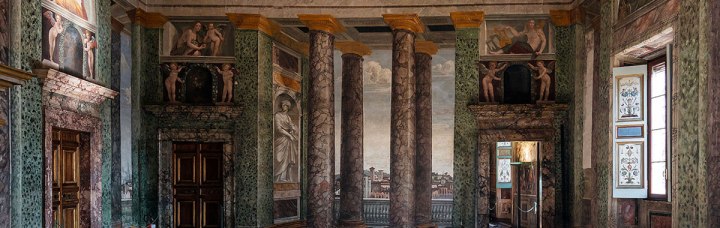
Hall of Perspectives, Villa Farnesina, frescoes painted by Baldassare Peruzzi, ca. 1510–16. Built for Agostino Chigi, the villa was acquired by the Farnese family in 1577.
◊ ◊ ◊ ◊ ◊
From ArtHist.net and the American University of Rome:
Architecture and the Literary Imagination, 1350–1750
American University of Rome, 6–8 November 2025
Organized by Fabio Barry and Paul Gwynne
Proposals due by 1 October 2025
Architecture and the Literary Imagination solicits conference papers that will broaden the repertoire of literary sources for understanding European architecture from around 1350 to 1750 and foster dialogue across disciplines. Architectural historians typically rely on histories for facts, and treatises for theories. A much wider range of texts records the reception of real buildings, the capacity to imagine fantastic ones, and the reciprocity between architecture and literature: poetry, dramaturgy, the picaresque novel, inauguration or consecration speeches, travelogues, epigraphy, and so on.
‘Architecture’ includes cities, civic buildings, palaces, villas, housing, individual rooms, gardens, grottoes, the constructions of nature itself, fountains, monuments, engineering, and decorations from vault painting to topiary. Our focus is largely Europe, but encompasses the Ottoman Empire, all territories ringing the Mediterranean basin, and descriptions of architecture transmitted by the global missions of the Church or travellers.
The source language may be in any vernacular, and we are also interested in Neo-Latin, Neo-Greek, and Classical Arabic as legacy languages of cultural transmission across history and borders. A particular theoretical concern is the intermedial relationship between immaterial words and solid buildings—however that may be defined.
A collection of essays from the conference will be published, subject to peer review, in an edited volume of the new book series, Architecture & the Literary Imagination (Harvey Miller Publishers, series editors, Fabio Barry and Paul Gwynne).
Papers will be 30 minutes in length and preferably in either English or Italian. Please send an abstract of 200 words by 1 October to Fabio Barry (rabirius@cantab.net) and Paul Gwynne (p.gwynne@aur.edu).
Call for Papers | Animals Inside
From ArtHist.net:
Animals Inside: A History of Objects and Furniture for Pets in Domestic Interiors
HEAD – Genève, Geneva, 17 November 2025
Organized by Javier Fernández Contreras and Youri Kravtchenko
Proposals due by 15 September 2025
The Master of Arts in Interior Architecture (MAIA) at HEAD – Genève studies the role of interior spaces in shaping contemporaneity, paying particular attention to human–non-human entanglements. This includes the dynamic relationships between humans and animals within the domestic sphere, a relationship that has transformed radically across time and geography.
This conference invites designers, architects, historians, researchers, artists, and theorists to explore the history of objects and furniture designed for pets in domestic interiors, from antiquity to today. We aim to investigate when and how animals entered the home, and more crucially, when their presence began to transform its design through specific furniture and objects created for their use.
From the ornately crafted birdcages of imperial courts to Victorian aquariums, and from today’s wall-mounted cat gyms to AI-powered talking buttons for dogs—these objects offer a unique lens through which to examine changes in domestic space, material culture, design, and our understanding of interspecies cohabitation.
We welcome contributions that
• Offer a 30-minute presentation based on original research or practice-based investigation
• Clearly specify the geographic and historical context of the case study
• Examine any type of non-human animal (birds, dogs, cats, fish, reptiles, etc.)
• Investigate any historical period, from ancient civilizations to contemporary design
• Address a range of objects and furnishings, such as aquariums, terrariums, bird cages, pet beds, perches, feeders, cat trees, wall gyms, litter furniture, wearables, communication devices, or smart pet furnishings
Please submit a proposal to javier.fernandez-contreras@hesge.ch and youri.kravtchenko@hesge.ch by 15 September 2025 with the following items:
• Title of your presentation
• Abstract (300–500 words)
• Biographical note (150 words)
• Affiliation and contact details
Call for Submissions | Metropolitan Museum Journal
Metropolitan Museum Journal 61 (2026)
Submissions due by 15 September 2025
The Editorial Board of the peer-reviewed Metropolitan Museum Journal invites submissions of original research on works of art in the Museum’s collection. The Journal publishes Articles and Research Notes. Works of art from The Met collection should be central to the discussion. Articles contribute extensive and thoroughly argued scholarship—art historical, technical, and scientific—whereas Research Notes are narrower in scope, focusing on a specific aspect of new research or presenting a significant finding from technical analysis, for example. The maximum length for articles is 8,000 words (including endnotes) and 10–12 images, and for research notes 4,000 words (including endnotes) and 4–6 images. Articles and Research Notes in the Journal appear in print and online, and are accessible in JStor on the University of Chicago Press website.
The process of peer review is double-anonymous. Manuscripts are reviewed by the Journal Editorial Board, composed of members of the curatorial, conservation, and scientific departments, as well as scholars from the broader academic community. Submission guidelines are available here. Please send materials to journalsubmissions@metmuseum.org. The deadline for submissions for Volume 61 (2026) is 15 September 2025.
Exhibition | L’étoffe des Lumières
Now on view at the Musée Jean-Jacques Rousseau:
L’étoffe des Lumières: Vêtements et accessoires au XVIIIe siècle
The Fabric of Enlightenment: Clothing and Accessories in the 18th Century
Musée Jean-Jacques Rousseau, Montmorency, 5 April — 26 October 2025

Antoine Vestier, Portrait de femme, 1750–90, oil on canvas (Paris: Musée Cognacq-Jay).
Réalisée en partenariat avec La Dame d’Atours, spécialiste de la reconstitution historique, cette exposition met en lumière les transformations vestimentaires de l’époque à travers une sélection de costumes, d’accessoires, de gravures et de peintures. Reflet d’une société en pleine mutation, la mode du XVIIIe oscille entre luxe aristocratique et quête de simplicité, en écho aux idéaux de Jean-Jacques Rousseau. Philosophe des Lumières, à la fois familier des salons et critique des artifices, il prône un retour à l’authenticité qui inspire encore aujourd’hui. Les costumes raffinés de La Dame d’Atours dialoguent avec des œuvres prêtées par le Musée Cognacq-Jay et les collections montmorencéennes, offrant une immersion inédite à la croisée de l’histoire sociale, de la mode et des arts. Ce parcours enrichi de dispositifs ludiques invite petits et grands à découvrir cette époque fascinante sous toutes les coutures.
New Book | Mrs Kauffman and Madame Le Brun
From Bloomsbury Publishing:
Franny Moyle, Mrs Kauffman and Madame Le Brun: The Extraordinary Entwined Lives of Two Eighteenth-Century Painters (London: Apollo, 2025), 496 pages, ISBN: 978-1801107440, $45.
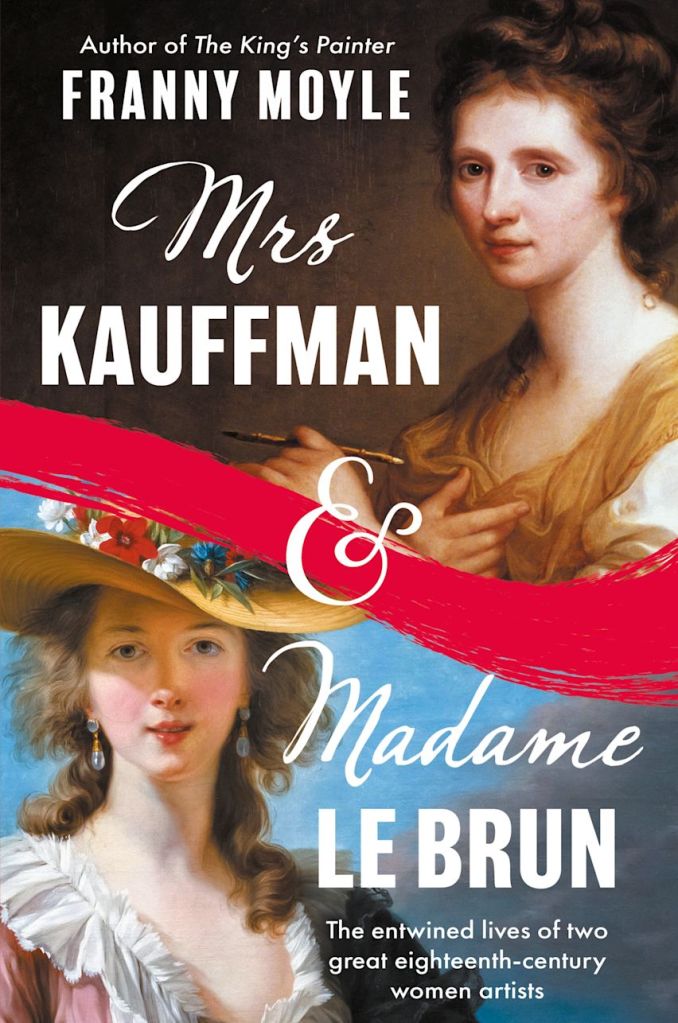 In the late autumn of 1789, two of Europe’s most celebrated painters met in Rome. One, Angelica Kauffman, was a Swiss-born prodigy who had conquered the art scenes of London and Italy. The other, Élisabeth Louise Vigée Le Brun, a Parisienne portraitist and favourite of the ancien regime, had just fled revolutionary France under threat of violence and scandal. Both were feted in their time, both were trailblazers in a male-dominated world—visionaries who helped define eighteenth-century art and feminism before the term existed.
This dual biography, framed within a thrilling story, restores these two extraordinary but unjustly overlooked figures to their rightful place in history. Set against a backdrop of revolution, empire and Enlightenment, it traces the dramatic lives and remarkable careers of Vigée Le Brun and Kauffman: artists who not only achieved unparalleled success and influence, but did so while pushing the boundaries of what women could be, both on canvas and in society. With vivid storytelling, one of the most gifted living writers of artistic biography, Franny Moyle, reclaims their legacies. She examines how each artist navigated fame, scandal and exile; explores the relationships between them and their peers; and considers how they were caught up in the huge cultural cross-currents that were reshaping Europe.
Through their work and their lives, they spoke boldly to the roles of women in public life, highlighted the prejudices and abuses suffered by their sex, reimagined and celebrated the female subject, and challenged the institutions that sought to contain them. Through them we encounter icons such as Marie Antoinette (whose portrait by Le Brun scandalised French society) and Catherine the Great, as well as cultural figures such as Emma Hamilton and Madame de Staël. The most notable men of their time—monarchs, statesman, aristocrats, artists, and more—are also woven into the fabric of the tale. Mrs Kauffman and Madame Le Brun is a timely, revelatory history that not only brings two forgotten artists into view, but rethinks the story of European art itself.
Franny Moyle is a British television producer and author. Her first book Desperate Romantics was adapted into the BBC drama serial of the same title by screenwriter Peter Bowker. Her second book Constance: The Tragic and Scandalous Life of Mrs Oscar Wilde was published in 2011 to critical acclaim. In 2016 she released The Extraordinary Life and Times of J.M.W Turner.
New Book | Daring: The Life and Art of Elisabeth Vigée Le Brun
The life of Vigée Le Brun, as targeted to teenagers; from The Getty (for the context of the cover design, see Elisabeth Egan, “The Book Cover Trend You’re Seeing Everywhere,” The New York Times 21 June 2025) . . .
Jordana Pomeroy, Daring: The Life and Art of Elisabeth Vigée Le Brun (Los Anges: Getty Publications, 2025), 112 pages, ISBN: 978-1947440104, $22.
 The dramatic life story of Elisabeth Vigée Le Brun, one of the greatest portrait painters of all time.
Supremely talented and strategically charming, Elisabeth Vigée Le Brun (1755–1842) overcame tragedy and broke gender barriers to reach the height of success as a portrait painter, first in Paris, and then across Europe. After losing her father at age twelve and facing financial insecurity, she fought to gain access to artistic training and opportunity. She was pressured to marry at age twenty, to an art dealer who both helped and harmed her career. Vigée Le Brun deployed her intelligence and beauty to attract powerful clients, who relied on her to style the personal identities they projected to the world. Vigée Le Brun’s salons were the talk of Paris, and she became court painter to Marie Antoinette. Then came the French Revolution, when marginalized groups demanded change to centuries-old systems of oppression. Vigée Le Brun was forced to reexamine her alliances and run for her life, taking her young daughter but leaving her husband behind. Making her way through the countrysides and capitals of Europe and Russia—including a stay at the imperial court of Catherine the Great—the artist conquered fear and adversity to refashion her life and art. Ages thirteen and up.
Jordana Pomeroy is director and CEO of the Currier Museum of Art and former chief curator at the National Museum of Women in the Arts.










 Enfilade
leave a comment